

How to Write a Professional Follow-Up Email (With 12+ Templates for Every Scenario)
You're staring at a blank compose window. You've typed "Hi [Name], just wanted to..." and deleted it three times. One person on r/interviews sent a follow-up and got a job offer 20 minutes later. Another person's follow-up sat in a spam folder for eternity. The difference isn't luck - it's knowing what to write, when to send it, and when to stop.
Most follow-up guides are written for salespeople. If you're following up after a job interview, chasing an overdue invoice, or nudging an internal stakeholder, you've been ignored until now. This guide covers all of it.
Here's the number that should change how you think about this: 42% of all cold email replies come from follow-up steps, not the first message. But a study of 16.5 million emails found the highest reply rate - 8.4% - actually comes from the first email alone. That means your follow-ups need to earn their place. Every single one has to add something new or you're just generating noise.
Three Rules Before Anything Else
- Add new value every time. If your follow-up says the same thing as your first email, delete it.
- Keep it under 5 sentences. Nobody reads a follow-up essay.
- Stop after 2-3 follow-ups. In Belkins' 16.5M-email dataset, sequences hitting 4+ emails more than triple unsubscribe and spam complaint rates. (If you want a deeper breakdown of timing, see when to follow up.)
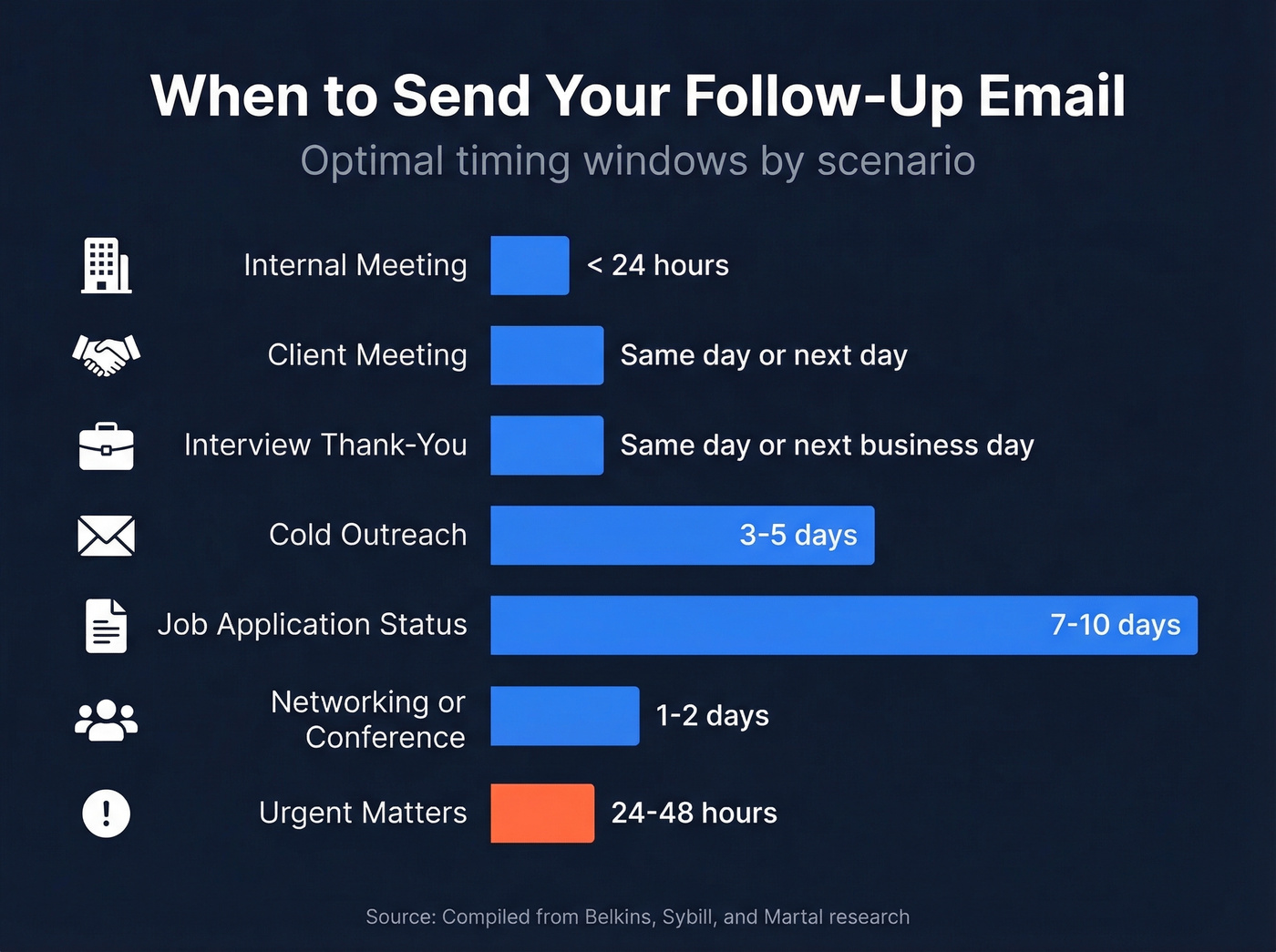
Timing by scenario:
| Scenario | Follow-Up Timing |
|---|---|
| Internal meeting | Within 24 hours |
| Client meeting | Same day or next day |
| Interview thank-you | Same day or next business day |
| Job application status | 7-10 days |
| Cold outreach | 3-5 days |
| Networking/conference | 1-2 days |
| Urgent matters | 24-48 hours |
Now let's make sure you don't blow it.
Mistakes That Kill Your Reply Rate
Bumping with no new information. This is the #1 mistake, per GMass's breakdown. "Just making sure you saw this" tells the recipient nothing new. Each follow-up should address a different angle - a new objection, a fresh resource, a relevant trigger event. (For more examples, compare with these cold email follow-up templates.)
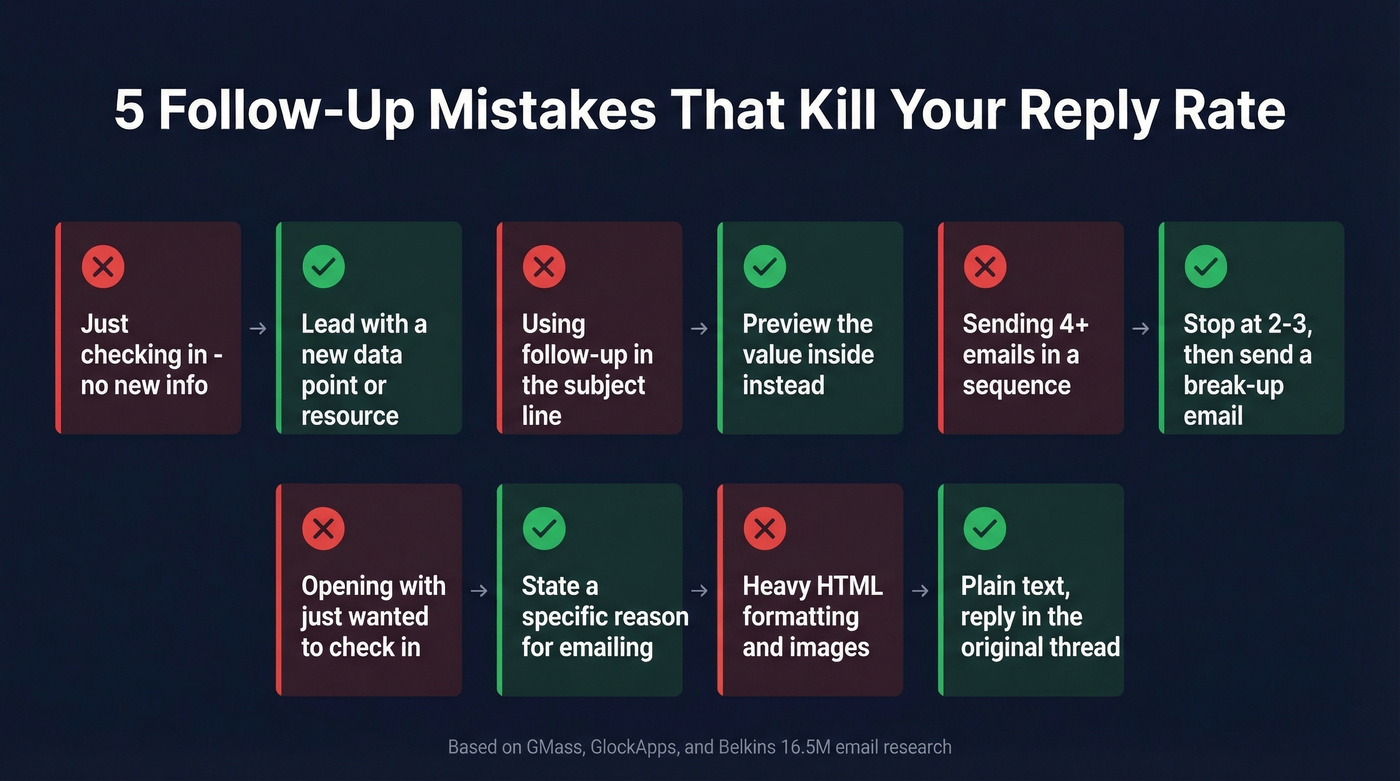
Using "follow-up" in your subject line. GlockApps flags this directly: it's low-value and easy to ignore. Your subject line should preview what's inside, not announce that you're pestering them again. Side note: people constantly debate whether to write "follow up email" or "follow-up email." The hyphenated form is grammatically correct as an adjective, but either way, keep it out of your subject line.
Sending 4+ emails in a sequence. In Belkins' analysis of 16.5M cold emails, four or more messages in a sequence more than triple unsubscribe and spam complaint rates. The "80% of sales require 5 follow-ups" stat that floats around the internet is misleading. The actual data says persistence past three emails actively hurts you. (If you're building sequences, use a real B2B cold email sequence framework.)
Opening with "just checking in." This is the worst opening line in professional email. Everyone knows it. It signals you have nothing to say but felt obligated to send something. Replace it with a reason - any reason - for the email to exist. (Here are better options for how to say just checking in professionally.)
Making it look like a template. GMass recommends plain text or near-plain text, sent as a reply to the original thread. Heavy formatting, images, and HTML signatures scream "mass email" and crush your reply rate. (More on writing that doesn’t feel canned: email copywriting.)
Subject Lines That Get Opened
47% of recipients decide whether to open based on the subject line alone. Even scarier: 69% mark emails as spam based purely on the subject line. So this isn't a detail - it's the whole game.
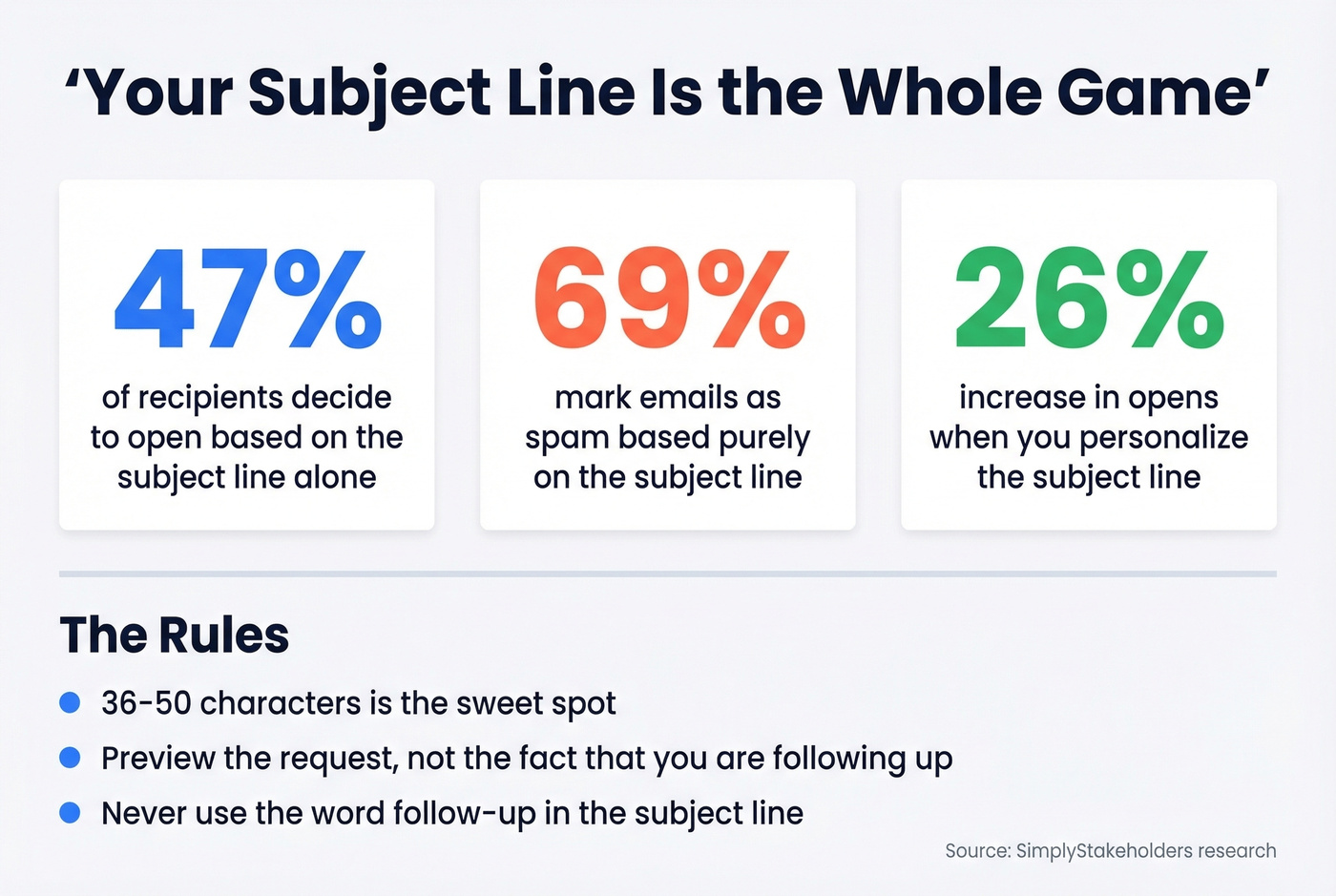
The sweet spot is 36-50 characters. Personalization increases opens by 26%. And the practical rule is simple: preview the request, not the fact that you're "following up." (Need more ideas? Steal from these email subject line examples.)
A swipe file organized by scenario:
| Scenario | Good Examples |
|---|---|
| Cold follow-up | "Quick thought on [specific problem]" / "Resource for [their initiative]" |
| Meeting recap | "Action items from Tuesday's call" / "Next steps: [project name]" |
| Interview | "Thank you - excited about [role]" / "Checking in on [role] timeline" |
| Invoice/payment | "Invoice #1234 - due [date]" / "Payment update needed" |
| Networking | "Great meeting you at [event]" / "[Shared topic] - following up" |
| Proposal | "Thoughts on the proposal?" / "Updated pricing for [project]" |
| Urgency-driven | "[Deadline] approaching - quick question" |
| Value-driven | "[Stat or result] - thought you'd want this" |
Notice what's missing from every single one: the word "follow-up."

You just learned that 42% of replies come from follow-ups - but none of that matters if your emails bounce. Prospeo's 98% verified email accuracy means your carefully crafted follow-ups actually land in real inboxes, not spam folders.
Stop perfecting emails that bounce. Start with verified contacts.
Templates for Every Scenario
After No Response to a Cold Email
Each follow-up should address a different objection - no need, no urgency, no trust, unclear value, or wrong timing. Don't repeat your pitch. Shift the angle. (If you want more variations, see these sales follow-up templates.)
Hi [Name],
I shared [specific thing] last week - wanted to add one more data point. [Company in their space] used [approach] to [specific result]. Might be relevant given [their situation/trigger].
Worth a 15-minute call this week?
[Your name]
Why this works: It leads with new information, not a reminder. The recipient gets value whether they reply or not - and that's what separates a follow-up from a nag.
After a Meeting (Client or Internal)
The best meeting follow-ups aren't thank-you notes. They're accountability documents. Summarize key points, then list action items with owners and deadlines. (More examples: sales meeting follow-up email.)
Hi [Name],
Thanks for the time today. Here's what we aligned on:
- [Key decision or takeaway]
- [Action item] - [Owner], by [date]
- [Action item] - [Owner], by [date]
Let me know if I missed anything. Looking forward to [next step].
[Your name]
After a Job Interview
Send the thank-you the same day or next business day. For a status check, wait at least two days past the expected update - or roughly two weeks post-interview if no timeline was given. Remember the Redditor who got a job offer 20 minutes after sending a follow-up? Their email was specific and timely, not generic.
Thank-you (do this):
Hi [Name],
Thank you for taking the time to speak with me about the [role] position. Our conversation about [specific topic discussed] reinforced my excitement about the opportunity.
I'm confident my experience with [relevant skill] would translate well to [specific challenge they mentioned]. Looking forward to hearing about next steps.
[Your name]
Thank-you (not this):
Hi [Name],
Thank you so much for meeting with me today! I really enjoyed learning about the role and the team. I think I'd be a great fit. Please let me know if you need anything else from me!
The second version says nothing specific. It could be sent after any interview at any company. That's the problem.
Status check:
Hi [Name],
I wanted to check in on the timeline for the [role] position - I remain very interested and would love to know if there are any updates.
Happy to provide any additional information that would be helpful.
[Your name]
After Sending a Proposal or Quote
The consensus on r/sales is that people agonize way too much over sounding desperate when following up on proposals. The fix is simple: add context, not pressure.
Hi [Name],
Wanted to make sure the proposal landed and see if any questions came up. I also noticed [new relevant detail - competitor move, industry news, updated timeline] that might affect the scope.
Happy to jump on a quick call to walk through anything.
[Your name]
Networking or Conference Follow-Up
Send within 1-2 days while the conversation is still fresh. Reference something specific you discussed.
Hi [Name],
Great connecting at [event] - enjoyed our conversation about [specific topic]. Here's that [resource/article/intro] I mentioned.
Would love to continue the conversation. Coffee or a call sometime next week?
[Your name]
Overdue Invoice or Payment
Professionals on r/Accounting describe the frustration of sounding "too polite" when chasing payments. Be direct. Politeness doesn't mean vagueness.
Hi [Name],
Invoice #[number] for [amount] was due on [date] and remains outstanding. Could you confirm when payment will be processed?
If there's an issue with the invoice, I'm happy to resolve it. Otherwise, I'd appreciate payment by [specific date].
[Your name]
Internal Stakeholder Follow-Up
One goal, one CTA. SimplyStakeholders' research shows single-CTA emails can increase conversions by 371% compared to multi-ask messages. Pick the one thing you need and ask for it.
Hi [Name],
Following up on the [deliverable/decision] we discussed on [date]. I need [specific thing] by [deadline] to keep [project] on track.
Can you confirm that timeline works?
[Your name]
Break-Up / Final Follow-Up
The graceful close. Give them an easy out - it actually increases response rates because it removes pressure.
Hi [Name],
I've reached out a couple of times and haven't heard back - totally understand if the timing isn't right. I'll close the loop on my end.
If [problem you solve] becomes a priority down the road, I'm here. No hard feelings either way.
[Your name]
Re-Engagement After Months of Silence
Lead with something new - a trigger event, a relevant resource, a change in their world. Never open with "it's been a while."
Hi [Name],
Saw that [their company] just [trigger event - new funding, product launch, expansion, leadership change]. Congrats.
We've been working with similar companies on [relevant outcome] - thought it might be timely. Worth reconnecting?
[Your name]
The Ideal Follow-Up Cadence
Cold outreach and warm follow-ups need different rhythms. For cold prospects, Sybill recommends 7-10 touches over 10-14 days. For warm leads who've already engaged, compress to 4-7 touches within a week. (If you’re scaling this, consider follow up email software.)
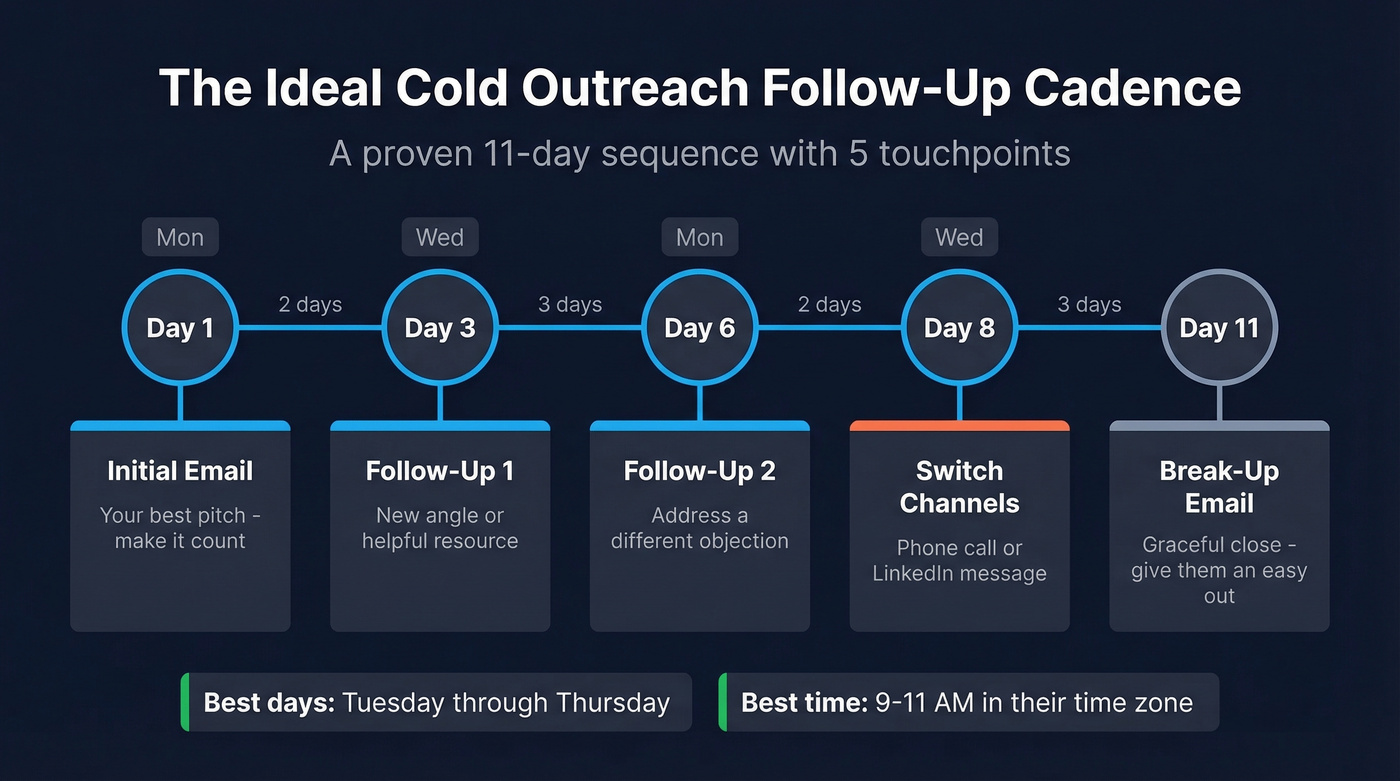
The spacing matters as much as the count. Space follow-ups 2-3 days apart, and favor midweek mornings - Tuesday through Thursday, 9-11 AM in the recipient's time zone. Martal's data suggests launching sequences on Monday and following up on Wednesday for peak engagement. (More data here: best time to send cold emails.)
A practical cold outreach cadence:
- Day 1 (Mon): Initial email
- Day 3 (Wed): Follow-up #1 - new angle or resource
- Day 6 (Mon): Follow-up #2 - different objection
- Day 8 (Wed): Phone call or different channel
- Day 11: Break-up email
For non-sales professional contexts, the cadence is simpler: one follow-up after the appropriate waiting period, a second if needed, then move on or switch channels. In our experience, two well-timed follow-ups beat five mediocre ones every time.
Mix channels when possible. Email plus a phone call plus a touchpoint on a professional network outperforms email-only sequences. Belkins' data showed a direct message plus profile visit on a professional network hit an 11.87% reply rate - significantly higher than email alone.
When to Stop Following Up
Here's the thing: the "never give up" advice is actively harmful.
The 16.5-million-email study shows engagement drops from 6.66% after one follow-up to 3.01% by the fourth. And sending four or more emails more than triples unsubscribe and spam complaint rates. The math is brutal and unambiguous.
If your average deal is under $15K, you almost certainly don't need a 7-touch email sequence. Three emails, max. The math doesn't support burning your domain reputation over smaller deals. Save the persistence for the accounts that actually move the needle. (If you’re worried about reputation, start with how to improve sender reputation.)
After two follow-ups with zero response, try a different channel entirely - a phone call, a mutual connection, a different stakeholder.
If you've followed up twice with silence, the problem might not be your email. It might be your data. Verify the address is valid before sending another message into the void - tools like Prospeo can confirm whether the email is even deliverable before you waste another send.
Deliverability Checklist
None of this matters if your email never reaches the inbox. 17% of cold emails never arrive - they bounce or get filtered to spam before the recipient has a chance to ignore you on their own terms. (If you want the full technical breakdown, read our email deliverability guide.)

Skip this section if you're only sending one-off follow-ups to people you already know. But for anyone running outreach at scale, these are non-negotiable:
- Verify the email address. A perfectly written follow-up that bounces is worse than no follow-up at all. Use an email verification tool to confirm deliverability before you send. (Benchmarks and fixes: email bounce rate.)
- Use plain text or near-plain text. Heavy HTML formatting triggers spam filters.
- Reply to the original thread for warm follow-ups. Threading signals legitimacy to email providers.
- Format for mobile. 44.7% of emails are opened on mobile devices. If your follow-up looks broken on a phone, it's getting deleted.
- Keep it short. Under 5 sentences. Under 100 words. Every word earns its place or gets cut.
We've seen teams cut their bounce rate from 35% to under 4% just by verifying addresses before sending - which means all those carefully crafted follow-ups actually land where they're supposed to.
Great follow-up copy deserves great contact data. Prospeo gives you 300M+ professional profiles refreshed every 7 days - so you're never following up with outdated addresses that tank your domain reputation.
Every bounced follow-up damages your sender reputation. Fix the data first.
FAQ
How long should a professional follow-up email be?
Three to five sentences, ideally under 100 words. Plain text or near-plain text outperforms formatted emails. The recipient should be able to read it, understand what you want, and respond in under 30 seconds.
Is it unprofessional to follow up more than once?
Not at all - up to 2-3 follow-ups is standard in professional contexts. Beyond that, diminishing returns hit hard. The 16.5-million-email study shows 4+ emails more than triple unsubscribe and spam complaint rates, so the line between persistent and annoying is around three messages.
What's the best day to send a follow-up email?
Wednesday is the peak engagement day for follow-ups, while Monday works best for initial outreach. Midweek mornings (9-11 AM) in the recipient's time zone consistently outperform other windows across every dataset we've reviewed.
Should I reply to the original thread or start a new one?
For warm follow-ups, reply to the original thread - it preserves context and signals legitimacy to email providers. For cold re-engagement after weeks or months of silence, start a new thread with a fresh subject line referencing something current.
How do I know my follow-up actually reached the inbox?
Verify the address before sending. Since 17% of cold emails never arrive, verification eliminates the most common silent failure point. If you're getting zero responses after multiple attempts, bad data is often the culprit - not your writing.