

How to Build a Go-to-Market Marketing Strategy That Actually Works
Your CEO wants a GTM plan by Friday. You've got a product roadmap, a rough sense of who might buy, and a Notion doc with "GTM Strategy" in the title that's been blank for two weeks. You're not alone - a Bain study of 2,300 global companies found that only 9% achieved sustained revenue and profit growth over a decade, and only 13% of SaaS companies reach $10M ARR after 10 years. The other 91% had strategies too. They just didn't have systems.
That's the gap this playbook closes. Not theory. Not a 47-slide deck your board skims. A working go-to-market marketing strategy for turning a product into revenue - with real benchmarks, inline templates, and a framework for choosing the right GTM motion before you spend a dollar.
What a GTM Marketing Strategy Is (And Isn't)
A go-to-market strategy isn't a campaign calendar with a fancier name. It's the full system that connects your product to paying customers: pricing, sales motion, channel selection, enablement, and feedback loops all operating as one machine. A marketing plan is one layer within that system, focused on demand generation and awareness. A business plan is the financial and operational wrapper around everything.
The confusion between these three is the single most common GTM mistake we see. Threads in r/startups and r/ProductMarketing regularly ask "what actually belongs in a GTM strategy?" - which tells you the definition problem isn't academic, it's operational. Teams build a content calendar, call it a strategy, and wonder why pipeline doesn't move.
Use the Ansoff Growth Matrix to figure out how much GTM work you actually need:
| Scenario | Ansoff Quadrant | What You Need |
|---|---|---|
| Existing product, existing market | Market Penetration | Marketing plan |
| Existing product, new market | Market Development | Full GTM strategy |
| New product, existing market | Product Development | GTM + product launch |
| New product, new market | Diversification | Full GTM + validation |
If you're in the top-left box, a lighter marketing plan is enough. Everywhere else, you need the full system.
Choose Your GTM Motion
Before you build anything, decide how you're going to sell. This isn't a philosophical question - it's a math problem driven by your average contract value.
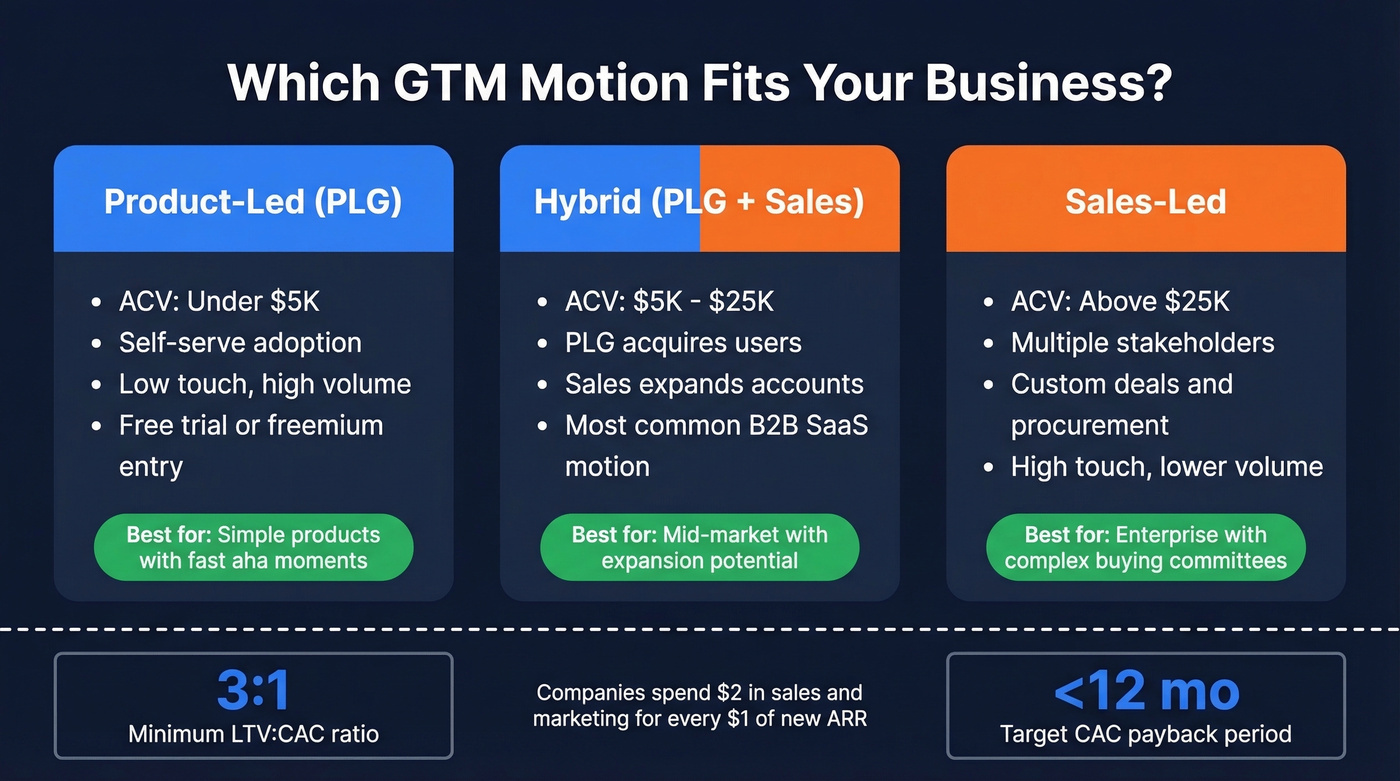
| ACV Range | Recommended Motion | Why |
|---|---|---|
| Under $5K | Product-led (PLG) | Low touch, self-serve adoption |
| $5K-$25K | Hybrid (PLG + sales) | PLG acquires, sales expands |
| Above $25K | Sales-led | Multiple stakeholders, custom deals |
PLG works when your product is simple enough to adopt without training and the deal size doesn't justify a sales team. Sales-led works when buying involves procurement, compliance, and six-figure budgets. The hybrid motion - where free users convert into enterprise contracts - is where most B2B SaaS companies land today. Inbound is the most common primary motion at 23% adoption, with outbound close behind at 19%. If you're leaning into outbound early, it helps to standardize your sales prospecting techniques so reps aren’t improvising list-building and targeting.
Two unit economics targets should anchor every motion decision. Your LTV:CAC ratio needs to hit at least 3:1, and CAC payback should stay under 12 months. Companies spend $2 in sales and marketing for every $1 of new ARR, and that ratio has climbed 14% since 2024. If your motion doesn't pencil out on these two metrics, fix the motion before you fix the messaging. If you need a deeper breakdown of CAC mechanics, see cost to acquire customer.
Here's the thing: if your deal size sits below $10K, you almost certainly don't need a sales team at launch. Build PLG first, prove the product converts on its own, then layer in sales for expansion. Most startups hire reps too early and burn cash on a motion that doesn't match their economics.
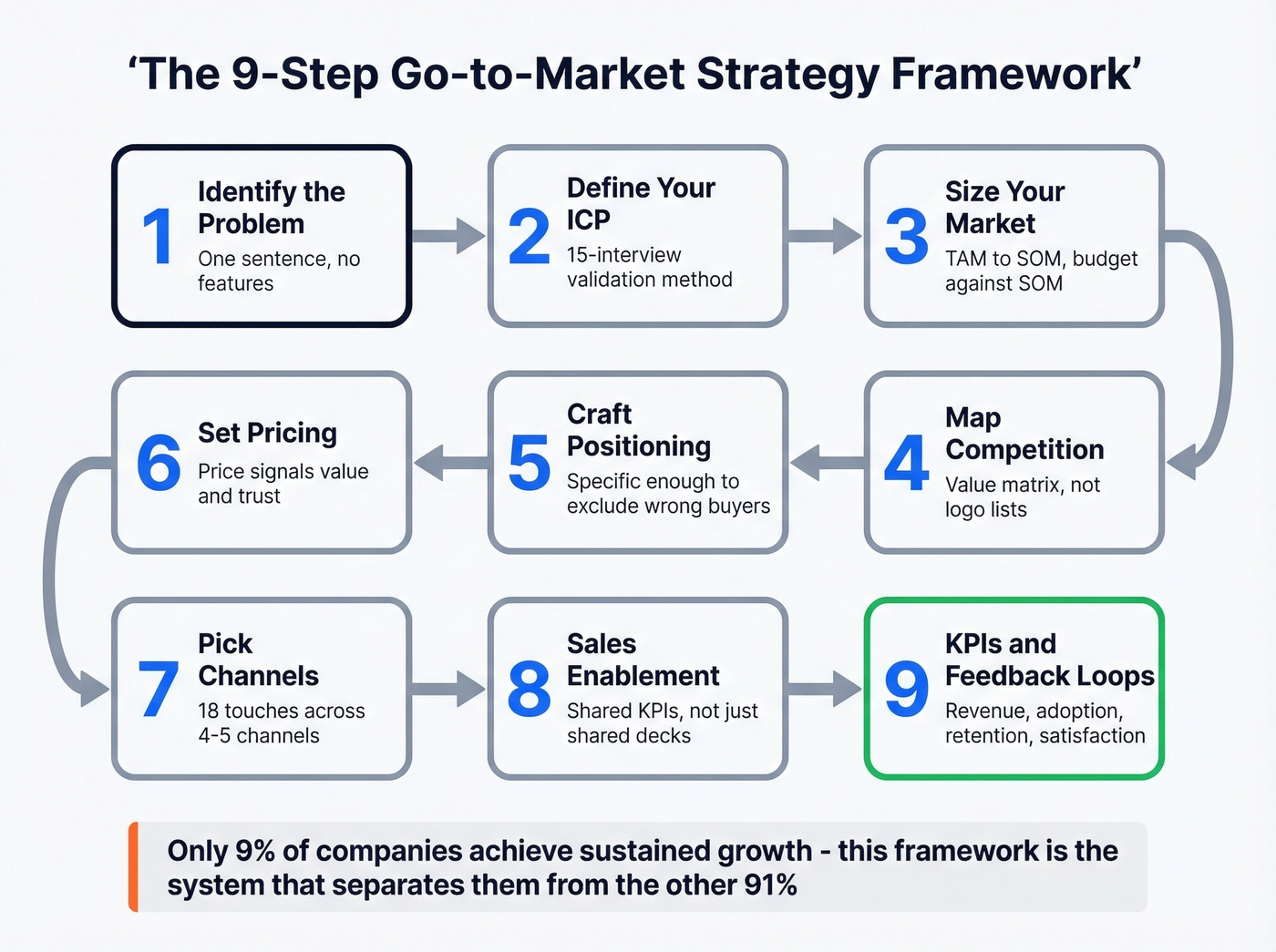
Build Your Strategy in 9 Steps
1. Identify the Problem You Solve
GTM starts with the problem, not the product. Every failed launch we've dissected traces back to the same root cause: the team built positioning around features instead of the pain those features eliminate. Write down the problem in one sentence. If you can't, you're not ready for a launch plan - you're still searching for product-market fit.
2. Define Your ICP
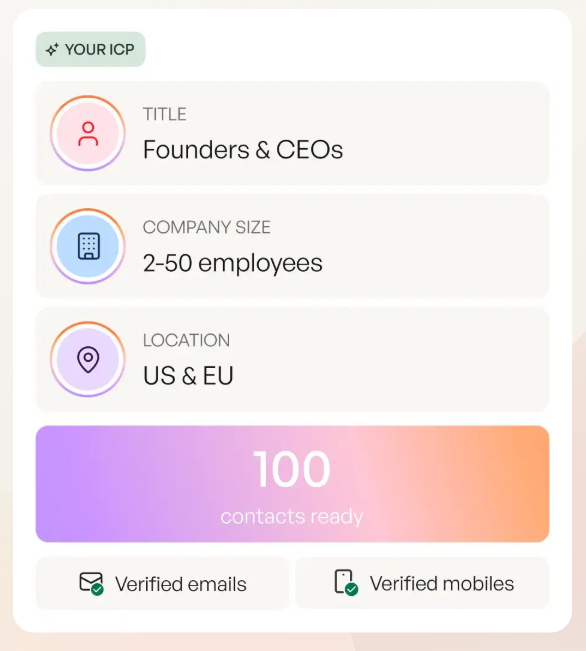
Your ideal customer profile isn't a demographic sketch. It's a pattern - the type of company and buyer where your product creates disproportionate value and where sales cycles are shortest. If you want a faster way to operationalize this, use an ideal customer profile template to score accounts consistently.
| Field | What to Define |
|---|---|
| Company | Industry, size, stage, tech stack |
| Buyer | Title, reporting line, daily work |
| Trigger | What event starts the search? |
| Pain | What's broken right now? |
| Dream | What does success look like in 6 months? |
| Proof | What evidence shows this profile converts? |
Validate it with the 15-interview method. Talk to 5 existing customers, 5 competitor customers, and 5 target-market prospects. If 8 or more of the 15 describe the same pain, you have signal. Fewer than that, and your ICP is a guess.
3. Size Your Market
TAM, SAM, SOM - you know the acronyms. The exercise matters because it forces you to quantify how big the opportunity actually is, which directly shapes your GTM investment. If you want a more detailed walkthrough, see addressable market.
A quick worked example: say you sell compliance software to mid-market fintechs. Your TAM might be every fintech globally ($50B market). Your SAM narrows to mid-market fintechs in North America and Europe ($8B). Your SOM - the slice you can realistically capture in 18 months with your current team and motion - might be $15M. That SOM number is what your GTM budget should be sized against, not the TAM number your pitch deck leads with.
4. Map the Competition
Don't just list competitors. Map them on a value matrix: one axis for the primary dimension buyers care about (usually price or depth), the other for your key differentiator. This reveals the gaps where your positioning can win. If you need a repeatable process for this, build a lightweight competitive intelligence strategy.
The real competition often isn't another vendor - it's the spreadsheet, the intern, or the "do nothing" option. Position against the actual alternatives your buyers are weighing, not just the logos on a G2 grid.
5. Craft Your Positioning
Use this canvas as your starting point:
For [target customer] who [problem], [product] is a [category] that [primary benefit]. Unlike [alternative], we [unique mechanism/proof].
Fill it in, then stress-test it. Can a new sales rep read it and immediately explain what you do? Can a prospect read it and know whether they're the right fit? If either answer is no, the positioning is too vague. The best positioning statements are specific enough to exclude people who aren't your buyer. For a deeper positioning framework, see B2B brand positioning.
6. Set Pricing and Packaging
Pricing signals value. Underpricing doesn't just leave money on the table - it actively reduces trust. Enterprise buyers assume a $29/month tool can't solve a $500K problem.
Tie your pricing to your GTM motion. PLG needs a freemium tier or free trial to drive adoption, and trial-to-paid conversions often peak in the first week, so design your trial experience to deliver an "aha moment" early. Sales-led needs demo-gated pricing that justifies the sales cycle. Hybrid motions often start with a generous free tier and gate advanced features behind a sales conversation. Whatever you choose, make sure the pricing structure incentivizes expansion, not just initial conversion.
7. Pick Your Channels
Only 5% of your market is ready to buy right now. The other 95% is forming impressions. Conversion typically takes 18 touchpoints across 4-5 channels, so channel selection isn't about finding one magic channel - it's about building a system that stays in front of buyers across their entire decision timeline.
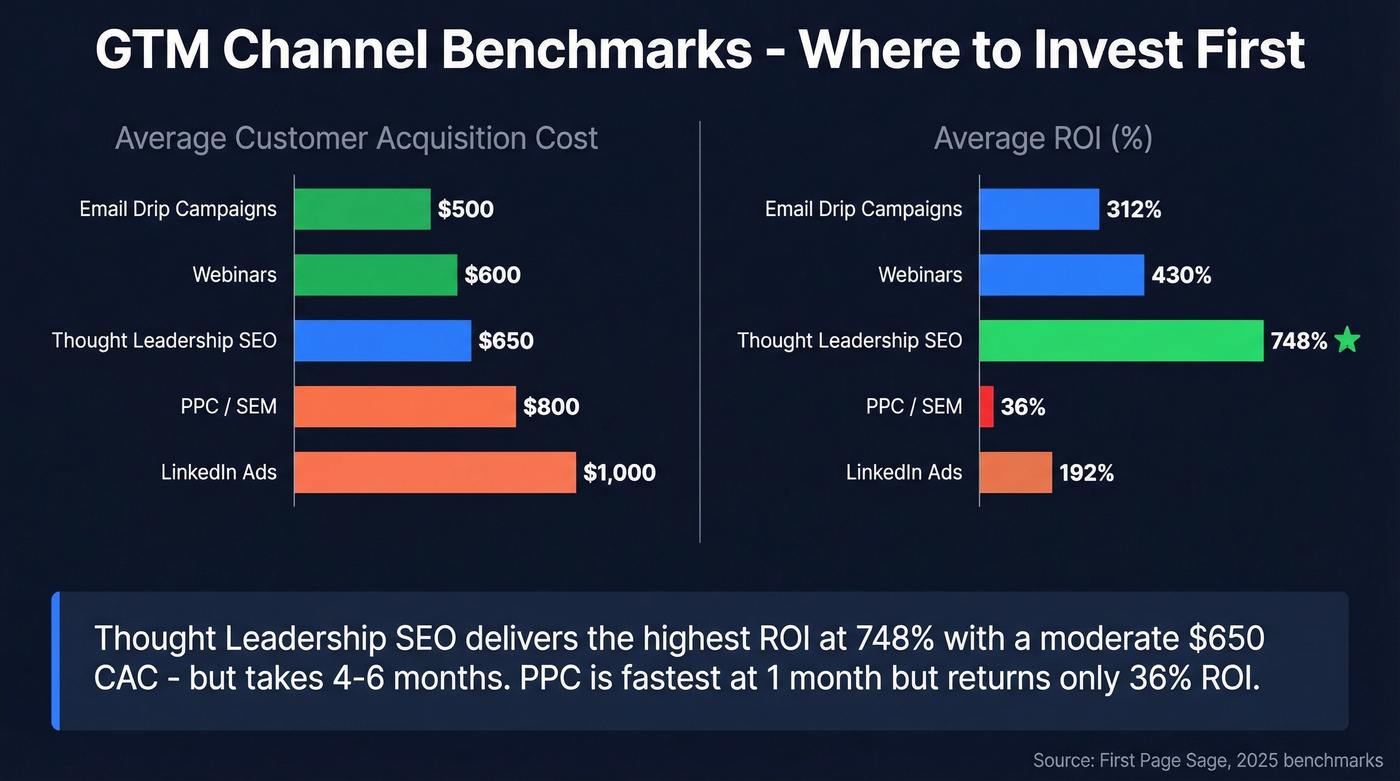
The channel benchmarks tell a clear story:
| Channel | Avg CAC | Time to Results | ROI |
|---|---|---|---|
| Thought leadership SEO | $650 | 4-6 months | 748% |
| Webinars | $600 | 2-4 months | 430% |
| Email drip campaigns | $500 | 3-6 months | 312% |
| LinkedIn ads | $1,000 | 3-4 months | 192% |
| PPC/SEM | $800 | 1 month | 36% |
For outbound specifically, timeline-based cold email hooks hit a 10.01% reply rate versus 4.39% for problem-based hooks. But average reply rates have declined from 6.8% to 5.8% year over year, which means list quality matters more than ever. Bad data burns sender domains and kills reply rates before your copy even gets a chance. If you’re building outbound sequences, keep a set of proven cold email follow-up templates handy.
8. Build Your Sales Enablement
Sales enablement isn't a slide deck. It's cross-functional alignment expressed through shared KPIs, not just shared collateral. Gartner's GTM framework identifies five core components: target market identification, first customer touchpoint design, sales compensation planning, corporate investment allocation, and voice of the customer. Most teams nail the first two and completely ignore compensation planning - then wonder why reps sell the wrong product mix. If you’re formalizing this function, a sales enablement manager playbook can help clarify ownership and deliverables.
The symptom of misalignment is always the same: marketing generates leads that sales can't convert. When that happens, the problem isn't lead quality or sales skill. It's that the two teams are optimizing for different definitions of success. Fix the shared KPIs first. The enablement materials follow.
9. Define KPIs and Feedback Loops
Your KPIs should span four categories:
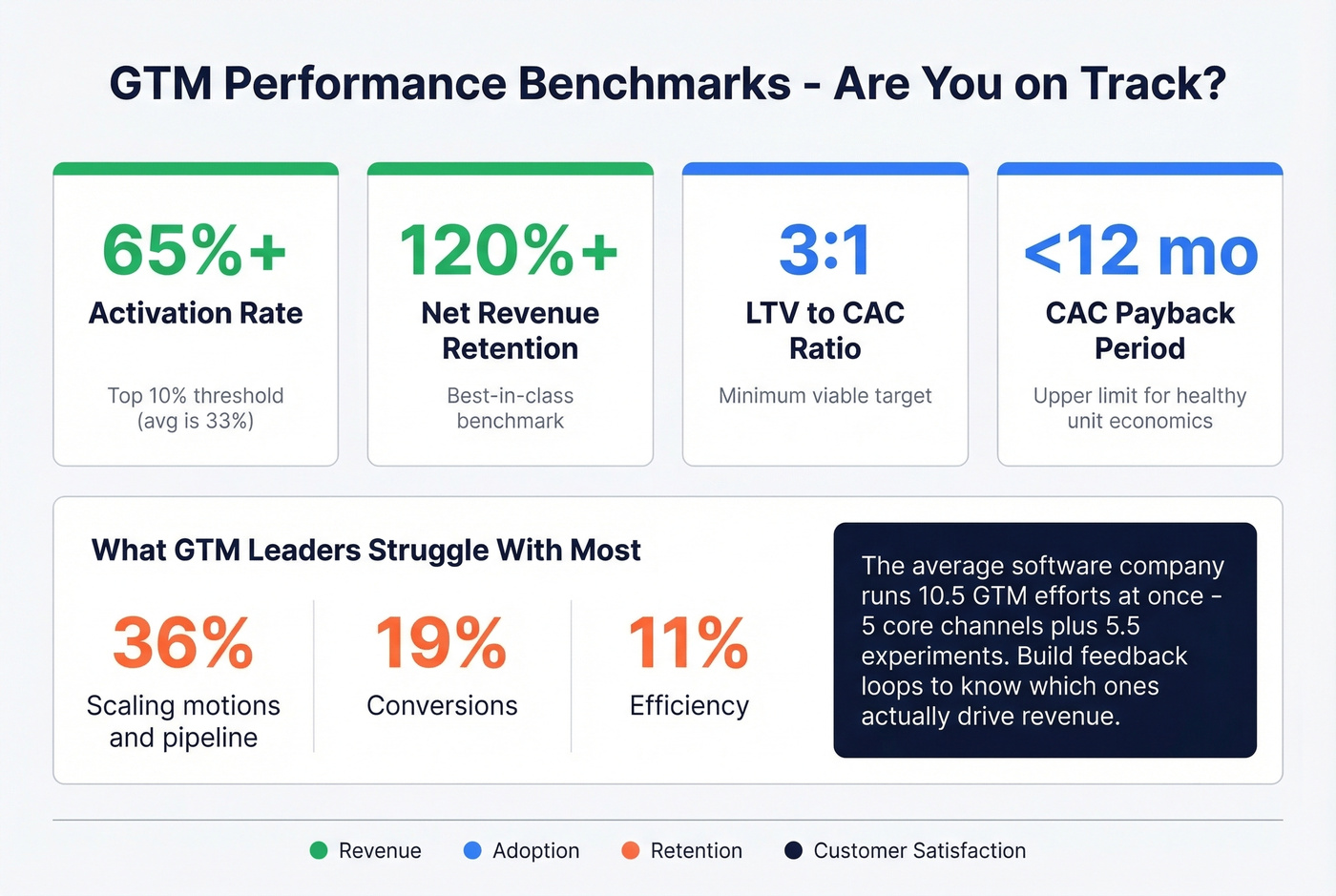
- Revenue: Pipeline generated, win rate, average deal size, CAC payback period
- Adoption: Activation rate, time-to-value, feature adoption depth
- Retention: Net revenue retention, churn rate, expansion revenue %
- Customer satisfaction: NPS, support ticket volume, referral rate
For PLG motions, the benchmarks are stark: top 10% of companies hit 65%+ activation rates versus a 33% average. Best-in-class net revenue retention exceeds 120%. If your numbers fall below these thresholds, your GTM system has a leak somewhere downstream of acquisition. To diagnose the downstream side, start with churn analysis.
Let's be honest about the challenge here: 36% of GTM leaders cite scaling motions and pipeline as their top problem, with another 19% pointing to conversions and 11% to efficiency. The average software company runs 10.5 GTM efforts simultaneously - 5 core channels plus 5.5 experiments. That's a lot of surface area. Build feedback loops that tell you which efforts actually drive revenue, and kill the ones that don't. Quarterly GTM reviews aren't optional.

Your ICP definition is only as good as the data you use to reach them. Prospeo gives you 300M+ profiles with 30+ filters - buyer intent, technographics, headcount growth, funding - so your GTM motion targets the right accounts from day one.
Stop building GTM strategies on bad data. Start with 98% accuracy.
GTM Budget by Company Stage
Your budget split between lead generation and lead nurturing should shift as you scale. Early-stage companies need to fill the top of the funnel. Mature companies need to convert and expand what's already there.
| Stage | Lead Gen / Nurture | Annual Budget |
|---|---|---|
| Startup | 80% / 20% | ~$250K |
| SMB | 70% / 30% | ~$500K |
| Mid-to-large | 50% / 50% | ~$1M |
| Enterprise | 35% / 65% | ~$2M |
These are directional benchmarks, not prescriptions. A startup spending $250K on demand gen should concentrate on 1-2 channels where they've validated CAC, not spread it across five. An enterprise spending $2M should be investing heavily in nurture, expansion, and customer marketing - not just top-of-funnel acquisition.
GTM Examples That Worked
Slack hit 8,000 users within 24 hours of launch and reached a $1B valuation in just 1.25 years. The motion was pure PLG plus word-of-mouth - no outbound sales team, no paid acquisition at launch. The product was the GTM strategy.
Zoom took a different path. Their freemium tier was the entry point, but the expansion was sales-led. Per their 2019 10-K, 55% of customers contributing over $100K in revenue started with at least one free host. That's the hybrid motion working exactly as designed: PLG acquires, sales expands. Any team building a go-to-market marketing strategy can learn from how Zoom layered sales on top of self-serve adoption rather than leading with it.
HubSpot is the classic inbound GTM example - content-first acquisition paired with free tools and a freemium CRM that pulled users into the ecosystem before sales-assisted expansion. The pattern across all three? They matched their motion to their economics, not the other way around.
7 GTM Mistakes That Sink Launches
Confusing GTM with marketing. A campaign calendar isn't a GTM system. If your "strategy" is just a list of channels and content themes, you've skipped the hard parts - pricing, sales motion, enablement, and feedback loops.
Targeting too broadly. "Mid-market SaaS companies" isn't an ICP. You need a beachhead segment narrow enough that you can dominate it before expanding.
Skipping channel validation. Your first channel rarely scales. Test CPA against LTV before committing budget. We've seen teams burn six figures on a channel that looked promising in a pilot but collapsed at 3x volume.
Neglecting pricing. Pricing is a GTM decision, not a finance decision. Get it wrong and your entire motion breaks - too low and enterprise buyers don't take you seriously, too high and PLG adoption stalls.
Ignoring the sales motion. Self-serve, inside sales, and enterprise field sales are fundamentally different systems. You can't bolt on a sales team after the fact and expect it to work.
Focusing only on acquisition. Retention, expansion, and referrals are GTM components. If your strategy ends at "close the deal," you're leaving the majority of your revenue on the table.
Scaling before product-market fit. Skip this one at your peril. GTM spend amplifies whatever you already have. If you have PMF, spending accelerates growth. If you don't, spending accelerates churn.
Your GTM Data Stack
A go-to-market marketing strategy is only as good as the data powering it. You need four layers: a CRM (HubSpot or Salesforce - both have free tiers), outbound sequencing (Instantly, Lemlist), analytics, and a B2B data platform for prospecting and enrichment. If you’re evaluating the data layer specifically, compare data enrichment services and best B2B company data before you commit.
The data layer is where most teams either overspend or underinvest. Enterprise platforms like ZoomInfo run $15K-$100K+/year, and many teams end up paying for intent, chat, and workflow features they never activate. On the other end, free tools give you volume without verification - and unverified data destroys deliverability. In our experience, the teams that struggle most with outbound aren't writing bad copy. They're sending to bad addresses. If you’re seeing bounces climb, start with email bounce rate and then tighten your email deliverability.
Prospeo sits between those extremes: 300M+ professional profiles, 98% email accuracy, and a self-serve credit-based model at roughly $0.01 per lead. The 7-day data refresh cycle means you're not working from stale records, and native integrations with Salesforce, HubSpot, Instantly, and Lemlist keep your data flowing into whatever tools you already run. When Snyk deployed it across 50 AEs, bounce rates dropped from 35-40% to under 5% and AE-sourced pipeline jumped 180%.

A 3:1 LTV:CAC ratio demands efficient pipeline. Teams using Prospeo book 26% more meetings than ZoomInfo and 35% more than Apollo - at $0.01 per verified email. That's how you make your GTM unit economics work.
Hit your CAC targets with data that actually connects you to buyers.
FAQ
What's the difference between a go-to-market strategy and a marketing plan?
A go-to-market strategy is the full system for entering a market - positioning, pricing, sales motion, channels, enablement, and feedback loops functioning as one machine. A marketing plan is one layer within that system, focused on demand generation and awareness. You need the GTM strategy first; the marketing plan follows from it.
Who owns the GTM strategy?
Cross-functional ownership, typically led by product marketing or a dedicated GTM lead. RevOps increasingly owns the operational layer - data flows, attribution, and pipeline reporting. The key is shared KPIs across product, marketing, sales, and customer success so no team optimizes in isolation.
How long does it take to see GTM results?
PLG companies can see activation data within weeks, but meaningful revenue signals usually take 3-6 months. Sales-led motions with longer deal cycles need 6-12 months. Define leading indicators - demo requests, trial activations, qualified pipeline - so you're not flying blind while waiting for closed-won revenue.
What's a good free tool for building ICP-matched prospect lists?
Prospeo offers 75 free email credits and 100 Chrome extension credits per month - enough to validate your ICP targeting before committing budget. Filter by 30+ attributes including intent signals, technographics, and headcount growth, then export verified contacts directly to your CRM or sequencer.