

GTM Solutions: Frameworks, Tools, and a 90-Day Playbook
The average software company runs 10.5 simultaneous go-to-market efforts - five core channels plus five-and-a-half experiments at any given time. Most are underfunded, undermeasured, and fighting each other for the same buyer's attention. You don't need more strategy decks. You need GTM solutions that turn strategy into pipeline.
The Short Version
If you're pressed for time, here's the entire article compressed into five decisions:
- Pick one GTM motion. Product-led, sales-led, or hybrid. Not all three at once.
- Define one ICP. One industry, one persona, one pain point. Expand later.
- Build a data-first tech stack. CRM plus a data intelligence layer, then engagement tools. In that order.
- Set pipeline coverage at 3-5x quota. If your team needs to close $500K this quarter, you need $1.5-2.5M in qualified pipeline.
- Run a 90-day sprint with kill criteria. If a channel isn't producing leading indicators by week eight, cut it.
That's the system. The rest of this article explains how to build it.
What "GTM Solutions" Actually Means
A go-to-market solution isn't a single tool or a launch checklist. It's the system connecting what you build and who you build it for - spanning product, sales, marketing, customer success, and the data layer underneath all of them.
Asana's GTM framework boils it down to four questions every system must answer: What product solves what problem? Who's the ideal customer and what's their pain? Where will you sell and what are the market conditions? How will you reach buyers and create demand?
Here's the distinction that matters: a GTM strategy is launch-specific and cross-functional. A marketing plan is one component of it, focused on demand generation and brand. Conflating the two is how teams end up with a beautiful content calendar and zero pipeline.
A quick note: GTM Solutions, Inc. is a direct sales and marketing firm in the greater Omaha area. This article covers the broader concept of go-to-market systems, frameworks, and tools.
Why Most Go-to-Market Strategies Fail
The strategy-to-execution gap kills more launches than bad products do. Here are the five mistakes we see most often, drawn from Dayta's analysis of common SaaS GTM pitfalls:
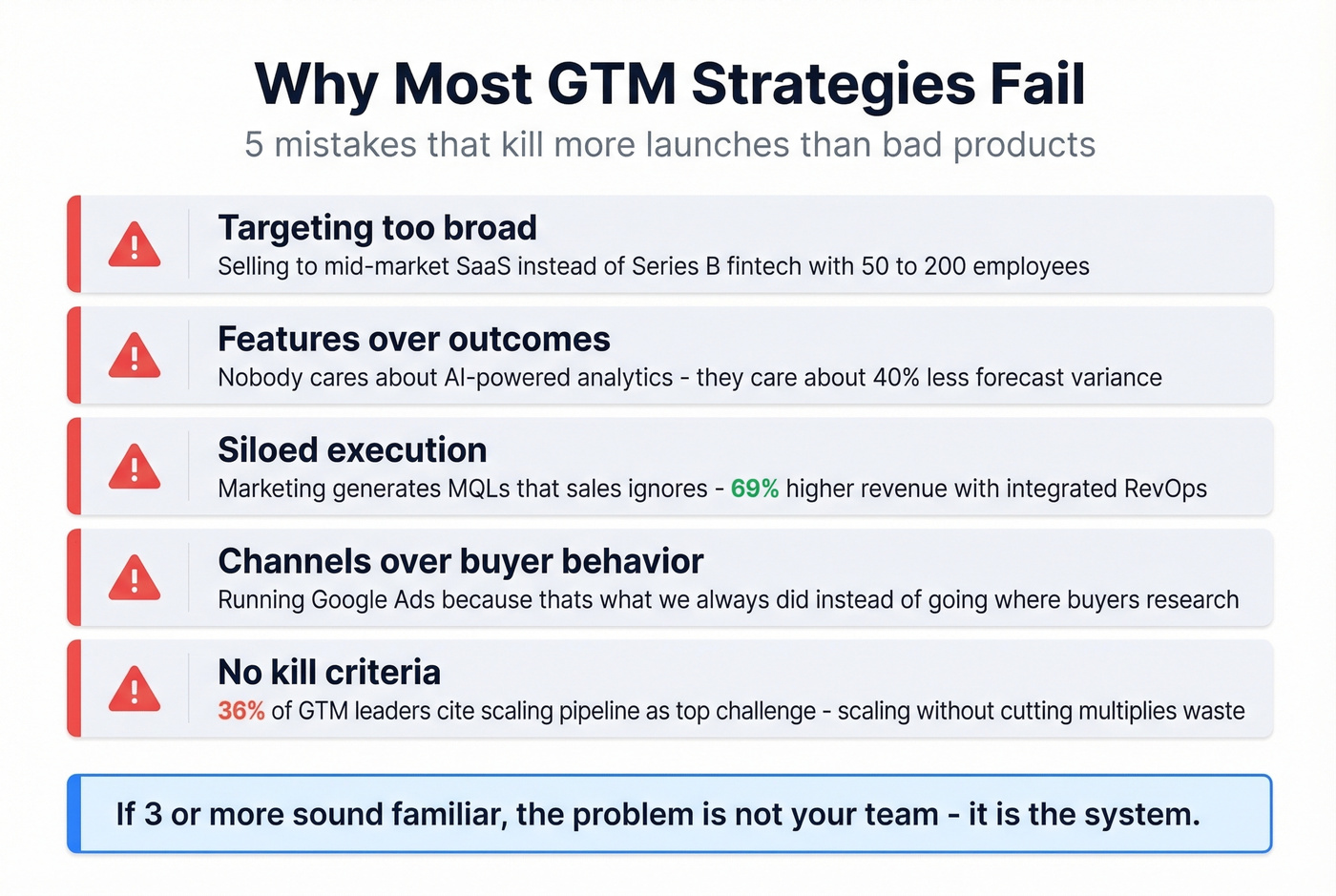
Targeting too broad. Trying to sell to "mid-market SaaS companies" instead of "Series B fintech companies with 50-200 employees who just hired a VP of Sales." Broad targeting dilutes messaging and burns budget on prospects who'll never convert.
Positioning features over outcomes. Nobody cares that your platform has "AI-powered analytics." They care that it cuts forecast variance by 40%. If you need a tighter positioning system, start with brand positioning.
Siloed execution. Marketing generates MQLs that sales ignores. Sales closes deals that CS can't retain. The strategy doc says "aligned" but the handoffs say otherwise. Companies running integrated RevOps and revenue intelligence stacks see 69% higher revenue growth - alignment isn't optional.
Defaulting to channels instead of buyer behavior. Running Google Ads because "that's what we've always done" instead of asking where your buyers actually research - which might be Reddit, peer communities, or analyst reports.
No kill criteria. 36% of GTM leaders cite scaling pipeline as their top challenge. But scaling without knowing when to cut underperforming channels just multiplies waste.
If three or more of these sound familiar, the problem isn't your team. It's the system.
The Five Forces Framework
The old playbook - build product, hand to marketing, hand to sales - is a liability. Modern buyers research across many channels before your sales team even knows they exist. Vivaldi's Five Forces framework reframes go-to-market planning as five interdependent decisions, not a linear sequence:
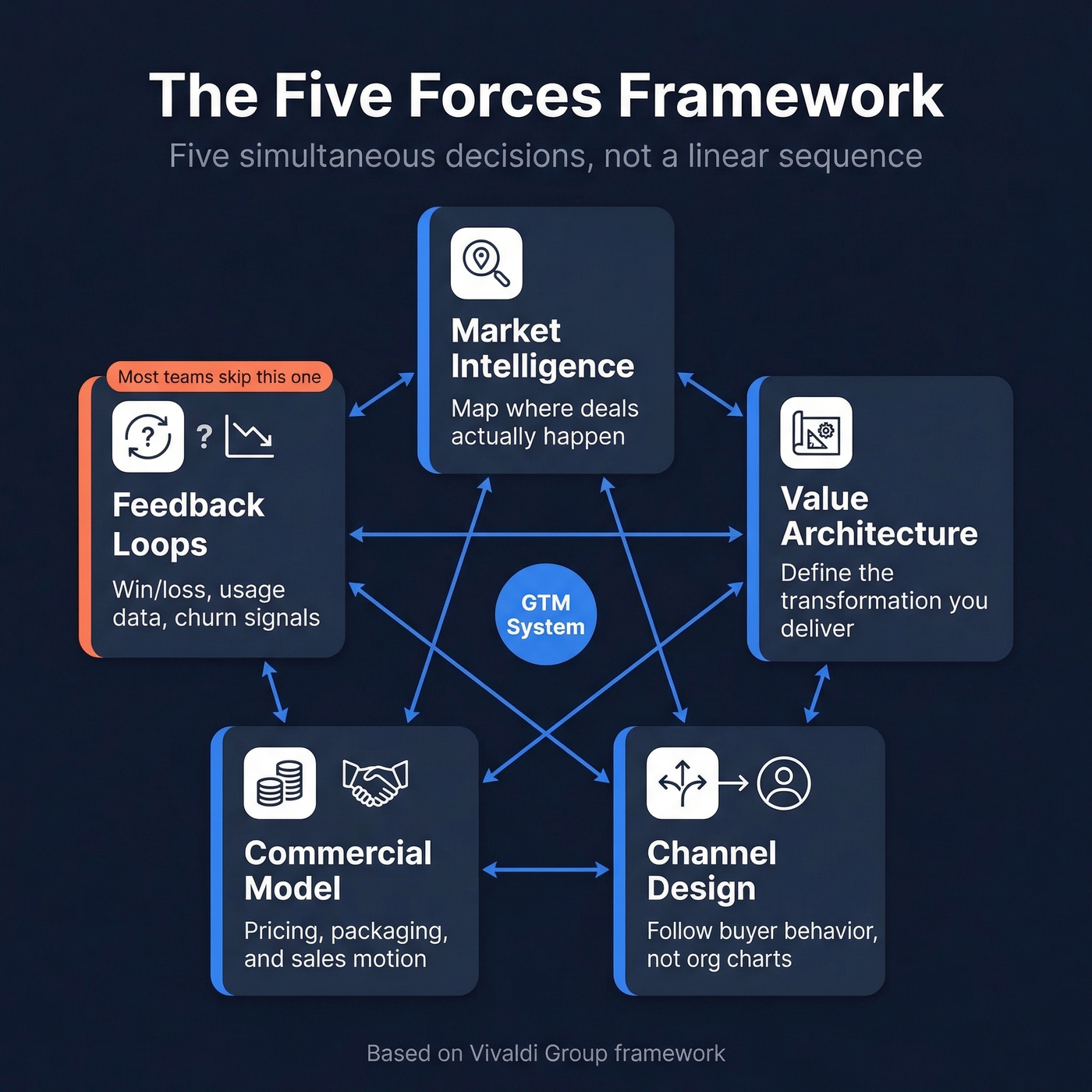
Market intelligence. Map where attention, spend, and decision power concentrate. Who's in the buying ecosystem? What needs are unmet - and which are unarticulated? This isn't a TAM slide. It's a gravity map of where deals actually happen. If you need a clean way to size and segment, use an addressable market model.
Value architecture. Define the transformation you deliver, your defensible differentiation, and the "why now" urgency. If you can't articulate why a buyer should act this quarter instead of next year, your pipeline will stall.
Channel design. Direct vs. indirect, digital vs. field, partner-led vs. owned. The channel mix should follow buyer behavior, not internal org charts.
Commercial model. Pricing, packaging, and the sales motion itself - PLG, sales-led, or hybrid. This is where unit economics meet buyer expectations.
Feedback loops. The force most teams skip entirely. Win/loss analysis, product usage data, churn signals, and NPS flowing back into the other four forces. Without this, your system is static while your market moves. If retention is a blind spot, start with churn analysis.
These five forces aren't sequential. They're simultaneous. Asana's GTM example highlights Oatly's US expansion as a case where value architecture, channel choices, and feedback loops reinforced each other - and revenue grew 10x between 2017 and 2018.

Your GTM solution starts with the data layer underneath it. Prospeo gives you 300M+ profiles with 30+ filters - buyer intent, technographics, job changes, funding, headcount growth - so your ICP targeting is surgical, not broad. 98% email accuracy means your pipeline coverage stays real, not inflated with bounces.
Stop building GTM motions on unreliable data. Start with Prospeo.
Choosing Your GTM Motion
The biggest architectural decision in your go-to-market system is the motion: product-led growth (PLG), sales-led growth (SLG), or a hybrid. Here's how they compare:
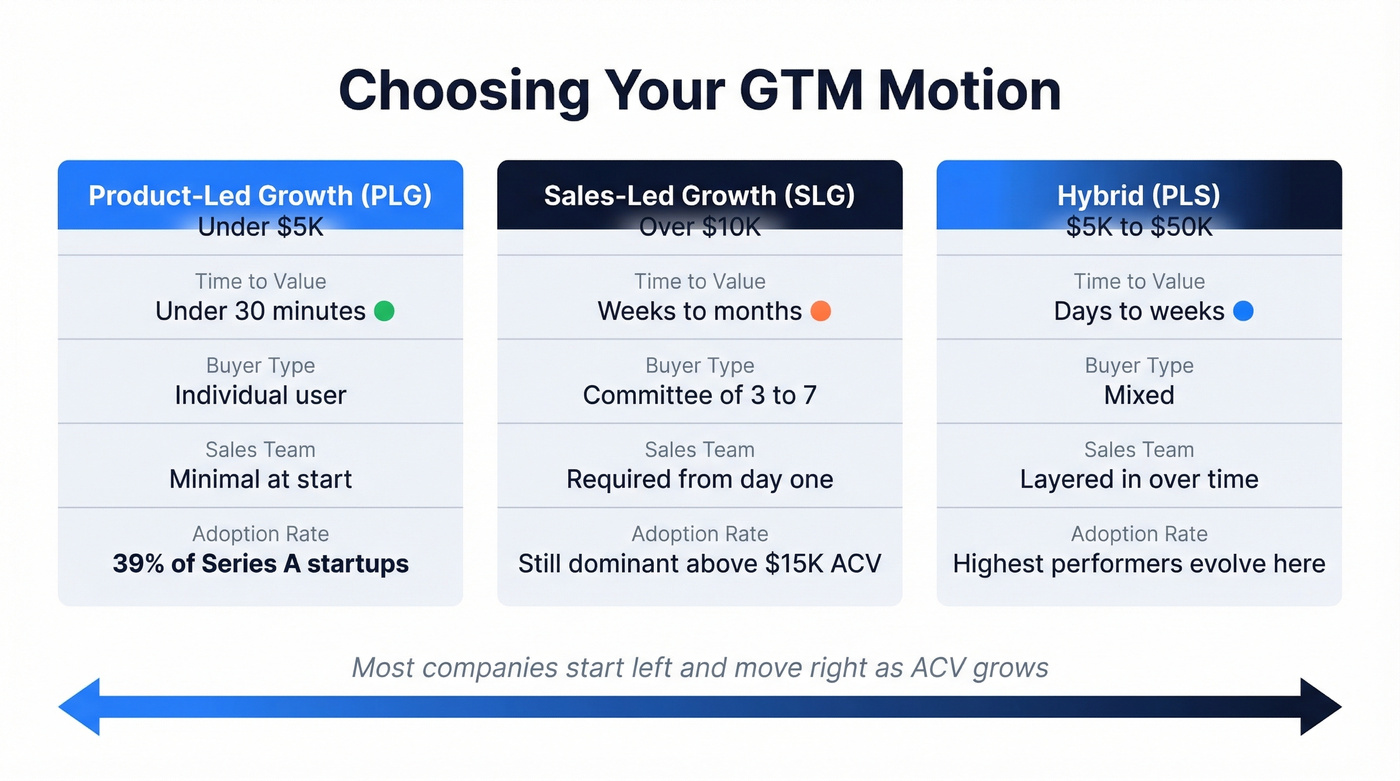
| Criteria | PLG | Sales-Led | Hybrid (PLS) |
|---|---|---|---|
| Best for ACV | Under $5K | Over $10K | $5K-$50K |
| Time-to-value | Under 30 min | Weeks/months | Days to weeks |
| Buyer complexity | Individual user | Committee (3-7) | Mixed |
| Sales team needed | Minimal at start | From day one | Layered in |
Data from 474 Series A startups shows 39% enable PLG or self-serve, with 25% offering a free tier. In DevTools specifically, that jumps to 50% PLG adoption. But PLG doesn't mean free - many PLG companies charge from day one. It means users can start without talking to sales.
Let's be honest about something: pure PLG rarely scales to enterprise on its own. McKinsey's analysis of 107 publicly listed B2B SaaS companies found that the highest-performing companies evolve into product-led sales - combining self-serve adoption with sales-assist for expansion.
If your average contract value sits below $10K, you probably don't need a ZoomInfo-level data platform or a 15-person sales team. A PLG motion with lightweight outbound will get you further, faster, and cheaper. Save the enterprise stack for enterprise deals. But if your average deal is north of $15K and involves multiple stakeholders, you need a sales-assist layer. Period. PLG can be your acquisition engine, but a human needs to close the deal.
Building the Right Tech Stack
Most teams are stuck in what revenue operations consultants call "Revenue Chaos" - disconnected systems, poor visibility, inaccurate forecasting. The fix is architectural, not incremental. Start with fewer tools that actually connect, rather than best-of-breed tools that create data silos. A Zapier connection that fires on a webhook isn't the same as native CRM enrichment.
Core Stack Layers
Your go-to-market tech stack needs five layers, regardless of company stage. The broader landscape spans 21+ categories including ABM, analytics, enablement, and CX - but these five are the foundation:
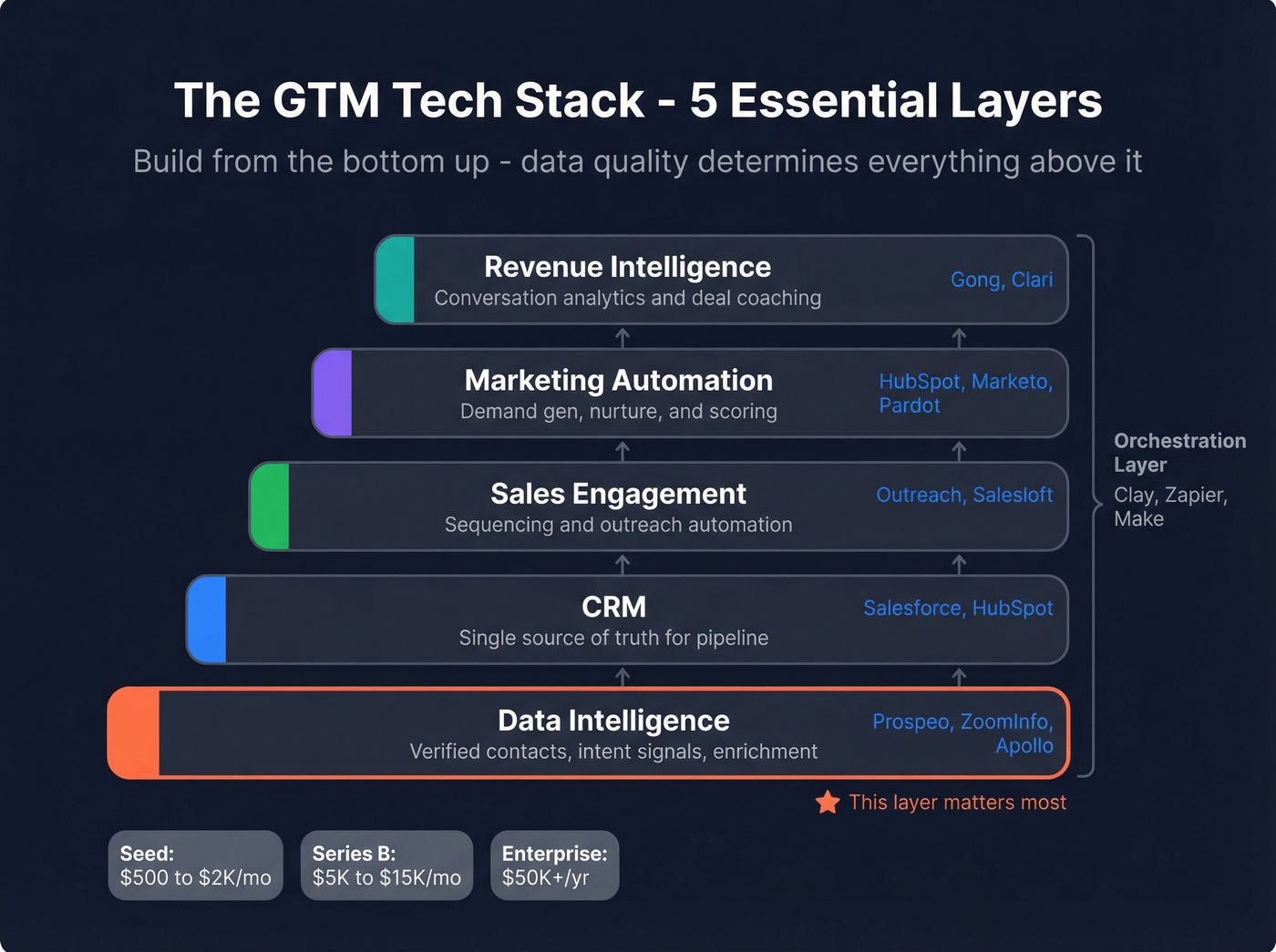
- CRM - Salesforce (~$25-$330/user/mo) for enterprise, HubSpot (free CRM; paid plans from ~$20-$50/user/mo) for everyone else. If you want a quick landscape view, see examples of a CRM.
- Data intelligence - Verified contacts, intent signals, and enrichment. This feeds everything downstream. (More options: data enrichment services.)
- Sales engagement - Sequencing and outreach. Outreach or Salesloft (~$100-$200/user/mo). If you're evaluating platforms, start with this list of SDR tools.
- Marketing automation - Demand gen, nurture, and scoring. HubSpot Marketing Hub, Pardot, or Marketo.
- Revenue intelligence - Conversation analytics and deal coaching. Gong (~$100-$200/user/mo) or Clari ($30K+/year).
| Company Stage | Monthly Stack Cost | What You Get |
|---|---|---|
| Seed | $500-$2,000 | CRM + data + 1 engagement tool |
| Series B | $5,000-$15,000 | Full stack, 2-3 integrations |
| Enterprise | $50,000+/year | Platform suite + custom ops |
The Data Intelligence Layer
This is the layer that matters most. We've seen the same pattern play out dozens of times: a team switches data providers, bounce rates drop from 35% to under 5%, reply rates double. Nothing else changed - not the copy, not the cadence, not the reps. Just the data. If you're troubleshooting, start with email bounce rate benchmarks and root causes.
Prospeo covers 300M+ professional profiles with 98% email accuracy and a 7-day data refresh cycle, compared to a 6-week industry average. The database spans 143M+ verified emails and 125M+ verified mobile numbers with 30+ search filters including buyer intent signals across 15,000 topics. Meritt, an outbound agency, tripled their pipeline from $100K to $300K per week after switching their data provider. At roughly $0.01 per email with a free tier to start, it's 90% cheaper than enterprise alternatives.
| Tool | Database | Key Strength | Pricing |
|---|---|---|---|
| Prospeo | 300M+ profiles | 98% email accuracy, 7-day refresh | From ~$0.01/email, free tier |
| ZoomInfo | 500M+ contacts | Full enterprise platform | $15K-$60K+/year |
| Apollo | 210M+ contacts | Free tier, all-in-one | From $49/mo per user |
| Cognism | EU-focused DB | GDPR-first, verified mobiles | ~$1K-$3K/mo |
| Demandbase | Account-level intent | ABM orchestration | $30K-$100K+/year |
| Gong | Conversation data | Revenue intelligence | ~$100-$200/user/mo |
ZoomInfo has one of the largest databases, but a 10-seat contract with intent data and mobile numbers can run $40-60K/year. The consensus on r/sales is that you end up paying for modules you'll never touch. Apollo's free tier makes it the obvious starting point for bootstrapped teams, though its email accuracy (79%) trails behind Prospeo's 98%. If you're comparing vendors, use this roundup of B2B company data providers.
For orchestration - stitching tools together with conditional logic - Clay, Zapier (8,000+ integrations), and Make handle most workflows. Clay is especially well-suited for enrichment waterfall sequences where you chain multiple data sources before pushing to your CRM. If you're doing this at scale, a dedicated Clay list building workflow helps.
2026 GTM Benchmarks
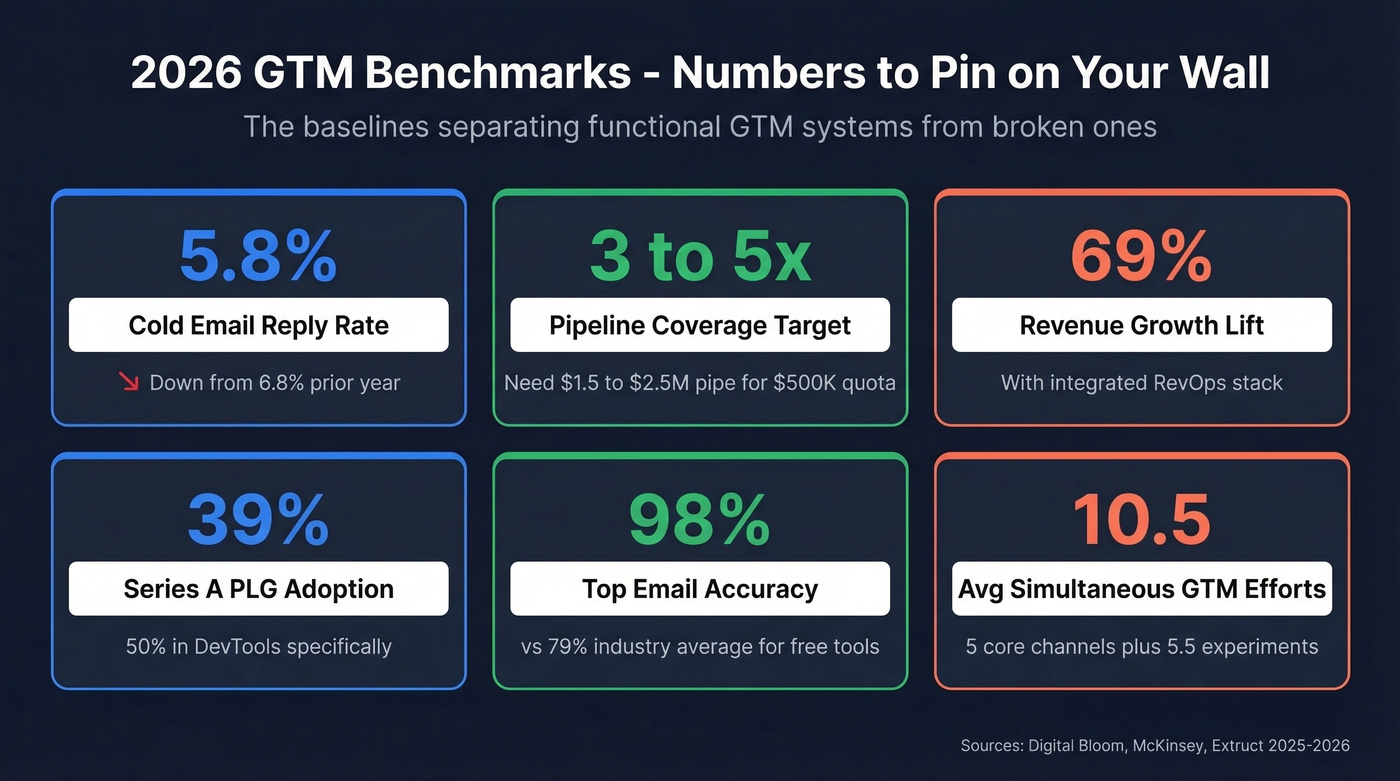
Numbers to pin on your wall. These are the baselines separating functional go-to-market systems from broken ones:
| Metric | Benchmark | Context |
|---|---|---|
| Cold email reply rate | 5.8% | Down from 6.8% the prior year |
| Timeline hooks vs. problem hooks | 10.01% vs. 4.39% reply | 2.3x difference |
| Timeline vs. problem meeting rate | 2.34% vs. 0.69% | 3.4x difference |
| Pipeline coverage | 3-5x quota | Lower = missed quarters |
| MQL to SQL | 25-35% | Below 25% = qualification issue |
| SQL to Opportunity | 50%+ | Below 50% = handoff problem |
| Win rate | 20%+ | Varies by ACV and cycle |
| Speed-to-lead SLA | 15 minutes | During business hours |
| PLG activation (top 10%) | 65%+ | Average is just 33% |
| Best-in-class NRR | >120% | The PLG gold standard |
The timeline hook data deserves a closer look. Emails that reference a specific trigger - a funding round, a job change, a product launch - pull 10.01% reply rates versus 4.39% for generic problem-focused hooks. Meeting rates show an even wider gap: 2.34% vs. 0.69%, a 3.4x multiplier. That's better targeting doing the heavy lifting, not better copywriting. This is exactly why intent data and job-change filters matter so much in your data layer. If you want more practical tactics here, use these sales prospecting techniques.
The 90-Day Launch Plan
Weeks 1-4: Foundation
This phase is about decisions, not execution. Get these wrong and you'll spend months optimizing the wrong things.
Define your ICP with tight specificity - one industry, one persona, one pain point. Write three messaging hypotheses you'll test in weeks 5-8. Set up your CRM and data intelligence layer first, connecting enrichment so verified contacts flow automatically into your sequences. Pick two to three launch channels based on where your ICP actually spends time, and establish baseline metrics for each. Skip this groundwork and you're building on sand. If you need a scoring template, use an ideal customer profile template.
Weeks 5-8: Activation
Launch your channels simultaneously, not sequentially. Implement a 15-minute speed-to-lead SLA for inbound demo requests. Follow up 5-7 times over 10 days - most reps give up after two touches, which is why most reps miss quota. If you want plug-and-play sequences, use these cold email follow-up templates.
Track pipeline velocity weekly: (Opportunities x Average Deal Size x Win Rate) / Sales Cycle Days. This single number tells you whether your system is accelerating or stalling. Flat velocity by week six usually points to data quality or messaging, not channel selection.
Weeks 9-12: Optimize or Kill
Set kill criteria before you launch so emotions don't override data. Any channel that hasn't produced leading indicators - reply rates above 5%, meetings booked, pipeline created - by week eight gets cut. Budget moves to what's working.
Double down on the channel with the best cost-per-opportunity, not the best vanity metrics. Review attribution honestly - multi-touch, not last-click. Feed everything you've learned back into your ICP definition and messaging. That's the feedback loop from the Five Forces framework in action.
GTM solutions aren't built in a single sprint. They compound. Each 90-day cycle sharpens your ICP, tightens your messaging, and concentrates spend on channels that actually produce pipeline. Our team has watched companies go from scattered multi-channel chaos to a focused, repeatable engine in two cycles - 180 days, not 18 months.
The article says it: companies running integrated data stacks see 69% higher revenue growth. Prospeo refreshes every 7 days (not 6 weeks), verifies emails through 5 steps, and enriches CRM records with 50+ data points at a 92% match rate. That's the data-first tech stack your GTM playbook demands - at $0.01 per email.
Fuel your 90-day GTM sprint with data that actually converts.
FAQ
What's the difference between a GTM strategy and a marketing plan?
A go-to-market strategy is launch-specific and cross-functional - spanning product, sales, marketing, and customer success. A marketing plan is one component focused on demand generation and channel execution. The GTM strategy is the blueprint; the marketing plan is one room in the building.
How much does a go-to-market tech stack cost?
Seed-stage teams can run a functional stack for $500-$2,000/month with a CRM, a data intelligence tool, and one engagement platform. Series B teams typically spend $5,000-$15,000/month. Enterprise stacks with platform suites run $50,000+ per year.
How long until a new GTM motion shows results?
Expect 90 days to validate a channel and six months for compounding returns. If you're not seeing leading indicators by week eight - reply rates above 5%, meetings booked, pipeline created - reassess your ICP definition or data quality before blaming the channel.