

How to Get New Customers: A Data-Backed Playbook for 2026
Customer acquisition costs have climbed 40-60% since 2023. The channels that worked five years ago now deliver negative ROI for most teams, and the generic advice floating around - "bring a friend" deals, community events, vague social media tips - hasn't kept pace.
This playbook replaces fortune-cookie tactics with actual numbers. CAC benchmarks by industry, ROI rankings by channel, and a prioritization framework so you stop spreading budget across ten channels and start doubling down on the two or three that actually work.
The Cheat Sheet
Before you read another word:
- Pick 2-3 channels, not 10. Spreading thin is the most expensive mistake in acquisition.
- Know your CAC before spending a dollar. If you can't calculate it, you don't have a strategy - you have a hope. (CAC)
- Prioritize referrals, thought leadership SEO, and email marketing. These three deliver the highest ROI by a wide margin.
- If cold outreach is part of your mix, verify your data first. Bad data is the silent killer of outbound ROI. (email verification)
What Customer Acquisition Actually Costs
The formula is simple: total sales and marketing spend divided by new customers acquired. But the benchmarks vary wildly by industry, and understanding them is the first step in figuring out how to attract customers to your business without lighting money on fire.
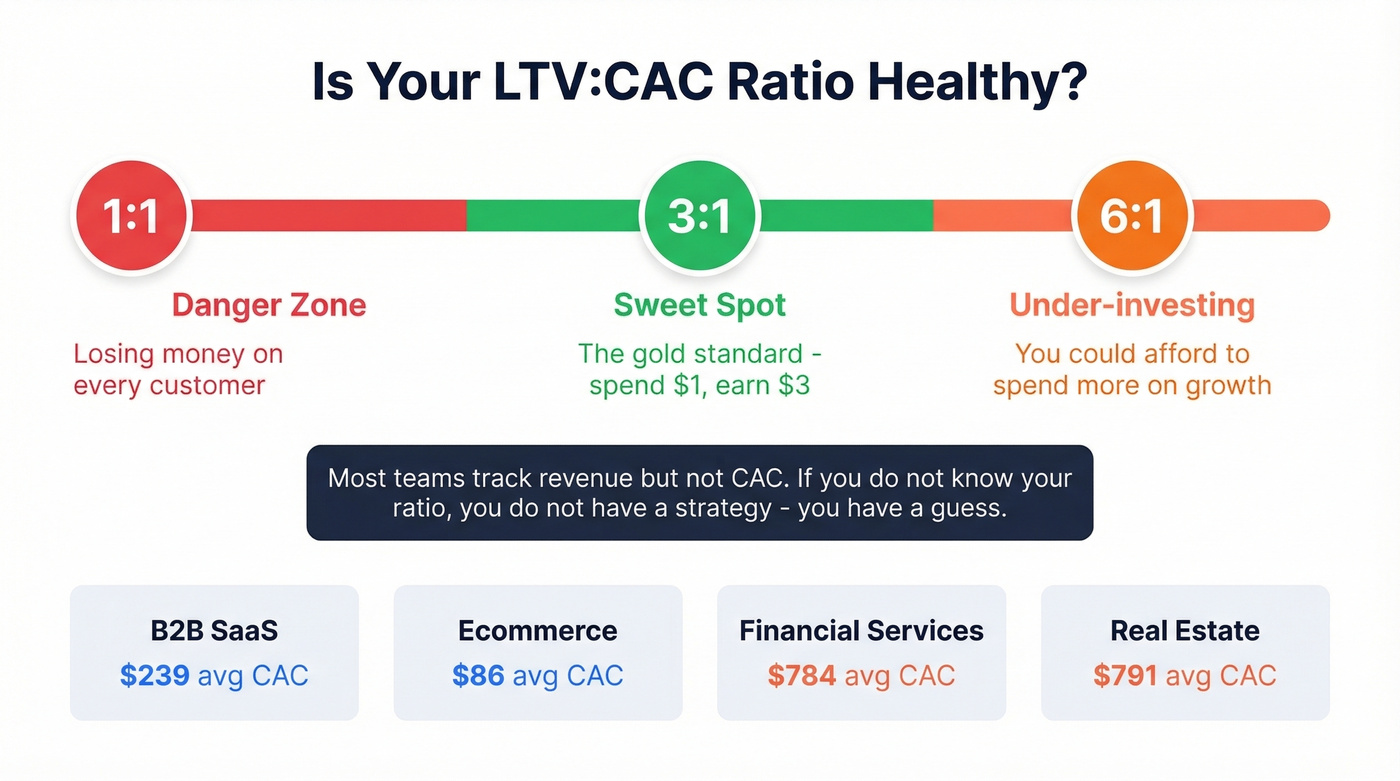
| Industry | Organic CAC | Paid CAC | Combined |
|---|---|---|---|
| B2B SaaS | $205 | $341 | $239 |
| Ecommerce | $87 | $81 | $86 |
| Financial Services | $644 | $1,202 | $784 |
| Real Estate | $660 | $1,185 | $791 |
Data via HubSpot/FirstPageSage benchmarks, updated for 2026. Benchmarks vary by methodology.
The health benchmark everyone should memorize: a 3:1 LTV:CAC ratio. For every dollar you spend acquiring a customer, you should generate three dollars in lifetime value. If your ratio exceeds 6:1, you're actually under-investing - leaving money on the table by not spending more aggressively on acquisition.
Here's the thing: most teams track revenue but not CAC. They celebrate a new customer without knowing whether that customer cost $86 or $800 to acquire. That's not a strategy. That's gambling with a spreadsheet. (funnel metrics)
Which Channels Deliver Real ROI
Not all channels are created equal. We've pulled together ROI data from FirstPageSage's channel rankings, and the results aren't what most marketers expect.
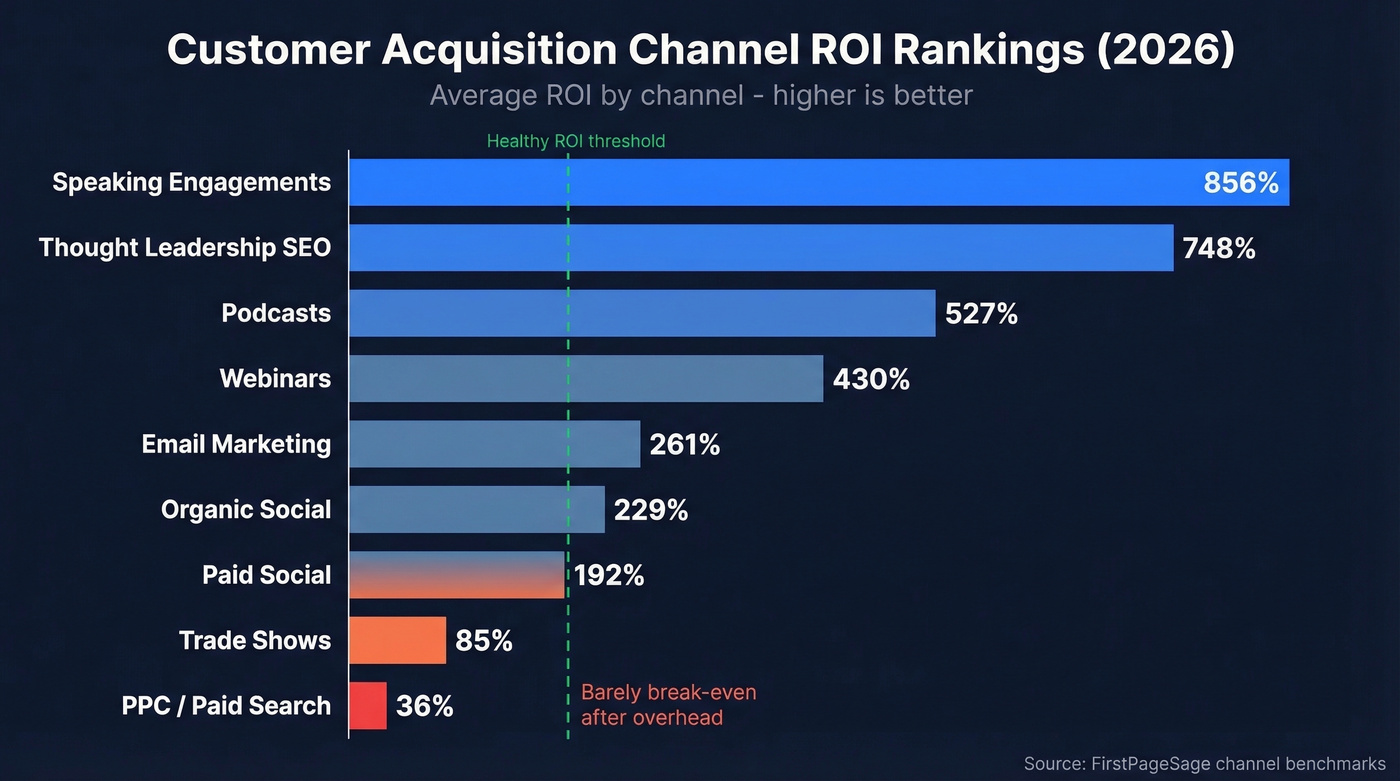
| Channel | Avg ROI |
|---|---|
| Speaking engagements | 856% |
| Thought leadership SEO | 748% |
| Podcasts | 527% |
| Webinars | 430% |
| Email marketing | 261% |
| Organic social | 229% |
| Paid social | 192% |
| Trade shows | 85% |
| PPC | 36% |
And here's what each channel costs per acquired customer:
| Channel | Avg CAC |
|---|---|
| Referral programs | $150 |
| Organic SEO | $290 |
| Facebook Ads | $230 |
| Paid Search (B2B) | $802 |
| LinkedIn Ads | $982 |
| Outbound sales | $1,980 |
PPC is the most overrated channel in acquisition marketing. A 36% ROI means for every dollar you spend, you get back $1.36. After overhead, that's barely break-even. Yet it's where most teams dump their first budget because it feels measurable.
For teams allocating budget, two templates that work:
Startup B2B: SEO 60% / PPC 20% / Email 15% / Organic social 5%
Small B2C: SEO 50% / Email 20% / Organic social 20% / Paid social 10%
SEO and email dominate every sensible budget allocation. Paid channels are supplements, not foundations.
12 Proven Ways to Find New Customers
1. Referral Programs
A RevOps lead we know built a double-sided referral program in two weeks using nothing but a landing page and a $50 gift card incentive. Within 90 days it was their lowest-CAC channel at $150 per customer. (lead generation metrics)
The data backs this up. People are 90% more likely to buy from a recommendation than from an ad. Referred customers carry 16% higher lifetime value and 37% better retention. Dropbox grew 3,900% largely on the back of its referral program, and Robinhood collected 1 million users before launch through a referral waitlist alone.
The structure that works: reward both the referrer and the referee. Make the incentive tangible and immediate - credits, discounts, or cash.
2. Thought Leadership SEO
At 748% ROI, thought leadership SEO is the highest-return channel that doesn't require you to physically show up somewhere. The key word is "thought leadership" - not just SEO. Publishing thin, keyword-stuffed pages won't cut it. Create content that answers real questions with genuine expertise, and the compound returns build over months. (B2B content marketing)
We've seen teams generate more pipeline from a single well-researched guide than from a quarter of paid ads. The catch is patience. SEO takes a few months to compound. But once it does, the CAC drops every month as existing content keeps pulling in traffic without additional spend.
3. Email Marketing & Nurture Sequences
Email delivers 261% ROI and remains the most controllable channel you own. The sequence structure that converts: welcome email, then value-driven content, then a case study or social proof, then a clear offer. Personalized CTAs drive 202% better conversions than generic ones, so segment your list from day one. (email copywriting)
Even basic segmentation by industry or company size dramatically improves open and reply rates. Don't blast your entire database with the same message.
4. Outbound Prospecting
Outbound has the highest CAC of any channel at $1,980 for B2B. But the cost isn't in the tooling or the reps - it's in the bad data. (sales prospecting techniques)
High bounce rates don't just waste sends. They damage your domain reputation, and once deliverability drops, even your good emails land in spam. We've watched teams burn through three domains in a quarter because they skipped verification. (email deliverability)
Prospeo's 5-step verification process delivers 98% email accuracy across 143M+ verified emails, all refreshed on a 7-day cycle. At roughly $0.01 per lead vs roughly $1 per lead with legacy providers, it's 90% cheaper than ZoomInfo. The Meritt team saw their bounce rate drop from 35% to under 4% while pipeline tripled to $300K per week.

5. Partnerships
Co-webinars, newsletter swaps, and bundled offers with complementary businesses let you tap into someone else's audience without paying for ads. A CRM company partnering with an email tool, for instance, creates obvious cross-sell value for both audiences. The best partnerships feel like a natural extension of both brands.
If you're wondering how to attract customers without a massive ad budget, strategic partnerships are one of the most underused levers available.
6. Social Media (Platform-Specific)
Platform selection matters more than posting frequency. B2B teams should focus on professional networks for thought leadership. B2C brands get more traction on Instagram, TikTok, and YouTube Shorts. Consistent posting for 100 days beats sporadic campaign bursts - it's one of the simplest ways to build momentum when you don't have budget.
7. Webinars & Virtual Events
At 430% ROI, webinars punch well above their weight. Lead with genuine value rather than a thinly disguised sales pitch. Gate registration with a simple form - name and email is enough. Follow up within 24 hours while the content is fresh.
8. Online Reviews & Reputation
For B2B, G2 and Capterra reviews directly influence buying decisions. For B2C, Google Reviews and Yelp drive local discovery. A strong but imperfect rating often looks more credible than suspiciously perfect reviews - ask for reviews immediately after a positive interaction, and respond to every review, positive or negative.
9. Local SEO / Google Business Profile
For service businesses, this is non-negotiable. Claim and fully optimize your Google Business Profile with photos, accurate hours, complete categories, and Q&A. Post updates regularly and keep the profile active. Local SEO is one of the most reliable ways to bring customers to your business when you serve a specific geography.
10. Community Building
Show up where your customers already gather - Reddit, Slack communities, industry forums, local meetups. Lead with value and expertise, not pitching. The customers come when you've earned credibility. The consensus on r/Entrepreneur and r/SaaS is consistent: people buy from people they've seen genuinely helping others, not from people who show up with a pitch on day one.
11. Paid Advertising
Use this for: testing new messaging, retargeting warm audiences, and short-term demand spikes.
Skip this as your primary acquisition channel. At 36% ROI and Google Ads CPL that hit $70+ and continues rising, it's a supplement - not a strategy. If your organic engine isn't running yet, paid can buy you time, but it shouldn't be the plan.
12. Customer Service as Acquisition
This one gets overlooked constantly. Exceptional customer service generates referrals without a formal program. Every support interaction is a chance to create a story someone tells their network. Support isn't just a cost center - it's an acquisition channel.

Your CAC is only as good as your data. Bad emails mean wasted sends, burned domains, and inflated acquisition costs. Prospeo delivers 98% email accuracy across 143M+ verified contacts - refreshed every 7 days - at $0.01 per lead. Teams using Prospeo book 26% more meetings than ZoomInfo users.
Cut your outbound CAC by 90% without sacrificing accuracy.
Acquiring Customers: B2B vs B2C
The tactics above work for both B2B and B2C, but the execution differs significantly.
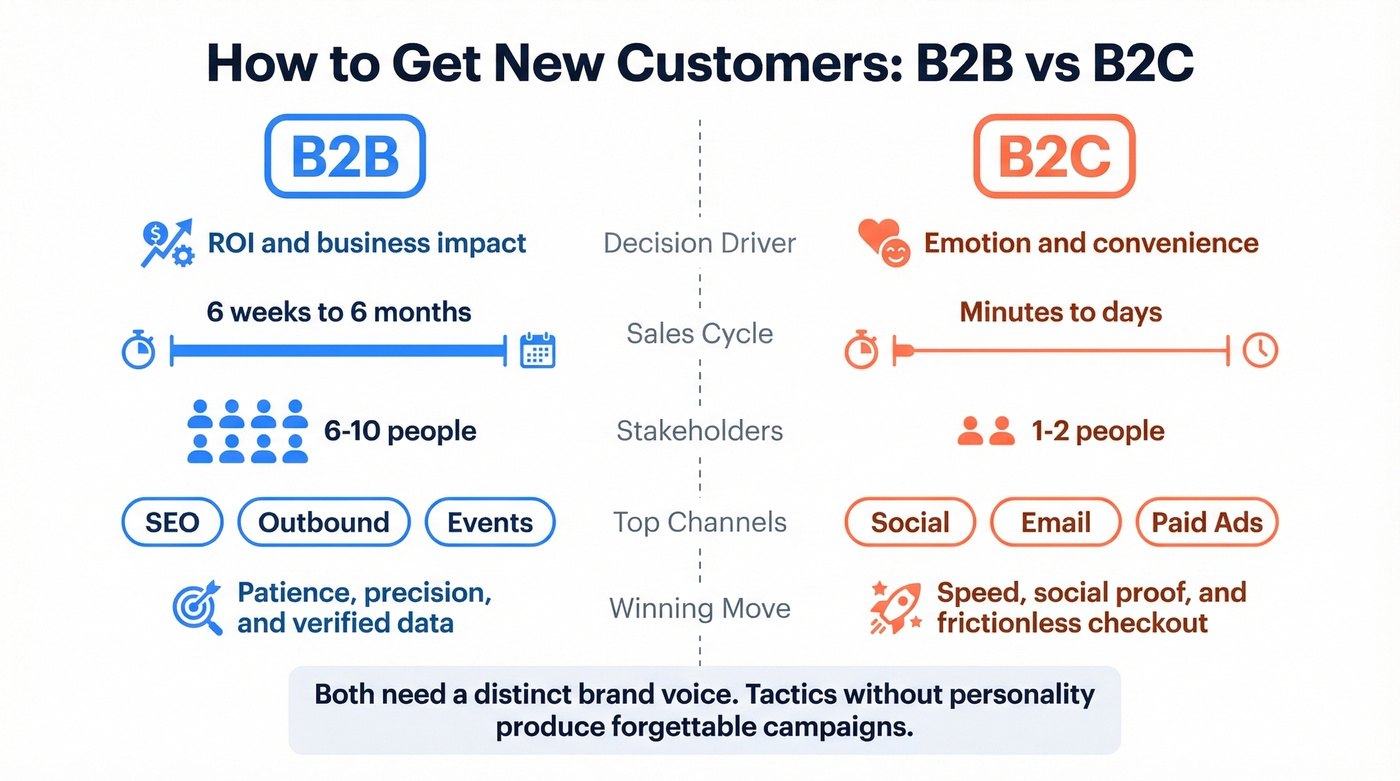
| Factor | B2B | B2C |
|---|---|---|
| Decision driver | ROI & business impact | Emotion & convenience |
| Cycle length | Weeks to months | Minutes to days |
| Stakeholders | 6-10 people | 1-2 people |
| Top channels | SEO + outbound + events | Social + email + paid |
| Relationship | Long-term partnership | Transactional |
For B2B, lead nurturing is essential because you're building consensus across multiple stakeholders. Content marketing, case studies, and outbound with verified data are the core engine - the sales cycle rewards patience and precision. (B2B sales)
For B2C, speed and emotional resonance win. Social proof, influencer partnerships, and frictionless checkout matter more than white papers. Email sequences should be shorter and more offer-driven.
Let's be honest: most acquisition advice ignores brand personality entirely. Tactics without a distinct voice produce forgettable campaigns. The companies winning new customers in 2026 aren't just optimizing channels - they're telling stories that make people care enough to buy.
Landing Your First 100 Customers
If you're pre-revenue or early-stage, the playbook looks different. Your first 20-30 customers almost certainly come from your personal network - people who already know and trust you.
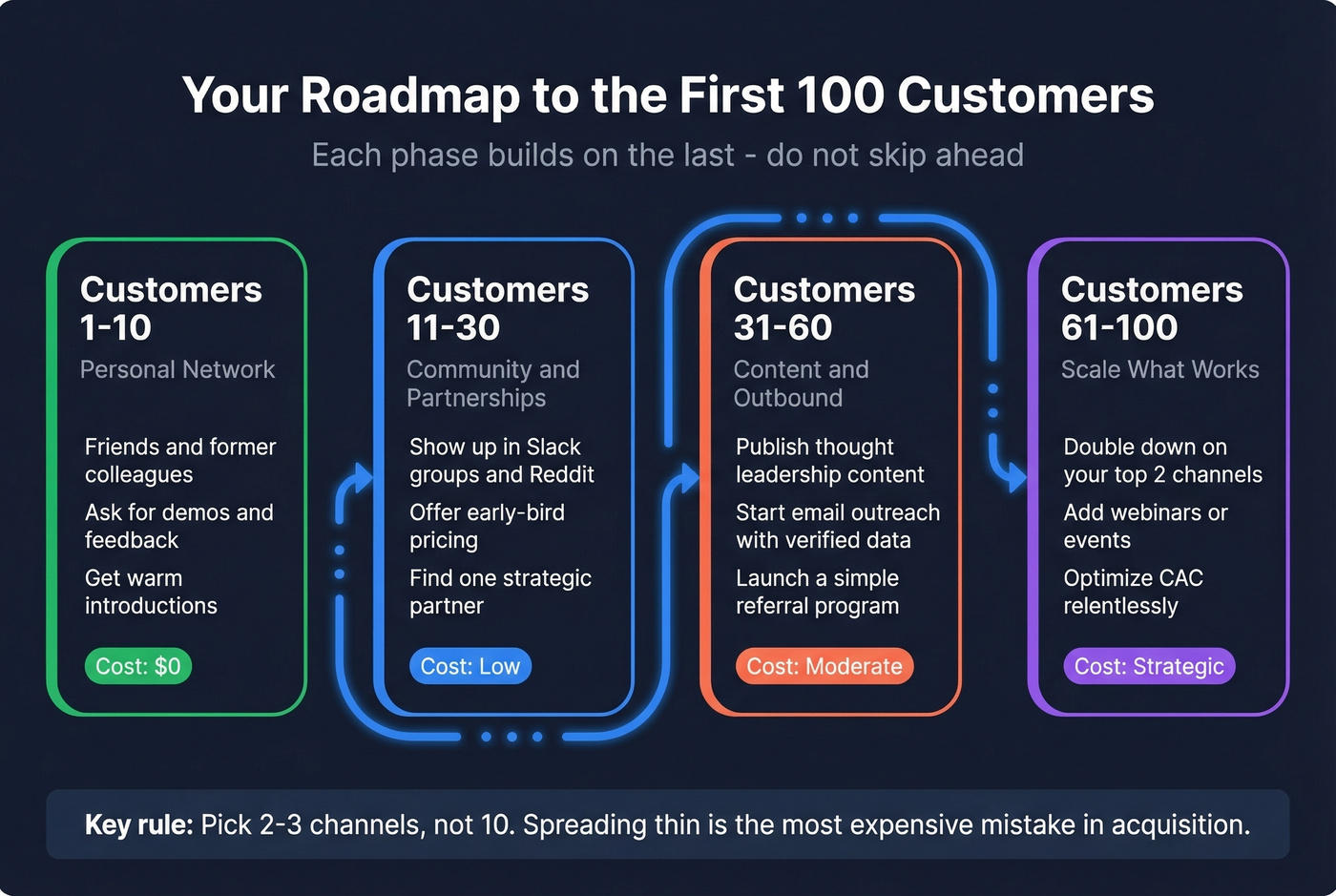
- Personal network first. Friends, former colleagues, industry contacts. Ask for feedback, demos, and introductions - not just sales.
- Create a clear offer. Early-bird pricing or founder's club access gives people a reason to act now.
- Show up where customers gather. Online communities, industry events, Slack groups. Lead with value.
- Build partnerships early. Co-webinars and newsletter swaps extend your reach without ad spend.
- Turn early users into advocates. A simple referral pathway - even just "tell a friend" with a small incentive - compounds quickly.
For SaaS specifically, the scrappy checklist from r/SaaS founders: list on Product Hunt, BetaList, and every relevant directory. Post consistently on social media for 100 days. Spy on competitors' listings and replicate their placements. Run small-budget paid tests at $5-10/day on multiple platforms. When you're a new business, gaining traction comes down to hustle and iteration more than budget.
Acquisition Mistakes That Burn Money
Five mistakes we see repeatedly - all preventable:
Targeting everyone instead of a niche. "Our product is for anyone who..." is the most expensive sentence in marketing. Define your ideal customer with painful specificity. One case study showed buyer personas drove a 900% increase in time on site and 171% lift in marketing revenue. (ideal customer)
Same message for all audiences. A VP of Engineering and a CMO care about completely different things. Role-specific messaging is the difference between a 2% and a 15% reply rate.
No feedback loop. You're being reviewed all the time, whether you know it or not. Build systematic feedback collection into every customer touchpoint. Secret-shop your own buying experience quarterly.
Ignoring personalization. 71% of buyers expect personalized interactions, and 76% get frustrated when it doesn't happen. Companies strong at personalization generate 40% more revenue. This isn't a nice-to-have anymore. (personalized outreach)
Using unverified contact data. Bad emails trigger spam traps and honeypots that tank your domain reputation. A 5-step verification process that includes spam-trap removal, honeypot filtering, and catch-all domain handling catches these before they hit your sequences - and it's the difference between a 35% bounce rate and a sub-4% one. (spam trap removal)
For context, 19% of startups fail because they're outcompeted and 14% fail due to poor marketing. Most of that poor marketing traces back to these five mistakes.
The 2026 Edge: AI and Personalization
AI in acquisition has shifted from experimentation to copilot mode. We're moving from scheduled workflows to self-optimizing orchestration that adapts across channels in real time. Personalized CTAs already drive 202% better conversions than generic ones, and the gap between companies that use AI for personalization and those that don't is widening every quarter.
Practical steps to stay ahead: integrate AI tools with your CRM and email platform, train models on first-party data rather than third-party lists that decay, and maintain human QA on every automated touchpoint. Privacy-first data - zero-party and first-party - is becoming a competitive advantage as third-party cookies disappear and regulations tighten.
The teams winning in 2026 aren't the ones with the biggest budgets. They're the ones with the cleanest data, the most relevant messaging, and the discipline to focus on two or three channels instead of ten. That's how to get new customers - not by doing more, but by doing less with better data.
The Meritt team tripled pipeline from $100K to $300K/week and dropped bounce rates from 35% to under 4% - same team, same effort, better data. With 300M+ profiles, 30+ search filters, and 125M+ verified mobile numbers, Prospeo gives you every channel to reach new customers without burning budget on bad contacts.
Find new customers faster with data you can actually trust.
FAQ
What's a good customer acquisition cost?
The universal benchmark is a 3:1 LTV:CAC ratio. B2B SaaS averages $239 combined, ecommerce around $86. If your ratio exceeds 6:1, you're under-investing and should spend more aggressively on growth.
What's the fastest way to get new customers?
Referral programs and paid ads deliver the fastest results. Referrals carry the lowest B2B SaaS CAC at $150 and produce customers with 37% better retention. Paid ads are fast but expensive - $230+ per customer on Facebook, $800+ per customer on Google for B2B.
How do I attract customers with no budget?
Start with your personal network, then list on free directories like Product Hunt and BetaList. Post consistently on social media for 100 days and build partnerships with complementary businesses for cross-promotion.
Is cold outreach still effective in 2026?
Yes, but only with verified data and personalized messaging. Outbound's high CAC ($1,980 for B2B) comes mostly from bounced emails destroying domain reputation. Using 98%-accurate emails on a 7-day refresh cycle cuts that cost dramatically - the Meritt team tripled pipeline while dropping bounce rates below 4%.
How do you get customers when entering a new market?
Research where your ideal buyers already spend time online, then validate messaging with a small test audience. Double down on the one or two channels showing early traction. Measure CAC from day one so you know whether your approach is sustainable before scaling spend.