

How to Write a Cold Email That Actually Gets Replies
You sent 500 emails last month. A handful of opens, one polite "not interested," and a whole lot of silence. Now you're half-convinced cold email is dead.
It's not - 61% of decision makers still prefer it over every other outreach channel. But 71% of those same people ignore cold emails that aren't relevant to them. Learning how to write a cold email that bridges that gap has almost nothing to do with clever copywriting and everything to do with data, infrastructure, and offer specificity.
The Short Version
- Fix your list first. Verified emails, bounce rate under 2%. Everything else is wasted effort if you're landing in spam. (If you’re picking a stack, start with these cold email marketing tools.)
- Write 60 words or fewer with a specific, low-friction offer. Not a meeting request - a deliverable. If you need options, use proven B2B cold email templates.
- Send 2-3 follow-ups that read like replies, not marketing sequences with countdown timers. (More on cold email follow up strategy.)
The benchmark worth remembering: average cold email reply rate is 3.43%. Top performers hit 10.7%+. The difference isn't wordsmithing - it's data quality, offer specificity, and infrastructure.
2026 Cold Email Benchmarks
Numbers first, opinions second. Here's where the bar sits right now, based on Instantly's analysis of billions of cold email interactions:
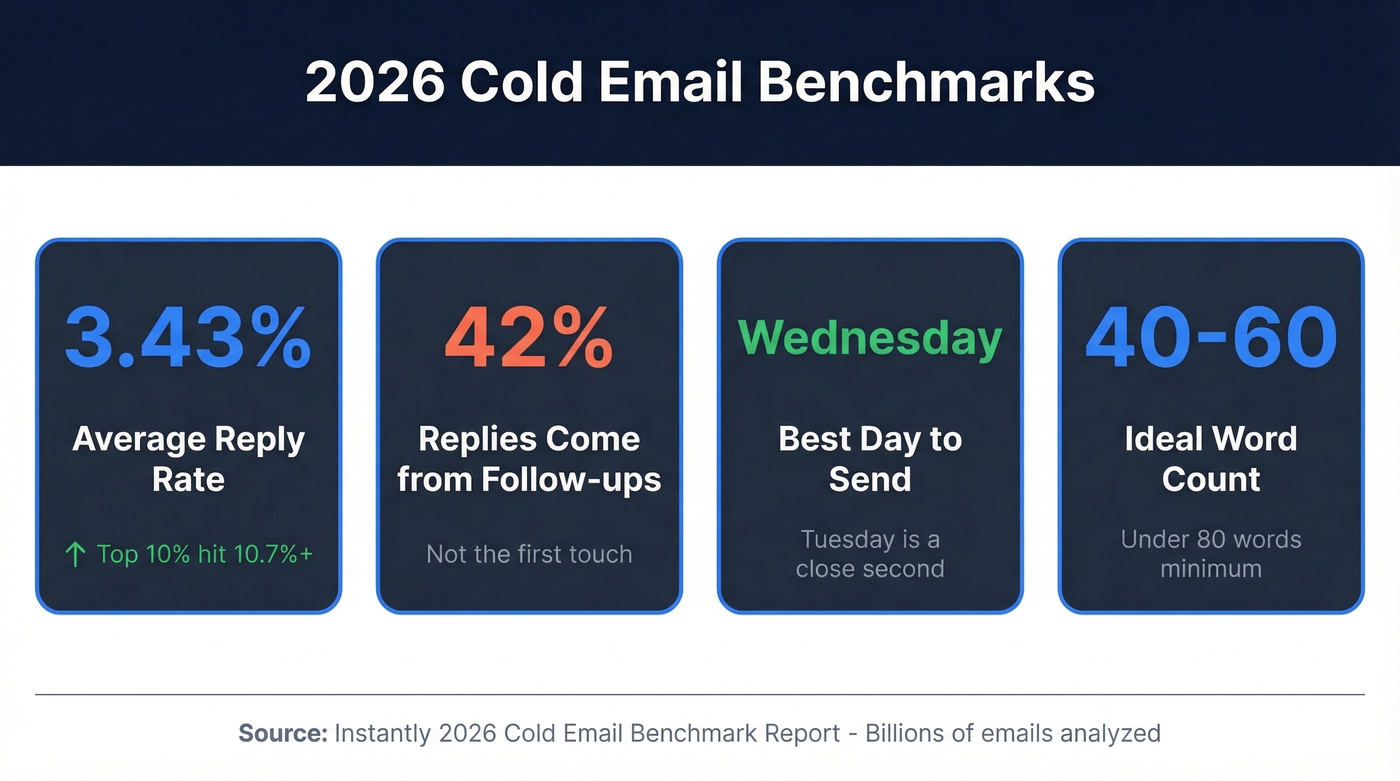
| Metric | Average | Top Quartile | Top 10% |
|---|---|---|---|
| Reply rate | 3.43% | 5.5%+ | 10.7%+ |
| Follow-up share of replies | 42% | - | - |
| Best days for replies | Tue-Wed | Wednesday | Wednesday |
| Email length (guideline) | Under 80 words | Under 80 words | 40-60 words |
Average B2B cold email open rate sits around 27.7%. That means roughly one in four people see your email. If your reply rate is below 3%, the problem isn't opens - it's what happens after the open. (Compare your numbers against cold email open rate benchmarks.)
Wednesday is consistently the best day across large datasets. Tuesday is close behind. Plenty of practitioners still do well Tue-Thu, but Wednesday is the safest bet if you're picking one day. If you want the deeper breakdown, see the best days to send cold emails data.
Here's the stat that should reshape your entire follow-up strategy: 42% of all replies come from follow-up emails, not the first touch. If you're sending one email and moving on, you're leaving almost half your replies on the table.
The 60-Word Cold Email Formula
Most cold emails fail because they're too long, too vague, and ask for too much. The practitioners on r/copywriting and r/Entrepreneur who are actually getting replies have converged on the same format - absurdly short emails with a specific offer and a soft CTA. It's the classic AIDA framework) (Attention, Interest, Desire, Action) compressed into 60 words. (This aligns with the broader cold email format patterns that consistently win.)
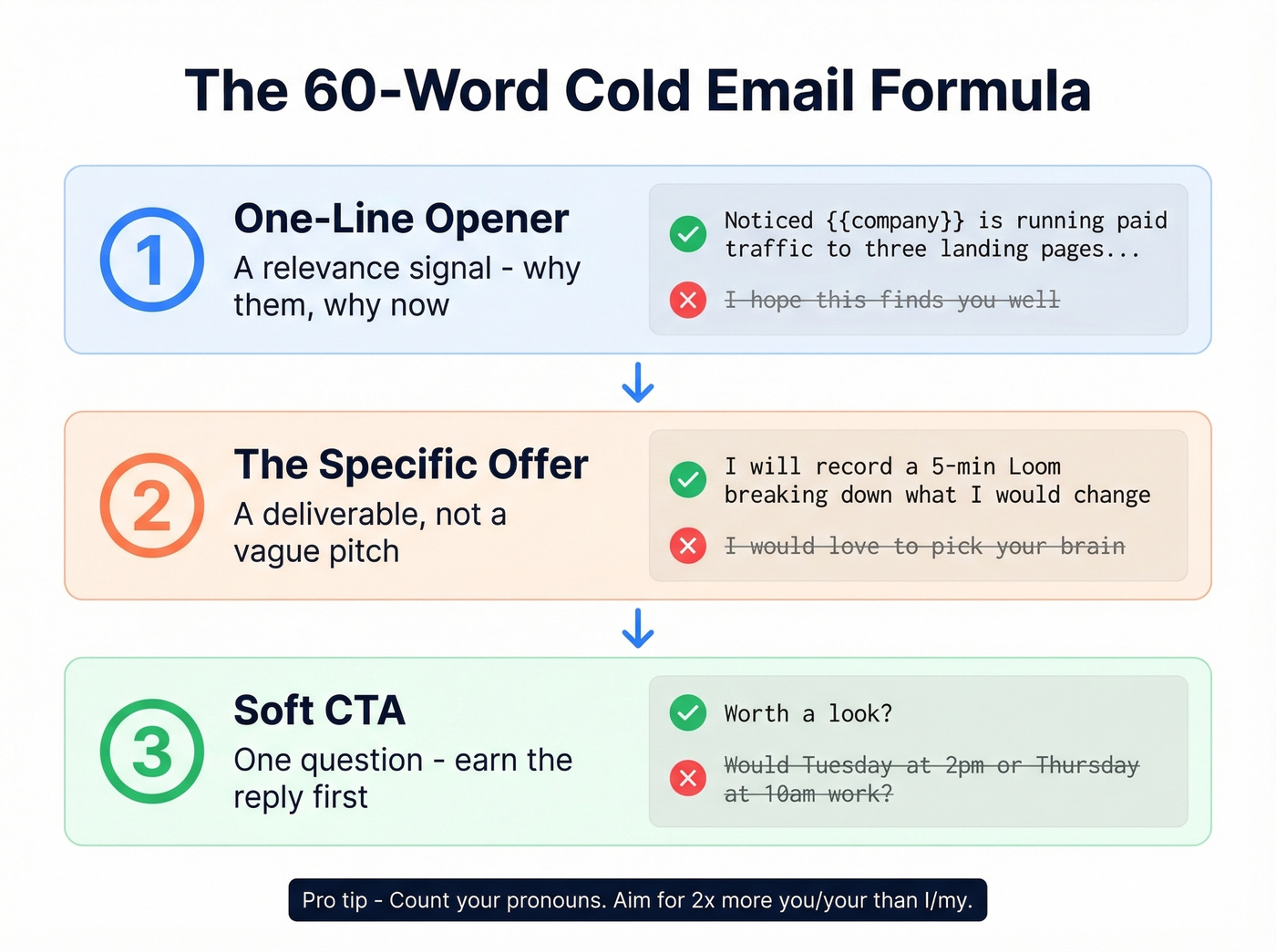
One-line opener - a relevance signal. Why them, why now. Not "I hope this finds you well." Something that proves you didn't blast 10,000 people with the same template. If you’re stuck, borrow from these cold email icebreakers.
The offer - a specific deliverable, not a vague "I'd love to pick your brain." Think: "I'll audit your top 3 landing pages and send a Loom with fixes." That's concrete. That's low-friction. That's something the recipient can evaluate in five seconds.
Soft CTA - one question. "Worth a conversation?" or just "Interested?" No calendar links. No "Would Tuesday at 2pm or Thursday at 10am work better?" Earn the reply first. (If you do need meeting language, use these meeting request email examples instead of guessing.)
Quick self-check before you hit send: count your pronouns. You should have roughly twice as many "you/your" as "I/my." If the ratio is inverted, you're talking about yourself, not solving their problem.
Here's what that looks like assembled:
Subject: quick loom for {{company}}
Hi {{first_name}},
Noticed {{company}} is running paid traffic to three landing pages that don't have social proof above the fold. That's often a missed conversion lever.
I'll record a 5-minute Loom breaking down what I'd change - no strings. If the ideas are useful, we can talk about working together.
Worth a look?
{{your name}}
The opener is specific (paid traffic + landing pages). The offer is a deliverable (Loom audit). The CTA is frictionless. Stop asking for meetings in the first email. Nobody wants to give 30 minutes to a stranger. Give them something valuable first, and the meeting earns itself.
Subject Lines That Earn the Open
An analysis of 85M+ cold emails found that the best-performing subject lines follow a few consistent patterns. If you want to test variations quickly, use a dedicated subject line tester.
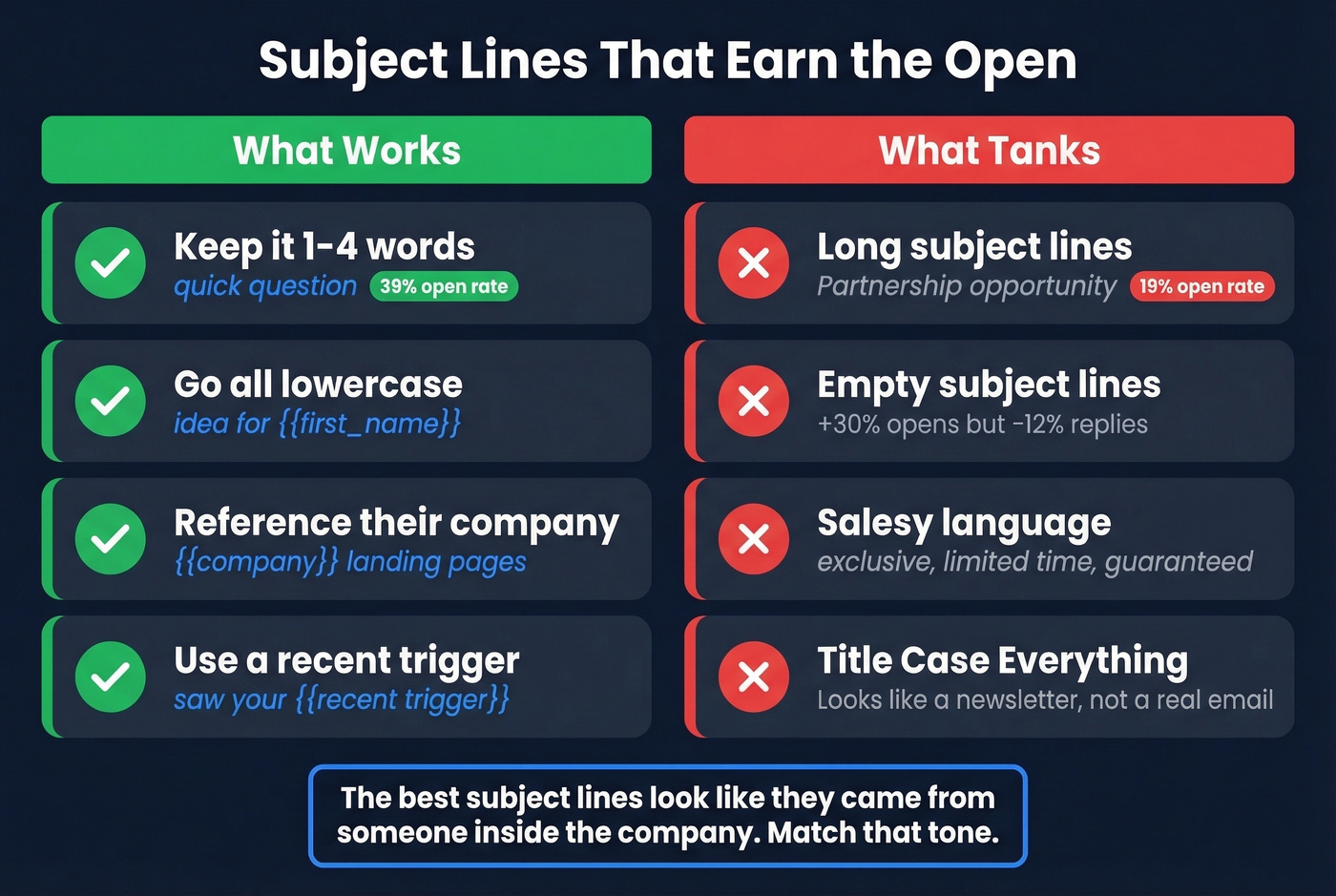
Keep it to 1-4 words. Shorter subject lines outperform longer ones consistently. "Quick question" pulled 39% opens in one Reddit case study. "Partnership opportunity" got under 19%. The shorter line wins because it looks like a real email from a real person - not a newsletter.
Go lowercase. All-lowercase subject lines have the highest open rates. Proper nouns are the exception, but drop the title case. "quick question about {{company}}" beats "Quick Question About {{Company}}."
Skip the gimmicks. Empty subject lines boost opens by ~30% but tank reply rates by 12%. Salesy language ("exclusive," "limited time," "guaranteed") reduces opens by up to 17.9%. If it sounds like marketing, it gets treated like marketing.
A few subject lines that consistently work:
quick question{{company}} landing pagesidea for {{first_name}}saw your {{recent trigger}}
The best subject lines look like they came from someone inside the company. Match that tone.

The 60-word formula only works when it reaches a real inbox. Prospeo's 98% email accuracy and under-2% bounce rates mean your carefully crafted cold emails land where they belong - not in spam. 15,000+ teams use Prospeo to build verified lists before they write a single word.
Fix your list first. Start with 75 free verified emails.
Deliverability - The Part Everyone Skips
Here's the thing: you can craft a perfect cold email with a killer subject line, and none of it matters if your messages land in spam. Deliverability is the unglamorous foundation that separates the 3% reply rate crowd from the 10%+ crowd. (If you want the full system view, start with cold email infrastructure.)
Infrastructure Non-Negotiables
Authentication: Configure SPF, DKIM, and DMARC on every sending domain. Start DMARC with p=none for monitoring, then tighten. Set up a custom tracking domain like track.yourcompanyhq.com - shared tracking domains pool your reputation with thousands of other senders.
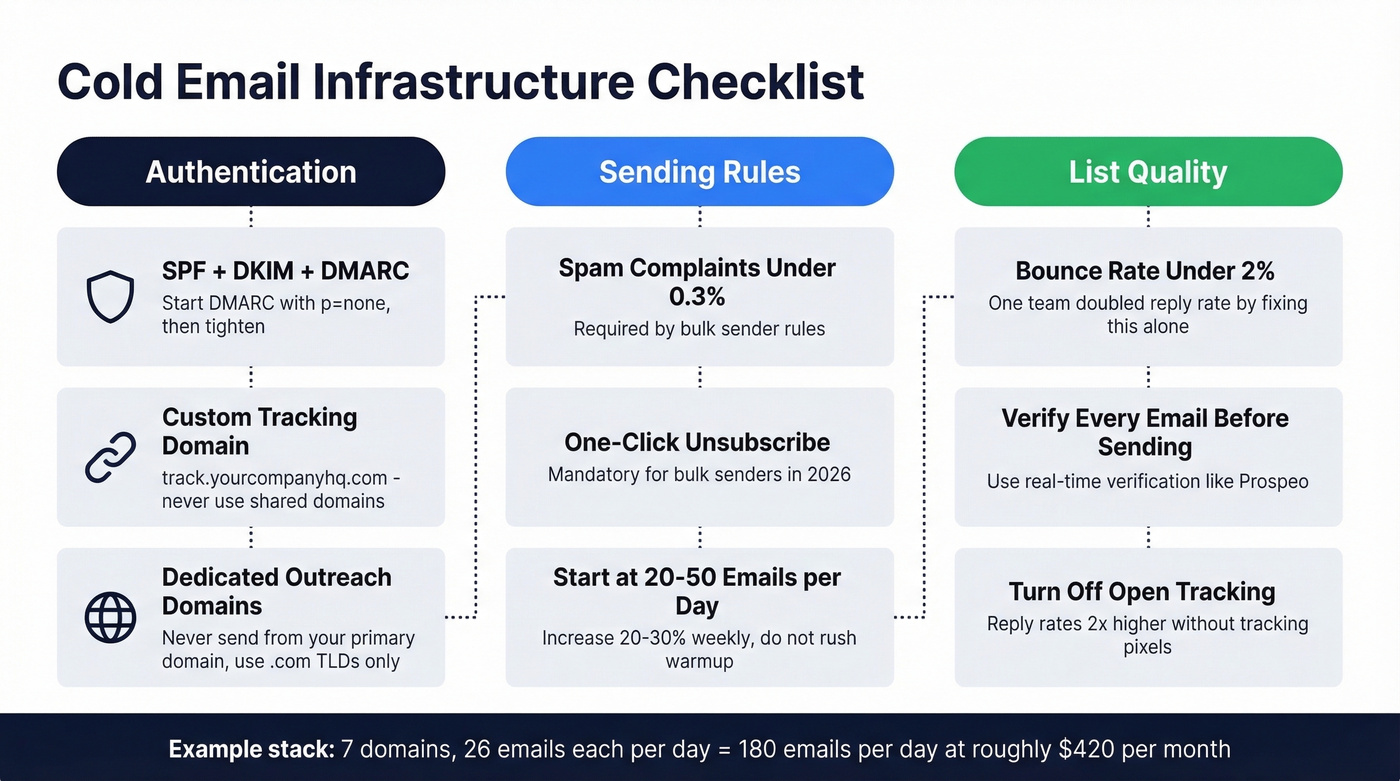
Domain strategy: Never send from your primary domain. Register dedicated outreach domains - brand-adjacent variants like yourcompanyhq.com or getyourcompany.com - and redirect them to your main site. Use multiple domains to distribute volume. One Reddit practitioner went from 3 domains to 7, each sending max 26 emails/day, totaling ~180 emails/day with minimal risk per domain. Stick with .com TLDs. Cheap-looking alternatives can come off spammy. (If you need a step-by-step, follow this cold email domain setup guide.)
Sending rules: Keep spam complaint rate under 0.3% (part of the newer bulk sender rules). Include a one-click unsubscribe in every email - it's a bulk sender requirement now. Prefer plain text with one link maximum: no images, no heavy HTML, no URL shorteners. Start new domains at 20-50 emails/day and increase volume 20-30% weekly. Don't rush warmup.
For reference, one practitioner documented their full outbound stack - 7 domains, verification, sending tool - at roughly $420/month, generating 16 qualified leads. Cold email infrastructure isn't free, but it's dramatically cheaper than most outbound channels.
List Quality Is the Multiplier
We've seen teams obsess over subject line A/B tests while sending to lists with 11% bounce rates. That's like optimizing the paint job on a car with no engine.
One practitioner on r/Entrepreneur documented cutting their bounce rate from 11% to under 2% - and their reply rate doubled from 3% to 6% over 62 days. List quality was the single change that made every other optimization actually work.
Let's be honest about something most cold email guides skip entirely: stop optimizing subject lines before you fix deliverability and list quality. A mediocre email sent to a clean, verified list will outperform a brilliant email sent to a dirty one every single time. I've watched teams spend weeks A/B testing copy when their bounce rate was above 8%. That's not optimization - it's rearranging deck chairs. (If you’re troubleshooting, start with these cold email mistakes.)

Run your list through a real-time verification tool like Prospeo before sending - 98% email accuracy and a 7-day data refresh cycle keep bounce rates under control. The free tier gives you 75 emails/month to test the workflow before committing.
Two more data points worth acting on. Emails from custom domains get almost 2x the reply rate compared to generic Gmail addresses. And turning off open tracking more than doubled reply rates in a study of 44M emails - 2.36% vs 1.08%. Open tracking pixels hurt deliverability more than the vanity metric is worth. Kill them for cold outreach.
Follow-Up Sequences That Don't Annoy
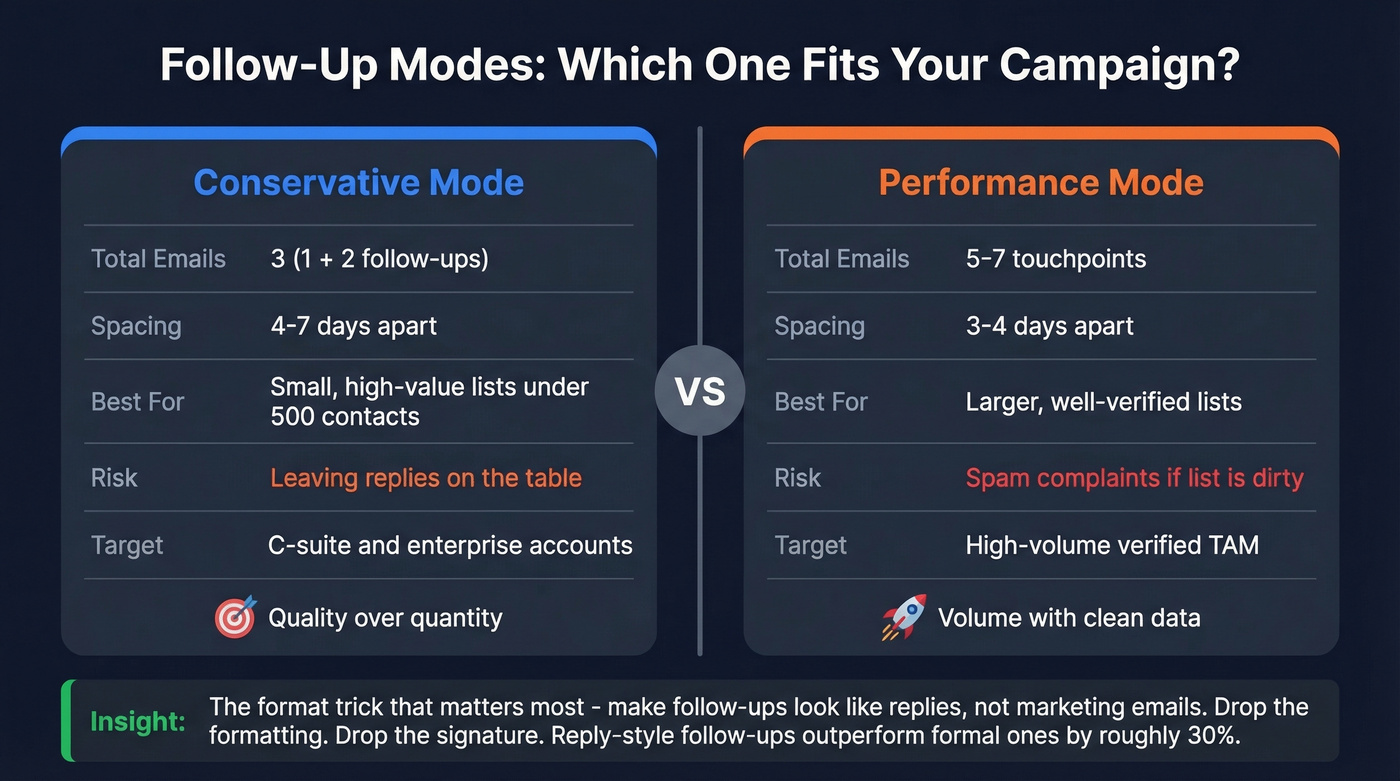
There's a genuine debate in the cold email world about follow-up cadence. Here are the two schools:
| Conservative Mode | Performance Mode | |
|---|---|---|
| Total emails | 3 (1 + 2 follow-ups) | 5-7 touchpoints |
| Spacing | 4-7 days apart | 3-4 days apart |
| Best for | Small, high-value lists | Larger, well-verified lists |
| Risk | Leaving replies on the table | Spam complaints if list is dirty |
| Recommended for | C-suite / enterprise targets | High-volume, verified TAM |
Conservative mode makes sense when your list is under 500 contacts and each prospect is high-value. We've tested both approaches, and two great follow-ups beat ten annoying ones when you're targeting senior executives at enterprise accounts.
Performance mode works when you've verified every email, your bounce rate is under 2%, and you're working a larger TAM. Instantly's data shows the 4-7 touchpoint sweet spot works - but only when infrastructure is solid. (Use these cold email sequence examples to model your cadence.)
The format trick that matters most: make your follow-up look like a reply, not a new marketing email. Drop the formatting. Drop the signature block. Just write two sentences like you're bumping a thread with a colleague. That "reply-like" approach outperforms formal follow-ups by roughly 30%.
Personalization That Scales
Personalization isn't a strategy. A specific, low-friction offer is the strategy. Personalization is just the wrapper that gets the offer noticed. (If you’re tooling up, these email personalization tools can help.)
The data backs a restrained approach. Reply rates drop significantly when segmented lists exceed 100 people - so keep your segments tight. Using more than 5 personalization variables per email actually backfires. The email starts reading like a mail merge gone wrong.
The workflow that's actually working for teams at scale: scrape a recent signal (job change, funding round, new hire, published content), generate a custom first line using AI, then export the custom lines to a CSV column and map it to a {{custom_message}} variable in your sending tool. One Reddit practitioner reported ~3x response improvement with this approach versus static templates.
Here's the critical nuance: AI can generate your first line, but the offer still needs to be genuinely specific. Recipients can smell a GPT-generated email that was personalized with scraped data but has no real insight behind it. The AI "uncanny valley" is real in cold email - a perfectly polished email that says nothing specific reads worse than a rough email with a genuinely useful observation. Signal-based personalization works because you're reacting to something the prospect actually did, not stuffing their company name into five different sentences.
Cold Email Examples That Work
Every example below follows the opener, offer, soft CTA structure. The first two are annotated; the rest let the pattern speak for itself. (For more variations, see these cold email examples.)
Sales Intro (Annotated)
Hi {{first_name}},
[Opener] Saw {{company}} just expanded the SDR team - congrats. That usually means outbound infrastructure needs to scale fast.
[Offer] We helped a similar-stage SaaS company cut their bounce rate from 12% to under 3% and double reply rates in 60 days. Happy to share the exact playbook.
[CTA] Worth a quick look?
Agency Pitch (Annotated)
Hi {{first_name}},
[Opener] Your Google Ads are sending traffic to a page with no testimonials above the fold.
[Offer] I'll mock up a revised layout with social proof placement and send it over - takes me 20 minutes, zero obligation.
[CTA] Interested?
Before & After: Founder-to-Founder
Most founder emails open with three paragraphs of backstory. The best cold emails cut to the signal:
| Before (142 words) | After (52 words) |
|---|---|
| "Hi, my name is Alex and I'm the founder of... We've been working on a platform that... I noticed your company is in a similar space and I thought it would be great to connect because..." | "Hi {{first_name}}, Fellow founder here. Noticed you're hiring your first AE - exciting stage. We built a cold outreach playbook that got us from $0 to $80K MRR without a single SDR. Happy to share the doc. Want me to send it over?" |
The after version is specific, generous, and asks for almost nothing.
Two More Quick Templates
Partnership request: "Your audience overlaps heavily with ours - we both serve B2B SaaS RevOps teams. I'd love to co-create a short benchmarking report. We bring the data, you bring the distribution. Worth exploring?"
Freelance inquiry: "Your blog hasn't published in 6 weeks, but your product just shipped a major update. I'll draft a 1,200-word launch post and send it for free. If you like it, we talk about a retainer. Sound fair?"
Notice the pattern across all five: every email gives something before asking for anything. The offer is the engine. The copy is just the delivery mechanism.
Pro tip from CopyHackers: build a swipe file of cold emails you actually replied to. Reverse-engineer why they worked - that's your best template library, and it's more honest than any "top 10 templates" blog post.
This article proves it: 42% of cold email replies come from follow-ups, and bad data kills every sequence before it starts. Prospeo refreshes every record on a 7-day cycle - so the prospect who ignored email one still has a valid address when email three lands. At $0.01 per verified email, clean data costs less than one wasted send.
Stop writing perfect emails to dead addresses.
FAQ
How long should a cold email be?
Under 80 words - ideally 40-60. Top-performing campaigns consistently stay in that range. Cut anything that doesn't directly support your offer or CTA. If a sentence doesn't earn the reply, it's dead weight.
What's a good cold email reply rate?
The average is 3.43%, top quartile hits 5.5%+, and the top 10% reach 10.7%+. If you're below 3%, fix list quality and offer specificity before touching copy. Clean, verified data matters more than wordsmithing.
Should I use open tracking?
No. Data from 44M emails shows disabling open tracking more than doubled reply rates - 2.36% vs 1.08%. Tracking pixels hurt deliverability more than the vanity metric is worth.
How do I verify emails before sending?
Use a real-time verification tool to check every address before it enters your sequence. Target a bounce rate under 2%. Anything higher damages sender reputation and tanks deliverability across your entire domain.
When's the best time to send?
Tuesday through Thursday, 8-11 a.m. in the recipient's timezone. Wednesday consistently shows the highest reply rates across large datasets. Avoid Monday mornings and Friday afternoons - your email will get buried.