

How to Write a Follow-Up Email That Actually Gets a Reply
You sent an email three days ago. No reply. Now you're staring at your inbox wondering if you should follow up or let it die.
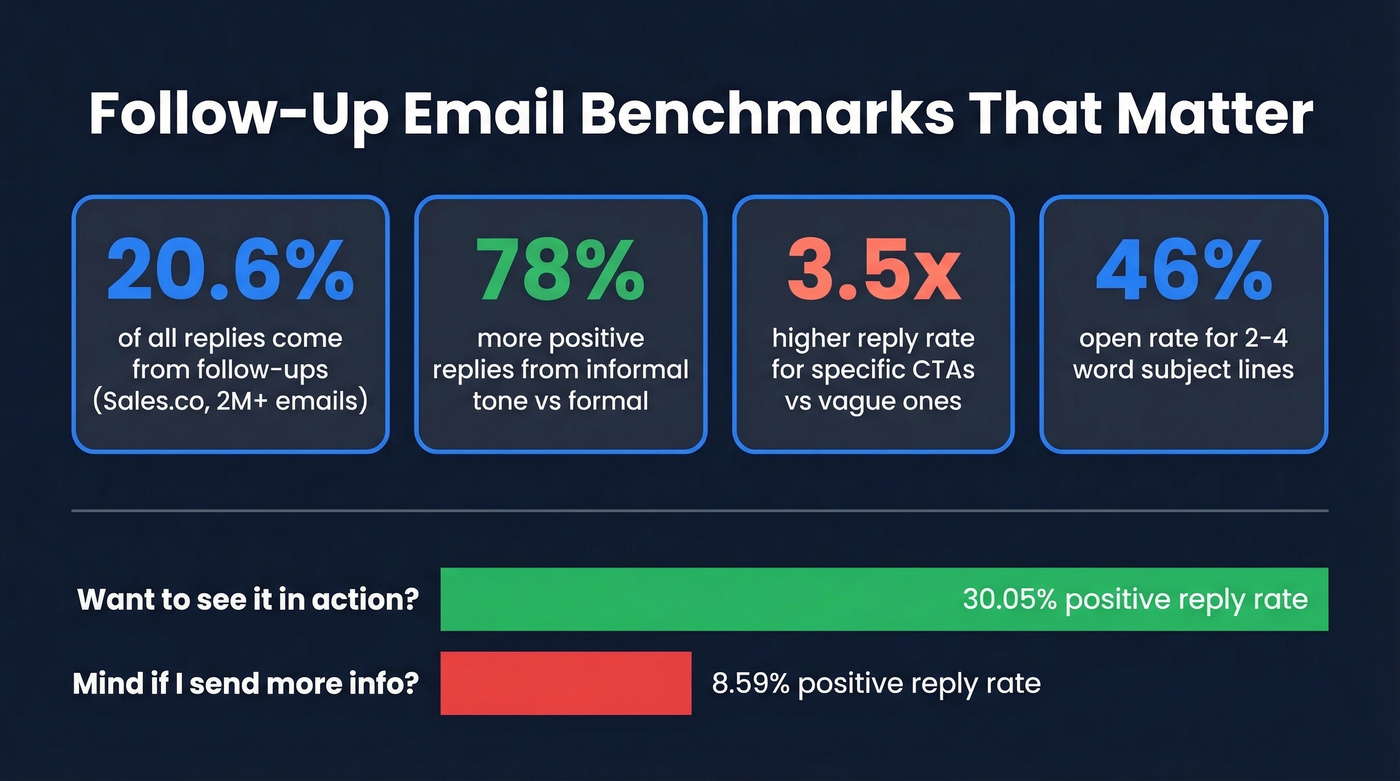
Don't let it die. Across 2M+ cold emails analyzed by Sales.co, 20.6% of all replies came from follow-ups. [Instantly's 2026 benchmark report](https://instantly.ai/cold-email-benchmark-report-2026) puts that number at 42% depending on campaign type. Either way, the follow-up is where a massive chunk of results live. We've tested dozens of follow-up structures across our own outbound campaigns, and the patterns below are what consistently earn replies - not just opens.
What Makes a Follow-Up Work
Four rules that actually move the needle:
- Add new value every time. A case study, a data point, a new angle. Never "just checking in." (If you need alternatives, see just checking in.)
- Keep it under 80 words. Your reader should understand what you're offering within five seconds. Practitioners on r/coldemail are adamant about this.
- End with a specific CTA. "Want to see it in action?" pulls a 30.05% positive reply rate. "Mind if I send more info?" gets 8.59%. That's a 3.5x difference. (More examples: email call to action.)
- Write like a human. Informal tone generates 78% more positive replies than formal language. Keep subject lines to 2-4 words - that range hits a 46% open rate. Personalized subject lines also hit 46% versus 35% without. For more, see email copywriting.
Step-by-Step Follow-Up Process
Once you understand the structure, writing a follow-up email becomes repeatable regardless of the scenario. (If you're building a full sequence, use a B2B cold email sequence.)
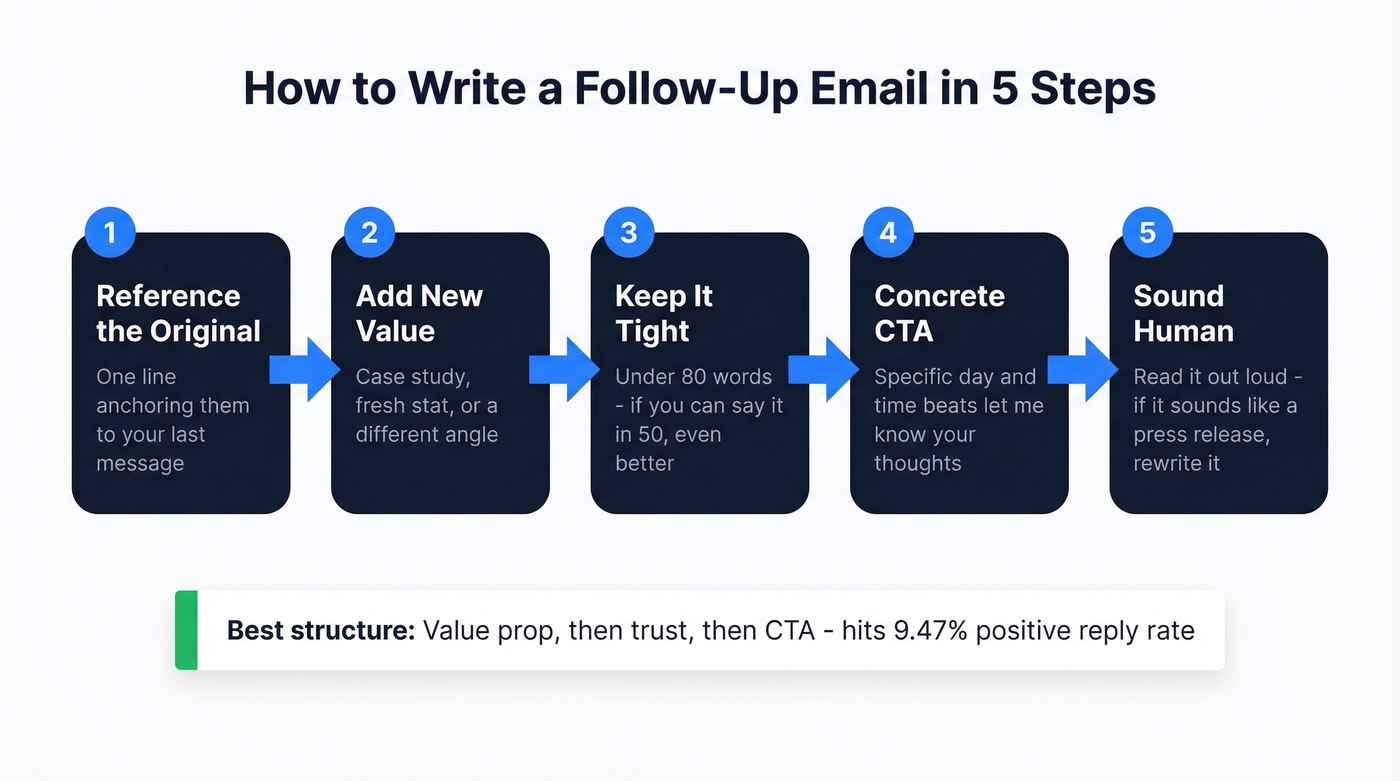
Step 1: Reference the original context in one line. "I sent over the proposal for your Q3 campaign last Tuesday" - enough to anchor them.
Step 2: Add something new. This is where most follow-ups fail. Bring a case study, a fresh stat, or a different angle. Structure it as value prop, then trust, then CTA - that sequence hits a 9.47% positive reply rate, the highest of any email structure tested across 2M+ sends. (More on the numbers: follow-up email reply rate.)
Step 3: Keep it tight. Under 80 words. If you can say it in 50, better.
Step 4: End with a concrete CTA. "Are you free for 15 minutes Thursday afternoon?" beats "Let me know your thoughts" every time. If you want more phrasing options, see email wording to schedule a meeting.
Step 5: Sound like yourself. Read it out loud. If it sounds like a press release, rewrite it.
6 Follow-Up Email Examples
After No Response (Cold Outreach)
Here's the generic version most people send:
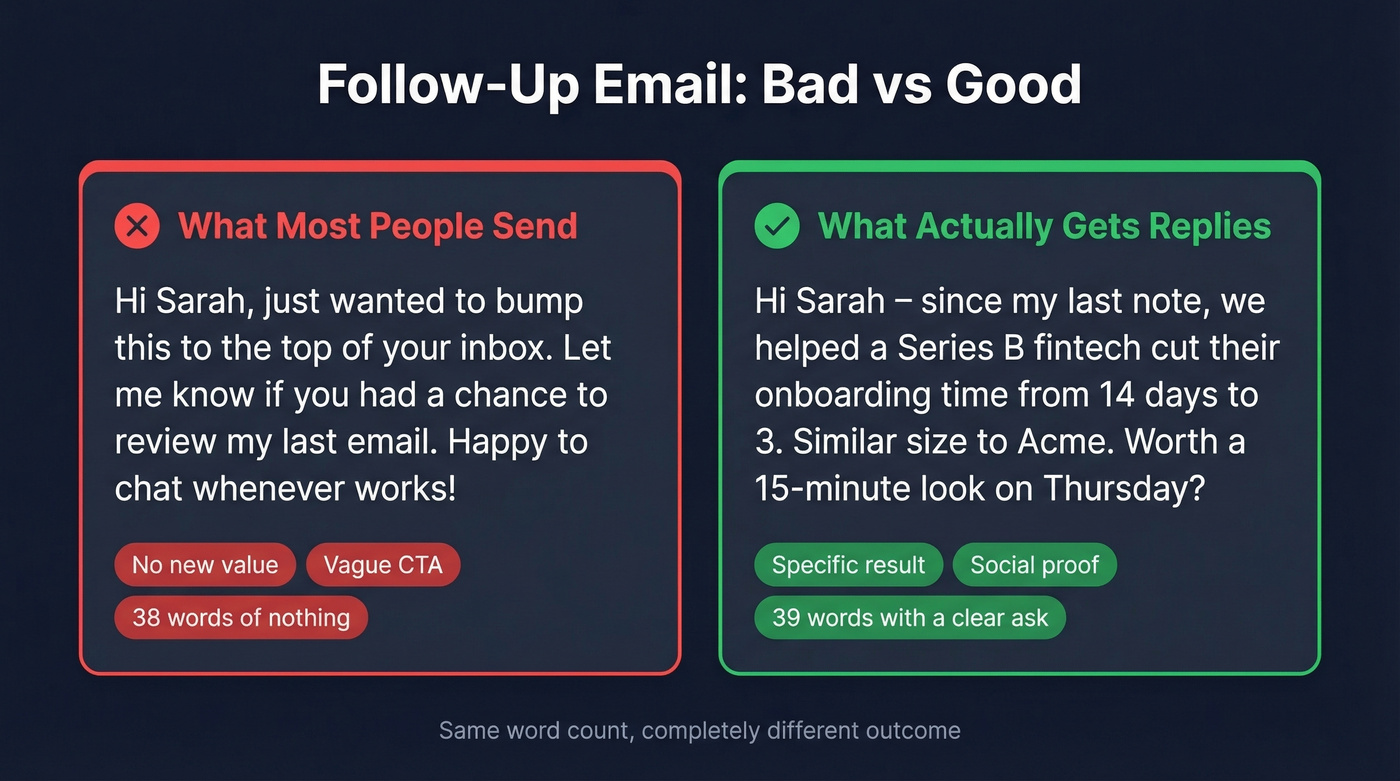
Bad: "Hi Sarah, just wanted to bump this to the top of your inbox. Let me know if you had a chance to review my last email. Happy to chat whenever works!"
Now the version that earns a reply:
Good: "Hi Sarah - since my last note, we helped a Series B fintech cut their onboarding time from 14 days to 3. Similar size to Acme. Worth a 15-minute look on Thursday?"
New information, a specific result, a concrete ask. Thirty-nine words. (Need more options? Use these cold email follow-up templates.)
After a Sales Demo
This one's easy to overthink. Don't recap the entire meeting - pull one specific thing they said and build on it.
"Hey Marcus - thanks for walking me through your pipeline challenges yesterday. I pulled a quick analysis showing how our routing logic would've saved ~6 hours/week based on the volume you mentioned. Attached. Want to loop in your ops lead this week?"
Notice the structure: acknowledge their problem, show you did homework after the call, then make the next step obvious. That's it. Three sentences, and Marcus knows exactly what to do. (More: sales meeting follow-up email.)
After a Job Interview
A hiring manager on Reddit with 1,000+ interviews under their belt shared the best tactic: mirror back the questions you asked during the interview.
"Hi Dr. Chen - thank you for the conversation yesterday. When you mentioned cross-functional alignment as the team's biggest challenge, it resonated. That's exactly the problem I tackled at Vero by building a shared sprint review process. Looking forward to next steps."
After a Networking Event
"Hey Priya - great meeting you at SaaStr on Tuesday. Your point about PLG cannibalizing outbound stuck with me. I wrote a short breakdown on how we're handling that tension - [link]. Would love to continue the conversation over coffee if you're in SF next month."
After Sending a Proposal
"Hi James - one thing I didn't include in Thursday's proposal: we just rolled out SOC 2 Type II compliance, which I know was a sticking point with your security team. Updated scope attached. Can we finalize terms this week?"
The Break-Up Email
"Hi Sarah - I've reached out a few times and I know you're busy, so I'll keep this short. If Acme's onboarding speed isn't a priority right now, totally understand. I'll check back in a couple months. If it is - I'm one reply away."
No guilt trip. No passive aggression. A clean exit that leaves the door open.

You just learned how to write follow-ups that earn replies. But here's the part most guides skip: a bounce rate above 2% destroys your sender reputation, and your perfect follow-up never reaches the inbox. Prospeo verifies email addresses in real time with 98% accuracy - so every follow-up you send actually lands.
Don't let dead addresses kill your follow-up sequence.
Subject Lines That Get Opened
A Belkins study of 5.5M emails found personalized subject lines hit a 46% open rate versus 35% without. Reply rates doubled - 7% versus 3%. If you want more ideas, use these email subject line examples.
Keep them to 2-4 words. Questions work well. Hype words like "ASAP" or "urgent" actually push opens below 36%. For follow-ups, the simplest approach is replying in the original thread so the subject line is already contextual - and it signals to the recipient that this isn't a cold first touch.
When to Send and When to Stop
Tuesday and Wednesday are peak reply days per Instantly's 2026 data. HubSpot and Twilio's research points to around 11 AM in the recipient's time zone. For a deeper breakdown, see best time to send cold emails.
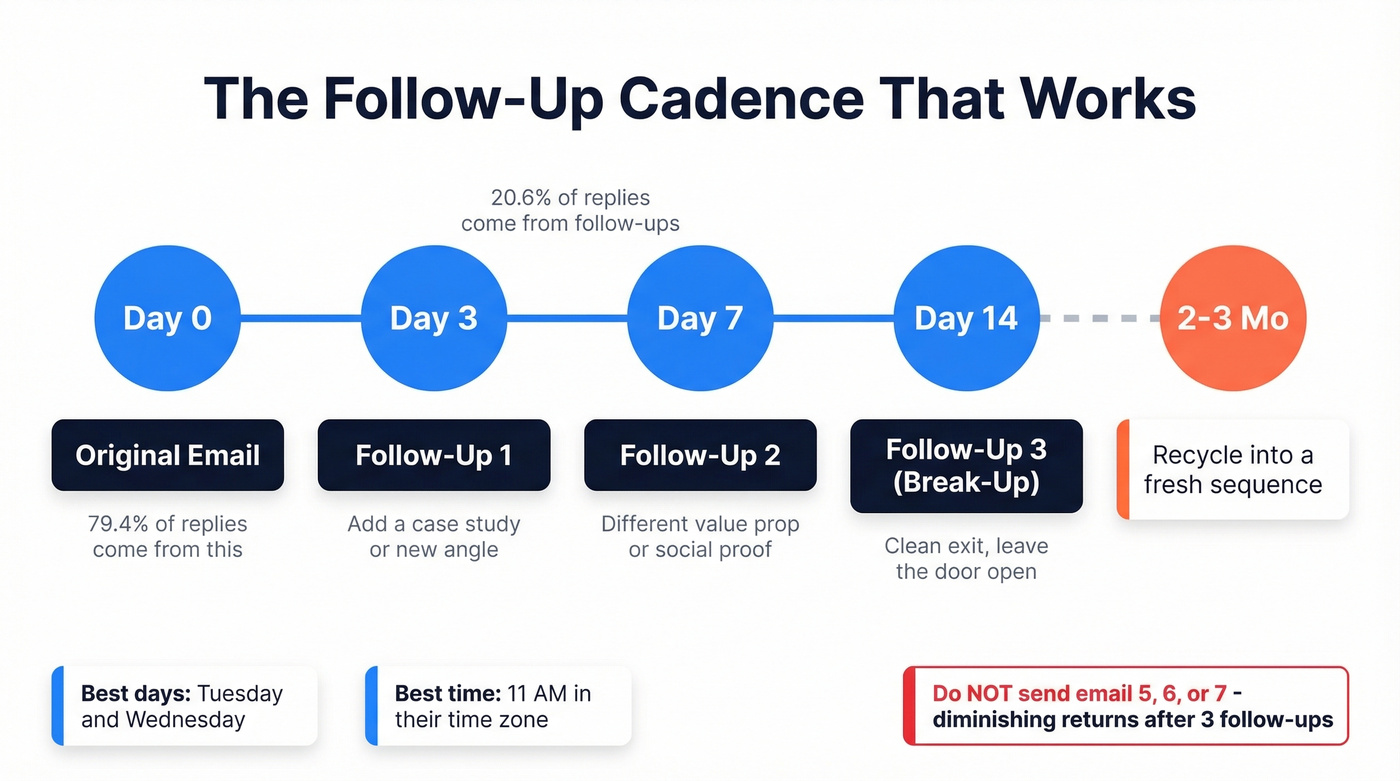
Here's the thing: you've probably seen the stat that "80% of sales need 5+ follow-ups." That number is unsourced and contradicted by actual data - 79.4% of replies come from the first message, and the remaining 20.6% come from follow-ups. In our experience, most campaigns see diminishing returns after three follow-ups. A simple cadence that works: Day 3, Day 7, Day 14. Three follow-ups, then stop. Don't send email number seven - recycle that prospect into a fresh sequence in 2-3 months. (More on the why: importance of follow-up in sales.)
Targeting smaller companies? Expect roughly 5x more positive replies than enterprise outreach (18.2% vs 3.4%), so adjust your patience accordingly.
Before You Hit Send
Verify the email address first. A bounce rate above 2% slowly kills your domain reputation, and no amount of clever copywriting fixes that. We've seen teams write perfect follow-up sequences only to torch their sender score because 15% of their list was dead addresses. Prospeo verifies addresses in real time with 98% accuracy, and the free tier covers 75 verifications per month - it takes seconds. (If you want the benchmarks and fixes, see email bounce rate and email deliverability.)

Beyond verification: send as a reply in the original thread, not a new message. Use plain text and skip over-designed templates. These small details compound. Let's be honest - most follow-ups fail not because the copy is bad, but because the basics are wrong. Now grab an example above, adapt it to your situation, and send it before the moment passes.
Great follow-up copy needs a real email address behind it. Prospeo gives you 98% verified emails at $0.01 each, with a 7-day data refresh cycle so you're never chasing contacts who've already moved on. 75 free verifications per month - no credit card, no sales call.
Start verifying emails in seconds, not hours.
FAQ
How many follow-up emails should I send?
Three follow-ups after the original message, so four emails total. Follow-ups capture about 20% of replies, but returns diminish sharply after the third. If there's still no response, recycle the prospect into a new campaign in 2-3 months rather than sending a fifth or sixth touch.
Is it okay to follow up after a job interview?
Yes - send it within 24-48 hours. Reference something specific from the conversation, ideally a topic the interviewer was passionate about. Generic "thanks for your time" notes get lost in a stack of identical messages.
How do I make sure my follow-up reaches the inbox?
Reply in the original thread, use plain text, and verify the recipient's address before sending. Skip this step and you're gambling with your domain reputation - a bounce rate over 2% tells inbox providers you don't maintain your lists, and they'll start routing your emails to spam.