

How to Write a Follow-Up Reminder Email That Gets Replies
A Reddit user managing roughly 200k emails per month across 15 clients rewrote every follow-up template in their stack. Reply rates went from 0.4% to 3.8% across 340k follow-up emails over three months. The difference wasn't magic - it was structure, timing, and one rule: stop sending "just checking in" and start adding something new every time.
If you're trying to figure out how to write a follow-up reminder email that actually gets replies, start here - with data, not a pile of templates. (If you want more ready-to-use options, see our sales follow-up templates.)
Why Most Follow-Ups Fail
The average cold email reply rate is 2.09%, and only about 1 in 157 contacts express interest. Most follow-up guides hand you 15 templates and zero data. That's backwards.
We've watched teams burn through thousands of sends with "just bumping this up" messages and wonder why nobody responds. The answer is always the same: no new value, no reply. Your follow-ups need to earn attention, not just remind people you exist.
Every effective follow-up reminder needs three things. New value in every touch - a case study, a relevant insight, a smaller ask (here’s a deeper guide on how to add value in sales). Brevity - keep it under 80 words. And verified contact data, because perfect copy sent to a dead address is just wasted effort (use an AI email checker to catch bad addresses early).
Follow-Up Timing and Cadence
Timing matters more than most people think. Here's how replies distribute across touches, based on QuickMail's dataset of 1 million replies:
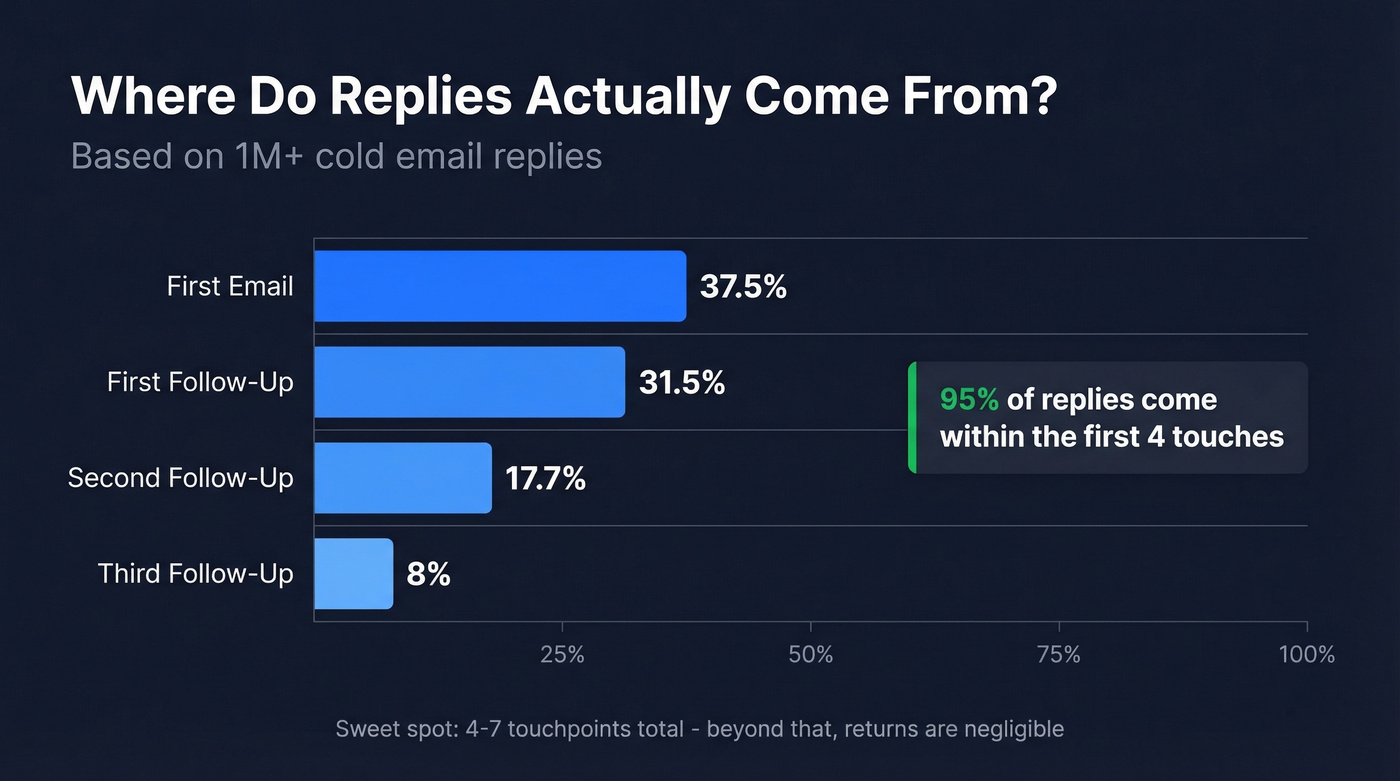
| Touch | Share of Replies |
|---|---|
| First email | 37.5% |
| First follow-up | 31.5% |
| Second follow-up | 17.7% |
| Third follow-up | 8% |
Nearly 95% of replies come within the first four touches. The sweet spot for sequence length is 4-7 touchpoints. Beyond that, returns are negligible.
Instantly's benchmark data across billions of cold email interactions shows a different split: 58% of replies come from the first email, and 42% come from follow-ups. Skip them and you're leaving a huge chunk of replies on the table.

A practitioner-tested cadence that we've seen work consistently - and that matches the Reddit field report - is day 4 after the initial send, then day 9, then day 16. This gives breathing room without letting the conversation go cold. Waiting two or more weeks between touches kills momentum; your follow-up has minimal impact at that point. (For more data on send windows, see best time to send cold emails.)
Best days to send? Monday pulls the highest overall reply rate, while Thursday generates the highest positive reply rate at 10.5%. Weekends drop reply rates by about 27%.
Here's the thing: you don't need 7 follow-ups. You need 3-4 genuinely good ones. Most sequences are too long and too lazy. Cut the filler, front-load the value, and you'll outperform the team sending 12-touch drip campaigns every time.
Step-by-Step Reminder Email Framework
Writing a follow-up isn't about finding the perfect words. It's about following a structure that respects the recipient's time while giving them a reason to respond. (If you’re building a full sequence, use this alongside a B2B cold email sequence.)
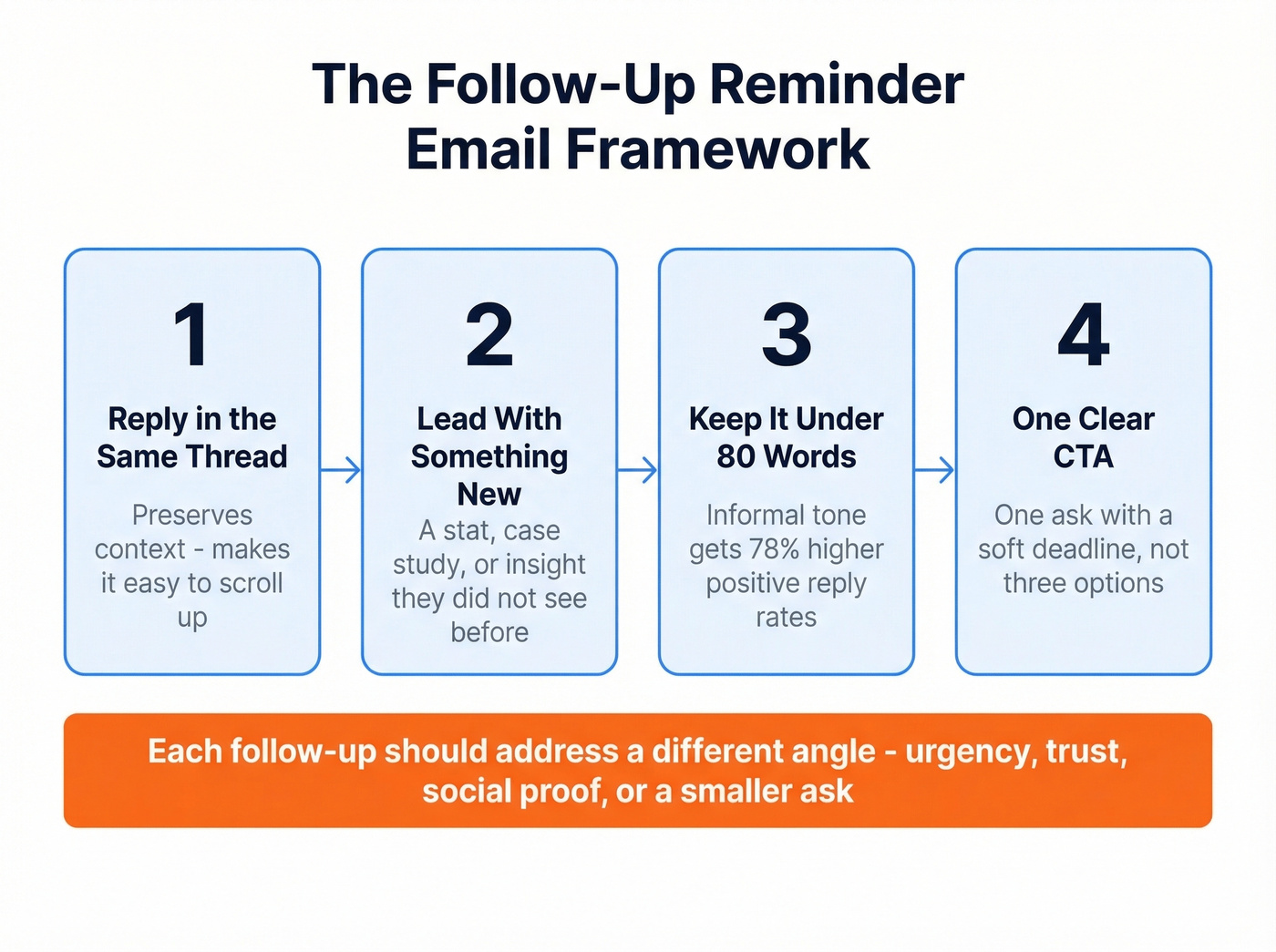
Reply in the same thread. It preserves context and makes it easy for the recipient to scroll up. Only start a new thread if you're changing the topic entirely.
Lead with something new. A relevant stat, a case study, a resource they'd find useful. Each touch should address a different angle or objection - one email tackles urgency, the next tackles trust, the next offers social proof through a case study. Use psychology deliberately: a limited-time offer adds scarcity, a customer win adds credibility.
Keep it under 80 words. Informal tone drives 78% higher positive reply rates compared to formal language. Write like you'd talk to a colleague. (More on this in our email copywriting guide.)
Include one clear CTA. Not three options. One ask, ideally with a soft deadline: "Would Thursday or Friday work for a 15-minute call?" (If you want examples, see email call to action.)
Don't reveal everything in email one. Spread value across touches so each follow-up has a reason to exist - this curiosity gap keeps recipients engaged across the sequence. And make every email look real: plain text, short paragraphs, natural tone. The more it looks like a template, the faster it gets ignored.

You just learned that 42% of replies come from follow-ups. But none of that matters if your emails bounce. Prospeo delivers 98% email accuracy with a 7-day data refresh - so every carefully crafted follow-up actually lands in a real inbox.
Stop perfecting copy that bounces. Start with verified data.
Subject Lines That Get Opened
A Belkins study of 5.5 million emails found that personalized subject lines hit a 46% open rate versus 35% without personalization. Reply rates more than doubled - 7% versus 3%.
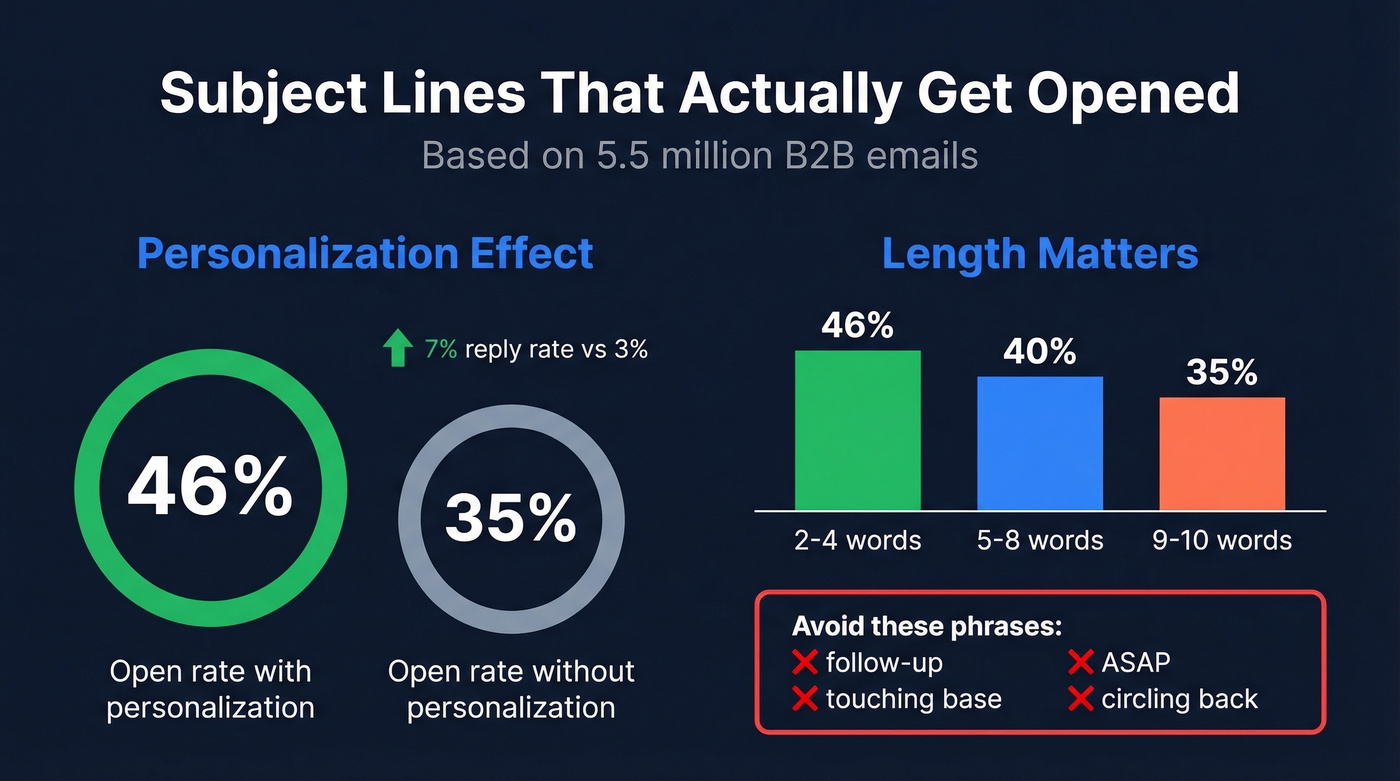
Keep subject lines short. Two to four words is the sweet spot, pulling 46% opens. Once you hit nine or ten words, opens drop to the mid-30s. (If you need ideas, pull from these email subject line examples.)
Phrases to avoid: "follow-up," "touching base," "ASAP," and anything that sounds like a buzzword bingo card. These signal low value before the recipient even opens the email.
Polite Reminder Email Templates
Each template below is under 80 words. These eight cover the most common scenarios, but the framework works for any context - adapt the structure, not just the words. (You can also compare with our cold email follow-up templates.)
No-Response Sales Follow-Up
Hi [Name], I came across [specific insight - article, competitor move, industry stat] and thought of your team. [One sentence connecting it to their challenge.] Worth a quick chat this week, or is this not a priority right now?
This works because it leads with value instead of a guilt trip. The closing gives them an easy out, which paradoxically increases replies - people respond when they don't feel cornered.
Job Application Follow-Up
Hi [Name], I wanted to follow up on my application for [Role] submitted on [Date]. I'm genuinely excited about [specific thing about the company]. Happy to provide any additional materials. Is there a timeline for next steps?
Payment or Invoice Reminder
Hi [Name], quick reminder that invoice #[Number] for [Amount] was due on [Date]. I've reattached it for convenience. Let me know if there are any questions or if payment is already in process.
Don't be too apologetic here. You're not bothering them - you're asking for money you're owed. Keep the tone professional but direct.
Meeting Reminder
Hi [Name], I'm trying to finalize my schedule for next week - wanted to confirm our meeting on [Day] at [Time]. I'm planning to cover [1-2 agenda items]. If the time no longer works, let me know and I'll find an alternative.
Post-Demo Follow-Up
Hi [Name], thanks for the time yesterday. You mentioned [specific pain point from the demo]. I put together a quick [one-pager / ROI estimate / case study] that addresses exactly that. Worth reviewing before your team syncs on this?
Proposal or Contract Follow-Up
Hi [Name], following up on the proposal I sent on [Date]. Happy to walk through any questions or adjust scope if needed. Would [Day] work for a 10-minute call to finalize?
Internal Project Nudge
Hey [Name], checking in on [deliverable]. We're on track for [milestone], but I need [specific input] from your side by [Date] to keep things moving. Can you flag if there's a blocker?
The Breakup Email
Your breakup email should be your best email. In our experience, the breakup outperforms every other touch when done right. This is where rejection-then-retreat works best - make a smaller ask after the bigger one went unanswered. Cialdini's research shows that concessions trigger reciprocity.
Hi [Name], I haven't heard back, so I'll assume the timing isn't right. Totally understand. If it'd be easier, could you point me to the right person on your team for this? Either way, I'll leave the door open. Thanks for your time, [Name].
Mistakes That Kill Your Reply Rate
Bumping with no new information. "Just making sure you saw this" tells the recipient you have nothing new to offer. Every follow-up needs to earn its place in their inbox. (If you want benchmarks to diagnose performance, see follow-up email reply rate.)
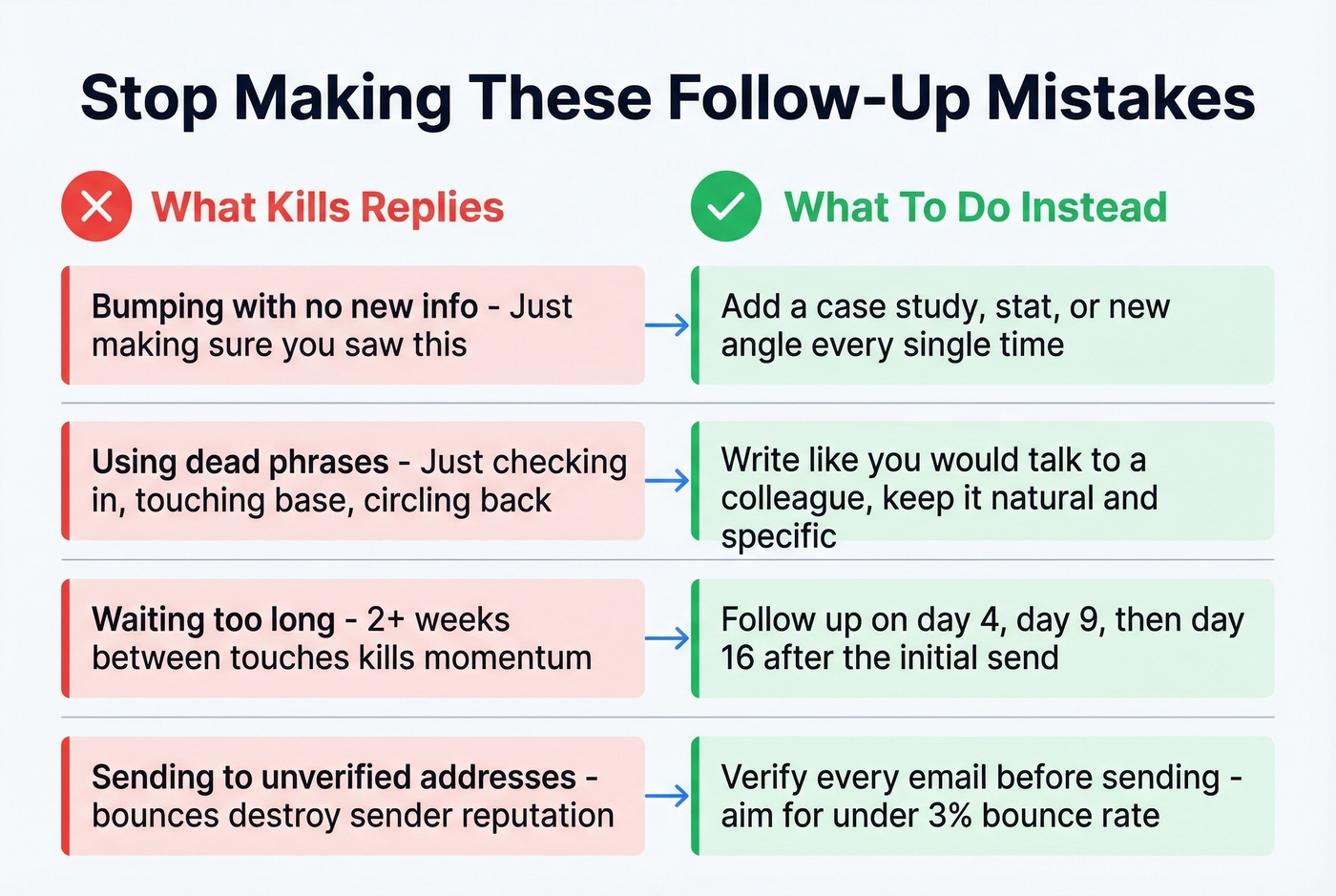
Using dead phrases. "Just checking in," "touching base," "circling back around" - these are widely disliked because they add zero value and read like a template. The consensus on r/sales is that these phrases are an instant delete for most buyers. (If you need alternatives, use how to say just checking in professionally.)
Waiting too long. If you're letting two-plus weeks pass between touches, you've already lost momentum. Follow up within days, not weeks.
Sending to unverified addresses. This is the silent killer. You can write the perfect follow-up sequence, nail the timing, personalize every line - and none of it matters if the email bounces. Bounces destroy your sender reputation, which tanks deliverability for every future email you send, even replies to warm leads. One of our agency customers, Stack Optimize, went from constant domain flags to 94%+ deliverability and under 3% bounce rates after switching to verified data. Skip this if you enjoy watching your domain reputation crater, but for everyone else, run your list through a verification tool like Prospeo before you hit send. (If you’re troubleshooting, start with email bounce rate and then work through an email deliverability guide.)
Great follow-up frameworks need great contact data underneath. Teams using Prospeo cut bounce rates from 35%+ to under 4% and tripled their pipeline. At $0.01 per verified email, bad data is no longer an excuse for low reply rates.
Verify every contact before your next follow-up sequence goes live.
FAQ
How many follow-up emails should I send?
Three to four value-adding follow-ups is the sweet spot. QuickMail data shows about 95% of replies come within the first four touches. Beyond that, returns are negligible - move on or try a different channel like phone or social.
Should I reply in the same thread or start a new one?
Reply in the same thread. It preserves context and makes it easy for the recipient to remember the conversation. Start a new thread only if the topic has changed entirely or you're re-engaging after 30+ days.
How do I write a polite reminder without sounding desperate?
Add something new every time - a case study, a smaller ask, a useful insight. Keep it under 80 words and use an informal tone. Low reply rates are sometimes a data problem, not a copy problem. If your emails are bouncing, the best writing in the world won't help.
What's the best day and time to send a follow-up?
Monday generates the highest overall reply rate, while Thursday pulls the highest positive reply rate at 10.5%. Avoid weekends - reply rates drop roughly 27%. Send during the recipient's local business hours for best results.
How long should I wait before following up?
Follow up 3-4 days after your initial email, then space subsequent touches at increasing intervals - day 9, day 16. Waiting more than two weeks between messages kills momentum and signals low urgency.