

Why Your Inbound Leads Aren't Converting (And How to Fix It in 2026)
Your VP of Sales just Slacked you: "Marketing sent 200 leads and we closed 3. What are we paying for?" You've heard this before. The problem isn't lead volume - it's inbound lead conversion, and specifically everything that happens after someone fills out a form.
The math in 2026 is brutal. The average B2B buying cycle runs 10.1 months. Buyers don't contact you until they're 61% through their journey, and 92% start with at least one vendor already in mind. The winning vendor is on the buyer's "Day One shortlist" 95% of the time - so by the time someone fills out your demo form, they've already done the homework. They're warm. Organic search leads close at roughly 14.6% while outbound-sourced leads limp along at 1.7%. Inbound works - when you don't fumble the handoff.
So why are most teams fumbling? Five reasons, all fixable.
What You Need (Quick Version)
- Set a 5-minute speed-to-lead SLA. This alone can 5x your connection rate. Jump to the details.
- Deploy a real lead scoring model. Copy the table in the scoring section, adjust the weights, and push it into your CRM this week.
- Audit your contact data. If more than 5% of your emails bounce, your conversion problem starts before your nurture sequence fires. Prospeo catches bounces before they waste rep time - more on that below.
Conversion Benchmarks by Industry
Before you can fix your funnel, you need to know what "good" looks like. The answer depends heavily on your vertical.
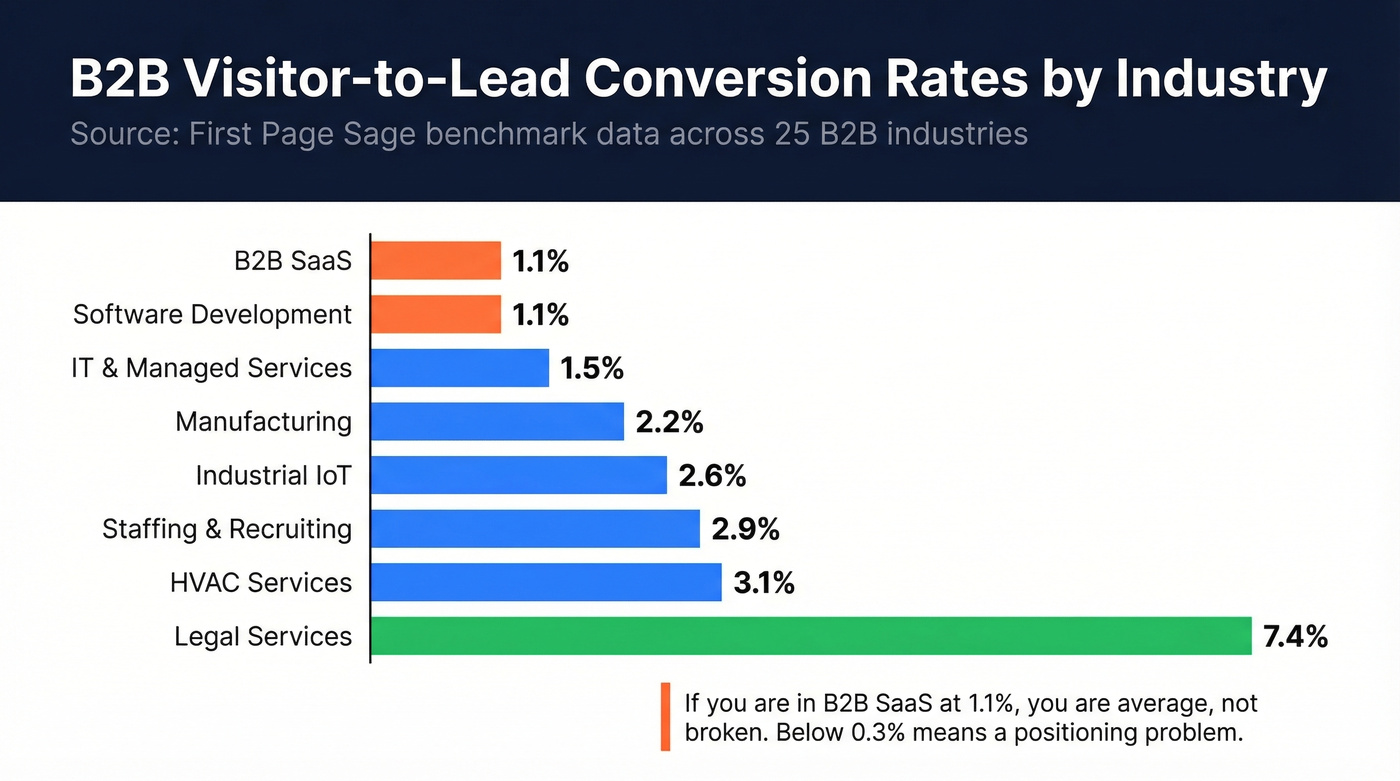
First Page Sage's benchmark data across 25 B2B industries shows massive variance in visitor-to-lead conversion rates:
| Industry | Visitor-to-Lead Rate |
|---|---|
| B2B SaaS | 1.1% |
| Software Development | 1.1% |
| IT & Managed Services | 1.5% |
| Manufacturing | 2.2% |
| Industrial IoT | 2.6% |
| Staffing & Recruiting | 2.9% |
| HVAC Services | 3.1% |
| Legal Services | 7.4% |
If you're in B2B SaaS and converting 1.1% of visitors to leads, you're average - not broken. If you're at 0.3%, you've got a positioning or targeting problem upstream of conversion.
For demo-led funnels specifically, Default's benchmark report found that once a B2B software site crosses 25,000 monthly visitors, the visitor-to-demo-request rate drops below 1%. Earlier-stage companies with smaller, more targeted traffic convert higher. That's not a bug - it's math.
The real question isn't "what's our visitor-to-lead rate?" It's "what happens to leads after they convert?" That's where most teams bleed.
Five Conversion Killers (And Fixes)
No Journey After Capture
A Reddit thread in r/SaaS nails this: most SaaS companies treat a lead magnet as "an entry point, not a journey." Someone downloads your guide, gets one follow-up email, and then... nothing. Or worse, they get a sales call 20 minutes later asking if they want a demo. The lead magnet did its job. Your nurture sequence didn't.
B2B buyers consume roughly 13 pieces of content before talking to sales. Jumping from "downloaded a PDF" to "book a demo" is a trust gap the size of the Grand Canyon. The fix is a staged value path that builds trust incrementally:
- Educational content leads to a deeper guide or checklist
- A framework or case study leads to a webinar or deep dive
- A product walkthrough leads to a demo conversation
Each step delivers standalone value while making your product the natural next step. You're moving leads from rented attention to owned engagement - your site, your email list, your community. Fill the trust gap with content that earns the next click. Without this journey, leads won't convert - not because they weren't interested, but because you never gave them a reason to take the next step.
Catastrophically Slow Response Times
This is the single highest-ROI fix in this entire article.
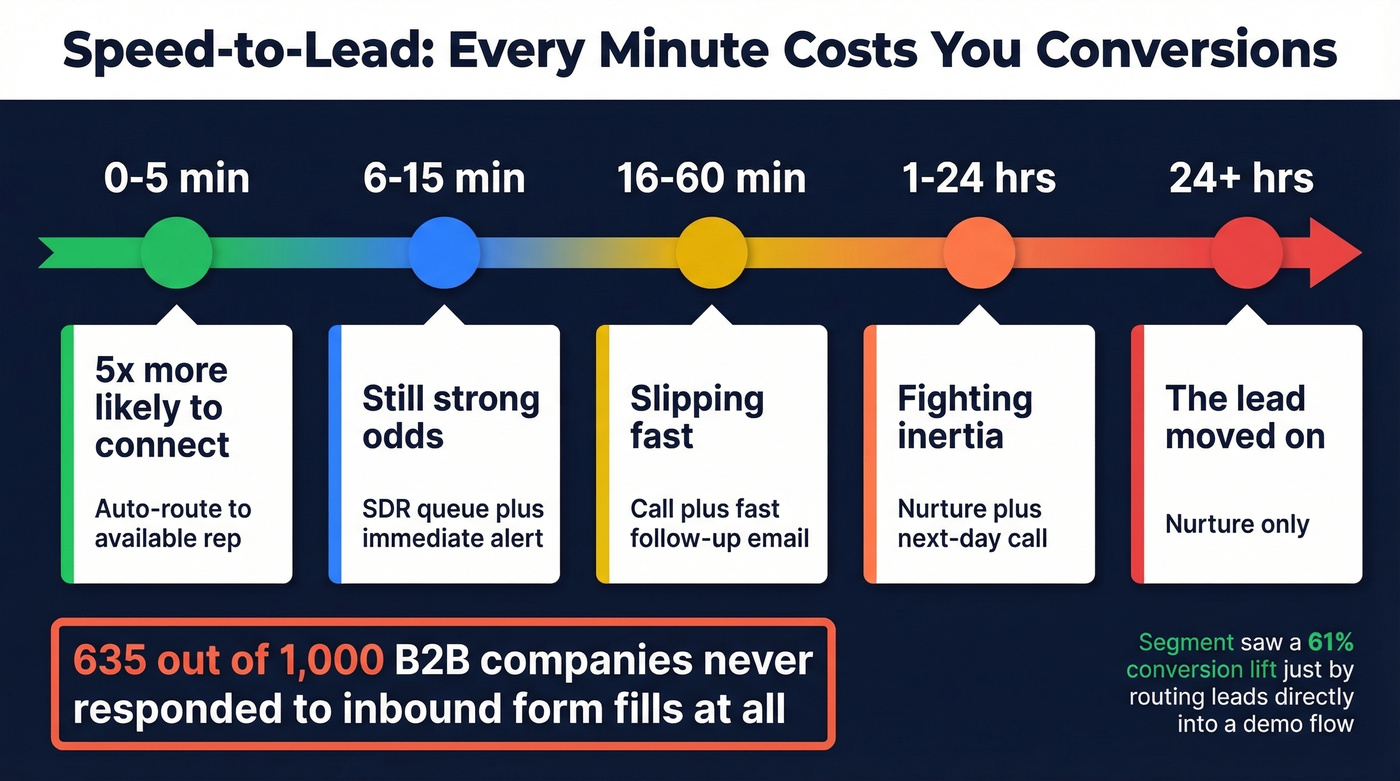
RevenueHero analyzed lead response times of 1,000 B2B companies and found that 635 out of 1,000 didn't respond to inbound form fills at all. Not slowly. Not poorly. They just never responded. Among the companies that did respond, response time varied heavily by form length:
- 1-2 fields: 3 hours 14 minutes
- 3-5 fields: 1 day, 5 hours, 13 minutes
- 6-9 fields: 1 day, 7 hours, 17 minutes
- 9+ fields: 1 day, 4 hours, 50 minutes
These are people raising their hands, and most companies leave them hanging.
The data on speed-to-lead is unforgiving. Contacting a lead within 5 minutes makes you 5x more likely to connect than waiting 10 minutes. After 30 minutes, your odds drop 21-fold. Here's the thing: we've watched teams agonize over email subject lines and CTA button colors while their average response time sits at 29 hours. That's like optimizing the paint job on a car with no engine.
| Response Time | What Happens | Action |
|---|---|---|
| 0-5 min | Best chance to connect | Auto-route to available rep |
| 6-15 min | Still strong | SDR queue + immediate alert |
| 16-60 min | Slipping fast | Call + fast follow-up email |
| 1-24 hrs | You're fighting inertia | Nurture + next-day call |
| 24+ hrs | The lead moved on | Nurture only |
Segment saw a 61% conversion lift simply by routing inbound leads directly into a demo flow instead of letting them sit in a queue. No new messaging, no new offer - just faster routing.
Speed-to-lead doesn't require new tools, new content, or new strategy. It requires an SLA and someone who enforces it. Set a 5-minute target for demo requests and a 15-minute target for content leads. Measure it weekly. Run a lead response benchmark to see where you stand today.
If you need to operationalize the handoff, start with lead status definitions and a simple lead generation workflow that makes ownership unambiguous.
No Lead Scoring (Or Broken Scoring)
How do you know your scoring is broken? Quick checklist:
- Your CRM uses default scoring weights that nobody has touched since setup
- There are no negative signals - competitor domains and bounced emails score the same as real prospects
- Sales and marketing have no shared, written definition of "qualified"
- Email opens are weighted heavily (Apple Mail's privacy features make these nearly useless)
- You can't point to a single closed deal where the lead score predicted the outcome
If three or more of those hit home, your scoring model is decoration, not infrastructure. 40% of marketers cite unqualified leads as their top funnel pain point, and 44% of sales reps say lead quality is their number-one complaint about marketing. Both teams are frustrated because neither has a shared definition of what "qualified" means. Lead scoring without a concrete rubric is just vibes.
We've built a deployable scoring model in the next section. Copy it, adjust the weights, and get it into your CRM this week. It takes two hours to set up in HubSpot or Salesforce. If you want the deeper framework, use our lead scoring guide and align it to an Ideal Customer Profile.
Sales and Marketing Misalignment
This is where the finger-pointing lives.
| Marketing's View | Sales' View | |
|---|---|---|
| MQL definition | "Met fit criteria, engaged with 3+ assets" | "Someone who actually wants to buy something" |
| Lead quality | "We sent 200 qualified leads this month" | "Maybe 15 were worth calling" |
| Follow-up | "Sales ignores 60% of our leads" | "60% of those leads were junk" |
| Timeline | "Nurture takes 3-6 months" | "If they don't close in 30 days, they're dead" |
| Success metric | MQL volume, cost per lead | Pipeline generated, closed revenue |
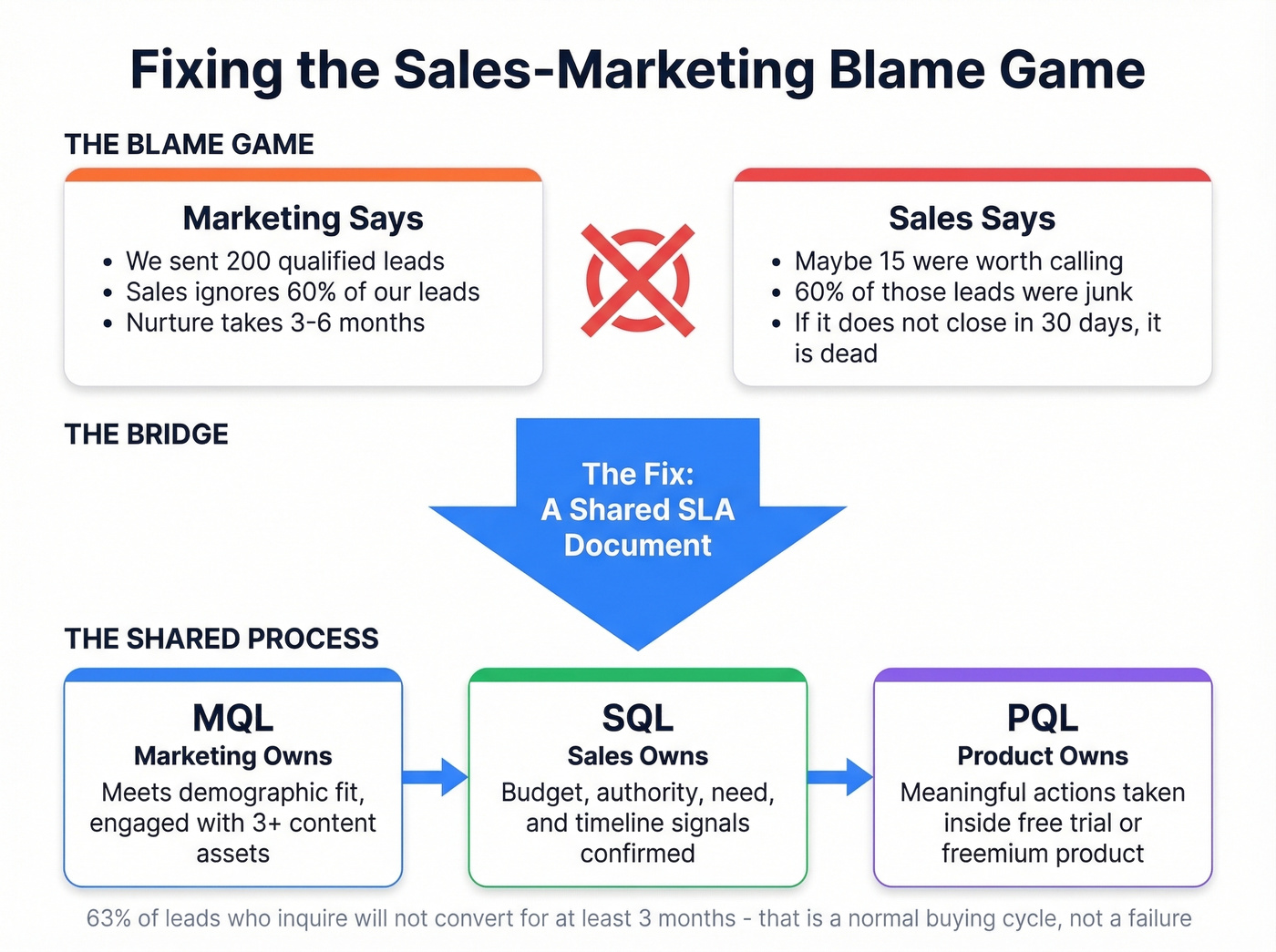
Both sides are right, which is the problem. The fix is a shared SLA document that specifies exactly when a lead moves from marketing to sales, what sales commits to doing with it, and what happens to leads that aren't ready.
Get the definitions on paper. An MQL meets demographic fit criteria and has engaged with enough content to warrant outreach - marketing owns it. An SQL is an MQL that sales has accepted and confirmed shows budget, authority, need, and timeline signals - sales owns it. A PQL is a user who's taken meaningful actions inside a free trial or freemium product - product owns it.
Let's be honest: 63% of leads who inquire won't convert for at least 3 months. That's not a failure of lead qualification - that's a normal buying cycle. If your sales team is disqualifying leads after one unanswered call, you're throwing away pipeline. Alignment doesn't mean generating more volume. It means both teams agree on what happens at every stage.
To make this stick, tie the SLA to sales operations metrics and review it in a monthly RevOps cadence.
Bad Contact Data
This is the silent killer. If your bounce rate is above 5%, skip everything else and fix this first.
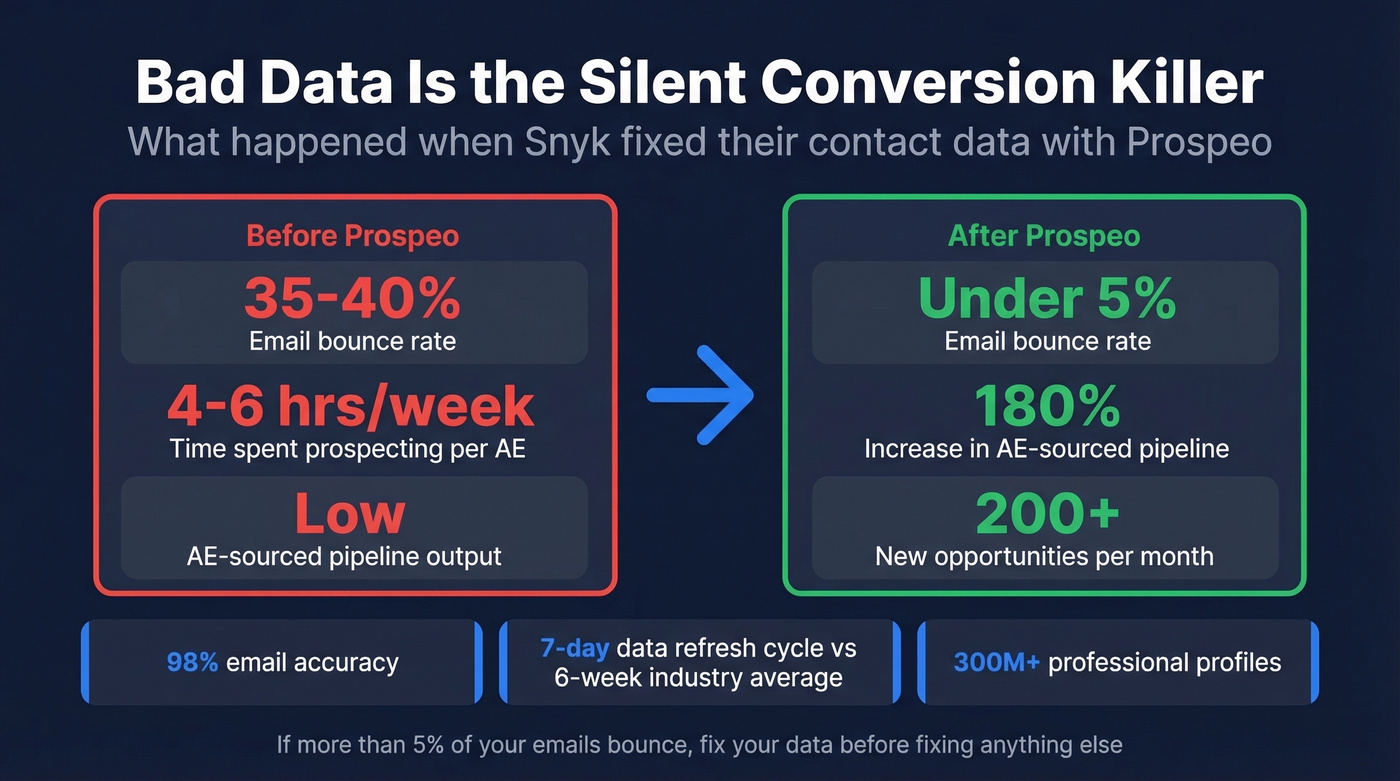
Teams spend weeks diagnosing messaging, offer positioning, and sequence timing when the real problem is that 30-40% of their contact data is stale. Emails bounce. Phone numbers are disconnected. The nurture sequence you spent a month building is going to inboxes that don't exist. We've seen this pattern over and over: a team will rebuild their entire follow-up cadence, A/B test subject lines for weeks, and then discover that a third of their list was dead on arrival.
Look at what happened at Snyk. Their 50-person AE team was prospecting 4-6 hours per week, but bounce rates ran 35-40%. After switching to Prospeo for email verification and enrichment, bounces dropped under 5%. AE-sourced pipeline jumped 180%, and they started generating 200+ new opportunities per month. The data was the bottleneck, not the reps.
Prospeo delivers 98% email accuracy with a 7-day refresh cycle - compared to the 6-week industry average - across 300M+ professional profiles. The free tier gives you 75 emails and 100 Chrome extension credits per month, so you can validate your data quality before committing.
You can have the best scoring model, the fastest response time, and perfect sales-marketing alignment - and still lose if your emails are bouncing. Data quality is the foundation everything else sits on. If you want a broader vendor landscape, see our roundup of data enrichment services and the deeper breakdown on email bounce rate.

If more than 5% of your inbound emails bounce, your nurture sequence is dead on arrival. Prospeo's 5-step verification and 7-day data refresh cycle keep your contact records clean - 98% email accuracy, 92% enrichment match rate. Enrich every form fill with 50+ data points so reps call the right person, at the right number, within your 5-minute SLA.
Stop losing warm leads to bad data. Enrich your inbound funnel now.
A Lead Scoring Model That Actually Works
Most scoring models fail because they're either too simple or too complex. One threshold and no negative signals? Useless. Fifty variables nobody maintains? Also useless. The model below balances fit and intent on a 60/40 split - 60% of the score comes from fit signals (who they are) and 40% from intent signals (what they do).
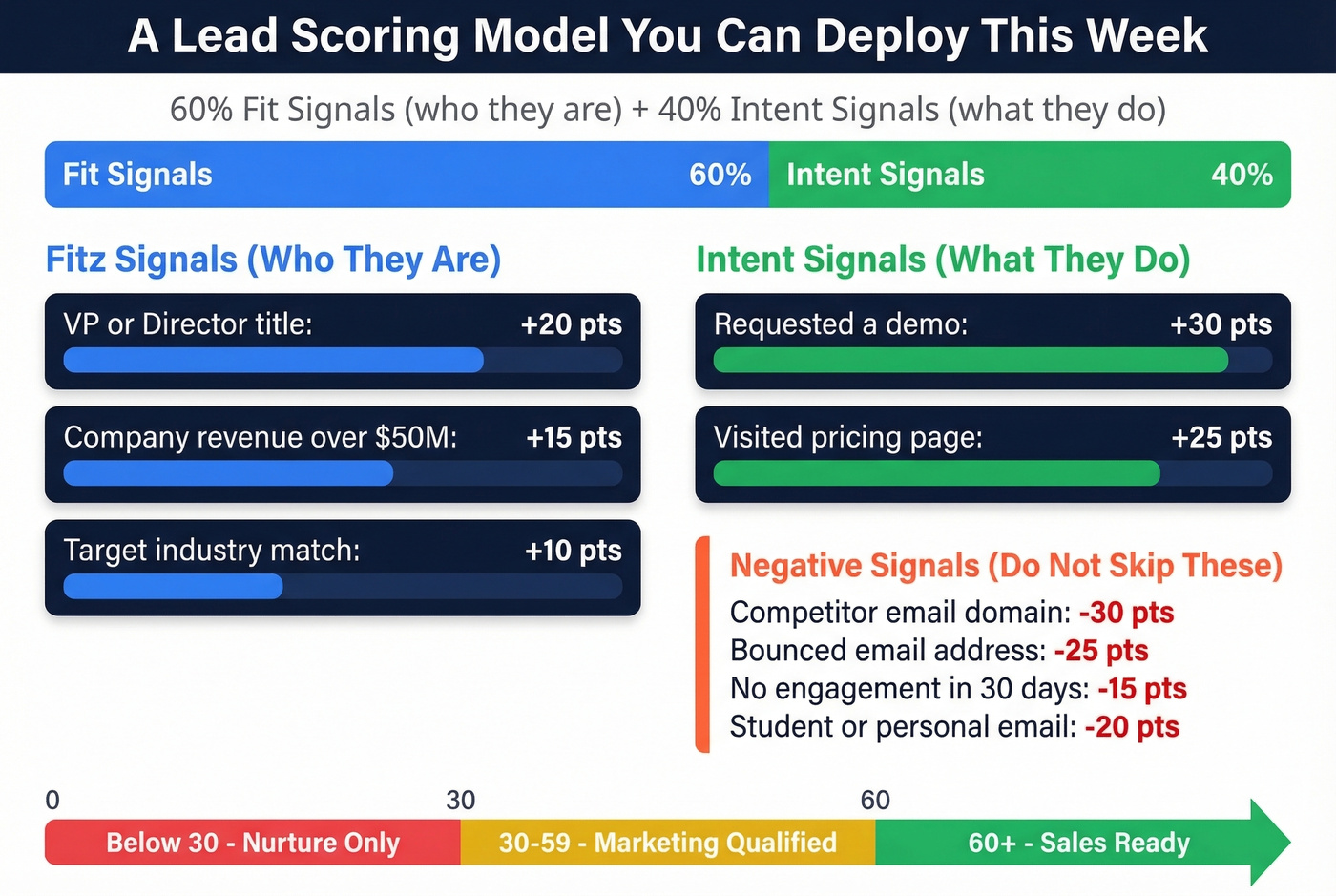
| Signal | Type | Points |
|---|---|---|
| VP/Director title | Fit | +20 |
| Company revenue >$50M | Fit | +15 |
| Target industry match | Fit | +10 |
| Requested a demo | Intent | +30 |
| Visited pricing page | Intent | +25 |
| Opened 3+ emails | Intent | +15 |
| Downloaded gated content | Intent | +15 |
| Email bounced | Negative | -25 |
| Competitor domain | Negative | -30 |
| Unsubscribed | Negative | -20 |
Threshold-to-action rules:
- 80+ points - Route straight to sales. This is a hand-raiser with fit. Don't make them wait.
- 60-79 points - SDR calls within 24 hours. Warm but needs qualification.
- Under 60 points - Stays in nurture. Don't waste rep time.
Two calibration notes worth flagging. First, negative scoring matters more than most teams realize. An email bounce (-25) should tank a lead's score because you literally can't reach them. A competitor domain (-30) should disqualify entirely - we've seen teams waste hours chasing leads that were competitors doing research.
Second, shift your buyer intent scoring toward on-site behavior - pricing page visits, form submissions, return visits - and away from email engagement metrics. Apple Mail's privacy features inflate open rates, making them nearly useless for intent measurement. Recalibrate quarterly by pulling your closed-won deals, checking which scoring signals they actually share, and adjusting weights accordingly. A scoring model that doesn't evolve with your data is just a prettier version of guessing.
How to Measure Your Conversion Rate
Measuring conversion sounds simple until you try to get a clean number.
The Umbrex framework provides the most rigorous approach we've found, and it starts with something most teams skip: defined time windows. Use 14-30 days for lead-to-MQL conversion and 30-60 days for MQL-to-SQL. Without fixed windows, your conversion rate is meaningless - a lead that converts in 90 days looks like a failure in a 30-day report.
Clean your data before you measure. Remove bots, internal test submissions, and competitor domains. Deduplicate by email and domain. Normalize your UTM parameters so you can actually attribute by channel. If your "unknown source" bucket exceeds 10-15% of total leads, your attribution is broken and your conversion rate is fiction.
Then close the loop all the way to revenue. Too many teams measure lead-to-MQL and MQL-to-SQL but never track which leads became customers and what they were worth. Build a closed-loop report in your CRM that traces original lead source through to closed-won revenue - without this, you're optimizing for volume at the top of the funnel while ignoring what actually drives the business. If you need a KPI list, start with funnel metrics and a baseline sales conversion rate. Analyze conversion by response-time bands (0-5 min, 6-15 min, 16-60 min, 1-24h, 24h+) to prove the speed-to-lead case with your own data. One sales ops leader on Reddit put it bluntly: "We spent six months blaming our messaging when the real problem was that half our contact records had the wrong job title."
What AI Changes in 2026
89% of revenue organizations now use AI-powered tools, up from 34% in 2023. Gartner predicts that by 2027, 60%+ of B2B sales teams will use ML-derived intent scoring as a core lead qualification component. AI-powered lead scoring delivers a 31% increase in qualification accuracy, and AI chatbots have helped 64% of adopters increase qualified lead volume.
The tooling is getting cheaper, too. HubSpot's predictive scoring requires Marketing Hub Enterprise at around $3,200/month. Salesforce Einstein runs $50/user/month as an add-on. Neither is cheap, but both are accessible to mid-market teams in a way they weren't two years ago.
Here's our hot take: most teams should ignore AI scoring entirely until their fundamentals are solid. If your speed-to-lead is 29 hours, AI scoring won't help - you'll just know faster which leads you're ignoring. If your sales and marketing teams can't agree on MQL definitions, predictive models will optimize for the wrong outcome. And if you're running AI across siloed channels with separate bots for chat, SMS, and email, you'll create context loss that makes the experience worse, not better.
The right sequence is: fix your fundamentals (speed, scoring, data quality, alignment), unify your channels into one journey view, and then add AI scoring and routing. Doing it in reverse just scales your dysfunction faster. If you're evaluating tooling, start with generative AI sales tools and a practical view of B2B predictive analytics.
Your lead scoring model is only as good as the data feeding it. Prospeo enriches CRM records with verified emails, direct dials, technographics, buyer intent signals across 15,000 topics, and company growth data - giving your scoring engine real signals instead of guesswork. 83% of leads come back enriched. At $0.01 per email, fixing data quality costs less than one wasted sales call.
Give your scoring model data it can actually score. Start enriching today.
FAQ
What's a good inbound lead conversion rate?
For B2B SaaS, a visitor-to-lead rate around 1.1% is average, while legal services hit 7.4%. Demo-led funnels at scale typically convert under 1% of visitors. Always benchmark against your specific vertical - universal numbers are misleading.
How fast should you respond to an inbound lead?
Within 5 minutes. Responding that quickly makes you 5x more likely to connect than waiting 10 minutes, and after 30 minutes your odds drop 21-fold. Set an SLA, assign ownership, and measure weekly.
What's the difference between MQL, SQL, and PQL?
An MQL meets fit criteria and has engaged enough for outreach - marketing owns it. An SQL is an MQL that sales has confirmed shows buying signals like budget, authority, need, and timeline. A PQL is a free-trial user who's taken meaningful product actions like completing onboarding or inviting teammates.
Does bad contact data really hurt conversion that much?
Yes. Bounce rates above 5% mean nurture sequences aren't landing, phones aren't connecting, and reps waste cycles on dead contacts. Fixing data quality is often the fastest path to better inbound lead conversion because it removes the invisible bottleneck that sits underneath every other optimization you're making.
Does AI improve inbound lead conversion?
AI-powered scoring delivers a 31% increase in qualification accuracy and can auto-route high-intent leads in real time. But it only amplifies what's already working - fix speed-to-lead, scoring fundamentals, and data quality first, then layer in AI.