

How to Build an Inside Sales Team That Actually Hits Quota
Only about 25% of B2B reps hit quota in recent years. Not 50%. Not 40%. A quarter. The other 75% aren't lazy - they're under-equipped, poorly structured, and running stale data through expensive tools. Building an inside sales team that beats those odds starts with three decisions most leaders get wrong.
What You Need (Quick Version)
Pick one of three team structures: island with full-cycle reps, assembly line with specialized handoffs, or pods with cross-functional units. Get three tools: a CRM, a sequencer, and a data provider with verified contacts. Everything else - the AI assistants, the intent platforms, the conversation intelligence - is a nice-to-have you layer on after those three are working.
Most teams start island and graduate to assembly line or pods as ARR grows, often in the low single-digit millions. Most teams also overcomplicate this. Don't.
What Is an Inside Sales Team?
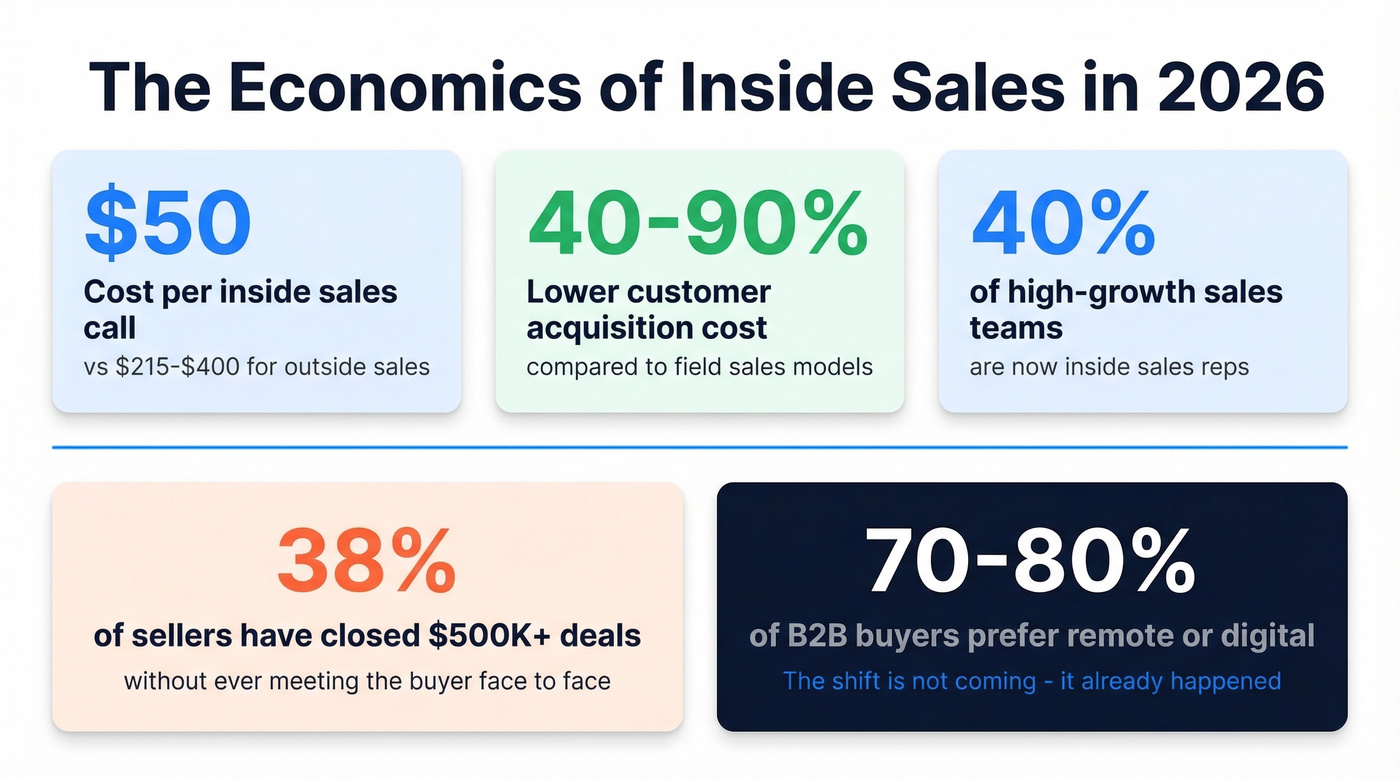
An inside sales team sells remotely - phone, email, video, chat. No flights, no rental cars, no expense reports from steakhouse dinners. The economics are straightforward: an inside sales call runs about $50 vs. $215-$400 for an outside sales call. Beyond the per-call savings, inside sales can reduce customer acquisition cost by 40-90% compared to field sales models. That cost gap is why inside sales reps now make up around 40% of high-growth sales teams.
The "inside" label sometimes gets confused with telemarketing. They're not the same thing. Telemarketing is scripted, high-volume, transactional. Inside sales involves discovery calls, demos, multi-touch sequences, and deal cycles that typically run 30-90 days. These are real salespeople working real deals - they just do it from a desk.
And the deals aren't small. 38% of sellers have closed $500K+ deals without ever meeting the buyer face-to-face, and 70-80% of B2B buyers now prefer remote meetings or digital self-service over in-person interactions, per McKinsey. The shift isn't coming. It happened.
Core Roles and Responsibilities
Most inside sales orgs are built from a similar set of roles. The titles vary - one company's "BDR" is another's "SDR" - but the functions don't.
| Role | What They Do | Key Metrics | OTE Range |
|---|---|---|---|
| SDR/BDR | Prospect, qualify, book meetings | Demos held, pipeline created | $70K-$90K |
| Inside Sales Rep | Run full-cycle deals (SMB) | Revenue closed, win rate | $90K-$110K |
| Mid-Market AE | Close mid-market deals | Revenue, deal velocity | $120K-$160K |
| Enterprise AE | Close complex, high-ACV deals | Revenue, multi-thread depth | $180K-$250K+ |
| Sales Manager | Coach, forecast, hire | Team quota attainment | $130K-$180K |
| CSM | Onboard, retain, expand | NRR, churn, expansion | $80K-$120K |
SDRs are the engine. They're the ones making 50-100 touches a day, turning cold lists into warm conversations. The mistake most teams make is treating the SDR role as a 12-month proving ground instead of a real career function - we'll come back to that.
Inside Sales Reps handle full-cycle deals at the SMB level. Mid-Market and Enterprise AEs take progressively larger, more complex accounts. The Sales Manager's job isn't to close deals - it's to make everyone else better at closing deals. And the CSM sits at the end of the chain, turning closed revenue into retained revenue.
SDR-to-AE ratios: start at 1:1 - one SDR feeding one AE - then adjust based on deal complexity and inbound volume. High-volume, lower-ticket models often run 2:1 SDR-to-AE. Enterprise teams with longer cycles run 1:2. Get this ratio wrong and you'll either starve your AEs or waste SDR capacity.
The OTE ranges above come from the latest Everstage compensation benchmarks and Payscale data/Salary). They're directional - your market, vertical, and stage will shift these up or down.
How to Structure Your Team
Three models. Pick one, then evolve.
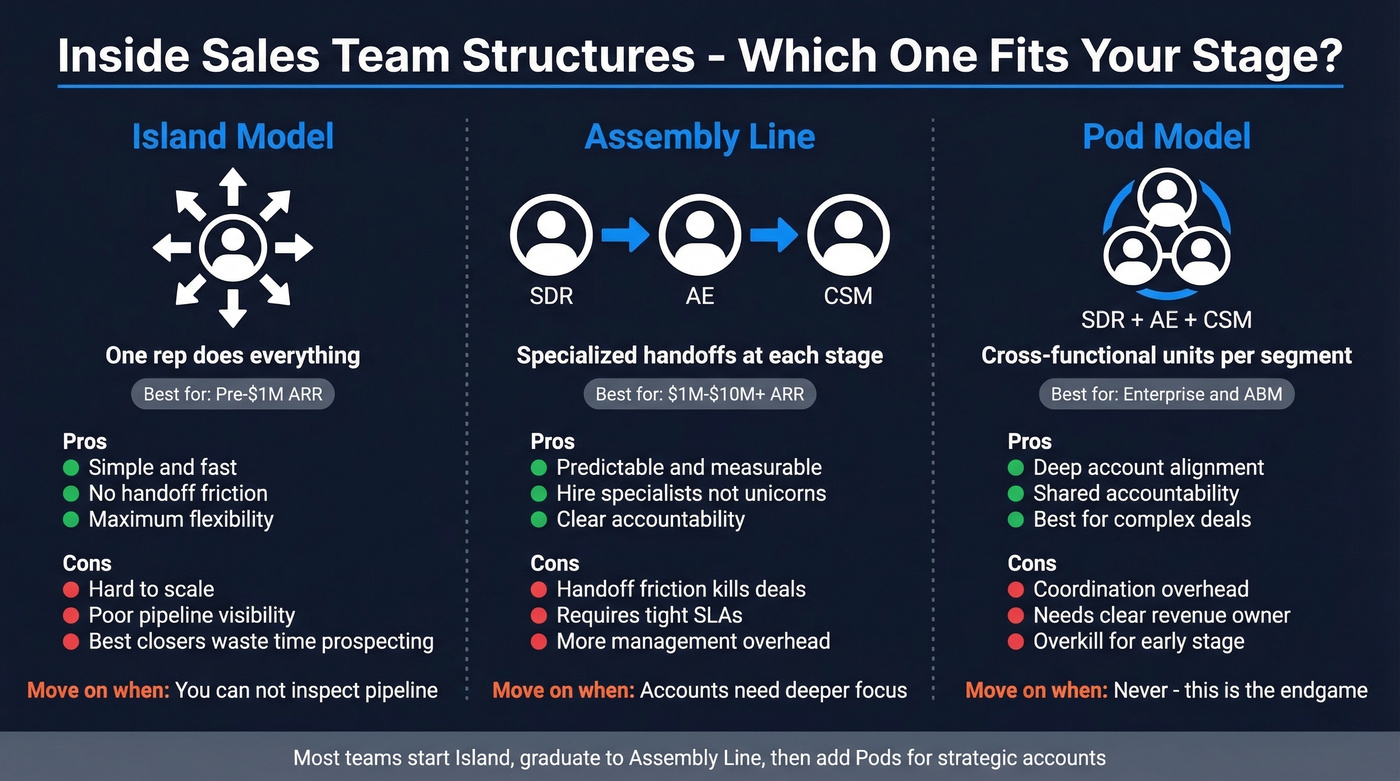
| Model | Best For | Pros | Cons | Move On When |
|---|---|---|---|---|
| Island | Early-stage, <$1M ARR | Simple, fast, flexible | Hard to scale/forecast | You can't inspect pipeline |
| Assembly Line | $1M-$10M+ ARR, volume | Predictable, measurable | Handoff friction | Accounts need deeper focus |
| Pod | Enterprise, ABM | Aligned, accountable | Coordination overhead | Never - it's the endgame |
Island Model
One rep owns everything: prospecting, qualifying, demoing, closing, and sometimes even onboarding. It's the default for early-stage companies because it's simple and you can't afford specialization yet.
The upside is speed. No handoffs, no "who owns this lead" debates, no Slack threads about SLAs. The downside is that your best closer is spending 40% of their day prospecting, and your pipeline visibility is whatever's in their head. Island works until it doesn't - and it often starts breaking as you approach the first couple million in ARR.
Assembly Line
SDRs prospect and qualify. AEs demo and close. CSMs onboard and expand. Each role has clear metrics, clear handoffs, and clear accountability.
This is the model most B2B SaaS companies land on as they scale through early growth into mid-market. It's predictable, it's measurable, and it lets you hire specialists instead of unicorns. The risk is handoff friction - if your SDR-to-AE handoff doesn't have a tight SLA covering response time, context transfer, and meeting prep, you'll lose deals in the gap. (If you need templates, start with these handoff patterns.)
Pod Model
A pod is typically an SDR, an AE, and a CSM aligned to a specific segment, vertical, or set of named accounts. They operate as a mini-team with shared goals.
Pods shine in enterprise and ABM motions where account depth matters more than volume. The coordination overhead is real - you need a clear revenue owner per pod, and you need to resist the urge to over-engineer the structure. If you're still early-stage and someone suggests pods, they're overcomplicating things. Many orgs run hybrids: assembly line for velocity segments, pods for strategic accounts. That's the right call for most mid-market teams.

You just read that 75% of reps miss quota - and stale data is a top reason. Prospeo gives your inside sales team 300M+ profiles with 98% email accuracy and 125M+ verified mobile numbers, refreshed every 7 days. At $0.01 per email, your SDRs spend time selling, not cleaning lists.
Stop starving your reps. Give them contacts that actually connect.
Compensation That Drives Results
OTE Ranges and Pay Mix
| Role | OTE Range | Pay Mix (Base/Variable) |
|---|---|---|
| SDR/BDR | $70K-$90K | 70/30 |
| Inside Sales Rep | $90K-$110K | 60/40 |
| Mid-Market AE | $120K-$160K | 50/50 |
| Enterprise AE | $180K-$250K+ | 50/50 |
SPIFFs - short-term performance incentives - typically run 5-10% of variable comp. Use them to drive specific behaviors like booking demos with a target persona or multi-threading into accounts, not as a permanent fixture.
The math that matters: per SaaStr, reps must eventually close roughly 4x their OTE to be profitable at scale. An AE with $150K OTE needs to close $600K+ in annual revenue. If your deal sizes don't support that, you've got a unit economics problem, not a hiring problem.
If you want to sanity-check your numbers, start with the definition and formula for OTE.
Comp Plan Design
39% of revenue leaders say their comp plans don't align with business goals. That's almost half the market running incentives that point reps in the wrong direction.
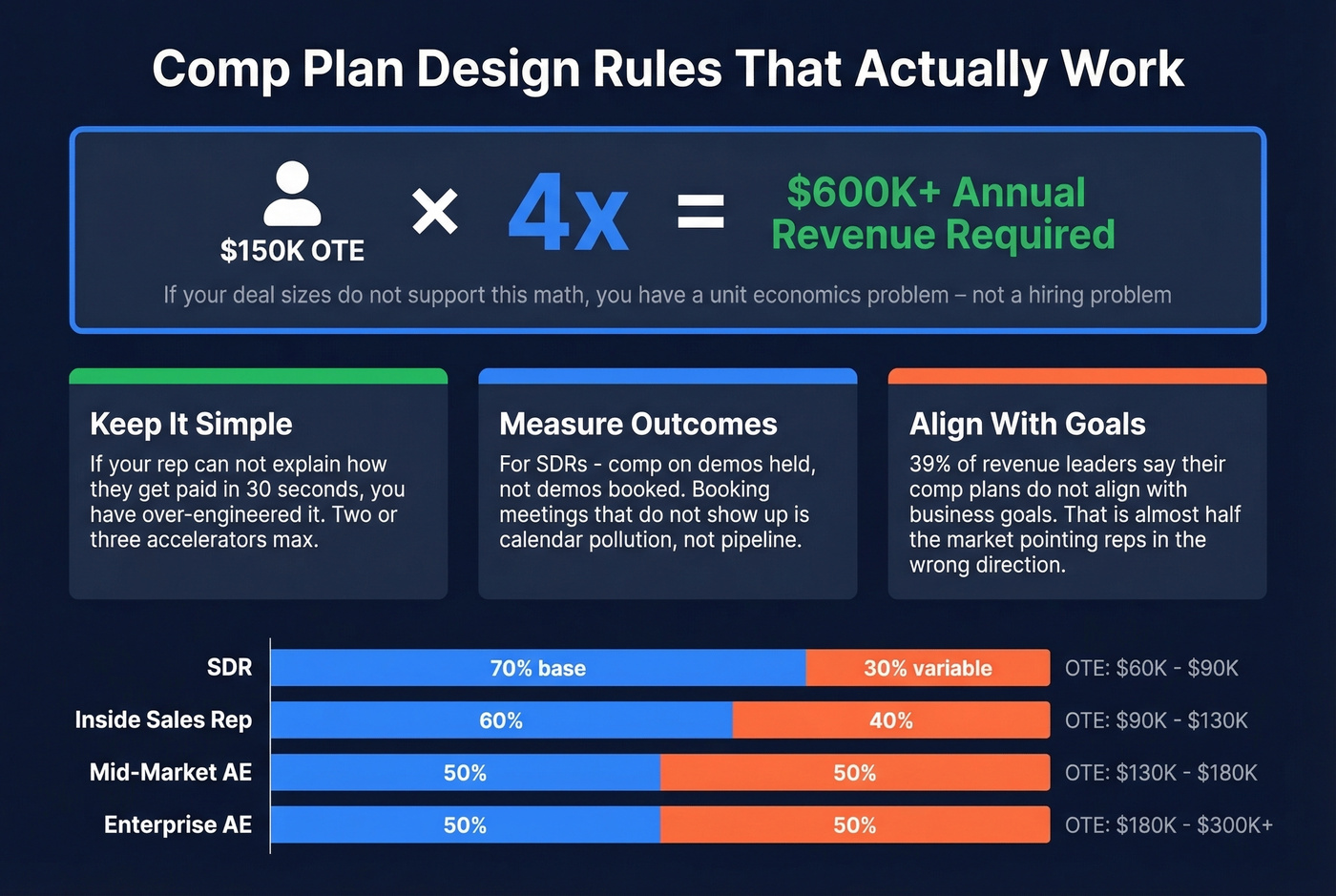
Here's the thing: if your rep can't explain how they get paid in 30 seconds, you've over-engineered it. Two or three accelerators max. One primary metric. One secondary metric. Done.
For SDRs, the primary comp trigger should be demos held - not demos booked, not raw dials, not emails sent. Booking meetings that don't show up is calendar pollution, not pipeline generation. Tie comp to the outcome that actually creates pipeline, and watch behavior change overnight.
KPIs and Benchmarks
Sales reps spend 60% of their time on non-selling tasks. That means your KPIs need to measure what reps do with the 40% that matters - not just whether they're busy.
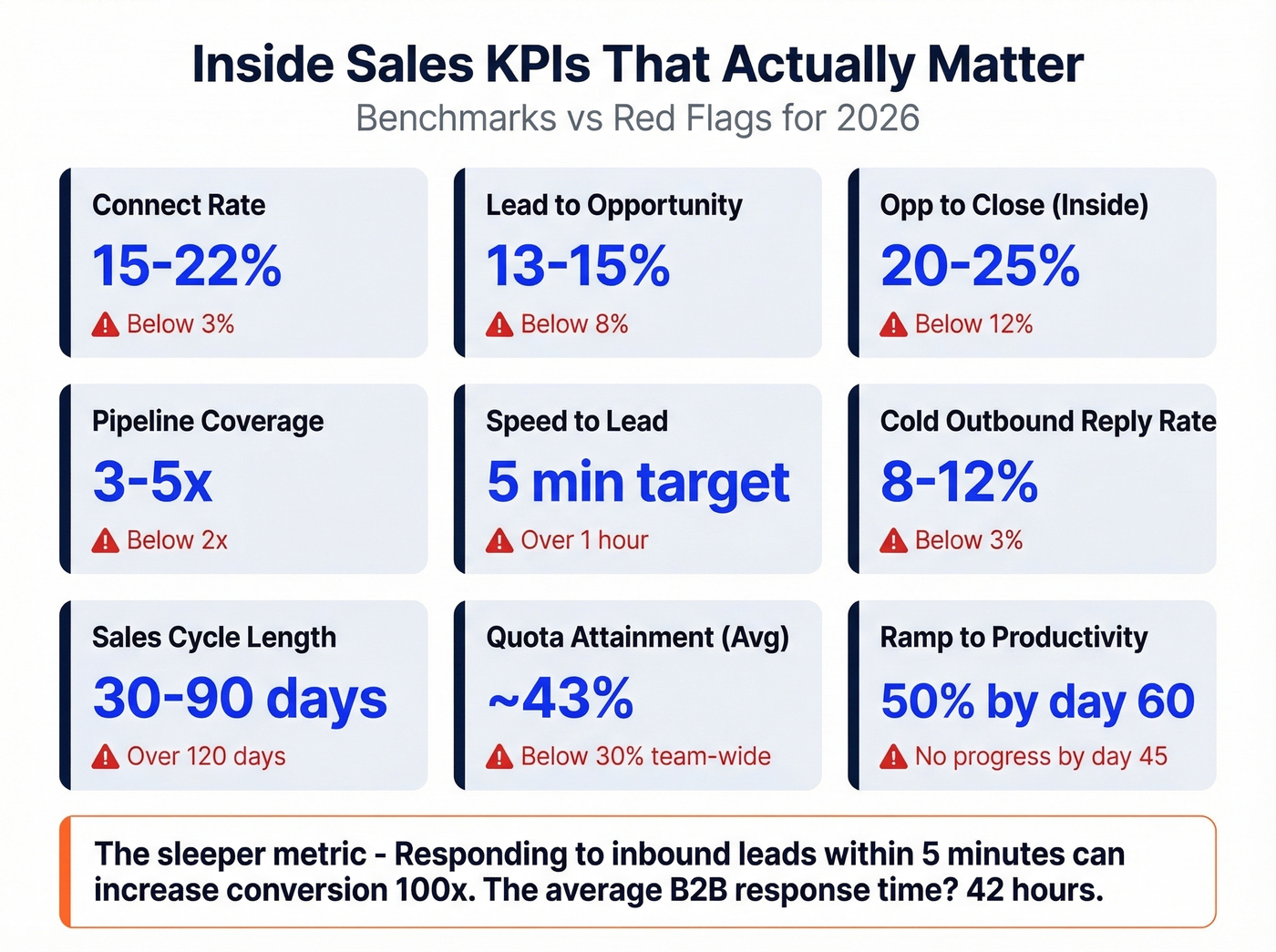
| Metric | Benchmark | Red Flag |
|---|---|---|
| Calls/day (high-value) | 30-50 | <15 |
| Calls/day (high-volume) | 80-100 | <50 |
| Emails/day | 30-50 | <15 |
| Connect rate | 15-22% | <3% |
| Lead-to-opportunity | 13-15% | <8% |
| Opp-to-close (inside) | 20-25% | <12% |
| Opp-to-close (enterprise) | 15-20% | <10% |
| Pipeline coverage | 3-5x | <2x |
| Speed-to-lead | 5 min target | >1 hour |
| Cold outbound reply rate | 8-12% (top-tier) | <3% |
| Sales cycle | 30-90 days | >120 days |
| Ramp to productivity | 50% by day 60 | No progress by day 45 |
| Quota attainment (avg) | ~43% | <30% team-wide |
Speed-to-lead is the sleeper metric. Contacting an inbound lead within 5 minutes can increase conversion up to 100x versus waiting 30 minutes. The average lead response time across B2B? 42 hours. That's not a typo.
Pipeline coverage below 2x means your team is flying blind. Above 5x usually means your pipeline is full of stale deals nobody's working. The sweet spot is 3-4x, with weekly pipeline hygiene to keep it honest. (More on keeping it clean: pipeline health.)
And quota attainment hovering around 43% isn't a rep problem - it's a systemic one. If fewer than half your reps are hitting number, look at data quality, territory design, comp alignment, and enablement before you start blaming effort.
Onboarding Reps (30-60-90 Plan)
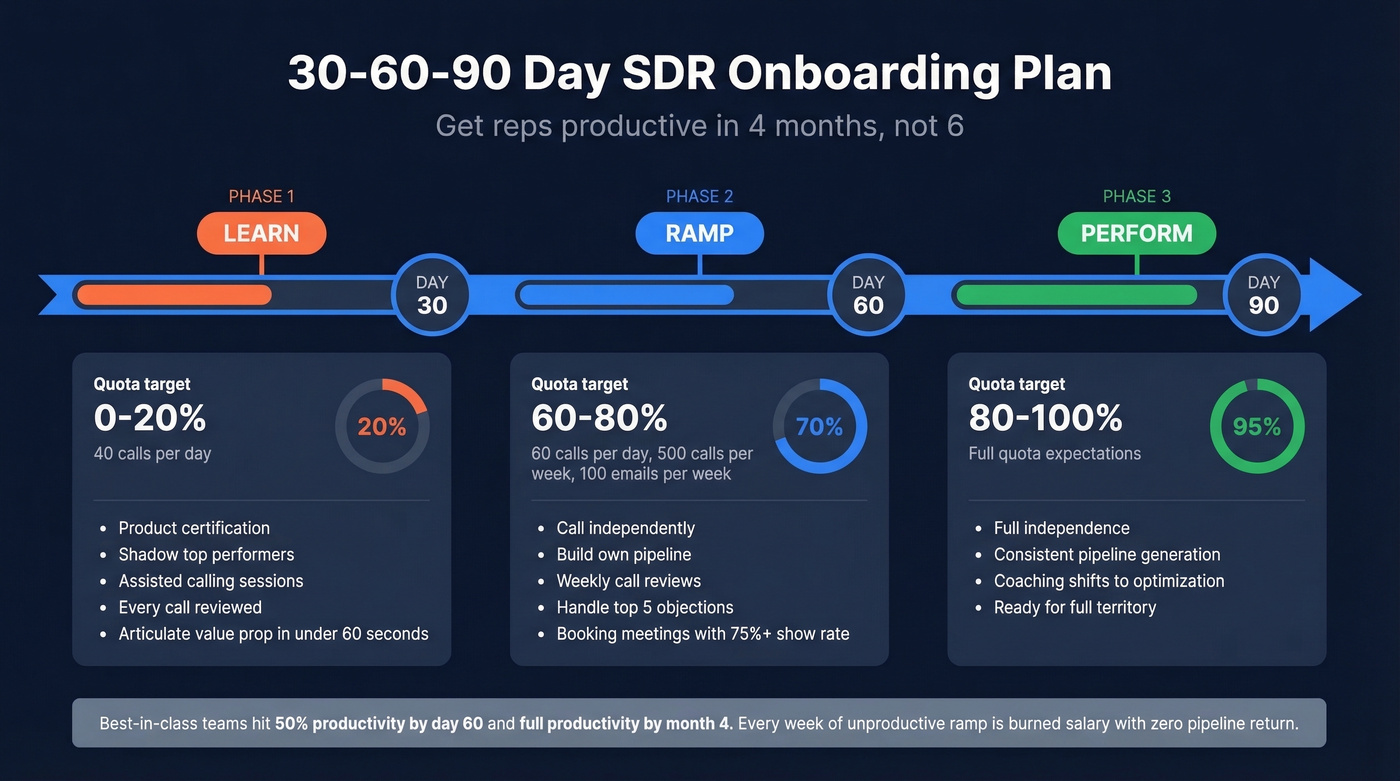
Industry average SDR ramp is 4-6 months. That's too long. A structured 30-60-90 plan should get reps productive fast - best-in-class teams hit 50% productivity by day 60 and full productivity by month four. Every week of unproductive ramp is a week of burned salary with zero pipeline return.
If you want a plug-and-play version, use this 30-60-90 plan framework.
Days 1-30: Learn
We've watched founders hand new SDRs a laptop and a login on day one and say "start dialing." Those reps are gone in 90 days. The first month isn't about production - it's about building the foundation.
Reps make 40 calls a day with a 15-20% contact rate, aiming for 6-8 conversations and 1-2 meetings per week. The focus is product certification, shadowing top performers, assisted calling sessions, and role plays. Every call gets reviewed. Every objection gets documented. Quota target: 0-20%.
By day 30, a rep should be able to run a cold call without a script in front of them and articulate the product's value prop in under 60 seconds. (If they struggle, give them a few sample elevator pitches to adapt.)
Days 31-60: Ramp
Quota target: 60-80%. Activity jumps to 60 calls/day, 500 calls/week, 100 emails/week, and 6-8 meetings/week. Reps are calling independently now, building their own pipeline, and getting weekly call reviews from their manager.
Use this checklist to evaluate ramp progress at day 45:
- Hitting 60%+ of quota
- Running discovery calls without manager support
- Handling the top 5 objections cleanly
- Building pipeline independently, not just working inbound
- Booking meetings that actually show (75%+ show rate)
The reps who check most of these boxes by day 45 are your keepers. The ones still struggling with basic objection handling need more coaching - or a different role.
Days 61-90: Perform
If a rep isn't at 80%+ productivity by day 60, something's broken. Either the training was insufficient, the territory is wrong, or the hire was wrong. Diagnose fast - don't let it drift to day 90 hoping things improve.
Full quota ownership kicks in here: 80-100 calls/day, 2-3 meetings daily, 85%+ show rate on booked demos. Coaching shifts from "how to prospect" to "how to close" - deal strategy, multi-threading, negotiation. Quota target: 90-110%.
The Essential Tech Stack
You need three tools. CRM, sequencer, data provider. Everything else is a nice-to-have you add when you've maxed out those three. We've seen teams stack six or seven tools and still book fewer meetings than a two-person team with the basics dialed in.
If your average deal size is under $15K, you don't need a $40K/year data platform or a $150/seat engagement tool. Nail the fundamentals with affordable, accurate tools and invest the savings in hiring another rep. That rep will generate more pipeline than any software upgrade.
CRM
Start with HubSpot (free tier, then paid Starter plans) or Pipedrive ($14-$79/seat/mo depending on tier). Both are intuitive, both integrate with everything, and neither requires a dedicated admin to manage. Close CRM starts around $9/month and includes a built-in dialer, so it's worth a look for cold-calling-heavy teams. Salesforce makes sense when you have 10+ reps and a RevOps person to manage it. Before that, it's overkill. (If you're still deciding, here are examples of a CRM with real pricing.)
Data and Prospecting
Your tech stack doesn't matter if your data is garbage. A $50K/year sales engagement platform running on ~79% accurate email data is a $50K bonfire. In one r/techsales thread, a poster cited a stack with multiple tools and still saw 19% open rates and 2.3% reply rates. The tools weren't the problem. The data was.
Prospeo is where we'd start for any team building its prospecting foundation. The database covers 300M+ professional profiles with 143M+ verified emails at 98% accuracy, plus 125M+ verified mobile numbers that hit a 30% pickup rate. Data refreshes every 7 days - the industry average is 6 weeks, which means most providers are serving you contacts who've already changed jobs. Credit-based pricing at roughly $0.01/email, with a free tier that gives you 75 emails and 100 Chrome extension credits per month. No contracts, no sales calls required.
If you're comparing vendors, start with a shortlist of data enrichment services and sales prospecting databases.
The proof point that matters: GreyScout cut rep ramp time from 8-10 weeks to 4 weeks after switching their data provider. Bounce rates dropped from 38% to under 4%, and pipeline went up 140%. When reps trust the data, they spend less time verifying and more time selling.

Apollo is the budget alternative - free tier with paid plans from $49-$99/mo per user. Solid for getting started, but email accuracy runs closer to 79%, which means one in five emails bounces. Skip ZoomInfo unless you're firmly mid-market - at $15K-$40K/yr on annual contracts, the ROI math doesn't work for most early-stage teams.
Sales Engagement / Sequencing
For cold email, Instantly (~$30/mo) or Lemlist are the go-to options. Both handle warm-up, sequencing, and basic analytics without the enterprise price tag.
Salesloft or Outreach ($100-$150/user/mo) make sense for larger teams that need multi-channel orchestration, call recording, and manager dashboards. Pick one. Master it. Don't stack four sequencers - that's how you end up with duplicate sends and burned domains. (If you want to level up the craft, use these sales follow-up templates and cold email follow-up templates.)
AI Tools
One stat worth paying attention to: sellers using AI sales tools are 3.7x more likely to meet quota. But the basics come first - CRM, sequencer, and data provider need to be dialed in before you add complexity. Once they are, AI-powered call coaching tools like Gong and Chorus are the next layer. In our experience, teams that add AI tooling before fixing their data quality just get faster at making the same mistakes.
You need three tools to launch an inside sales team: a CRM, a sequencer, and a data provider with verified contacts. Prospeo covers that third pillar with 30+ search filters, 98% email accuracy, and a 30% mobile pickup rate - so your assembly line never stalls on bad data.
Teams using Prospeo book 35% more meetings than Apollo users.
Mistakes That Kill Performance
Hiring reps you wouldn't buy from yourself. If a candidate can't sell you on why they want the job during the interview, they won't sell your product to strangers. Trust your gut on this one.
Not training reps 3-10. Look, your first two hires figured it out because they had to. Reps 3-10 won't have that same founder proximity. They need real onboarding, real enablement, and real coaching. One thread on r/Entrepreneur nailed it - business owners blamed underperformance on motivation, but the real culprit was lack of training and org support. Treating SDR as a 12-month proving ground instead of a real role is how you burn through talent.
Running bad data through good tools. Teams that switch to verified, frequently refreshed data see bounce rates drop from 35-40% to under 5% and pipeline increases of 140-180%. Data quality isn't a nice-to-have - it's the foundation everything else sits on. (If you're diagnosing issues, start with email bounce rate benchmarks and fixes.)
Overly complex comp plans. Remember the simplicity test: 30 seconds. If your reps can't explain how they get paid, they can't optimize for it.
Too few leads per rep - or too many. Under-fed reps prospect desperately and take bad meetings. Over-fed reps cherry-pick and let good leads rot. Find the optimal load for your deal cycle and defend it.
Hiring a VP Sales who's never built from scratch. Managing a team of 50 at a large tech company is a completely different skill than building a team of 5 at a Series A startup. Hire builders, not managers. (If you're scaling the function, this sales leadership guide helps.)
Waiting too long to specialize. Closers close. Openers open. The moment you have enough pipeline to justify splitting the roles, split them. Every week you wait is a week your best closer spends prospecting instead of closing. 73% of B2B buyers avoid sellers who send irrelevant outreach - specialization is how you stay relevant, and a well-run inside sales team separates these functions early to compound gains in pipeline velocity and win rates.
FAQ
What's the difference between inside and outside sales?
Inside sales reps sell remotely via phone, email, and video at roughly $50 per call. Outside reps travel to meet prospects in person at $215-$400 per call. With 70-80% of B2B buyers preferring remote engagement, inside sales delivers better unit economics for most companies.
How many SDRs do I need per AE?
Start with a 1:1 ratio - one SDR feeding one AE - then adjust based on deal complexity and inbound volume. High-volume, lower-ticket models often run 2:1 SDR-to-AE. Enterprise teams with longer sales cycles run 1:2.
How long does it take to ramp a new rep?
Industry average is 4-6 months. With a structured 30-60-90 onboarding plan, best-in-class teams hit 50% productivity by day 60 and full productivity by month four. Structured training beats "shadow someone for a week and start dialing."
What's a good quota attainment rate?
Recent benchmarks put average B2B quota attainment around 43%. Fully ramped SaaS reps typically achieve 50-60%. If your team is consistently below 40%, audit data quality, comp alignment, and enablement before blaming individual effort.
What's the best free data tool for a new inside sales team?
Prospeo's free tier includes 75 verified emails and 100 Chrome extension credits per month with 98% email accuracy - enough to validate data quality before committing budget. Apollo also offers a free tier, though email accuracy sits closer to 79%.