

IT Sales Lead Generation: A Data-Driven Playbook for 2026
Your SDR team just burned through a 2,000-contact list in three weeks. Open rates looked decent. Reply rates were abysmal. The VP of Engineering at your top target account? Bounced email, disconnected phone number, and a job title that's six months out of date. Meanwhile, the lead gen software market hit $7.4 billion - and 79% of marketing leads still never convert into sales.
The problem isn't that IT sales lead generation is impossible. It's that most teams are running a 2021 playbook against 2026 buyers who've already defined their requirements before they'll take your call. The gap between "generating leads" and "generating pipeline" is wider in IT than almost any other vertical, because the buying committees are bigger, the cycles are longer, and the technical buyers can smell a generic pitch from three tabs away.
This playbook covers what actually works - real CPL benchmarks, infrastructure math, and a tool stack you can deploy for under $200/month.
The Short Version
Fix your data first. Email verification alone can lift deliverability from 60% to 92%. Everything downstream - sequences, nurture, ABM - depends on reaching real inboxes. (If you want the deeper mechanics, start with an Email Deliverability Guide.)
Cold email is the highest-ROI channel for IT sales. $225 CPL vs $840 for trade shows. But only with proper domain infrastructure and warmup. (Use a safe email velocity model, not vibes.)
Start with three tools. A verified B2B data source, a sending platform like Instantly or Smartlead, and your existing CRM. Total cost: under $200/month. If you're evaluating platforms, compare SDR tools first.
Why IT Lead Gen Is Different
IT buying decisions don't look like SaaS purchases. They look like committee negotiations with technical veto power at every stage.
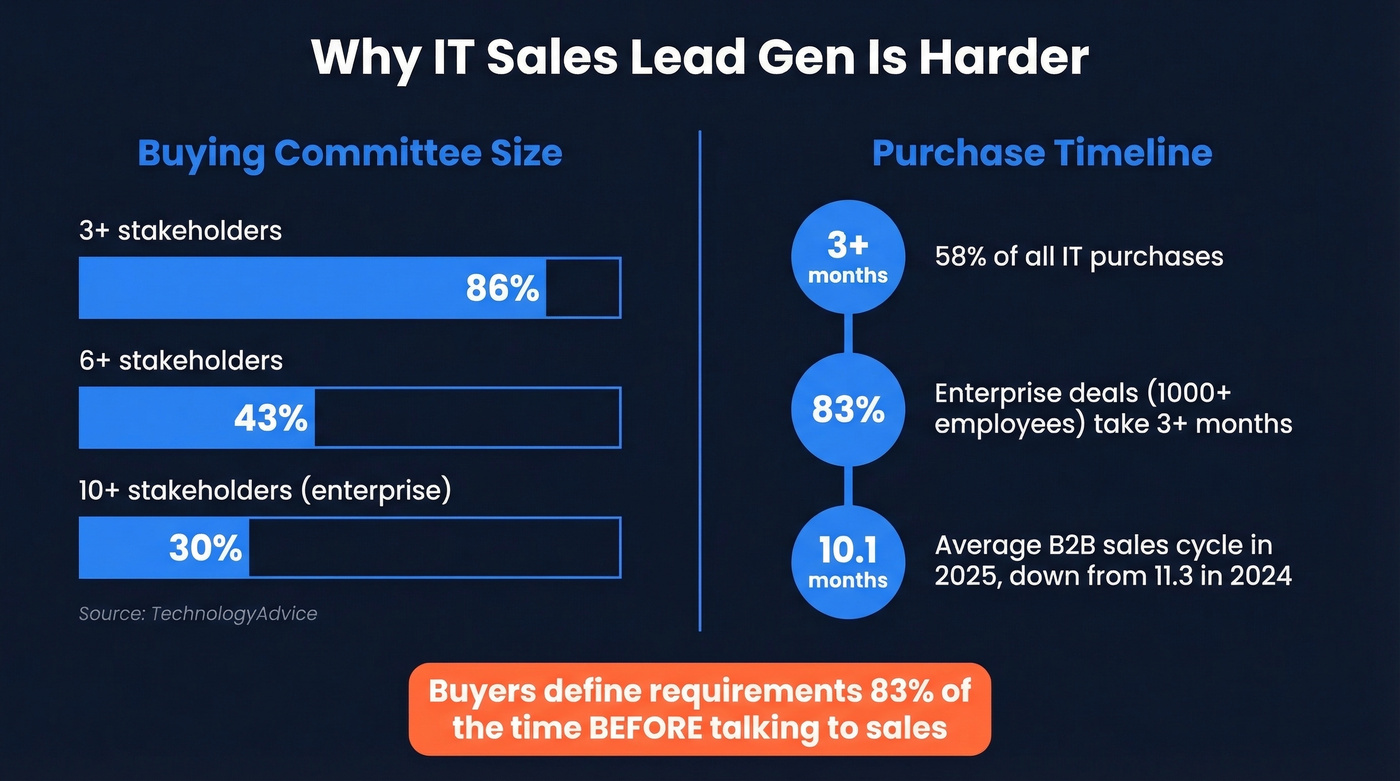
86% of IT professionals report three or more stakeholders involved in purchase decisions. 43% report six or more. At large enterprises, roughly 30% of deals involve ten-plus people - which means your single-threaded outreach to the CTO is reaching one node in a sprawling decision graph. That's a problem, and it's one that generic "spray and pray" outbound can't solve.
The timeline compounds the complexity. 58% of IT purchases take three or more months, and that number jumps to 83% at enterprises with 1,000+ employees. Average B2B sales cycles have compressed slightly - from 11.3 months in 2024 to 10.1 months in 2025 - but that compression is driven by buyers doing more independent research, not by sellers getting faster.
Buyers now define their purchase requirements 83% of the time before they'll talk to a salesperson. First contact has moved from 69% to 61% of the way through the buyer journey, pulling outreach earlier by roughly six weeks. Your lead gen program needs to reach prospects while they're still forming opinions - not after they've shortlisted three vendors and are just collecting a fourth quote for procurement. (This is where identifying buying signals becomes a core competency.)
AI Is Reshaping IT Buyer Research
Here's a shift you can't ignore: 80% of buyers trust AI tools at least sometimes for purchase research, up 19 points year-over-year. Google AI Overviews, ChatGPT-driven vendor comparisons, and autonomous research agents mean your prospects synthesize information faster than ever. They arrive at vendor conversations with deeper technical knowledge and sharper questions. If your outreach doesn't reflect that sophistication - if you're still leading with "I'd love to learn about your challenges" - you've already lost. (If you're leaning into automation, use AI cold email outreach responsibly.)
Why IT Lead Gen Programs Fail
Most failures don't happen at the top of the funnel. They happen at transition points - the handoffs, sync gaps, and ownership cracks that kill momentum after a lead is captured.
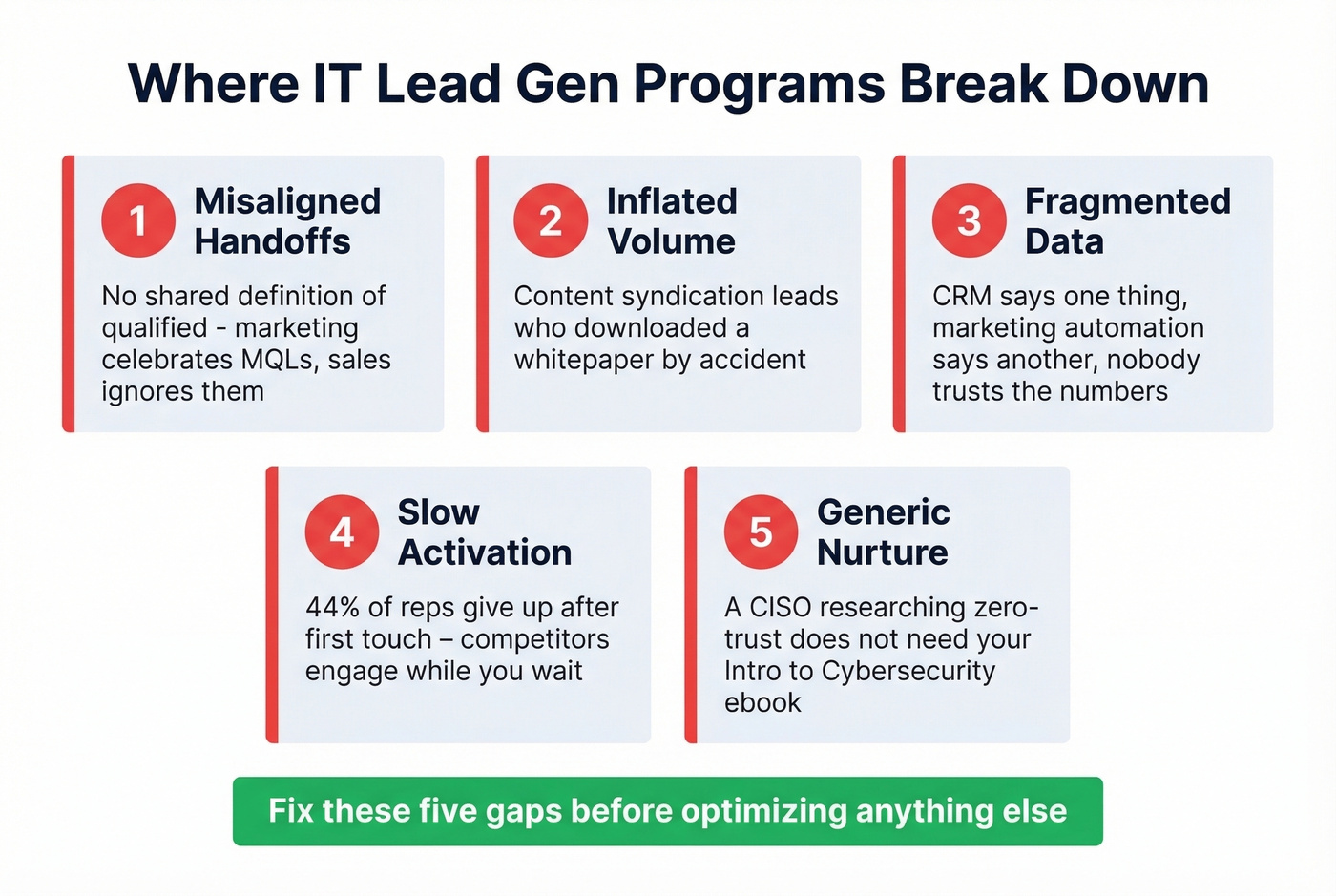
Misaligned marketing-to-sales handoffs. No shared definition of "qualified." No SLA on follow-up timing. Marketing celebrates MQLs; sales ignores them. 44% of reps give up after the first touch, and 80% of meetings come from follow-ups two through four. (If you need copy that actually drives those touches, keep sales follow-up templates handy.)
Low-quality placements inflating volume. Content syndication vendors promising 500 leads/month at $30 CPL sound great until you realize the "leads" downloaded a whitepaper while looking for something else entirely. We've fallen for this ourselves - the numbers look incredible in the dashboard and terrible in the pipeline.
Fragmented data and broken attribution. CRM says one thing, the marketing automation platform says another, and the intent data dashboard contradicts both. Nobody trusts the numbers, so nobody acts on them. (This is usually a lead generation workflow problem, not a reporting problem.)
Slow lead activation. Manual routing, delayed notifications, and "I'll get to it Monday" SDR culture mean competitors engage first. In IT sales, response time within the first hour dramatically increases meeting rates. Wait until tomorrow and you're fighting uphill.
Generic nurture after capture. Dumping every lead into the same drip sequence regardless of intent signal, persona, or buying stage. A CISO researching zero-trust architecture doesn't need your "Introduction to Cybersecurity" ebook.
What IT Leads Actually Cost
Let's put real numbers on this. Sopro's benchmarks break down CPL by industry and channel - and the spread is enormous.
CPL by Industry
| Industry | Average CPL | Low | High |
|---|---|---|---|
| IT & Managed Services | $501 | $385 | $617 |
| Software Development | $595 | $510 | $680 |
| B2B SaaS | $188 | $65 | $310 |
CPL by Channel
| Channel | Average CPL |
|---|---|
| Referrals | $25 |
| Multi-channel prospecting | $188 |
| SEO | $206 |
| Cold email | $225 |
| Cold calling | $300 |
| Paid LinkedIn ads | $408 |
| PPC | $463 |
| Trade shows / events | $840 |
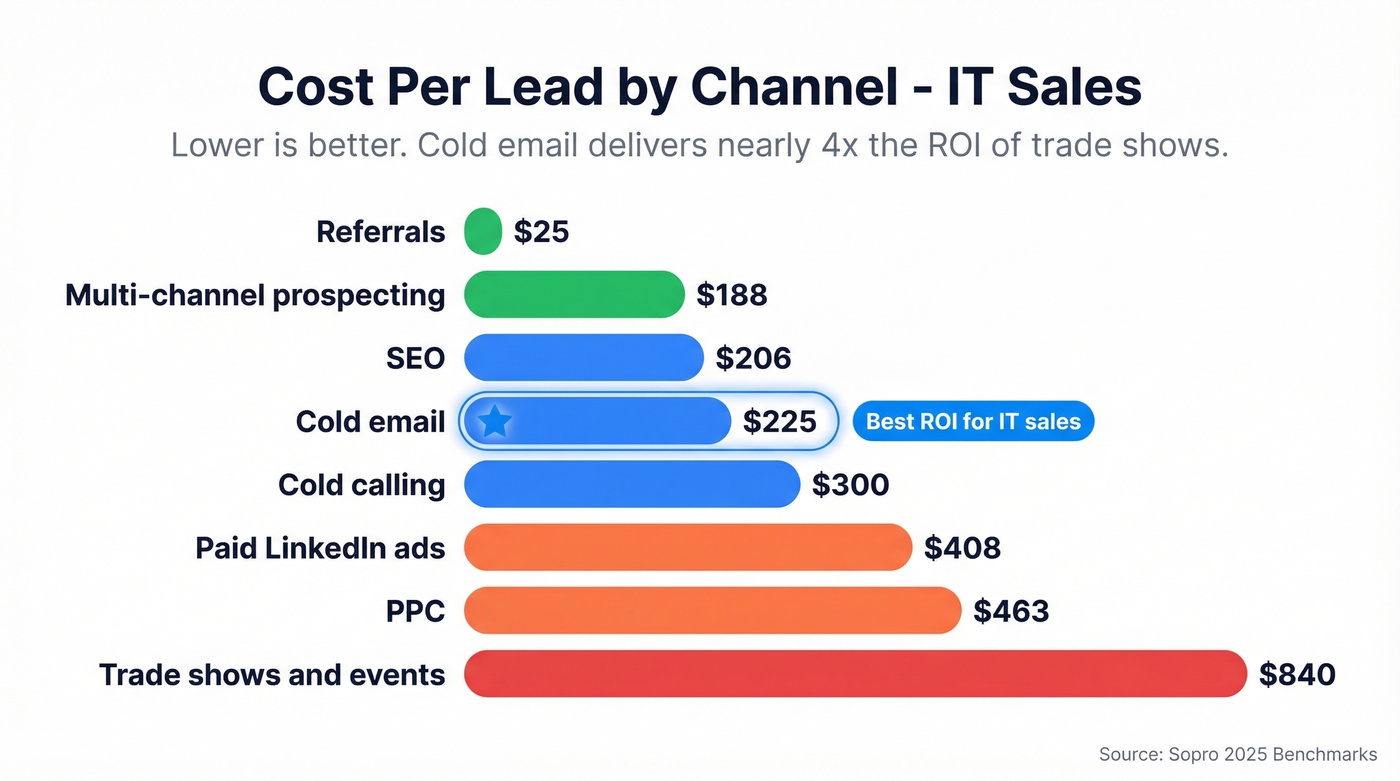
The ROI case for cold email is stark. At $225 per lead versus $840 for events, you're looking at nearly 4x the efficiency - assuming your infrastructure is right. That "assuming" is doing a lot of heavy lifting, which is why the next section matters more than anything else in this playbook.
Fix Your Data Before Anything Else
None of the strategies below work if your contact data is garbage. Bad emails tank deliverability, burn domains, and train inbox providers to treat your outreach as spam. We've seen teams waste months optimizing sequences and subject lines before realizing their data was the real bottleneck all along. (If you're cleaning lists at scale, start with data enrichment services and verification.)
List validation can move deliverability from 60% to 92%. That's not a marginal improvement - it's the difference between a sequence that generates pipeline and one that generates spam complaints.
Before you send a single email, get your domain infrastructure right. Configure SPF, DKIM, and DMARC records on secondary domains - never your primary. Warm those domains for 14-21 days. Skip this step and nothing else matters. (If you need a technical checklist, use SPF record examples and DMARC alignment.)

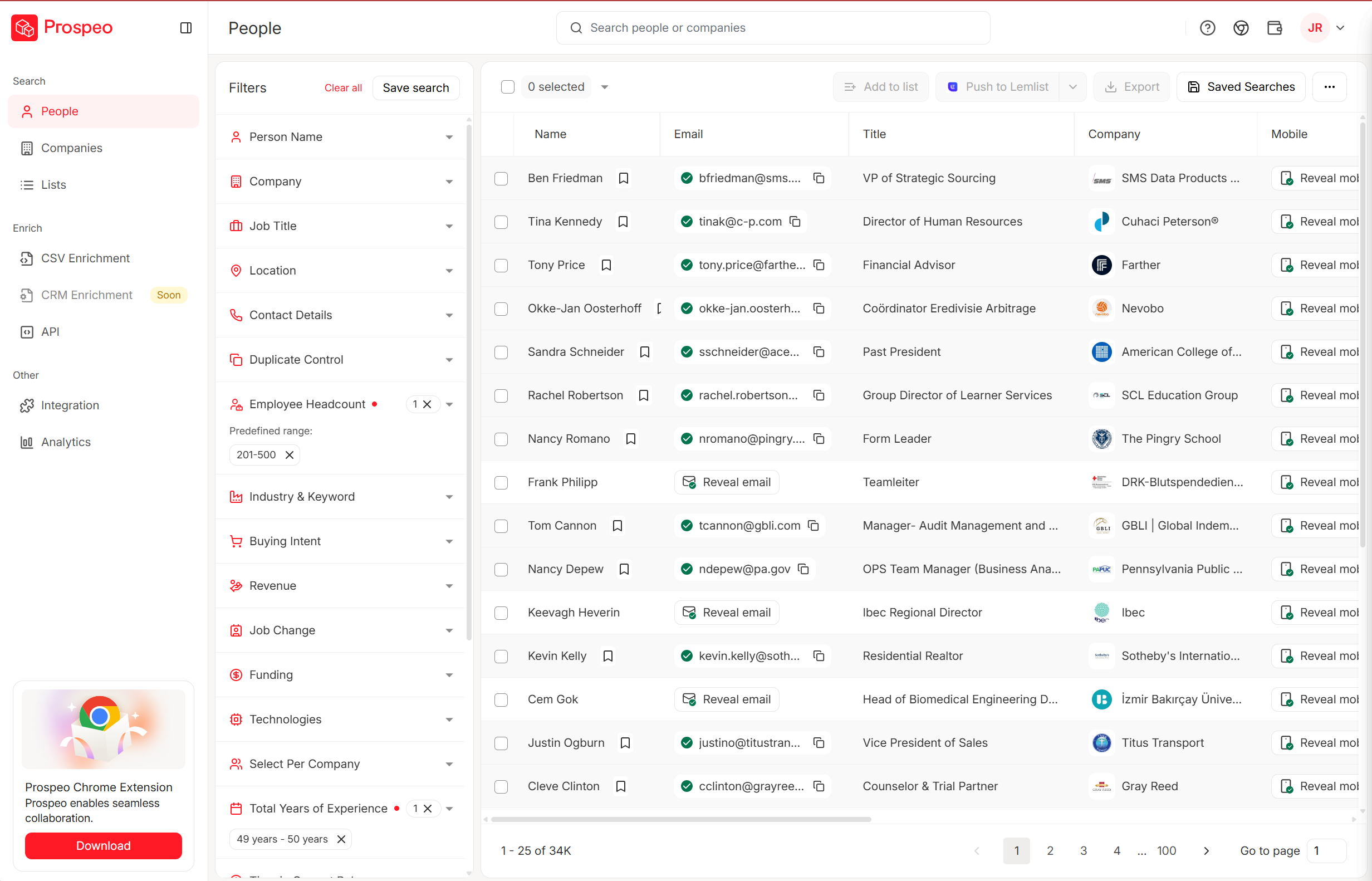
You just read that list validation can move deliverability from 60% to 92%. Prospeo's 5-step verification delivers 98% email accuracy on 300M+ profiles - refreshed every 7 days, not every 6 weeks. At $0.01 per email, your entire 2,000-contact IT list costs less than a single trade show lunch.
Stop burning domains on bad data. Start with emails that actually land.
Cold Email for IT Sales Leads
Cold email at $225 CPL is the best channel on the board for technology lead generation. But "cold email" isn't one thing - it's an infrastructure problem disguised as a messaging problem. (If you want a build-from-scratch framework, use a B2B cold email sequence.)
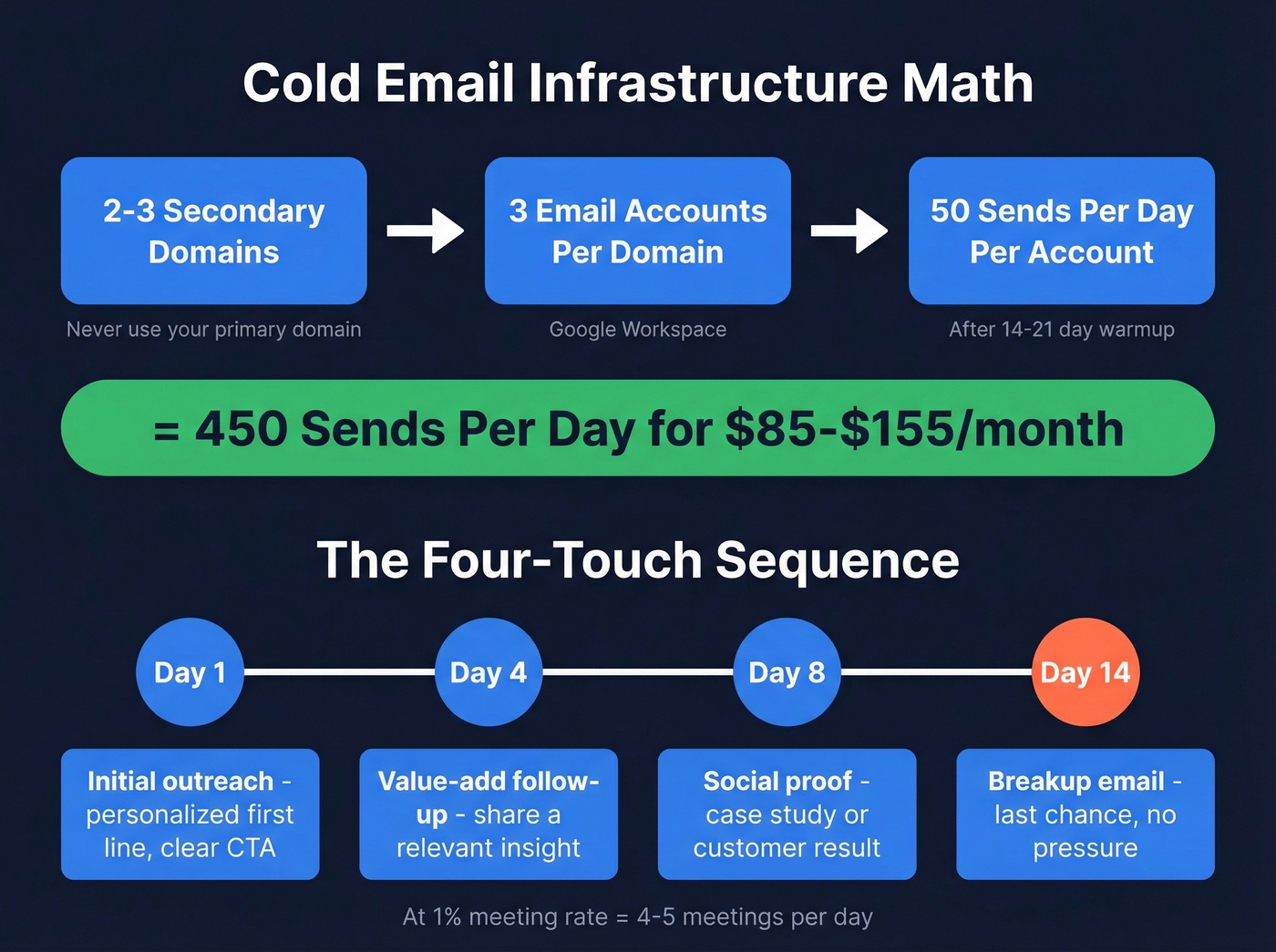
The infrastructure math. Buy 2-3 secondary domains. Create 3 email accounts per domain. Cap each account at 50 sends/day after warmup. That gives you 3 domains x 3 accounts x 50 emails = 450 sends per day. Total infrastructure cost runs about $85-$155/month for domains, Google Workspace, and a sending tool like Instantly.ai ($30-$97/mo) or Smartlead ($39-$94/mo).
The four-touch sequence. In our testing, four touches over two weeks consistently outperforms longer drips for IT buyers. Day 1 is your initial outreach. Day 4 is a value-add follow-up. Day 8 brings social proof or a case study. Day 14 is the breakup email. Don't overthink the copy - personalization on the first line and a clear, low-friction CTA matter more than clever subject lines. (If you need ideas, pull from these cold email subject line examples.)
What good looks like. Cloudreach's SDR team generated 100-150 leads per week per rep using a sales intelligence platform, building $4.9M in pipeline. That's the kind of output a well-oiled outbound engine produces - but it requires clean data feeding the top of the sequence, not a purchased list from two years ago.
Realistic benchmarks for your sequences:
| Metric | Expected Range |
|---|---|
| Deliverability | 95%+ |
| Open rate | 40-60% |
| Reply rate | 3-8% |
| Positive reply rate | 1-3% |
| Meeting booking rate | 0.5-2% |
At 450 sends/day with a 1% meeting rate, that's roughly 4-5 meetings per day. Even at the low end, you're booking 2+ meetings daily for under $200/month in core tooling.
Intent Data for In-Market IT Buyers
Intent data is the most overhyped and underdelivered category in B2B sales tech. 91% of B2B marketers now use it, but only 24% report exceptional ROI. That gap tells you everything about how most teams implement it.
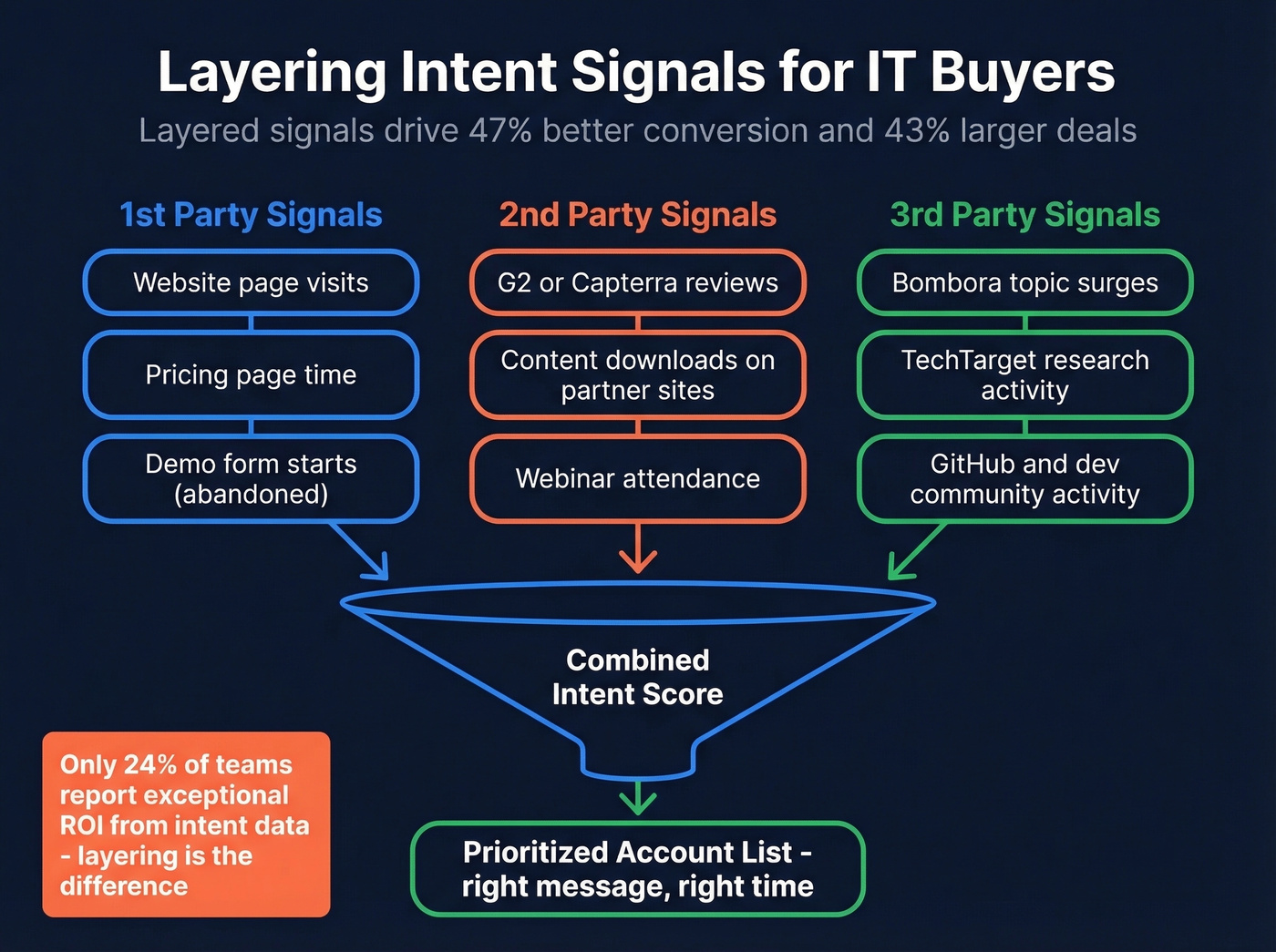
The teams that get results layer multiple signal types - first-party (your website visitors), second-party (review site activity, content consumption), and third-party (Bombora, TechTarget, etc.). Layered signals drive 47% better conversion rates and 43% larger deal sizes compared to single-source intent. (To operationalize this, build intent based segmentation into your routing and sequences.)
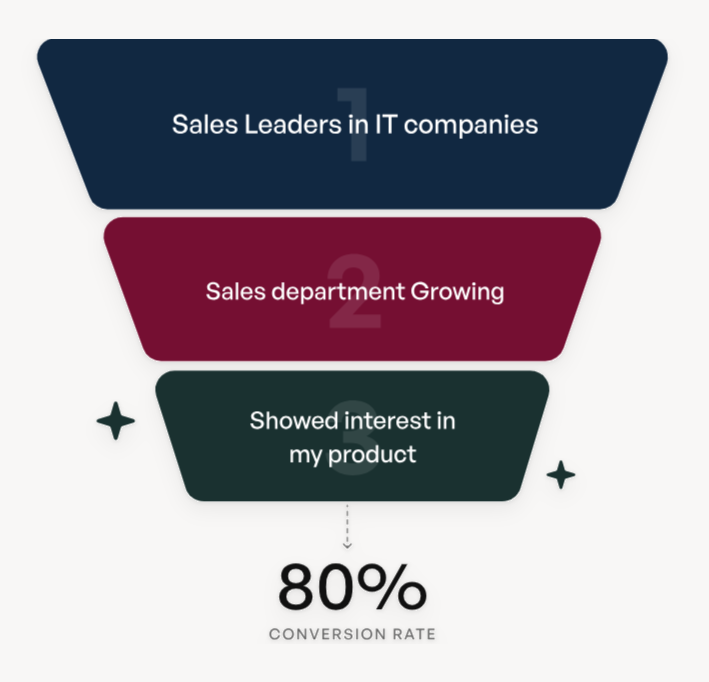
One firm used Bombora to identify companies actively researching "zero-trust architecture," then targeted those accounts with tailored outreach. The result: 37% more booked demos in two months.
For technical buyers specifically, don't overlook non-traditional intent signals. GitHub activity, open-source contributions, developer community engagement, and discussions in subreddits like r/sysadmin or r/devops can reveal which companies are actively evaluating solutions in your category. The consensus on r/sales is that these signals are harder to capture at scale, but they're also signals your competitors aren't tracking - which makes them disproportionately valuable.
The pricing spread is wild. Standalone Bombora contracts run $12K-$40K/year. 6sense enterprise deployments can hit $300K+/year. Entry-level website visitor identification tools start around $99/month. If you want to test intent data without a five-figure commitment, Prospeo includes Bombora-powered intent data covering 15,000 topics as part of its platform - a far more accessible entry point.
ABM for IT Sales Teams
Account-based marketing maps naturally to IT buying because IT buying is already account-based - you're just formalizing what the committee structure demands. (If you're aligning sales + marketing around accounts, follow account-based selling best practices.)
The framework that works uses three tiers. 1:Many targets hundreds of accounts with personalized ads and content. 1:Few runs cluster campaigns for 10-50 accounts sharing a vertical or pain point. 1:1 deploys fully custom plays for your top 5-10 accounts with bespoke content, executive engagement, and multi-threaded outreach.
The proof points are strong. AVEVA ran a 1:1 ABM program targeting GSK that generated PS7m in active pipeline and 46 new relationships, winning Forrester's B2B Program of the Year. Acxiom built PS1.5m in pipeline within 120 days entering a new vertical. BlueBotics - with a marketing team of one - generated PS4m+ in opportunities and PS750K+ in revenue from their initial ABM investment. The common thread across all three: multi-threading into the buying committee. When 43% of IT purchases involve six or more stakeholders, a single-threaded approach is a coin flip at best.
Let's be honest: if your average contract value is under $15K, skip ABM entirely. The ROI math only works when the deal size justifies the per-account investment. Below that threshold, well-executed cold email with tight segmentation will outperform a half-baked ABM program every time.
Content IT Buyers Actually Trust
IT buyers are skeptical by training. They evaluate tools the way they evaluate code - by looking at what's proven, not what's promised. (If you're building a system around this, start with what is B2B content marketing.)
The content formats that IT professionals rate highest are customer case studies (63% rate them highly important), independent expert research (62%), and product reviews (59%). Notice what's missing - vendor whitepapers, infographics, and thought leadership pieces don't crack the top three.
For generating B2B IT leads specifically, ungate your best content. Gating a case study behind a form generates a "lead" who resents you for making them fill out fields to read a PDF. Ungate the case study, let it build trust, and gate the high-commitment formats instead: webinars with live Q&A, free trial access, and personalized demo requests. Those are the formats where form friction signals genuine buying intent.
One emerging quality signal worth watching is zero-party data - information buyers voluntarily declare through interactive assessments, preference centers, or manual opt-ins. A "What's your IT infrastructure maturity?" quiz that delivers a personalized report generates far higher-quality leads than a gated PDF, because the prospect is actively telling you what they care about.
The Complete Tool Stack
Here's the full stack organized by function so you can see where the money goes.
| Category | Tool | Pricing |
|---|---|---|
| B2B Data | Prospeo | Free (75 emails/mo), paid from ~$39/mo |
| B2B Data | Apollo | Free tier, $49-$99/mo/user |
| B2B Data | ZoomInfo | ~$15K-$40K/yr |
| Email Verification | MillionVerifier | ~$37 per 10K emails |
| Email Verification | ZeroBounce | ~$40 per 5K emails |
| Sending + Warmup | Instantly.ai | $30-$97/mo |
| Sending + Warmup | Smartlead | $39-$94/mo |
| CRM | HubSpot | Free, Starter from $15/user/mo |
| CRM | Salesforce | Starter $25/user/mo |
| Intent Data | Bombora (standalone) | $12K-$40K/yr |
| Intent Data | 6sense | ~$30K-$300K+/yr |
The minimum viable stack - Prospeo + Instantly + HubSpot free tier - runs under $200/month and covers data sourcing, verification, sending, warmup, and CRM. That's a complete lead gen engine for less than the cost of one trade show booth rental.
IT buying committees average 6+ stakeholders. Single-threading to the CTO won't cut it. Prospeo gives you verified emails and 125M+ direct mobile numbers across every department - with 30+ filters for technographics, intent signals, and headcount growth to multi-thread into the full decision graph.
Reach the entire buying committee, not just one node in the org chart.
FAQ
What's a good cost per lead for IT sales?
The average CPL for IT & Managed Services is $501, with cold email averaging $225 - the most cost-efficient outbound channel. Referrals are cheapest at $25, while trade shows run $840. Teams heavy on outbound email typically land in the $200-$350 blended range.
How long does the IT sales cycle take?
58% of IT purchases take three or more months, rising to 83% at enterprise scale. Average B2B cycles recently compressed from 11.3 to 10.1 months as buyers research independently earlier. Plan for 3-6 months minimum at mid-market, 6-12 months for enterprise deals.
What tools do I need to start generating IT leads?
Three tools cover the essentials: a B2B data platform for verified contacts, a sending tool like Instantly or Smartlead for cold email infrastructure, and a CRM such as HubSpot's free tier. Total investment: under $200/month. Add intent data when you're ready to prioritize by buying signals.
How do I build an IT prospect list from scratch?
Define your ideal customer profile - industry, company size, tech stack, and the job titles on the buying committee. Use a B2B database with technographic and intent filters to pull verified contacts matching those criteria. Segment by persona so each sequence addresses that stakeholder's concerns: a CISO cares about compliance and risk, while a VP of Engineering cares about integration complexity and developer experience.
What's the best channel for IT sales lead generation?
Cold email at $225 average CPL - nearly 4x more efficient than trade shows and cheaper than paid LinkedIn ads or PPC. The catch: it requires proper domain infrastructure, verified data, and genuine personalization. Done poorly, it's spam. Done well, it's the most scalable outbound channel for IT sales teams in 2026.