

Lead Generation Sources: The 10 Best Channels Ranked by ROI and Cost
92% of B2B buyers already have a vendor in mind before they start evaluating - and that vendor wins 95% of the time. Your lead generation sources aren't filling a funnel. They're determining whether you exist in the buyer's mind before the buying cycle even begins.
The part that actually matters isn't the list itself. It's what each channel costs, how long it takes to produce pipeline, and which combinations work for your budget. Let's break it down.
Quick Recommendations
| Source | Avg CPL | Best For |
|---|---|---|
| SEO | $31 | Long-term, lowest cost |
| $53 | Fastest to test | |
| ~$75-100 | High-intent B2B |
Got 6-12 months and $2K-$5K/month? Invest in SEO - it has the lowest B2B CPL at $31. Need pipeline in 60 days? Start with email outreach and paid search. Don't spread budget across six channels. Pick two or three.
What Is a Lead Source?
A lead source is the channel where a prospect first encounters your business - the origin point, not the tactic you use afterward. Instagram is a source. The follow-up call your SDR makes is a method.
This distinction changes how you measure and invest. When your CRM tracks lead sources, you're answering "where did this person come from?" Conflating source and method is how teams end up with 47 categories in Salesforce and zero actionable insight.
Inbound vs. Outbound: Use Both
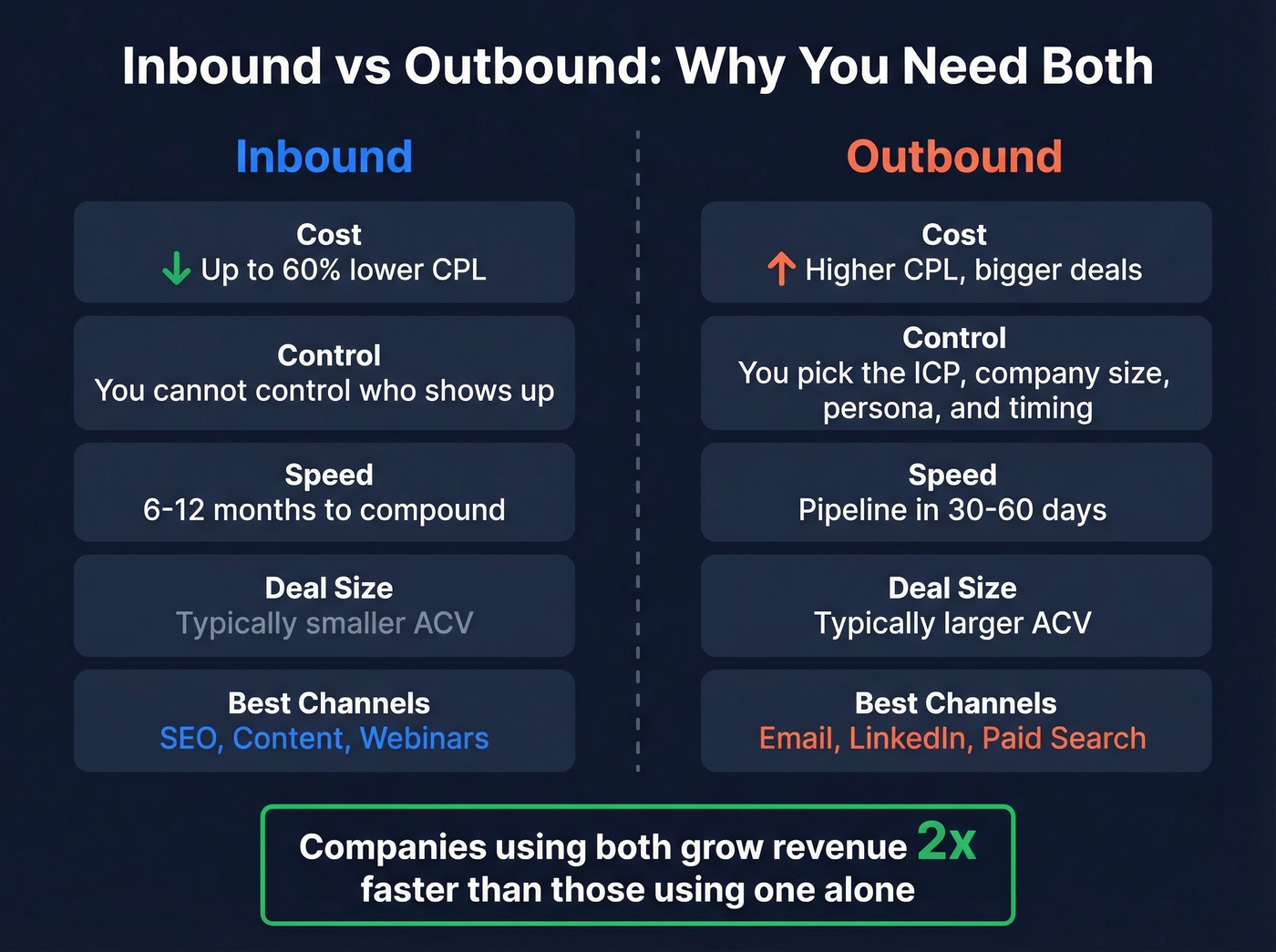
Companies running both inbound and outbound see 2x faster revenue growth than those relying on one alone. Inbound leads cost up to 60% less and arrive with built-in intent, but you can't control who shows up. Outbound lets you choose the ICP, the company size, the persona, and the timing - and it typically generates larger deals. The tradeoff is higher cost per lead and more operational overhead.
Here's the thing: if your average deal size is under $15K, you can probably build pipeline with inbound and email outreach alone. Save the expensive ABM and events budget for when deal sizes justify it.
10 Best B2B Lead Sources Ranked by ROI
1. SEO / Organic Search
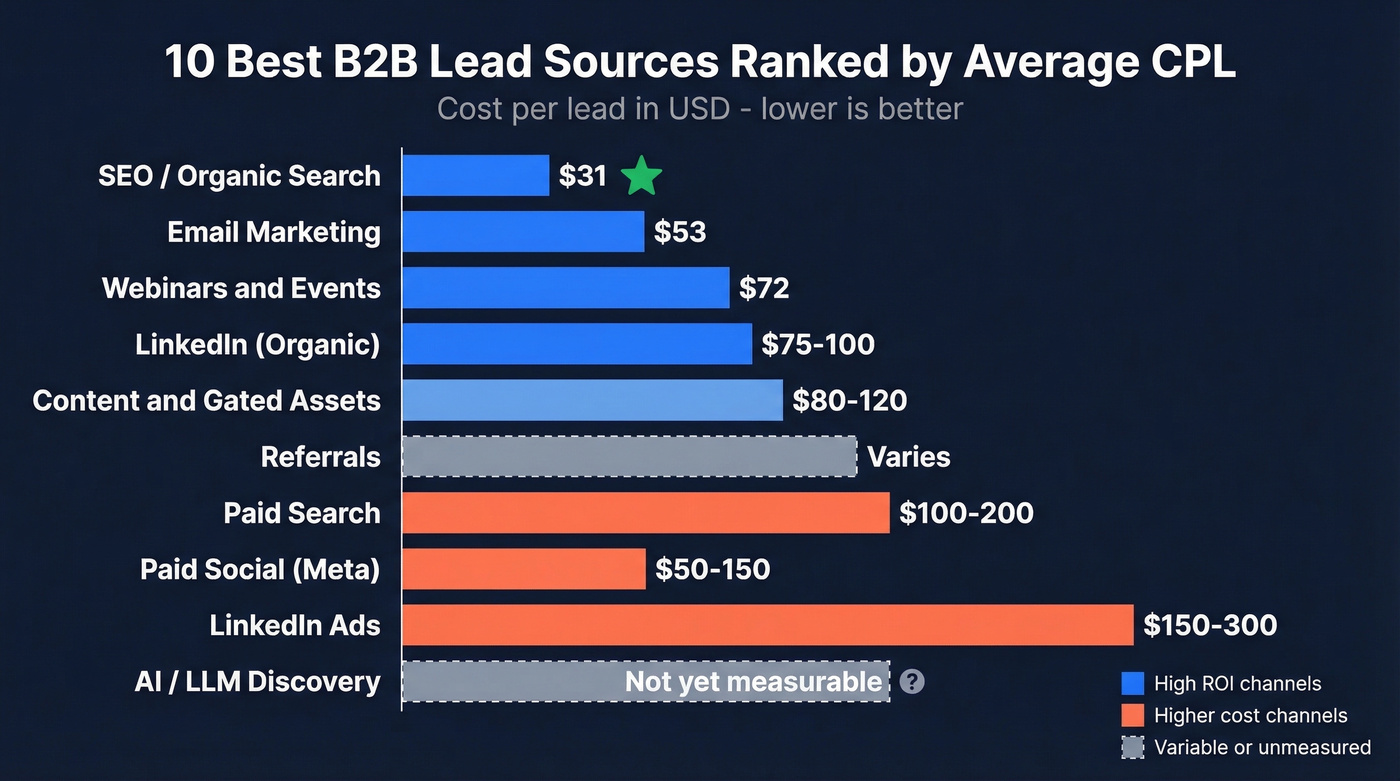
The #1 ROI channel according to HubSpot's State of Marketing data. Average CPL of $31 - the lowest of any B2B channel. The catch is time: expect 6-12 months before SEO compounds into predictable pipeline. But once it does, the economics are unbeatable, and every piece of content you've published keeps working while you sleep. (If you want the playbook, start with SEO.)
2. Email Marketing
CPL of $53 and the fastest channel to test - you can launch a campaign in days, not months. Ask any SDR team which channel they'd cut last, and email wins every time. ROI is often benchmarked around $36 for every $1 spent.
But email effectiveness lives and dies on data quality. Bad emails mean bounces, bounces mean domain reputation damage, and domain reputation damage means your entire outbound motion grinds to a halt. Prospeo verifies emails in real time with 98% accuracy, so your sequences actually land. (For deliverability fundamentals, see our email deliverability guide.)
3. LinkedIn
The best channel for businesses selling high-ACV products. LinkedIn drives 80% of all B2B social media leads, and the intent signal is built in - people are on the platform in a professional context. Organic posting and direct outreach don't require ad spend. LinkedIn Ads, on the other hand, get expensive fast with CPMs of $60-$200.
4. Webinars & Events
73% of marketers say webinars produce their best quality leads at an average CPL of $72. Attendees have self-selected into a topic, which means they're further down the intent spectrum than blog readers. Trade shows typically cost $15K-$80K per event but create relationship density that digital channels simply can't replicate.
5. Referrals
Your highest-converting source and the one you can't scale. A warm introduction from a happy customer converts at rates that make every other channel look broken. Build a referral program and incentivize it, but don't make it your primary pipeline source - the volume will never be predictable enough.
6. Paid Search (Google Ads)
Immediate pipeline. You turn on ads, you get leads. Minimum viable investment is $3K-$8K/month. Paid search captures existing demand - people actively searching for what you sell. It won't create demand the way content or events do, but for bottom-of-funnel capture, nothing's faster.
7. Content & Gated Assets
Blog posts, whitepapers, templates, calculators. Content compounds over time like SEO but requires $2K-$5K/month minimum to produce at a quality level that generates leads. We've found the sweet spot is gating high-value assets like benchmarks and templates while keeping educational content open - it builds trust and still captures intent. (If you need a framework, use a B2B sales funnel template.)
8. Paid Social (Meta / LinkedIn Ads)
Primarily an awareness and retargeting play. Meta CPMs run $8-$30, making it affordable for top-of-funnel. LinkedIn Ads are 3-8x more expensive but reach decision-makers directly. Skip this if you're expecting paid social to drive bottom-funnel conversions on its own - it works best warming up accounts before outbound touches.
9. Partnerships & Co-Marketing
Imagine a co-webinar with a complementary vendor whose audience already trusts them. Those leads arrive pre-warmed in a way cold outreach never achieves. The challenge is finding partners with aligned audiences and actually executing. Most partnership programs take 3-6 months to produce meaningful volume, and the consensus on r/sales is that most partnerships fizzle because neither side commits enough resources to make them work.
10. AI / LLM Discovery
The channel nobody's measuring yet. Google AI Overviews reach 2B monthly users across 200 countries. Businesses using AI for lead generation report a 50% increase in sales-ready leads and up to 60% lower acquisition costs. Nearly 30% of marketers report decreased traditional search traffic as buyers shift to AI tools. This isn't a source you "run" - it's one you position for by creating the kind of authoritative content LLMs cite. (More on this in our breakdown of generative AI lead generation.)

Email outreach is the fastest lead generation source to test - but only if your data doesn't wreck your domain. Prospeo's 98% email accuracy and 7-day refresh cycle mean your sequences land in inboxes, not spam folders. Teams using Prospeo book 35% more meetings than Apollo users.
Stop burning your best lead source on bad data.
What Each Source Costs
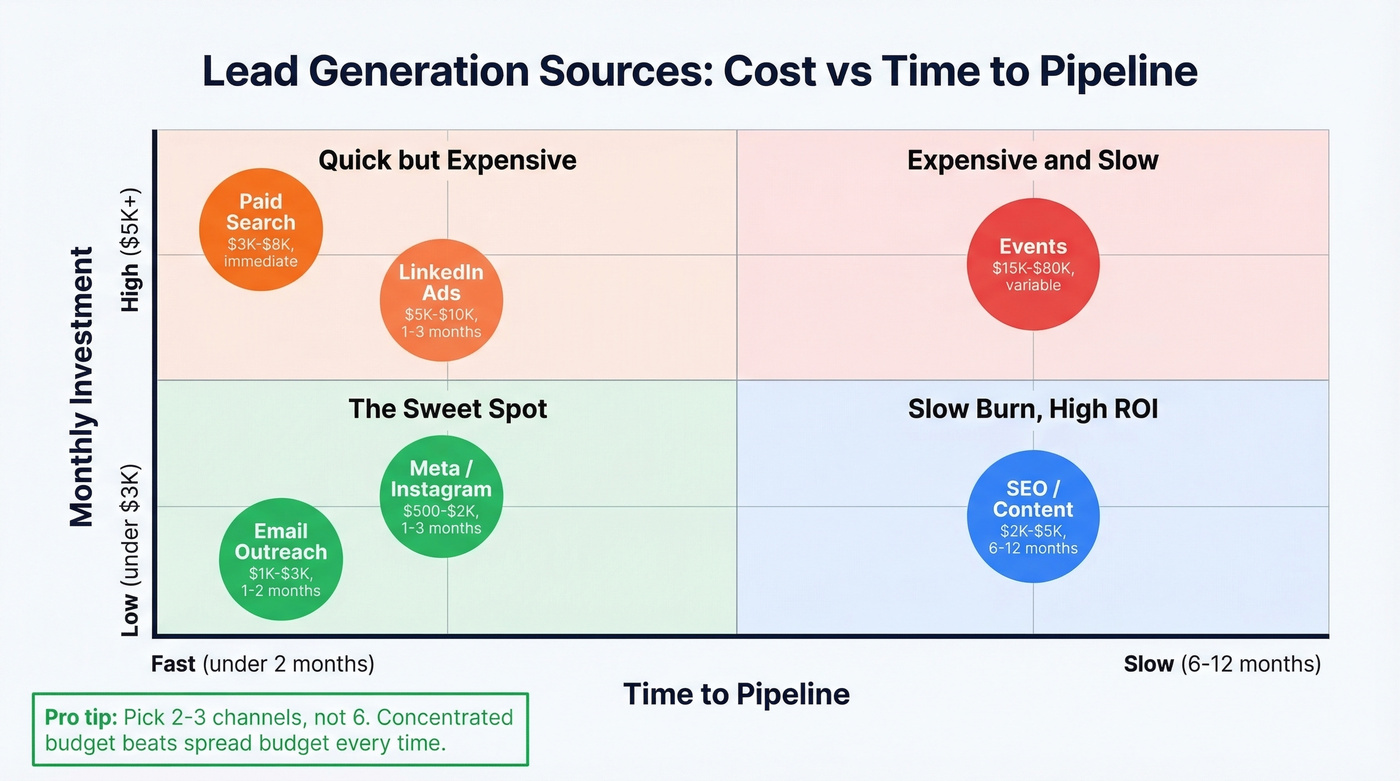
Here's the minimum investment required for a channel to produce signal, not noise.
| Channel | Min Monthly Spend | Time to Pipeline |
|---|---|---|
| SEO / Content | $2K-$5K | 6-12 months |
| Email Outreach | $1K-$3K | 1-2 months |
| Paid Search | $3K-$8K | Immediate |
| LinkedIn Ads | $5K-$10K | 1-3 months |
| Meta/Instagram | $500-$2K | 1-3 months |
| Events | $15K-$80K/event | Variable |
Spreading $5K/month across six channels means none of them produce enough data to optimize. In our experience, teams that invest properly in two sources outperform those spreading budget across five every single time.
AI Discovery: The Unmeasured Source
In 2026, AI Overviews continue expanding after Semrush tracked them appearing on 6.49% of searches in January 2025, spiking to 24.61% by July, then settling at 15.69% by November.
Search Engine Land recommends a polling-based framework: define 250-500 high-intent queries, run them through major LLMs weekly, and track brand mentions over time. Layer that with GA4 referral tracking and branded search volume in Search Console.
Teams that start measuring now will have a 12-month head start on competitors who are still pretending AI search doesn't exist.
How to Track Lead Sources
75% of marketers already use or plan to adopt an attribution model - the question isn't whether to track, but how. For most B2B teams, first-touch plus last-touch is the practical sweet spot. It answers the two questions that drive budget decisions: what created awareness, and what triggered conversion. (If you're tightening reporting, start with lead generation metrics.)
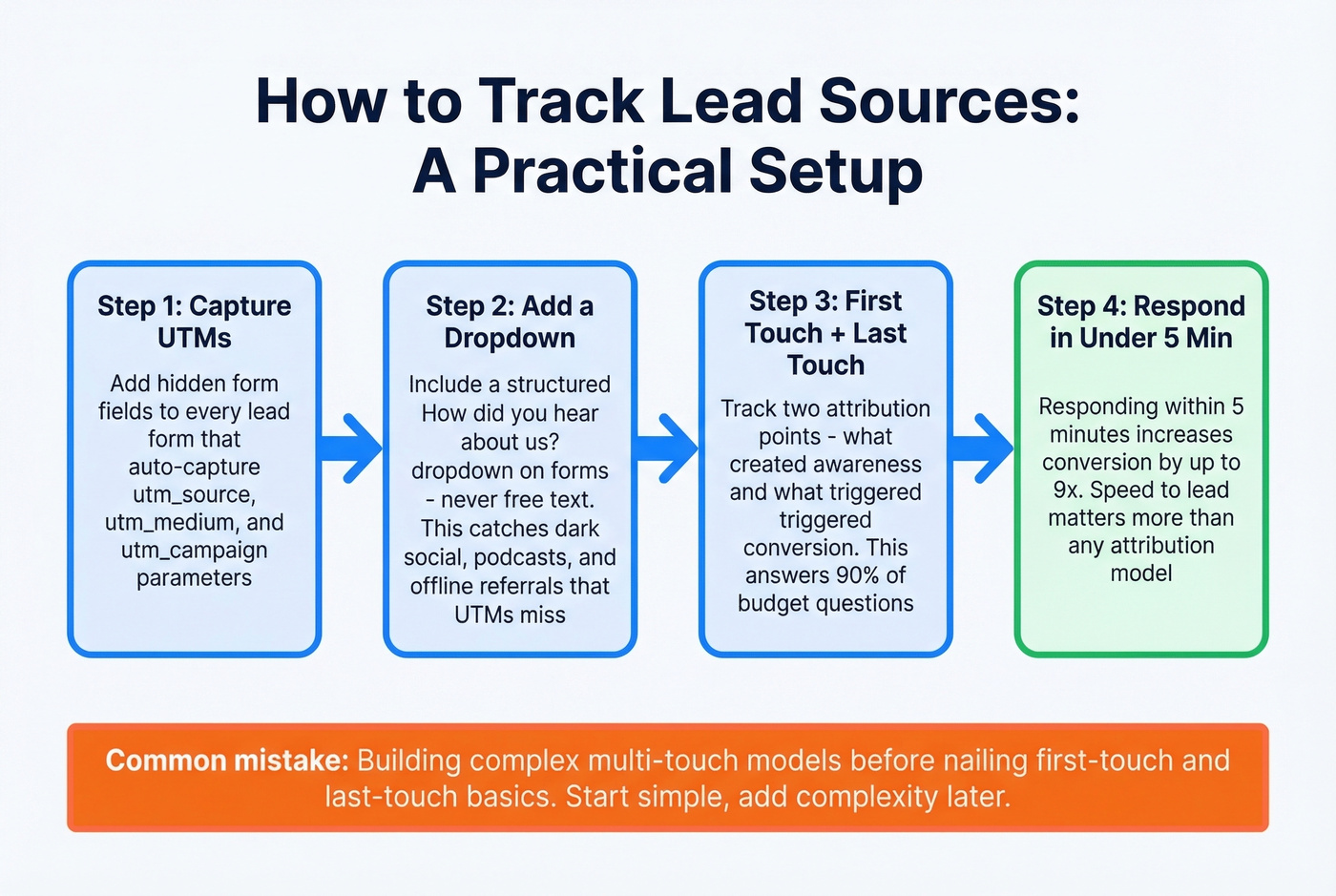
Implementation is straightforward. Add hidden form fields that capture UTM parameters on every lead form. Set up a structured "How did you hear about us?" dropdown - not a free-text field, or you'll get garbage data. This catches dark social, podcast mentions, and offline referrals that UTMs miss.
We've seen teams waste months building multi-touch models when first-touch plus last-touch answered 90% of their questions. And one detail that matters more than any attribution model: responding within 5 minutes increases conversion by up to 9x. All the attribution in the world doesn't help if your speed-to-lead is measured in hours. (To operationalize this, use sales follow-up templates.)
The Data Quality Multiplier
Every lead generation source feeds the same downstream funnel. If the contact data is bad, the source looks broken - even when it's working perfectly. A $31 CPL from SEO becomes $0 if the email bounces. (This is where data enrichment services can help.)
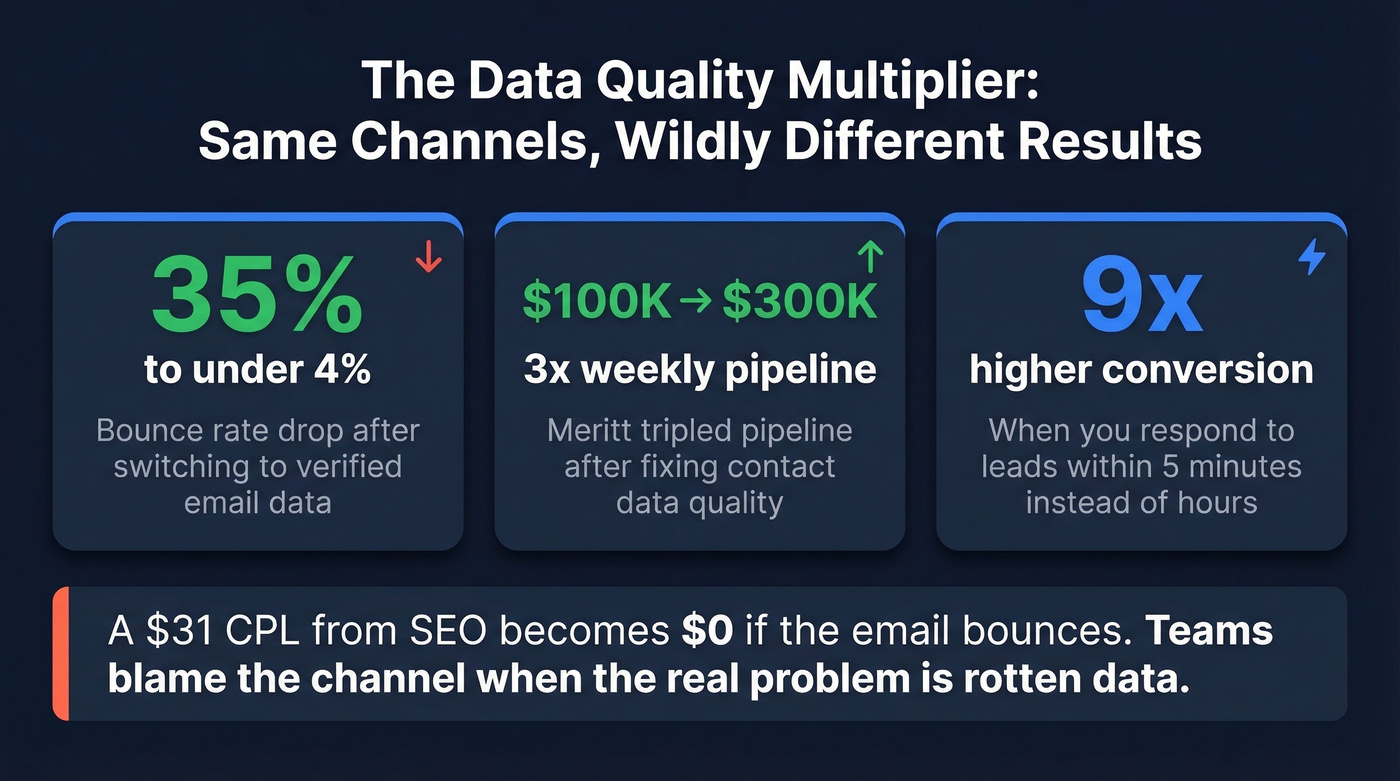
This is the frustrating part that doesn't get enough attention: teams blame the channel when the real problem is rotten data. Meritt tripled weekly pipeline from $100K to $300K after switching to Prospeo, with bounce rates dropping from 35% to under 4%. That's not a marginal improvement - it's the difference between a channel "not working" and a channel producing real revenue.
You don't need six lead sources. You need two that work - powered by data you can trust. Prospeo gives you 300M+ profiles with 30+ filters for intent, technographics, and headcount growth, starting at $0.01 per email. No contracts, no sales calls.
Turn your top two channels into a pipeline machine.
How to Choose the Right Channels
Evaluate every channel against three criteria.
Consistency. Can this source produce predictable lead flow month over month? SEO and paid search score high. Referrals and partnerships are lumpy. If your forecasting depends on steady pipeline, weight consistency heavily. (If you’re diagnosing gaps, see sales pipeline challenges.)
Cost. Look beyond CPL - calculate LTV-to-CAC ratio for leads from each source. A $72 webinar lead that closes at 2x the rate of a $31 SEO lead is actually cheaper per dollar of revenue. The best lead generation sources aren't always the cheapest ones; they're the ones where the math works for your specific deal size and close rate. (Related: cost to acquire customer.)
Quality. Does the source deliver ICP-matched leads with real buying intent? High volume at low quality just creates work for your SDRs. Track conversion rates by source, not just lead counts. (To systematize this, implement lead scoring.)
FAQ
What's the cheapest lead generation source?
SEO has the lowest average CPL at $31 for B2B, followed by email outreach at $53. Referrals cost less per lead but don't scale predictably. Factor in time-to-pipeline alongside raw cost - SEO takes 6-12 months while email produces results in weeks.
How many lead sources should a B2B company use?
Two to three, each funded at or above the minimum budget threshold. Pick one high-ROI channel like SEO for long-term compounding and one fast channel like email or paid search for near-term pipeline.
How do I track which lead source drives revenue?
Use first-touch and last-touch attribution with UTM parameters and hidden form fields on every conversion point. Add a structured "How did you hear about us?" dropdown to capture dark social and offline referrals that UTMs miss.