

Lead Nurturing Automation: Scoring Models, Workflows, and Mistakes to Avoid
96% of your website visitors aren't ready to buy. That's Marketo's benchmark, and it hasn't budged. The gap between "visited your site" and "ready to talk to sales" is where lead nurturing automation lives - and where most teams lose deals by doing nothing or doing the wrong thing.
What You Need (Quick Version)
Automated nurturing requires three things most teams skip: a scoring model that separates signal from noise, behavior-triggered workflows, and clean data underneath everything. This article gives you all three as copy-paste assets.
What It Actually Means
A VP of Engineering downloads your integration guide on Tuesday, visits your pricing page Thursday, then goes silent. Without automation, that signal dies in a spreadsheet. With it, she gets a relevant case study on Friday, and your SDR gets a Slack alert when her score crosses the MQL threshold.
That's the core - behavioral triggers and scoring rules moving prospects through your pipeline without manual babysitting. 79% of marketing leads never convert into sales due to poor nurturing. The leads aren't bad. The follow-up is.
Why It Matters in 2026
B2B buyers now engage across an average of 10 channels before purchase. Omnichannel engagement converts at 18.96% versus 5.4% for single-channel. You can't cover 10 channels manually. The lead generation software market is projected to hit $16.2B by 2034, and that growth is driven almost entirely by teams realizing they need automation to keep up with how buyers actually behave now - jumping between email, webinars, social, review sites, and Slack communities before they ever fill out a demo form.
Automating your nurture sequences isn't a nice-to-have. It's the only way the math works.
Build Your Lead Scoring Model
Start with 5-7 criteria that actually predict conversions. Here's a scoring model you can implement today:
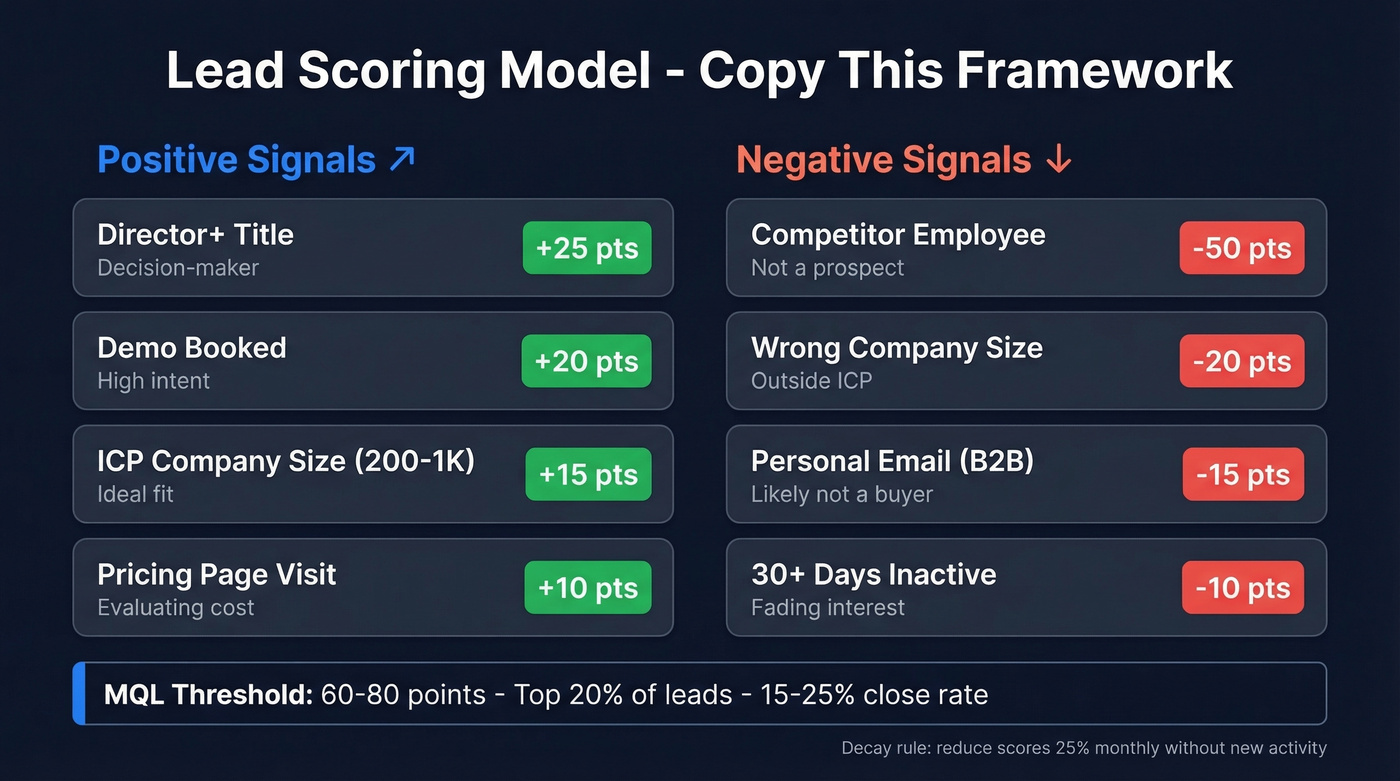
| Signal | Points | Why |
|---|---|---|
| Director+ title | +25 | Decision-maker |
| Demo booked | +20 | High intent |
| Pricing page visit | +10 | Evaluating cost |
| 200-1,000 employees | +15 | ICP fit |
| Wrong company size | -20 | Outside ICP |
| 30+ days inactive | -10 | Fading interest |
| Personal email (B2B) | -15 | Likely not a buyer |
| Competitor employee | -50 | Not a prospect |
Set your MQL threshold at 60-80 points. That typically captures the top 20% of leads by score and yields 15-25% conversion rates from qualified to closed.
Here's the thing most teams get wrong: they overthink scoring and completely ignore decay. We reduce scores by 25% monthly without new activity. A lead who was hot six months ago and hasn't engaged since is dead weight - treat it that way.
If you need a deeper framework, start with a dedicated lead scoring setup and tie it back to your Ideal Customer Profile so points reflect real fit, not vanity engagement.

Your lead scoring model is worthless if half your contacts bounce. Prospeo verifies emails with 98% accuracy and refreshes data every 7 days - so your nurture workflows reach real inboxes, not dead ends. One customer dropped bounce rates from 35% to under 4%.
Stop nurturing leads you can't actually reach.
Automated Workflows You Can Copy
Every workflow below follows the same structure: trigger, timing, goal.
Welcome Series
Trigger: New lead enters your system. Timing: 4 emails over 14 days.
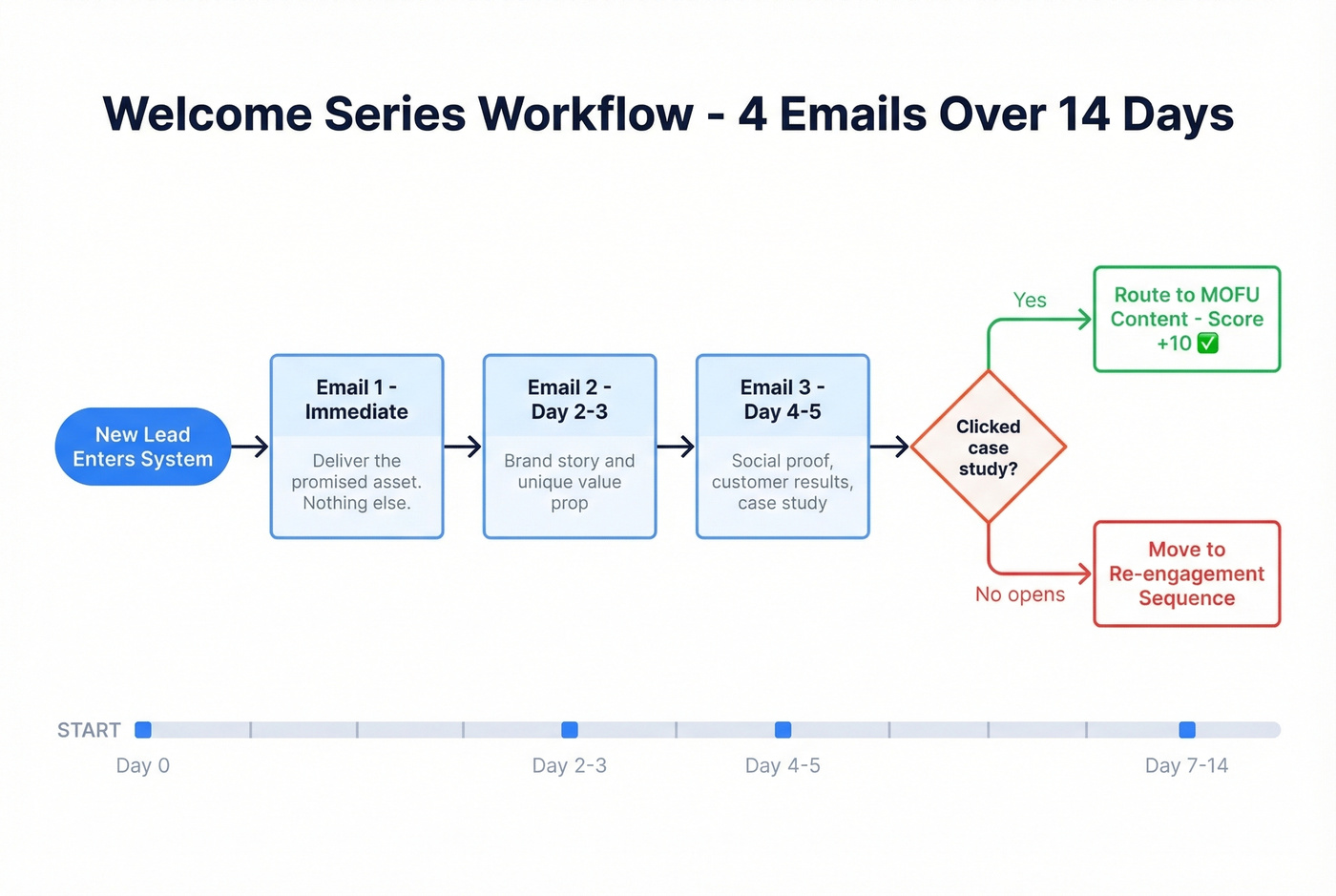
- Email 1 (immediate): Deliver the promised asset. Nothing else.
- Email 2 (Day 2-3): Brand story and unique value prop.
- Email 3 (Day 4-5): Social proof - customer results, a case study.
- Email 4 (Day 7+): Segment based on engagement. Clicked the case study? Route to MOFU. No opens? Move to re-engagement.
If you want plug-and-play copy, keep a library of email subject lines and sales follow-up templates so your sequences don’t stall on writing.
Re-Engagement Sequence
Trigger: Score decay hits - 30+ days without engagement. Timing: 3 touches over 10 days.
When a lead's score drops below threshold from inactivity, fire this sequence automatically. Send your strongest MOFU asset - a comparison guide, a fresh case study, or a "what's new" update. If they don't engage after three touches, suppress them. Don't keep emailing ghosts.
Instant SMS Follow-Up
Trigger: High-intent form submission (demo request, quote, consultation). Timing: Immediate.
A practitioner on r/n8n open-sourced a working automation for exactly this: Jotform webhook to n8n to Twilio to Google Sheets. The workflow sends a personalized SMS within seconds of submission, branches by lead type, and logs everything. The n8n JSON template is free via a shared gist link. For service businesses, instant SMS prevents the lead leakage that kills deals between "form submitted" and "rep calls back two hours later."
One thing most nurture guides miss: don't limit yourself to email and SMS. Retargeting ads and display campaigns work as nurture channels too, especially for buying committees where multiple stakeholders need warming simultaneously. If your average deal size justifies it, layer in display retargeting alongside your email sequences.
Mistakes That Kill Your Nurture Sequences
Dirty data. Your beautifully crafted welcome sequence means nothing when it opens with "Hi Unknown!" or bounces 30% of the time. High bounce rates wreck your domain reputation, which tanks deliverability for every email you send afterward. We've seen teams cut bounce rates by 80%+ just by adding a verification layer before automation kicks in. Prospeo verifies emails in real time with 98% accuracy and refreshes contact data every 7 days - compared to the 6-week industry average. One customer, Meritt, saw bounce rates drop from 35% to under 4% after switching.
If deliverability is a recurring issue, fix it systematically with an email deliverability guide and track your email bounce rate as a leading indicator.
Vanity metrics. The industry average open rate is 23.44%. That number tells you nothing about pipeline impact. Measure pipeline influenced, dormant accounts reactivated, and sales cycle shortened instead. If you need a KPI set that maps to revenue, use a funnel metrics framework.
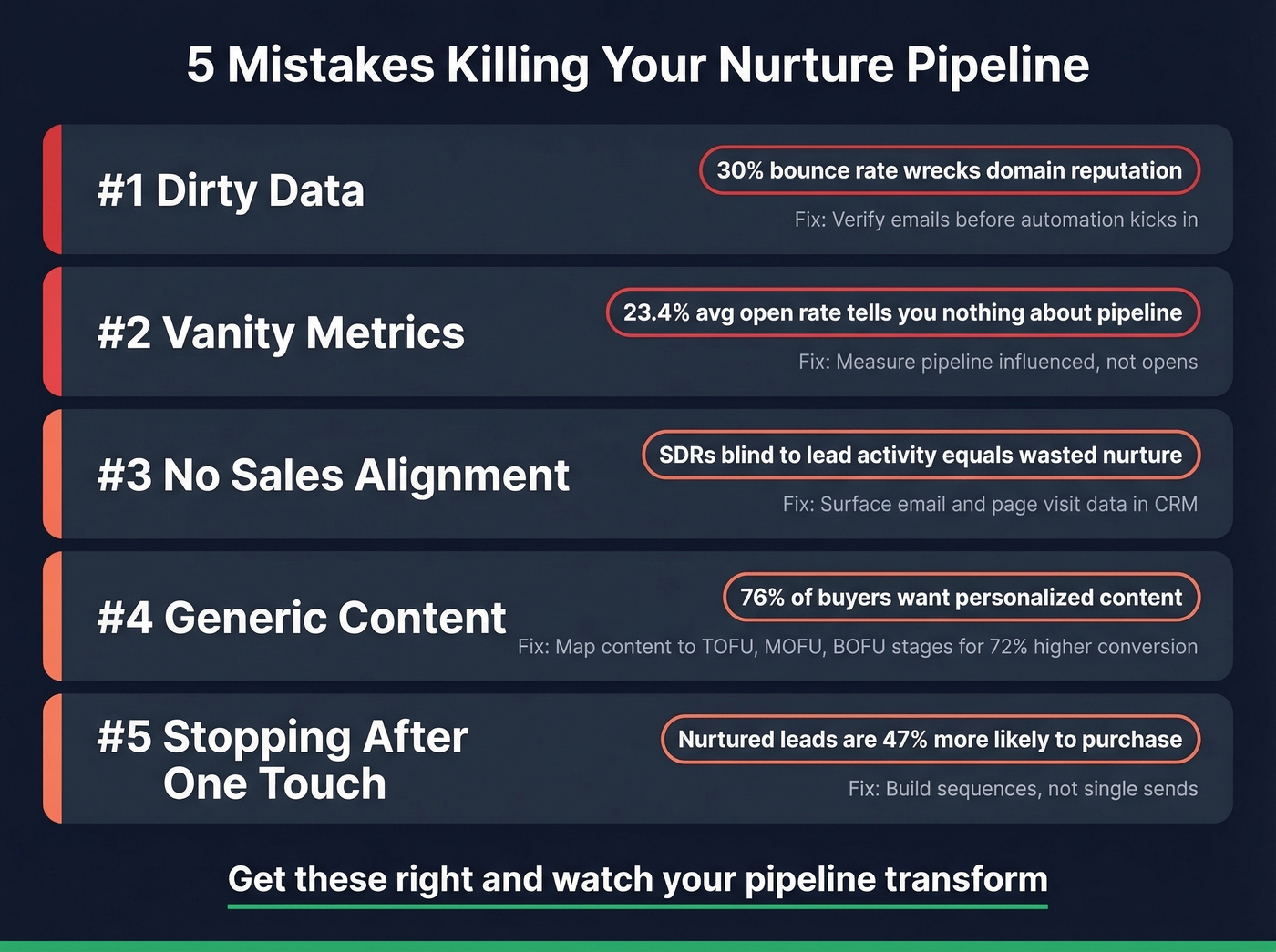
No sales alignment. If your SDRs can't see which emails a lead opened or which pages they visited, your nurturing exists in a vacuum. Make touchpoints visible in your CRM so reps know when to follow up - and when to stay quiet. This is easier when you standardize lead status definitions across marketing and sales.
Generic content. 76% of buyers want personalized content, and stage-targeted content yields 72% higher conversion rates. Map content to funnel stage: thought leadership for TOFU, case studies and comparisons for MOFU, demos and pricing for BOFU. In our experience, this single change moves the needle more than any workflow tweak. For a practical system, build around personalized outreach and targeted email campaigns.
Stopping after the first touch. Nurtured leads are 47% more likely to purchase than non-nurtured ones. One email isn't nurturing - it's a notification. Build sequences, not single sends.
Tools Worth Using
| Tool | Best For | Starting Price | Key Strength |
|---|---|---|---|
| Prospeo | Data quality layer | Free (75 emails/mo) | 98% email accuracy, 7-day refresh |
| HubSpot | All-in-one MAP | $45/mo (Starter, annual) | Deepest ecosystem |
| ActiveCampaign | Growing teams | $15/mo (1K contacts) | Best value automation |
| n8n | Custom workflows | Free (self-hosted) | Open-source flexibility |
| Salesforce MCAE (Pardot) | Enterprise Salesforce | ~$1,250/mo+ | Native Salesforce integration |
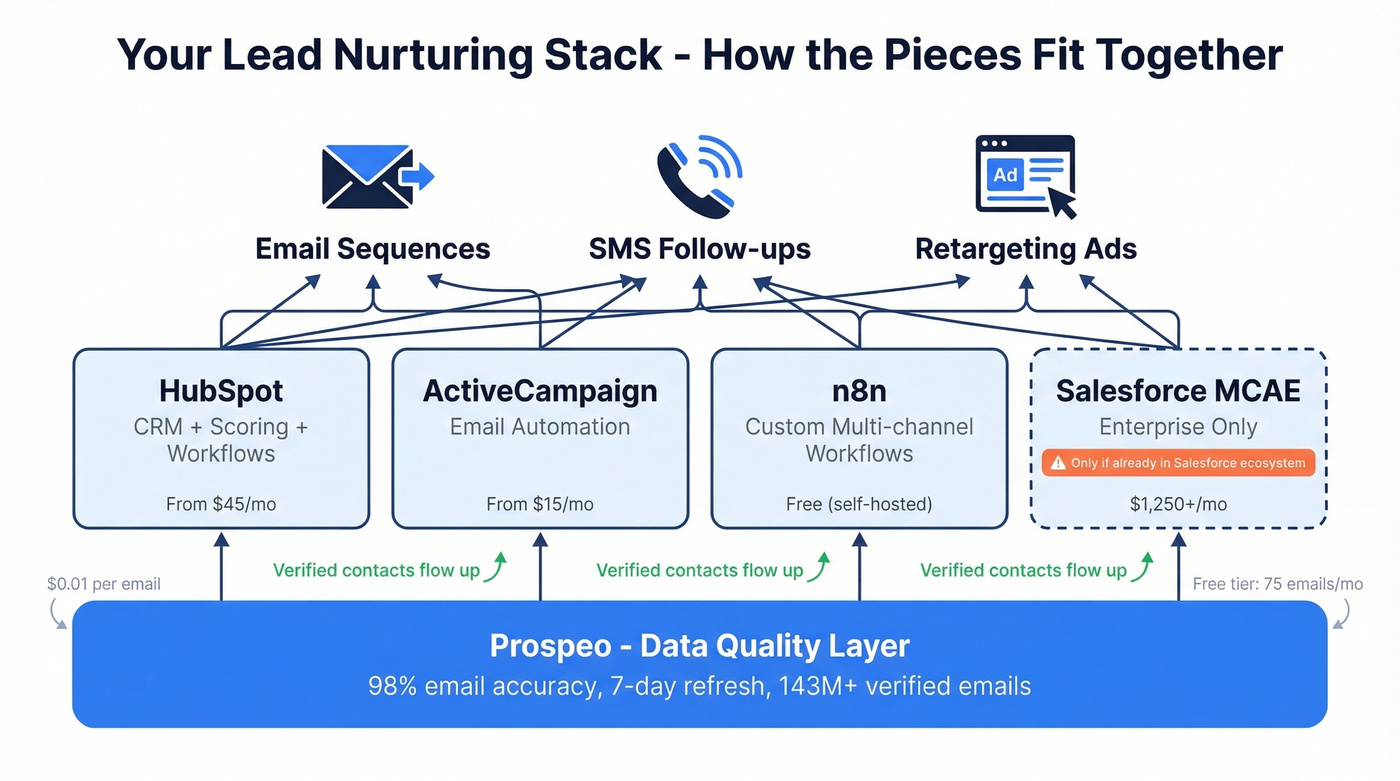
Prospeo sits underneath your automation stack as the data quality layer that makes everything else work. With 143M+ verified emails, 125M+ verified mobiles, and a 7-day refresh cycle, it ensures your nurture sequences actually reach real inboxes. Integrates natively with HubSpot, Salesforce, Smartlead, Instantly, and Lemlist. Pricing starts free at 75 emails/month, scaling to roughly $0.01/email with no contracts.
If you’re evaluating vendors, compare options across data enrichment services and broader free lead generation tools before you lock in a stack.
HubSpot is the default for teams that want CRM, email, scoring, and workflows in one place. The free CRM is genuinely useful; Marketing Hub scales from $45/month at Starter to $3,600/month at Enterprise. Costs climb fast with your contact database, but the ecosystem depth is hard to beat.
ActiveCampaign delivers the best automation features per dollar for growing teams. n8n is the open-source option for total control over multi-channel workflows - free self-hosted, around $20/month for cloud. Skip Salesforce MCAE (typically $1,250-$4,000+/month) unless you're already deep in the Salesforce ecosystem; the ROI doesn't justify the cost otherwise.
AI-Powered Nurturing in 2026
Sellers spend just 28% of their time actually selling - AI reclaims the rest. Daily AI tool usage surged 233% in six months, and AI leaders achieve 1.7x revenue growth versus laggards. The concrete applications are already here: predictive lead scoring that adjusts in real time, AI-drafted follow-ups, and automatic sequence removal when a prospect replies. If you’re exploring this, start with best AI for automating sales follow-ups and then expand into generative AI lead generation.
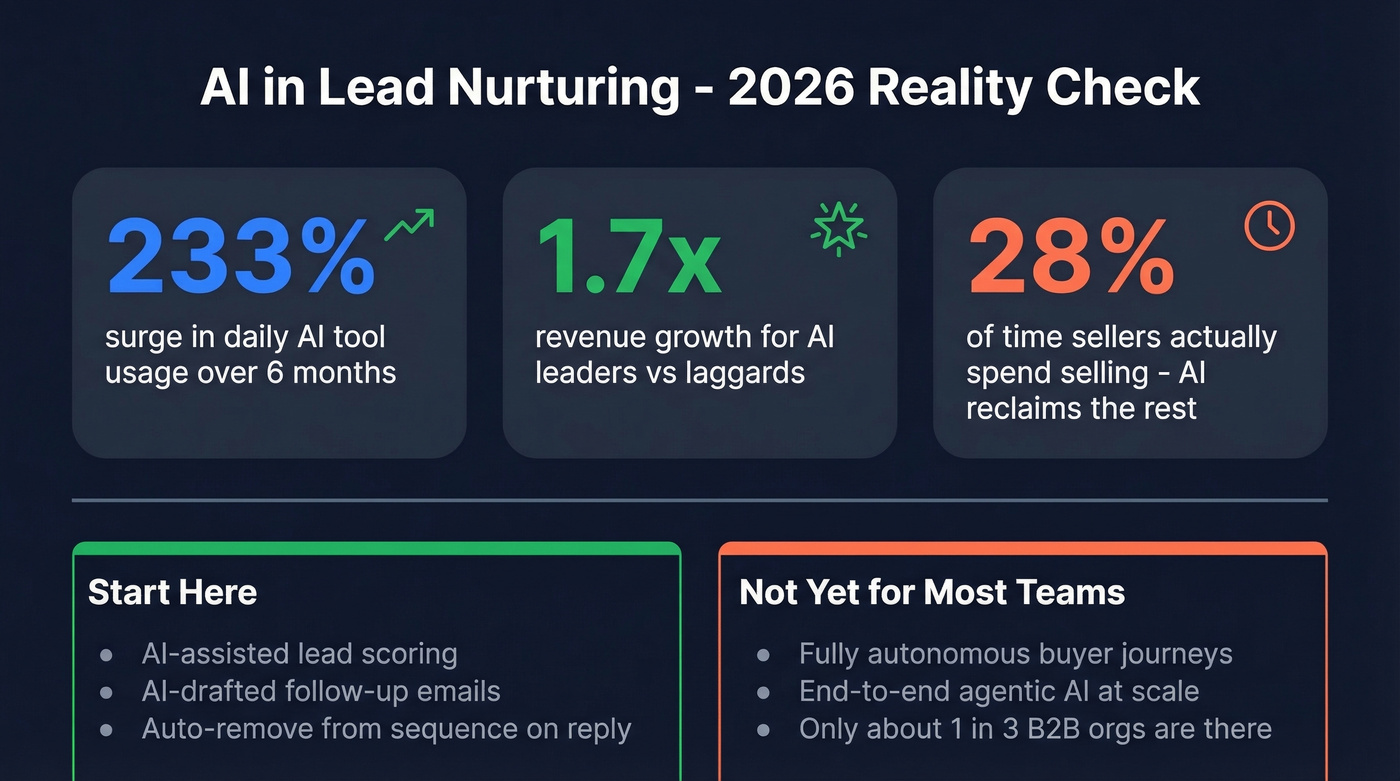
But let's be honest - only about a third of B2B orgs have implemented agentic AI at scale. Start with AI-assisted scoring and follow-up drafts before trying to automate entire buyer journeys end to end.
Dirty data is the #1 killer of nurture sequences. Prospeo's 5-step verification and 7-day refresh cycle ensure every automated email lands with the right person - at $0.01 per verified email. No contracts, 75 free emails to start.
Clean data in, pipeline out. It starts at free.
FAQ
What's the difference between drip campaigns and lead nurturing automation?
Drip campaigns send pre-scheduled emails regardless of behavior. Lead nurturing automation triggers messages based on actions - page visits, content downloads, score changes. If your "nurture" runs on a fixed calendar schedule, it's a drip, and it'll underperform behavior-triggered sequences by 20-50% on conversion rate.
How many emails should a nurture sequence include?
Welcome series: 3-7 emails over 7-14 days. Re-engagement: 3 touches over 10 days. Enterprise deals with 6+ month cycles need longer sequences of 12-20 touches, while SaaS trials where someone can convert in a week should stay short and punchy.
How do I start without a massive tech stack?
A CRM with basic workflow capabilities, a verified contact list, and a scoring model cover the essentials. n8n (free, self-hosted) handles custom workflows, ActiveCampaign ($15/month) covers email automation, and Prospeo's free tier handles 75 verified emails per month to keep your data clean from day one.
How do I keep my nurture list clean over time?
Verify emails before they enter your automation - catching invalid addresses at the point of capture prevents bounce damage before it starts. Remove contacts with no engagement after 90 days, or route them into a re-engagement sequence first. A smaller, clean list always outperforms a large, stale one.