

Marketing Audience Segmentation: The Practitioner's Guide to Doing It Right
Your last campaign hit a 0.8% CTR. You segmented by age and gender, called it targeting, and wondered why nobody clicked. That's not marketing audience segmentation - that's sorting. Segmented campaigns drive 760% more revenue than one-size-fits-all blasts, and 81% of customers now expect a personalized experience. The gap between what buyers expect and what most teams deliver is where pipeline goes to die.
Quick version: Stop segmenting by demographics alone, refresh your data weekly not quarterly, and limit yourself to 3-5 segments you actually activate.
What Is Audience Segmentation?
Marketing audience segmentation is the practice of dividing your total addressable audience into smaller groups that share meaningful characteristics - then tailoring messaging, offers, and channels to each group. Segmentation creates the groups. Targeting decides which groups get which campaign.
The numbers back this up. Companies that excel at personalization generate 40% more revenue from those activities compared to average players. Seven in ten marketers already use segmentation, and eight in ten who do report increased sales.
10 Types of Audience Segmentation
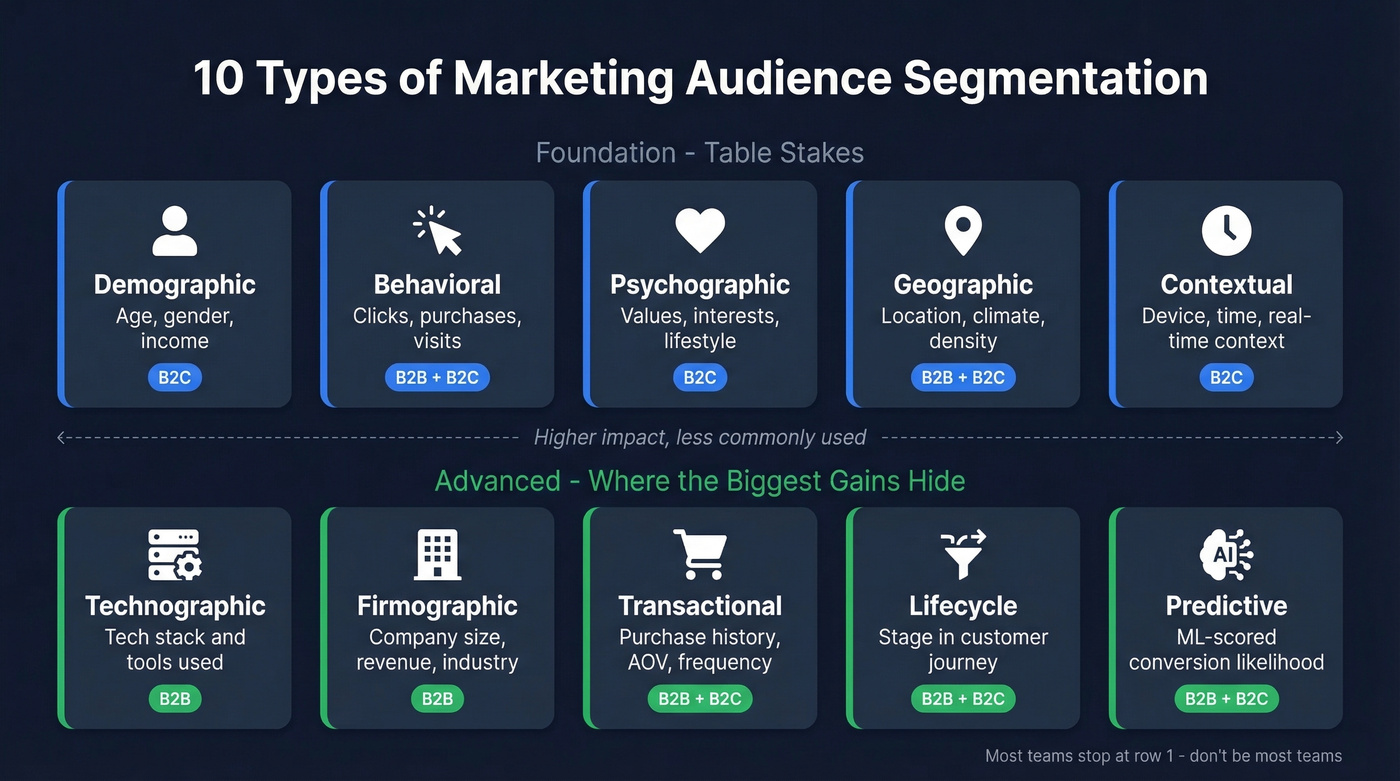
Most guides cover four types and call it a day. That's why most marketers still default to age-and-gender targeting. Here are ten dimensions that actually matter in real campaigns - and the contexts where each one shines.
| Type | What It Measures | Example | Best For |
|---|---|---|---|
| Demographic | Age, gender, income, education | Women 25-34, $75K+ income | B2C |
| Behavioral | Actions like clicks, purchases, visits | Visited pricing page 3x this week | Both |
| Psychographic | Values, interests, lifestyle | Sustainability-focused buyers | B2C |
| Geographic | Location, climate, urban/rural | Northeast US metro areas | Both |
| Technographic | Tech stack, tools used | Runs Salesforce + Outreach | B2B |
| Firmographic | Company size, revenue, industry | SaaS, 50-200 employees | B2B |
| Transactional | Purchase history, AOV, frequency | 3+ purchases, $200+ AOV | Both |
| Contextual | Real-time context (device, time) | Mobile users browsing at 9pm | B2C |
| Lifecycle | Stage in customer journey | Trial users not yet activated | Both |
| Predictive | ML-scored likelihood to convert/churn | Likely buyers, next 30 days | Both |
The first four are table stakes. In our experience, the last six are where the biggest gains hide.
Technographic and firmographic segmentation transform B2B targeting. Knowing a prospect runs HubSpot and raised a Series B tells you more than knowing their CEO is 42 years old. If you're still segmenting B2B audiences by age or gender, you're guessing - and your competitors who aren't guessing are eating your pipeline.
5-Step Segmentation Workflow
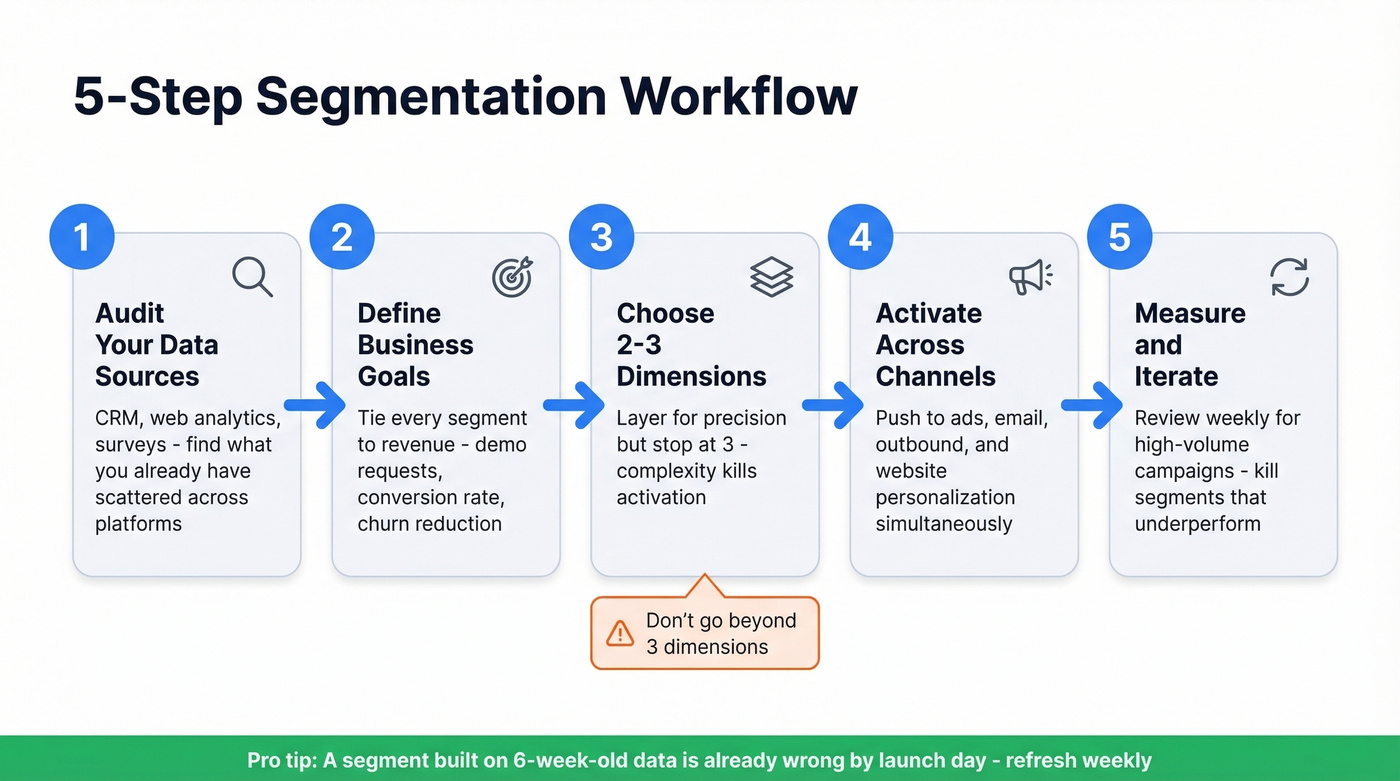
Step 1: Audit Your Data Sources
Start with what you have. CRM data gives you job titles, company size, and industry. Web analytics shows behavioral patterns. Surveys capture psychographic and zero-party data. Most teams have more data than they realize - it's just scattered across four platforms that don't talk to each other.
If you're stitching sources together manually, consider data enrichment to fill gaps and standardize fields.
Step 2: Define Goals Tied to Business Outcomes
"Segment our audience" isn't a goal. "Increase demo requests from mid-market SaaS companies by 30% this quarter" is. Every segment you build should connect to a measurable outcome: pipeline generated, conversion rate improved, churn reduced. If you can't tie a segment to revenue, it's an academic exercise.
If you need a clean way to map outcomes to stages, use a B2B sales funnel template and align segment KPIs to each step.
Step 3: Choose 2-3 Segmentation Dimensions
Layer dimensions for precision. A single dimension (industry = SaaS) is too broad. Two dimensions (SaaS + 50-200 employees) gets sharper. Three dimensions (SaaS + 50-200 employees + showing intent for your category) gets actionable.
Don't go beyond three. Complexity kills activation.
This is where practitioners consistently get stuck. One r/PPC thread shows a marketer trying to split Meta audiences into three categories but unsure "whom to add and whom to remove." The fix: start with your highest-converting customer profile, build one segment around it, and expand from there.
To make that repeatable, start from an ideal customer profile and score segments against it.
Step 4: Build and Activate Across Channels
A segment that lives only in your email tool is half a segment. Push it to paid ads, outbound sequences, and website personalization simultaneously. Google Ads practitioners in r/googleads stack combinations like "Small business owners + In-market for business services" - but Search audience segments are observation and bid adjustments, not strict targeting. The goal is matching the right message to the right group at the right moment, regardless of channel.
For outbound, your activation layer is usually your SDR tools plus a reliable list source.
Step 5: Measure, Iterate, Retire
Set a review cadence - weekly for high-volume campaigns, every couple of weeks for everything else. Kill segments that underperform. A segment built on six-week-old data is already wrong by launch day.
If you're diagnosing why certain segments stall, a simple pipeline health review can reveal where conversion drops by segment.
AI and Machine Learning in Segmentation
Manual segmentation works until it doesn't. Once you're dealing with thousands of accounts and dozens of behavioral signals, human pattern-matching breaks down fast.
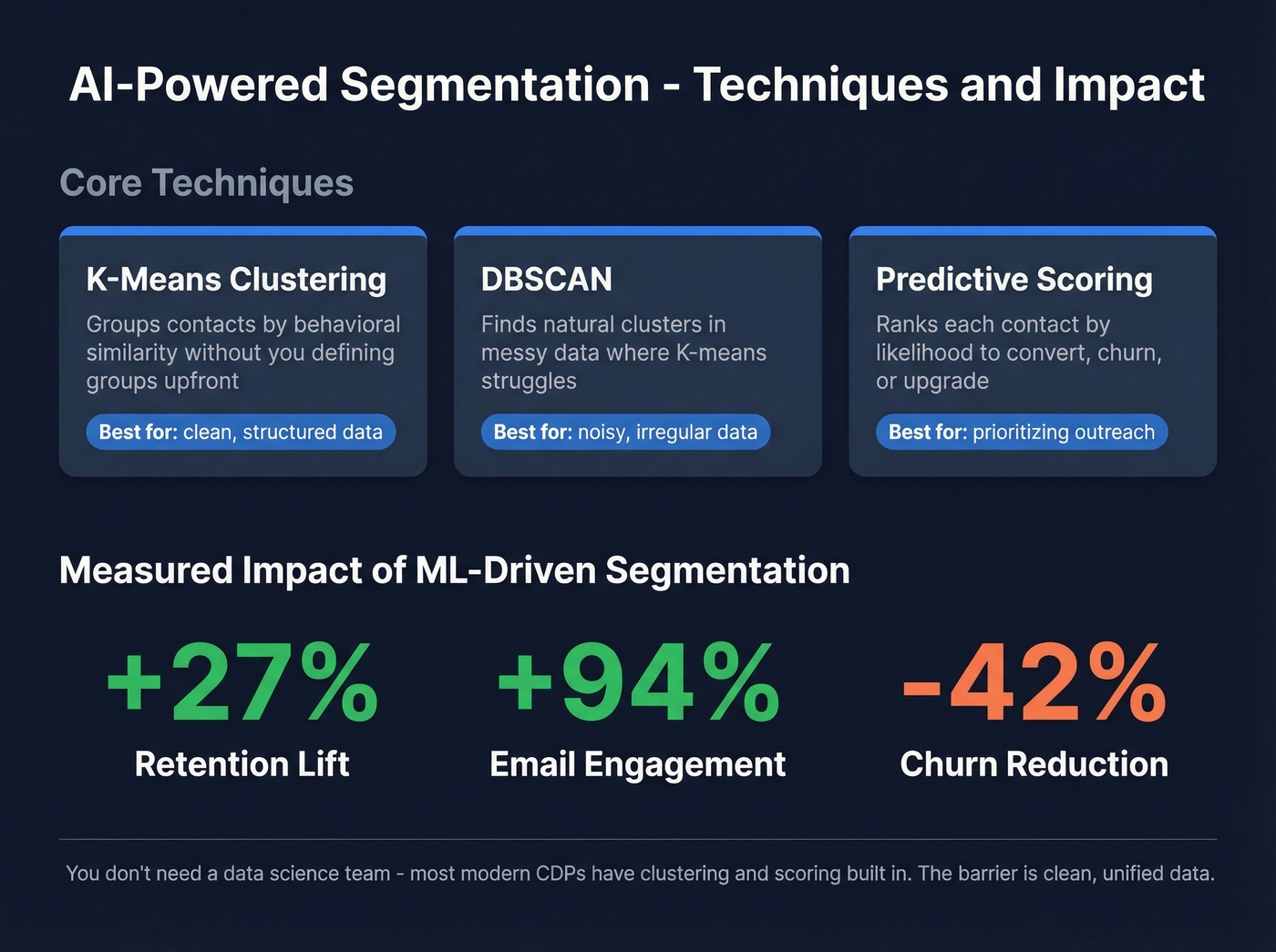
The core techniques are more accessible than they sound. K-means clustering groups contacts by behavioral similarity without you defining the groups upfront. DBSCAN finds natural clusters in messy data where K-means struggles. Predictive scoring uses classification models to rank each contact's likelihood to convert, churn, or upgrade.
If you're applying scoring to prioritize outreach, pair this with a practical lead scoring model so sales and marketing use the same definitions.
Real-time segmentation is where things get interesting. Batch-processed segments refreshed quarterly can't keep pace with buyer behavior. Platforms like Braze, Bloomreach, and Salesforce Data Cloud now update segments dynamically as new behavioral data flows in - enabling campaigns that respond to what a buyer is doing right now, not what they did last month. We've seen teams implementing ML-driven segmentation track lifts of 27% in retention, 94% in email engagement, and 42% in churn reduction.
You don't need a data science team to start. Most modern CDPs and marketing platforms have clustering and predictive scoring built in. The barrier isn't technology - it's having clean, unified data to feed the models.

You just read that segments built on six-week-old data are wrong by launch day. Prospeo refreshes every 7 days - not 6 weeks like the industry average. Layer 30+ filters including buyer intent (15,000 Bombora topics), technographics, firmographics, headcount growth, and funding stage to build segments that actually convert. At $0.01 per email with 98% accuracy, bad data stops killing your campaigns.
Build segments on live data, not last quarter's spreadsheet.
Segmentation in a Cookieless World
75% of marketers still rely heavily on third-party cookies. That's a problem, because the infrastructure supporting those cookies is disappearing. Publishers anticipate up to 60% ad revenue declines without alternatives, and GDPR fines have hit EUR5.88B cumulatively - with maximum penalties of EUR20M or 4% of global revenue.
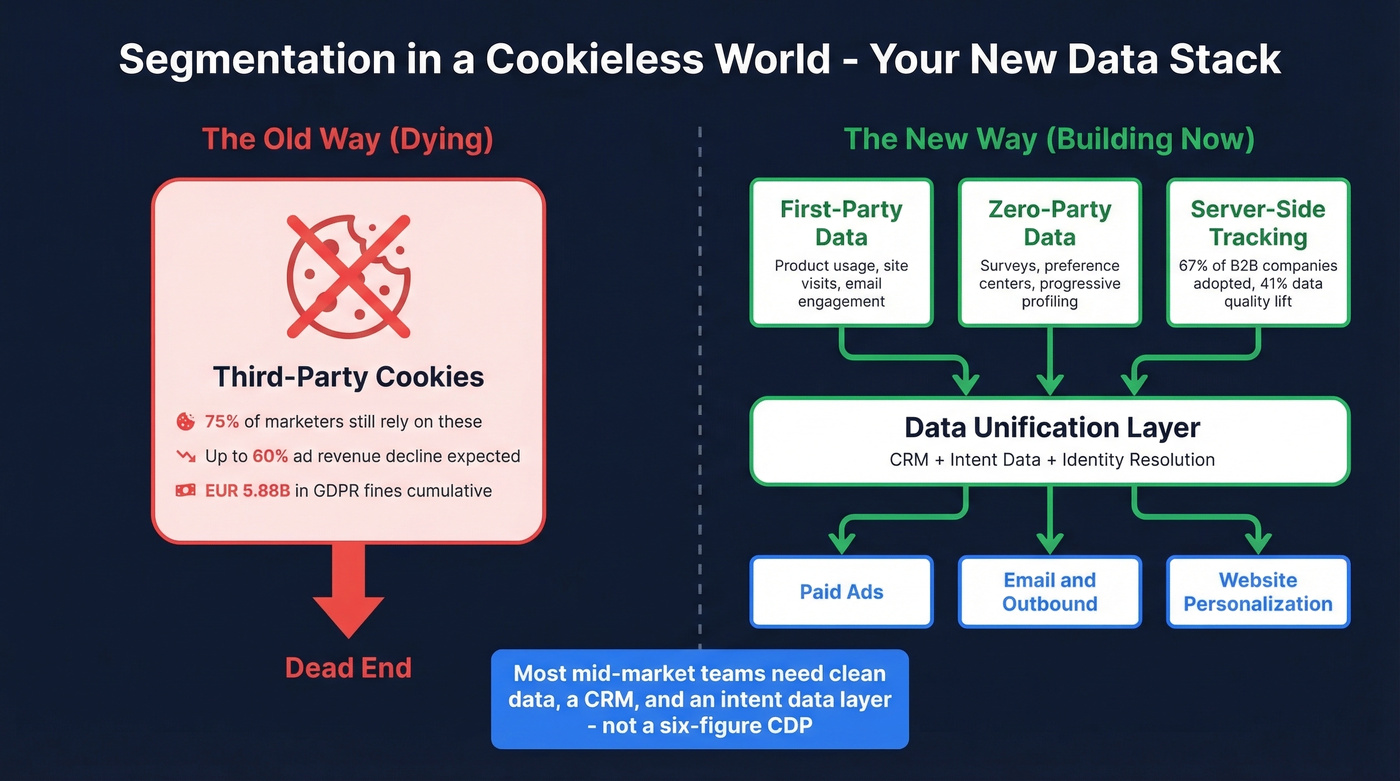
Privacy-first segmentation requires rethinking where your data comes from.
First-party data - what customers give you directly through interactions with your product, site, and emails - becomes your foundation. Zero-party data goes further: signup surveys, preference centers, and progressive profiling where customers tell you what they want. This is also the most ethical approach to segmentation. Self-reported preferences beat data mining on both accuracy and trust.
Server-side tracking is gaining momentum fast, with 67% of B2B companies already adopting it and reporting 41% data quality improvements. Google's Privacy Sandbox and Topics API offer category-level signals without individual tracking. Identity resolution frameworks like Unified ID 2.0 provide cross-site recognition with consent baked in.
Let's be honest: CDPs are powerful for unifying all of this, but they're overkill for most teams. Most mid-market companies need clean data, a CRM, and an intent data layer - not a six-figure platform implementation that takes nine months to deploy.
7 Mistakes That Kill Segmentation Performance
1. Demographic-only segmentation. Lazy marketing. Behavioral + intent signals outperform demographics every time. Layer at least two dimensions before you call something a segment.
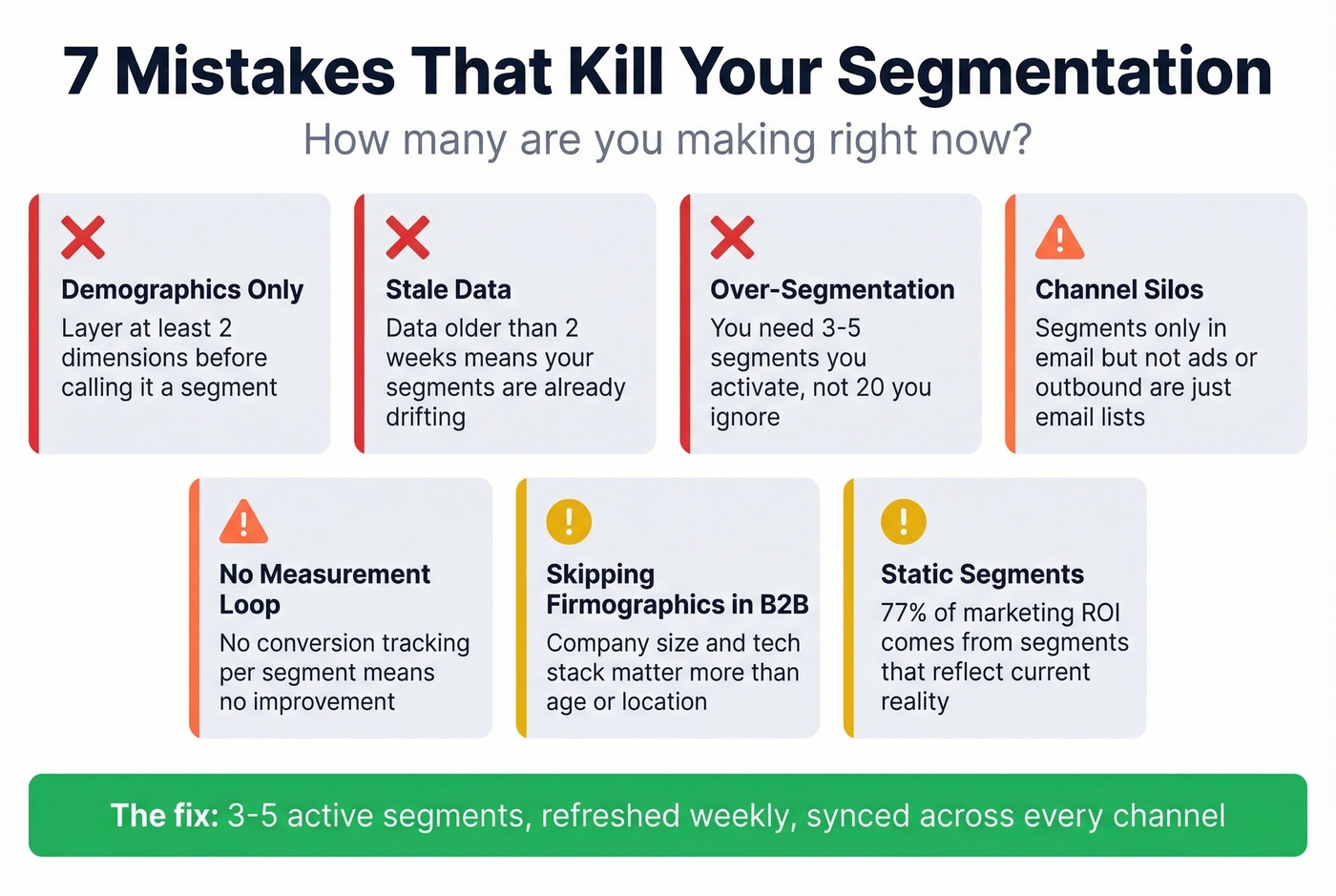
2. Stale data. If your data is more than two weeks old, your segments are already drifting. People change jobs, companies get acquired, buying intent shifts. Weekly refresh is the standard worth hitting.
3. Over-segmentation. You don't need 20 micro-segments. You need 3-5 you actually activate with differentiated messaging and offers. If you've built a segment for "middle-aged customers who buy at Christmas, pay with Discover, and live in Minnesota," you've segmented yourself into a sample size of twelve. Every segment you can't resource is a segment that wastes your time.
4. Channel silos. Segments that exist in your email platform but not your ad accounts or outbound tools aren't segments - they're email lists. Sync everywhere or don't bother.
5. No measurement loop. If you're not tracking conversion rates per segment, you have no idea what's working. No feedback loop, no improvement.
6. Ignoring firmographics in B2B. Company size, revenue, tech stack, and funding stage matter more than the individual's age or location. B2B segmentation that skips firmographics is B2C segmentation in disguise.
7. Static segments that never refresh. A segment you built in Q1 and haven't touched since is a liability. Automate refresh cycles or set calendar reminders - 77% of marketing ROI comes from segmented, targeted, and triggered campaigns, but only when those segments reflect current reality.
Segmentation Tools and Infrastructure
Three categories matter - and each fits a different stage of maturity.
| Category | What It Does | Examples | Typical Cost |
|---|---|---|---|
| CDP | Unifies data, resolves identity, activates segments | Segment, Salesforce Data Cloud, Adobe RT-CDP, Tealium | $15K-$300K+/yr |
| CRM | System of record for contacts and deals | HubSpot, Salesforce CRM | Free-$1,500+/mo |
| Intent Data | Identifies in-market buyers by topic | Bombora (standalone), Prospeo (bundled) | $20K-$80K+/yr standalone |
| DMP | Third-party anonymous data (declining) | Oracle BlueKai, Lotame | $25K-$150K+/yr |
CDPs are the system of intelligence - they unify first-party data from every touchpoint and make it actionable. The trend is toward composable CDPs that use your existing cloud data warehouse rather than creating another silo. Twilio Segment is widely known for 700+ pre-built connectors and a free tier.
If you're evaluating vendors, it helps to compare B2B company data providers and sales prospecting databases based on refresh rate and match coverage.
For psychographic research, GWI offers 200K+ profiling points across global audiences - useful when you need deep attitudinal data before building segments. DMPs, built on third-party cookie data, are declining fast. Skip them unless you have a very specific programmatic use case.
Here's a scenario we see constantly: an SDR team is working a list of 10,000 "decision-makers" and booking 4 meetings a week. The list is 6 weeks old, half the contacts have changed jobs, and there's no intent signal attached. That's not segmenting - that's spamming.

How to Activate Segments Across Channels
Segments sitting in a dashboard don't generate revenue. 68% of B2B companies already use behavioral and transactional data to drive personalization - the question is whether you're activating across every channel or just email.
Email remains one of the highest-ROI channels. Automated emails generate roughly 41% of email orders while accounting for just 2% of sends. Personalized CTAs convert 202% better than generic defaults.
If you're trying to lift CTR, start with the basics: click rate, email copywriting, and a tighter email call to action.
Paid ads require translating your segments into platform-native audiences. On Meta, that means custom audiences and lookalikes built from your best-performing segments. On Google, Search audience segments function as observation layers and bid adjustments - they don't narrow reach the way Display targeting does.
Website personalization is underused. Amazon attributes roughly 35% of its ecommerce revenue to recommendation engines. You don't need Amazon's infrastructure - even basic personalization like showing different hero content to different segments moves conversion rates meaningfully.
Outbound prospecting is where B2B segmentation pays off fastest. Sync or export your segmented list into Salesforce, HubSpot, Instantly, or Lemlist and launch personalized sequences within minutes. Cart abandonment sequences work the same way in ecommerce - the average abandonment rate is 70.19%, and a 3-email recovery sequence can recover 12% of abandoned carts versus 3% from a single reminder.
If you're building outbound plays around intent, use an intent based segmentation approach so your messaging matches what buyers are researching.
The article says three segmentation dimensions beat one. Prospeo gives you 30+ filters to stack: technographics via Wappalyzer, firmographic data across 300M+ profiles, intent signals tracking 15,000 topics, job changes, and department headcount growth. One platform, every dimension you need - no stitching four tools together.
Every segmentation dimension in one platform, activated in minutes.
FAQ
What's the difference between audience segmentation and market segmentation?
Market segmentation divides an entire market into broad groups - enterprise vs SMB, healthcare vs fintech. Audience segmentation narrows further by behavior, intent, or lifecycle stage to personalize specific campaigns. Getting this distinction right ensures you reach people most likely to act, not just the broadest possible group.
How many segments should I create?
Three to five well-defined, regularly refreshed segments outperform 20 stale micro-segments every time. If you can't write differentiated copy for a segment, it's not a real segment - merge it or kill it.
What data do I need to start segmenting?
CRM data (job title, company size, industry) plus behavioral data (website visits, email engagement, content downloads) is the minimum viable starting point. Adding intent signals and technographics dramatically improves precision - 78% of marketers say subscriber segmentation is their most effective email strategy.
How often should I refresh my segments?
Weekly is ideal. People change jobs, companies grow, and buying intent shifts constantly. Most platforms refresh every 4-6 weeks, which means your segments are stale by launch day. Build refresh cycles into your workflow, not your quarterly planning.
Does this approach work for B2B?
Absolutely. B2B segmentation relies on firmographics (company size, revenue, funding), technographics (tech stack), and buyer intent rather than personal demographics. The combination of intent signal + job title + company size outperforms any demographic-only approach by a wide margin - and it's the foundation for campaigns that actually fill pipeline instead of just inflating impression counts.