

Marketing Data: What It Is, Why Most Teams Get It Wrong, and How to Fix It
It's Q1 planning. The CMO asks which channel drove the most revenue last quarter. The demand gen lead pulls up HubSpot - it says paid search. The BI analyst opens Looker - it says organic. The attribution tool says a webinar from six months ago deserves 40% of the credit. Three tools, three answers, one very quiet room.
That isn't a technology failure. It's a marketing data discipline failure. 84% of data and analytics leaders say their strategies need significant overhauls, and the average enterprise stack runs $200K-$850K per year - most of that spend producing conflicting dashboards rather than clear decisions.
The Short Version
Your data is only as good as its quality, governance, and the decisions it drives. Three priorities for 2026:
- Fix data quality before buying new tools. 30% of CMOs say improving data quality is the single biggest lever for marketing performance. Not a new CDP. Not another attribution platform. Clean data. (If you need a framework, start with a data quality audit.)
- Adopt a governance framework. Only 43% of data and analytics leaders have one. If your team can't agree on what counts as an "engagement," no tool will save you.
- Measure CAC/LTV per channel instead of last-click ROAS. Last-click attribution is a comforting fiction that overvalues whatever touchpoint happens to sit closest to conversion.
What Is Marketing Data?
Marketing data is any information that helps you understand who your customers are, how they behave, and which activities actually move revenue. That includes demographic and firmographic profiles, behavioral signals from your website and product, transactional records, intent data, and the contact information that feeds your outbound pipeline. In B2B specifically, it comes down to firmographic, technographic, and intent signals that help you identify and prioritize accounts most likely to buy.
The gap between teams that use data well and teams that don't is enormous. Data-driven personalization delivers five to eight times the ROI on marketing spend - a widely cited benchmark that aligns with what practitioners consistently report. The more grounded number: 30% of CMOs cite data quality as the single biggest lever to improve performance. Not more data. Better data. (If you’re diagnosing root causes, see common data quality metrics and scorecards.)
Here's the uncomfortable truth: 77% of organizations report increased access to useful data, but only 49% say they're effective at actually using data-informed insights. Most teams are drowning in dashboards while starving for decisions. Understanding what businesses use this information for - segmentation, attribution, pipeline forecasting, personalization - is the first step toward closing that gap.
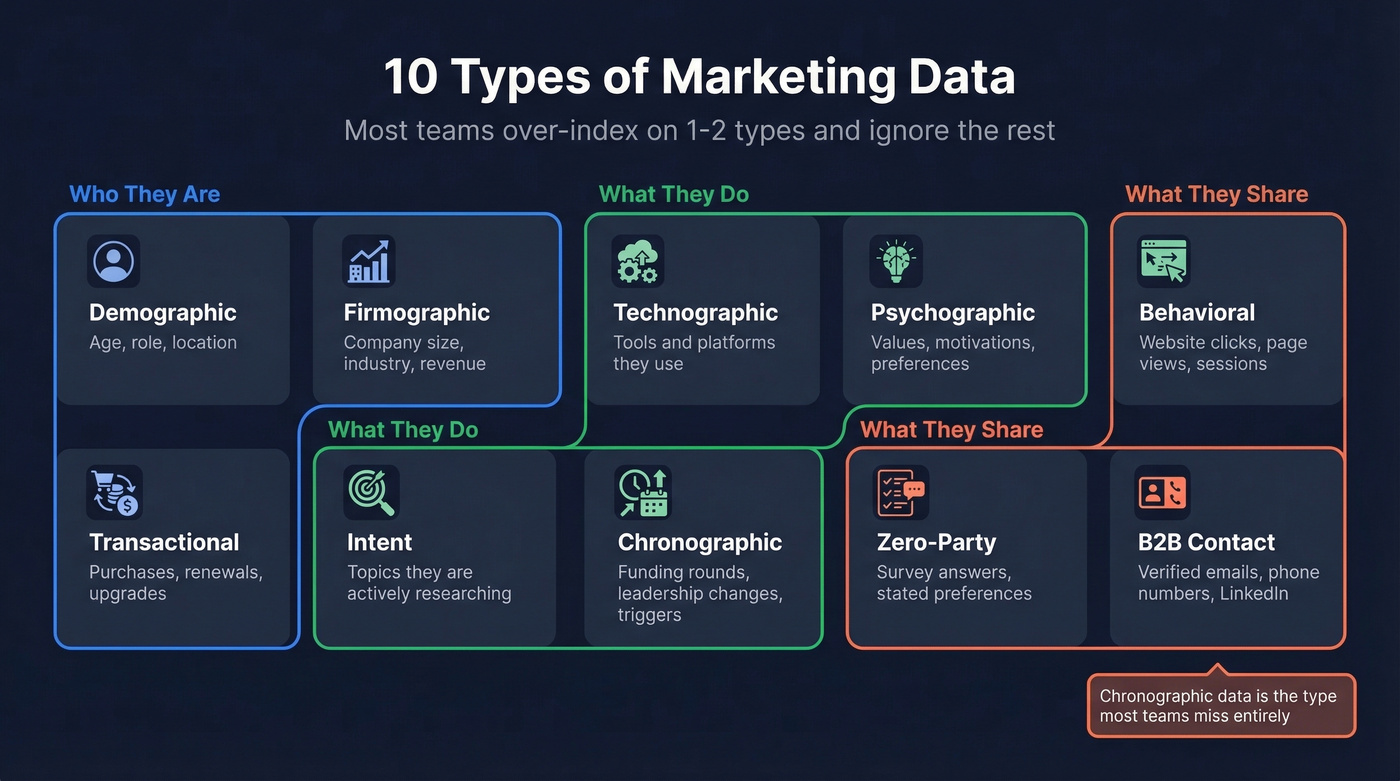
The 10 Types of Marketing Data
Not all categories are created equal. Most teams over-index on one or two while ignoring the rest.
| Type | What It Tells You | Example Source | Best For |
|---|---|---|---|
| Demographic | Who the person is | CRM, forms, surveys | Segmentation, targeting |
| Firmographic | Company attributes | Enrichment tools, filings | ABM, ICP definition |
| Technographic | Tech stack in use | Wappalyzer, job postings | Product-market fit |
| Behavioral | What they do on-site | GA4, product analytics | Conversion optimization |
| Transactional | What they've bought | E-commerce, billing | LTV modeling, upsell |
| Intent | What they're researching | Bombora, G2, review sites | Demand gen timing |
| Psychographic | Values, motivations | Surveys, social listening | Messaging, positioning |
| Chronographic | Events and triggers | News feeds, CRM alerts | Sales triggers, timely outreach |
| Zero-party | What they tell you directly | Preference centers, quizzes | Personalization |
| B2B contact | Verified emails, phones | Enrichment providers, APIs | Outbound, enrichment |
Chronographic data - funding rounds, leadership changes, mergers, headcount surges - is the type most teams overlook entirely. It's the difference between emailing a VP of Sales on a random Tuesday and emailing them the week after their company closed a Series B. Timing transforms cold outreach into relevant outreach. (This is the backbone of trigger events and signal-based outbound.)
Most teams collect behavioral and transactional signals passively through analytics tools but neglect firmographic, technographic, and intent data entirely. That's a massive blind spot. Knowing which types your strategy actually requires is what separates a spray-and-pray list from a targeted campaign. (For B2B, it’s worth going deeper on B2B technographics and B2B intent data.)
Sources: First-Party, Zero-Party, and Third-Party
Every piece of information comes from one of three buckets, and understanding the tradeoffs between them matters more in 2026 than ever.
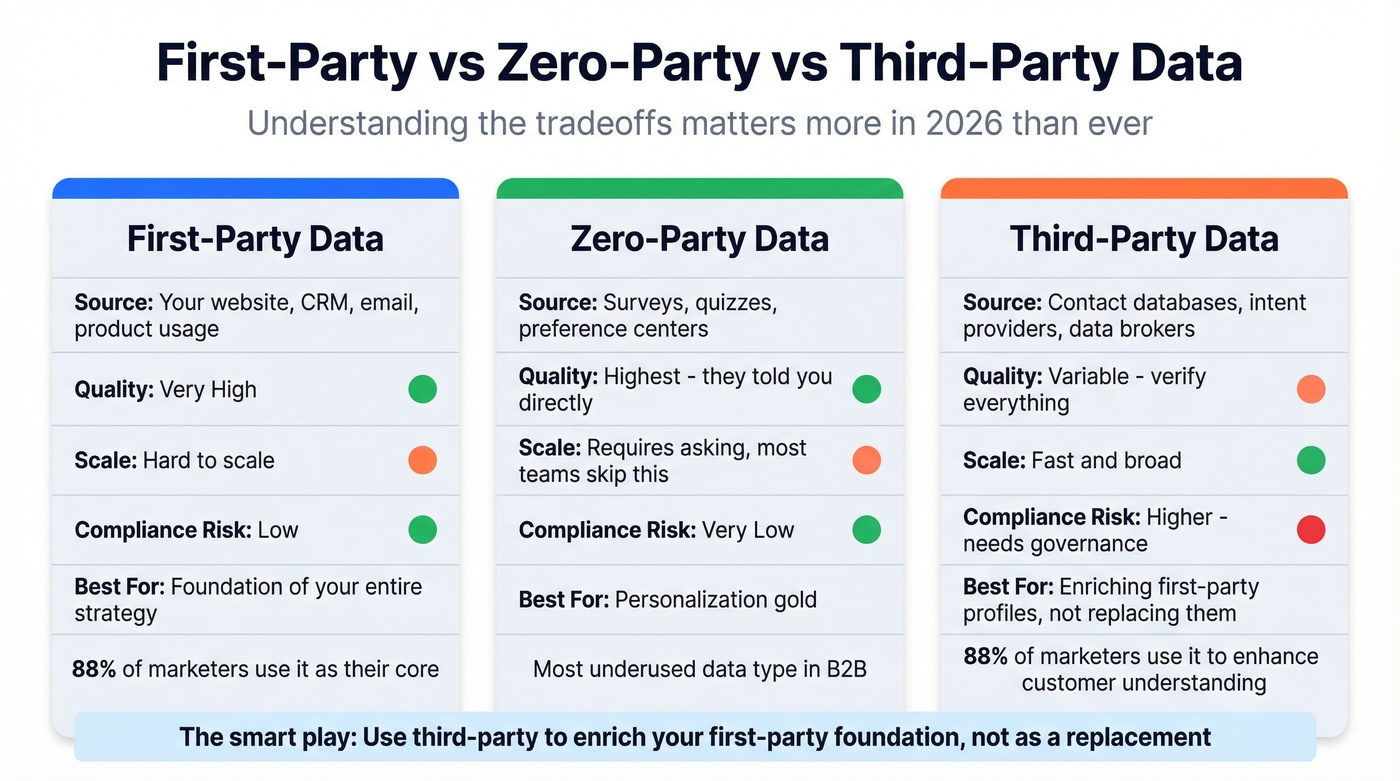
First-party data is what you collect directly from your audience - website behavior, CRM records, email engagement, product usage. It's the highest quality, the most defensible legally, and the hardest to scale. This is your foundation. (If you’re building the pipeline, use a structured first-party data collection plan.)
Zero-party data is what customers voluntarily share - survey responses, preference selections, quiz answers. It's gold for personalization but requires you to actually ask for it, which most teams don't do systematically.
Third-party data is purchased or aggregated from external sources - contact databases, intent providers, data brokers. It scales fast but carries quality and compliance risk. The smart play is using third-party data to enrich and extend your first-party foundation, not as a replacement for it. 88% of marketers use third-party data to enhance their understanding of each customer, but the key is pairing it with strong first-party signals so you're enriching real profiles rather than building on sand. (If you’re evaluating vendors, start with a third-party data risk checklist.)
The Cookie Situation in 2026
Let's be direct. In 2024, Google shifted away from full third-party cookie deprecation toward a user-choice approach and new privacy controls. Chrome holds roughly 65% of global browser market share, so this decision matters.
Don't mistake a pause for a reprieve. Google's "Tracking Protection" already limits cross-site tracking for about 30 million Chrome users. During the 1% restriction test, publishers saw a -34% drop in programmatic revenue on Google Ad Manager and -21% on AdSense when third-party cookies were removed without adequate alternatives. The Privacy Sandbox's Topics API covers 470 categories - far less granular than cookie-based targeting.
Build your strategy on first-party data. Third-party cookies aren't dead, but they're on life support, and every quarter you delay the shift makes the eventual transition harder.
How to Build a Data Strategy
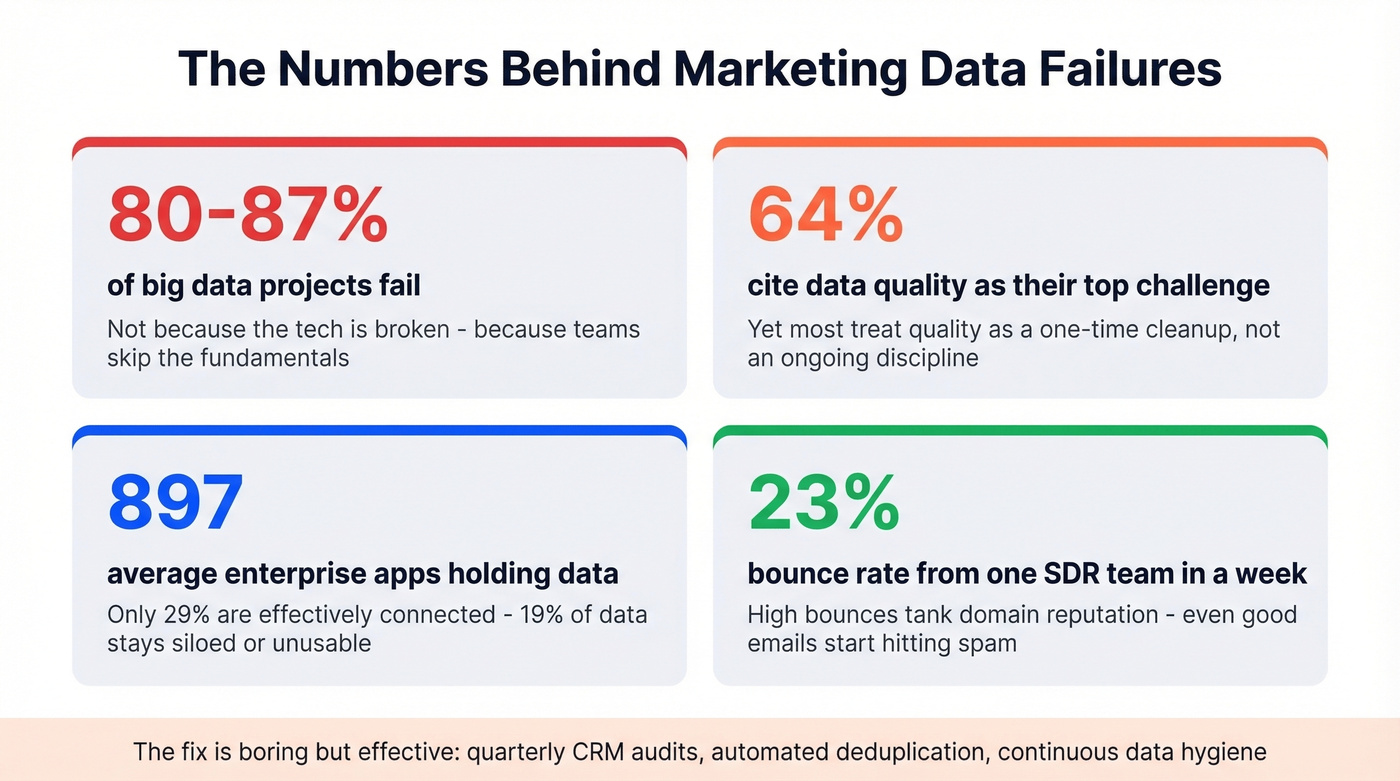
Most strategies fail not because teams pick the wrong tools, but because they skip the boring foundational work. Data sits across an average of 897 enterprise applications, and only 29% of those are effectively connected. 19% of enterprise data remains siloed or unusable, and 70% of leaders believe valuable insights are hidden in data they can't access. That's not a technology problem. It's an architecture problem.
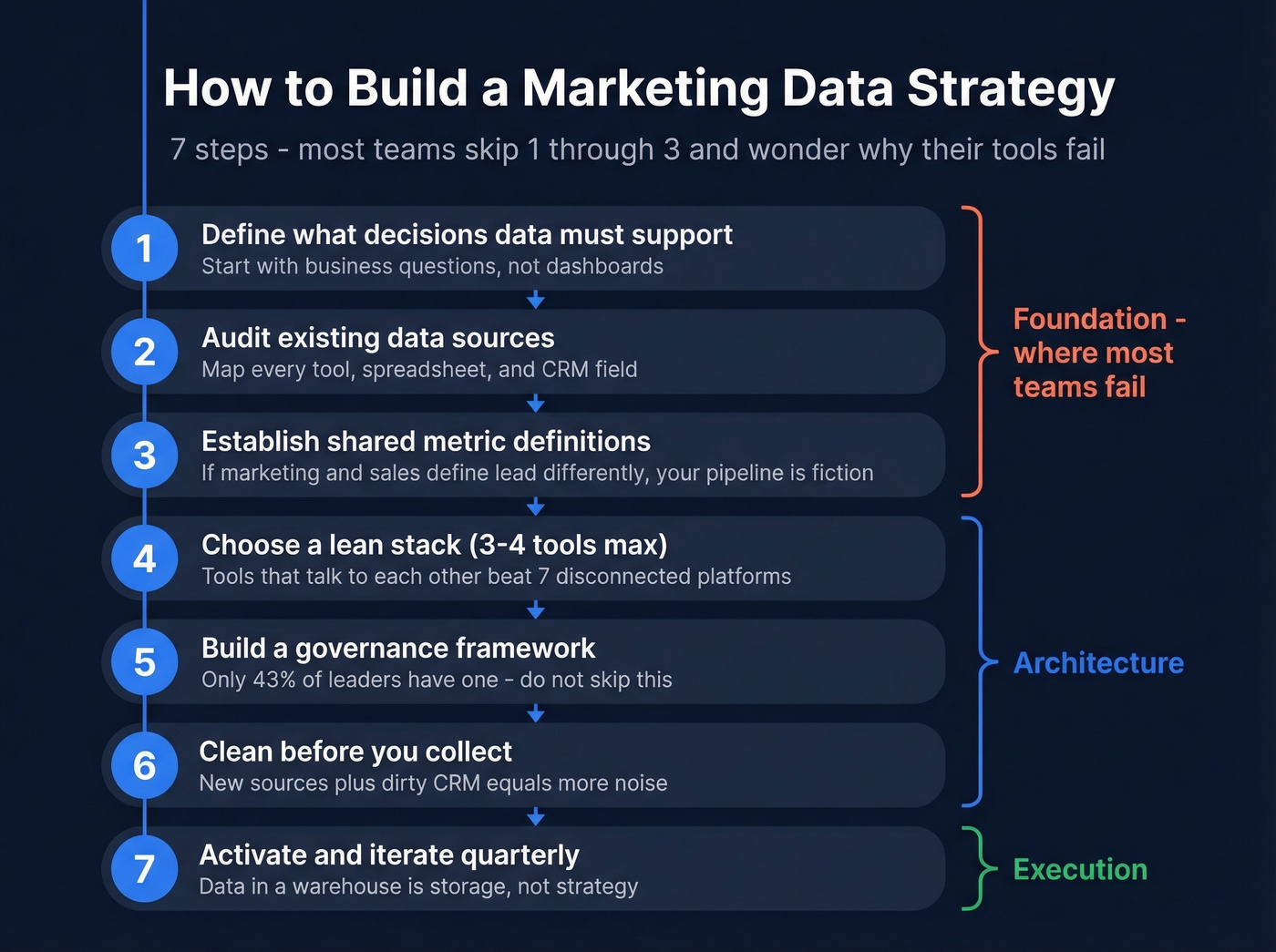
1. Define what decisions data must support. Start with the business questions, not the dashboards. "Which channels should we increase spend on next quarter?" is a decision. "We need more data" is not.
2. Audit existing data sources. You probably have more than you think - and most of it is disconnected. Map every tool, every spreadsheet, every CRM field. You'll find redundancies and gaps.
3. Establish shared metric definitions. If marketing counts a "lead" differently than sales, your pipeline reporting is fiction. Get alignment on definitions before you build anything.
4. Choose a lean stack. You don't need seven tools. You need three or four that talk to each other. Over-customizing too early undermines the standardization you need to scale.
5. Build a governance framework. Only 43% of data and analytics leaders have formal governance in place. The majority are flying blind on data ownership, access controls, and quality standards.
6. Clean before you collect. Adding new sources to a dirty CRM just creates more noise. Deduplicate, verify, and standardize what you have first. (If you need a repeatable process, follow a CRM hygiene playbook.)
7. Activate and iterate. Data that sits in a warehouse isn't strategy - it's storage. Build feedback loops between your campaigns and the teams who need to optimize spend, messaging, and targeting in real time. Revisit your framework quarterly.

30% of CMOs say data quality is the biggest lever for performance. Prospeo delivers 98% email accuracy through 5-step verification, firmographic and technographic filters, and intent data across 15,000 Bombora topics - all on a 7-day refresh cycle.
Replace conflicting dashboards with data you can actually trust.
Mistakes That Kill ROI
80-87% of big data projects fail to produce sustainable business results. Not because the technology doesn't work - because teams make the same avoidable mistakes over and over.
Trying to do everything at once. Spending six months building a "unified data platform" that nobody uses because requirements changed by the time it shipped. Start with one use case, prove value, then expand. Ship something in 30 days.
Treating marketing data as marketing-only. Business intelligence that doesn't flow to sales, product, and finance is half as valuable as it should be. If your SDR team can't see which accounts are showing intent signals, you're leaving pipeline on the table. Build cross-department visibility into your data architecture from day one. (This is where sales and marketing alignment stops being a slogan and becomes an operating system.)
Misreading ROI and attribution. If your attribution model says branded search drives 60% of revenue, it's not wrong - it's just measuring the last mile and ignoring the marathon. Ask any RevOps professional what their biggest data headache is, and you'll hear the same answer: attribution disagreements between marketing and sales. Layer multi-touch attribution over last-click. Compare CAC/LTV per channel, not just ROAS.
Sending campaigns on bad contact data. We've watched an SDR team send 1,800 emails in a week and get a 23% bounce rate. That's not just wasted effort - it's active damage. High bounce rates tank your domain reputation, which means even your good emails start landing in spam. Verify at the source. Use a provider with real-time verification and frequent refresh cycles rather than cleaning up after the fact. (If you’re seeing decay, benchmark against B2B contact data decay.)
Ignoring data quality as a strategic priority. 64% of organizations cite data quality as their top data integrity challenge. Yet most teams treat quality as a one-time cleanup project rather than an ongoing discipline. Schedule quarterly CRM audits. Automate deduplication. Treat data hygiene like you treat security - continuous, not annual.
AI and Marketing Data in 2026
90% of marketers using AI say it helps them make decisions faster. The concrete use cases are real: anomaly detection that catches CPC spikes before they drain your budget, automated budget reallocation recommendations, and generative content that cuts production time by 30-50% for early adopters.
The case studies are well-documented at this point. JPMorgan Chase used AI-written ad copy and saw CTR lift by up to 450% versus human-written versions. Nutella generated 7 million unique AI label designs - every jar sold out. These are production results, not hypotheticals.
But 89% of data and analytics leaders with AI in production have experienced inaccurate or misleading outputs. AI doesn't fix bad data. It amplifies it. Feed a predictive model dirty CRM records and you'll get confidently wrong recommendations at scale. (Related: AI data quality is becoming a budget line item, not a nice-to-have.)
The teams getting real value from AI in 2026 aren't the ones with the fanciest models. They're the ones who spent the previous year cleaning their data, establishing governance, and building reliable pipelines. AI is an accelerant - if your foundation is solid, it accelerates growth. If your foundation is broken, it accelerates the wrong decisions.
Here's our take: if your average deal size sits below $10K and your CRM has more than 15% bad records, you'll get more ROI from a data cleanup sprint than from any AI tool on the market. Fix the pipes before you turn on the pressure.
Tools: Costs and How to Choose
Most guides skip the cost conversation entirely. Let's fix that.
What a Stack Actually Costs
| Component | Typical Annual Cost | Notes |
|---|---|---|
| ETL/Connectors | $2K-$20K | Supermetrics, Funnel, Fivetran |
| BI/Visualization | $40K-$200K | Looker, Tableau, Power BI |
| GA360 | $150K+ | Free GA4 covers most teams |
| Attribution | $30K-$300K | Northbeam, Triple Whale, Measured |
| CDP | $20K-$120K | Segment, Tealium, mParticle |
| B2B Contact Data | $0-$80K | Ranges from free tiers to enterprise contracts |
| Marketing Automation | $50K-$200K | HubSpot, Marketo, Pardot |
You don't need a $500K stack to be data-driven. A lean team can run GA4 (free) + a CRM like HubSpot + one consolidation tool like Supermetrics ($2K-$20K/year depending on connectors and volume) and get 80% of the insight that enterprise stacks deliver. The remaining 20% is where you decide whether the marginal value justifies the marginal cost.
How to Evaluate Tools
A solid evaluation framework covers five criteria: measurement accuracy, full-funnel visibility, decision support, data unification, and scalability. We'd add a sixth: how well does it play with your existing stack? A tool that requires six months of implementation before it delivers value isn't a tool - it's a project.
Quick category map: GA4 or Adobe Analytics for web analytics. Supermetrics or Funnel for data consolidation. Segment or Tealium if you genuinely need a CDP - most teams under $50M in revenue don't. Northbeam or Triple Whale for DTC attribution. And for B2B contact data, you need a dedicated provider with real-time verification, not a CRM that happens to have an append feature. (If you’re comparing options, start with data enrichment services and contact data enrichment.)
B2B Contact Data
This is where most guides go silent, and it's the category that matters most for B2B teams running outbound or ABM. In our experience, the quality of your contact data determines whether your outbound campaigns build pipeline or burn your domain. (If you’re shopping, use a ranked list of the best B2B contact databases.)
Prospeo covers 300M+ professional profiles with 143M+ verified emails and 125M+ verified mobile numbers. The 98% email accuracy rate comes from a 5-step verification process with catch-all handling, spam-trap removal, and honeypot filtering - and every record refreshes on a 7-day cycle versus the 6-week industry average. Pricing starts free with 75 emails and 100 Chrome extension credits per month, scaling at roughly $0.01/email. No annual contracts, no sales calls required.

For comparison, ZoomInfo typically runs $15K-$80K/year with annual contracts and benchmarks around 87% email accuracy. Cognism is strong in EMEA and typically lands in the $15K-$50K/year range. Apollo offers a generous free tier but email accuracy sits closer to 79%. Skip Apollo if deliverability matters to your team - a 21-point accuracy gap compounds fast when you're sending thousands of emails per week.
Privacy and Compliance
Data without a compliance framework is a liability, not an asset.
| Dimension | GDPR | CCPA/CPRA |
|---|---|---|
| Consent Model | Opt-in required | Opt-out (user must request) |
| Scope | EU residents | California residents |
| Max Penalty | EUR 20M or 4% of global revenue | $7,500/intentional violation |
| Key Requirement | Lawful basis for processing | "Do Not Sell" link required |
| Response Window | 30 days for DSARs | 45 days for DSARs |
CCPA applies if your business exceeds $26.6M in revenue, processes data on 100K+ California residents, or derives 50%+ of revenue from selling or sharing personal information. One company was fined $345,178 simply for failing to honor opt-out requests during a 40-day infrastructure failure. That's not a hypothetical risk - it's a line item that could appear on your balance sheet.
Your operational checklist for 2026:
- Cookie consent management - block non-essential scripts until consent is granted.
- "Do Not Sell or Share" link - visible on every page, not buried in a footer sub-menu.
- Honor GPC signals - Global Privacy Control is legally required under CCPA.
- 45-day DSAR response process - with acknowledgment within 10 business days.
- Vendor mapping and DPAs - know exactly which third parties touch your data and ensure contracts are in place.
81% of consumers believe how an organization treats personal data indicates how it respects customers. Compliance isn't just legal risk management - it's brand trust. (For B2B teams, a practical compliant B2B data checklist helps prevent “we didn’t know” surprises.)
KPIs That Matter in 2026
58-60% of Google searches now end without a click. More than half your potential audience never visits your site, and you're still measuring success by sessions and pageviews.
Last-click ROAS tells you which channel was standing closest to the finish line, not which channels actually built the pipeline. The KPIs that matter in 2026 look different:
Old metrics (still tracked, less trusted): website traffic, sessions, last-click ROAS, MQLs by source.
New metrics (where the signal lives): CAC/LTV per channel, AI Overviews share of voice, conversion path analysis across GA4 + CRM + marketing automation, share of search, and pipeline velocity by data source.
The shift from "how much traffic did we get?" to "how efficiently did we acquire customers who actually retained?" is the single most important measurement upgrade most marketing teams can make this year. If you're still reporting last-click ROAS to your board, you're optimizing for a metric that rewards the wrong channels.
Every framework, tool, and KPI in this article points back to the same foundation: clean, governed, decision-ready marketing data. Get that right, and the rest follows. Get it wrong, and no amount of tooling will save you.
Your enrichment pipeline is only as good as your third-party sources. Prospeo returns 50+ data points per contact at a 92% match rate - firmographic, technographic, and intent signals unified in one platform at $0.01 per email.
Enrich your first-party foundation without the enterprise price tag.
FAQ
What is marketing data?
Marketing data is the raw input - contact records, behavioral events, transaction logs, intent signals - that helps teams understand their audience and measure campaign impact. Marketing analytics is the process of extracting patterns from that data to inform decisions. You need both, but data quality comes first. Sophisticated analytics built on garbage records produces wrong conclusions faster.
How much does a data stack cost?
Enterprise stacks typically run $200K-$850K per year across ETL, BI, attribution, CDPs, and automation - excluding headcount. Lean teams can start with GA4 + a CRM + one consolidation tool for under $10K/year. The real cost isn't the tools. It's the integration and maintenance labor most budgets underestimate.
What's the best way to improve data quality?
Start with verification at the source rather than cleanup after the fact. For B2B contacts, a 5-step verification process with a 7-day refresh cycle prevents bad records from entering your systems in the first place. For behavioral and transactional data, standardize field definitions across tools, deduplicate regularly, and audit your CRM quarterly.
Do I need a CDP?
Probably not unless you're doing $50M+ in revenue with complex multi-channel journeys spanning web, app, retail, and multiple ad platforms. A well-maintained CRM integrated with GA4 gets most teams further than they expect. CDPs run $20K-$120K/year and require dedicated resources - a significant investment many teams underutilize.