

Miller Heiman Gold Sheet: Complete Guide for 2026
You just inherited a strategic account. Your VP wants a Gold Sheet by Friday. You've never seen one - and nobody's published a real breakdown.
Most guides out there are either a high-level overview of Miller Heiman's methodology or a pitch for a ~$2,600+ workshop. Nobody actually shows you what's inside the Gold Sheet or how to fill it out. That changes here.
The short version: The Gold Sheet is the account-level planning tool from Miller Heiman's LAMP methodology, designed to map stakeholders, set 1-3 year revenue goals, and create a living strategic plan for your largest accounts. The official template is usually only handed out through paid LAMP training, but you can build your own using the section-by-section breakdown below. One catch - the Gold Sheet only works if your stakeholder data is current. Stale CRM records undermine the entire exercise.
What Is the Gold Sheet?
The Gold Sheet is a structured worksheet - typically Excel or PDF - used within the Large Account Management Process (LAMP) to plan and manage strategic accounts over a 1-3 year horizon. Robert Miller and Stephen Heiman created the framework; Korn Ferry now owns and delivers the Miller Heiman IP.
Think of it as the opposite of reactive account management. Instead of responding to whatever your biggest customer throws at you this quarter, the Gold Sheet forces you to map the full account landscape: stakeholders, revenue trajectory, strategic strengths, vulnerabilities - all feeding into a plan that spans years, not weeks. It's a living document referenced across sales, customer success, and executive sponsors. Not a one-time exercise you complete during onboarding and never open again.
Most account plans die in a Google Doc. The Gold Sheet is designed to be reviewed, updated, and debated quarterly. That's the distinction that matters.
Gold vs Blue vs Green Sheet
Miller Heiman's methodology produces three worksheets, and most guides conflate them.
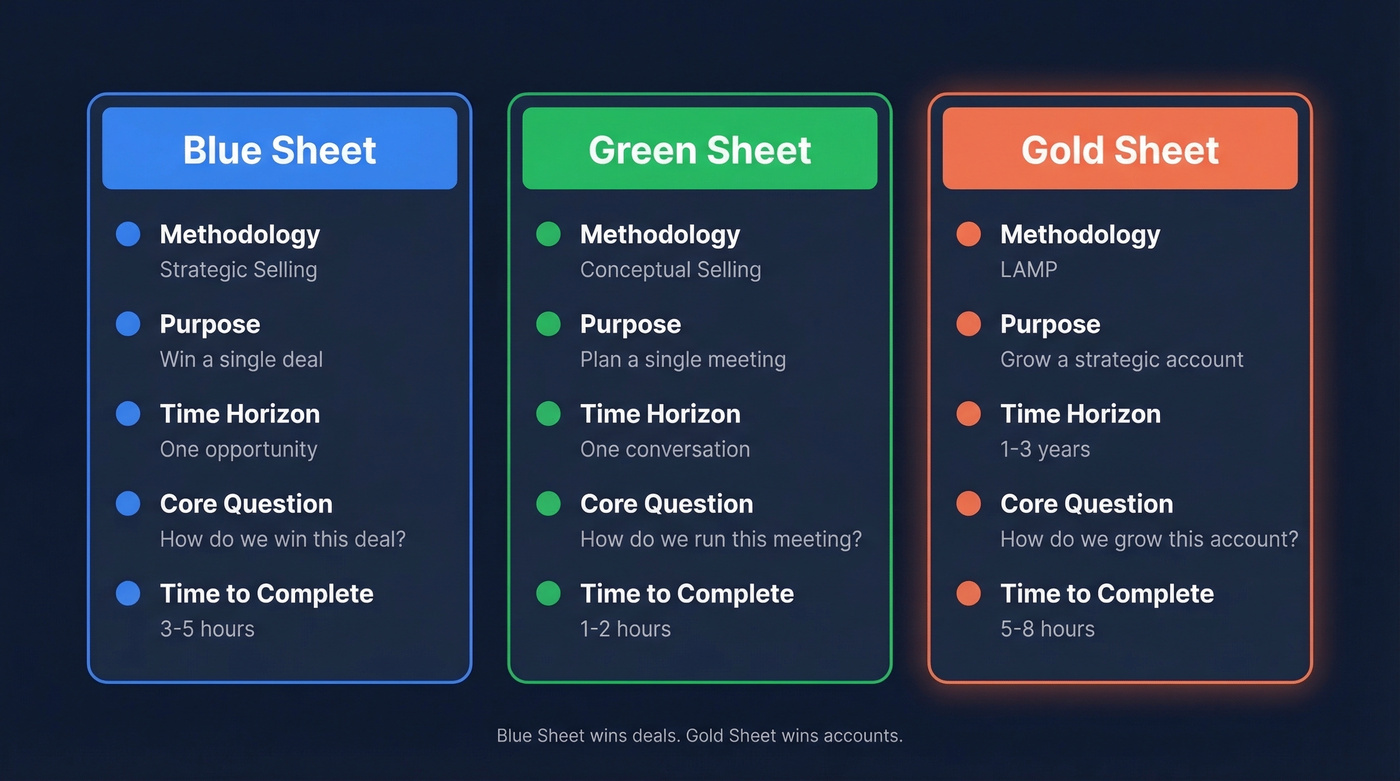
| Sheet | Methodology | Purpose | Time Horizon | Core Question |
|---|---|---|---|---|
| Blue | Strategic Selling | Deal strategy | Single opp | How do we win this deal? |
| Green | Conceptual Selling | Meeting planning | Single call | How do we run this meeting? |
| Gold | LAMP | Account strategy | 1-3 years | How do we grow this account? |
If you're choosing which to learn first: Blue Sheet for deal strategy, Gold Sheet for account strategy. The Green Sheet is optional unless your team consistently botches discovery calls - it structures conversations around confirmation, new information, and attitude questions.
Here's the thing: most Miller Heiman content focuses on the Blue Sheet. That's the wrong sheet for account managers working multi-year relationships. The Blue Sheet wins deals. The Gold Sheet wins accounts.
According to BDM Sales Training, the Gold Sheet serves four core purposes: understanding the customer situation in detail, building a 2-3 year strategy with the customer, developing a strong action plan using the wider account team, and maintaining a review process to stay on track. Every section below maps to one of those four goals.
What's Inside the Gold Sheet
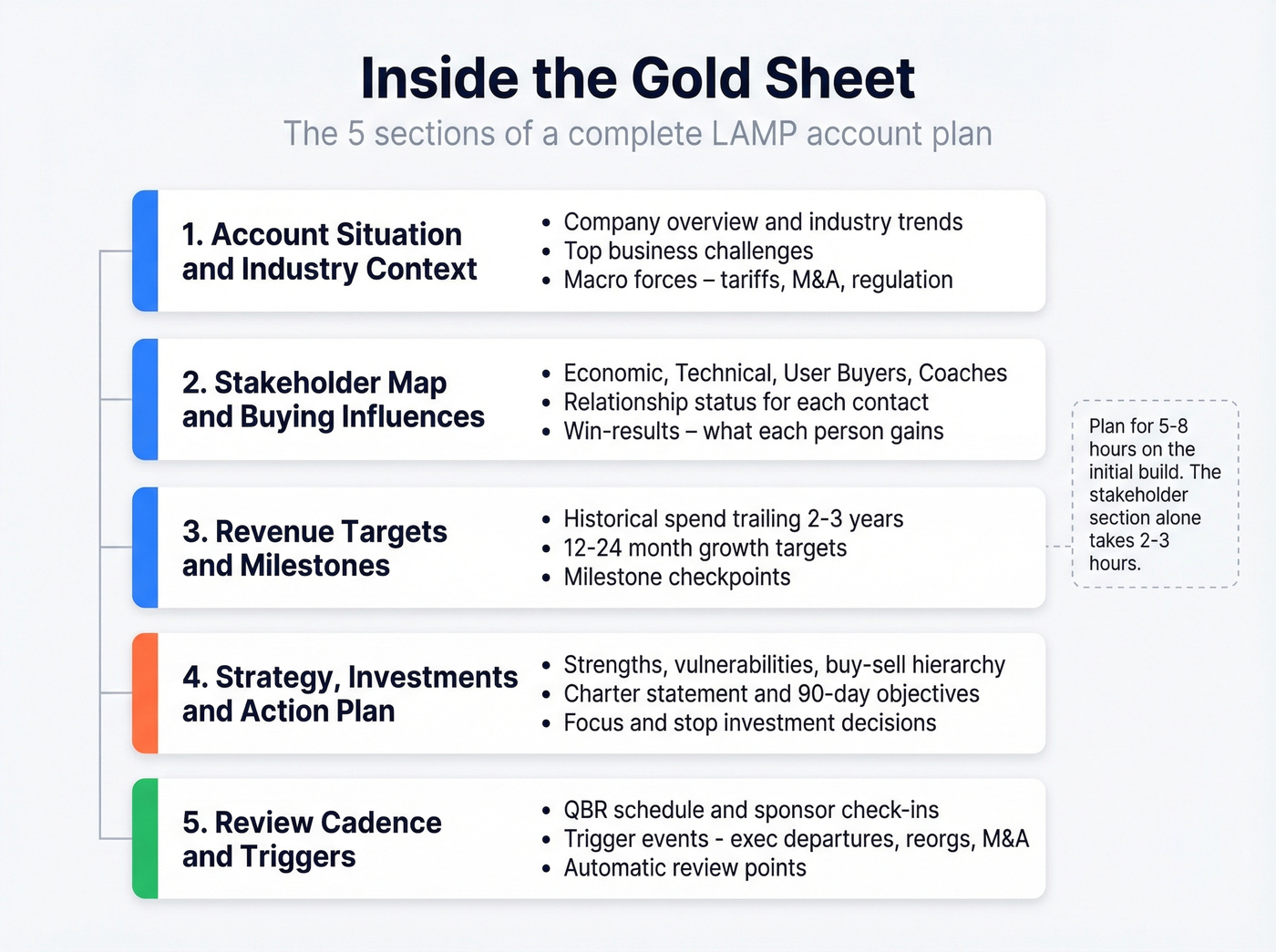
This is the section nobody publishes. The official template is locked behind training, but the Gold Sheet's anatomy is well-documented across LAMP training partners, practitioner resources, and the original books.
Account Situation & Industry Context
This section captures company overview, industry trends affecting the account, their top business challenges, competitive landscape, and macro forces like regulatory shifts, M&A activity, or market headwinds that shape how they buy.
A Gold Sheet that opens with "they spend $200K/year with us" instead of "they're navigating a 15% tariff increase on raw materials" has already missed the point. You're demonstrating that you understand the customer's world, not just your pipeline.
Stakeholder Map & Buying Influences
You'll document every person who influences the account relationship, categorized by Miller Heiman's buying influence roles: Economic Buyers, Technical Buyers, User Buyers, and Coaches/Champions. For each stakeholder, record their current title, department, contact data, relationship status (strong, neutral, or at risk), and their win-results - what they personally gain from working with you.
Complex B2B accounts typically involve six to ten stakeholders per Gartner research. That's a lot of people to track, and the #1 reason Gold Sheets go stale is that the stakeholder section relies on last year's org chart.
Before you start filling this section, enrich your account contacts. Prospeo's CRM enrichment returns 50+ data points per contact with an 83% match rate and a 7-day refresh cycle, so you're building your stakeholder map on current names, titles, verified emails, and direct dials instead of guessing who still works there. (If you’re comparing vendors, start with data enrichment services and lead enrichment.)
Revenue Targets & Milestones
Map out historical revenue from this account (trailing 2-3 years), current annual spend, 12-24 month growth targets, and milestone checkpoints that indicate whether you're on track.
This is the financial backbone of the Gold Sheet. Without concrete numbers, the rest of the document is just a relationship narrative. Set specific targets: "Grow from $180K to $280K in 18 months by expanding into their European operations" - not "increase revenue." (If you need a clean way to define targets vs projections, see sales forecast vs sales goal.)
Strategy, Investments & Action Plan
This is the densest section. It covers strategic strengths where you're entrenched and valued, vulnerabilities where competitors have footholds or your relationship is thin, and your position in the buy-sell hierarchy. That hierarchy has four levels, and knowing where you sit is critical:
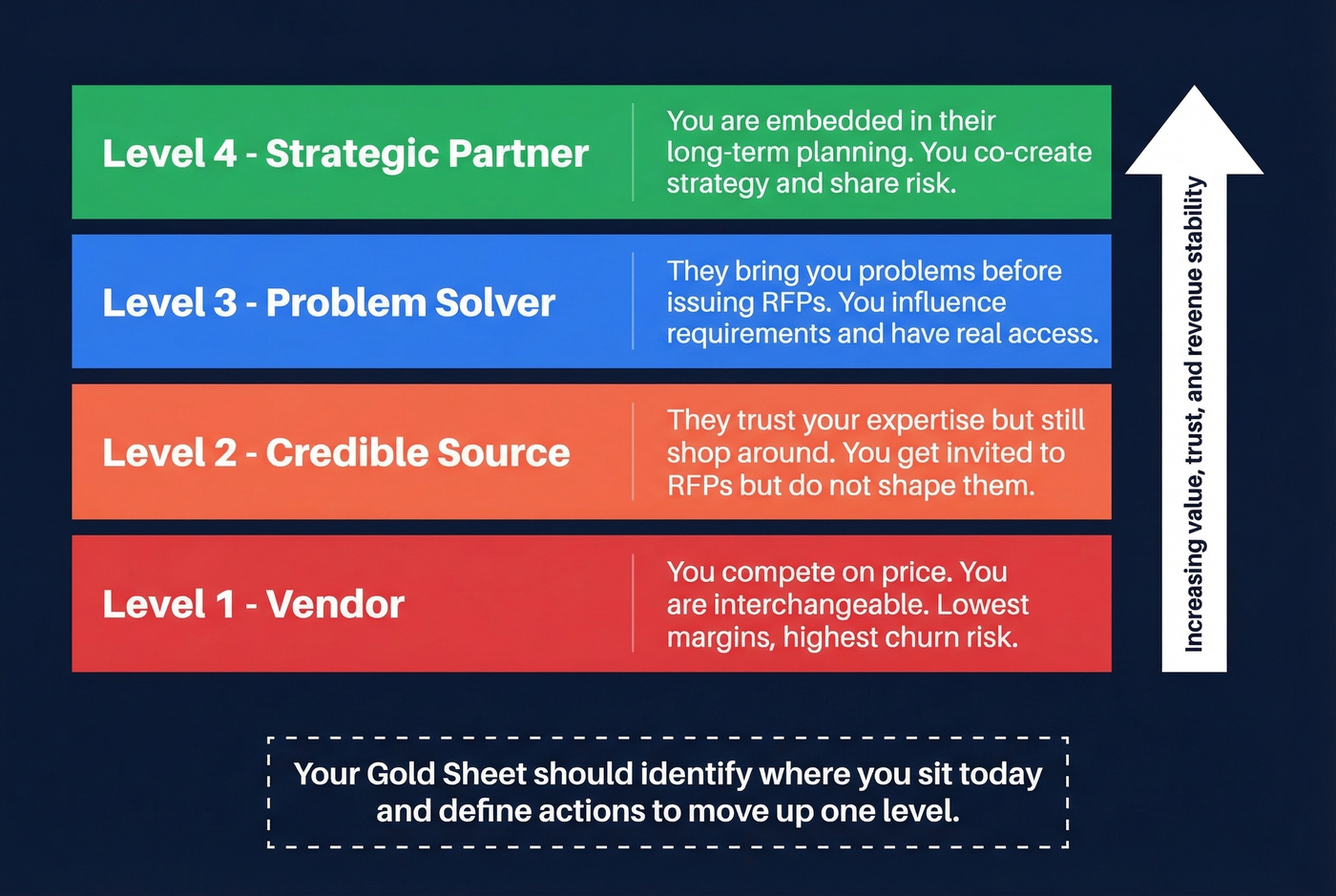
- Vendor - you compete on price, you're interchangeable
- Credible source - they trust your expertise but shop around
- Problem solver - they bring you problems before issuing RFPs
- Strategic partner - you're embedded in their long-term planning
Beyond the hierarchy, this section includes a charter statement defining the relationship's purpose, focus/stop investment decisions, single sales objectives for the next 90 days, and a concrete action plan with owners and deadlines. (For a complementary framework to align stakeholders and qualification, compare with MEDDPICC economic buyer and technical buyer vs economic buyer.)
The charter statement is particularly underrated. It forces you to articulate why this account should invest in you beyond price. If you can't write a compelling charter statement, you don't understand the account well enough to fill out the rest of the Gold Sheet.
Review Cadence & Triggers
Define your QBR schedule, executive sponsor check-in cadence, and trigger events that demand an immediate update - executive departures, org restructures, major competitive wins or losses, M&A announcements, and budget cycle shifts. (If you want a tighter QBR structure, use QBR questions to ask and clarify QBR vs EBR.)
This section separates a living strategic plan from a static one. Without defined triggers, the document gathers dust until someone panics before a renewal. Build in automatic review points and you'll catch problems while they're still fixable. In our experience, teams that skip this section end up with a beautifully crafted document that's outdated within a quarter.

The #1 reason Gold Sheets go stale? Outdated stakeholder data. Prospeo's CRM enrichment returns 50+ data points per contact - current titles, verified emails, direct dials - with an 83% match rate and a 7-day refresh cycle. Build your stakeholder map on facts, not last year's org chart.
Stop planning strategic accounts with dead contact data.
Filling Out a Gold Sheet: Worked Example
Let's make this concrete. You're an account manager at a mid-market SaaS company selling supply chain software. Your largest customer is Apex Manufacturing, a Fortune 1000 company spending $180K/year across two divisions.
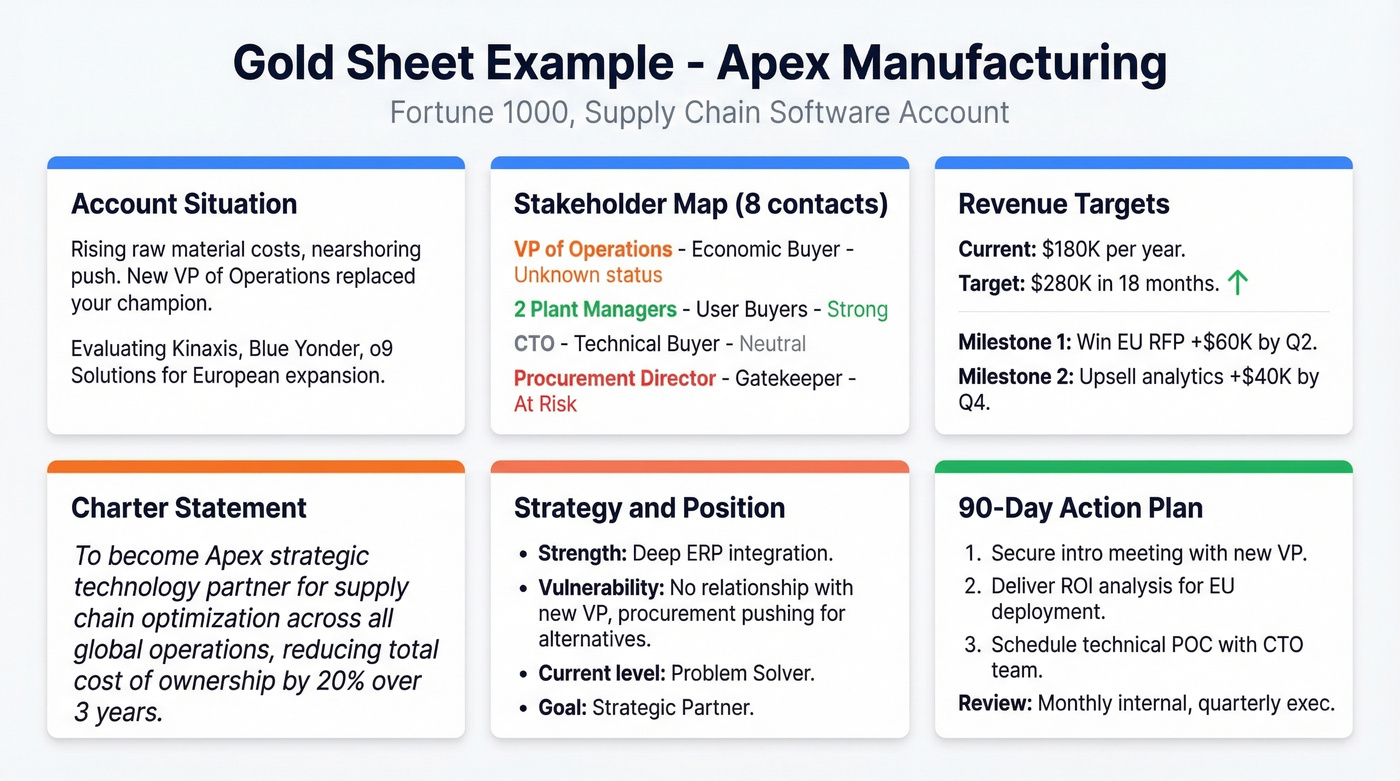
Account Situation: Apex is navigating rising raw material costs and a push toward nearshoring. They've announced a new VP of Operations (replacing your champion) and are evaluating three competing platforms - Kinaxis, Blue Yonder, and o9 Solutions - for their European expansion.
Stakeholder Map: You identify eight buying influences. The new VP of Operations is your Economic Buyer with an unknown relationship status. Two plant managers are User Buyers with strong relationships. The CTO is a Technical Buyer, neutral. A procurement director is a gatekeeper, at risk - she's been pushing for a competitive RFP. Three department leads influence adoption. You pull current contact data and verify titles before filling this in. Plan for 2-3 hours on the stakeholder section alone. It always takes the longest.
Revenue Targets: Grow from $180K to $280K in 18 months. Milestone 1: win the European expansion RFP ($60K incremental) by Q2. Milestone 2: upsell analytics module to the US plants ($40K) by Q4. (If you’re building the expansion motion, see upsell vs cross-sell in SaaS.)
Charter Statement: "To become Apex's strategic technology partner for supply chain optimization across all global operations, reducing total cost of ownership by 20% over 3 years."
Strategy & Action Plan: Strength - deep integration with their ERP. Vulnerability - no relationship with the new VP of Operations, and the procurement director is pushing for alternatives. Current buy-sell hierarchy position: problem solver (aiming for strategic partner). 90-day action items: secure intro meeting with new VP, deliver ROI analysis for European deployment, schedule technical proof-of-concept with CTO's team. (If you need a tighter plan format, borrow from a 30-60-90 day plan for sales reps.)
Review Cadence: Monthly internal check-in, quarterly executive review, immediate update if VP of Operations hires externally for the evaluation team.
Expect 5-8 hours for the initial build. The Blue Sheet takes roughly 3-5 hours - the Gold Sheet covers a longer horizon and more strategic depth.
Where to Get the Template
You've got three paths. Pick the one that matches your budget and team size.
Official training works best when you're rolling out LAMP across an enterprise sales org and need facilitator guidance, certification, and organizational buy-in. A commonly referenced option is a ~$2,600 3-day workshop. You get the official template, structured exercises, and a shared language across your team. Sales reps on Reddit consistently report that the template is impossible to find without paying for training - this is the only guaranteed path to the official version.
Build your own if you're an individual contributor or small team that can't justify the training cost. Use the section breakdown above to create your version in Excel or Google Sheets. Multiple PDF versions of the template circulate online if you want a structural reference. This captures roughly 80% of the value without the price tag.
Go CRM-native if you want the planning framework integrated into your existing workflow. Build the sections as custom fields or objects on the account record in Salesforce or HubSpot. The Gold Sheet was designed to launch from the account record in CRM - a separate spreadsheet nobody opens defeats the purpose. We've tested CRM-native implementations in both Salesforce and HubSpot, and custom objects work better than custom fields. Objects let you version the plan over time and tie stakeholder records directly to the account. (If you’re standardizing your stack, start with examples of a CRM and a quick read on best contact management software.)
Real talk: Path 2 gets most teams 80% of the way there. Pair it with a quarterly review discipline and you'll outperform most teams that paid for the workshop but never updated their plans. The methodology is valuable. The template is just a worksheet.
Modernizing Account Planning for 2026
The framework is sound, but the execution needs updating. Here's what modern enterprise sales demands.
CRM-native implementation. Gold Sheet fields should live inside the account record, not in a detached spreadsheet. Custom objects in Salesforce or HubSpot let you tie stakeholder data, revenue targets, and action items directly to the account - with version history and team visibility built in.
Automated data refresh. The stakeholder section is only as good as its data. Tools like Prospeo can automatically refresh contact data in your CRM on a weekly cycle, so the stakeholder map stays accurate between QBRs without manual research before each review.
AI-assisted account intelligence. AI tools can now auto-summarize call notes, track stakeholder sentiment shifts, and flag account health changes before they become emergencies. Layer these signals into your review process and you'll spot risks that manual quarterly reviews miss entirely. (If you’re building this into your workflow, see generative AI sales tools.)
Intent signals. Buyer intent data identifies when key accounts are actively researching solutions. If Apex Manufacturing starts surging on "supply chain optimization" topics, that's a trigger event worth capturing in your Gold Sheet. Intent data from providers like Bombora turns reactive reviews into proactive strategy. (To operationalize this, use a system for how to track sales triggers.)
Collaborative access. The plan should be visible to sales, CS, and executive sponsors - not locked in one rep's folder. Shared CRM views or linked dashboards make cross-functional alignment the default, not the exception.
The underlying principle hasn't changed: 80% of revenue typically comes from 20% of accounts. The Gold Sheet ensures those accounts get the strategic attention they deserve. What's changed is the tooling available to keep that attention informed and current.
Mapping 6-10 buying influences per account means you need verified emails and direct dials for every Economic Buyer, Coach, and Champion. Prospeo gives you 300M+ profiles at 98% email accuracy and 125M+ verified mobiles - at roughly $0.01 per email. No contracts, no sales calls.
Fill every Gold Sheet role with a real phone number and verified email.
FAQ
Is the Gold Sheet the same as the Blue Sheet?
No. The Blue Sheet maps a single opportunity through buying influences and win strategies. The Gold Sheet maps a 1-3 year strategic relationship across stakeholders, revenue targets, and investment decisions. Different methodology (LAMP vs Strategic Selling), different purpose, different time horizon.
Can I use the Gold Sheet without LAMP training?
Yes. The framework's principles are documented in Miller Heiman's books and across training partner sites. You won't have the official template, but you can build an effective version using the section breakdown in this guide. The training adds facilitation and organizational alignment - the worksheet itself is reproducible.
How often should I update my Gold Sheet?
At minimum, every QBR - so quarterly. Also update after executive changes, org restructures, major wins or losses, or any event that shifts the account's strategic landscape. Teams that treat it as a quarterly checkbox miss the point. It's a living document. If it's not updated when things change, it's worthless.
What CRM works best for Gold Sheet planning?
Salesforce and HubSpot are the most common choices. Build the sections as custom objects on the account record. The key is that the plan lives where your team already works - a beautifully formatted spreadsheet in someone's personal drive is worse than a rough set of CRM fields the whole team can see and update.