

The Outbound Funnel: A Practitioner's Guide to Building One That Actually Converts
A RevOps lead at a mid-market SaaS company ran the same outbound playbook for 18 months - 500 accounts per rep, email-only sequences, a "verified" list that bounced 28% on the first send. Pipeline was flatlined. When they cut rep books to 300 accounts, added phone and social touches, and swapped their data provider, meetings booked jumped 40% in a quarter. The playbook wasn't broken. The outbound funnel was.
Outbound is harder than it was three years ago. Sales cycles have lengthened 32% since 2021, buyers barely pick up the phone, and reps spend roughly two hours a day actually selling - the rest is admin, CRM hygiene, and chasing bad data. The r/techsales crowd isn't wrong when they say outbound feels like it's dying. It's not dying. But the lazy version of it is dead.
The Five Non-Negotiables
Before the deep dive, here are the components every outbound sales funnel needs to convert:
- Clean data. Everything downstream - deliverability, connect rates, rep confidence - depends on accurate emails and phone numbers.
- Tight ICP. Not "Series B SaaS companies." More like "Series A startups under 50 employees that just hired their first RevOps lead." Specificity is the difference between 3% and 10% reply rates.
- Multi-channel cadence. Email alone doesn't cut it. Phone, social, and email in a coordinated sequence warm prospects without overwhelming them.
- Stage benchmarks. You can't fix what you don't measure. Know your open rates, reply rates, meeting conversion, and pipeline velocity. (If you want a deeper KPI list, see funnel framework metrics.)
- ROI tracking. Outbound ROI lags 3-9 months. If you're only measuring meetings booked, you're missing the picture.
What Is an Outbound Funnel?
An outbound funnel maps the journey from cold prospect to closed deal - but unlike an inbound funnel, awareness starts with your sales team's outreach, not the buyer's discovery. Nobody Googled your product and downloaded a whitepaper. Your SDR sent a cold email, made a call, or connected on social. That's a fundamentally different starting point, and it changes every stage that follows.
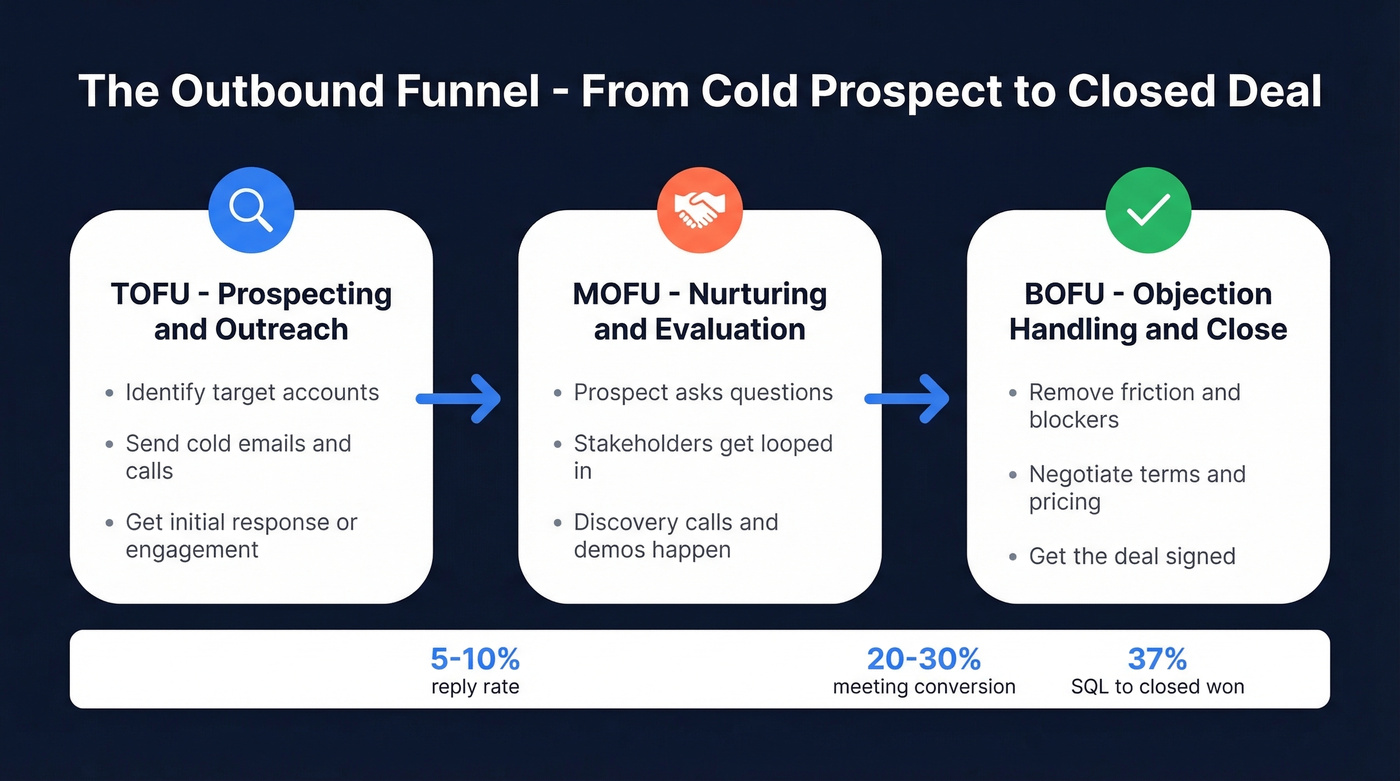
The simplest way to think about it: TOFU is prospecting and initial outreach - identifying the right accounts and getting a response. MOFU is nurturing and evaluation - the prospect is engaged, asking questions, looping in stakeholders. BOFU is objection handling and close - removing friction, negotiating terms, getting the deal signed. (If you want a parallel framework, compare it to the AIDA funnel.)
Each stage has its own conversion rate, its own failure modes, and its own levers. The funnel framework forces you to diagnose where deals die rather than just throwing more volume at the top.
Outbound vs. Inbound
| Dimension | Outbound | Inbound |
|---|---|---|
| Targeting control | You choose who to reach | Buyers self-select |
| Data dependency | High - enrichment and intent required | Lower |
| Attribution clarity | Easier to model | Multi-touch, messy |
| Cost profile | Higher upfront, linear | Lower CAC over time |
| Time to results | Weeks to months | Months to years |
Neither approach wins outright. Inbound compounds - a blog post written today generates leads for years. Outbound is immediate - you can book meetings this week if your list and messaging are right. Most teams running $2M+ in ARR need both. The hybrid model uses inbound content to warm accounts that outbound is already targeting, and outbound to accelerate deals that inbound surfaced but didn't convert.
How to Build an Outbound Sales Funnel
Define Your ICP (For Real)
"Mid-market SaaS companies" isn't an ICP. It's a category.
A real ICP looks like this: Series A SaaS startups with fewer than 50 employees that just hired their first RevOps lead. That level of specificity tells your reps exactly who to target, what pain points to lead with, and what timing signals to watch for. Within that ICP, segment further - a 20-person company and a 200-person company in the same vertical have completely different buying processes, budgets, and decision-making structures. Treating them identically is one of the fastest ways to tank your reply rates. Build 3-5 micro-segments within your ICP, each with tailored messaging and cadence timing. (If you need a scoring rubric, use an ideal customer profile template.)
Layer Intent Signals
Firmographics tell you who could buy. Intent signals tell you who's likely buying now. Prioritize accounts showing these signals:
- Recent funding rounds, which signal new budget availability
- Rapid team growth that creates scaling pain points
- Tech stack changes indicating the company is evaluating alternatives
- Relevant job postings suggesting they're building a function you serve
- Content engagement showing they're researching your category
- Website activity like visits to your pricing page
Tools like Bombora and 6sense track topic-level intent at scale. The goal is to move from "spray and pray" to "reach the right person at the right moment." (For a practical approach, see identifying buying signals and intent based segmentation.)
Build Your List
Here's the thing: your outbound funnel lives or dies on data quality. A 30% bounce rate doesn't just waste rep time - it damages your sending domain's reputation, which tanks deliverability for every future campaign. We've seen teams spend months rebuilding domain health after a single bad list. (If you're troubleshooting, start with email bounce rate and an email deliverability guide.)
Prospeo covers 300M+ professional profiles, including 143M+ verified emails and 125M+ verified mobile numbers, with 98% email accuracy and a 7-day refresh cycle. That refresh cadence matters when the industry average sits at six weeks. Snyk's team of 50 AEs saw bounce rates drop from 35-40% to under 5% after switching, with AE-sourced pipeline up 180%.

For context, Apollo's free tier is a solid starting point for early-stage teams. ZoomInfo remains the enterprise default at $15-40K/year. If you're under $3M ARR, you'll usually get more ROI by putting that budget into better targeting, better messaging, and cleaner data instead of paying enterprise prices for modules you won't fully use yet. (If you're comparing vendors, start with best sales prospecting databases or data enrichment services.)
Design Your Cadence
A multi-touch cadence across channels outperforms single-channel every time. Here's a proven sequence:
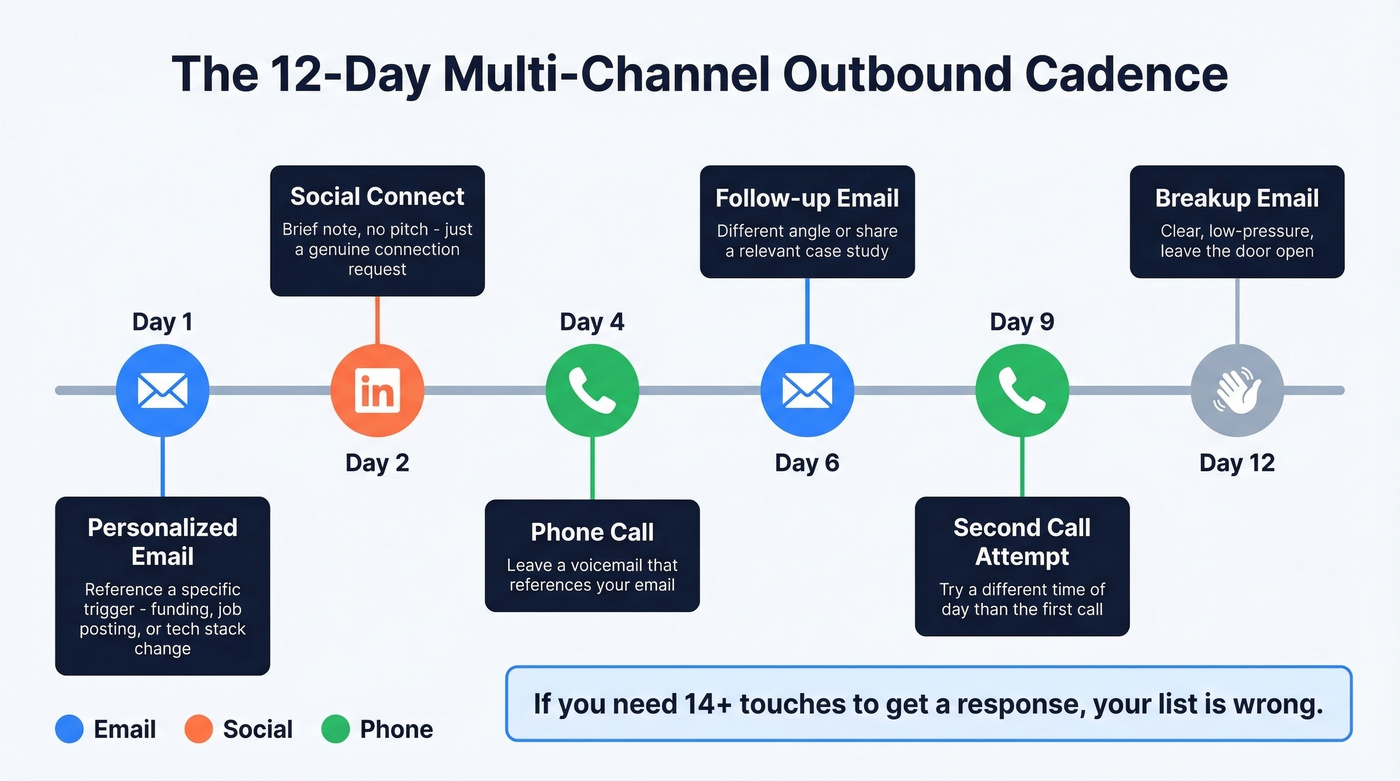
- Day 1: Personalized email referencing a specific trigger - funding, job posting, tech stack change
- Day 2: Social connect with a brief note
- Day 4: Phone call, leave a voicemail referencing the email
- Day 6: Follow-up email with a different angle or case study
- Day 9: Second call attempt
- Day 12: Breakup email - clear, low-pressure, leave the door open
If you need 14+ touches to get a response, your list is wrong.
A practical default for B2B outbound is 5-7 multi-channel touches over 10-14 days. The point isn't to "add steps." It's to earn attention with relevance, timing, and clean data. (If you want copy you can deploy fast, use these sales follow-up templates.)
Pick Your Channels
Email is the backbone, but it can't carry the funnel alone. Phone still works for director+ prospects - cold call connect rates often land around 4-6%, and when you do connect, calls convert to meetings far better than email replies. (If your team needs a system, see cold calling system.)
Social touches like thoughtful comments and DMs with context warm the prospect before the call. The r/Entrepreneur consensus is clear: relying on one channel is one of the top outbound mistakes. Multi-channel sequences don't just increase touchpoints - they create familiarity. By the time you call, the prospect has seen your name twice. That changes the conversation entirely.

A 30% bounce rate doesn't just waste rep time - it kills your domain and every campaign after it. Prospeo delivers 98% email accuracy with a 7-day refresh cycle, so your outbound funnel starts on a foundation that actually holds. Snyk's 50 AEs dropped bounce rates from 35-40% to under 5% and grew AE-sourced pipeline 180%.
Stop feeding bad data into a funnel you spent months building.
Benchmarks That Actually Matter
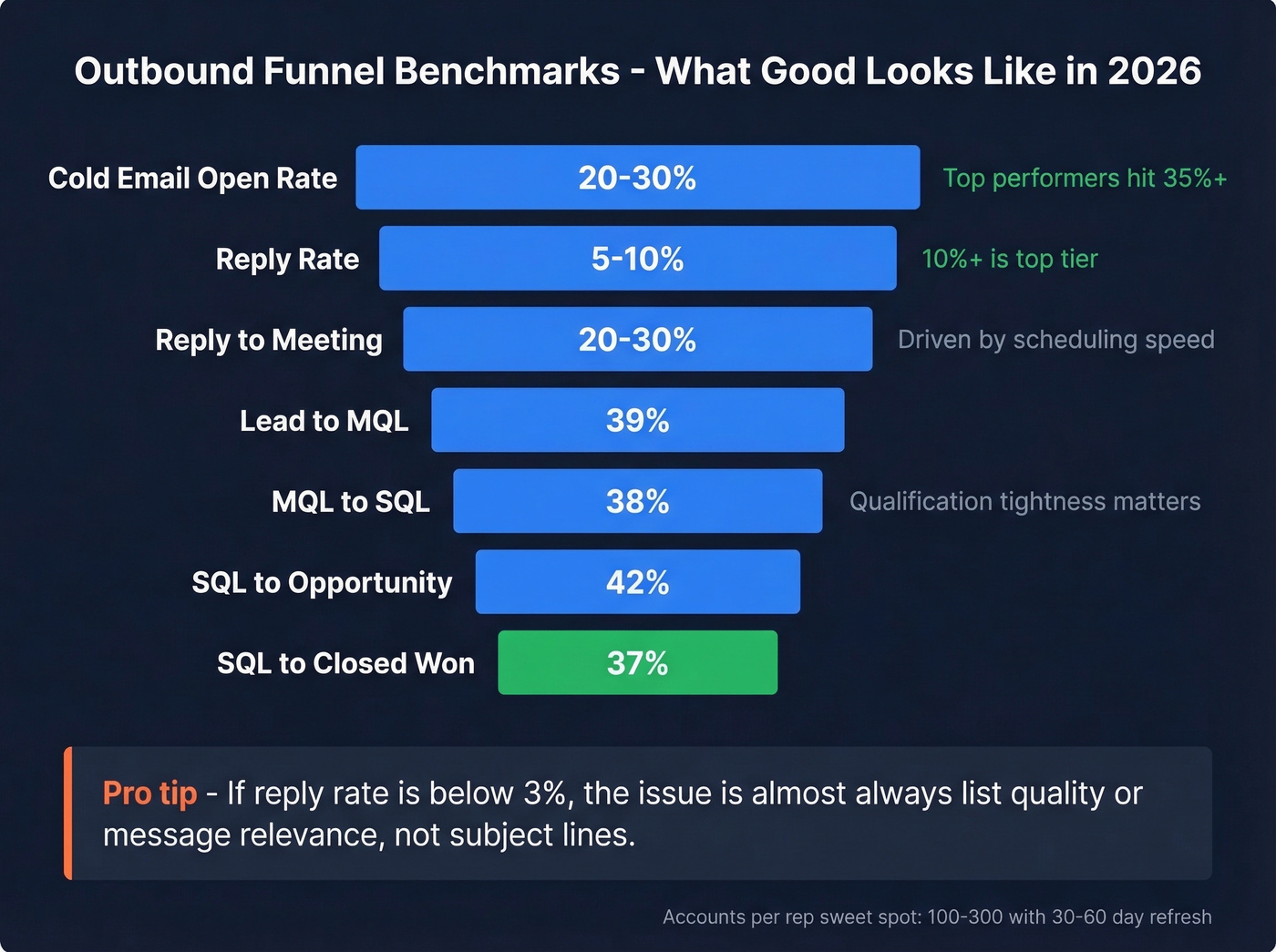
Here's what "good" looks like across the full funnel:
| Stage | Benchmark | Notes |
|---|---|---|
| Cold email open rate | 20-30% | Top performers hit 35%+ |
| Reply rate | 5-10% | 10%+ is top-tier |
| Reply to meeting | 20-30% | Driven by scheduling speed |
| Lead to MQL | 39% | B2B SaaS average |
| MQL to SQL | 38% | Qualification tightness matters |
| SQL to opportunity | 42% | - |
| SQL to closed won | 37% | - |
For capacity planning, high-performing teams run 100-300 active accounts per rep with a 30-60 day refresh cycle. If your team is running 500+ accounts per rep, you don't have a funnel - you have a spam cannon. One company we studied reduced rep books from 500+ to 300-400 accounts and saw win rates climb from 13% to over 20% in under a year.
Let's be honest about diagnosing problems. If your reply rate is below 3%, the issue is almost always list quality or message relevance - not subject lines. If your reply-to-meeting conversion is below 15%, look at scheduling friction and follow-up speed. Diagnose by stage, not by gut feel. (For more baseline numbers, see sales pipeline benchmarks.)
Recommended Tech Stack
Look, the r/SalesOperations crowd keeps saying this - and they're right: tools don't fix bad targeting. As one commenter put it, "most tools add overhead but don't improve conversion - fundamentals do." Buy tools that remove friction from a process that already works. (If you're building the stack from scratch, start with SDR tools.)
| Category | Tool | Starting Price |
|---|---|---|
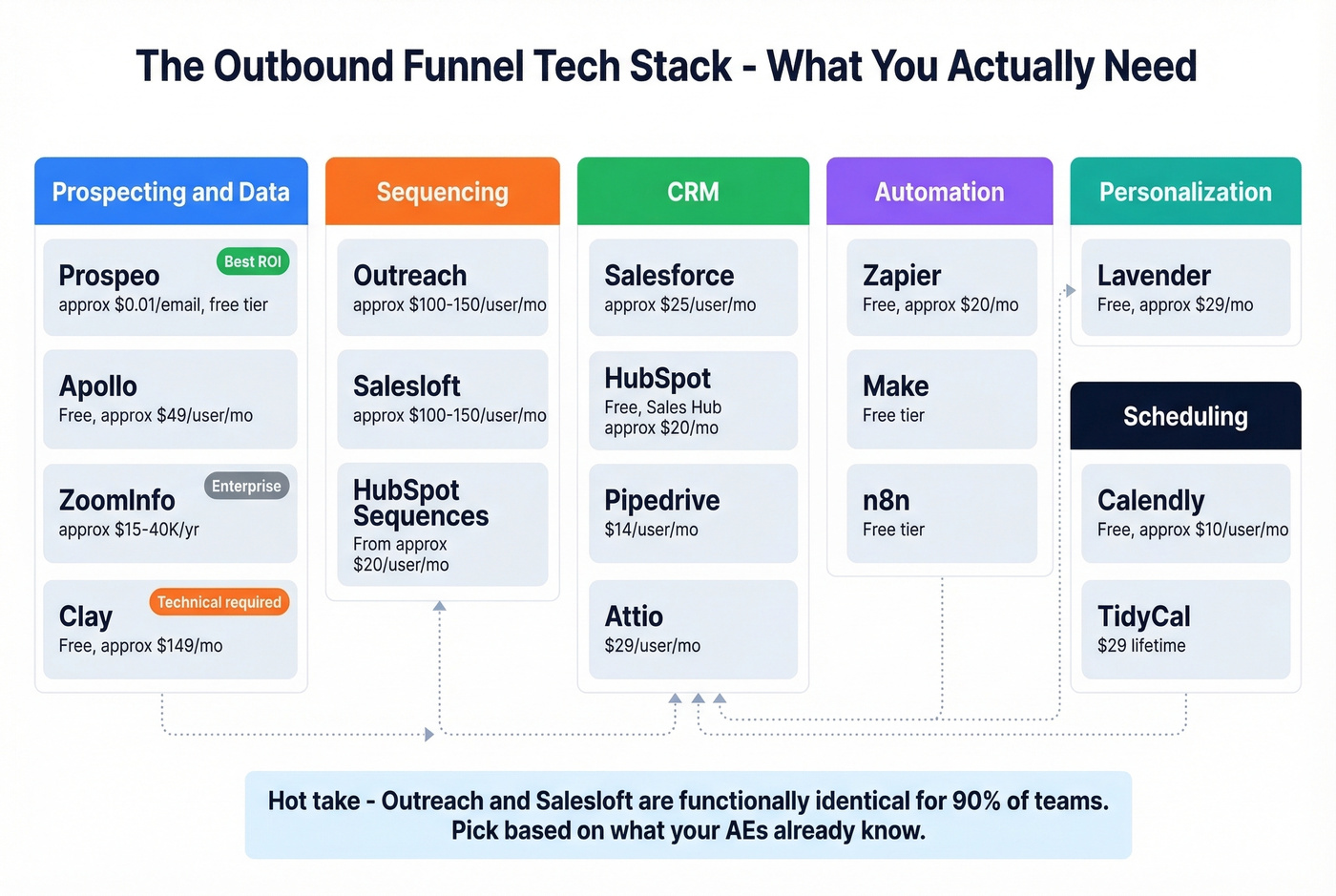
| Prospecting & Data | Prospeo | ~$0.01/email, free tier |
| Prospecting & Data | Apollo | Free; ~$49/user/mo |
| Prospecting & Data | ZoomInfo | ~$15-40K/yr |
| Prospecting & Data | Clay | Free; ~$149/mo |
| Sequencing | Outreach | ~$100-150/user/mo |
| Sequencing | Salesloft | ~$100-150/user/mo |
| Sequencing | HubSpot Sequences | Sales Hub from ~$20/user/mo |
| CRM | Salesforce | ~$25/user/mo |
| CRM | HubSpot | Free; Sales Hub ~$20/mo |
| CRM | Pipedrive | $14/user/mo |
| CRM | Attio | $29/user/mo |
| Automation | Zapier | Free; ~$20/mo |
| Automation | Make | Free tier available |
| Automation | n8n | Free tier available |
| Personalization | Lavender | Free; ~$29/mo |
| Scheduling | Calendly | Free; ~$10/user/mo |
| Scheduling | TidyCal | $29 lifetime |
Hot take: Outreach and Salesloft are functionally identical for 90% of teams. Pick based on which one your AEs already know, not feature comparison spreadsheets. The switching cost is never worth the marginal feature difference.
Skip Clay if you don't have someone technical on the team to build workflows. It's powerful but has a real learning curve - you'll waste the subscription if nobody configures it properly.
Every stage of your outbound funnel - from ICP targeting to multi-channel cadence - depends on reaching real people at verified contacts. Prospeo gives you 300M+ profiles with 30+ filters including buyer intent, technographics, and job changes, plus 125M+ verified mobiles with a 30% pickup rate. All for roughly $0.01 per email.
Build the outbound funnel from this article with data that converts.
Measuring Outbound ROI
The basic formula is straightforward: (Revenue from outbound - Total outbound costs) / Total outbound costs x 100%. The hard part is getting honest about costs. Fully-loaded outbound spend includes SDR/AE labor, tech stack subscriptions, data provider fees, and creative assets. Most teams undercount by 20-30% because they forget to include rep time spent on admin. (If you're tightening the model, start with cost to acquire customer.)
Here's what most leaders miss: there are five distinct ways to measure ROI, and you should track at least three.
- Pipeline contribution - pipeline generated divided by outbound investment
- Revenue realization - closed revenue divided by fully-loaded cost
- Cost per meeting / cost per opportunity - reverse-engineer to revenue
- Territory coverage - penetration, engagement velocity, multi-threading depth
- Risk mitigation - how outbound stabilizes pipeline when inbound or paid slows down
Gartner's research shows 6-10 stakeholders are involved in complex B2B purchases, which means your SDR's cold email today might not become revenue until next quarter. Track leading indicators weekly - meetings booked, pipeline created, accounts engaged - while waiting for lagging indicators to mature. Healthy targets: CAC payback under 12 months, LTV:CAC ratio of 3:1 or better, and pipeline coverage of at least 3x quota.
Common Mistakes to Avoid
These come straight from practitioner threads and patterns we've seen repeatedly.
Targeting "ICP on paper" without a real reason to care. If you can't articulate why this prospect should care right now, don't reach out. A vague ICP match isn't a buying signal.
Not segmenting within ICP. A 20-person startup and a 200-person scale-up need different messages, different proof points, different cadence timing. One size fits nobody.
Generic messaging. "I noticed your company is growing" isn't personalization. Reference their specific tech stack, a recent hire, or a funding round. If you can't find something specific, your data is too thin.
Single-channel reliance. Email-only funnels cap out fast. Add phone and social. The data on this is unambiguous.
Volume over fit. Sending 500 emails to a mediocre list will always lose to 100 emails to a great one. Always.
Pitching before problem recognition. If the prospect doesn't know they have a problem, your solution pitch lands flat. Lead with the pain, not the product.
Stale ICP. Markets shift. Revisit your ICP quarterly - the segments that converted six months ago aren't necessarily the best targets today.
FAQ
What's the difference between an outbound funnel and a sales pipeline?
An outbound funnel is a conversion framework that maps stages and drop-off rates to show where prospects leak out, while a sales pipeline tracks individual deals moving toward close. The funnel reveals system-level health; the pipeline shows which specific deals need attention. You need both.
How many touches does an outbound sequence need?
Five to seven multi-channel touches over 10-14 days is the sweet spot for most B2B outbound. If you consistently need 14+ touches to generate a reply, the problem is targeting or message relevance, not persistence. Revisit your list before adding more steps.
What's a good reply rate for cold outbound?
A 5-10% reply rate is standard for well-targeted campaigns; anything above 10% is top-tier. Reply rate is driven far more by list quality and message relevance than by subject line tricks. Fix your targeting first, then optimize copy.
How long before an outbound funnel shows ROI?
Expect 3-9 months for full revenue attribution in most B2B sales cycles. Track leading indicators - meetings booked, pipeline created, accounts engaged - weekly from day one. These early signals tell you whether the funnel is working long before closed revenue confirms it.
What's the most important tool in an outbound stack?
Your data provider, because bad contact data cascades into bounced emails, damaged domain reputation, and wasted rep time. If your emails don't land, nothing else in the stack matters.