

How to Write an Outreach Email That Actually Gets Replies
A practitioner on r/b2bmarketing sent 217,000 cold emails last year. His reply rate started at 2.1%, then cratered to 0.7% as domains burned faster than he could warm up new ones. He spent more time managing SPF records and inbox rotation than actually selling. He's not alone.
Across 16.5M cold emails analyzed by Belkins, the average reply rate fell to 5.8% - down 15% from the year before. The bar for every outreach email is higher, inboxes are more crowded, and the margin for error on infrastructure, copy, and targeting has essentially disappeared.
What You Need (Quick Version)
- Infrastructure before copy. Authenticate your domain, verify your list, cap sends at 50/day per inbox. None of your writing matters if emails land in spam.
- Write 40-60 words, lead with a specific offer, end with a soft CTA. That's the format getting replies right now.
- Three follow-ups maximum. After that, you're burning your domain, not building pipeline.
What Is an Outreach Email?
An outreach email is any cold or semi-cold message sent one-to-one or one-to-few to start a conversation. Sales prospecting, link-building pitches, PR outreach, recruiting messages, partnership proposals - they all fall under this umbrella.
The key distinction from marketing blasts: these messages target specific individuals with a specific ask, not a list of thousands with a newsletter. They're personal, they're low-volume, and they live or die on relevance. Whether you're crafting a sales prospecting email or a partnership pitch, the same principles apply.
2026 Benchmarks Worth Knowing
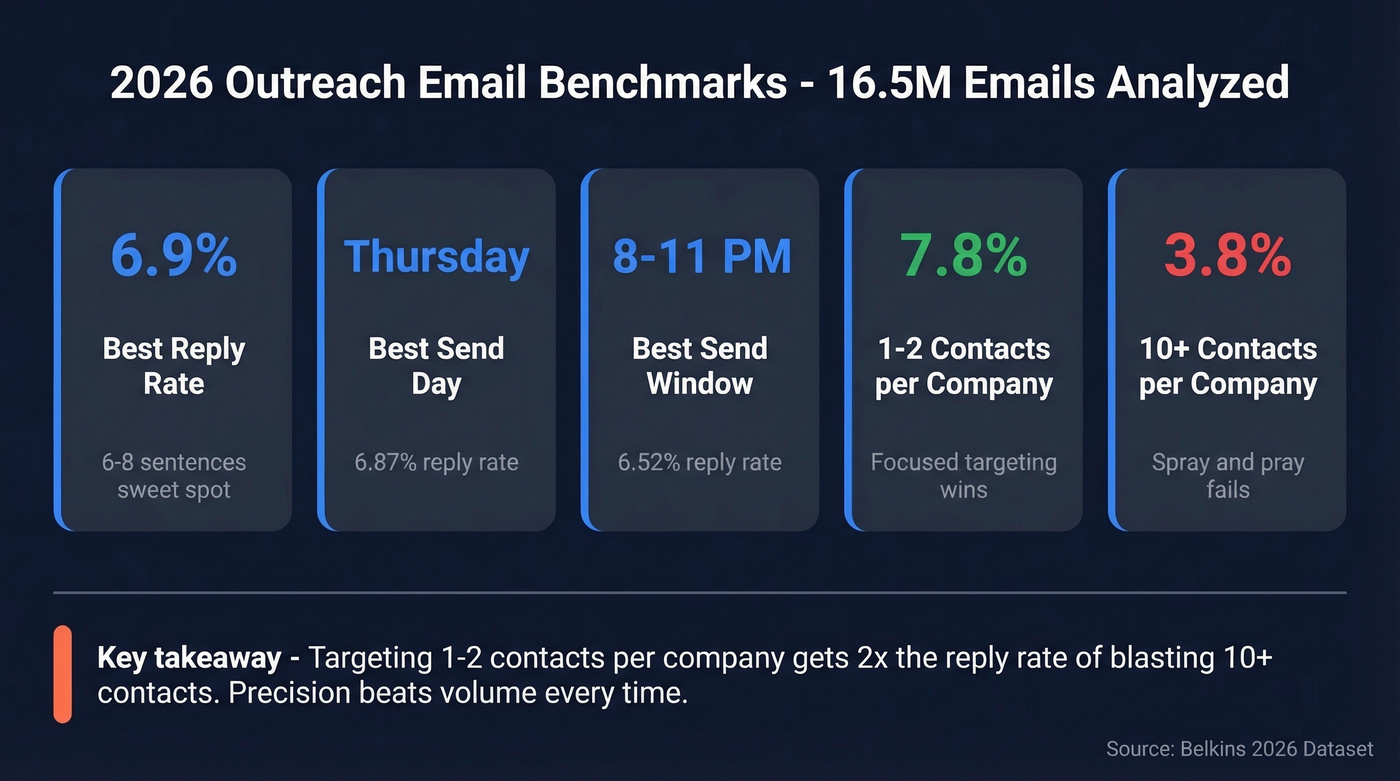
Let's ground this in real data. The Belkins dataset - 16.5M emails across 93 business domains - gives us the clearest picture of what's actually working.
| Factor | Best Performing | Reply Rate |
|---|---|---|
| Email length | 6-8 sentences | 6.9% |
| Day of week | Thursday | 6.87% |
| Send window | 8-11 PM | 6.52% |
| Targeting depth | 1-2 contacts/company | 7.8% |
| Targeting depth | 10+ contacts/company | 3.8% |
The targeting depth numbers are the most important row in that table. Teams blasting 10+ contacts at the same company get half the reply rate of teams targeting one or two. Spray-and-pray is measurably worse. Siege Media, running a focused link-building campaign, hit 81% open and 13% reply rates - that's what happens when targeting is tight and the offer is relevant.
The Thursday/evening send window surprised us too. Conventional wisdom says Tuesday morning. The data says otherwise - people respond when their inbox is quieter, not when everyone else is also sending.
Here's the thing: if your average deal size is under $10k, you probably don't need a 12-step multi-channel sequence. A tight list, a strong offer, and three well-timed emails will outperform the elaborate playbooks that enterprise teams run. Complexity isn't a strategy.
Set Up Sending Infrastructure First
Most cold emails fail before they're written. They fail in the infrastructure layer.
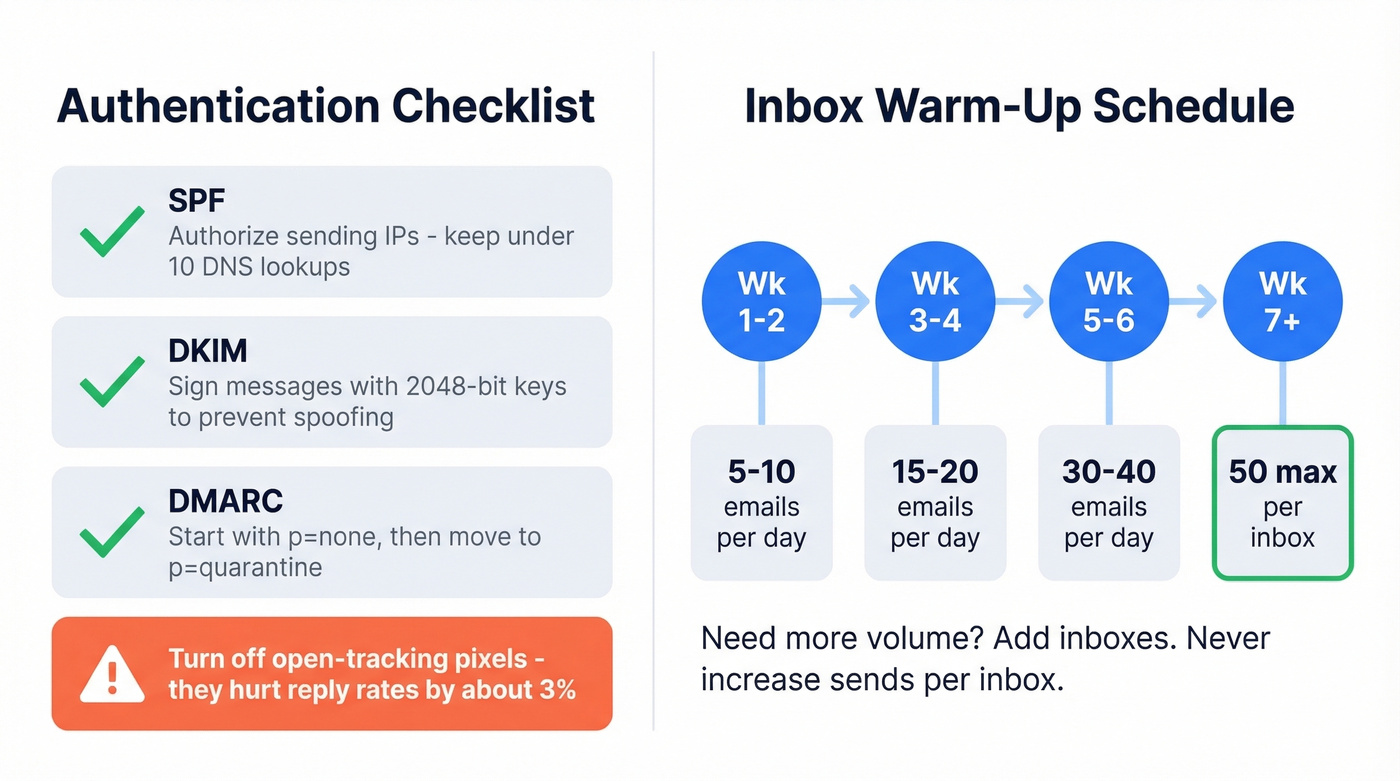
Google and Yahoo now enforce authentication aggressively - Google's bulk sender guidelines are explicit - and for bulk senders, exceeding a 0.3% spam complaint rate can trigger throttling. The authentication checklist is non-negotiable:
- SPF - tells receiving servers which IPs can send on your behalf. Keep it under 10 DNS lookups or it breaks silently.
- DKIM - cryptographically signs your messages so they can't be spoofed. Use 2048-bit keys. (If you’re unsure, start with how to verify DKIM is working.)
- DMARC - enforces policy when SPF or DKIM checks fail. Start with
p=noneto monitor, then move top=quarantine. (More detail: DMARC alignment.)
Turn off open-tracking pixels. Benchmark data shows roughly 3% higher response rates without them, and Apple's Mail Privacy Protection inflates open data to the point of uselessness anyway. Track replies, not opens. (Related: email tracking pixels and tracking domain.)
Your warm-up schedule should look like this: 5-10 emails/day in weeks 1-2, ramp to 15-20 in weeks 3-4, 30-40 in weeks 5-6, and cap at 50/day per inbox by week 7. Want more volume? Add inboxes. Don't increase sends per inbox. (See also: email velocity.)
Authentication protects you from one failure mode. The other silent killer is bad data - sending to invalid addresses, spam traps, and honeypots that tank your sender reputation overnight. List verification isn't a nice-to-have; it's a deliverability lever. We've seen teams go from 35% bounce rates to under 4% just by switching to a verification tool with catch-all handling and spam-trap removal, like Prospeo's 5-step process with its 7-day refresh cycle. (If you’re troubleshooting, start with email bounce rate and spam trap removal.)

Bad data is the #1 reason outreach emails bounce - and bounces destroy sender reputation. Prospeo's 5-step verification with catch-all handling and spam-trap removal keeps bounce rates under 4%. Data refreshes every 7 days, not the 6-week industry average.
Stop burning domains. Start with verified emails at 98% accuracy.
How to Write Emails That Get Replies
Subject Lines
We've tested dozens of subject line formats across client campaigns. Lowercase, short, and honest consistently wins. An analysis of 85M+ cold emails confirms it: 1-4 word subject lines perform best. Salesy triggers - "exclusive offer," "limited time," "free" - reduce open rates up to 17.9%. (If you want a swipe file, use these email subject line examples.)
"Quick question" still works. "RE: Our conversation" does not - it's deceptive and recipients know it.
The Offer Beats Personalization
There are two tiers of personalization: basic (name, company, role) and deep - a specific observation tied to a business problem. Basic is table stakes. The "I saw your post about..." opener is dead because every AI tool generates it now. Recipients can smell it.
What actually moves the needle is your offer. A specific, low-friction, immediately valuable offer in 50 words beats a 200-word personalized essay every time. "We built a teardown of your checkout flow - want the Loom?" outperforms "I noticed your company has been growing rapidly and I thought you might be interested in exploring how we help companies like yours..."
When you do personalize, base it on real signals - company growth, tech stack, recent hires - not guesswork from a quick profile scan. (Frameworks here: personalized outreach and an ideal customer profile.)
Pre-Outreach Warming
Before you send a single cold message, warm the relationship. Engage with a prospect's content on social platforms, comment in shared Slack communities, or reply to their forum posts. This turns a cold email into a warm one. Even a single prior touchpoint can double your reply rate because the recipient recognizes your name when your message lands.
Body Structure
Under 200 words. The 6-8 sentence sweet spot from the data isn't a coincidence - it's enough to establish context, deliver value, and ask a question without demanding a time commitment. (If you want more examples, see emails that get responses.)
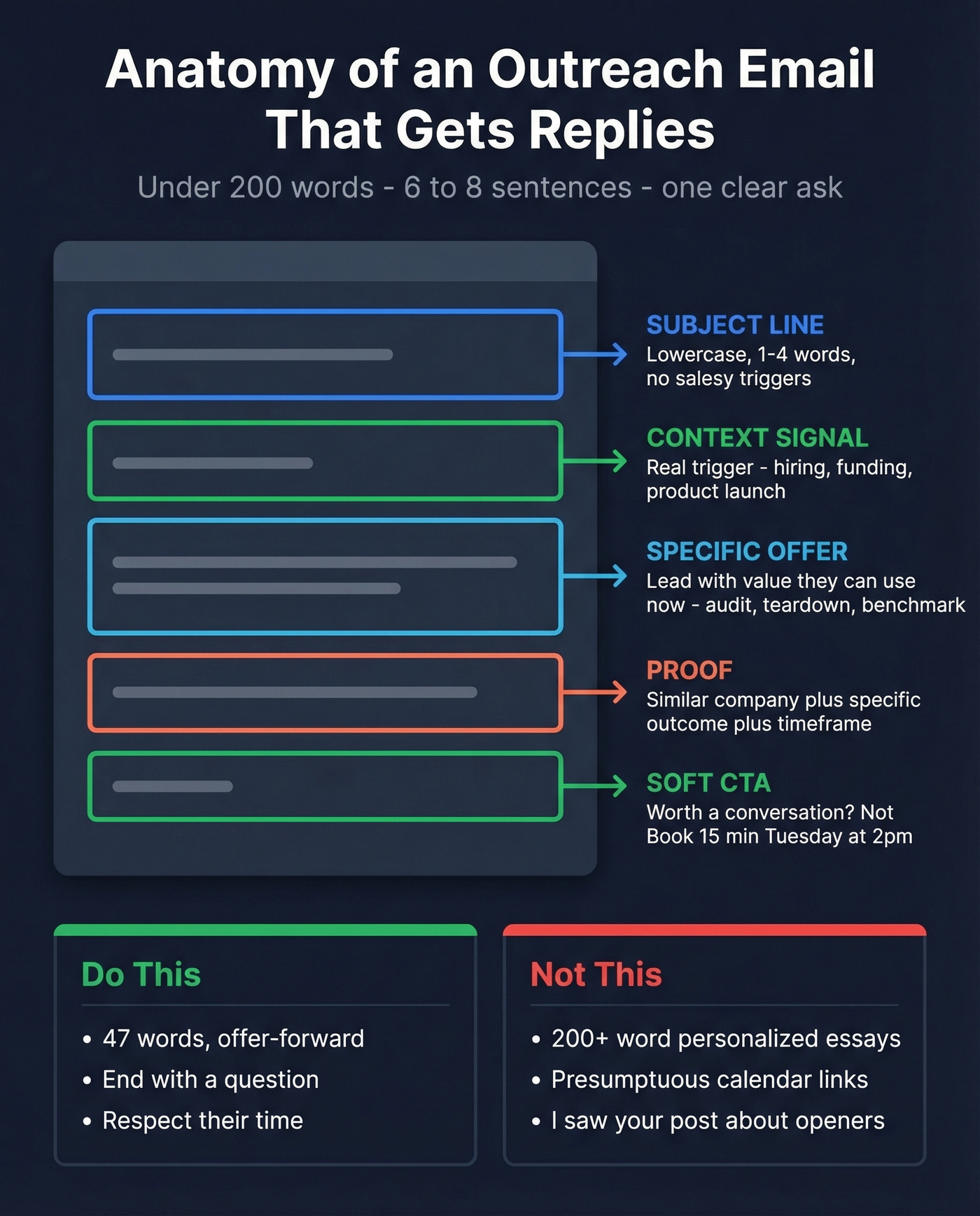
End with a soft CTA. "Worth a conversation?" works. "Book 15 minutes on my calendar Tuesday at 2pm" doesn't - it's presumptuous when someone hasn't expressed any interest yet.
Outreach Email Templates That Work
The Minimalist (~47 Words)
This format comes from a practitioner trend on r/copywriting - absurdly short, offer-forward:
Saw you're hiring [role] - usually means [pain point] is a priority.
We helped [similar company] [specific outcome] in [timeframe].
Built a quick [deliverable] for your team. Worth 5 minutes?
That's it. Context signal, ICP/outcome, proof, soft CTA. The brevity itself signals respect for the recipient's time.
The Value-Forward
Lead with something the recipient can use immediately - an audit, a teardown, a benchmark comparison. "We analyzed your [specific thing] and found three quick wins. Here's the summary - happy to walk through it if useful." The deliverable does the selling. You're not asking for time; you're offering value first.
The Trigger-Based
Time your message to a specific event: funding round, executive hire, expansion announcement, product launch. Outreach.io's research shows trigger-based timing dramatically improves relevance. "Congrats on the Series B. Teams at this stage usually hit [specific problem] within 90 days - we built [solution] for exactly that moment." (To operationalize this, use a system for tracking sales triggers.)
The Follow-Up
Never send "just checking in." Every follow-up needs new value - a relevant case study, a benchmark, a resource. About 60% of replies come after the first follow-up, so skipping follow-ups entirely is a mistake. But there's a hard ceiling. (If you need copy, use these sales follow-up templates.)
Follow-Up Strategy - Three Max
The data here is unambiguous. Spam complaints nearly triple by the fourth email - from 0.5% on the first send to 1.6% by the fourth. Unsubscribes spike from 0.8% in round three to 2% in round four. Response rates drop 55% by the fifth email compared to earlier touches.
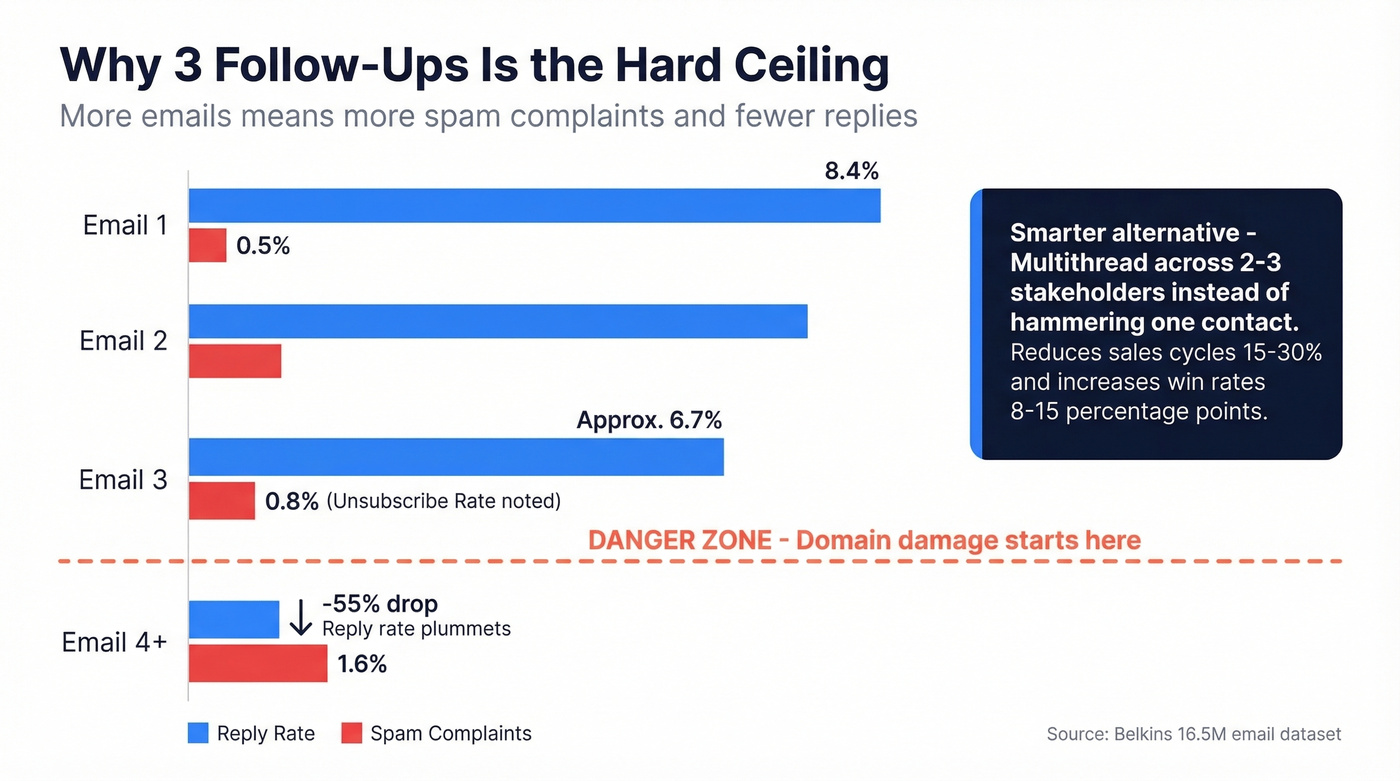
One-touch sequences actually had the highest reply rate at 8.4%. Adding a third email drops reply rates up to 20%. The math is clear: three follow-ups is the practical maximum, and even that's pushing it. If someone hasn't replied after three touchpoints, they're not interested. Move on before you damage your domain.
Multithreading - reaching two or three stakeholders at the same account - is a smarter play than hammering one contact with five emails. Research shows multithreading reduces sales cycles 15-30% and increases win rates 8-15 percentage points. Spread your touches across the buying committee instead of stacking them on one inbox.
Best Tools for Email Outreach
| Tool | Best For | Starting Price | Free Tier |
|---|---|---|---|
| Prospeo | Verified contact data | ~$39/mo | Yes (75 emails) |
| Instantly | High-volume sending | ~$30/mo | No |
| Apollo | Data + sending combo | $59/mo/user | Yes (100 credits) |
| GMass | Works inside Gmail | $25/mo | Trial (50/day) |
| Saleshandy | Budget sending | ~$36/mo | 7-day trial |
| Lemlist | Sequences | $59/mo/user | 14-day trial |
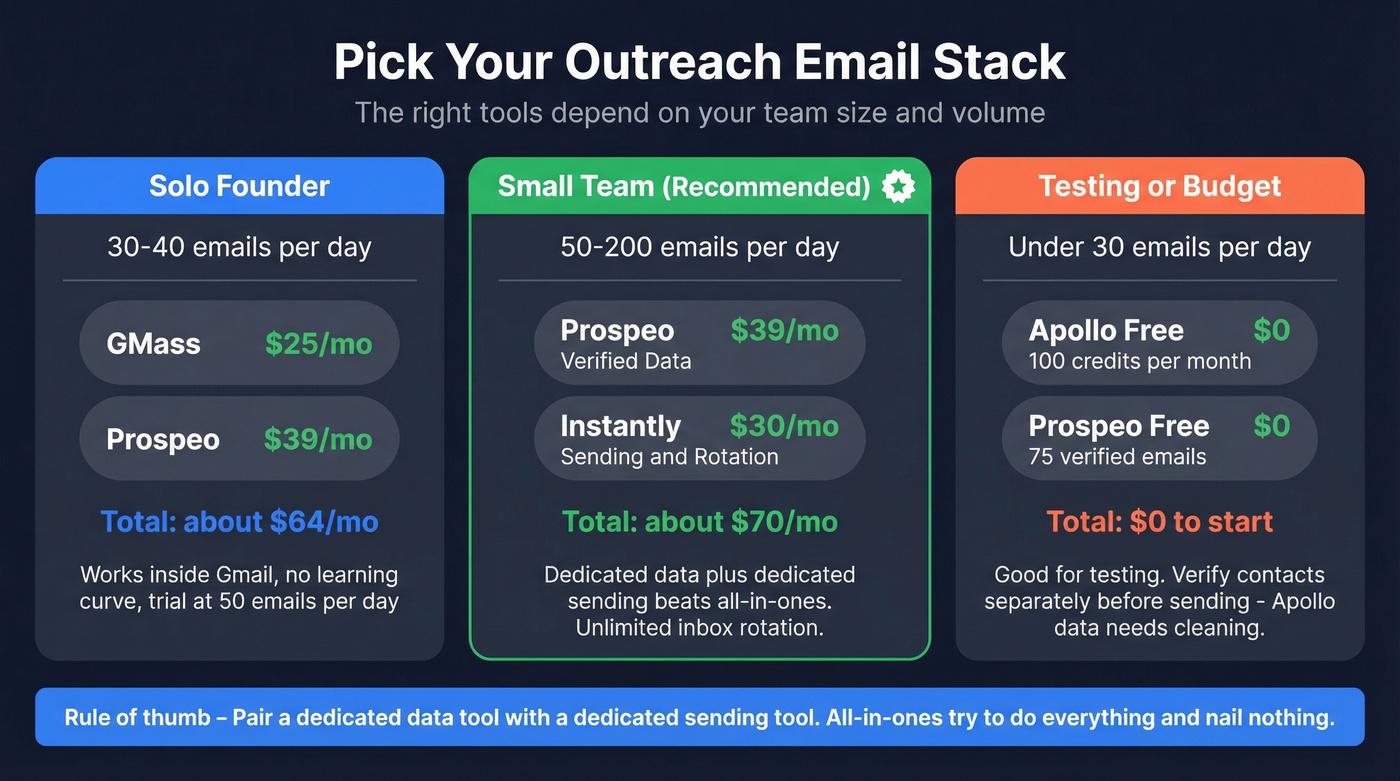
For most teams, start with Prospeo for data and Instantly for sending. That combination covers verified contacts and high-volume delivery for around $70/month. In our experience, pairing a dedicated data tool with a dedicated sending platform consistently outperforms all-in-ones that try to do everything and nail nothing.
If you're a solo founder sending 30-40 emails a day from your personal inbox, GMass is the lightest-weight option. It works inside Gmail with no learning curve - trial at 50 emails/day, paid from $25/mo. You won't outgrow it until you need inbox rotation.
Instantly is built for high-volume sending. It lets you connect unlimited sending accounts for one flat price, so you can rotate inboxes without worrying about costs scaling with headcount. It doesn't have its own contact database, though - pair it with a data tool.
Apollo tries to be everything: database, sequences, and dialer in one platform. The free plan with 100 credits per month is generous for testing. Real talk: verify contacts separately before loading them into sequences, because Apollo's email accuracy sits around 79% compared to 98% from dedicated verification tools. Paid plans start at $59/mo per user. (If you’re comparing providers, start with data enrichment services.)
Saleshandy is budget-friendly sending with decent analytics at ~$36/mo. Good enough for small teams that don't need multi-channel.
Skip Lemlist unless you need advanced sequencing. It starts at $59/mo per user - powerful if you're running coordinated multi-step plays, overkill if you only need straightforward cold email delivery.
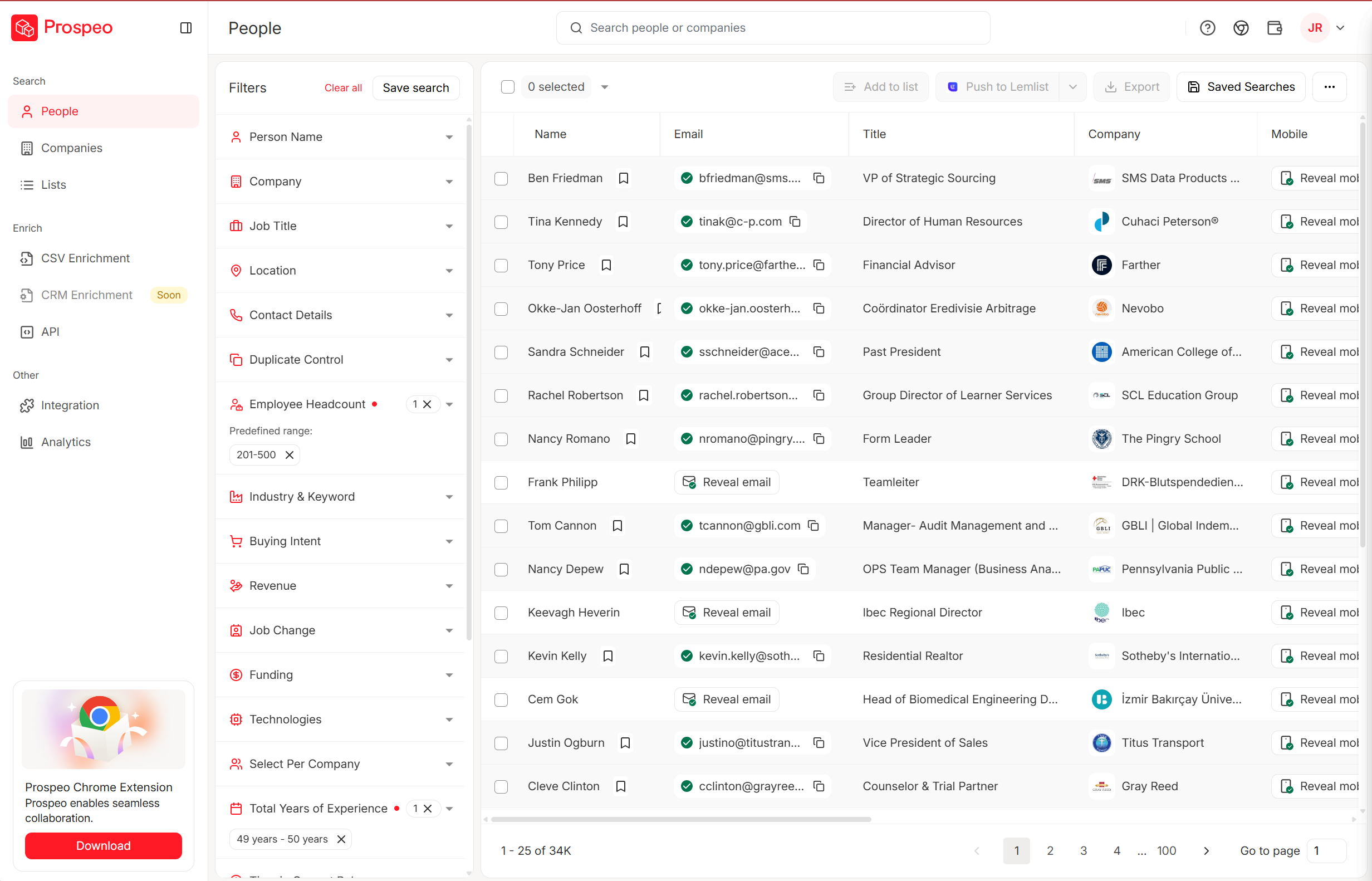
The data proves it: targeting 1-2 contacts per company doubles your reply rate vs. spraying 10+. Prospeo's 30+ filters - buyer intent, tech stack, job changes, headcount growth - let you build the tight, signal-rich lists that drive 7.8% reply rates.
Build laser-targeted outreach lists for $0.01 per verified email.
Legal Compliance Checklist
CAN-SPAM (US)
Every commercial email needs a valid physical address, honest sender info, truthful subject lines, and a working opt-out mechanism. Honor opt-outs within 10 business days. Penalties run up to $50,120 per violation per email - per email, not per campaign.
GDPR (EU/UK)
Cold prospecting under GDPR requires either consent or legitimate interest. If you're relying on legitimate interest - and most B2B outreach does - document a Legitimate Interest Assessment covering purpose, necessity, and balancing tests. Penalties reach EUR 20M or 4% of global turnover.
CASL (Canada)
Requires express or implied consent. Your unsubscribe link must remain functional for at least 60 days. Penalties up to $10M. Don't fake "Re:" subject lines or manufacture urgency - Canadian regulators have been aggressive about deceptive practices.
FAQ
How long should an outreach email be?
Under 200 words. Data from 16.5M emails shows 6-8 sentences hit the sweet spot at a 6.9% reply rate. Practitioners in 2026 are pushing even shorter - 40-60 words with a specific offer and soft CTA. Anything over 200 words sees measurable reply-rate drops.
How many follow-ups should I send?
Three maximum. Spam complaints nearly triple by the fourth email, from 0.5% to 1.6%, and response rates drop 55% by the fifth. One-touch sequences actually had the highest reply rate at 8.4%. More emails won't fix a weak offer.
How do I keep cold emails out of spam?
Authenticate your domain with SPF, DKIM, and DMARC. Verify every address before sending - 5-step verification that catches spam traps and honeypots is the standard you should expect from any data provider. Stay under 50 sends per inbox per day and keep complaints below 0.3%. Turn off open-tracking pixels.
What's the best free tool for finding outreach contacts?
Prospeo's free tier includes 75 verified emails per month plus 100 Chrome extension credits - enough for a solo founder running targeted campaigns. Apollo offers 100 free credits monthly but with lower email accuracy (79% vs. 98%). Hunter gives 25 free searches but caps enrichment data.