

How to Write a Professional Email Intro That Actually Gets Replies
You've rewritten the first line four times. You've toggled between "Dear" and "Hi" like it matters. Meanwhile, the actual problem isn't your greeting - it's the rest of your professional email intro. The opening line, the structure, the length, the send timing - that's what separates emails that get replies from emails that get archived.
What You Need (Quick Version)
- Skip the greeting obsession. "Hi [Name]" is fine. The opening line - the sentence after the greeting - determines read vs. delete.
- Keep it short. 6-8 sentences, under 200 words. A Belkins study of 16.5M emails shows this length bracket performs best on opens and replies.
- Send on Thursday. That same study found Thursday pulls a 6.87% reply rate vs. Monday's 5.29%. Timing isn't everything, but it's not nothing. (If you want a deeper breakdown, see best-performing send day.)
- Verify before you send. Roughly 17% of cold emails never reach the inbox. A perfect intro that bounces is worthless. If you're troubleshooting bounces, start with email deliverability.
What the Data Says
Let's ground this in numbers, not opinions.
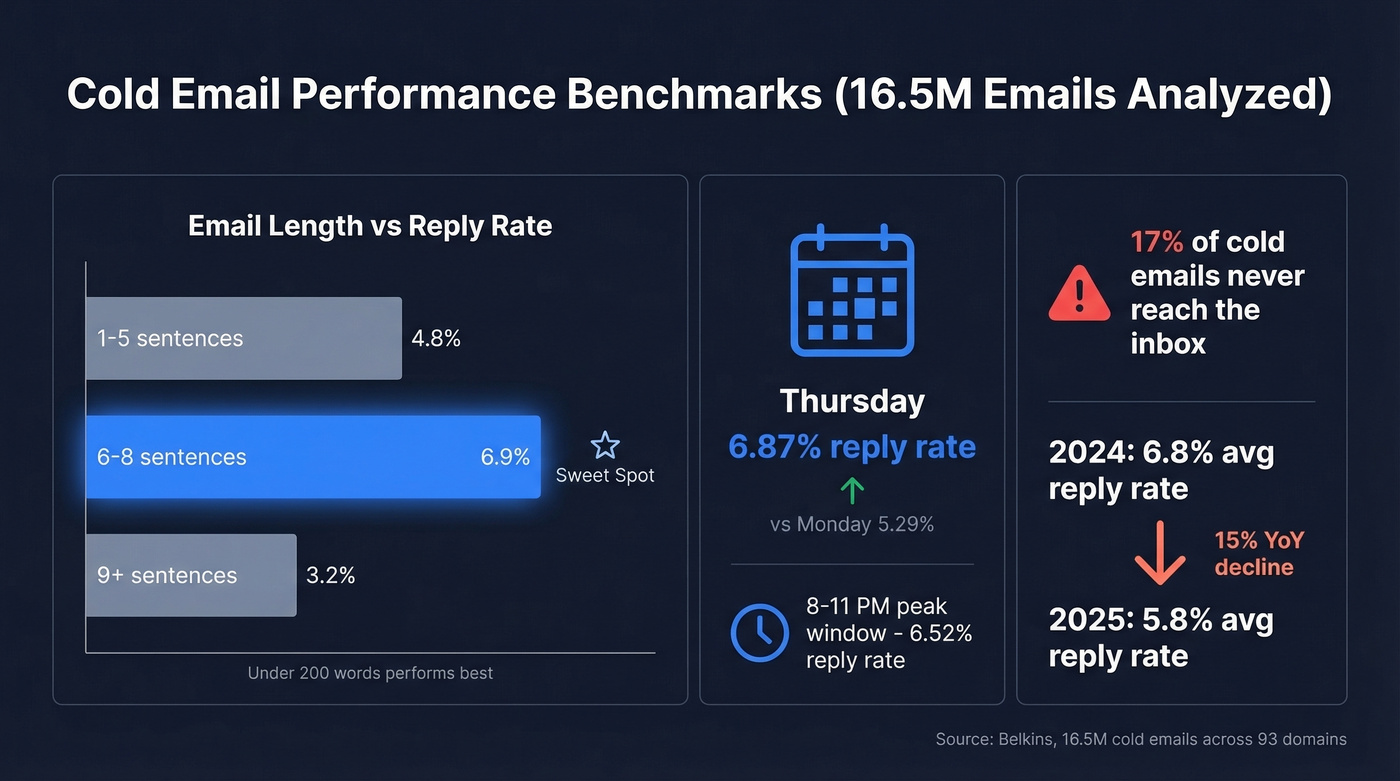
Belkins analyzed 16.5M cold emails across 93 business domains. The average reply rate was 5.8% - down from 6.8% the year before. That's a 15% year-over-year drop. Inboxes are more crowded, filters are smarter, and recipients are pickier than they were even twelve months ago.
The best-performing emails hit 6-8 sentences and stayed under 200 words, pulling a 42.67% open rate and a 6.9% reply rate - well above average. Longer emails underperform. Every time.
Timing matters more than most people think. Thursday was the highest-performing send day at 6.87%, and evenings between 8-11 PM peaked at 6.52%. A Reddit practitioner on r/Entrepreneur found Tue-Thu, 8-11 AM worked best for their audience. We've seen similar patterns across our own outreach: the same email sent Monday morning vs. Thursday evening can produce wildly different results.

That same Reddit practitioner cut their emails from 141 words to under 56 words and watched their reply rate double from 3% to 6%. The takeaway isn't "shorter is always better." It's that most people write emails that are twice as long as they need to be.
And none of this matters if your email doesn't arrive. About 17% of cold emails never reach the inbox - they bounce or get caught by spam filters. Deliverability is step zero. (To diagnose issues fast, use an email spam checker and track your email bounce rate.)
Anatomy of a Strong Email Introduction
Every well-crafted introduction email has seven elements. The difference between a good one and a forgettable one is how much weight you put on each.
Subject line. This is your first impression. It determines whether the email gets opened at all - 47% of recipients decide based on subject line alone. If you need inspiration, pull from these email subject line examples.
Greeting. "Hi [First Name]" works in 90% of situations. Don't overthink this.
Opening line. This is the single most important element. It's the sentence that earns the next sentence. A personalized reference to the recipient's work, a relevant trigger event, or a sharp question all outperform generic openers by a wide margin. (For more patterns, see emails that get responses.)
Purpose statement. Why are you emailing? Say it in one sentence. Readers shouldn't have to guess.
Value proposition. What's in it for them? Not what you do - what they get.
Call to action. One specific ask. "Would a 15-minute call on Thursday work?" beats "Let me know if you'd like to chat sometime." If you want a tighter framework, use these email call to action rules.
Close. Keep it simple. "Best," "Thanks," or "Cheers" - match the formality of the rest of your email. The under-200-word benchmark isn't arbitrary. It forces you to cut the filler and keep only what earns a reply.
Subject Lines That Get Opened
An analysis of 85M+ cold emails found that 1-4 words is the ideal subject line length. All lowercase outperforms title case. Top reps consistently hit 58%+ open rates with short, specific subjects.
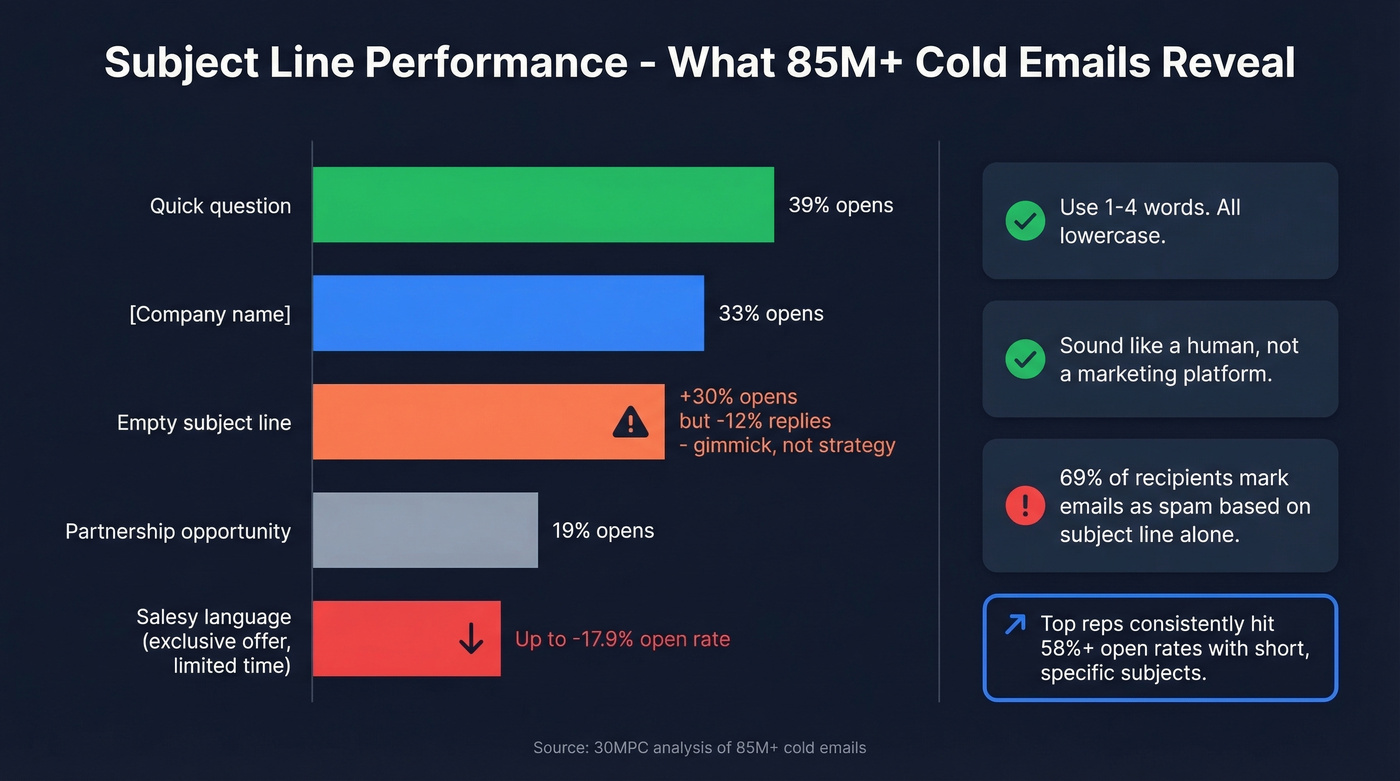
Etiquette expert Jacqueline Whitmore puts it simply: subject lines should be "short, simple, and specific." Here's what the data shows:
- "Quick question" pulled 39% opens in one practitioner's test. Company-name subjects hit 33%. "Partnership opportunity" dropped below 19%.
- Empty subject lines boost opens by 30% - but they cut reply rates by 12%. That's a gimmick, not a strategy.
- Salesy language ("exclusive offer," "limited time") reduces open rates by up to 17.9%.
- 69% of recipients mark emails as spam based on the subject line alone.
The pattern is clear: write subject lines that sound like a human sent them, not a marketing automation platform. For more data-backed patterns, see subject lines that get opened.

17% of cold emails never reach the inbox. Your perfectly crafted intro means nothing if it bounces. Prospeo's 5-step verification delivers 98% email accuracy - so every opening line you write actually lands.
Stop perfecting intros that bounce. Start with verified data.
Opening Lines That Replace "I Hope You're Well"
Here's the thing: "I hope you're well" signals zero personalization in a cold context. It tells the recipient you couldn't be bothered to write something specific. The consensus across Reddit and Quora threads is the same - get to the point immediately.
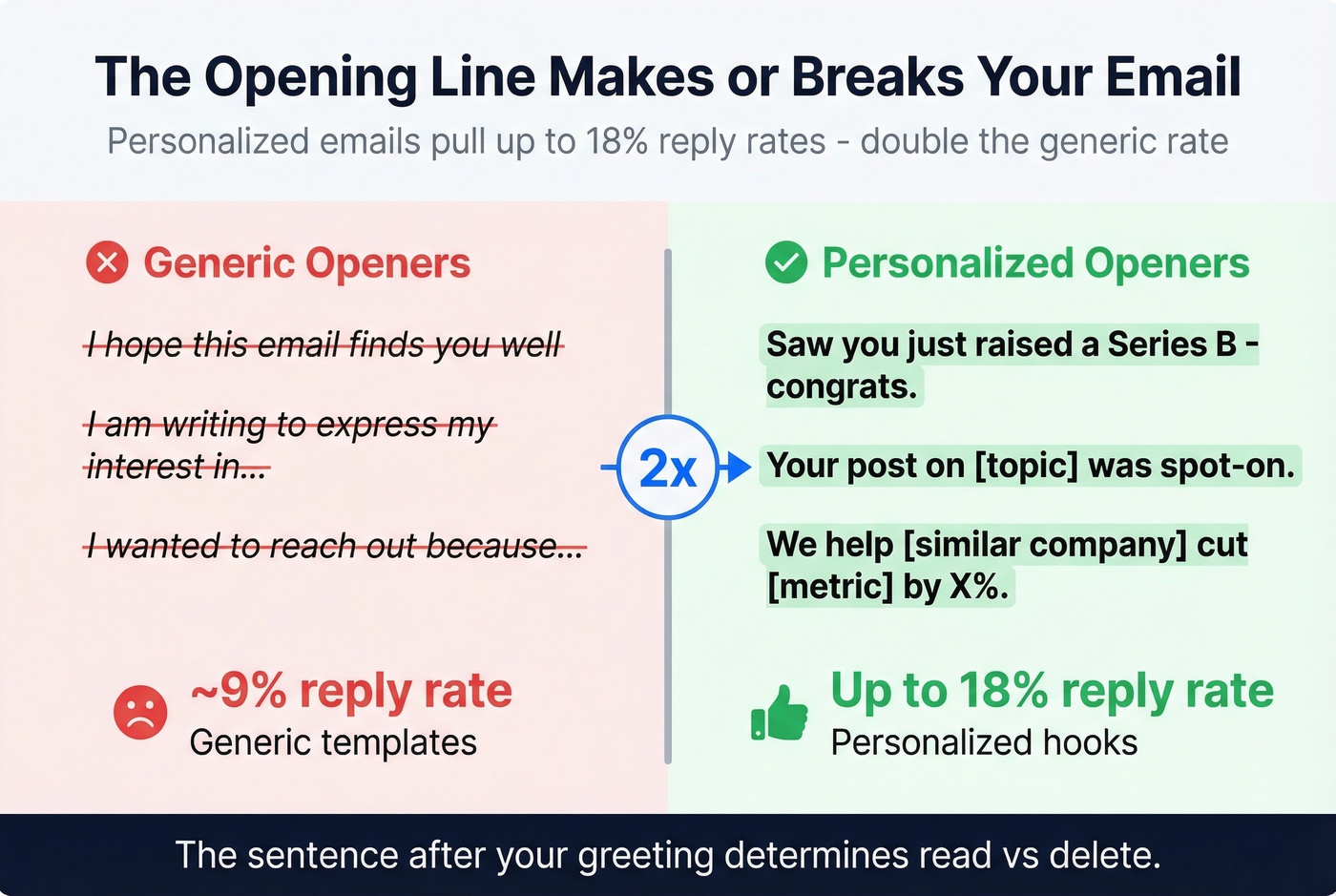
Personalized emails pull reply rates up to 18%, double the rate of generic templates. That one opening line is doing more work than most people realize. If you want a system for scaling this, use a personalized outreach workflow.
| Context | Opening Line | Why It Works |
|---|---|---|
| Cold (trigger event) | "Saw you just raised a Series B - congrats." | Timely, specific, flattering |
| Cold (content ref) | "Your post on [topic] was spot-on." | Shows you did homework |
| Cold (mutual connection) | "Sarah Chen suggested I reach out." | Borrowed trust |
| Cold (direct) | "We help [similar company] cut [metric] by X%." | Leads with value |
| Warm follow-up | "Following up on our chat at [event]." | Anchors shared context |
| Internal (new hire) | "Just joined [team] - excited to work on [project]." | Warm, role-specific |
| Client handoff | "I'm your new point of contact for [product]." | Clear ownership |
| Networking | "I've been following your work on [topic]." | Genuine interest |
| Job search | "Your team's approach to [specific thing] stood out." | Proves research |
| Reconnection | "It's been a while - your recent [achievement] caught my eye." | Relevant, not random |
Templates by Scenario
Cold Sales Outreach
Start with verified contact data - emailing the wrong person at the right company is still a wasted email. We've found that narrowing down to the right decision-maker before writing a single word makes the biggest difference in reply rates, more than any copywriting trick. (If you're building lists at scale, this B2B cold email sequence guide pairs well with the intro structure below.)
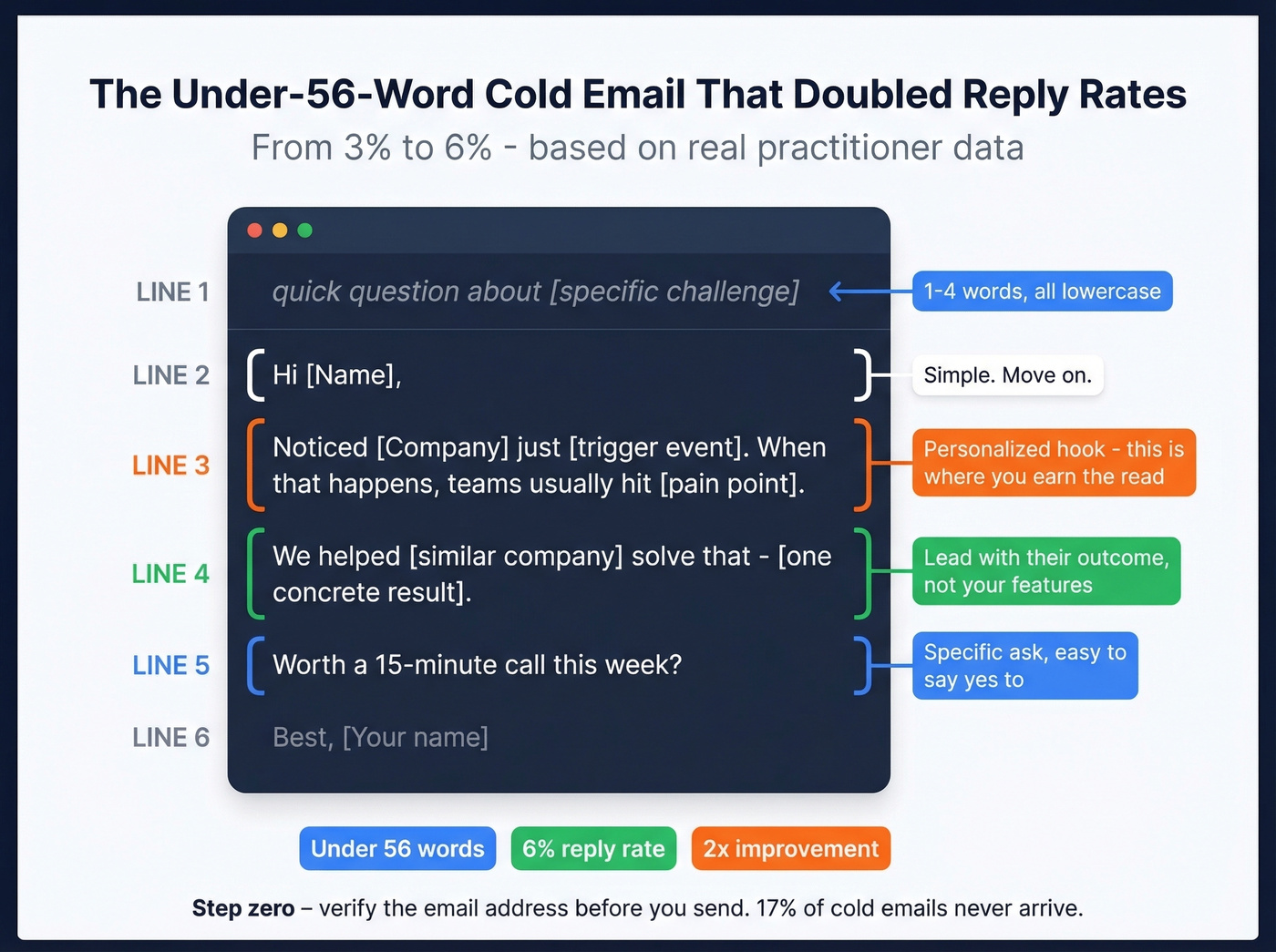
Subject: quick question about [specific challenge]
Hi [Name],
Noticed [Company] just [trigger event - new hire, funding, expansion]. When that happens, teams usually hit [specific pain point].
We helped [similar company] solve that - [one concrete result].
Worth a 15-minute call this week?
Best, [Your name]
No preamble, no company history, no throat-clearing. That template mirrors the exact structure the Reddit practitioner used to double their reply rate - under 56 words with a personalized hook and a specific ask.
Job Search: The Anti-Application
Recruiting teams get 300+ applications per role. A cold email to the hiring manager bypasses the pile entirely.
What most people send (the autobiography approach): "Dear Hiring Manager, I am writing to express my interest in the [role] position. With over 8 years of experience in [field], I believe I would be a strong addition to your team. I have a proven track record of..."
What actually works (the hook approach):
Subject: [role] - quick note
Hi [Name],
Your team's work on [specific project or initiative] stood out to me.
Quick background:
- [Relevant achievement with a number]
- [Skill that maps to their needs]
Would a 20-minute chat make sense? Happy to work around your schedule.
Best, [Your name]
Follow up once after 5 business days. No more.
Introducing Two People (Connector Intro)
Always use a double opt-in - get permission from both parties before connecting them. Nobody likes being surprise-CC'd into an obligation.
Subject: Introduction: [Name A], meet [Name B]
Hi both,
[Name A] - [one-line credibility]. [Name B] - [one-line credibility]. I think you'd have a great conversation about [specific topic].
I'll let you two take it from here.
Best, [Your name]
Then exit the thread. Your job is done.
New Client / Account Handoff
The anti-pattern here is what one Reddit thread called "tacky peacocking" - a three-paragraph autobiography nobody asked for. The fix is four elements: name, role, what you own, how you'll help. (If you want more ready-to-send options, use a handoff email template.)
Hi [Name],
I'm [Your Name], your new [role] at [Company]. I'll be your primary contact for [specific products/services] going forward. I've reviewed your account and have a few ideas on [specific area]. Let's find 20 minutes to connect this week.
Internal Introduction (New Team Member)
Skip the formality here - this one should feel like a Slack message that happens to live in email. Something like: "Hi team, I'm [Name], just joined [department] as [role]. I'll be working on [project/area]. Looking forward to connecting - feel free to grab time on my calendar." Warm, brief, and gives people a reason to reach out.
International Email Etiquette
The US default of "direct and concise" can read as rude in other cultures. This section is worth reading even if you only email domestically - you'll eventually email someone whose norms differ from yours.
Default to formal salutations. "Dear Mr. Schmidt" is always safer than "Hey Thomas" on a first email. Use titles and last names until the recipient invites you to use their first name. In Germany, academic titles (Dr., Prof.) matter. In Japan, formality is deeply codified.
Avoid idioms and ambiguous date formats. "Let's circle back EOD" means nothing to someone in Sao Paulo. Write "12 January 2026," not "1/12/26." Mirror the formality of the most senior person in the thread - if the VP uses "Dear," you use "Dear."
In the EU, unsolicited emails without a legitimate interest basis can violate GDPR. Check your compliance before scaling outreach. When in doubt, look at how formal institutions in that country write their correspondence. Bank letters, government communications - that's your baseline.
Best Practices That Prevent Common Mistakes
Do this: Personalize the opening line with something specific to the recipient. Not that: Open with "I hope you're well" or "I hope this email finds you well" in a cold context. It's the email equivalent of a form letter.
Do this: State your purpose in the first two sentences. Not that: Write a four-sentence autobiography before getting to the point.
Do this: Use the recipient's name and correct title. When you're unsure about gender or pronouns, use their full name. Not that: Guess. Ever.
Do this: Read your email out loud before sending. Whitmore recommends this as a proofreading technique - you'll catch awkward phrasing and typos your eyes skip over. Not that: Send while frustrated or angry. Draft it, save it, revisit it tomorrow.
Do this: Verify every email address before sending. Prospeo checks emails in real time with 98% accuracy and flags catch-all domains, spam traps, and honeypots - so your intro actually lands. Not that: Blast a list you bought or scraped without verification. That's how you tank your domain reputation. (If you're scaling, monitor email velocity to avoid deliverability issues.)
Do this: Write subject lines that sound human. Not that: Use salesy language that reduces open rates by up to 17.9%.
Follow-Up After Your Intro
One follow-up is smart. Four follow-ups is spam.
A first follow-up lifts reply rates by up to 49%, and 42% of all replies come from follow-up steps - so skipping follow-ups entirely leaves real conversations on the table. But by follow-up #4, response rates drop 55% and spam complaint rates climb from 0.5% to 1.6%. If you need copy you can send today, use these sales follow-up templates.
Here's the counterintuitive part: Belkins also found that one-touch sequences with no follow-ups at all outperformed longer sequences overall. That tells you the quality of your first email matters more than your follow-up cadence. The sweet spot is one to two follow-ups, spaced 3-5 business days apart, sent on a Thursday if you can manage it.
I'll say it plainly: if your first email isn't good enough to stand on its own, no amount of follow-ups will save it. Most teams would get better results rewriting their first email than adding a fifth touch to their sequence.
The data is clear: emailing the right decision-maker matters more than any copywriting trick. Prospeo gives you 300M+ profiles with 30+ filters - buyer intent, job changes, funding - so your professional email intro reaches someone who actually cares.
Find the right person before you write the first line.
FAQ
How do you start a professional email to someone you don't know?
Open with a personalized hook referencing their work, company news, or a recent trigger event - then state your purpose and include a clear call to action. Skip "To Whom It May Concern" entirely. If you know their name, use it. If you don't, find it using a tool like Prospeo's Chrome extension, which surfaces verified contacts from any company website.
How long should an introduction email be?
Six to eight sentences, under 200 words. The Belkins 16.5M-email study found this length hits 42.67% open rates and 6.9% reply rates - the highest of any length bracket. Shorter emails force you to cut filler and lead with value.
Should you follow up after an introduction email?
Yes - once. A first follow-up boosts reply rates by up to 49%. After that, returns diminish fast and spam complaints rise. Make sure your emails actually reach inboxes first - a follow-up to a bounced address does nothing but hurt your sender reputation.
What's the biggest mistake people make with email introductions?
Writing about themselves instead of the recipient. Personalized opening lines double reply rates (up to 18%) compared to generic templates. Lead with something specific to the reader - a trigger event, a content reference, a mutual connection - not a paragraph about your background.