

The Practitioner's Guide to Sales Prospecting in 2026
A RevOps lead shared a story on r/sales that stuck with us. Four new reps, one month in, quota of 10 meetings each. Total meetings booked across all four? One. The marketing leads were out of business, wrong ICP, or already burned by a previous rep. Management wouldn't let them prospect outside the provided list. That's not a training problem - it's a prospecting problem. Bad data, wrong targets, no signal.
And it's everywhere. 84% of reps missed quota last year. 67% don't expect to hit it this year. The gap between teams that prospect well and teams that just "do outreach" has never been wider.
The Short Version
Sales prospecting in 2026 comes down to three things:
- Signal-based targeting. Stop working static lists. Target accounts showing buying signals - intent surges, leadership changes, funding rounds - not just ICP fit on paper. (If you want a deeper playbook, see sales prospecting techniques.)
- Verified data. If your emails bounce and your phone numbers are dead, nothing else matters. Data decays up to 30% annually. Your list from Q1 is already rotting. (More on the ops side in data enrichment services.)
- Multichannel follow-up. Email alone won't cut it. Phone alone won't cut it. The combination - email, phone, social - across 5-12 touchpoints is what books meetings. (Use these sales follow-up templates to speed up execution.)
Everything else is noise. Below: the benchmarks, the process, the mistakes, the tools, and the math.
What Is Sales Prospecting?
The definition is simpler than most sales blogs make it sound. Prospecting is the act of identifying specific people at specific companies who could buy your product, then reaching out to start a conversation. No funnel diagrams required.
The distinction that matters: a prospect is someone sales has actively chosen and contacted. A lead is someone who raised their hand - downloaded a whitepaper, filled out a form, attended a webinar. In CRM terms, prospects are SQLs that a rep has vetted and decided to pursue. Leads are MQLs that may or may not be worth a rep's time.
Who actually does this work in 2026? SDRs and BDRs still carry most of the pipeline generation load, but the mix is shifting. Budget tightening has pushed more outbound responsibility onto AEs, especially at companies that cut SDR headcount. At startups, founders and C-suite executives reach out directly - they don't have the luxury of a dedicated team. Outreach's 2024 sales survey of 500+ professionals reflects that shift: pipeline generation isn't just the SDR's job anymore. (If you're building the stack, start with this SDR tool guide.)
Prospecting vs. Lead Generation
Prospecting is sales-led, one-to-one, and fast. You pick the account, find the contact, write the message, make the call. Lead generation is marketing-led, one-to-many, and slow. Marketing runs ads, publishes content, builds landing pages, and waits for inbound interest to trickle in.
The practical difference matters more than the theoretical one. The average marketing conversion rate across 14 industries is 2.9%. For every 1,000 visitors marketing drives, roughly 29 become qualified leads. When pipeline is light and the quarter is slipping, outbound is the faster fix. You can't wait for inbound to compound - you need meetings this week.
Prospecting by the Numbers
These benchmarks frame everything that follows. Bookmark this section.
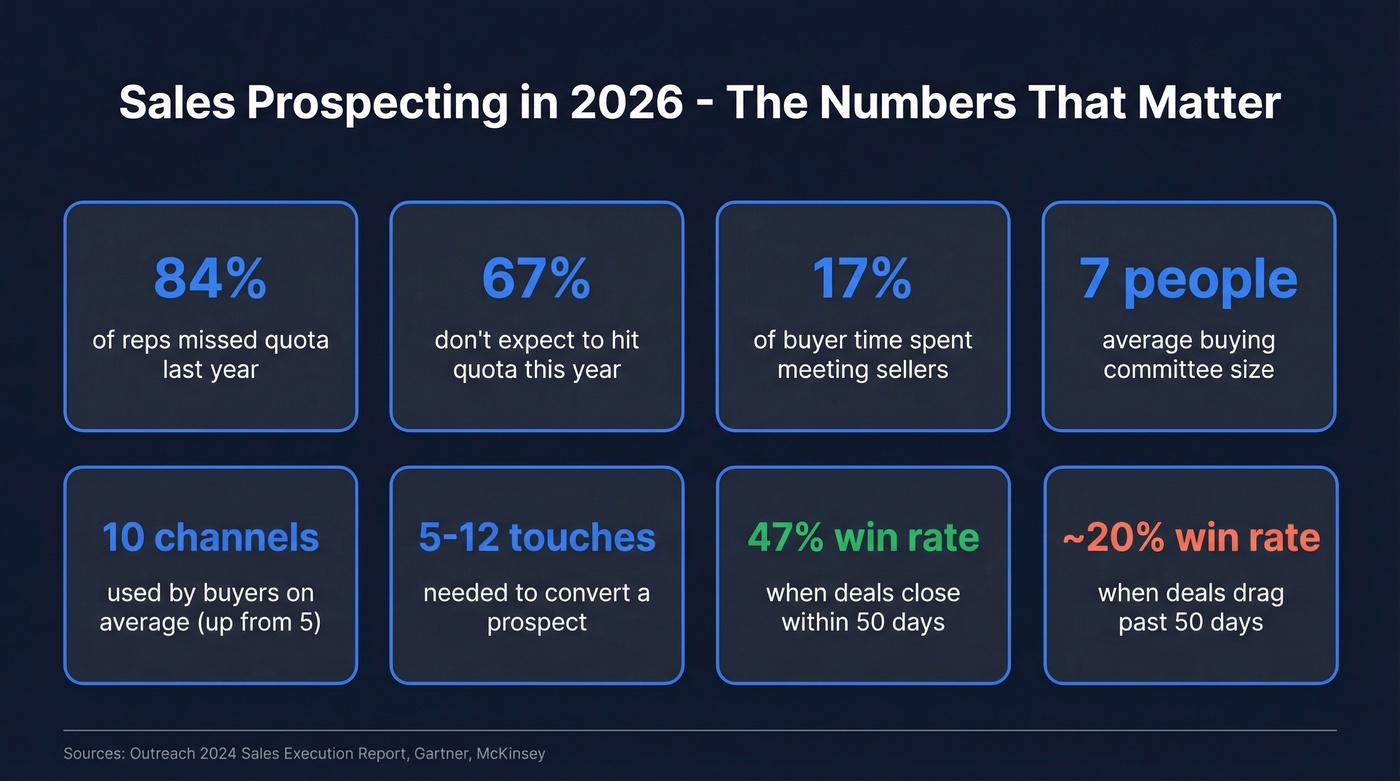
- 84% of reps missed quota last year. 67% don't expect to hit it this year. Compare that to 2012, when 53% of reps were hitting quota.
- 80% of B2B sales interactions now happen through digital channels.
- Buyers use ~10 interaction channels on average, up from 5 in 2016.
- Buyers spend just 17% of their buying time meeting with suppliers. The rest is independent research.
- 7-person buying committees are the norm for mid-sized firms (100-500 employees). If you're only talking to one person in an account, you're losing to the rep who's threading three.
- 89% of buyers report at least one deal stalling in the past year - usually budget freezes.
- Most deals require 5-12 touchpoints across multiple channels before converting.
- Opportunities closed within 50 days show a 47% win rate. After 50 days, it drops to ~20%.
The takeaway isn't complicated. Buyers are harder to reach, committees are bigger, deals stall more often, and speed kills. Every day your deal sits open past day 50, your win probability gets cut roughly in half.
The Modern Targeting Framework
The old way of targeting - pull a list of companies that match your ICP, blast them - doesn't work anymore. Inbox saturation, spam filters, unknown-number screening, and poor data quality have made "reachability" a real constraint, not just a nice-to-have. (If you're operationalizing triggers, use this guide on how to track sales triggers.)
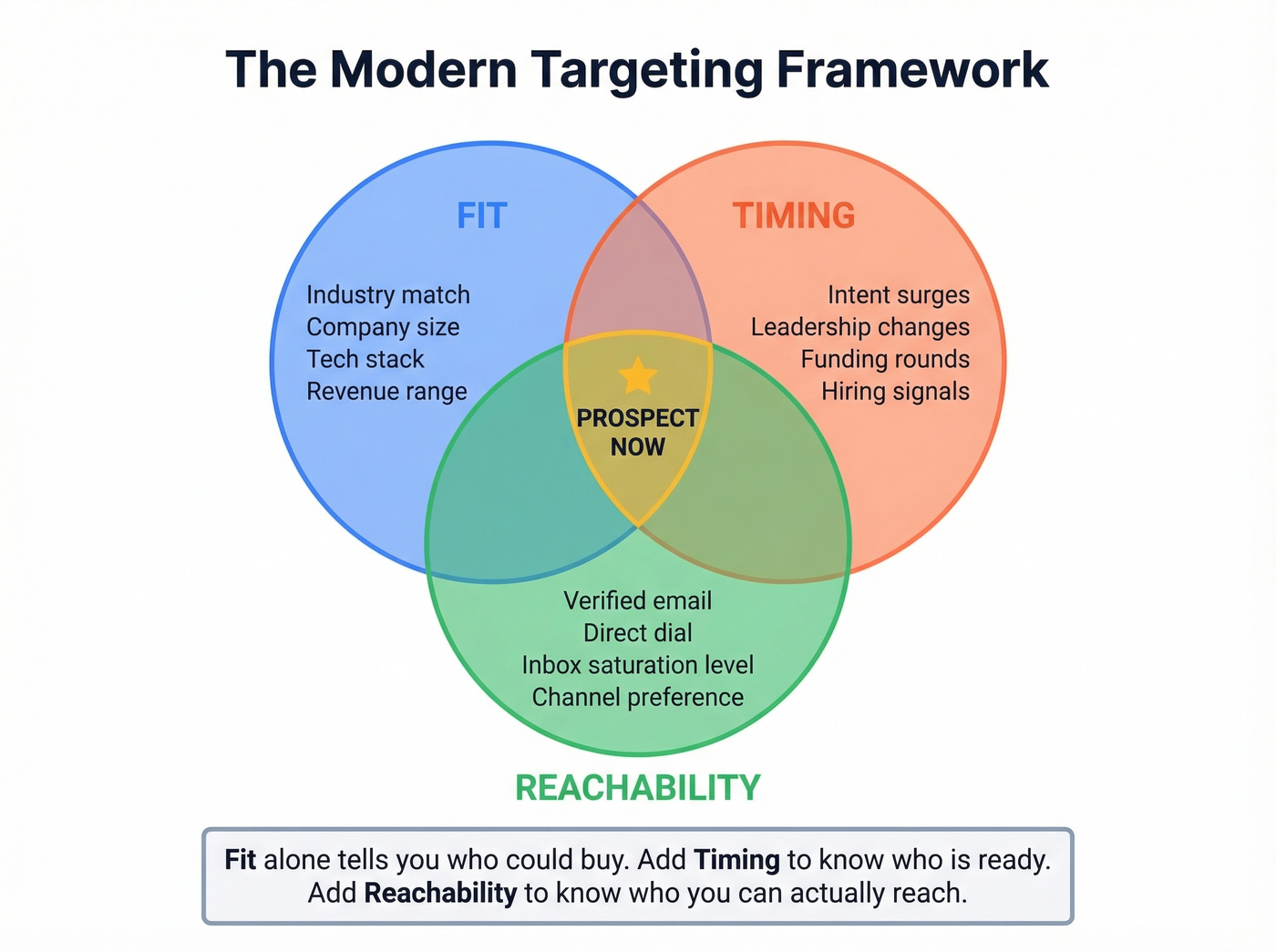
The framework that works in 2026 has three pillars: Fit + Timing + Reachability.
Fit is your ICP match - industry, company size, tech stack, revenue range. Table stakes. Every tool can filter on fit. But fit alone tells you nothing about whether someone is ready to buy. (If you need a scoring rubric, grab an ideal customer profile template.)
Timing is the signal layer. Intent data, trigger events, hiring patterns, funding announcements, leadership changes. Here's the key insight: use intent data as a filter, not a verdict. A company researching your category is interesting. A company researching your category and hiring for the role your product supports and showing first-party engagement on your site - that's a prospect worth calling today. Define 3-5 trigger events aligned to your solution and set recency rules so reps aren't chasing stale signals. (More detail in identifying buying signals.)
Reachability is whether you can actually get through. Do you have a verified email that won't bounce? A direct dial that rings? Is this person's inbox so saturated that your message will never surface? This pillar is where most teams fall apart - they nail fit and timing, then waste it on contacts that bounce or ring out.
One more thing: your targeting should learn from outcomes. Track which accounts convert, which objections come up, which signals correlated with closed deals. Feed that back into your list-building criteria every quarter.
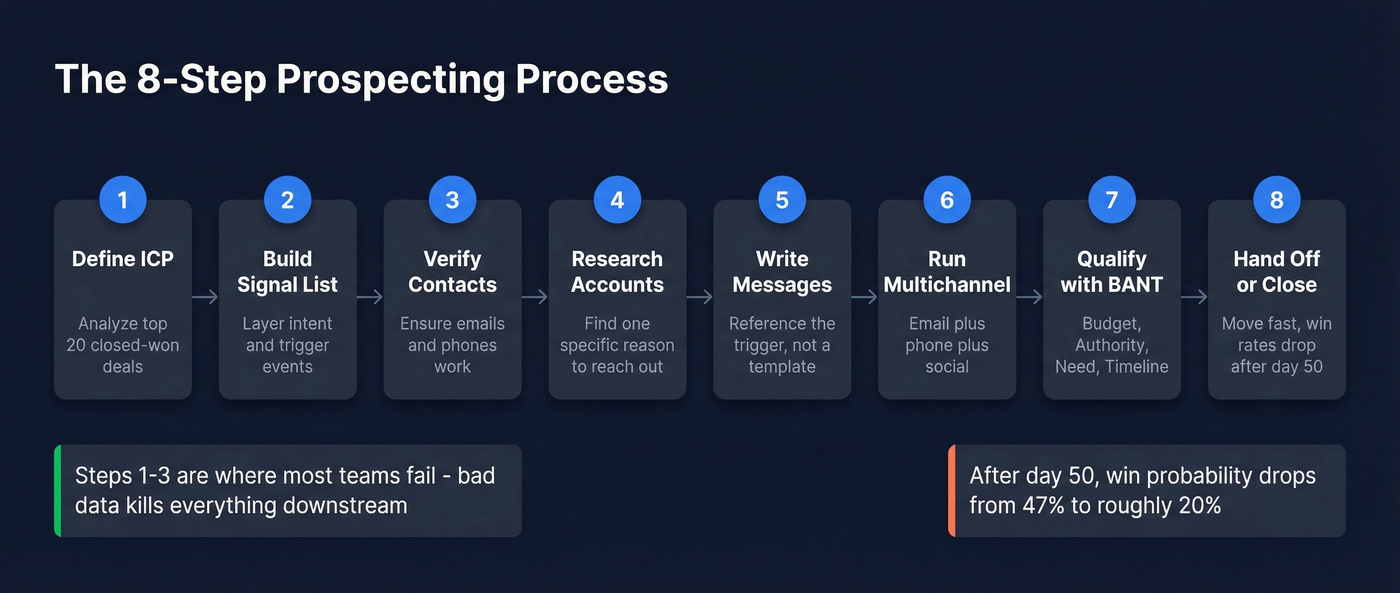
The 8-Step Process
1. Define Your ICP
Start with your best customers, not your assumptions. Pull your top 20 closed-won deals from the last 12 months and look for patterns - industry, headcount, tech stack, funding stage, department structure. Your ICP should be specific enough that a rep can say "yes" or "no" in under 30 seconds.
2. Build a Signal-Driven List
Don't just filter on firmographics. Layer in timing signals: companies showing intent around your category, recent leadership hires in your buyer persona, funding rounds in the last 90 days, job postings that signal a problem you solve. A list of 200 signal-qualified accounts will outperform a list of 2,000 that merely match your ICP on paper. (If you're doing this at scale, see Clay list building.)
3. Verify Contact Data
4. Research Each Account
AI has compressed this step from 15 minutes per account to under 2 minutes. Use AI tools to scan company websites, recent news, job postings, and earnings calls. The goal is one specific, relevant reason to reach out - not a generic "I noticed your company is growing."
5. Write Signal-Based Messages
Generic cold email gets 3-5% reply rates. Signal-personalized outreach hits 15-25%. The difference is referencing the specific trigger that put this account on your list. "I saw you just hired a VP of Revenue Operations - that usually means the CRM data is a mess" lands differently than "I help companies like yours grow revenue." (For a full system, see personalized outreach.)
6. Run Multichannel Sequences
Email, phone, and social - in combination, not isolation. Buyers use ~10 channels. Your sequence should touch at least three. Email first to establish context, phone follow-up 24-48 hours later referencing the email, and a social touch in between to build familiarity. 43% of buyers who accept meetings say they're fine being contacted 5+ times before agreeing. Most reps give up after two.
One tactic most guides miss: multithread the account. With 7-person buying committees being the norm, reaching out to a single contact is a losing strategy. Identify 2-3 stakeholders per account - the end user, the budget holder, and the champion - and run parallel sequences. When multiple people in the same org recognize your name, your meeting acceptance rate climbs dramatically.
7. Qualify with BANT
Once you've got a conversation, qualify fast. Budget - can they pay? Authority - are you talking to a decision-maker or an influencer? Need - is the pain real and urgent? Timeline - is there a forcing function? BANT prevents your pipeline from filling up with deals that'll never close.
8. Hand Off or Close
If you're an SDR, the handoff to the AE needs context: what triggered the outreach, what pain the prospect confirmed, who else is involved in the decision, and what the timeline looks like. If you're an AE or founder doing your own prospecting, this is where you transition to deal mode. Move fast - win rates drop sharply after day 50.

You just read that data decays up to 30% annually. Prospeo refreshes every 7 days - not every 6 weeks like competitors. With 30+ filters including buyer intent, job changes, and funding signals, you can build the signal-driven lists this guide describes. 98% email accuracy means your outreach actually lands.
Build signal-qualified prospect lists that don't bounce. Start free.
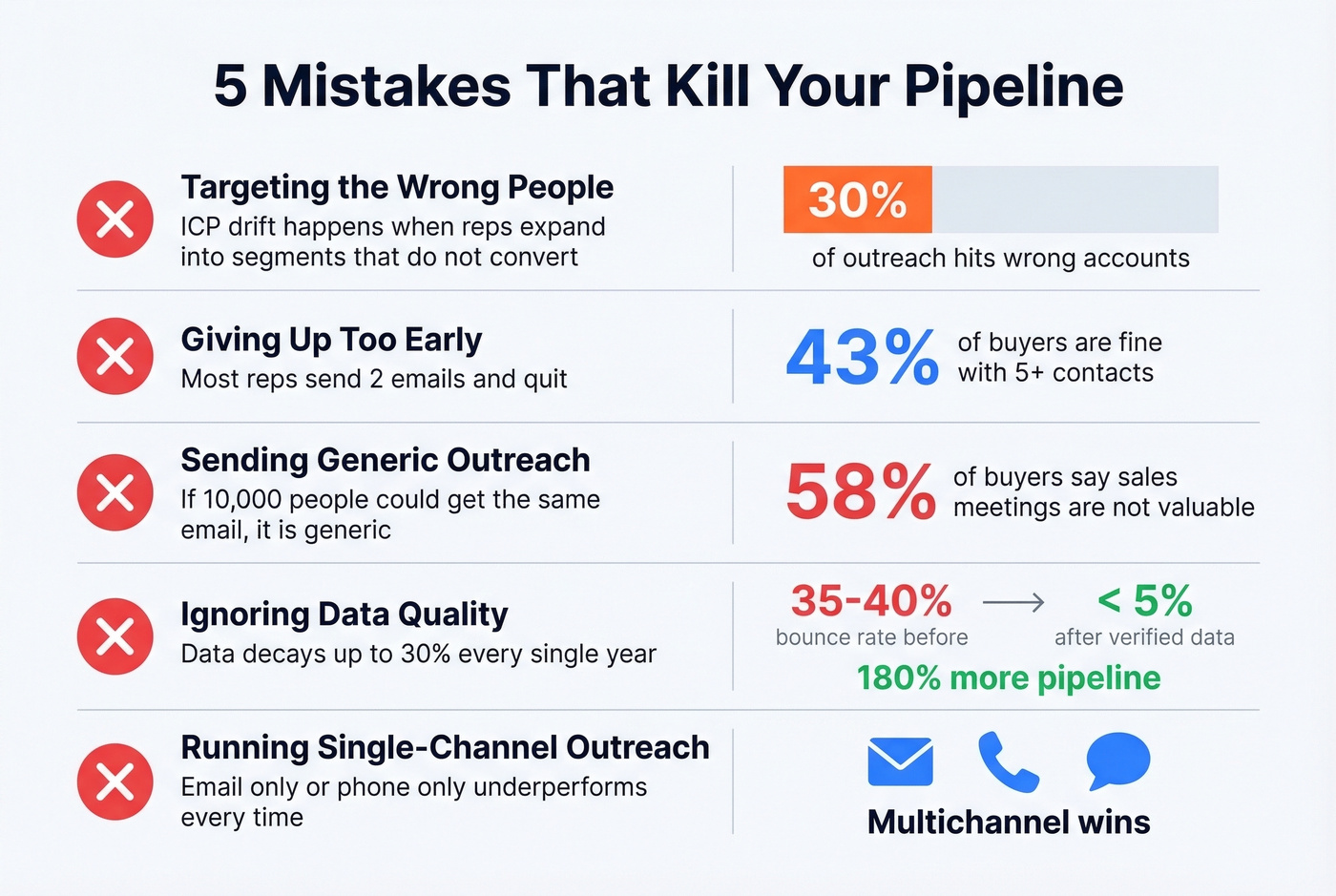
Five Mistakes That Kill Pipeline
Targeting the Wrong People
ICP drift is silent and deadly. It starts when reps run out of ideal accounts and start "expanding" into adjacent segments that don't convert. Or when marketing hands over a list that matches on industry but misses on company stage, tech stack, or buying authority. The fix: audit your target list monthly against closed-won patterns. If less than 30% of your outreach is going to accounts that look like your best customers, your targeting has drifted.
Giving Up Too Early
43% of buyers who accept meetings say they're okay being contacted 5+ times. Most reps send two emails, get no reply, and move on. The math is brutal - you're abandoning prospects right before the window where persistence starts paying off. Build sequences with 8-10 touches across 3+ weeks. The fifth email isn't annoying if it's relevant.
Sending Generic Outreach
58% of buyers say sales meetings aren't valuable. That's a damning stat, and it starts with the outreach that books those meetings. If your email could be sent to 10,000 people without changing a word, it's generic. Reference the trigger event. Mention the specific challenge. A LinkedIn Sales Navigator analysis found a 46% lift in InMail acceptance when the seller mentions at least one commonality - shared connections or same school being the strongest.
Ignoring Data Quality
Data decays up to 30% every year. People change jobs, companies get acquired, email domains shift. If your bounce rate is above 5%, your data provider is the problem. Snyk's 50 AEs saw their bounce rate drop from 35-40% to under 5% after switching to a provider with a 7-day refresh cycle and 5-step verification - and their AE-sourced pipeline jumped 180%. (If you're troubleshooting, start with email bounce rate.)
Running Single-Channel Outreach
Email-only sequences underperform multichannel by a wide margin. Cold calls alone are even worse. Combining email, phone, and social consistently outperforms any single channel. Cold calls work best as a follow-up to an opened email - the prospect already has context, and the call feels less random. Skip this section if you're already running multichannel; for everyone else, this is the single biggest lever you're not pulling.
The Data Quality Crisis
Let's be honest about the elephant in every outbound workflow. Data decays up to 30% annually. Manual research to compensate eats ~40% of a rep's week. And when bad data hits your sequences, the damage compounds fast. (If you need the deliverability side, see the email deliverability guide.)
Here's the scenario we've seen play out dozens of times. You load 5,000 contacts into your sequencer. Your data provider's "verified" emails bounce at 16%. That's 800 bounced emails in a week. Your email service provider flags your domain, deliverability tanks for every email you send going forward, and it takes weeks to recover. One bad batch poisons the well for months.
The tool with the biggest database isn't the best tool. The tool with the cleanest data is.
Building Your Tech Stack
Your stack should flow: discovery -> research -> outreach -> CRM sync. Each tool handles one job well and passes data cleanly to the next. Four categories matter.
Sequencing & outreach handles the actual sending. Instantly and Lemlist are the best options for SMB and mid-market teams. Outreach and Salesloft are enterprise-grade but come with enterprise complexity and pricing.
CRM is non-negotiable. HubSpot's free tier is a strong starting point. Salesforce is the standard once you're scaling. (If you're comparing options, see examples of a CRM.)
Here's the thing: if your average deal size is under $25K, you almost certainly don't need ZoomInfo. You need clean data, a solid sequencer, and a free CRM. Our opinionated budget recommendation: Prospeo + Instantly + HubSpot free = under $500/month. That's a complete stack with verified data, multichannel sequencing, and CRM tracking. Save the enterprise platforms for when you have the headcount and deal size to justify them.
| Tool | Category | Starting Price | Notes |
|---|---|---|---|
| Prospeo | Data & verification | Free (75 emails/mo); ~$0.01/email paid | 98% accuracy, 7-day refresh, no contracts |
| Apollo | Data & sequencing | Free; $49/user/mo | 275M+ contacts; higher bounce rates |
| ZoomInfo | Data & intelligence | ~$15-40K/year | Enterprise, annual contracts |
| Cognism | Data & compliance | ~$1-3K/month | Strong EMEA data |
| Clay | Enrichment & workflows | $149/month (credits) | Powerful; costs add up fast |
| Hunter | Email finding | Free-$99/month | Lightweight; limited database |
| LinkedIn Sales Nav | Research & social | $99/user/month | Essential for social selling |
| Instantly | Email sequencing | $37/month | Sequencing only, no data |
| Lemlist | Multichannel sequences | $55/user/month | Email + social |
| Outreach | Enterprise sequencing | ~$100/user/month | Complex setup, enterprise |
| Salesloft | Enterprise sequencing | ~$125/user/month | Complex setup, enterprise |
| 6sense | Intent & ABM | ~$50K+/year | Enterprise intent platform |
Step 3 says verify your contact data. Teams using Prospeo cut bounce rates from 35%+ to under 4% and book 26% more meetings than ZoomInfo users. 300M+ profiles, 125M+ verified mobiles, and emails at $0.01 each - no contracts, no sales calls required.
Fix the reachability pillar that's killing your pipeline today.
AI and the Future of Prospecting
81% of sales teams have implemented or are experimenting with AI. But let's be precise about what AI actually changes.
AI doesn't replace sales judgment - it replaces busywork. Research that took 15 minutes per account now takes 90 seconds. Personalization that required reading a 10-K now happens from a one-line prompt. The AI SDR market is projected to hit $15B by 2030 at a 29.5% CAGR, and 22% of teams have already fully replaced human SDRs with AI agents. (If you're applying it to outbound, see AI cold email outreach.)
The hybrid model is where most teams are landing. 45% now run a hybrid AI-SDR setup where AI handles research, list building, and first-draft messaging, while humans handle the actual conversations and judgment calls. LinkedIn's data shows 56% of sales professionals use AI daily, and daily users are 2x as likely to exceed their targets. Outreach's coaching assistant closes deals 11 days faster on average and lifts win rates by up to 10 percentage points on deals over $50K - concrete proof that AI-assisted selling works when applied to the right steps.
Signal-personalized outreach achieves 15-25% reply rates versus 3-5% for generic cold email. That gap will only widen as AI tools get better at pattern-matching intent signals to messaging. If you're not using AI for at least research and personalization by now, you're competing with one hand tied behind your back.
Measuring Your ROI
The formula is simple: ROI = ((Revenue Generated - Total Cost) / Total Cost) x 100.
A healthy operation should hit at least 3x ROI to justify the investment. If you're spending $50K per quarter on tools, salaries, and overhead, your outbound-sourced pipeline should be generating $150K+ in closed revenue.
Track these KPIs at the team, individual, and campaign level. CAC tells you total spend divided by customers acquired. CLV tells you whether the customer value justifies the acquisition cost. Sales cycle length reveals whether deals are closing faster or slower over time. Win rate shows what percentage of qualified opportunities close. Average deal size indicates whether you're reaching the right tier of accounts.
Separate your activity metrics - dials made, emails sent, time on phone - from your result metrics: SQLs generated, meetings booked, meetings held. Activity without results means your targeting or messaging is broken. Results without activity means you've got a capacity problem. Both matter, but results are what pay the bills.
FAQ
What's the difference between prospecting and lead generation?
Prospecting is sales-led, one-to-one outreach to specific accounts you've chosen. Lead generation is marketing-led, one-to-many campaigns designed to attract inbound interest. Prospecting fills pipeline faster when you need meetings now; lead gen builds it over time through content, ads, and events.
How many touchpoints to book a meeting?
Most deals require 5-12 touchpoints across multiple channels. 43% of buyers who accept meetings say they're fine being contacted 5+ times. Most reps give up after 2 - that's the gap. Build sequences with at least 8 touches across email, phone, and social over 3+ weeks.
What's a good tool stack for small teams?
Prospeo for verified data (free tier: 75 emails/month, 98% accuracy), Instantly or Lemlist for sequencing, and HubSpot's free CRM. Total cost: under $500/month for a complete stack covering data, outreach, and tracking - no enterprise contracts required.
Is cold calling dead in 2026?
No - but standalone cold calling underperforms. Multichannel sequences combining email, phone, and social consistently beat single-channel outreach. Cold calls work best as a follow-up to an opened email, when the prospect already has context for who you are and why you're calling.
How does AI change the process?
AI cuts research and personalization time by up to 90%. 45% of teams now run hybrid AI-SDR models where AI handles list building and first drafts while humans manage conversations. Signal-personalized outreach achieves 15-25% reply rates versus 3-5% for generic cold email - that's the real impact.