

Proposal Email Templates: Data-Backed Examples That Actually Get Replies
You've had the discovery call, scoped the project, built the proposal deck - and now you're staring at a blank compose window trying to figure out what to actually write in the email. Meanwhile, 392.5 billion emails get sent today. Your proposal email template needs to cut through every single one of them.
The good news: proposal emails aren't hard to write well. They're just hard to write short enough.
The Cheat Sheet
Before the templates and data, here's what matters:
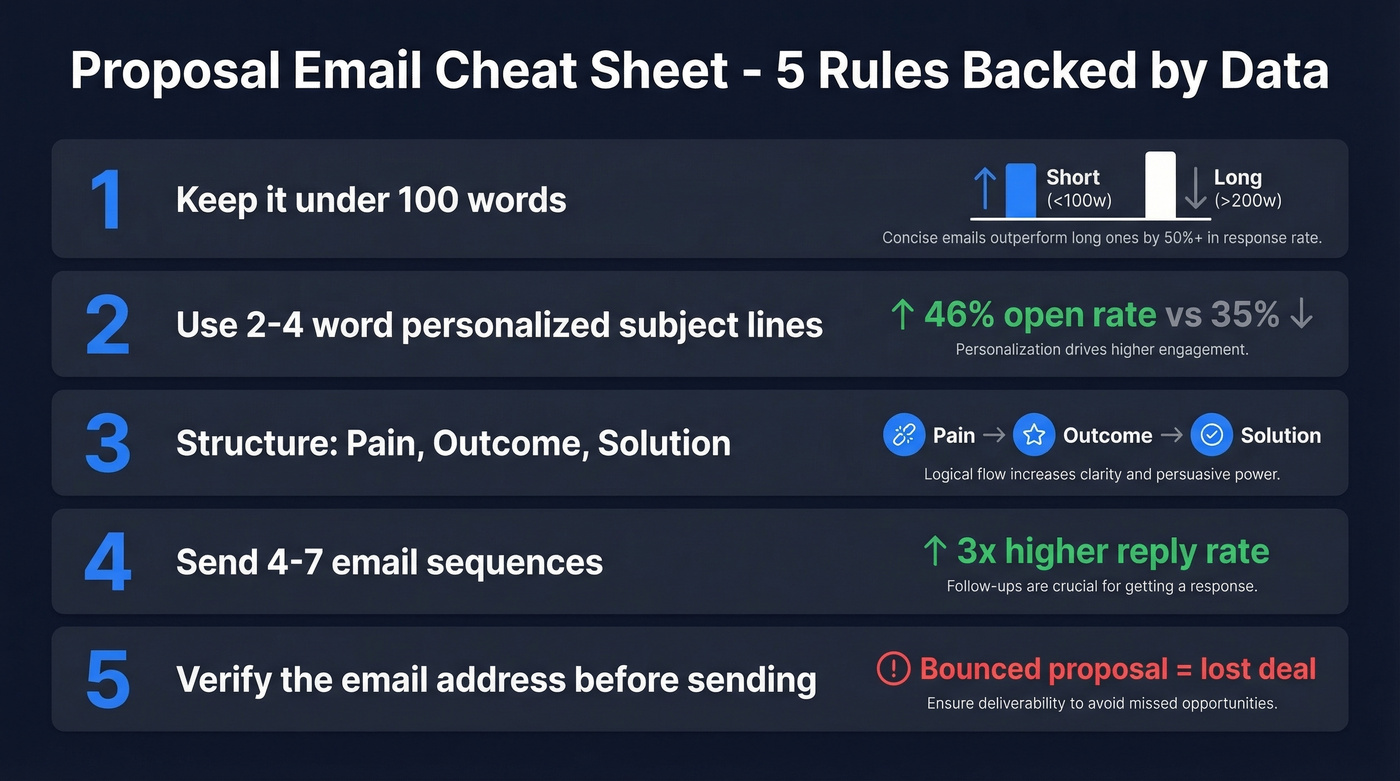
- Keep the email under 100 words - the proposal document carries the detail.
- Use a 2-4 word personalized subject line (46% open rate vs. 35%). (If you want more options, pull from these email subject lines.)
- Structure it: painful problem, desired outcome, your solution as the bridge.
- Use a 4-7 email sequence (about 3x higher reply rate than sending just 1-3 emails). (More sales follow-up templates help here.)
- Verify the email address before sending. A bounced proposal is a lost deal. (See email bounce rate benchmarks and fixes.)
What Makes a Proposal Email Work
The average cold email reply rate sits at 3.43%. Elite campaigns hit 10%+. Proposal emails - the warm ones sent after a real conversation - should blow past cold baselines, but only if you don't sabotage yourself with a wall of text.
An analysis of billions of cold email interactions found that campaigns with first-touch emails under 80 words consistently outperform longer ones. That tracks with what practitioners report on Reddit too: one estimator on r/estimators shortened their proposal emails and immediately got "a lot more feedback" and "more email replies." The proposal document does the heavy lifting. The email is just the door.
Subject lines matter more than most people think. A study of 5.5M emails found personalized subject lines hit a 46% open rate versus 35% without personalization, and reply rates jumped from 3% to 7%. That's a 133% increase from a few extra seconds of effort. (If you're building outbound from scratch, start with a B2B cold email sequence.)
The Transformation Framework
Here's the thing: most proposal emails read like a table of contents. "Attached please find our proposal for website redesign services including..." Nobody gets excited about that.
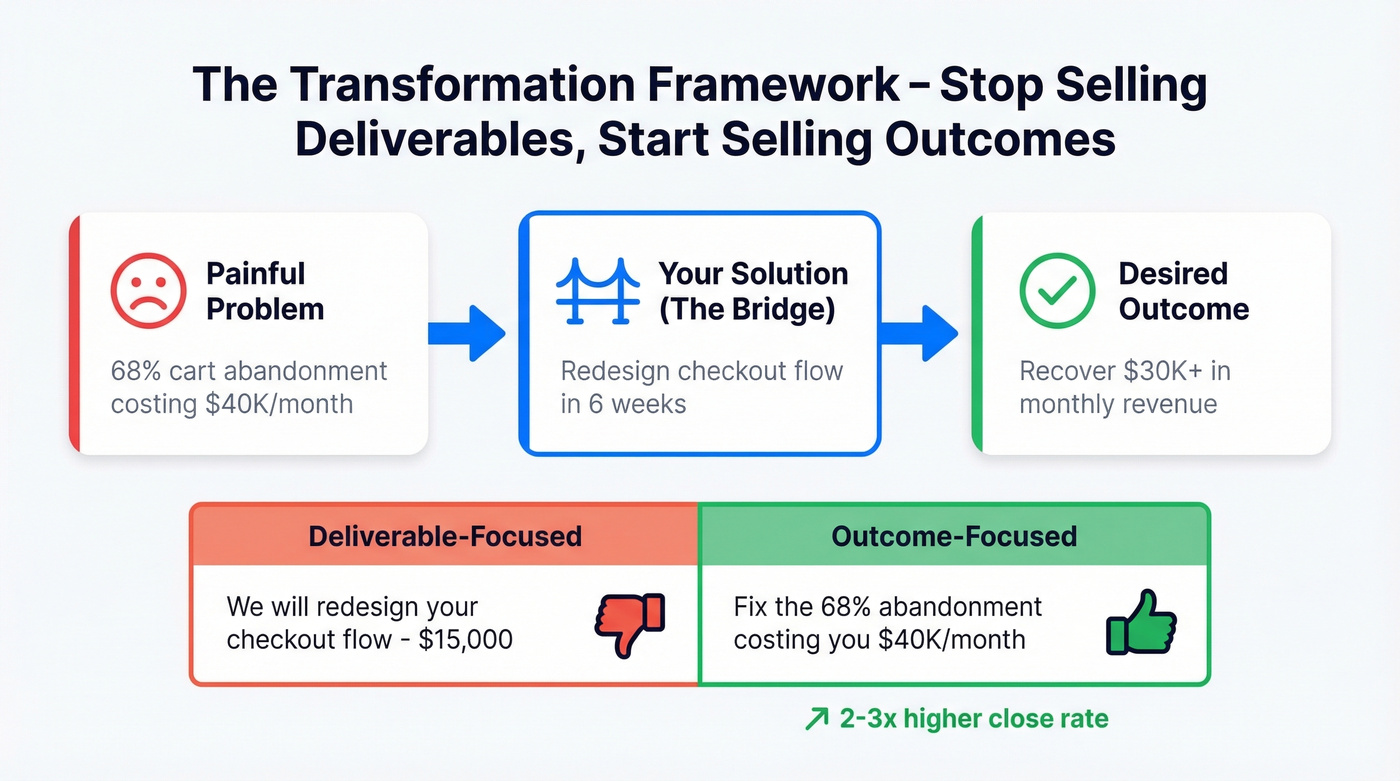
A freelancer on r/copywriting shared the reframe that helped them land $5K-$10K+ projects consistently: stop selling deliverables and start selling transformation. Name the client's painful problem, paint the desired future state, then position your work as the bridge between the two. Use the client's own language so they feel understood before they even open the attachment.
In our experience, proposals framed around outcomes close at 2-3x the rate of deliverable-focused ones. When you tie your price to an outcome instead of a list of hours, higher pricing becomes easier to justify. "We'll redesign your checkout flow" is a cost. "We'll fix the 68% cart abandonment that's costing you $40K/month" is an investment. The email sets that frame before the proposal fills in the details.
Hot take: If your average deal is under $5K, you probably don't need a separate proposal document at all. Put everything in the email itself (the Freelancer template below does exactly this). The extra step of opening a PDF or clicking a link is friction - and friction kills small deals faster than big ones.
Proposal Email Structure: 7 Elements
Geoffrey James outlined a 7-point proposal email structure that holds up well:
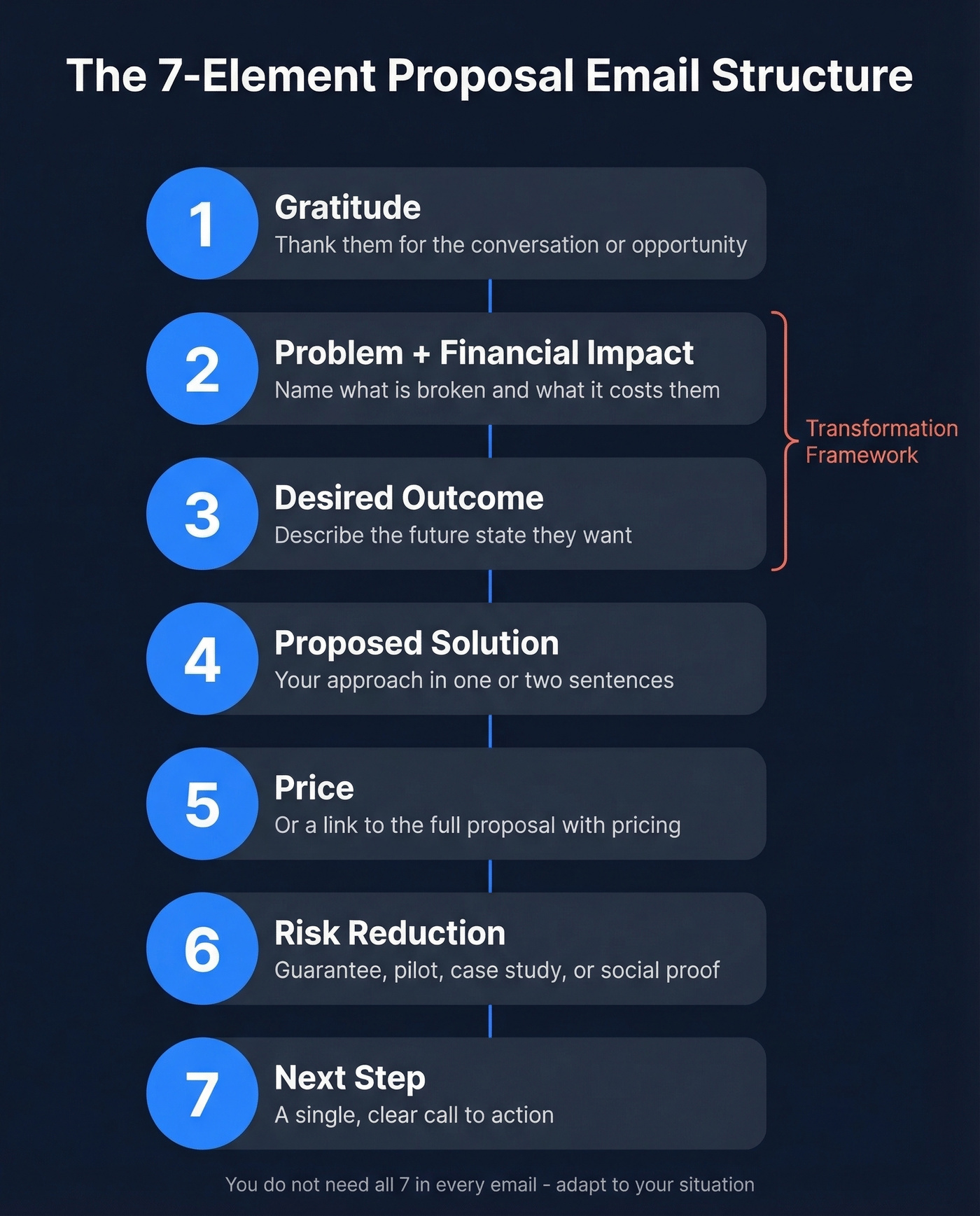
- Gratitude - thank them for the conversation or opportunity.
- Problem + financial impact - name what's broken and what it costs them.
- Desired outcome - describe the future state they want.
- Proposed solution - your approach, in one or two sentences.
- Price - or a link to the full proposal where pricing lives.
- Risk reduction - guarantee, pilot, case study, or social proof.
- Next step - a single, clear CTA.
You don't need all seven in every email. Cold proposals can skip gratitude. Warm proposals can compress the problem/outcome into a callback to the discovery call. But this skeleton keeps you from rambling.
Copy-Paste Templates for Every Scenario
Cold Proposal Email
Use when you're reaching out to someone who hasn't asked for a proposal. This uses the transformation framework and stays under 80 words.
Subject: [Company]'s [specific metric]
Hi [First Name],
[Company] is losing roughly [$ or %] on [specific problem] - based on what I've seen in similar [industry] companies.
We helped [similar client] fix this and [specific outcome, e.g., "cut churn by 34% in 90 days"].
I put together a short proposal showing how we'd do the same for [Company]. Here's the link: [proposal URL]
Worth 10 minutes this week?
[Your name]
Why this works: It leads with their pain, not your credentials. The proposal link keeps the email clean. And "Worth 10 minutes?" is a low-commitment CTA - it asks for time, not a decision. (For more, see AI cold email outreach.)
Warm Proposal Email (Post-Discovery)
Sent after a meeting. Reference what they told you - it proves you listened.
Subject: Proposal for [project name]
Hi [First Name],
Great speaking Thursday. You mentioned [specific pain point from the call] - and that fixing it would [desired outcome they stated].
I've put together a proposal covering our approach, timeline, and pricing: [proposal URL]
The short version: we'd [one-sentence solution summary] within [timeframe], starting at [price or "detailed in the proposal"].
Happy to walk through it live. Does [day/time] work?
[Your name]
Why this works: Mirroring their own words back builds trust instantly. We've tested this against generic warm emails and the difference in reply rate is stark. (If you need better call prep, use these discovery questions.)
Freelancer Proposal Email (Before vs. After)
Most freelancer proposal emails look like this:
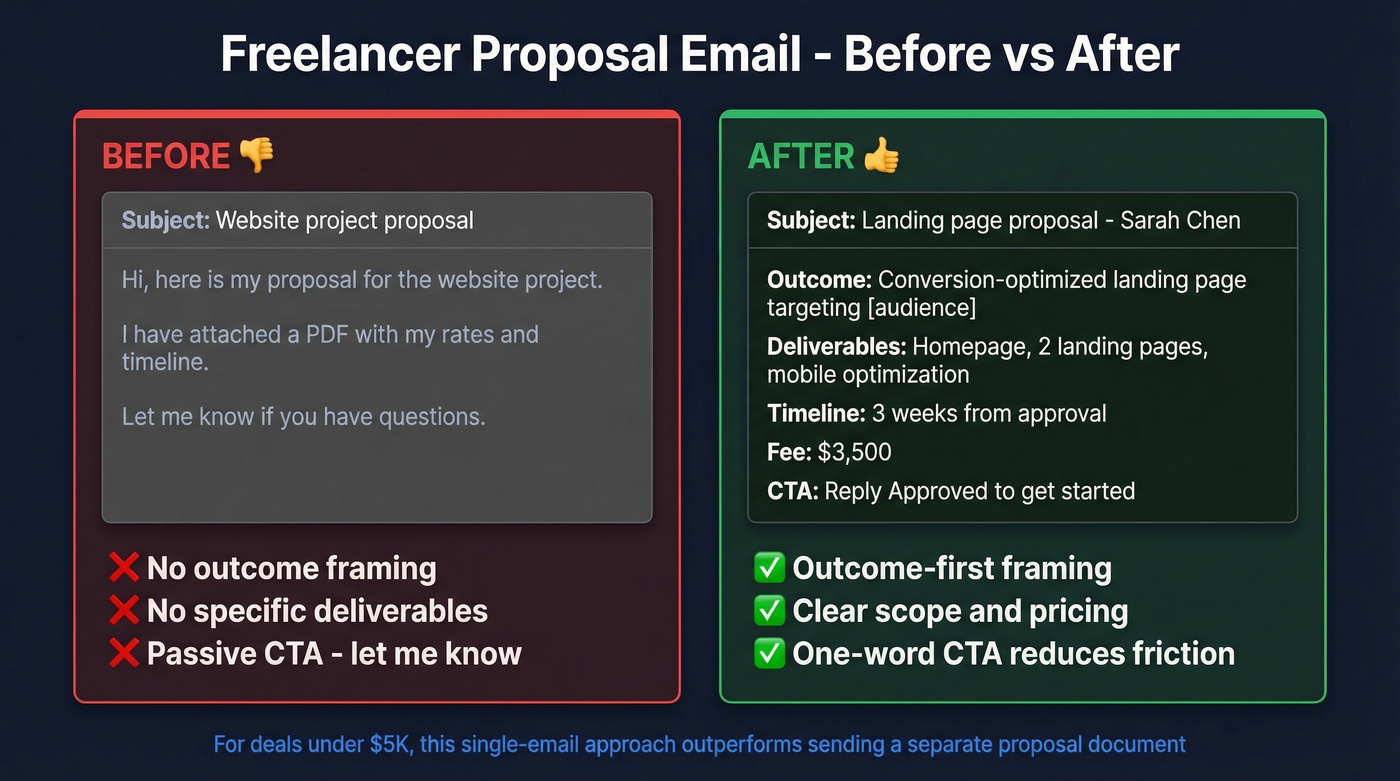
"Hi, here's my proposal for the website project. I've attached a PDF with my rates and timeline. Let me know if you have questions."
That's a nothing email. It gives the client zero reason to feel excited. Compare it with this version, borrowed from the Dynamic Freelancer framework:
Subject: [Project] proposal - [Your Name]
Hi [First Name],
Here's what I'm proposing for [project]:
Outcome: [What they'll get - e.g., "a conversion-optimized landing page that targets [audience]"] Deliverables: [Specific items] Timeline: [X weeks from approval] Revisions: [Number] rounds included Fee: [Amount] Payment: [50% upfront, 50% on delivery / your terms]
To get started, I'll need [assets/access].
If this looks good, reply "Approved" and I'll send the invoice and start on [date].
[Your name]
The "Reply Approved" CTA eliminates friction. No contracts to sign, no links to click - just one word to get started. For deals under $5K, this single-email approach outperforms sending a separate proposal document.
Business Proposal Email Template
For larger engagements where ROI framing matters more than line-item pricing, a business proposal email template needs to anchor on financial impact.
Subject: [Company] growth proposal
Hi [First Name],
Based on our conversation, [Company] is leaving [estimated $] on the table due to [problem].
Our proposal outlines a [timeframe] engagement to [desired outcome]. Here's the full breakdown: [proposal URL]
For context, we ran a similar program for [client/industry] and they saw [specific result]. Case study here: [link]
The investment starts at [price range]. Happy to walk through the ROI model - does [day] work?
[Your name]
Why this works: Framing price as "investment" alongside a case study shifts the conversation from cost to value.
Partnership Proposal Email
Lighter on price, heavier on mutual upside. One critical mistake to avoid: opening with "we'd love to partner with you," which really means "we want access to your audience" and everyone knows it. Lead with what they get instead.
Subject: [Your company] + [Their company]
Hi [First Name],
[Their company]'s audience overlaps with ours in [specific area]. I think there's a partnership that benefits both sides.
The idea: [one-sentence partnership concept]. We'd bring [your contribution], you'd bring [their contribution], and both audiences get [shared benefit].
I sketched out the details here: [proposal URL]
Worth a 15-minute call this week?
[Your name]
Why this works: Naming the specific overlap and the shared benefit proves you've done your homework, not just mass-emailed every company in your space.
Internal Proposal Email
Proposing a project or budget to leadership requires a different approach. Decision-makers inside your company don't need to be sold on your credibility - they need to see business impact fast. Skip the pleasantries and lead with the number.
Subject: Proposal: [project name]
Hi [Name],
[Problem] is costing us approximately [$/time/resources] per [period]. I've put together a proposal to fix it: [link or attachment].
Expected impact: [specific metric improvement]. Budget needed: [amount]. Timeline: [weeks/months].
Can we discuss at [meeting/time]?
[Your name]
Internal stakeholders care about three things: what it costs, what it saves, and how long it takes. This answers all three in under 60 words.
Pricing-Only Follow-Up
When they said "just send me pricing" - don't overthink it.
Subject: Pricing for [project]
Hi [First Name],
As promised - pricing and scope details are here: [proposal URL]
Happy to jump on a quick call if anything needs clarifying. What works this week?
[Your name]
It matches the energy of their request. They asked for something simple; you delivered something simple.

A bounced proposal email is a lost deal - period. Prospeo's 5-step email verification delivers 98% accuracy, so your carefully crafted proposal actually reaches the decision-maker. At $0.01 per email, verifying every address before sending is the cheapest insurance your pipeline will ever get.
Stop losing deals to bad email addresses. Verify before you send.
Subject Lines That Get Opened
The largest public dataset on email subject lines - 5.5M messages analyzed - paints a clear picture:
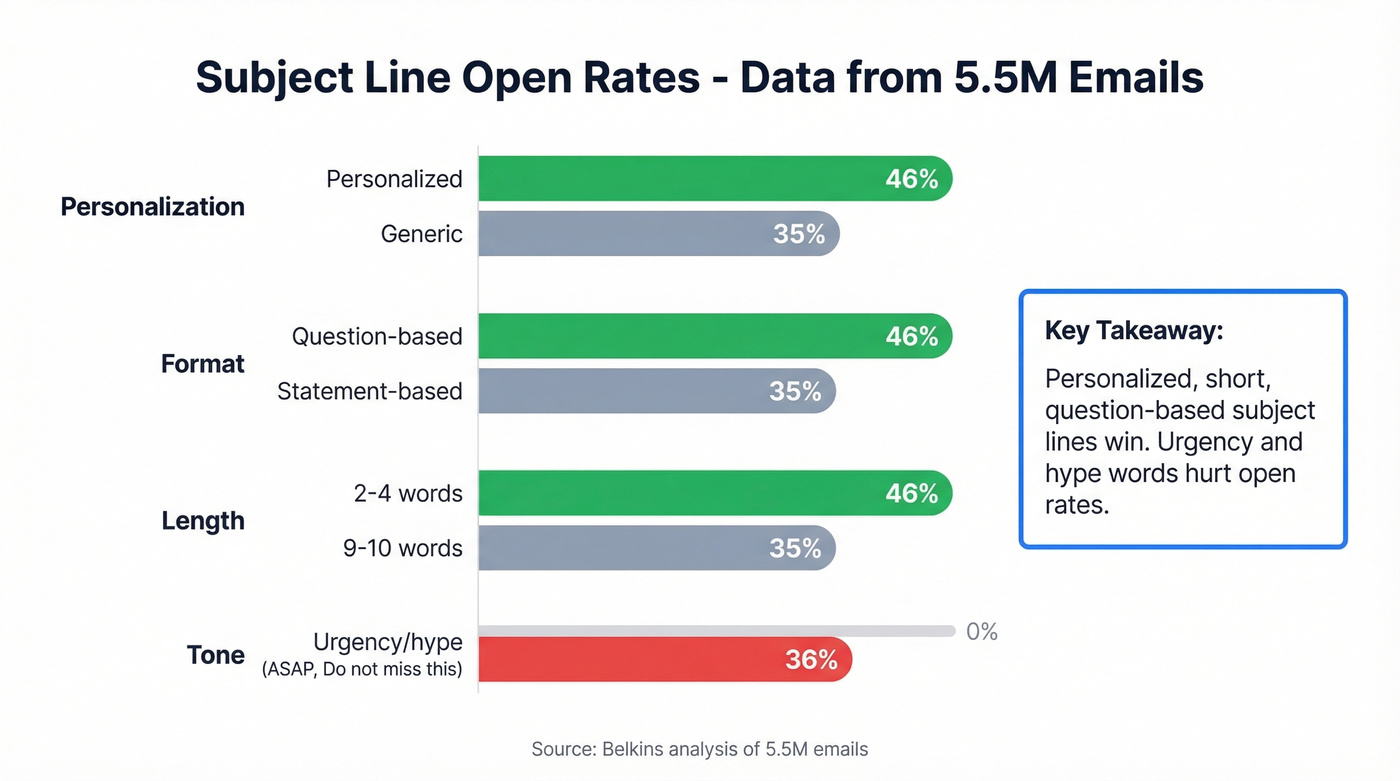
- Personalized subject lines: 46% open rate (vs. 35% generic)
- Question-based subject lines: 46% open rate
- 2-4 words: 46% open rate. At 9-10 words, it drops to ~35%.
- Urgency/hype phrasing ("ASAP," "Don't miss this"): below 36%
- Numbers in subject lines: slightly worse (27% vs. 28%)
Ten subject lines built on those principles:
- [Company] proposal
- Quick proposal, [First Name]
- Thoughts on [project]?
- [Company]'s [metric] fix
- Proposal: [one-word topic]
- Following up - [project]
- [Mutual connection] suggested this
- Ready for [First Name]?
- [Company] + [Your Company]
- The [specific problem] proposal
Short, personalized, no hype. That's the formula. (You can also sanity-check against subject lines that get opened.)
Attach It or Link It?
| Link | Attachment | |
|---|---|---|
| Spam risk | Lower | Higher, especially PDFs |
| Size limits | None | 10-25MB cap |
| Version control | Always current | Static once sent |
| Tracking | Can track opens/views | Blind after send |
| Convenience | Instant view | Download needed |
For first-touch emails - cold ones especially - link to a hosted proposal. Attachments add friction, increase deliverability risk, and you lose version control. For warm follow-ups where the recipient expects a document, attachments are fine. Rule of thumb: keep your first email as clean as possible. Zero attachments, one link max. (If you're worried about inboxing, start with an email deliverability guide.)
The Follow-Up Sequence
Follow-Ups Beat First Emails
Here's a stat that should change how you think about proposals: 80% of sales require at least five follow-ups, yet 48% of salespeople never follow up once. That's not a gap - it's a canyon.
An analysis of 20M+ sales emails found sequences with 4-7 emails achieve a 27% reply rate, roughly 3x higher than sequences with just 1-3 emails. Benchmark data across billions of sends shows 42% of all replies come from follow-ups, not the initial email. We've seen this play out firsthand: proposal sequences with 5+ touches consistently outperform single-send approaches, often dramatically. (If you want to go deeper, see importance of follow-up in sales.)
The Cadence
- Day 1: Send the proposal email
- Day 3-4: First follow-up (gentle nudge)
- Day 7-8: Second follow-up (add new value)
- Day 12-14: Third follow-up (direct ask)
- Day 21: Breakup email
Waiting three days between touches increases replies by 31%. Mid-week sends perform best, with Wednesday the highest-engagement day. (More timing data: best time to send cold emails.)
Follow-Up Templates
Follow-Up #1 (Day 3-4) - Gentle Nudge:
Subject: Re: [Original subject]
Hi [First Name],
Just floating this back up. Did you get a chance to review the proposal? Happy to clarify anything or jump on a quick call.
[Your name]
Follow-Up #2 (Day 7-8) - Add Value:
Subject: Re: [Original subject]
Hi [First Name],
Wanted to share a quick case study that's relevant - [client] had a similar [problem] and saw [specific result] within [timeframe]: [link]
The proposal is still here if you'd like to revisit: [proposal URL]
[Your name]
Breakup Email (Day 14-21):
Subject: Closing the loop
Hi [First Name],
Haven't heard back, so I'll assume the timing isn't right. Totally understand.
If [problem] becomes a priority again, the proposal stands. Just reply to this thread and we'll pick up where we left off.
[Your name]
Before You Hit Send
Run through this checklist before every proposal email:
- Proofread for client details. Wrong company name = instant delete. We've seen it happen more than you'd think.
- Verify the email address. The best proposal email is worthless if it bounces. Prospeo's free tier gives you 75 email checks per month with 98% accuracy, which covers most proposal workflows without spending a dime. (If you need a process, see how to check if an email will bounce.)
- Test your subject line. Is it under 5 words? Personalized? Free of hype language? Check it against the benchmarks above. (Tools help too: subject line tester free.)
- Confirm the proposal link works. Open it in an incognito window. Broken links kill deals silently.
Writing the perfect proposal email means nothing if you're sending it to the wrong person. Prospeo's database gives you 300M+ verified contacts with 30+ filters - find the actual decision-maker, grab their verified email, and send your proposal to someone who can say yes.
Find the right inbox first. Then send the proposal that closes.
Mistakes That Kill Your Close Rate
Let's be honest - most of these are obvious, and people still make them constantly. The data backs that up:
Robotic intros. "Dear Sir/Madam, I am writing to submit our proposal for your consideration" - delete that. Write like a human talking to another human.
Burying the point. If the recipient can't understand what you're proposing within 10 seconds, you've lost them. Lead with the outcome, not the backstory.
No personalization. Generic proposals get generic responses (silence). Reference their company, their problem, their words from the call. (More on this: personalized outreach.)
Weak subject lines. Anything longer than 5 words or containing "ASAP," "exciting opportunity," or "just checking in" underperforms the baseline.
Only sending one email. The consensus on r/sales is clear: one-and-done is the biggest mistake in outbound. Use a 4-7 email sequence.
Too many links and attachments. Every extra link hurts deliverability and makes the email feel spammy. One link to your proposal. That's it.
Overly technical language. If your email reads like a scope-of-work document, it's getting archived. Save the technical details for the proposal itself.
Vague timelines. "We'll get started soon" tells the client nothing. Specify weeks, milestones, and a start date - vagueness signals you haven't thought the project through.
Failing to differentiate. If your proposal email could've been sent by any competitor with a name swap, it won't stand out. Name what makes your approach different: a proprietary method, a specific result from a similar client, a guarantee nobody else offers.
FAQ
How long should a proposal email be?
Under 100 words for cold proposals, under 150 for warm. Analysis of billions of emails shows first-touch messages under 80 words outperform longer ones consistently. The proposal document carries the detail - the email is just the hook that gets them to open it.
When should I follow up after sending a proposal?
Wait 3-4 days for the first follow-up - that gap increases replies by 31% versus shorter intervals. Then follow up at Day 7-8 and Day 12-14. Sequences with 4-7 emails achieve a 27% reply rate, roughly 3x higher than 1-3 email sequences.
How do I make sure my proposal email doesn't bounce?
Verify the recipient's address before sending. Tools like Prospeo's free tier cover 75 email checks per month at 98% accuracy - more than enough for most proposal workflows. A bounced proposal wastes your effort and hurts sender reputation.
What's the best proposal email template for cold outreach?
The Cold Proposal Email template above is built for unsolicited outreach. It leads with the prospect's pain, references a similar client result, and stays under 80 words. Adapt the structure to any industry by swapping the metric and outcome - the transformation framework works regardless of deal size.