

SaaS Demand Generation: The Data-Backed Playbook
CAC surged 222% over the last eight years. The average B2B SaaS sales cycle stretched from 107 to 134 days. And the median company now spends $2.00 to acquire every $1.00 of new ARR - bottom-quartile teams burn $2.82. SaaS demand generation has become the most scrutinized line item on every marketing budget, and most guides about it are useless because they name channels without telling you what anything costs.
Every section below includes a number - a benchmark, a budget range, a conversion rate - so you can make decisions instead of nodding along to "create valuable content."
The 30-Second Version
- Demand gen MQLs convert to SQLs at 4.37x the rate of lead gen MQLs. Stop optimizing for cheap CPL. A $570 MQL that converts at 21% beats a $262 MQL that converts at 5%.
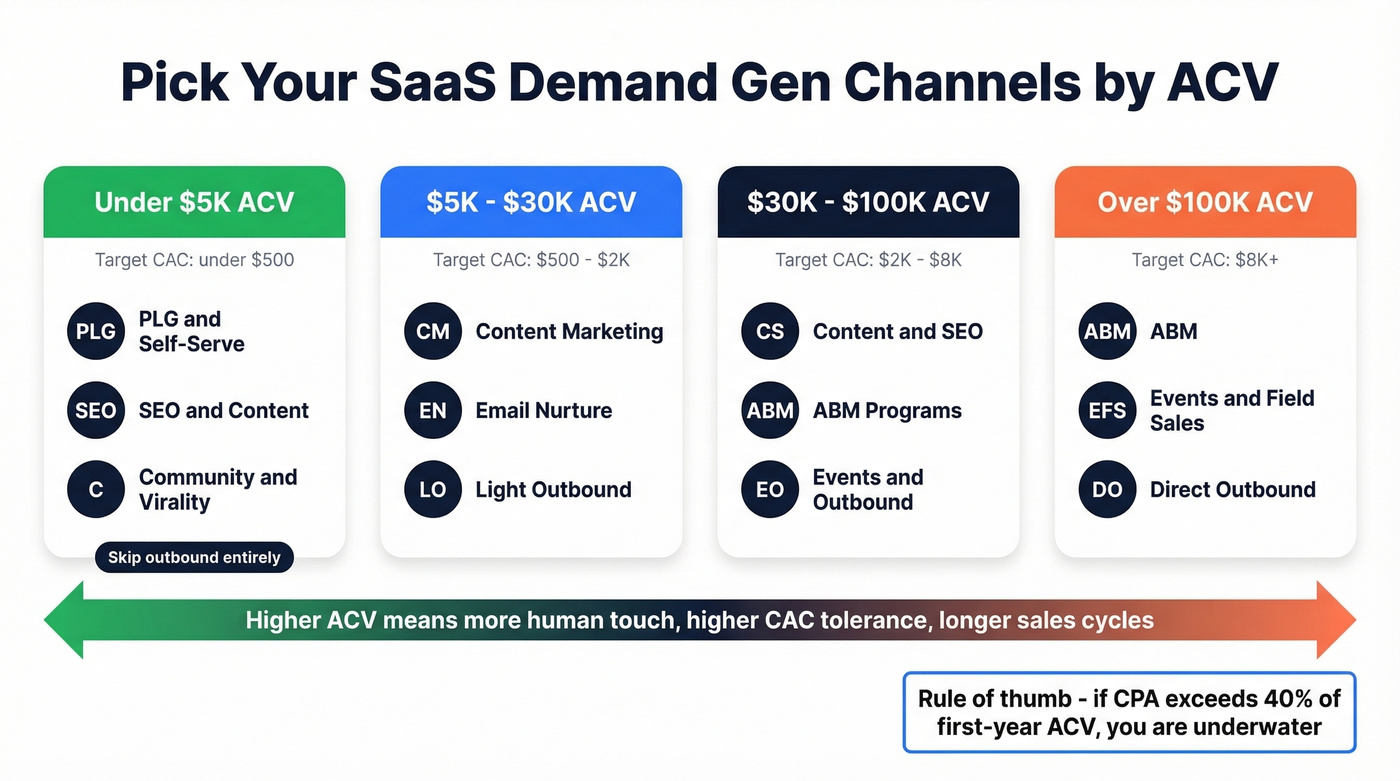
- Your channel mix depends on ACV. Under $5K: PLG, SEO, community. $5K-$30K: content + email + light outbound. $30K+: ABM + events + outbound.
- None of it works if your data is bad. A 15% email bounce rate kills sender reputation and wastes every dollar downstream. Fix data before you fix channels.
What Is SaaS Demand Generation?
SaaS demand generation creates awareness, trust, and urgency for your product before a prospect ever enters a sales cycle. It's the work that makes someone think "I should check out [your product]" before they see a demo request form.
| Demand Gen | Lead Gen | |
|---|---|---|
| Goal | Create desire | Capture info |
| Timing | Before buying intent | At buying intent |
| Metrics | Pipeline, SQL rate | MQL volume, CPL |
| Typical tactics | Podcasts, ungated content | Gated ebooks, webinars |
The distinction changes how you spend money, what you measure, and how you staff your team.
The 87-Company Verdict
[HockeyStack analyzed 87 B2B SaaS companies](https://www.hockeystack.com/lab-blog-posts/the-final-verdict-demand-gen-vs-lead-gen) running sales-led motions over six months - 270,811 MQLs, $103.9M in ad spend, $559M in pipeline, and $72M in closed revenue. Demand gen MQLs came from high-intent forms like demo requests and pricing pages. Lead gen MQLs included everything else.
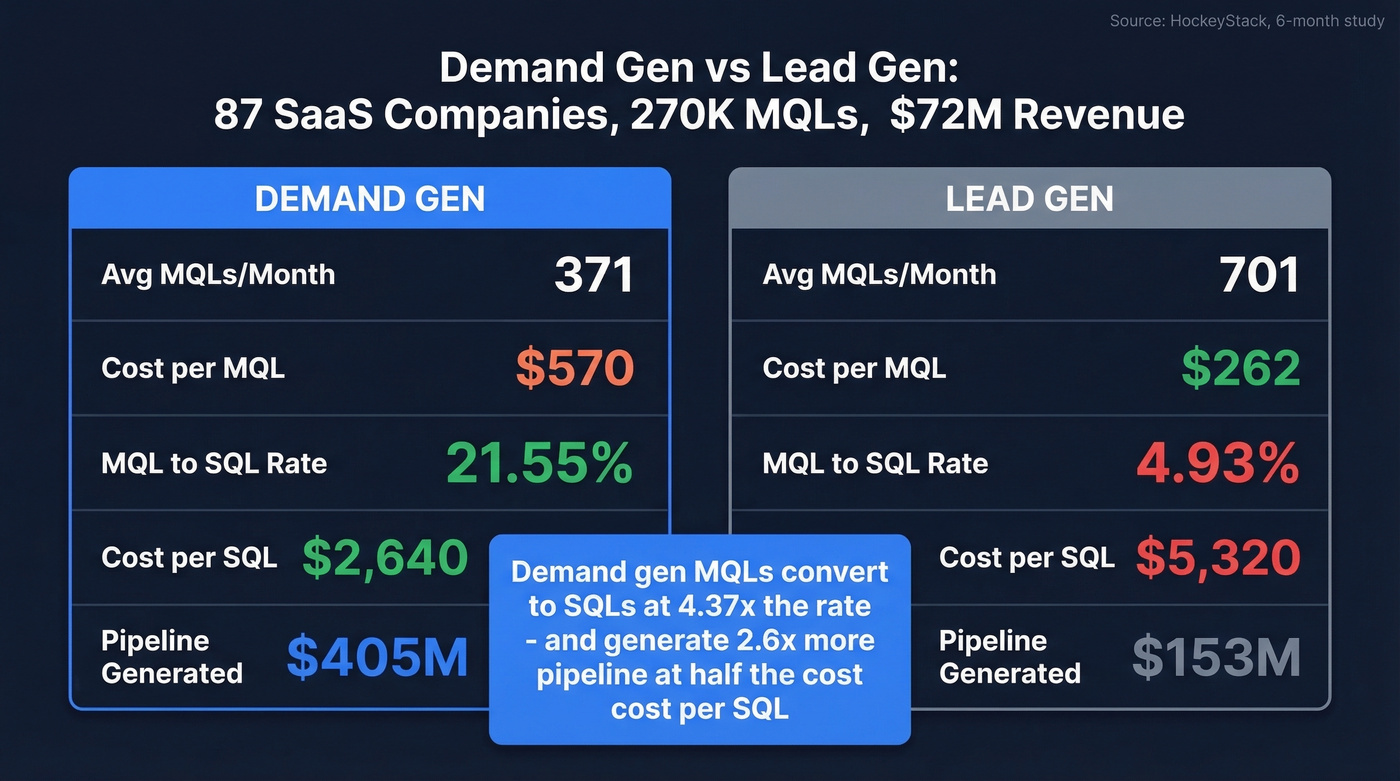
| Metric | Demand Gen | Lead Gen |
|---|---|---|
| Avg MQLs/month | 371 | 701 |
| Cost per MQL | $570 | $262 |
| MQL-to-SQL rate | 21.55% | 4.93% |
| Cost per SQL | $2,640 | $5,320 |
| Pipeline generated | $405M | $153M |
Lead gen produced 1.9x more MQLs at half the cost per lead. On a dashboard, it looks like the winner. Follow the money downstream and demand gen generated 2.6x more pipeline at roughly half the cost per SQL.
The takeaway isn't "kill lead gen." It's "stop judging channels by CPL." Directive's Investment Matrix scores your situation across six variables - intent volume, market maturity, sales cycle length, ACV, pipeline coverage, and need for in-quarter impact. Score 20+ and lean demand gen. Score 12 or below and lean lead gen. Between 13-19, blend both. Most teams scoring honestly land in the blended zone.
Here's the thing: if your ACV is under $10K and your sales cycle is under 60 days, you probably don't need a dedicated demand gen program at all. PLG with good onboarding will outperform any awareness campaign you can build.
Full Funnel with Real Benchmarks
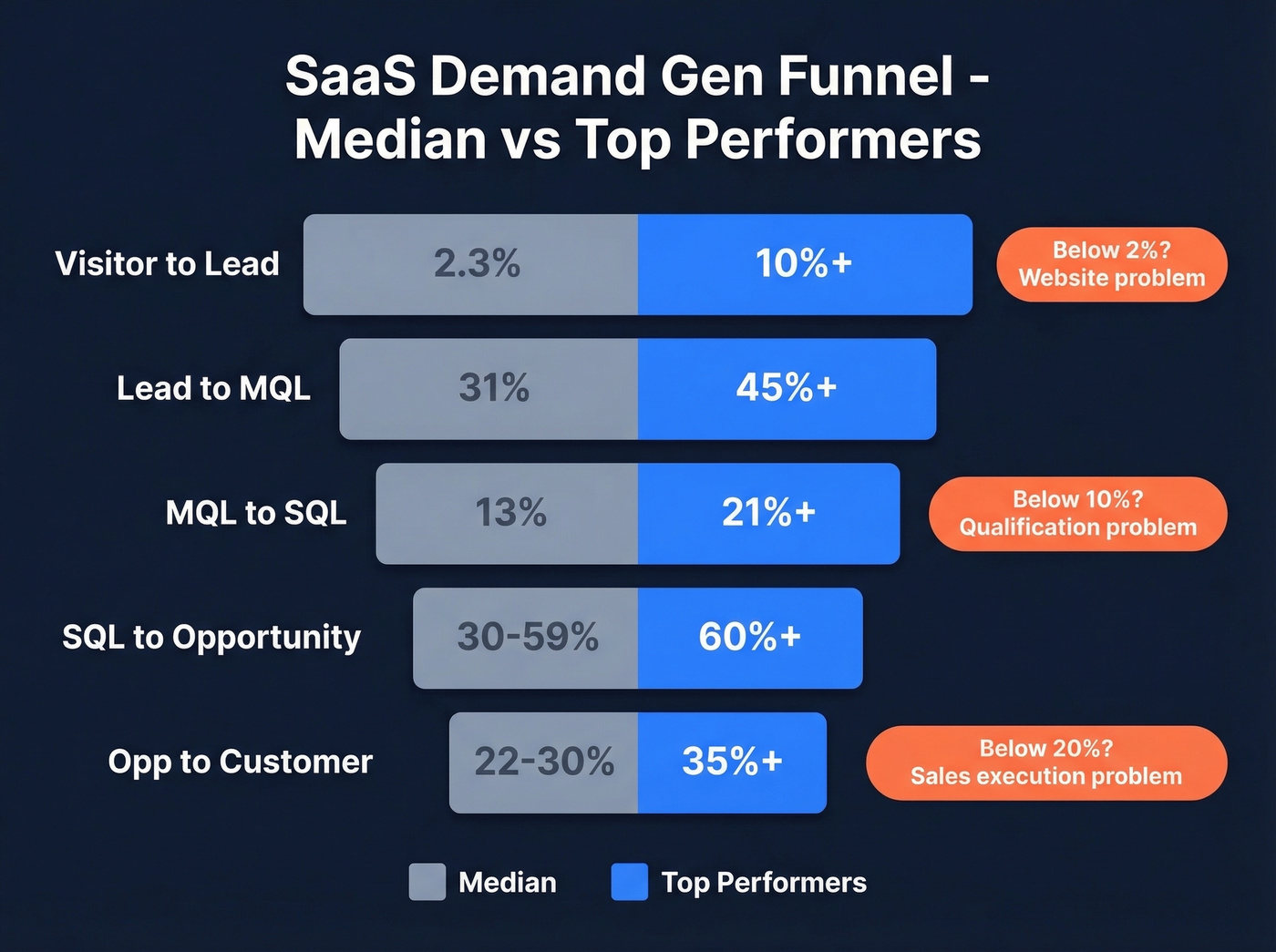
Here's the SaaS conversion waterfall with median and top-performer numbers:
| Stage | Benchmark | Top Performers |
|---|---|---|
| Visitor to Lead | 2.3% | 10%+ |
| Lead to MQL | 31% | 45%+ |
| MQL to SQL | 13% | 21%+ |
| SQL to Opportunity | 30-59% | 60%+ |
| Opp to Customer | 22-30% | 35%+ |
If your visitor-to-lead rate is below 2%, you've got a website problem. MQL-to-SQL below 10%? That's qualification. Opp-to-customer below 20%? Sales execution.
CAC by Vertical
"Average CAC" is meaningless without context. Fintech SaaS and eCommerce SaaS operate in different universes:
| Vertical | SMB CAC | Mid-Market CAC | Enterprise CAC |
|---|---|---|---|
| Fintech SaaS | $1,461 | $4,903 | $14,772 |
| eCommerce SaaS | $299 | $1,407 | $2,206 |
If you're a Fintech SaaS company benchmarking against eCommerce CAC numbers, you'll think your funnel is broken when it's actually performing well for your category. Always benchmark against your vertical.
Channel CAC and Conversion
| Channel | CAC Range | Conversion Rate |
|---|---|---|
| SEO | $480-$942 | 2.1% visitor-to-lead |
| Paid Search | ~$802 CPA | 0.7% visitor-to-lead |
| Referrals | ~$150 | Highest quality |
| Outbound | ~$1,980 | Varies by ACV |
One more data point most teams overlook: credit-card-required trials convert at 49-60%, while no-card trials convert at 18-25%. Shorter trials win too - 7-day trials hit 40.4% conversion versus 30.6% for 61+ day trials. If you're running a 30-day free trial with no card required, you're leaving money on the table.
5 Core Demand Gen Channels
Content & SEO
SEO CAC runs $480-$942 per customer, dropping to ~$290 long-term as content compounds. But this is a 6-12 month bet. If your runway is 12 months and you haven't started, paid channels buy you time while content builds. Watch your visitor-to-lead conversion - below 2.1% means your content is attracting the wrong traffic or your CTAs need work.
We've found that the companies who win at SaaS content aren't publishing more; they're publishing fewer, deeper pieces that actually rank and convert. Ten articles that each generate 50 SQLs per year beat 200 articles that generate noise.
Paid Search & Social
The fastest way to test messaging and ICP fit. Paid search delivers leads within days, not months. But at $802 CPA and 0.7% visitor-to-lead conversion, the math doesn't work for products under $2K ACV unless you've got exceptional LTV. The rule: if CPA exceeds 40% of first-year ACV, you're underwater.
Email Nurture
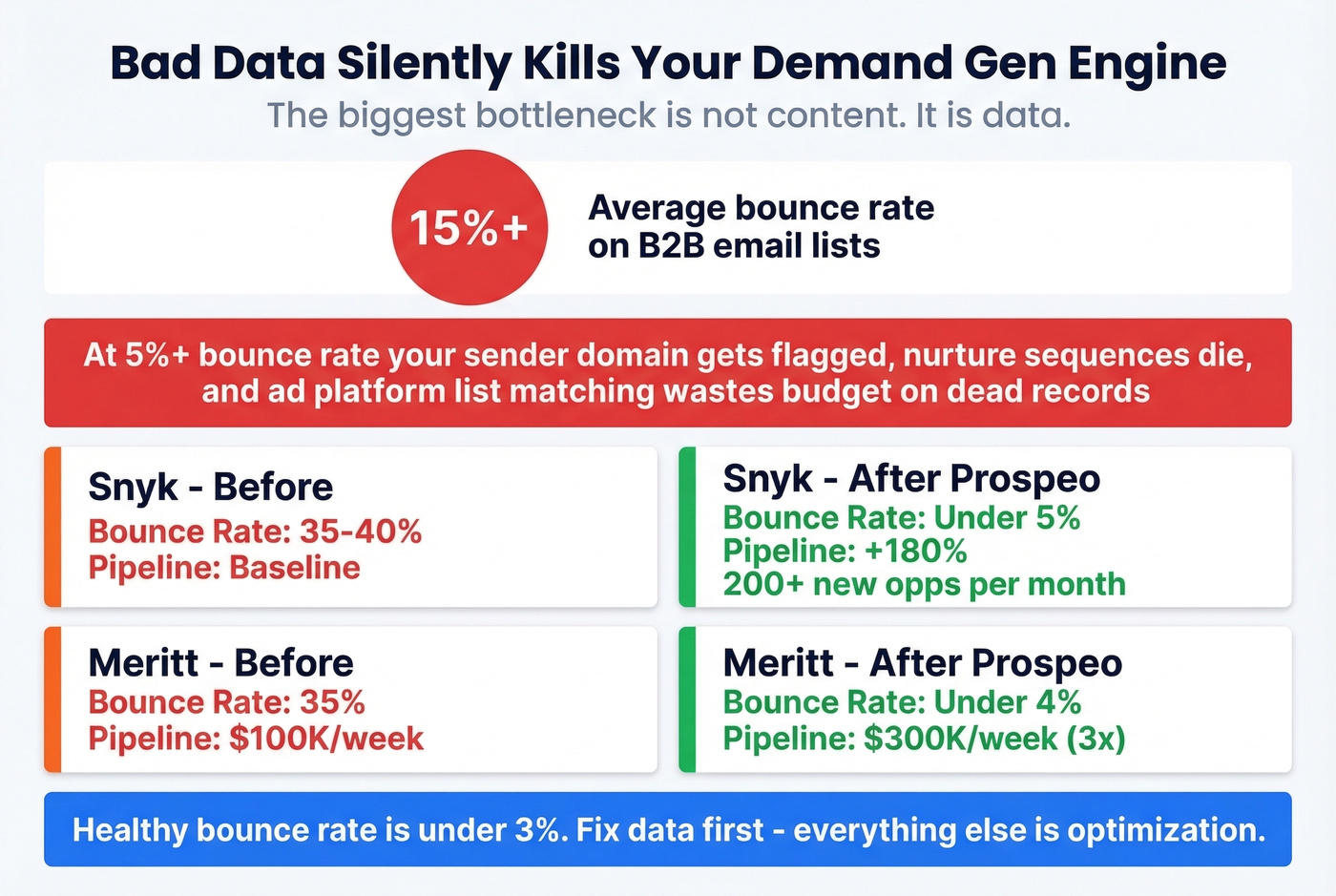
The most common mistake here isn't strategy - it's data quality. 81% of B2B companies use email as an acquisition channel, but teams routinely send to lists with 15%+ bounce rates. That doesn't just waste money; it destroys sender reputation and tanks deliverability for every future campaign. Healthy bounce rate is under 3%. At 5%+ you've got a list hygiene problem that's silently killing your entire demand gen engine, because once your domain reputation drops, even your good emails stop landing in inboxes. (If you need a deeper benchmark breakdown, see bounce rate and email deliverability.)
Community & Social Proof
Referral CAC runs ~$150 - one of the lowest CAC channels. The consensus on r/sales and r/startups is pretty clear on this: practitioners consistently warn that "agencies sell the dream then staff juniors on your account." Invest in G2 reviews and genuine community presence before you invest in another agency retainer.
Outbound & ABM
Reserve this for $30K+ ACV where deal sizes justify the ~$1,980 CAC. The non-negotiable prerequisite is verified contact data - outbound without accurate emails and direct dials is expensive noise. Prospeo's 30+ search filters, including buyer intent signals, technographics, and job change data, let you build targeted lists that actually connect, with 98% email accuracy on a 7-day refresh cycle. (For tooling options, compare outbound lead generation tools and sales prospecting databases.)
The ACV decision tree:
- Under $5K: PLG, SEO, community, virality
- $5K-$30K: Content + email + light outbound
- $30K-$100K: Content + ABM + events + outbound
- Over $100K: ABM, events, direct outbound, field sales
Skip outbound entirely if your ACV is under $5K. The math won't work no matter how good your sequences are.

The HockeyStack study proves it: demand gen MQLs convert at 4.37x the rate of lead gen MQLs. But none of that pipeline materializes if 15% of your emails bounce. Prospeo's 98% email accuracy and 7-day data refresh cycle keep your bounce rate under 3% - protecting your sender reputation and every demand gen dollar you spend.
Stop burning pipeline on bad data. Start with 75 free verified emails.
The Data Quality Problem Nobody Talks About
You've read five demand gen guides that all say "create valuable content." Here's what they skipped: the biggest bottleneck isn't content. It's data.
Alex Kracov's demand gen engine framework positions the CRM database as the foundational layer - bigger database, more powerful engine, with emails as the most valuable identifier for matching and nurture. Every program you run depends on having accurate contact data. When that data is stale, the entire engine breaks. If you're building this operationally, start with lead enrichment and a short list of data enrichment services.
We've seen this play out with our own users. Snyk's 50-person AE team was running bounce rates of 35-40%. After switching to Prospeo, bounces dropped under 5%, AE-sourced pipeline jumped 180%, and they now generate 200+ new opportunities per month. Meritt saw pipeline triple from $100K to $300K per week after their bounce rate went from 35% to under 4%.

You can have the best demand generation strategy in the world, but if 15% of your emails bounce, your sender domain gets flagged, your nurture sequences die, and your ad platform list matching wastes budget on dead records. Fix data first. Everything else is optimization. If you're diagnosing root causes, use a checklist like improve sender reputation and spam trap removal.
Outbound at $30K+ ACV only works with verified contact data. Prospeo gives you 30+ search filters - buyer intent, technographics, job changes, headcount growth - across 300M+ profiles so your ABM lists actually connect reps to real buyers. At $0.01 per email, the math works at any ACV.
Build targeted outbound lists that justify the $1,980 CAC.
Budget Allocation by ARR Stage
B2B companies typically spend 7-9% of revenue on marketing. That percentage means very different dollar amounts depending on where you are.
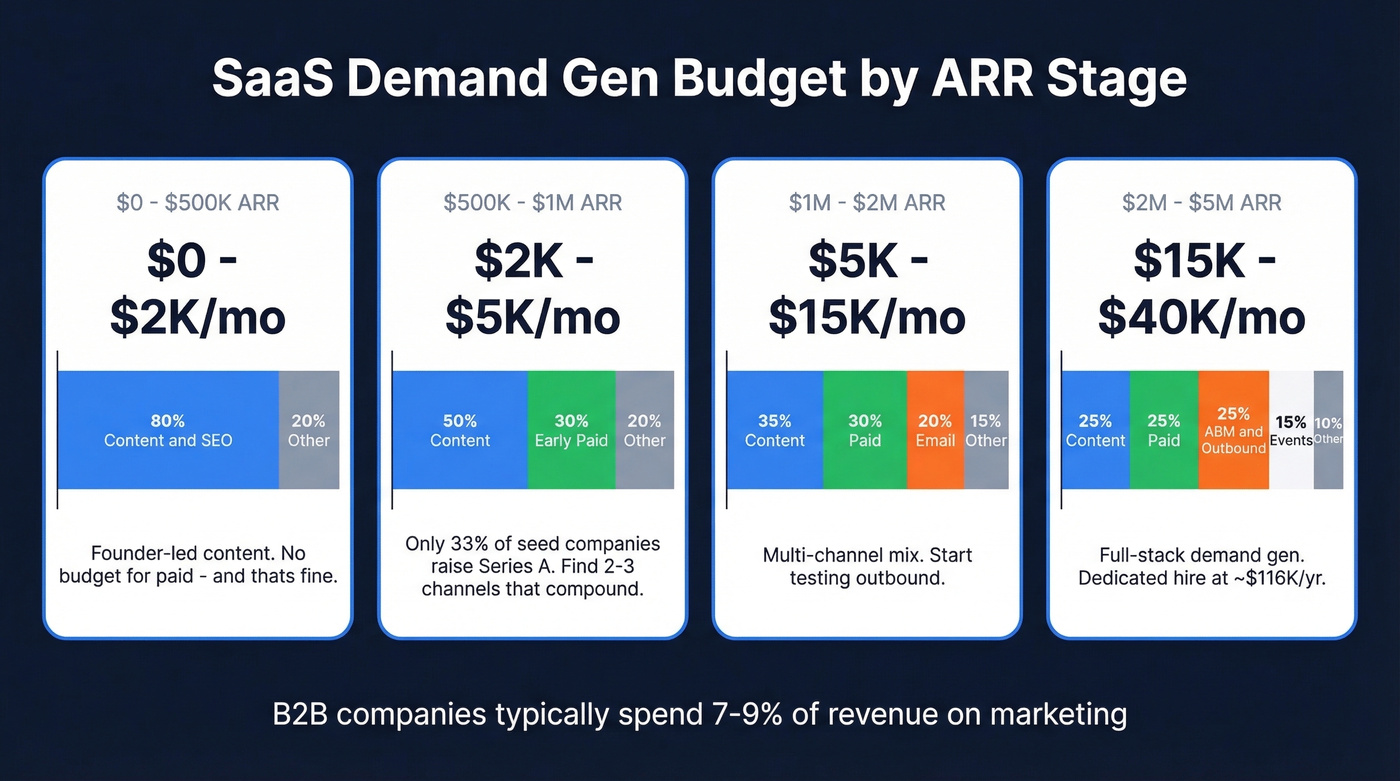
| ARR Range | Monthly Budget | Primary Allocation |
|---|---|---|
| $0-$500K | $0-$2K/mo | 80% content/SEO |
| $500K-$1M | $2K-$5K/mo | Content + early paid |
| $1M-$2M | $5K-$15K/mo | Multi-channel mix |
| $2M-$5M | $15K-$40K/mo | Full-stack demand gen |
At $0-$500K, you're doing founder-led content and SEO. There's no budget for paid, and that's fine - the goal is product-market fit and an organic foundation. A dedicated demand gen hire runs ~$116K/year, so most early-stage teams are better off with a fractional marketer or a focused founder.
The jump from $500K to $1M is where most companies stall. Only 33% of seed-funded companies raise a Series A, and the median Series A now requires $2.5M ARR - up 75% from 2021. The companies that make it find 2-3 channels that compound, not 10 that dilute.
Measurement That Actually Works
73% of B2B marketers can't connect their efforts to closed deals. That's not a tools problem - it's a configuration and patience problem.
First, extend your attribution windows to 90-180 days. The default 30-day window in most analytics platforms is designed for e-commerce, not SaaS. With a 134-day average sales cycle, a 30-day window misses the majority of marketing's contribution. SaaS deals touch 15-20 marketing and product interactions before close, and individual-lead tracking misses the picture entirely.
Second, group stakeholders under account-level attribution. SaaS deals involve 6-10 decision makers. Track accounts, not individuals. If you need a clean framework for this, map it to funnel metrics and pipeline health.
The KPIs that matter:
- Pipeline coverage: 3x minimum for the quarter
- CAC payback: 23 months is the private SaaS average
- NRR: Median 106%, top performers 120%+
- Activation rate: The leading indicator most teams ignore
Let's be honest about the operational discipline this requires. Kill the MQL dashboard. Replace it with pipeline and revenue attribution. Set SLAs - demo leads touched in under 5 minutes, SALs accepted or rejected within 2 business days. Enforce UTM governance, replace free-text CRM fields with picklists, and audit routing accuracy weekly. It's tedious. It's also the difference between a team that knows what's working and one that's guessing.
AI in Demand Gen Measurement
AI-driven lead scoring and personalization are delivering 10-30% productivity lifts for teams that implement them well. The biggest wins aren't in content generation - they're in scoring accuracy, dynamic nurture sequencing, and real-time intent signal processing. If you're still scoring leads with static point models from 2019, that's your lowest-hanging upgrade for 2026. (If you're rebuilding scoring, start with lead scoring.)
Expansion as Demand Gen
Most demand gen playbooks stop at the closed deal. That's a mistake.
The bowtie funnel model treats activation, adoption, and expansion as equal investments to acquisition - and the math supports it. Median NRR across SaaS sits at 106%, with top performers hitting 120%+. Median gross retention is 90%. One team lifted NRR from 102% to 112% in six months by building usage-based upsell triggers and seat expansion campaigns. That's cheaper than acquiring new customers and compounds faster. If you're pressure-testing retention assumptions, run a proper churn analysis.
If you're spending 80% of your demand gen budget on acquisition and 0% on expansion, you're leaving the highest-ROI motion on the table.
Building a Strategy That Compounds
The teams that build effective B2B SaaS demand generation programs don't start with channels - they start with the economics. Map your ACV to the channel decision tree above, audit your data quality, and set attribution windows that match your actual sales cycle. A strategy that ignores any of these three inputs will burn budget regardless of how clever the creative is.
Start with one channel you can own, measure it over 90+ days, and only add a second when the first is producing pipeline - not just MQLs. That discipline separates the SaaS companies that scale efficiently from the ones that spend $2.82 to acquire $1.00 of ARR.
FAQ
What's the difference between demand generation and lead generation?
Demand generation builds awareness and trust before the sales cycle - think ungated content, podcasts, and community presence - while lead generation captures contact info from buyers with existing intent. The 87-company study found demand gen MQLs convert to SQLs at 4.37x the rate of lead gen MQLs. Most teams perform best running both, weighted by ACV and sales cycle length.
How long does it take to show results?
Expect 90-180 days minimum for meaningful attribution data, given the 134-day average B2B SaaS sales cycle. Content and SEO compound over 6-12 months; paid channels show signal in 30-60 days. Judging any program on a 30-day window will kill initiatives that are working but haven't had time to convert downstream.
What tools do I need to get started?
Three essentials: a CRM like HubSpot or Salesforce, a verified data source with 98%+ email accuracy, and a marketing automation platform. Prospeo offers 75 free verified emails per month with no contract - a solid starting point for teams testing outbound or enrichment workflows. Clean data is the foundation every channel runs on.
How should I pick channels for my ACV?
Companies under $5K ACV should lean into PLG, SEO, and community - outbound CAC won't pencil out at that deal size. Between $5K-$30K, blend content, email nurture, and light outbound. Above $30K, ABM, events, and dedicated outbound justify the ~$1,980 CAC. Layer in measurement with 90-180 day attribution windows, and prioritize data quality over channel quantity.