

How to Build a SaaS ICP That Actually Drives Revenue
Two-thirds of "qualified" leads in a typical B2B SaaS pipeline never convert. That's not a lead gen problem - it's a targeting problem. And the fix doesn't start with better sequences or a new SDR hire. It starts with a SaaS ICP specific enough to actually change how your team sells, scores, and routes accounts.
The Quick Version
- Your ICP is a company profile, not a person. ICP = firmographics and technographics. Personas = the humans inside those companies.
- Pre-PMF: start with psychographics and 5 discovery calls. Post-PMF: lead with data from your best customers.
- Score accounts on a 100-point rubric covering firmographics, technographics, and intent. Tier A = 80+.
- Turn your ICP into a prospect list using enrichment tools that match your criteria, then verify the data before you touch it.
What an Ideal Customer Profile Is (and Isn't)
An ICP defines the company most likely to buy, expand, and stick around. It's not a buyer persona - that's the individual. It's not a market segment - that's a broader slice of your TAM. Your ideal customer profile narrows your total addressable market into a serviceable one; personas describe who you're actually talking to inside those companies.
One practical rule: if your ICP doesn't fit on a single slide, it's too complex. Distill it into a single sentence. Can't do it? It's not sharp enough. Industry, headcount range, tech stack, revenue band, geography - that's the skeleton. Everything else is refinement.
Why This Matters More Than You Think
Without a clear ICP, you're running spray-and-pray GTM. A $50M ARR SaaS company typically spends $15-20M a year on sales and marketing, and roughly 80% of that pipeline never closes. That's a staggering amount of wasted CAC.
Teams that nail their ideal customer profile see 30-50% higher marketing conversion rates, 20-35% shorter sales cycles, and 15-25% higher LTV. Those aren't marginal gains. They compound across every stage of the funnel and directly improve NRR.
Here's the thing: if your average deal size is under $10k, you probably don't need ZoomInfo-level data infrastructure. But you absolutely need a sharp ICP, because at low ACVs, every misallocated sales hour kills your unit economics.
What to Include
Your ICP document should cover five dimensions:
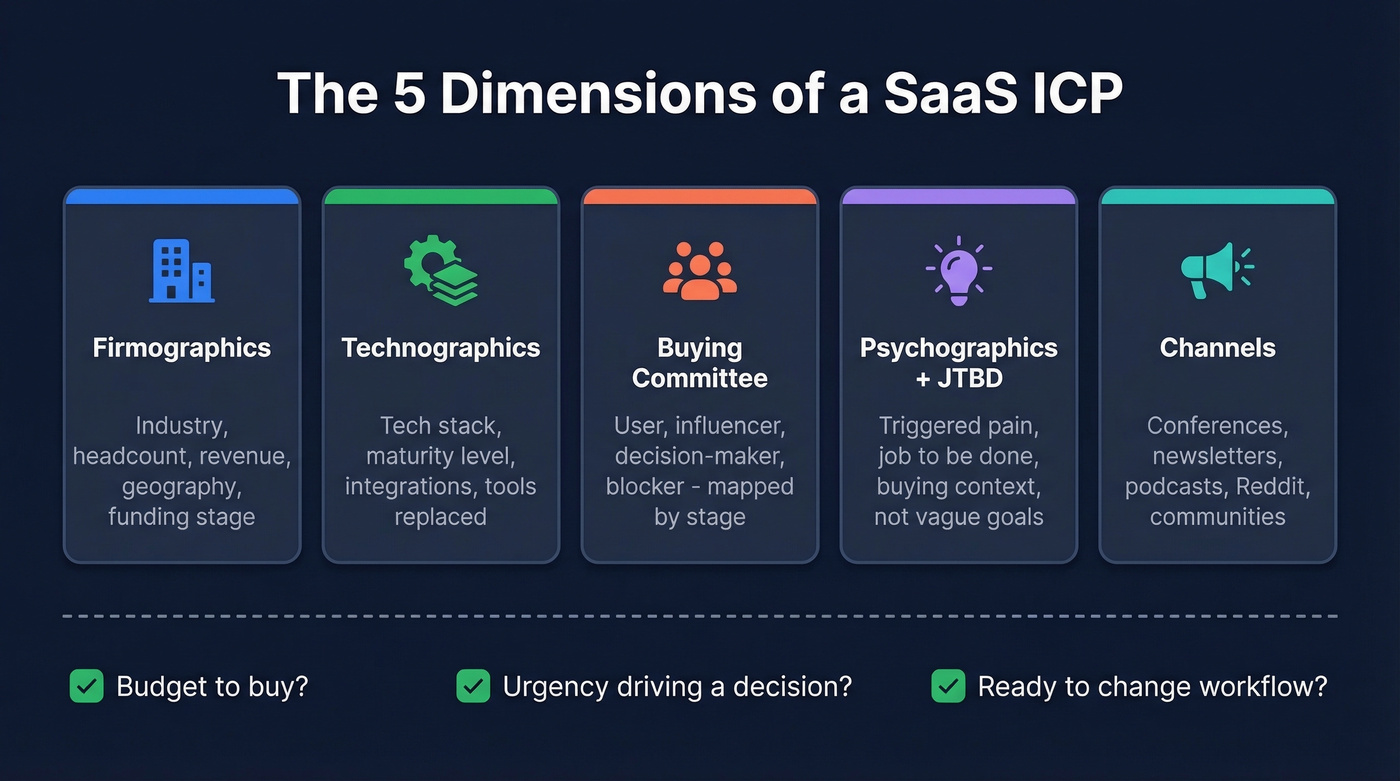
- Firmographics: Industry and sub-industry, employee count, revenue range, geography, funding stage. (If you want to operationalize this, start with firmographic filters.)
- Technographics: Current tech stack, maturity level, dependency on specific tools your product replaces or integrates with. (More detail: firmographic and technographic data.)
- Buying committee: User, influencer, decision-maker, blocker - and which roles enter at which stage.
- Psychographics and JTBD: What job are they hiring your product to do? What pain triggered the search? Skip vague descriptors like "interested in efficiency." Focus on recently triggered buying context - a new VP of Sales, a failed migration, a board mandate to cut costs.
- Channels: Where do these companies hang out? Conferences, newsletters, podcasts, Reddit communities like r/sales or r/SaaS.
Before you finalize, run three checks. Does this company have the budget to buy? Is there urgency driving a decision? Are they ready to change their current workflow? If any answer is no, they're not ICP. They're aspirational.

You've defined your ICP dimensions - firmographics, technographics, intent. Now turn that framework into a live prospect list. Prospeo's 300M+ profiles with 30+ filters let you match on industry, headcount, tech stack, funding stage, and buyer intent across 15,000 topics. Every email is 98% verified. Data refreshes every 7 days, not 6 weeks.
Stop scoring accounts you can't actually reach.
How to Build Yours by Stage
Two tracks, and which one you're on depends entirely on your customer count.
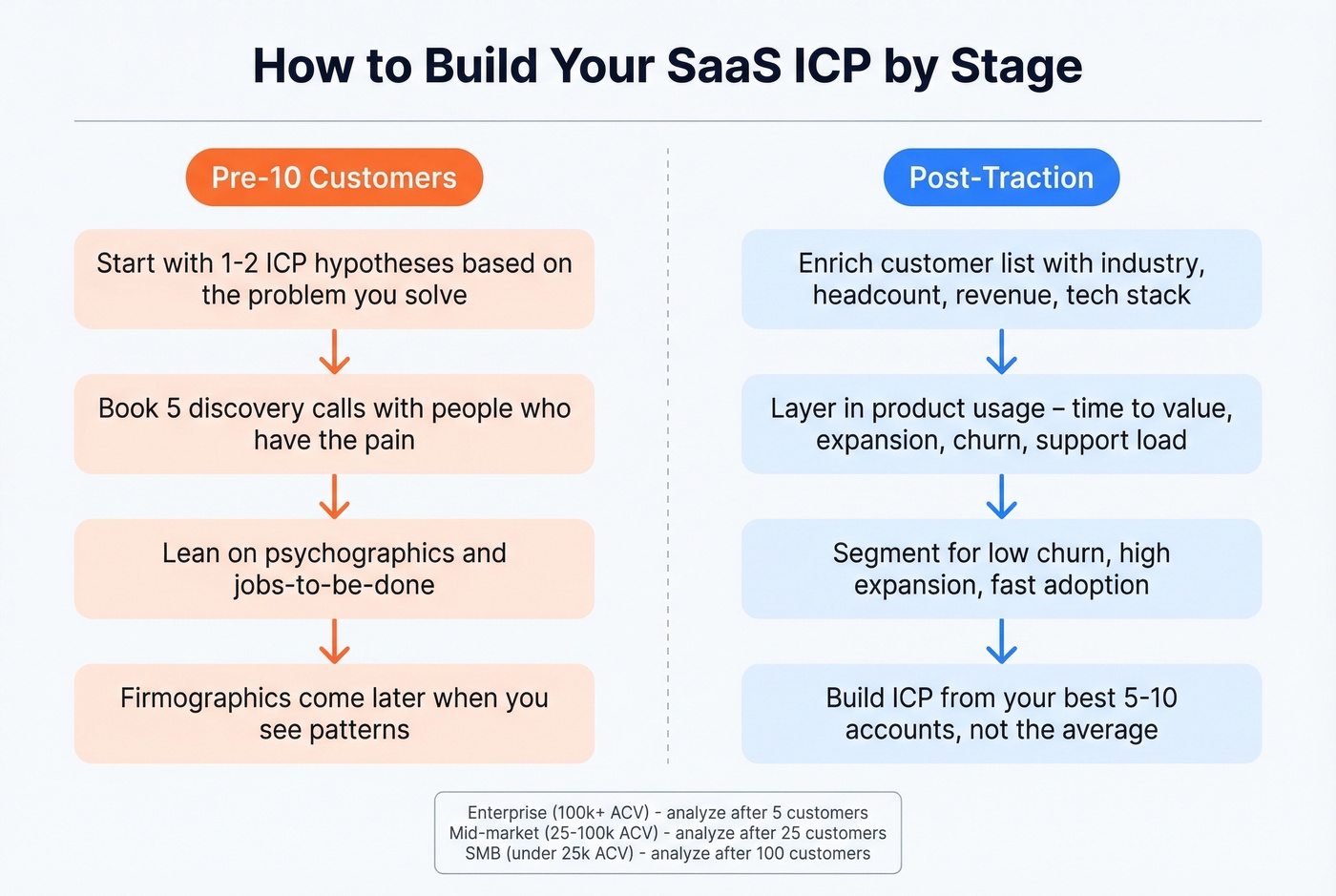
Pre-10 Customers (Minimum Viable ICP)
You don't have data yet, so don't pretend you do. Start with one or two ICP hypotheses based on the problem you solve. Book 5 discovery calls with people who have the pain. Lean on psychographics and jobs-to-be-done - firmographics come later when you have patterns to work with. (If you need a structure for those calls, use a discovery questions framework.)
Post-Traction (Data-Led)
Enrich your customer list with industry, headcount, revenue, tech stack, and location data. Layer in product usage metrics: time-to-value, expansion rate, churn, support load. If you need a repeatable process, follow a lead enrichment workflow.
Then segment for the patterns that matter - low churn, high expansion, fast adoption. We've seen teams transform their close rates by building their ICP from their best 5-10 accounts, not their average customer. The average includes bad-fit deals your team shouldn't have closed in the first place, and those accounts will skew every insight you pull from the data.
When do you have enough data? For enterprise deals at EUR100k+ ACV, analyze after about 5 customers. Mid-market at EUR25-100k, you'll want around 25. SMB? Closer to 100. Going narrow earlier reduces GTM complexity across messaging, playbooks, and support.
How to Score and Tier Accounts
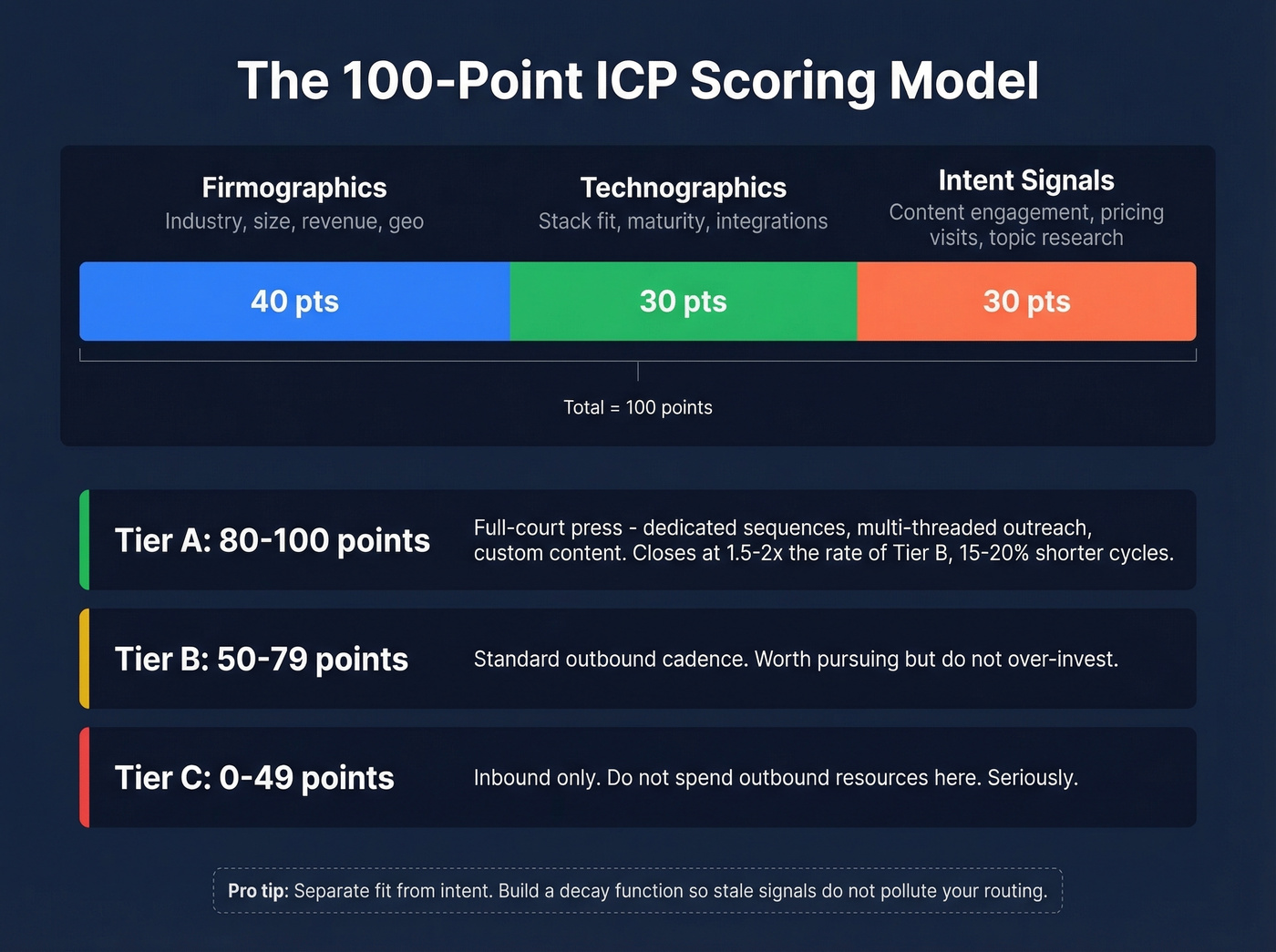
Once your ideal customer profile is defined, rank accounts against it. A 100-point scoring model works because it's intuitive and easy to communicate to sales reps who won't read a 12-page methodology doc. (If you want a plug-and-play version, start from an Ideal Customer Profile Template.)
| Category | Points | What You're Measuring |
|---|---|---|
| Firmographics | 40 | Industry, size, revenue, geo |
| Technographics | 30 | Stack fit, maturity, integrations |
| Intent signals | 30 | Content engagement, pricing page visits, topic research |
Tier A (80-100): Full-court press. Dedicated sequences, multi-threaded outreach, custom content. These accounts close at 1.5-2x the rate of Tier B with 15-20% shorter cycles.
Tier B (50-79): Standard outbound cadence. Worth pursuing but don't over-invest.
Tier C (0-49): Inbound only. Don't spend outbound resources here. Seriously.
One thing we've learned the hard way: separate fit from intent. A company can be a perfect firmographic match but show zero buying signals. And intent decays - a pricing page visit from three months ago isn't the same as one from last week. Build a decay function into your intent scoring so stale signals don't pollute your routing. (Related: lead scoring and identifying buying signals.)
Validate and Refine Over Time
Your first ICP is a hypothesis. Treat it like one.
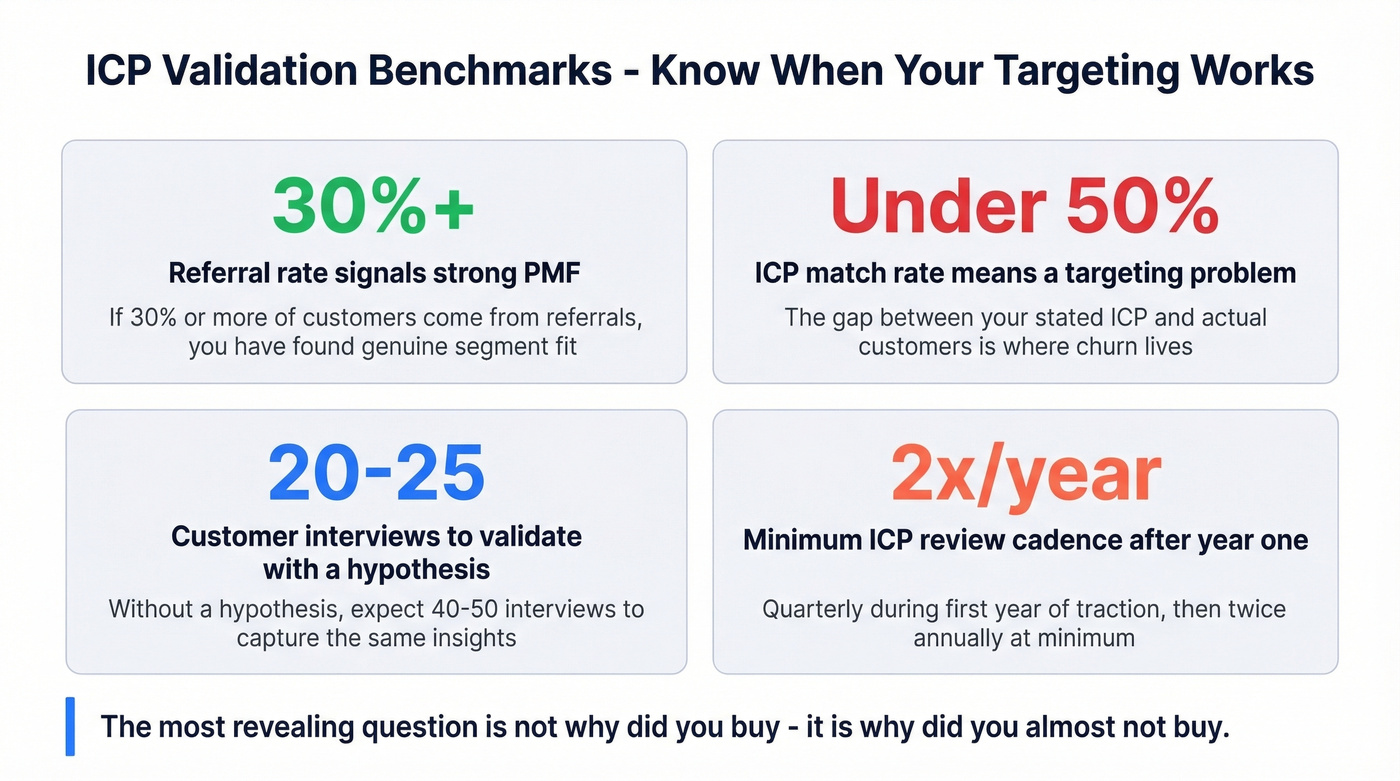
A strong PMF signal: if roughly 30% or more of your customers come from referrals, you've likely found a segment with genuine fit. If less than 50% of your customer base matches your stated ICP, you have a targeting problem. The gap between your ICP and your actual customer profile is where churn lives. (To quantify it, run a simple churn analysis.)
For structured validation, run 20-25 customer interviews. Teams that start with a clear hypothesis capture main ICP elements in about 20 interviews; without one, expect 40-50. In our experience, the most revealing question isn't "why did you buy?" It's "why did you almost not buy?"
Review your ICP quarterly early on, then at least twice a year. This isn't a one-time workshop deliverable. It's a living document.
Common Mistakes
- Targeting surface traits instead of deep pains. "Mid-market SaaS companies" isn't an ICP - it's a census category. About 38% of SaaS startups waste ad spend this way, according to Gartner's digital marketing research.
- Over-engineering the rubric. If sales ignores your scoring model because it has 47 weighted variables, it's useless. Keep it simple enough that an SDR can explain it in 30 seconds.
- Treating ICP as a one-time exercise. Your market shifts. Your product evolves. Your best customers in Q1 might not be your best in Q4. The consensus on r/SaaS is that most founders pivot their ICP 2-3 times before finding real product-market fit, and that tracks with what we've seen.
Tools to Operationalize Your ICP
An ICP document in a Google Doc doesn't generate pipeline. You need to translate those criteria into a searchable prospect list - and bad data costs companies $15M annually on average. If you're comparing vendors, start with data enrichment services and a shortlist of sales prospecting databases.
| Tool | Database Size | Starting Price | Best For |
|---|---|---|---|
| Prospeo | 300M+ profiles | Free (75 emails/mo); ~$0.01/email paid | Verified emails + intent data at scale |
| ZoomInfo | 321M+ contacts | ~$14,995/yr | Enterprise budgets |
| Apollo.io | 210M+ contacts | Free tier; $59/user/mo paid | Free-tier starting point |
| Clay | Waterfall enrichment | Free; $149/mo paid | Multi-source workflows |
| Clearbit (Breeze Intelligence) | Enrichment for HubSpot | $45/mo | HubSpot-centric teams |
Let's be honest - for most teams building their first ICP-driven outbound motion, you don't need a $15k/year contract. Prospeo lets you filter across 300M+ profiles by technographics, buyer intent across 15,000 Bombora topics, headcount growth, funding stage, and 30+ filters total. Emails are verified at 98% accuracy on a 7-day refresh cycle, so you're not burning domain reputation on stale data. Free tier, no contracts.
Skip ZoomInfo unless you're enterprise with budget to spare. Skip Apollo if email accuracy matters to you - we've seen bounce rates north of 20% on Apollo exports, which is a deliverability nightmare.
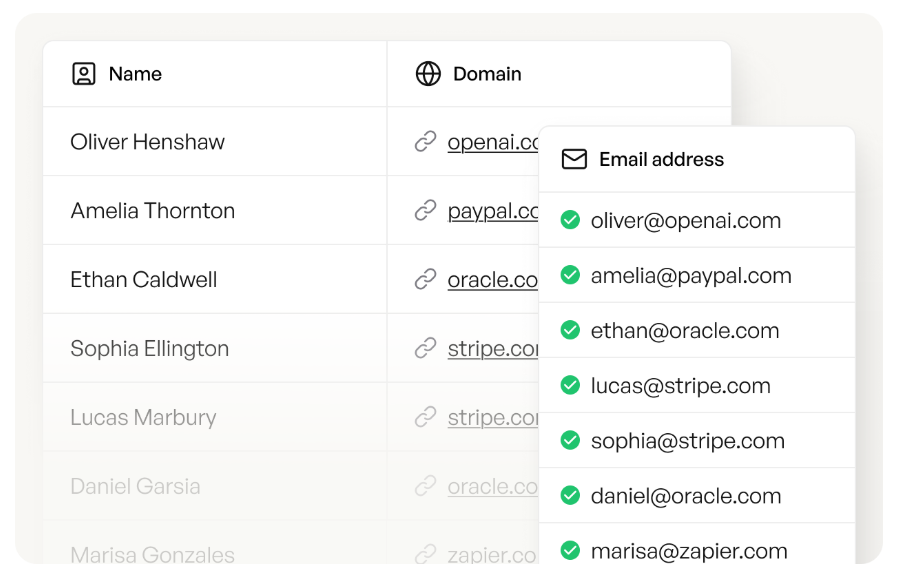
Your post-traction ICP needs enriched customer data - industry, revenue, tech stack, headcount. Prospeo's CRM enrichment returns 50+ data points per contact at a 92% match rate. Upload your best accounts, enrich them in minutes, and find the patterns that separate Tier A from everyone else. At $0.01 per email, the math works at any ACV.
Enrich your customer list and let the ICP patterns reveal themselves.
FAQ
What's the difference between an ICP and a buyer persona?
An ICP defines the company - firmographics, tech stack, revenue, headcount - while a buyer persona describes the individuals inside it. Build your ideal customer profile first to determine which companies are worth pursuing, then layer personas on top to guide messaging and outreach to specific roles.
How often should I update my ICP?
Quarterly during your first year of traction, then at least twice annually. Revisit it whenever you ship a major feature, change pricing, or notice churn clustering in a specific segment.
How do I turn my ICP into a prospect list?
Use a B2B database that supports filtering by your ICP criteria - industry, tech stack, headcount, intent signals - and export verified contacts directly into your CRM. The key is email accuracy: anything below 95% verification will damage your sender reputation over time.
What does ICP mean in SaaS?
In SaaS, ICP refers to a detailed description of the company type that gets the most value from your product and delivers the highest LTV with the lowest churn. It covers firmographics, technographics, and buying context - not individual job titles. Think of it as the blueprint that aligns your entire GTM motion around the right accounts.