

5 SaaS Sales Examples That Show How Teams Actually Sell
Most articles about SaaS sales examples list SaaS products. Slack, Zoom, Salesforce - great companies, zero insight into how their sales teams actually close deals. The SaaS market is projected to hit $307B by 2026, and the motions driving that revenue look wildly different depending on whether you're selling a $3K/year tool or a $300K platform.
Here's the thing: the motion matters more than the product. Five motions below, organized by deal size. Pick the one that matches your ACV, steal the structure, adapt the messaging.
Which Sales Model Fits Your ACV?
Your sales motion should follow your deal size, not the other way around. The LTV:CAC target is 3:1+ - if you're spending $2 in sales and marketing for every $1 of new ARR, your motion is wrong for your price point.
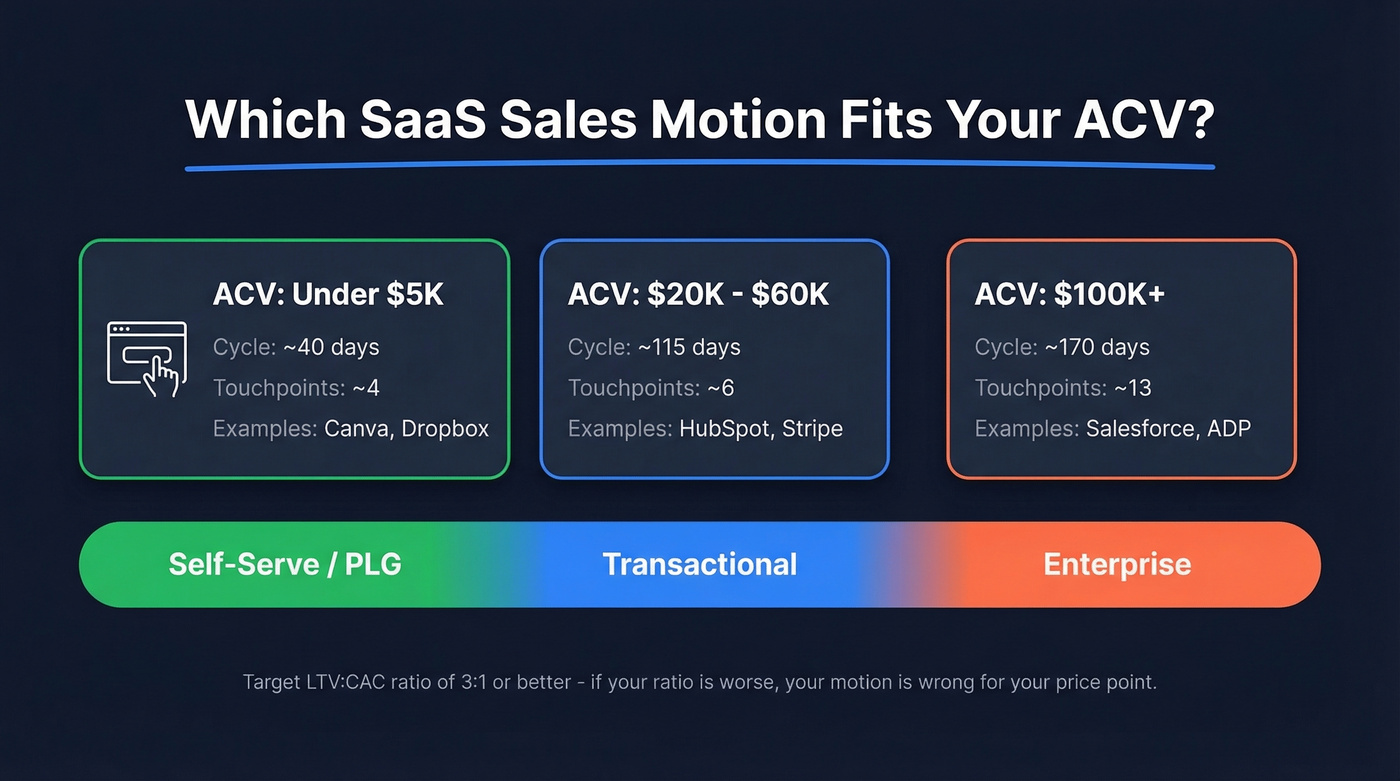
| Model | ACV Range | Avg Cycle | Touchpoints | Real Example |
|---|---|---|---|---|
| Self-serve / PLG | <$5K | ~40 days | ~4 | Canva, Dropbox |
| Transactional | $20K-$60K | ~115 days | ~6 | HubSpot, Stripe |
| Enterprise | >$100K | ~170 days | ~13 | Salesforce, ADP |
5 B2B SaaS Sales Motions With Real Numbers
Self-Serve PLG - How Canva Hit $1B+ ARR
Canva scaled to well over $1B ARR without a traditional sales org. Users signed up free, hit value fast, and upgraded when they needed premium templates or brand kits. Dropbox ran the same playbook with its referral-driven freemium model - different product, identical growth loop.
Freemium-to-paid conversion runs 5-10%, and free trial-to-paid sits higher at 15-25%. Net revenue retention for healthy PLG companies lands between 110-135%.
PLG only works when the product delivers value before a rep ever gets involved. Most SaaS products can't pull that off, and forcing a PLG motion on a product that needs explanation is how startups burn runway while pretending they're Slack.
Cold Email Outbound - The 4-Email Sequence
This is the motion most SMB and mid-market teams run. We've tested dozens of variations, and the framework that consistently performs answers four questions in four sentences: Who are you and why should they care? How do you make their life better? Why should they believe you? What happens next?
If you're building this motion from scratch, start with these sales prospecting techniques and a repeatable B2B cold email sequence.
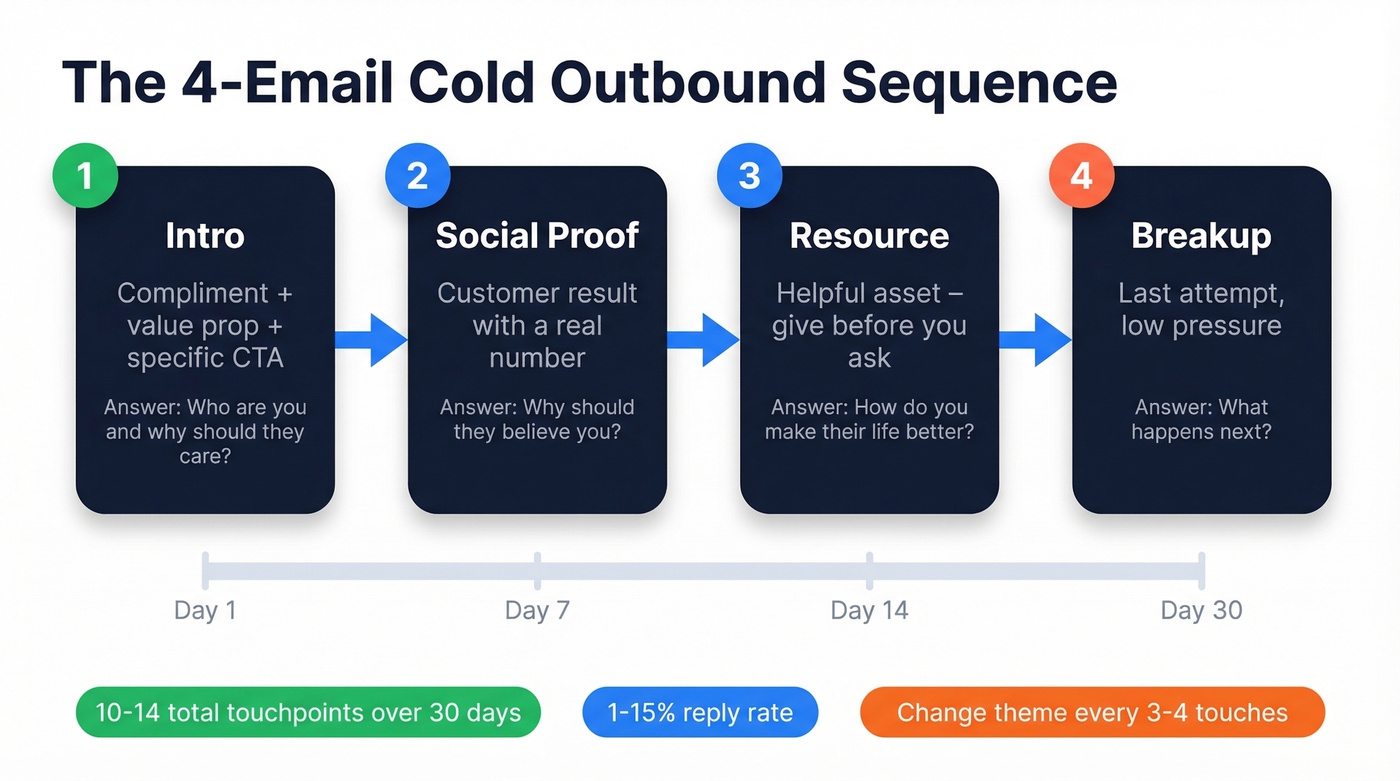
- Email 1 - Intro: Compliment + value prop + specific CTA
- Email 2 - Social proof: Customer result with a number
- Email 3 - Resource: Helpful asset - give before you ask
- Email 4 - Breakup: Last attempt, low-pressure
Layer in calls and video messages to hit 10-14 total touchpoints over 30 days. Change your theme every 3-4 touches. Reply rates land in the 1-15% range depending on list quality, offer strength, and targeting.
None of this works if your emails bounce. Bounce rates above ~5% damage deliverability and domain reputation fast. Snyk's outbound team of 50 AEs dropped bounce rates from 35-40% to under 5% after switching to Prospeo for email verification, and AE-sourced pipeline jumped 180%. (If you're troubleshooting this, start with email bounce rate and the core email deliverability guide.)

The Demo That Doubled Close Rates
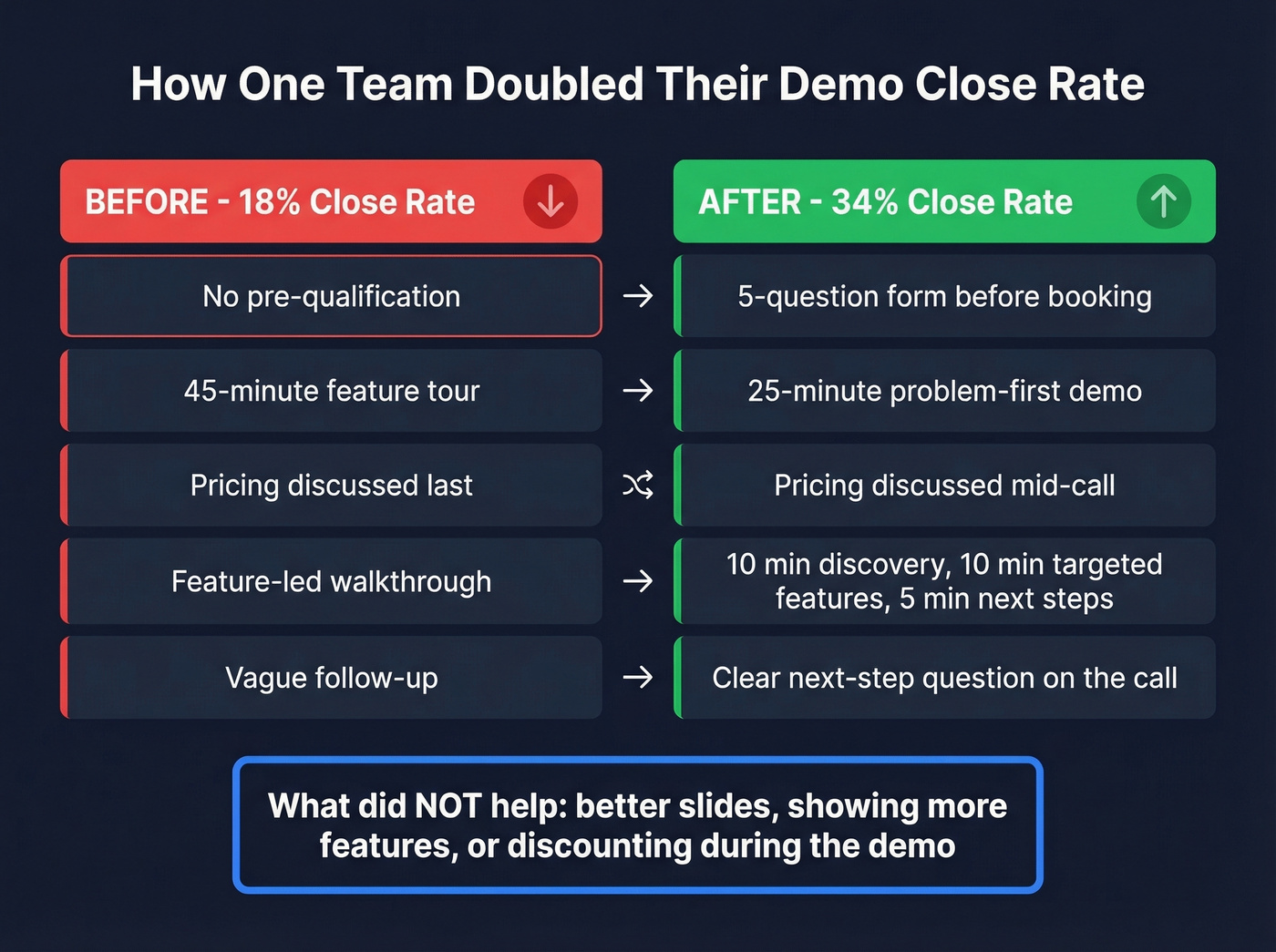
A practitioner on r/SaaS tracked demo-to-close obsessively for six months and shared exactly what moved the needle - from 18% to 34%. Five changes made the difference:
| Before | After |
|---|---|
| No pre-qualification | 5-question form before booking |
| 45-minute feature tour | 25-minute problem-first demo |
| Pricing discussed last | Pricing discussed mid-call |
| Feature-led walkthrough | 10 min discovery, 10 min targeted features, 5 min next steps |
| Vague follow-up | Clear next-step question on the call |
What didn't help? Better slides. Showing more features. Discounting during the demo. The takeaway from that thread was blunt: shorter demos that focus on the prospect's problem beat feature tours every single time. We've seen the same pattern in our own sales conversations - the moment you stop touring and start solving, close rates climb. (For a tighter structure, use a product demo checklist and these software demo tips.)
Product-Led Sales Assist - Free Users Who Need a Nudge
This motion sits between pure PLG and traditional sales. Instead of waiting for free users to convert on their own, SDRs reach out to ICP-fit accounts that haven't activated within seven days - not with a sales pitch, but with white-glove onboarding help.
Skip this if your free tier doesn't generate enough signups to justify a rep's time. PLS only makes economic sense when you have hundreds of monthly signups and clear product-qualified lead signals like feature usage, team invites, or integration attempts.
Harness runs this well with a 14-day free trial, with sales stepping in when usage signals suggest a team plan makes sense. The key insight: PLS playbooks shouldn't rely on a single PQL score. The customer journey is nonlinear, and stage-aware plays outperform one-size-fits-all triggers. For teams that want to try this, start by mapping your top three activation events and building outreach around the accounts that hit two of three but stall. (If you need a starting point, use an ideal customer profile and a simple lead scoring model.)
Enterprise Deals - 7 Stakeholders, 170 Days
Look, enterprise SaaS sales is a different sport entirely. Gartner puts the average buying committee at 7-10 stakeholders. Cycles run ~170 days for $100K+ ACV deals. You're not closing a deal - you're managing a project that involves AEs, Sales Engineers running technical validation, and champions navigating internal procurement.
One playbook from r/coldemail breaks down a relationship motion for $10M+ contracts: build relationships with 20-30 VP-level decision-makers, host a private dinner ($50K-$100K event cost), narrow to 2-3 execs, close one within a month. Conversion rate: ~10%. One closed deal justifies the entire spend.
For contracts in the $100K-$500K range, Mutual Action Plans and MEDDICC qualification keep deals from stalling. A 50-rep SaaS org improved win rates from 18% to 36% and compressed cycles from 60 to 47 days by adding structured qualification and earlier multi-stakeholder engagement. At this ACV, ~13 human touchpoints is the benchmark - and every one of them needs to move the deal forward, not just "check in." (If you're selling upmarket, this enterprise B2B sales guide pairs well with MEDDIC sales qualification.)

Your outbound sequence is only as good as the data behind it. Snyk's 50-AE team dropped bounce rates from 35-40% to under 5% with Prospeo - and AE-sourced pipeline jumped 180%. At $0.01 per verified email, bad data is no longer an excuse for missed quota.
Stop burning sequences on dead emails. Verify before you send.
Key SaaS Sales Benchmarks for 2026
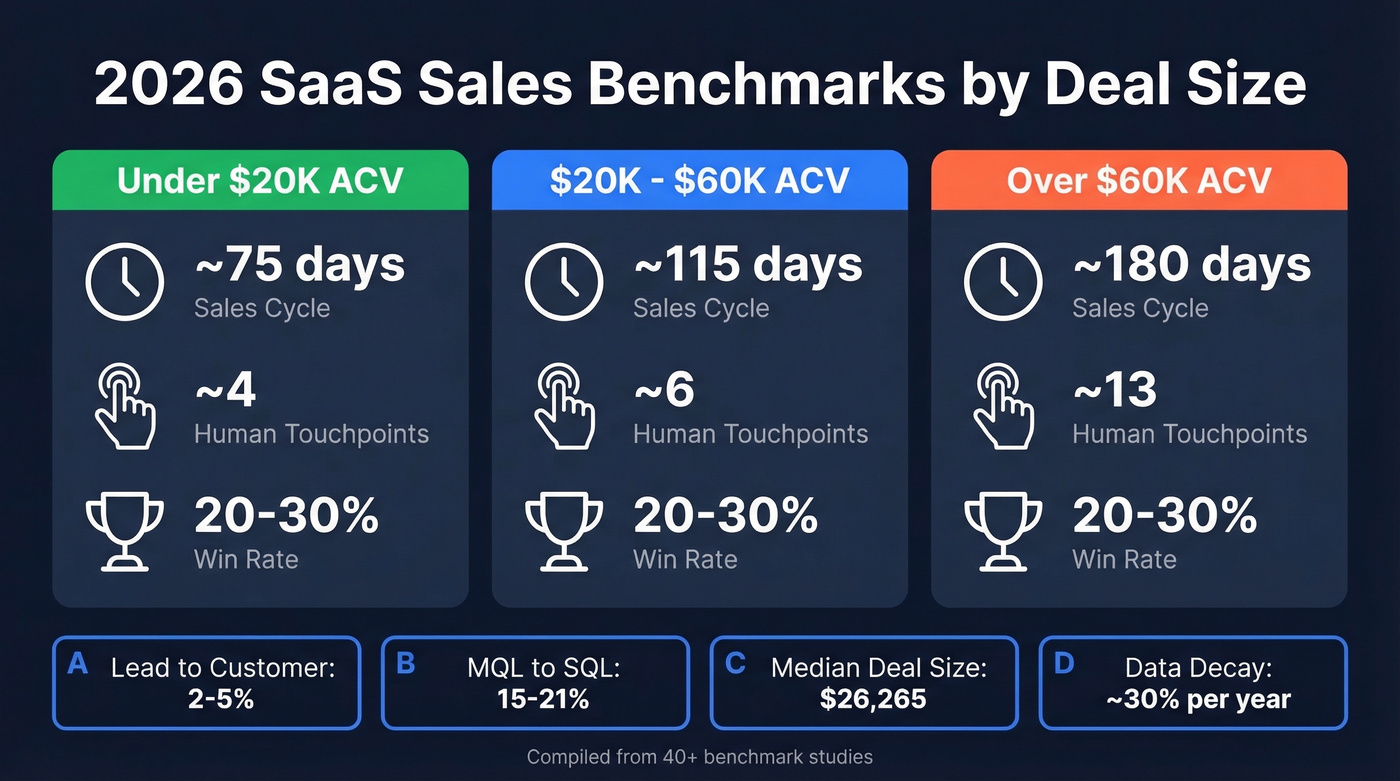
Data compiled from 40+ benchmark studies so you can calibrate your own numbers:
| Metric | <$20K ACV | $20K-$60K | >$60K |
|---|---|---|---|
| Sales cycle | ~75 days | ~115 days | ~180 days |
| Human touchpoints | ~4 | ~6 | ~13 |
| Typical win rate | 20-30% | 20-30% | 20-30% |
Lead-to-customer conversion runs 2-5%. The MQL-to-SQL bottleneck sits at 15-21%. Median deal size for private SaaS: $26,265.
Let's be honest - if your numbers are significantly below these ranges, the problem probably isn't your reps. It's your motion, your targeting, or your data quality. Fix those first. (To pressure-test your funnel, compare against these sales pipeline benchmarks and track funnel metrics.)
Mistakes That Kill SaaS Deals
Four anti-patterns we see repeatedly:
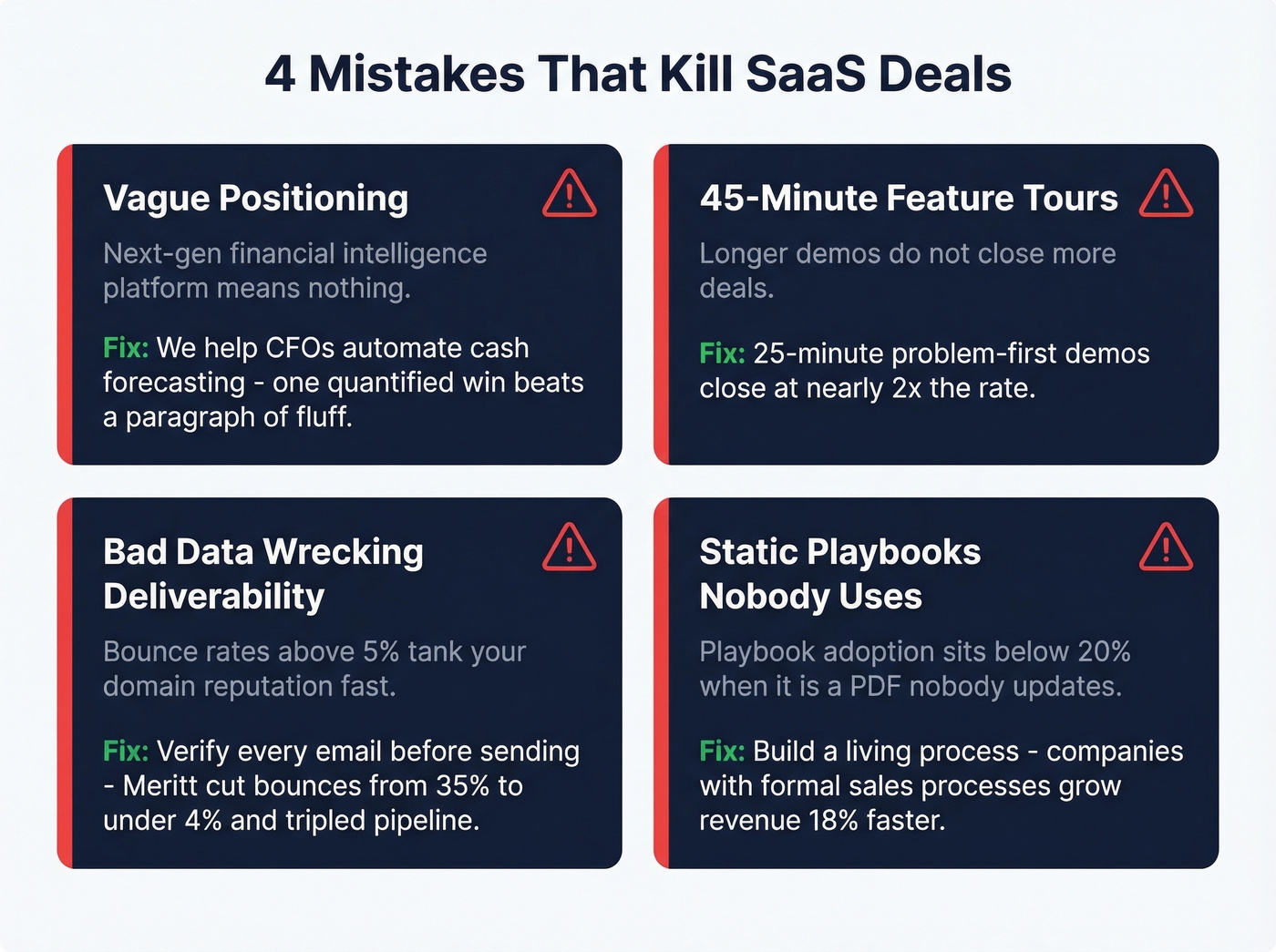
- Vague positioning. "Next-gen financial intelligence platform" means nothing. "We help CFOs automate cash forecasting" gets meetings. One quantified win beats a paragraph of generic claims. (If you need a framework, start with B2B brand positioning.)
- 45-minute feature-tour demos. The data is clear: shorter, problem-first demos close at nearly double the rate. Stop running walkthroughs.
- Bad data destroying domain reputation. Bounce rates above ~5% tank deliverability. Meritt dropped bounce rates from 35% to under 4% with verified contact data and tripled pipeline to $300K/week.
- Static playbooks nobody uses. Playbook adoption sits below 20% when it's a PDF nobody updates. Companies with a formal, living sales process grow revenue 18% faster. (This is where sales process optimization pays off.)
Enterprise deals need 13+ touchpoints across 7-10 stakeholders. That means you need accurate direct dials and verified emails for every buyer on the committee - not just one champion. Prospeo gives you 125M+ verified mobiles with a 30% pickup rate and 30+ filters to map entire buying groups.
Build your full buying committee list in minutes, not weeks.
FAQ
What's a typical SaaS sales cycle length?
Deals under $5K ACV close in about 40 days. Mid-market deals ($20K-$60K) average 115 days, and enterprise contracts above $100K stretch to roughly 170 days. Cycle length scales directly with stakeholder count and procurement complexity.
How many emails should a cold outbound sequence have?
Four to five emails, layered with calls and video messages to reach 10-14 total touchpoints over ~30 days. Change your theme every 3-4 touches. The first email gets the highest open rate, so front-load your strongest value prop there.
Which SaaS sales examples are best to study?
The strongest examples span every deal size: Canva's self-serve PLG motion for low-ACV products, HubSpot's transactional mid-market approach, and Salesforce's multi-stakeholder enterprise playbook. Study the motion that matches your ACV rather than copying a company at a different price point.
How do I keep outbound emails from bouncing?
Keep bounce rates under 5% - anything higher damages your domain reputation and tanks deliverability. Use a verification tool with real-time validation to check every address before sending. Contact data decays roughly 30% per year, so occasional list cleaning isn't enough; you need a system that refreshes continuously.