

What Is a Sales Executive? Role, Pay & Career Path in 2026
You see the job listing: "Sales Executive - OTE $200k, fast-growing SaaS company, unlimited earning potential." Sounds great until you realize the same title appears on a posting for a junior B2C rep making £25k base in Manchester. The sales executive title is one of the most overloaded in business - it can mean a first-year cold caller or a C-suite leader running a $50M P&L. That ambiguity costs people real career decisions.
Here's what we'll cover quickly: what the role actually involves day-to-day, what you'll realistically earn (not what the listing says), the skills and KPIs that separate top performers from everyone else, and how to map a career path from SDR to CRO. Let's get into it.
What the Role Actually Involves
The core job hasn't changed in decades: find prospects, build relationships, close deals. What's changed is the infrastructure around it. A modern sales executive spends as much time in tools and dashboards as they do on calls.
Core Responsibilities
The day-to-day breaks into six buckets:
- Prospecting - identifying and qualifying buyers through outbound, inbound follow-up, and referral networks. (If you want a tighter system, see sales prospecting.)
- Relationship management - nurturing accounts through long sales cycles, especially in B2B.
- Demos and presentations - tailoring pitches to specific buyer pain points, not running a generic slide deck. (Use a simple product demo checklist to stay consistent.)
- Negotiation and closing - handling objections, structuring deals, getting contracts signed.
- Forecasting - keeping your pipeline honest so leadership can plan. (More on pipeline health metrics.)
- CRM hygiene - logging activities, updating stages, preventing data rot. (If you're evaluating tools, start with examples of a CRM.)
A Typical Day
Most productive reps time-block aggressively. Mornings (8-10 AM) go to prospecting - cold calls, email sequences, working new leads before the inbox takes over. Mid-day fills with discovery calls, demos, and internal meetings. Afternoons shift to pipeline review, proposal follow-ups, and deal strategy sessions.
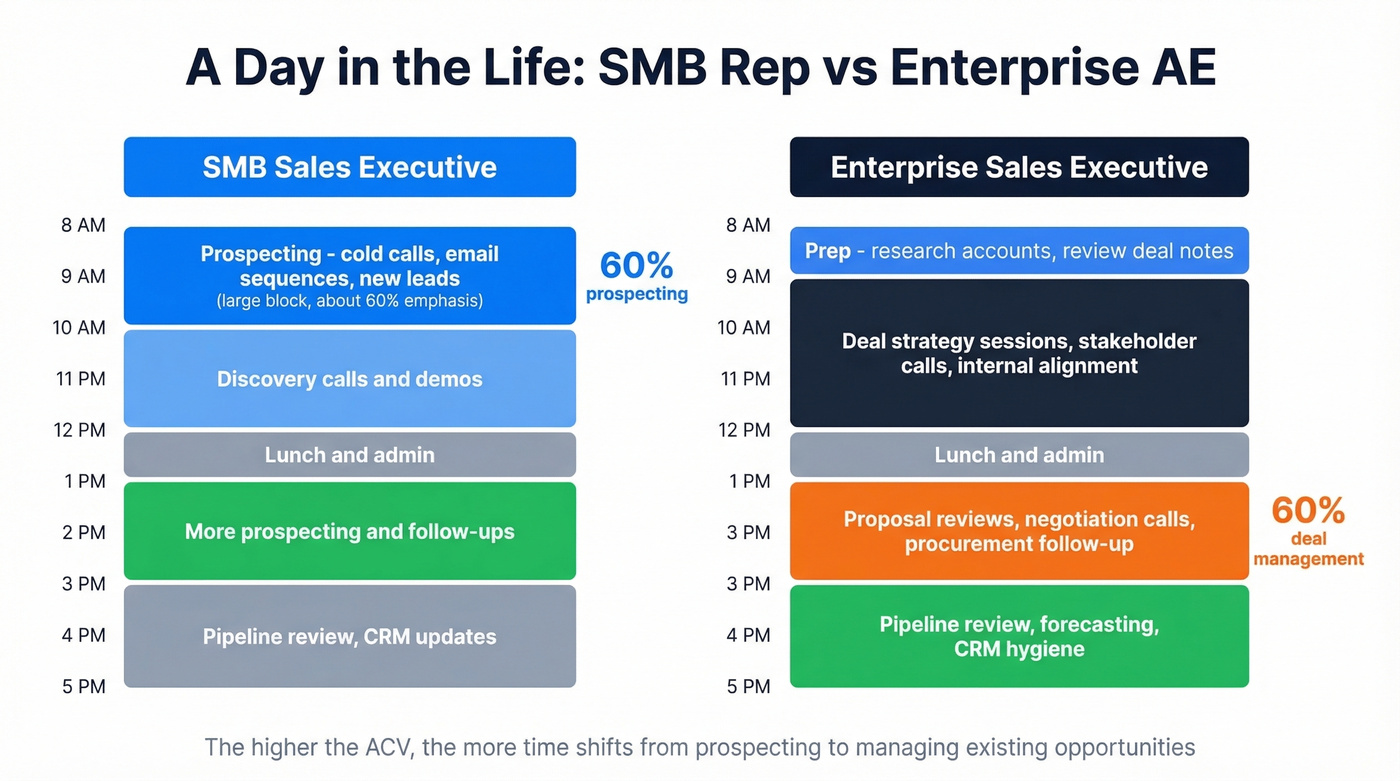
The ratio changes as you move upmarket: an SMB rep might spend 60% of their day prospecting, while an enterprise AE spends 60% managing existing opportunities. We've seen this firsthand across the teams we work with - the higher the ACV, the more time goes to deal management and the less goes to top-of-funnel activity.
B2B vs B2C Differences
In B2C, you're selling higher volume at lower price points - think retail, insurance, or financial products. Cycles are short, decisions are emotional, and you're working with individual consumers. B2B flips that: formal procurement, multiple stakeholders, larger contracts, and cycles stretching months. A B2C rep might close 10 deals a day. A B2B enterprise AE might close 10 deals a quarter. Both carry the same title. (For deeper benchmarks, see B2B sales.)
Titles, Hierarchy & Similar Roles
The title confusion is real. Here's how the most common ones actually map:
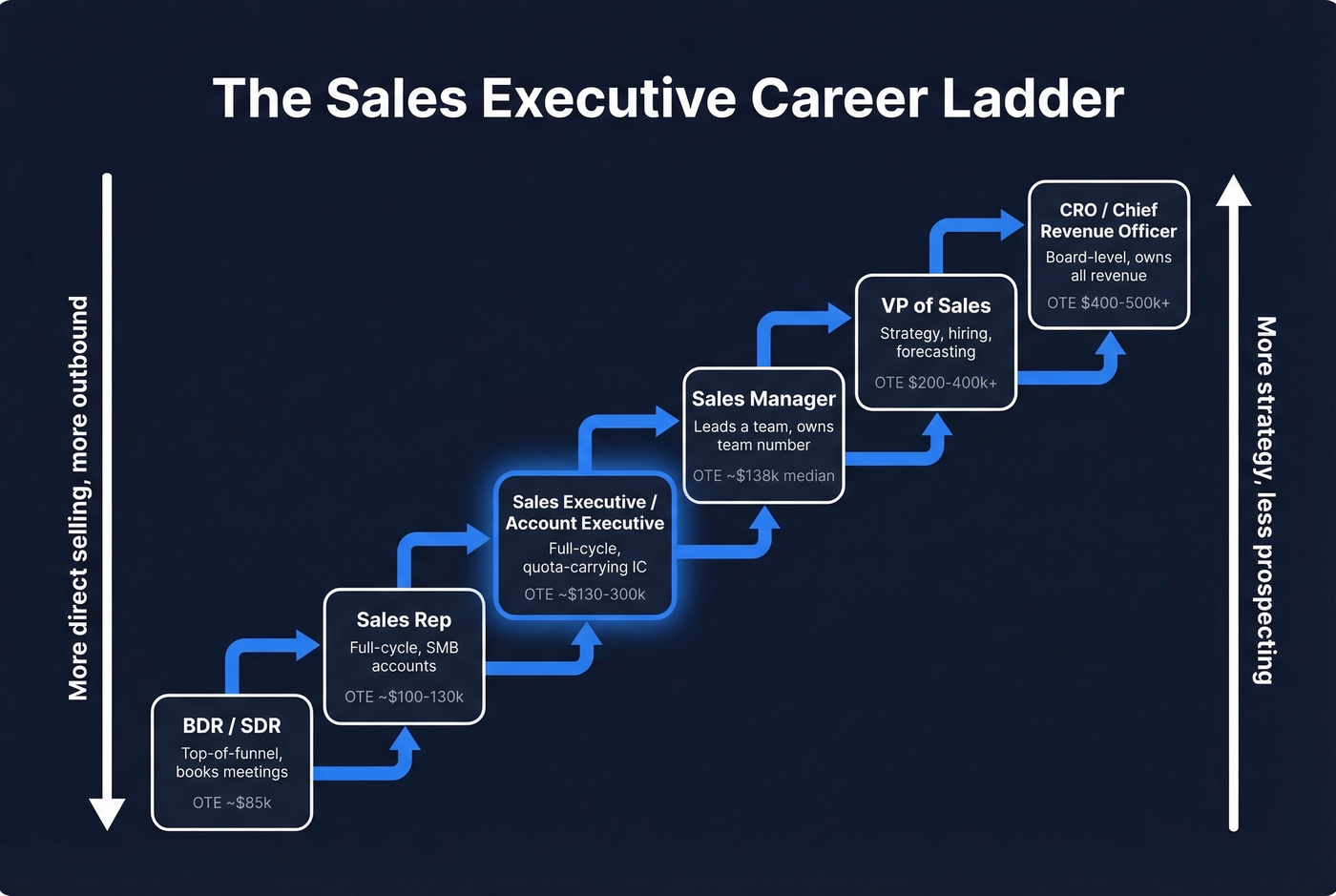
| Title | Scope | Typical OTE | Key Distinction |
|---|---|---|---|
| BDR/SDR | Top-of-funnel | ~$85k | Books meetings, doesn't close |
| Sales Rep | Full-cycle, SMB | ~$100-130k | Owns the deal, smaller accounts |
| Sales Executive | Full-cycle, varies | ~$130-300k | Varies wildly by company |
| Account Executive | Full-cycle, defined | ~$130-265k | Almost always a quota-carrying IC |
| Sales Manager | Team lead | ~$138k median | Manages reps, owns team number |
| VP of Sales / CRO | Executive | $200k-$500k+ | Strategy, forecasting, board |
The biggest distinction happens at the manager-to-executive jump. As one SVP shared on r/sales, the CRO job is "a lot of forecasting" - you stop being the sales org and start being the senior leadership team. You're predicting outcomes and justifying investment to the board. (If you're building the function, this sales leadership guide helps.)
That same SVP offered operating principles worth remembering: "Name everything" - give every initiative, process, and framework a label so the org can rally around it. "Give clear, simple direction you repeat frequently." And critically, "Document everything" - because at the exec level, your memory isn't the system; your documentation is. The SVP also warned against execs who personally cover enablement, rev ops, and deal sponsorship simultaneously. That's unsustainable. Better to use forecasting to show what resources are needed than to burn out carrying the team on your back.
The BLS pegs Sales Manager median pay at $138,060, a useful benchmark for the IC-to-management transition point.
Salary & Compensation in 2026
Base, OTE, and Reality
This table uses RepVue data compiled by TheQuota's 2026 salary guide, aggregating self-reported comp from thousands of reps:
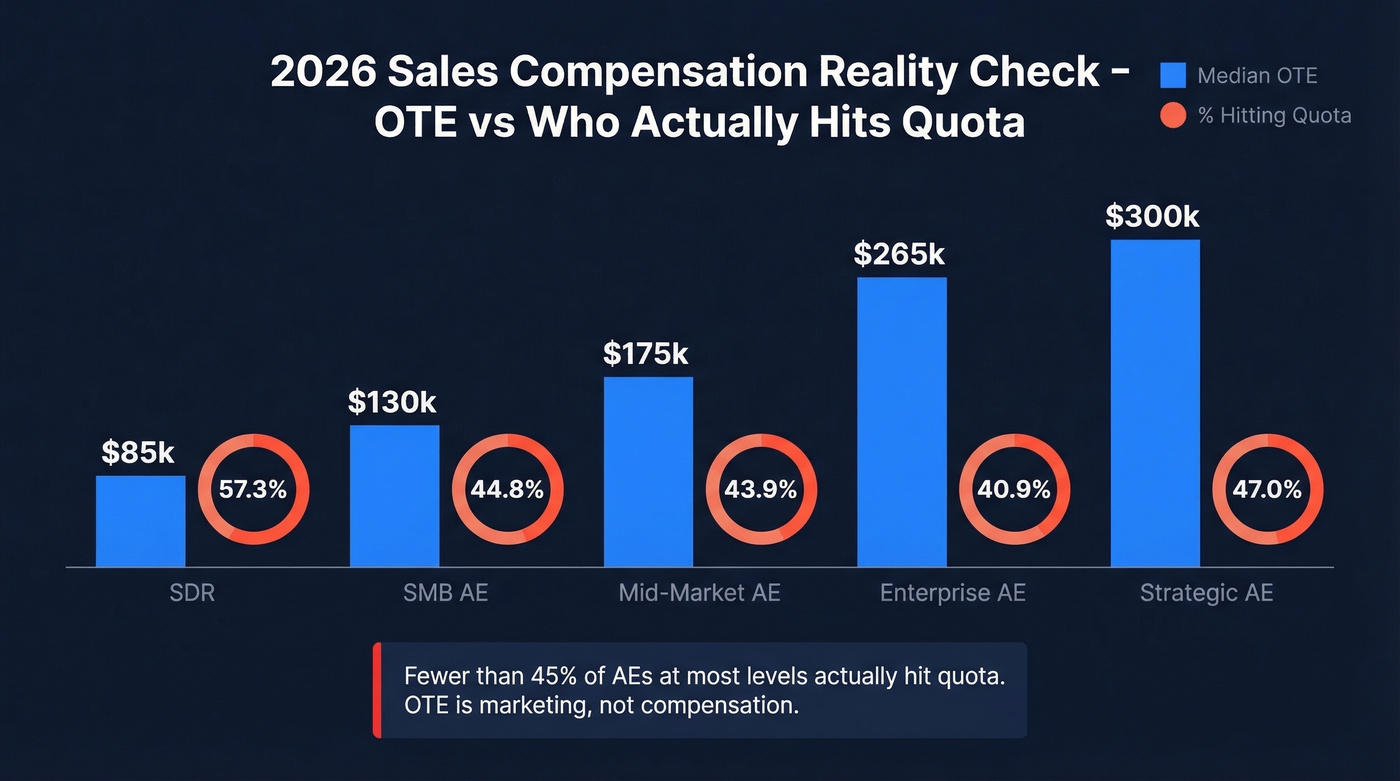
| Segment | Median Base | Median OTE | % Hitting Quota |
|---|---|---|---|
| SDR | $60k | $85k | 57.3% |
| SMB AE | $70k | $130k | 44.8% |
| Mid-Market AE | $90k | $175k | 43.9% |
| Enterprise AE | $135k | $265k | 40.9% |
| Strategic AE | $150k | $300k | 47.0% |
Fewer than 45% of reps at most AE levels actually hit quota. That's the number that should jump off the page. OTE is a theoretical ceiling for most people, not a realistic expectation, and the gap between what companies advertise and what reps take home is one of the biggest sources of frustration in the profession. (If you want the math, see OTE.)
For UK context, base salaries start around £25k-£28k for entry-level roles, climb to £28k-£45k with experience, and can exceed £100k at senior levels with commission.
Commission Structures
The four main structures you'll encounter:
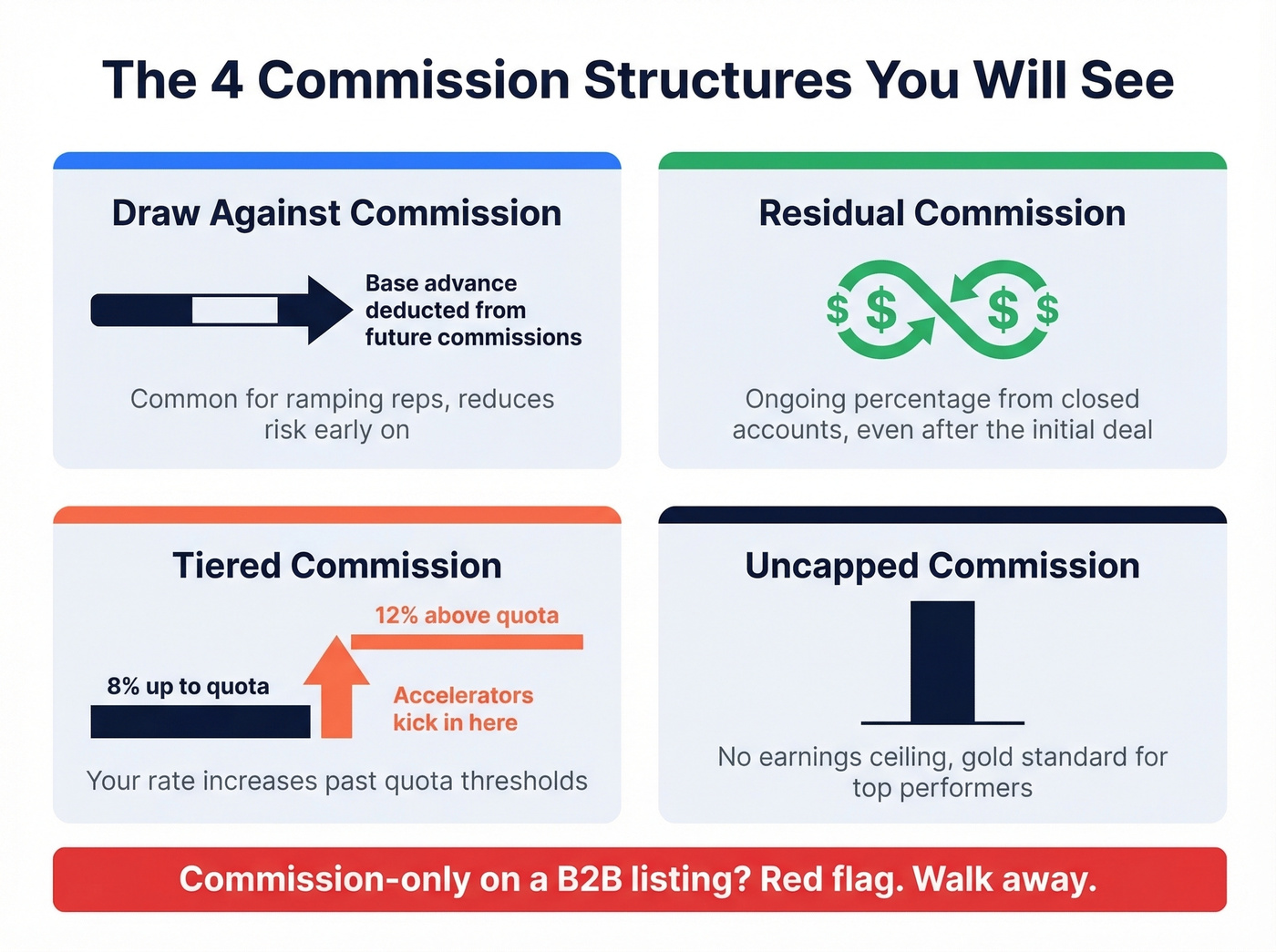
- Draw against commission - a guaranteed base advance deducted from future commissions. Common for ramping reps.
- Residual commission - ongoing percentages from accounts you've closed, even after the initial deal.
- Tiered commission - your rate increases past quota thresholds (8% up to quota, 12% above, for example). This is where accelerators live.
- Uncapped commission - no ceiling on earnings. The gold standard for top performers, though companies sometimes pair it with lower base.
If you see "commission-only" on a B2B job listing, that's a red flag. Walk away.
The Number to Ask in Every Interview
Stop chasing OTE. Chase quota attainment rate. Ask every interviewer: "What percentage of your reps hit quota last year?" If they dodge the question or the number is below 40%, the OTE they're advertising is marketing, not compensation. A company where 60%+ of reps hit quota with a $175k OTE will pay you more than one where 30% hit quota with a $265k OTE.
Here's the thing: if your average deal size is under $10k, you probably don't need an enterprise-grade tech stack or a six-month sales cycle. Match your tools and process to your deal size, not to what the biggest companies are doing.
Skills That Separate Top Performers
The gap between average and top-performing reps isn't charisma. It's process.
Hard skills: CRM proficiency - not just logging calls, but building reports, managing pipeline views, automating follow-ups. Pipeline management and forecasting accuracy. Data analysis - understanding conversion rates, cycle times, where deals stall. Financial acumen for calculating ROI for buyers and understanding procurement. And increasingly, AI literacy - using AI-assisted research, prompt engineering for sales tools, and auto-generated call summaries to prep faster. (If you're operationalizing this, see data-driven selling.)
Soft skills: Negotiation - knowing when to push and when to concede. Communication - adapting your message to technical buyers vs. economic buyers vs. end users. Resilience - handling rejection without losing momentum. Time management - protecting prospecting blocks from meeting creep. (If this is your bottleneck, build a system for resilience in sales.)
65% of B2B sales organizations using data-driven strategies are projected to outperform gut-instinct sellers by 2026, according to Gartner's sales research. The reps who treat their pipeline like a spreadsheet - not a feelings exercise - consistently win.

You spend your mornings prospecting - make every hour count. Prospeo gives sales executives 300M+ verified profiles with 98% email accuracy, so your outbound actually reaches real buyers instead of bouncing.
Stop wasting your 8-10 AM block on bad data.
KPIs That Define Success
Every sales executive lives and dies by a handful of metrics. Here are the ones that matter, with benchmarks:
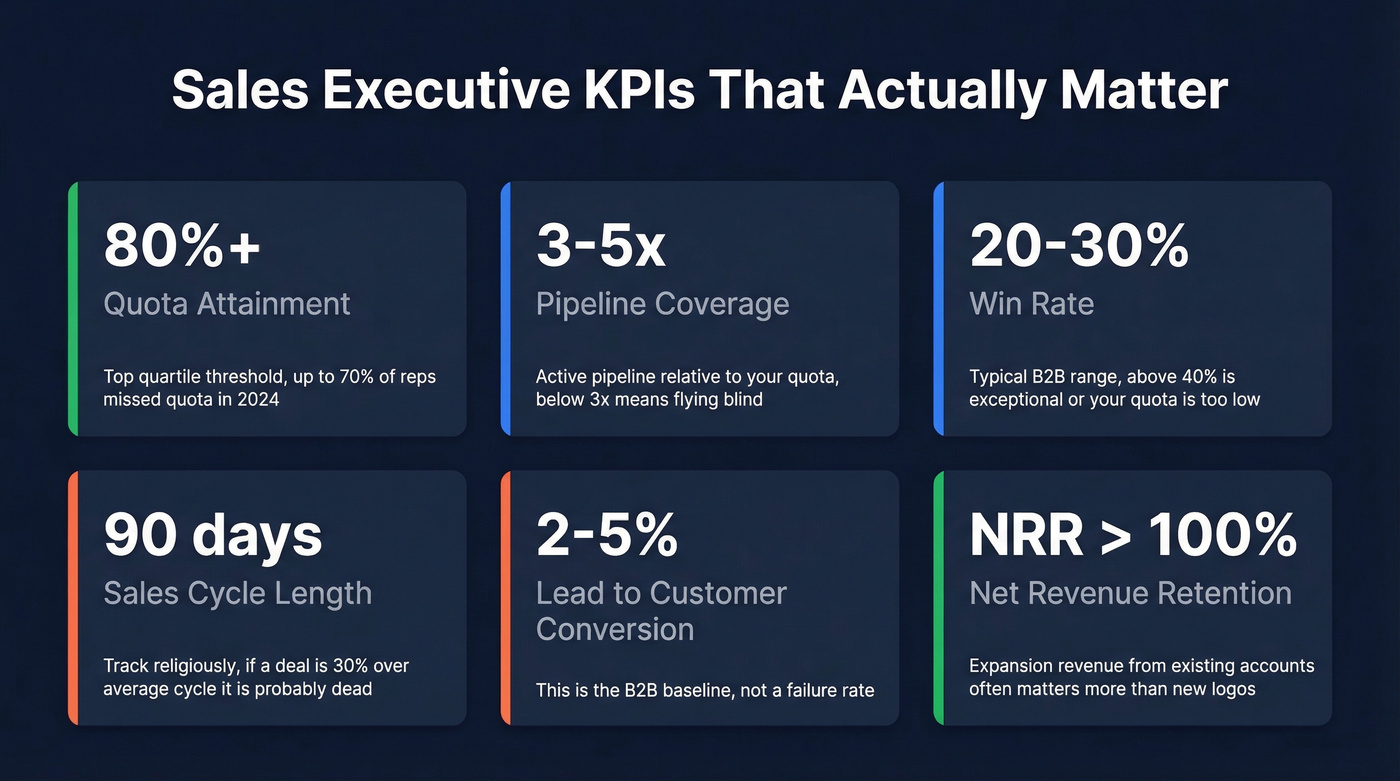
- Quota attainment - the master metric. Up to 70% of B2B reps missed quota in 2024. If you're consistently above 80%, you're top quartile.
- Pipeline coverage - 3-5x your quota in active pipeline. Below 3x and you're flying blind. (Compare against sales pipeline benchmarks.)
- Win rate - 20-30% is typical for B2B. Above 40% means you're either exceptional or your quota is too low.
- Sales cycle length - track this religiously. If your average cycle is 90 days and a deal has been open for 120, it's probably dead.
- Lead-to-customer conversion - only 2-5% of B2B leads convert into paying customers. That's the baseline, not a failure rate.
- MRR/NRR - for SaaS roles, monthly recurring revenue and net revenue retention are the metrics leadership watches most closely. Expansion revenue from existing accounts often matters more than new logos.
- CAC and LTV - understanding your customer acquisition cost relative to lifetime value determines whether your deals are actually profitable.
One thing that kills these KPIs before a rep even gets a chance: bad contact data. If 20% of your emails bounce and half your phone numbers are disconnected, your pipeline velocity craters regardless of skill. In our experience, reps who fix their data quality first see pipeline velocity improve within weeks - it's the highest-leverage change you can make. (Start with data enrichment services.)
The Modern Sales Tech Stack
The average sales team runs 5-10 tools. Here's what matters by category.
CRM
| CRM | Best For | Starting Price |
|---|---|---|
| Salesforce | Enterprise | Varies by edition |
| HubSpot | Growth-stage | Free tier; paid plans scale by seats |
| Pipedrive | SMB | Varies by tier |
Modern CRMs now include AI features like predictive lead scoring and automated data entry. But if your data isn't clean going in, AI just makes bad predictions faster.
Prospecting & Lead Intelligence
This is where pipeline starts. Prospeo covers 300M+ professional profiles and 143M+ verified emails with 98% accuracy, plus 125M+ verified mobile numbers - all refreshed every 7 days versus the roughly six-week industry average. The search interface offers 30+ filters including buyer intent signals, technographics, job changes, headcount growth, and funding data. The free tier gives you 75 emails/month plus 100 Chrome extension credits/month, and paid plans run about $0.01/email with no contracts.

ZoomInfo is the incumbent at $15k-$40k/year depending on seats and modules, with the deepest US database but significantly higher cost and longer contracts. For teams that aren't running 50+ seat deployments, it's overkill. Skip it if you're a small team or early-stage - you'll pay enterprise prices for features you won't use.
Outreach & Engagement
Outreach and Salesloft dominate sequencing at roughly $100-$150/user/mo, handling multi-step email and call cadences with CRM sync. For budget-conscious teams, Smartlead (~$39-$94/mo) and Instantly (~$30-$78/mo) offer solid email sequencing at a fraction of the cost. (If you need copy that converts, use these sales follow-up templates.)
Conversation Intelligence & Forecasting
Gong leads conversation intelligence (roughly $1k-$3k/mo for small teams), recording and analyzing sales calls to surface coaching insights. Clari handles revenue forecasting (roughly $30k-$50k+/year for mid-market), predicting which deals will close based on activity data rather than rep gut feel. (If you're comparing platforms, see sales forecasting solutions.)
The broader trend: AI is being embedded everywhere. But the tools are only as good as the data feeding them.
Top-performing sales executives close more because their pipeline starts with real contact data. Prospeo delivers verified emails at $0.01 each and 125M+ direct dials with a 30% pickup rate - no enterprise contract required.
Hit quota more often when every dial and email connects.
How to Become a Sales Executive
You don't need a specific degree. A business or marketing background helps, but top performers come from education, hospitality, military, and completely unrelated fields. What matters is the progression path.
The typical ladder: SDR/BDR (12-18 months) -> Account Executive (2-4 years) -> Senior AE or Sales Manager -> Director -> VP of Sales / CRO. The critical fork happens after Senior AE - you either go the enterprise IC track (Strategic AE, Principal AE) or the management track. Both pay well north of $200k at senior levels, but they require fundamentally different skills. The IC track rewards deep deal expertise and relationship building across long cycles. The management track rewards coaching, forecasting, and organizational design. (If you're ramping into the role, use a 30-60-90 day plan for sales reps.)
Resume tip: Quantify everything. "Closed $2.1M in new ARR, 118% of quota" beats "responsible for closing deals" every time. Hiring managers scan for numbers first.
In the UK, apprenticeship routes are increasingly viable - the Level 4 Sales Executive Higher Apprenticeship and Level 6 B2B Sales Professional Degree Apprenticeship offer structured entry without university debt. Certifications like Salesforce Admin and HubSpot Sales Software also signal competence, especially for career switchers.
Is This Role Right for You?
Ask yourself three questions. Do you get energy from conversations with strangers, or does cold outreach drain you? Can you handle hearing "no" 20 times a day without it affecting call 21? Are you motivated by variable compensation, or does income uncertainty keep you up at night?
If you answered yes, no, and yes - sales will eat you alive. The best reps genuinely enjoy the hunt and have an unusually short memory for rejection.
Job Outlook & Getting Hired
The BLS projects overall sales employment to decline through 2034. But that headline masks the reality: roughly 1.8 million sales openings will exist each year from replacement churn alone. Sales management specifically is growing at 5%, with about 49,000 openings projected annually.
AI isn't eliminating sales roles; it's restructuring them. Transactional, order-taking positions are disappearing. Consultative, complex-sale roles are growing. If you're selling a product that requires a human to explain, negotiate, and build trust, your job is safe. If you're essentially a checkout page with a phone, start upskilling now.
Five Interview Questions That Separate Candidates
Based on Zendesk's interview research, these reveal the most about a candidate:
- "Walk us through your resume." Green flag: a coherent narrative. Red flag: blaming every departure on bad management.
- "Describe the last product you sold." Green flag: explaining the buyer's problem first. Red flag: leading with features.
- "What do you do when lead volume is low?" Green flag: specific outbound strategies. Red flag: "I wait for marketing.
- "How do you prioritize your time?" Green flag: a structured system. Red flag: "I handle whatever comes up."
- "Describe your sales process." Green flag: a repeatable framework. Red flag: "Every deal is different" with no methodology.
And the question you should ask them: "What's your team's quota attainment rate?" It tells you more about earning potential than any OTE number on the listing.
FAQ
What's the difference between a sales executive and an account executive?
"Sales executive" can mean anything from junior B2C rep to C-suite leader. "Account executive" almost always means a quota-carrying IC managing a defined sales cycle. Ignore the title - focus on comp plan, quota, and deal size to understand the actual role.
How much does a sales executive make in 2026?
Base salaries range from $70k (SMB AE) to $150k (strategic enterprise AE). OTE runs $130k-$300k, but fewer than 45% of AEs hit quota at most levels, making base the more reliable number to evaluate.
What tools do sales executives use daily?
A CRM (Salesforce or HubSpot), a prospecting platform for verified contact data, an outreach tool (Outreach or Salesloft), and conversation intelligence software (Gong). Budget-friendly alternatives exist at every layer.
Is this a good career path in 2026?
Yes, with caveats. Overall sales employment is declining, but 1.8 million openings per year persist from turnover. Sales management is growing at 5%. The career rewards data-driven sellers who build repeatable process.
What's the hardest part of the job?
Quota pressure. Up to 70% of B2B reps missed quota in 2024. The best defense is choosing companies with high team-wide attainment rates and investing in data quality upstream - bad contact data tanks pipeline before skill even enters the equation.