

Sales Follow-Up Email Examples That Actually Get Replies
A rep on r/coldemail laid it out: 100 emails sent, a clean 3-step sequence, 25% open rate, zero replies. Not one. He'd built a second campaign - 300+ prospects, same structure - and was staring at the same flatline. The templates weren't broken. The timing wasn't off. The entire approach was wrong.
Here's what the best sales follow-up email examples have in common: they're built on data, not instinct. An analysis of 16.5M cold emails shows the highest reply rate - 8.4% - comes from sending just one email. Every follow-up after that yields diminishing returns, and by the 4th follow-up (the 5th email), spam-mark risk more than triples. The problem isn't that you're not following up enough. It's that you're following up badly.
What You Need (Quick Version)
Three things separate follow-ups that get replies from follow-ups that get ignored:
- Verified contact data. If your emails bounce, your domain reputation tanks and even your good emails land in spam. Fix the data first. (If you want benchmarks and fixes, see our bounce rate guide.)
- Scenario-specific templates. A post-demo follow-up and a cold no-response follow-up are completely different emails. Stop using the same template for both. (More frameworks here: sales follow-up templates.)
- A multi-channel sequence. Email alone isn't enough. The best sequences blend email, calls, and social touches across 8-12 days.
You don't need more templates. You need the right template at the right time - and the data quality to make sure it actually arrives.
How Many Follow-Ups Should You Send?
Let's kill the most-cited stat in sales: "80% of sales require five follow-ups." That number has been circulating for over a decade, and nobody can trace it to a real study. It's become an excuse to spam prospects.
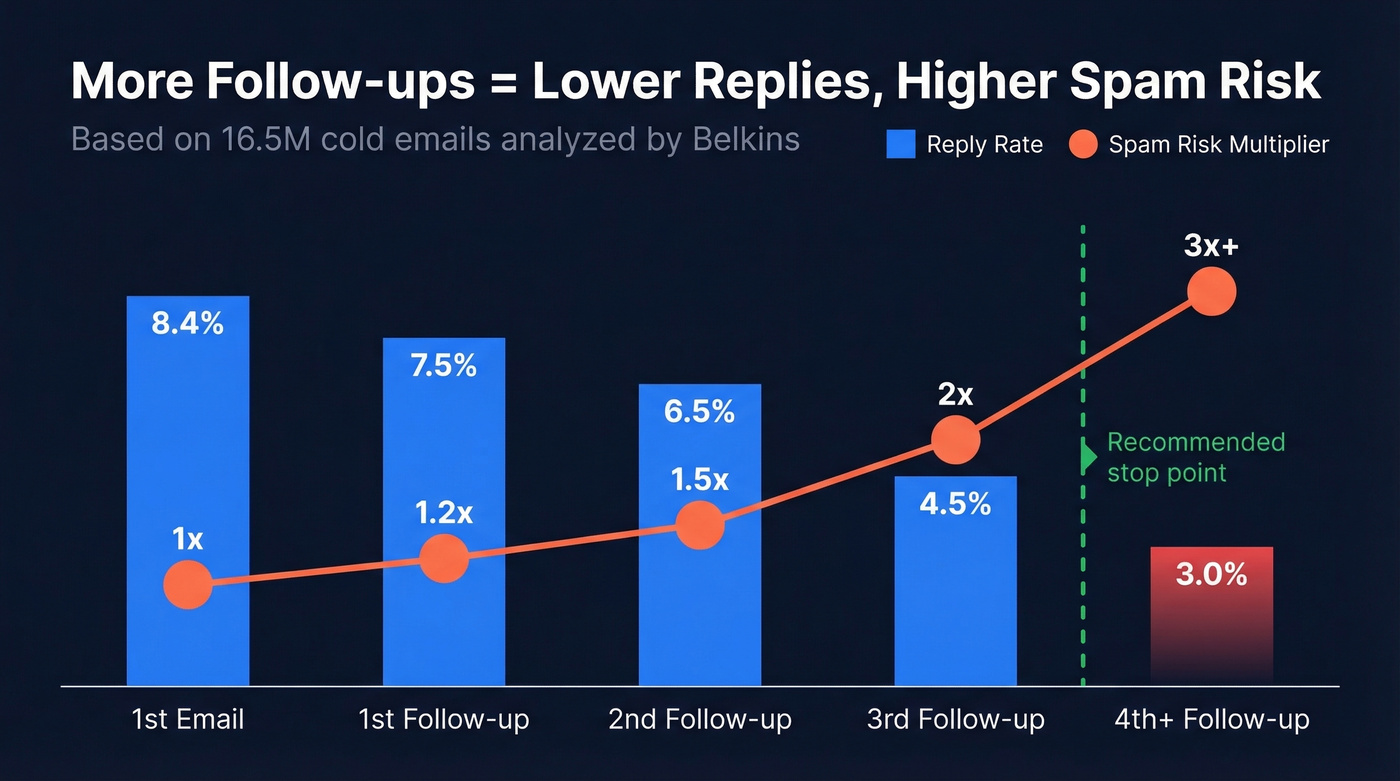
The Belkins dataset - 16.5M cold emails across 93 business domains - tells a different story. Peak reply rate hits at one email. Each additional follow-up chips away at performance, and by the 4th follow-up, you've more than tripled your spam-mark risk.
Company size matters. Small businesses (2-50 employees) are the most tolerant - reply rates start at 9.2%, dip to 8% on the first follow-up, then tick back up to 8.4% on the second. Enterprise prospects (1,000+ employees) ghost quickly and punish persistence.
The founder/C-suite pattern is particularly interesting. Founders hold steady through early follow-ups - 6.64% initial, 6.66% after one, even 6.94% after the second. Then it falls off a cliff: 5.75% on the third, 3.01% on the fourth. You get two shots at a founder. Three if the signal is strong. After that, you're burning the bridge.
| Sequence Position | Reply Rate | Risk Level |
|---|---|---|
| 1st email | 8.4% | Baseline |
| 1st follow-up | ~7-8% | Low |
| 2nd follow-up | ~6-7% | Moderate |
| 3rd follow-up | ~4-5% | Elevated |
| 4th+ follow-up | ~3% or less | 3x+ spam risk |
Ranges approximate across all segments in the Belkins dataset.
In our experience, the third follow-up is where most reps should stop. Four if you have a strong reason. Five or more is almost never worth the domain risk. (For more data, see follow-up email reply rate.)
When to Send Each Follow-Up
Timing isn't about finding the perfect day of the week. It's about matching the prospect's decision window. A post-demo follow-up sent five days later might as well not exist - they've already started evaluating your competitor.
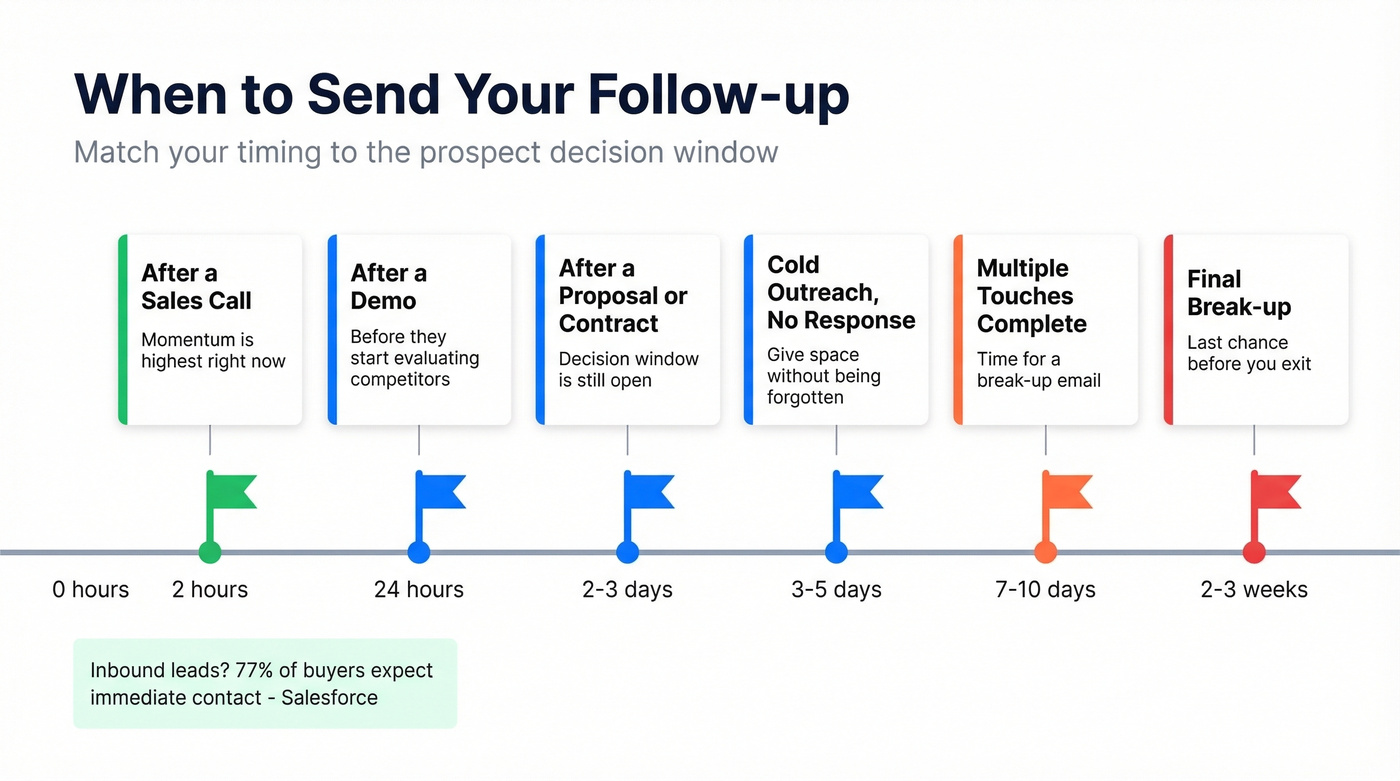
| Scenario | Timing | Why |
|---|---|---|
| After a sales call | Within 2 hours | Momentum is highest |
| After a demo | Within 24 hours | Before competitor eval starts |
| Cold outreach, no response | 3-5 days | Space without being forgotten |
| After sending a quote | 2-3 days | Decision window is open |
| After sending a contract | 2-3 days | Urgency without pressure |
| Break-up email | After 7-10 touches, 2-3 weeks | Last chance before exit |
For inbound leads, the clock moves even faster. Salesforce's research found that 77% of customers expect to interact with someone immediately when they contact a company. If someone fills out your demo form at 10am and you follow up at 4pm, you've already lost ground. (More on timing: best time to send cold emails.)
Subject Lines That Earn Opens
Belkins and Reply.io analyzed 5.5M emails focused specifically on subject lines. The results contradict a lot of conventional wisdom.
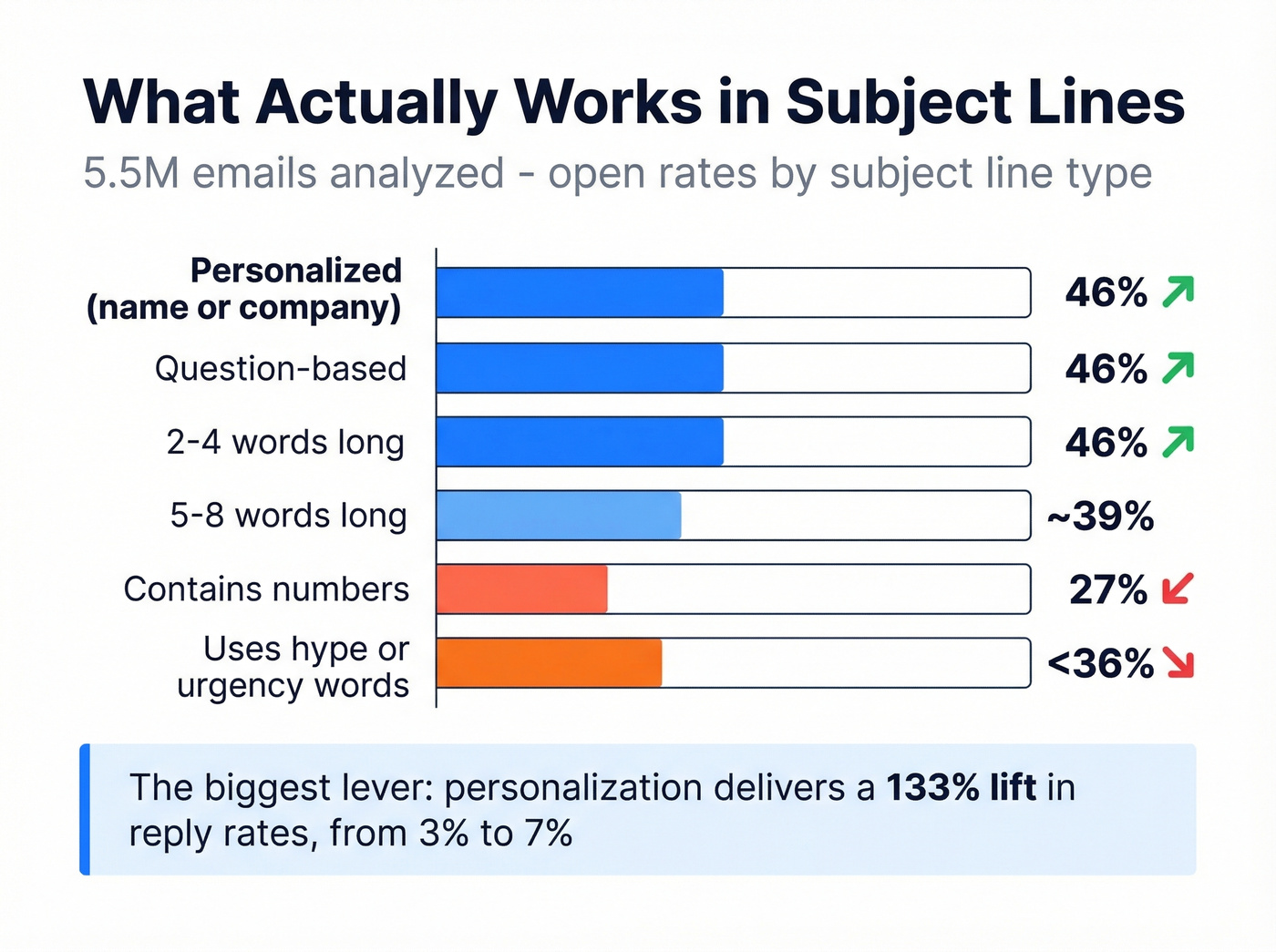
Personalized subject lines - ones that include the prospect's name or company - hit 46% open rates versus 35% without. That's a 31% lift. Reply rates jumped from 3% to 7%, a 133% increase. Personalization isn't a nice-to-have. It's the single biggest lever you have.
Questions matched that 46% open rate, making them the top-performing format. Length matters too: 2-4 words is the sweet spot at 46% opens. Once you cross 9 words, you're down to 34-35%.
Here's the surprise: numbers in subject lines actually hurt. Lines with numbers opened at 27% versus 28% without. And hype or urgency words - "ASAP," "limited time," "act now" - dragged opens below 36%. Your prospects can smell desperation. I've tested short subject lines against longer ones across plenty of campaigns and consistently see the shorter variant win. (More ideas: email subject line examples.)
| Subject Line Type | Open Rate | Notes |
|---|---|---|
| Personalized (name/company) | 46% | 31% lift vs generic |
| Question-based | 46% | Top performer |
| 2-4 words | 46% | Sweet spot |
| 5-8 words | ~38-40% | Acceptable |
| 9+ words | ~34-35% | Diminishing returns |
| With numbers | 27% | Slightly worse |
| Without numbers | 28% | Baseline |
| Hype/urgency words | <36% | Avoid |
Swipe-file subject lines by scenario:
- Post-meeting: "Quick recap" / "Next steps?"
- No response: "Still relevant?" / "Worth revisiting?"
- Trigger event: "[Company] + [trigger]" / "Saw the news"
- Value-add: "Thought of you" / "Quick resource"
- Break-up: "Should I close your file?" / "Last one"
Keep them short, keep them personal, and drop the urgency theater.

The best follow-up template in the world is worthless if it bounces. Every bounced email tanks your domain reputation, pushing even your good emails into spam. Prospeo's 98% email accuracy and 7-day data refresh mean your follow-ups actually land in inboxes - not the void.
Fix the data before you fix the copy. Start free today.
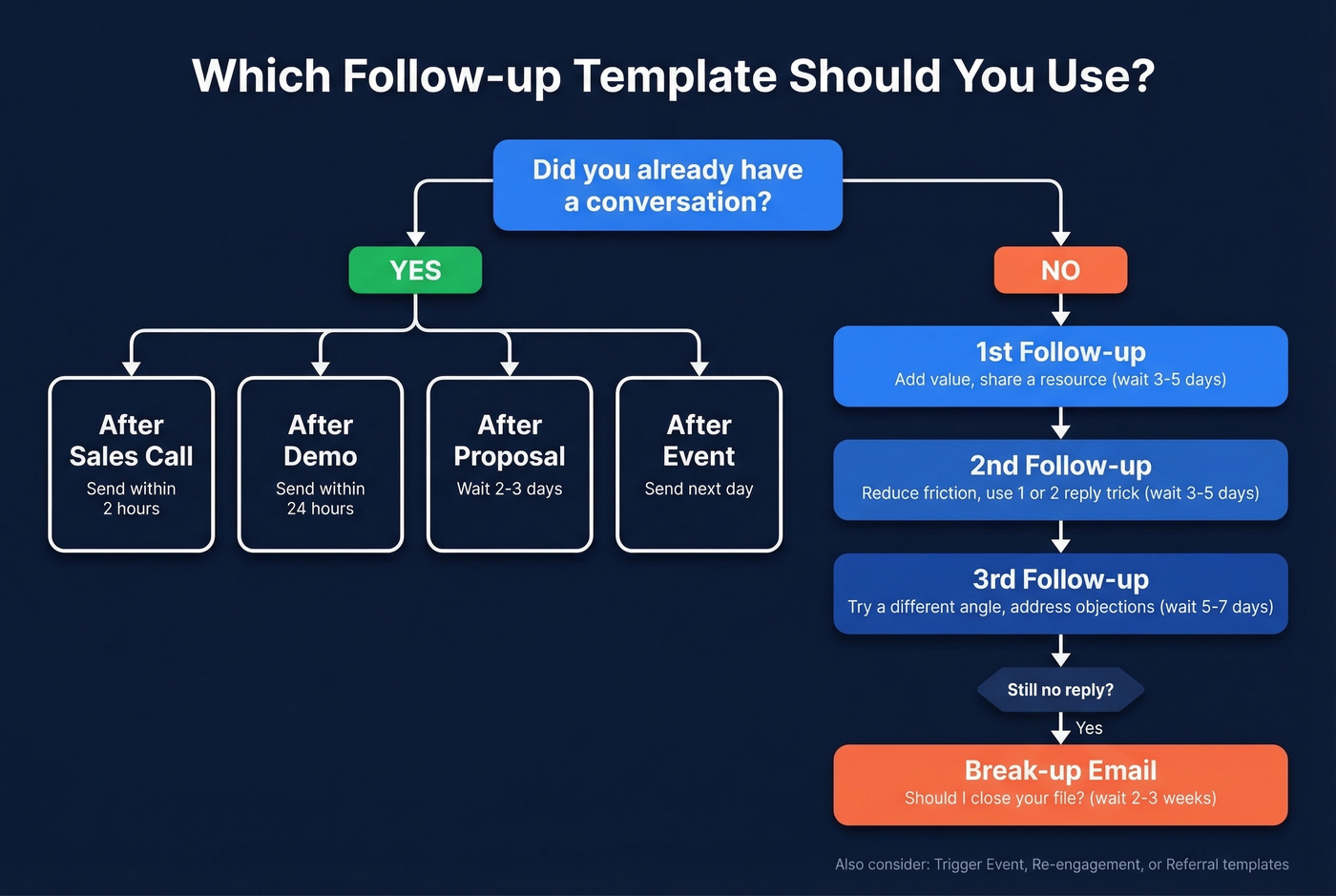
12 Follow-Up Email Templates by Scenario
Every template below follows the same structure: plain text, under 100 words, one clear CTA. Don't copy these verbatim - Mailshake's research confirms templates are widely reused, and prospects notice. Use them as frameworks, then personalize. (If you need more follow-up-specific variations, see cold email follow-up templates.)
After a Sales Call
Subject: Quick recap
Hi [Name],
Great speaking with you today. Here's what I took away:
- [Key pain point they mentioned]
- [Timeline they shared]
- [Next step you agreed on]
I'll have [deliverable] over to you by [date]. If I missed anything, let me know.
Why it works: Proves you listened and anchors the next step in writing.
After a Demo
Subject: [Product] + [their specific use case]
Hi [Name],
Based on what you shared about [specific challenge], the biggest win for your team would be [specific feature/outcome].
I've attached [one-pager/case study] covering how [similar company] solved the same problem.
Worth a 15-minute call Thursday to map this out?
Why it works: Ties the demo back to their problem, not your product.
After Sending a Proposal
Send this when the prospect has your proposal but hasn't responded in 2-3 days. You suspect it's stalled internally.
Subject: Thoughts on the proposal?
Hi [Name],
Wanted to check in on the proposal I sent [day]. Two things I want to make sure are clear:
- [Key ROI point]
- [Implementation timeline]
If anything needs adjusting - scope, pricing, timeline - I'd rather tweak it now than have it stall. What questions are coming up?
Why it works: Invites objections instead of waiting for silence.
After a Trigger Event
Subject: Saw the [funding round / new hire / expansion]
Hi [Name],
Congrats on [specific trigger event]. That usually means you're scaling the outbound team or rebuilding the tech stack.
We helped [similar company] navigate that exact transition. Happy to share what worked if it's useful.
Why it works: Trigger events create urgency you don't have to manufacture.
No Response - First Follow-Up
Subject: Quick resource on [their challenge]
Hi [Name],
I know [initial email topic] might not be top of mind right now. Thought this might be useful regardless - [link to relevant article, benchmark, or tool].
No pitch. Just figured it'd be relevant given [specific detail about their company/role].
Why it works: Adds value instead of asking for something. Resets the dynamic from "salesperson chasing" to "helpful contact." This is the follow-up that earns a reply by giving before asking.
No Response - Second Follow-Up
The insight behind this one: reducing reply friction to near zero. A "2" is still a reply - and a reply reopens the conversation.
Subject: Still relevant?
Hi [Name],
I don't want to keep reaching out if the timing's off. Quick question:
Reply 1 if you're interested but swamped right now. Reply 2 if this isn't a priority and I should check back in Q[X].
Either way, no hard feelings.
No Response - Third Follow-Up
Subject: Different angle
Hi [Name],
I've been approaching this from a [original angle] perspective, but I'm wondering if the real blocker is budget timing or internal buy-in.
If that's the case, we have a pilot program that doesn't require procurement approval. Would that change the conversation?
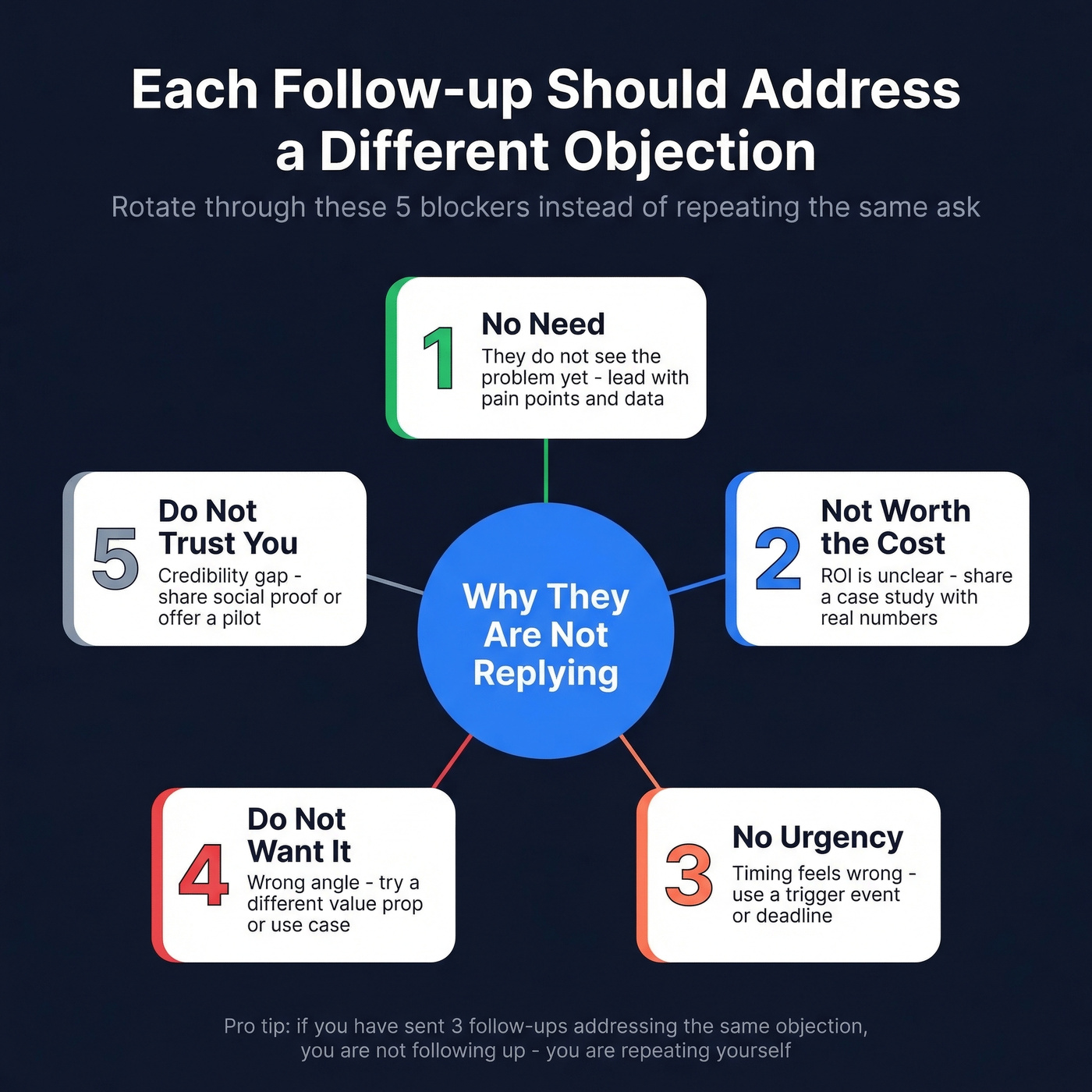
Why it works: Each follow-up should address a different objection from the five main blockers: no need, not worth the cost, no urgency, don't want it, or don't trust you.
Re-Engagement After Going Cold
Subject: [Name], quick update
Hi [Name],
We last spoke [timeframe] about [topic]. Since then, we've [new development - product update, case study, pricing change].
Figured it was worth a fresh look. Still relevant for [their company]?
Why it works: A legitimate reason to re-engage - not "just checking in."
Referral / Wrong Contact
Subject: Right person for this?
Hi [Name],
I've been reaching out about [topic] but I'm not sure I have the right person. Would you mind pointing me to whoever handles [specific function] at [Company]?
Appreciate the redirect either way.
Why it works: Low-effort ask. People are surprisingly willing to forward you when you make it easy.
Networking or Event Follow-Up
Subject: Good meeting you at [event]
Hi [Name],
Enjoyed our conversation at [event] about [specific topic]. You mentioned [specific challenge] - I wanted to share [relevant resource or idea].
Worth continuing the conversation over coffee or a quick call?
Why it works: Specificity proves you're not mass-emailing every attendee. Works equally well for conferences, trade shows, and professional meetups.
Walk-Away / Break-Up Email
Subject: Should I close your file?
Hi [Name],
I've reached out a few times and haven't heard back, which usually means one of three things:
- The timing's wrong.
- You've gone with someone else.
- You're being chased by a bear and can't respond.
If it's 1 or 3, I'm happy to reconnect later. If it's 2, no worries at all.
Why it works: Break-up emails placed after 7-10 touches often recover 1-3% of dead threads. The humor disarms, and the permission to say "no" paradoxically makes people more likely to say "not yet."
Post-Break-Up Re-Open
Subject: [Trigger event] made me think of you
Hi [Name],
I closed your file a while back, but [specific trigger - job change, funding, company news] caught my eye.
If the timing's better now, I'd love to pick up where we left off. If not, I'll disappear again. Promise.
Why it works: Only re-open with a real trigger. "Just circling back" after a break-up email destroys whatever goodwill the break-up created.
Building a Complete Follow-Up Sequence
Templates are ingredients. A sequence is the recipe. Here's an 8-touch, 12-day framework that blends channels and maps to the templates above.
- Day 1 - Email: Problem + proof + question. Use your initial outreach or Template #5 for re-engagement.
- Day 2 - Call: 15-second voicemail mirroring the email. "Sent you a note about [topic] - worth 10 minutes?"
- Day 3 - Email: Specific outcome. Template #5 or #4 if you have a trigger event.
- Day 5 - Social touch: Engage with their content or send a direct message tied to a real signal. Message + visit combos hit 11.87% reply rates in the Belkins dataset - higher than any email-only sequence position.
- Day 7 - Email with asset: Attach a 60-second screen recording or case study. A short Loom video often outperforms a PDF. Template #8 works well here. (If you use video, see Loom video cold email.)
- Day 9 - Call: Reference the asset. "Did the case study land? Happy to walk through it."
- Day 11 - Email: Address a specific objection. Template #7 (different angle).
- Day 12 - Graceful close: Template #11 (break-up email).
The spacing rule: 2-3 days between touches. Closer than that feels desperate. Wider than that and you're forgotten. For warm leads, compress to 4-7 touches within a week - 77% of inbound leads expect immediate interaction, so speed matters more than spacing.
Run this through HubSpot, Outreach, or any sequencing tool. The channel mix is what makes it work. (If you're building this into tooling, start with sequence management.)
Personalizing Follow-Ups at Scale
Generic templates pull 0.5-2% reply rates. AI-personalized emails - ones that reference the prospect's company, role, recent news, or tech stack - hit 6-20%. That's the difference between cold calling and warm introductions. (More on the workflow: AI cold email outreach.)
The bottleneck is research time. A rep can manually write 10-15 truly personalized emails per day. Tools like Instantly and Clay scale that with AI, pulling in signals like job changes, funding rounds, and hiring patterns to generate custom opening lines. AI-optimized send timing alone can lift engagement 20-40%.
But personalization at scale has an invisible prerequisite: data quality. Your follow-up sequence is only as good as your contact data. If your emails bounce, your domain reputation tanks and even your well-crafted messages land in spam. The best template in the world still fails if it never reaches the inbox. (If you're troubleshooting, use an email deliverability guide and an email spam checker.)
We've seen this play out firsthand. Meritt dropped their bounce rate from 35% to under 4% after switching to Prospeo's verified data, and Stack Optimize runs under 3% bounce with zero domain flags across all their clients. When you're running multi-touch sequences like the one above, that kind of deliverability isn't optional - it's the foundation everything else sits on.
Use this if: You're scaling outbound and need verified contact data before launching sequences. Skip this if: You're sending fewer than 50 emails a month and can manually verify each one.
5 Follow-Up Mistakes That Kill Replies
1. "Just bumping this" with no new information. Every follow-up needs to address a different objection. The five main objections are: no need, not worth the cost, no urgency, don't want it, and don't trust you. If your follow-up doesn't tackle at least one, it's noise.
2. Sending to bad or stale data. This is the invisible killer. You can write the perfect follow-up sequence and still get zero replies if your emails are bouncing. Bounced emails destroy sender reputation, which pushes your good emails into spam. Run your list through a verification tool before launching any sequence. (If you need a process, start with how to check if an email exists.)
3. Too many follow-ups. The data is clear: by the 4th follow-up, spam-mark risk more than triples. More follow-ups doesn't mean more persistence. It means more prospects hitting the spam button.
4. Same channel every time. Email, email, email, email. That's not a sequence - it's a drip campaign. Mix in calls and social touches. The multi-channel framework above alternates channels every 1-2 days for a reason.
5. Copy-pasting templates verbatim. Look - Mailshake warns about this explicitly. If your prospect has received the same "Should I close your file?" break-up email from three other vendors this month, yours won't land. A common complaint on r/sales captures it perfectly: "Just following up, did you receive our quote?" feels desperate and generic. Use templates as scaffolding, then make them yours. (If you need better phrasing, see how to say just checking in professionally.)
Here's our hot take: if your average deal size is under $5k, you probably don't need a 12-touch multi-channel sequence. Three well-timed, personalized emails will outperform a bloated cadence that burns your domain and annoys your prospects. Save the complex sequences for deals worth the effort.
You just saw the data: you get 2-3 shots at a founder before the bridge burns. Don't waste them on unverified emails. Prospeo gives you 143M+ verified emails and 125M+ direct dials so every follow-up reaches a real person - at roughly $0.01 per email.
Make every follow-up count with contacts that are actually real.
FAQ
How many follow-up emails should I send?
Two to three follow-ups work best for most scenarios, based on the 16.5M-email Belkins dataset. By the 4th follow-up (5th email), spam-mark risk more than triples and reply rates drop to around 3%. Enterprise deals with multiple stakeholders might warrant four - but switch channels rather than stacking more emails.
What makes a follow-up email effective?
The best follow-up is under 100 words, references something specific about the prospect's situation, and includes a single clear CTA. It addresses a real objection rather than just "checking in." Use the sales follow-up email examples above as starting frameworks, then personalize with details from your research or previous conversations.
When's the best time to send a follow-up?
9-11am in the prospect's local time zone is the standard window, but timing to a trigger event beats timing to a clock every time. A perfectly timed Tuesday-morning email still loses to a follow-up sent two hours after their Series B announcement.
How do I improve follow-up deliverability?
Start with verified contact data - bounced emails destroy sender reputation and push even well-written messages into spam. Beyond verification, keep sending volume consistent, warm up new domains gradually, and avoid spam-trigger words in subject lines.
What if a prospect never responds?
Send a break-up email after 7-10 touches over 2-3 weeks. If they don't respond, move on. Re-engage only when a real trigger appears - a job change, funding round, or product launch that changes the conversation. "Just checking in" three months later doesn't work.