

Sales Nurturing: The Practitioner's Guide to Moving Pipeline
Your SDR team is sitting on 200 MQLs nobody's touched in six weeks. Marketing says they're "nurturing" them. Sales says they're "not ready." Meanwhile, 40.4% of B2B buyers take 6-12 months to decide, and 95% of deals go to a vendor already on the buyer's shortlist from day one. That gap between "not ready" and "already decided" is where sales nurturing lives - and where most teams lose deals they never knew they had.
Here's the short version: this discipline is sales-owned, multi-channel, and meeting-focused. It's not a marketing drip. Segment contacts into Cold/Warm/Hot, run 6-10 touches over 30 days alongside SDR outreach, measure pipeline influenced - not opens - and verify every email before it enters a sequence.
What Sales Nurturing Actually Is
Lead nurturing and sales-driven nurturing aren't the same thing. Treating them interchangeably is how pipeline dies quietly.
Lead nurturing is marketing's domain - automated email sequences, content downloads, scoring logic. One agency documented a marketing nurture build with 22 unique emails across 36 paths, a multi-month project just to set up. Sales nurturing is owned by SDRs and AEs. It's hands-on, spans channels - email, calls, social touches, video - and the objective isn't education. It's a meeting. Sales sequences typically run 5-20+ steps over a few weeks, blending automated sends with manual personalization.
Most B2B teams need both running concurrently. The mistake is treating nurturing as what happens after sales rejects a lead. The process should start the moment a lead enters the system, not weeks later when momentum has evaporated.
Why It Matters for the Buying Cycle
The average B2B buying cycle runs 10.1 months. During that window, 45.8% of buyers consume more than seven pieces of content before making a decision. If your team isn't consistently in front of those buyers, you're invisible during the months that matter most.
Let's be honest: if your average contract value is under $20k, you probably don't need a 36-path marketing automation monster. You need an SDR with a tight sequence, clean data, and the discipline to follow up for 30 days straight. We've watched that approach outperform elaborate "nurture programs" more times than we can count.
How to Build a Nurture System
Start with segmentation. Three buckets work for most teams:
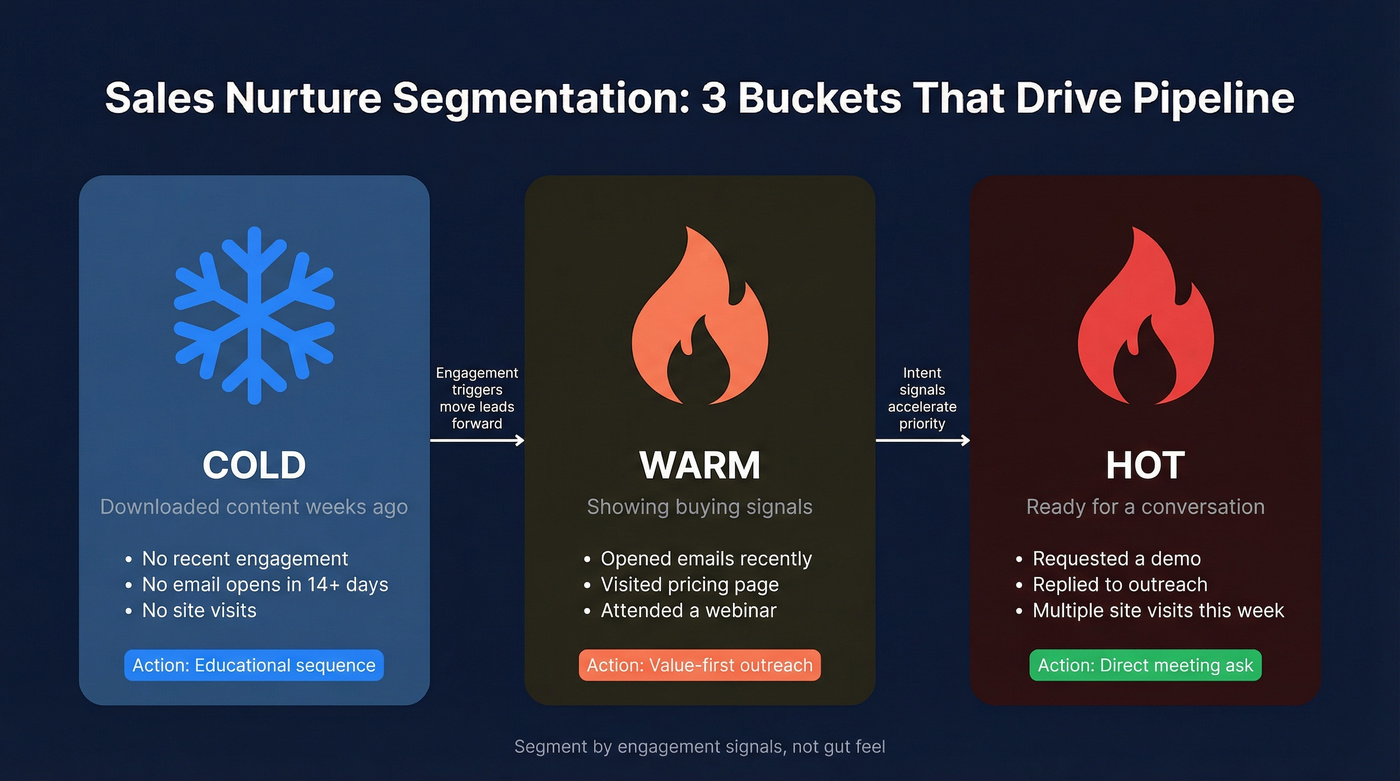
- Cold - downloaded something weeks ago and haven't engaged since.
- Warm - opened emails, visited pricing, or attended a webinar.
- Hot - requested a demo, replied to outreach, or hit your site multiple times in a week.
Every contact lands in one of these based on engagement signals, not gut feel. Getting this right determines whether reps spend time on the right accounts or chase dead ends for weeks.
Run nurture and SDR follow-up concurrently. Don't wait for sales to "have a crack" and then dump rejects into a marketing drip. Launch a welcome sequence from the SDR - informal, personalized - the moment a lead enters. The first 48 hours are critical for momentum.
Follow the 3:1 give-to-get ratio. Deliver value three times before you ask for a meeting - insights, benchmarks, case studies, not three variations of "got 15 minutes?" (If you need copy you can paste, use these sales follow-up templates.)
Then orchestrate across channels. Email is the backbone, but layer in retargeting ads for contacts who open but don't click, trigger a sales call when an account crosses an engagement threshold, and use social touches to stay visible. One practitioner on r/sales described embedding 30-60 second video snippets into nurture flows to reopen dormant deals - a tactic that outperformed plain-text emails by a wide margin. (For a deeper system, see personalized outreach.)
Think in accounts, not contacts. Buying decisions are made by committees. If you're only nurturing one person per account, you're hoping they forward your emails internally. Multi-thread into 3-5 contacts per account. This is the core of account-based selling.

Multi-threading 3-5 contacts per account requires verified emails for every one of them. Prospeo gives you 143M+ verified emails at 98% accuracy with a 7-day refresh cycle - so your nurture sequences reach real inboxes, not bounce logs.
Stop nurturing contacts who'll never see your emails.
A Sequence You Can Steal
Here's an 8-email, 30-day SaaS nurture sequence with per-email performance benchmarks:
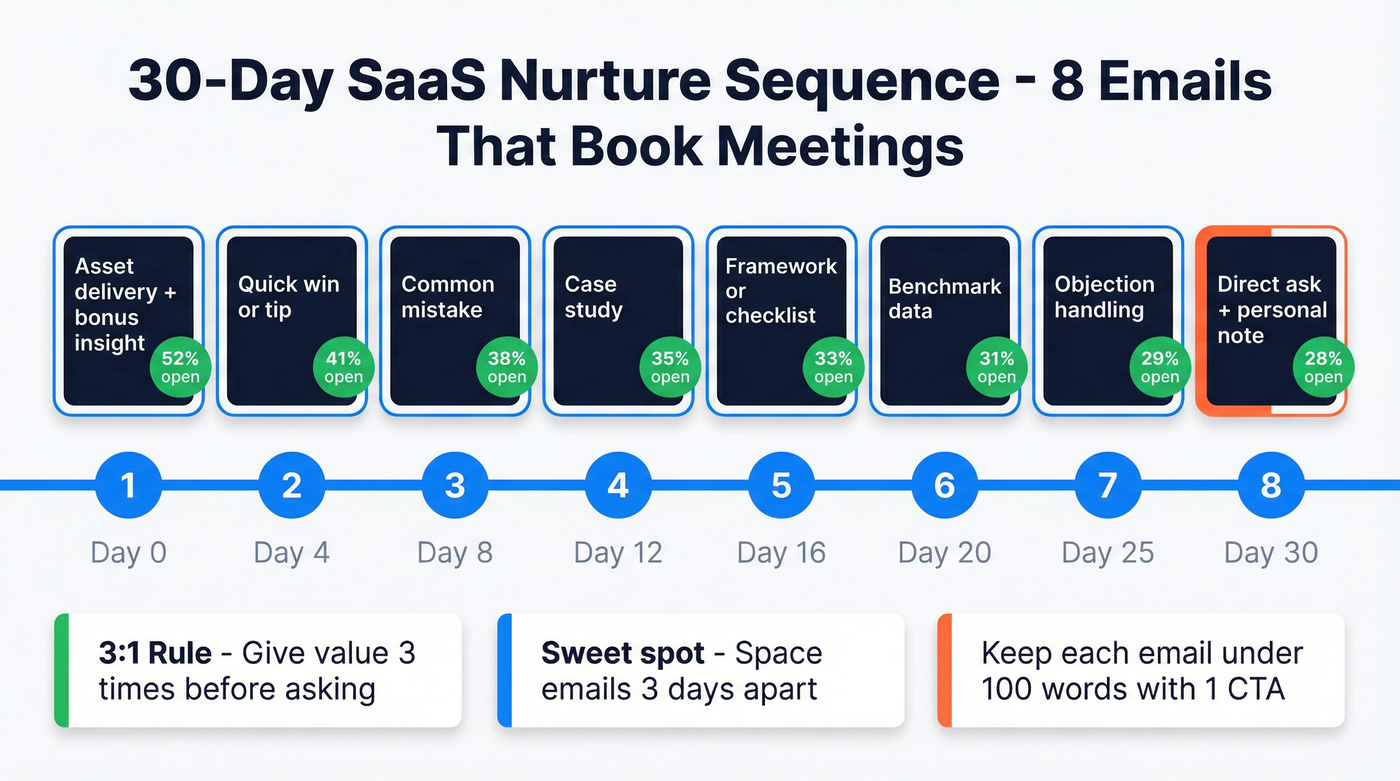
| Email # | Day | Subject Line Theme | Open Rate | CTR |
|---|---|---|---|---|
| 1 | 0 | Asset delivery + bonus insight | 52% | 12% |
| 2 | 4 | Quick win / tip | 41% | 8% |
| 3 | 8 | Common mistake | 38% | 9% |
| 4 | 12 | Case study | 35% | 6% |
| 5 | 16 | Framework / checklist | 33% | 7% |
| 6 | 20 | Benchmark data | 31% | 8% |
| 7 | 25 | Objection handling | 29% | 5% |
| 8 | 30 | Direct ask + personal note | 28% | 4% |
For enterprise or high-ACV cycles, stretch to 10 emails over 60 days with diagnostic questions, ROI guides, and evaluation frameworks. Space emails 2-4 days apart - three days is the sweet spot - and keep each under 100 words with one clear CTA. (If you want more structure around steps and timing, use this sequence management guide.)
Before loading contacts into any sequence, verify emails to keep bounce rates under 3%. Prospeo handles this at 98% accuracy across 143M+ verified addresses with a 7-day refresh cycle, so you're not burning domain reputation on stale data. If you're troubleshooting deliverability, start with an email deliverability guide and then tighten your email velocity.
Metrics That Actually Matter
Stop measuring opens and clicks as primary KPIs. They're diagnostic, not strategic. The metrics that reveal whether your nurture engine is working are pipeline influenced, dormant accounts reactivated, and sales cycle shortened. (To operationalize this, track funnel metrics and monitor pipeline health.)
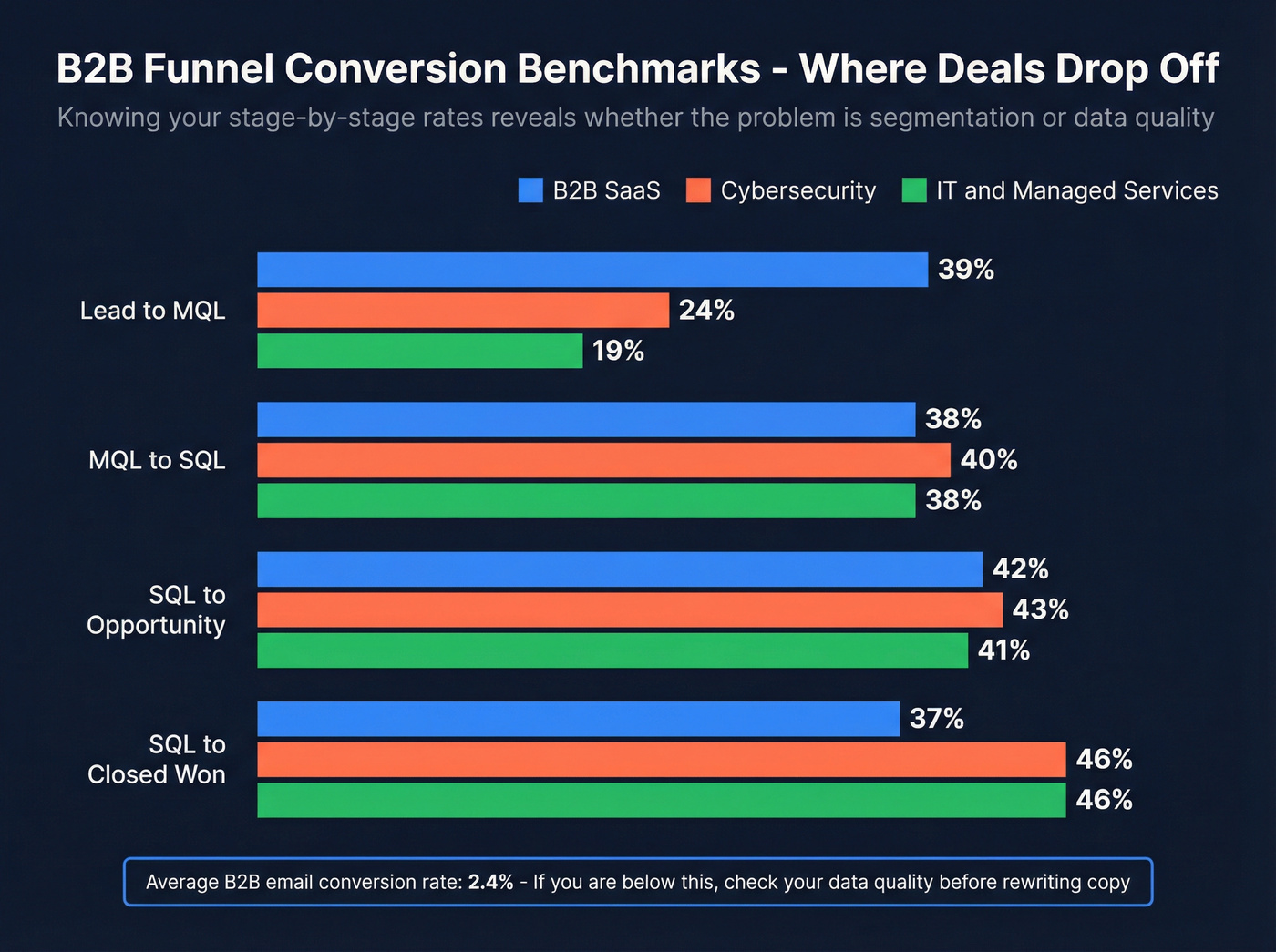
Funnel conversion benchmarks for context:
| Stage | B2B SaaS | Cybersecurity | IT & Managed Svcs |
|---|---|---|---|
| Lead to MQL | 39% | 24% | 19% |
| MQL to SQL | 38% | 40% | 38% |
| SQL to Opp | 42% | 43% | 41% |
| SQL to Closed Won | 37% | 46% | 46% |
Average B2B email conversion rate sits at 2.4%. If your sequences convert below that, the problem is usually segmentation or data quality - not copy. We've debugged dozens of underperforming sequences and the root cause is almost always dirty lists, not weak messaging. (If you're diagnosing list decay, start with email bounce rate.)
Five Mistakes That Kill Nurture Programs
1. Running a 5-email drip nobody's updated since 2023. Nurturing is a living system. If your sequences haven't been refreshed in six months, they're stale and your prospects can tell.
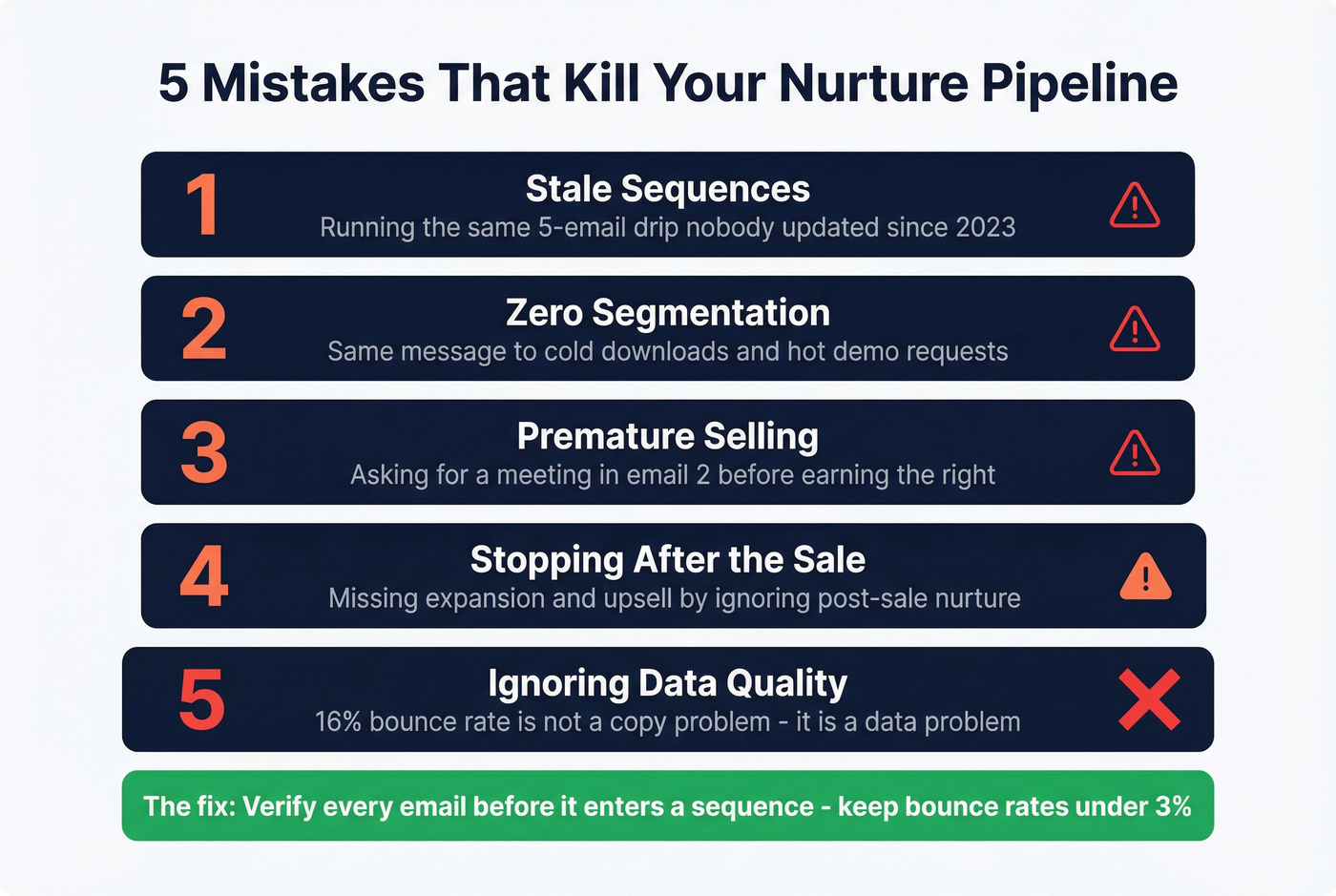
2. Generic messaging with zero segmentation. Sending the same sequence to a cold download and a hot demo request is lazy. Segment or lose.
3. Premature selling. Asking for a meeting in email two violates the 3:1 ratio. You haven't earned it yet. Skip this approach entirely if you're working enterprise accounts - it'll torch the relationship before it starts.
4. Stopping after the sale. Post-sale nurturing drives expansion and upsell. The best programs map reactivation, education, and upsell journeys - not just acquisition. (If you're building the post-sale motion, use this upsell vs cross-sell in SaaS breakdown.)
5. Ignoring data quality. You sent 5,000 emails. 800 bounced. That's a 16% bounce rate, and it's not a copy problem - it's a data problem. I've seen teams burn through entire sending domains because they skipped verification. Prospeo's 5-step verification with catch-all handling and spam-trap removal keeps bounce rates under 3%, so your sequences actually land in inboxes instead of damaging your sender reputation. (If you're already in trouble, follow this how to improve sender reputation playbook.)

Dirty data is the #1 killer of nurture programs. Before loading a single contact into your 30-day sequence, verify every address. Prospeo's 5-step verification keeps bounce rates under 3% at roughly $0.01 per email - protecting the domain reputation your pipeline depends on.
Fix your data before you blame your copy.
AI in Sales Nurturing
Sellers spend just 28% of their time actually selling. The rest disappears into CRM updates, research, and admin. AI earns its keep in nurturing by recapturing that lost capacity - predictive lead scoring that surfaces hot accounts before a rep notices, auto-generated account briefs from CRM history, and draft follow-ups reps can personalize in 30 seconds instead of writing from scratch. (If you're building this into your stack, start with best AI tools for automating sales follow-ups and AI sales follow-up.)
Companies leading on AI adoption are seeing 1.7x revenue growth compared to laggards. AI doesn't replace the human touch in the nurture process. It removes the busywork that prevents reps from delivering it.
FAQ
What's the difference between sales nurturing and lead nurturing?
Sales nurturing is sales-owned, multi-channel, and focused on booking meetings within weeks. Lead nurturing is marketing-owned, automated, and focused on long-term education. Most B2B teams need both running concurrently to move prospects through the entire buying cycle.
How many touches to convert a B2B lead?
Plan for 6-10 touches across 2-4 weeks for mid-market outbound sequences. For enterprise cycles spanning 6-12 months, stretch to 10+ touches over 30-60 days across email, social, and calls. Below six touches, most reps give up before the buyer is ready.
How do I keep nurture emails from bouncing?
Verify every email before it enters a sequence. Tools with 98%+ accuracy and weekly refresh cycles keep bounce rates under 3% and protect your sender reputation. Anything above 5% bounce signals data decay and risks domain blacklisting.
Does the process change for enterprise deals?
Yes. Enterprise cycles are longer and involve 5-11 stakeholders, so you need to multi-thread across the buying committee. Stretch sequences to 60+ days, include ROI calculators and evaluation frameworks, and coordinate closely with marketing nurture tracks so messaging stays consistent across every touchpoint.