

The Sales Strategies Template That Includes the Numbers Everyone Else Leaves Out
You downloaded the template. It had 12 blank boxes, a mission statement placeholder, and zero math. Three weeks later, it's still blank because nobody knew what numbers to put in the boxes.
Sales professionals using structured planning are 4x more likely to hit their objectives, yet 84% of reps missed quota last year. The gap isn't effort - it's that most sales strategies templates skip the only part that matters: the numbers. Here's the one we wish we'd had three years ago.
What's Inside This Template
Stop downloading blank frameworks. Start doing the math.
- The 7 sections every sales strategy document needs - filled in, not blank
- Pipeline math reverse-engineered from a $1.2M revenue target
- 2026 benchmarks to sanity-check your targets
- Template variants for enterprise, SaaS/PLG, and outbound-heavy motions
- A three-tool tech stack that makes the plan executable without a $50k budget
The Core Template: 7 Sections
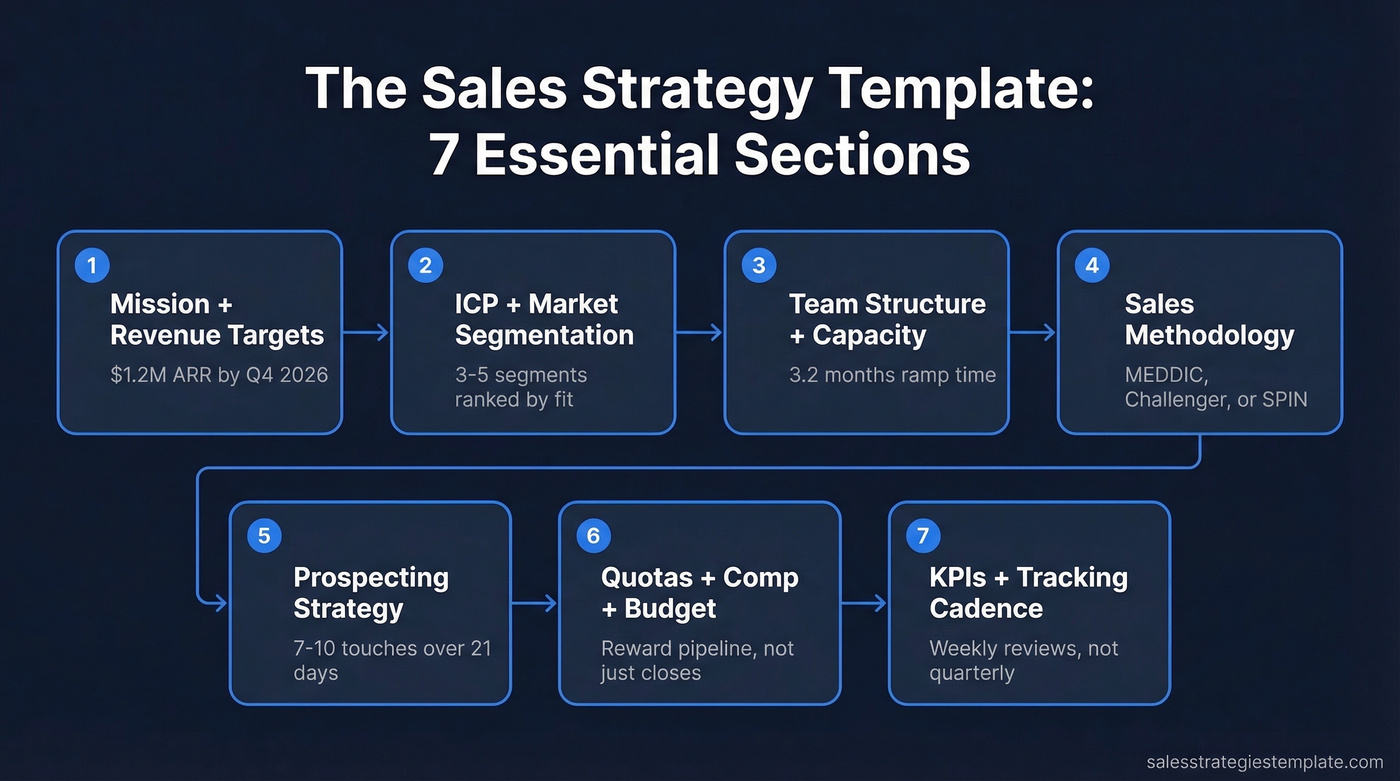
Every sales strategy document needs seven sections. Not five, not twelve. Seven. Here's each one with real numbers - a complete sales strategy outline you can adapt to your motion.
Mission + Revenue Targets
"Grow revenue" isn't a target. "$1.2M in new ARR by Q4 2026, split $700K new logos and $500K expansion" is. Tie it to a timeline, assign ownership, and make it specific enough that every rep can tell you whether you're on track in any given week.
ICP + Market Segmentation
A 200-person fintech actively hiring SDRs is a different prospect than a 200-person fintech in a hiring freeze. Segment your ICP by company size, industry, pain point, and buying urgency. Three to five segments, ranked by fit and expected close rate. (If you need a starting point, use an ideal customer profile template.)
Team Structure + Capacity
New reps take 3.2 months to ramp to full productivity, and ramped reps spend roughly 28% of their week actually selling. We've seen teams model full quota for new hires in Q1 and wonder why they're 40% behind by Q3. If you're hiring two reps in Q3, don't model them at full quota until Q4.
Sales Methodology
Pick two or three methodologies that match your motion. MEDDIC for complex enterprise deals with multiple stakeholders. Challenger for status-quo-comfortable buyers. SPIN for discovery-heavy sales. Map your methodology to your average deal size and cycle length - a $5K self-serve deal doesn't need the same framework as a $200K enterprise contract. (For deeper qualification, see MEDDIC sales qualification.)
Prospecting Strategy + Channels
80% of sales require 5-12 follow-up attempts. Your prospecting plan needs to map channels - cold email, phone, social, events, inbound - to specific cadence structures. A typical outbound sequence runs 7-10 touches over 21 days. If you want plug-and-play messaging, start with sales follow-up templates and a B2B cold email sequence.
Here's the thing most templates ignore: your pipeline math breaks if 30% of your emails bounce. Data quality isn't a nice-to-have. It's a planning variable. When you're modeling the opportunities needed to hit target, you can't afford a third of them going nowhere because the contact data is stale. (Use email bounce rate benchmarks to set a hard ceiling.)

Quotas + Comp + Budget
Latest data shows quota attainment at just 43.14% - and even after companies reduced quotas, 77% of sellers still missed. Build comp plans that reward pipeline generation and expansion, not just closed-won. Budget for the tools, events, and data that make the plan executable.
KPIs + Tracking Cadence
Track weekly, not quarterly: win rate (benchmark: 21%), close rate (29%), lead-to-customer conversion (2-5%), and pipeline coverage ratio (3-4x). One KPI deserves special attention: lead response time. Responding within 5 minutes increases engagement by 9x, yet over 99% of companies don't hit that window. Build a response-time SLA into your template and actually measure it. (To pressure-test your funnel, use funnel metrics.)
Pipeline Math Nobody Shows You
This is the section most planning documents leave blank - and it's the most important one. Let's work through the math that turns a revenue target into daily activity.
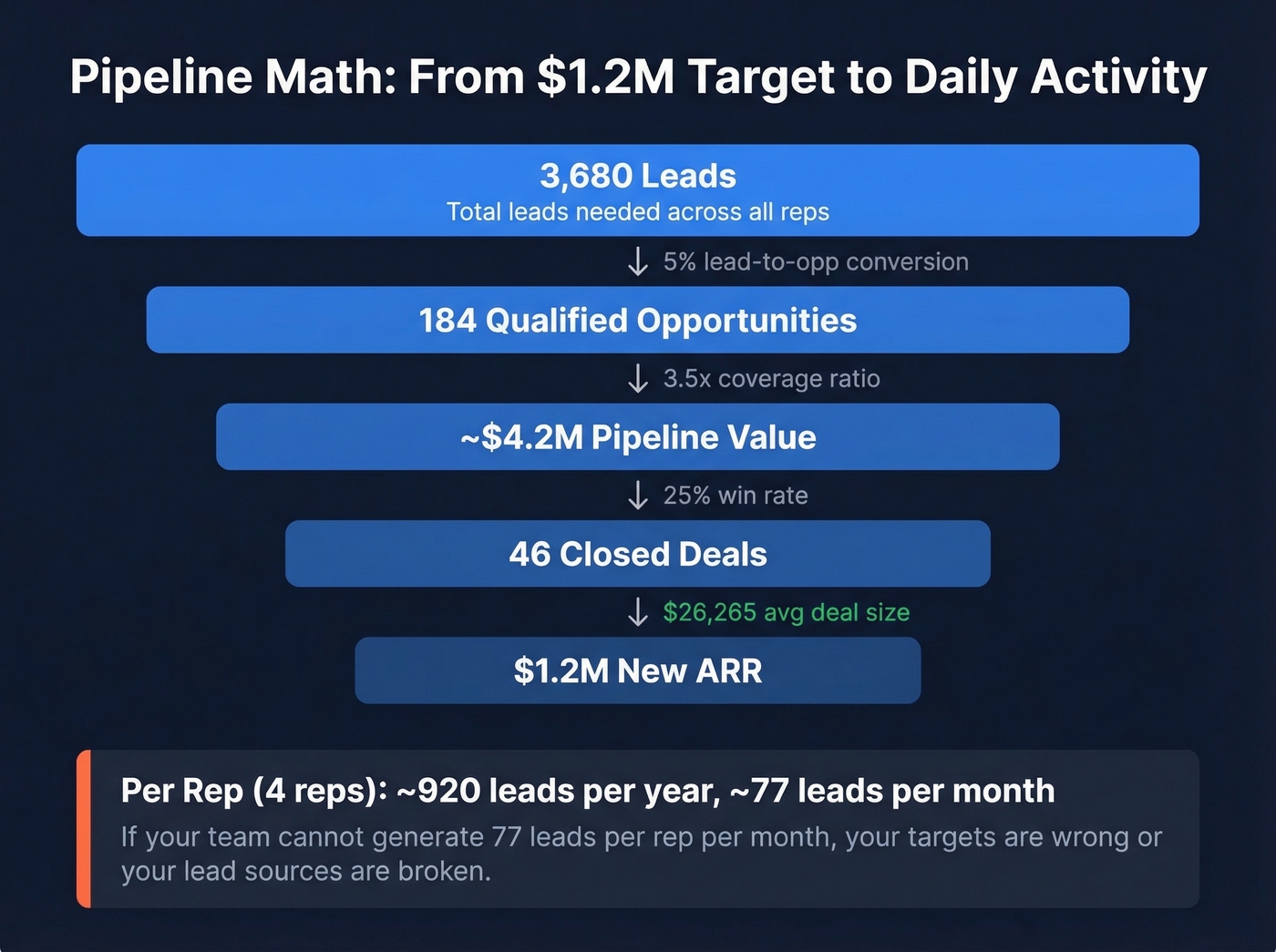
- Revenue target: $1.2M new ARR
- Win rate: 25%
- Average deal size: ~$26,265 (latest private B2B SaaS benchmark)
- Closed deals needed: $1,200,000 / $26,265 = ~46 deals
- Qualified opportunities needed: 46 / 0.25 = ~184 opportunities
- Pipeline coverage sanity check: 3.5x coverage implies ~$4.2M in pipeline, roughly 160 deals' worth at a $26,265 average
- Lead-to-opportunity conversion: 5% means you need ~3,680 leads to create ~184 opportunities
- Per rep (4 reps): ~920 leads each per year, or about 77 new leads per rep per month
That's the math. If your team can't generate ~77 leads per rep per month at your current conversion rates, either your targets are wrong or your lead sources are broken. (Compare your inputs against sales pipeline benchmarks.)
Look - most teams don't have a pipeline problem. They have a math problem. They set a revenue target, skip this calculation entirely, and then act surprised when they're at 43% attainment in Q3. Do the math first. Adjust the target if the inputs don't work. A realistic plan you execute beats an ambitious plan you abandon every single time.
The most common reason pipeline math fails in execution is data decay. Contact data degrades roughly 30% annually as people change jobs and emails go stale. Prospeo's 98% email accuracy and 7-day data refresh cycle keep the contact lists feeding your sequences from collapsing by month two. (If you're cleaning/enriching lists, see data enrichment services.)

You just calculated that each rep needs ~77 leads per month. That math collapses if a third of your contact data is stale. Prospeo refreshes 300M+ profiles every 7 days - not every 6 weeks - so the leads feeding your sequences actually connect. 98% email accuracy, 125M+ verified mobiles, $0.01 per email.
Make your sales strategy template executable with data that doesn't decay.
2026 Benchmark Reference Table
Pin this to your sales strategy document. Every target you set should be sanity-checked against these numbers.
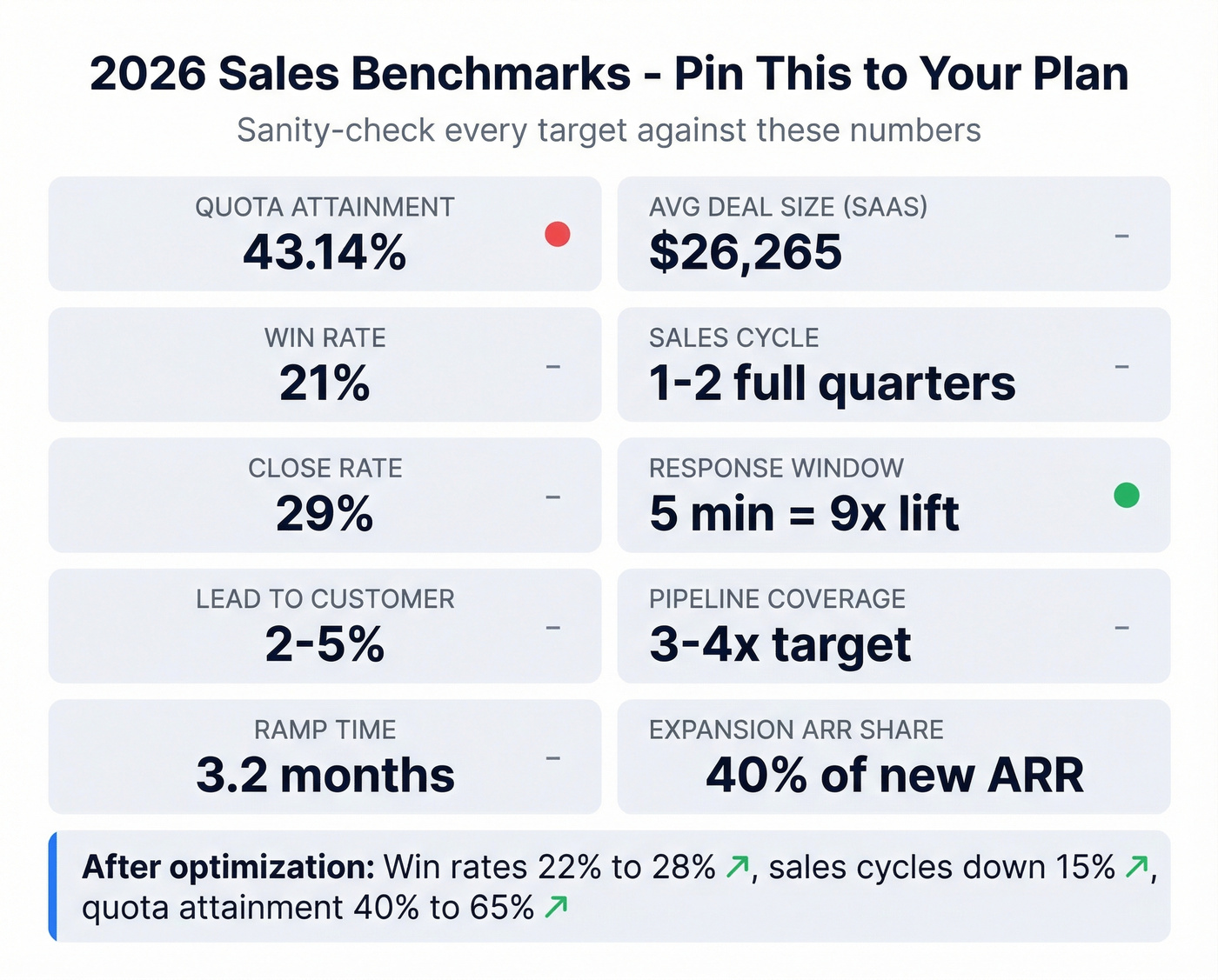
| Metric | Benchmark |
|---|---|
| Quota attainment | 43.14% |
| Win rate | 21% |
| Close rate | 29% |
| Lead-to-customer | 2-5% |
| Ramp time | 3.2 months |
| Avg deal size (SaaS) | $26,265 |
| Sales cycle | 1-2 full quarters |
| Response window | 5 min = 9x lift |
| Pipeline coverage | 3-4x target |
| Expansion ARR share | 40% of total new ARR |
What "good" looks like after optimization: Teams running structured audit-before-planning cycles have pushed win rates from 22% to 28%, cut sales cycles by 15%, and moved quota attainment from 40% to 65%. Those aren't theoretical - they're the improvement targets data-driven orgs are hitting right now.
Template Variants by Motion
Enterprise (Long Cycle, ABM)
Sales cycles run 90+ days, often stalled by legal and procurement. Build a 7-touch multichannel sequence across email, phone, direct mail, and events. Focus ABM efforts on your top 50-100 accounts with named owners and a whitespace analysis grid mapping business units against product lines. Only 28% of sales leaders believe account management meets cross-sell targets, so plan for expansion from day one - don't bolt it on later. (If you're formalizing ABM, use account-based selling best practices.)
SaaS / PLG
The SaaS motion is faster and more forgiving, but only if you treat expansion revenue seriously. Expansion now represents 40% of total new ARR, which means your template needs an expansion playbook, not just a new-logo plan. Track product-qualified leads alongside MQLs. Model a self-serve + sales-assist hybrid where reps focus on accounts above a deal-size threshold. Shorter cycles of 30-60 days mean weekly pipeline reviews, not monthly.
For a one-page executive summary version - useful for board decks or CSO briefings - condense the seven sections into a single sheet: revenue target, ICP summary, pipeline math, three KPIs, and quarterly milestones.
Outbound-Heavy
This is where we've spent the most time in our own planning, and it's where template quality matters most because the margin for error is razor-thin.
Plan for 50-80 activities per rep per day across cold email and cold call cadences. List quality is make-or-break - bad lists burn sender domains and waste rep time on bounced emails and wrong numbers. Map channels explicitly: email for initial outreach, phone for follow-up, social for warming, events for enterprise accounts. Budget for data tooling as a line item, not an afterthought. Skip this if your team runs fewer than 500 outbound touches per week - at that volume, manual research is still viable. (For channel tactics, see sales prospecting techniques.)
5 Mistakes That Kill Sales Plans
1. No lead qualification criteria. If every lead gets the same treatment, reps waste cycles on prospects who'll never close. Define your disqualification criteria, not just your ICP.
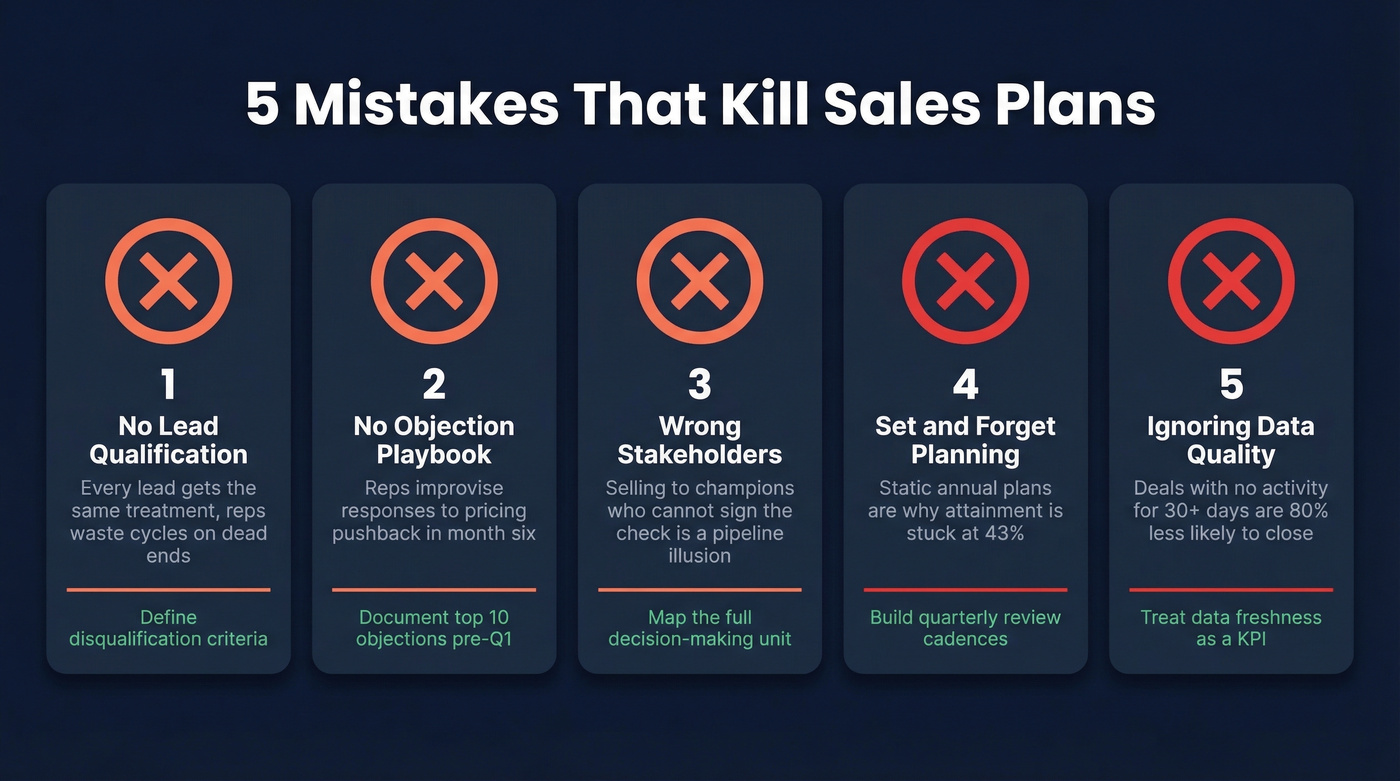
2. No objection-handling playbook. Reps shouldn't improvise responses to pricing objections in month six. Document the top 10 objections and train against them before Q1 starts.
3. Targeting the wrong stakeholders. Selling to a champion who can't sign the check is a pipeline illusion. Map the decision-making unit in your template - economic buyer, technical evaluator, end user, legal. (If you sell complex deals, read technical buyer vs economic buyer.)
4. "Set and forget" planning. Static annual plans are why quota attainment is stuck at 43%. Udemy reduced annual planning time by 80% after moving from static annual plans to in-year adjustments. Build quarterly review cadences with pipeline and conversion checkpoints.
5. Ignoring data quality. Deals with no activity for 30+ days are 80% less likely to close. Stale contacts create stale deals. Treat data freshness as a KPI, not a footnote.
The Tech Stack That Makes It Work
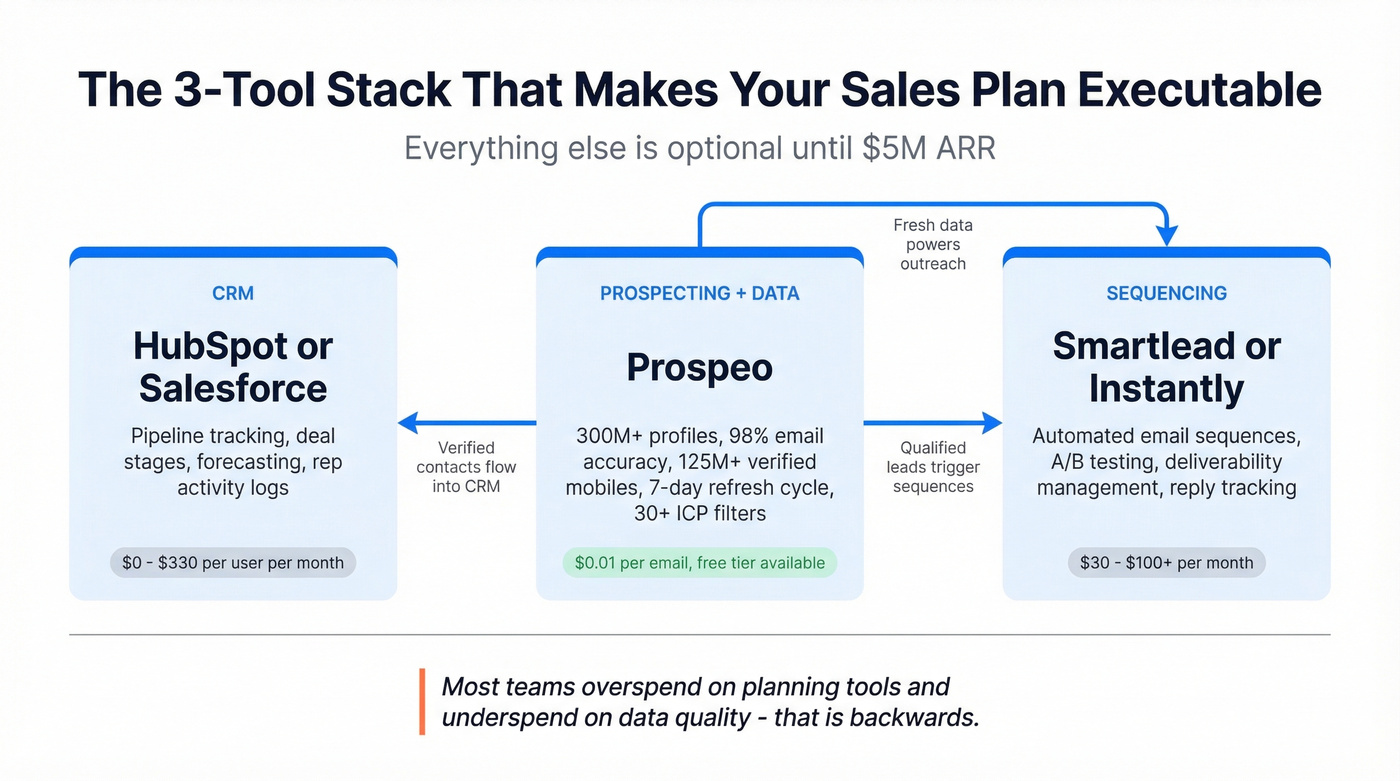
Every team needs three things. Everything else is optional until $5M ARR. AI-powered planning tools can improve forecast accuracy by 25-40% versus spreadsheets, but most teams under 20 reps can run their plan from a CRM and a spreadsheet - and that's fine.
| Category | Tool | Cost |
|---|---|---|
| CRM | HubSpot (free tier) or Salesforce | $0-$330/user/mo |
| Prospecting + Data | Prospeo | ~$0.01/email, free tier available |
| Sequencing | Smartlead or Instantly | ~$30-$100+/mo |
For dedicated sales planning software, expect $50-$200/user/month. But honestly, the consensus on r/sales is that most teams overspend on planning tools and underspend on data quality - and that's backwards. Your CRM is only as good as what goes into it. (If you're evaluating options, see examples of a CRM.)
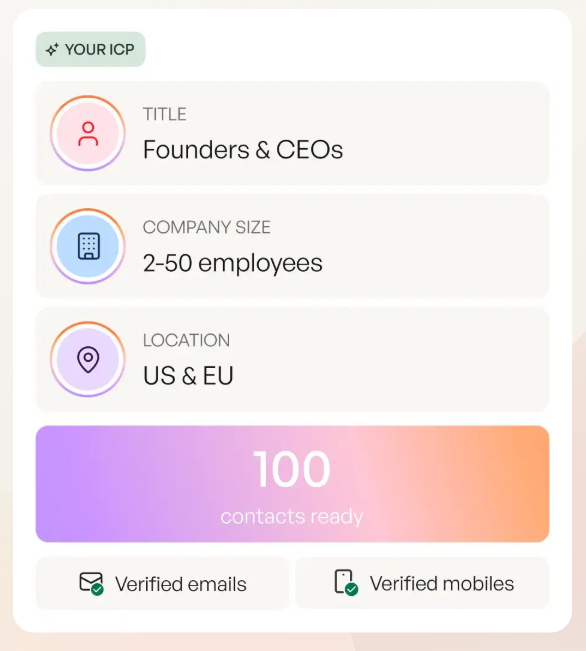
Your template has the benchmarks, the pipeline math, and the methodology. Now you need the data layer that makes it work. Prospeo gives you 30+ filters - buyer intent, technographics, headcount growth, funding - to build the exact ICP segments your strategy defines. No $50K contracts. No sales calls required.
Turn your sales strategy from a document into a pipeline machine.
FAQ
What's the difference between a sales plan and a sales strategy?
A strategy defines how you win - methodology, positioning, ICP. A plan turns that into targets, timelines, headcount, and budget. You need both. The strategy sets direction, and the plan makes it measurable.
How often should you update your sales plan?
Quarterly at minimum, with monthly pipeline coverage check-ins. Udemy cut planning overhead 80% by shifting to rolling in-year adjustments instead of static annual documents.
What's a good pipeline coverage ratio?
3-4x your revenue target is the standard benchmark. Below 3x and you're flying without a net. Above 5x usually signals that qualification criteria are too loose and reps are padding the funnel with deals that'll never close.
What tools do I need to execute a sales plan?
A CRM for pipeline management, a prospecting data platform for verified contacts, and a sequencing tool for automated cadences. Pair Prospeo with HubSpot and Smartlead for a complete stack under $150/month.
How do I build a sales strategy outline from scratch?
Start with the seven sections in this template: revenue targets, ICP segmentation, team capacity, methodology, prospecting channels, comp and budget, and KPIs. Fill in the pipeline math before anything else - it tells you whether your targets are achievable with your current resources. If the math doesn't work, adjust the inputs before you waste a quarter finding out the hard way.