

Target Account Selling: The Framework That Replaces Volume With Precision
Your CRO just handed you 150 accounts and said "go land them." No scoring model, no stakeholder maps, no data on which ones are actually in-market. Just a spreadsheet and a quota. This is how most target account selling initiatives die before they start - and it's why 69% of reps missed quota in 2024 while spending just 28% of their time actually selling, per Ebsta and Pavilion's benchmark report.
The methodology doesn't fail because the concept is wrong. It fails because teams skip the hard parts and jump straight to "send personalized emails to a list."
What You Need (Quick Version)
TAS is a B2B sales methodology that concentrates resources on a small number of data-selected, high-value accounts through personalized, multi-stakeholder engagement. Three things make or break it:
- Account selection quality - most teams pick too many accounts with no scoring model
- Multi-threading across buying groups - not just your champion, the entire decision unit
- Contact data accuracy - stale emails and wrong numbers kill execution before it starts (see email accuracy)
The scored ICP rubric below gives you the exact model to get account selection right.
What Is TAS?
Target account selling is a B2B methodology where sales teams concentrate resources on a curated set of high-value accounts, using data-driven selection and personalized multi-stakeholder strategies to win deals. Instead of spraying outbound across thousands of contacts, you pick 20-50 accounts that genuinely fit your ICP (use an ideal customer profile template) and build deep engagement plans for each.
People confuse TAS with ABM and ABS constantly. ABM is a marketing motion - nurture and awareness. TAS is a sales motion - close the deal. Account-based selling is the umbrella that covers both working together (see account-based selling best practices). The key insight: TAS is where strategy meets execution. It's what your reps actually do inside those target accounts, and it's the foundation of any serious account-focused sales motion.
Why TAS Matters in 2026
The B2B buying environment has gotten brutally complex. Gartner's research found that buying groups now range from 5 to 16 stakeholders across as many as four functions - and 74% of those groups demonstrate unhealthy conflict. Buying groups that reach consensus are 2.5x more likely to report the deal was high-quality.
Volume-based selling keeps getting worse. Win rates are down 18% vs. 2022 according to Ebsta's benchmark data. Outreach's analysis shows that opportunities closed within 50 days have a 47% win rate; after that threshold, it craters to 20% or lower.
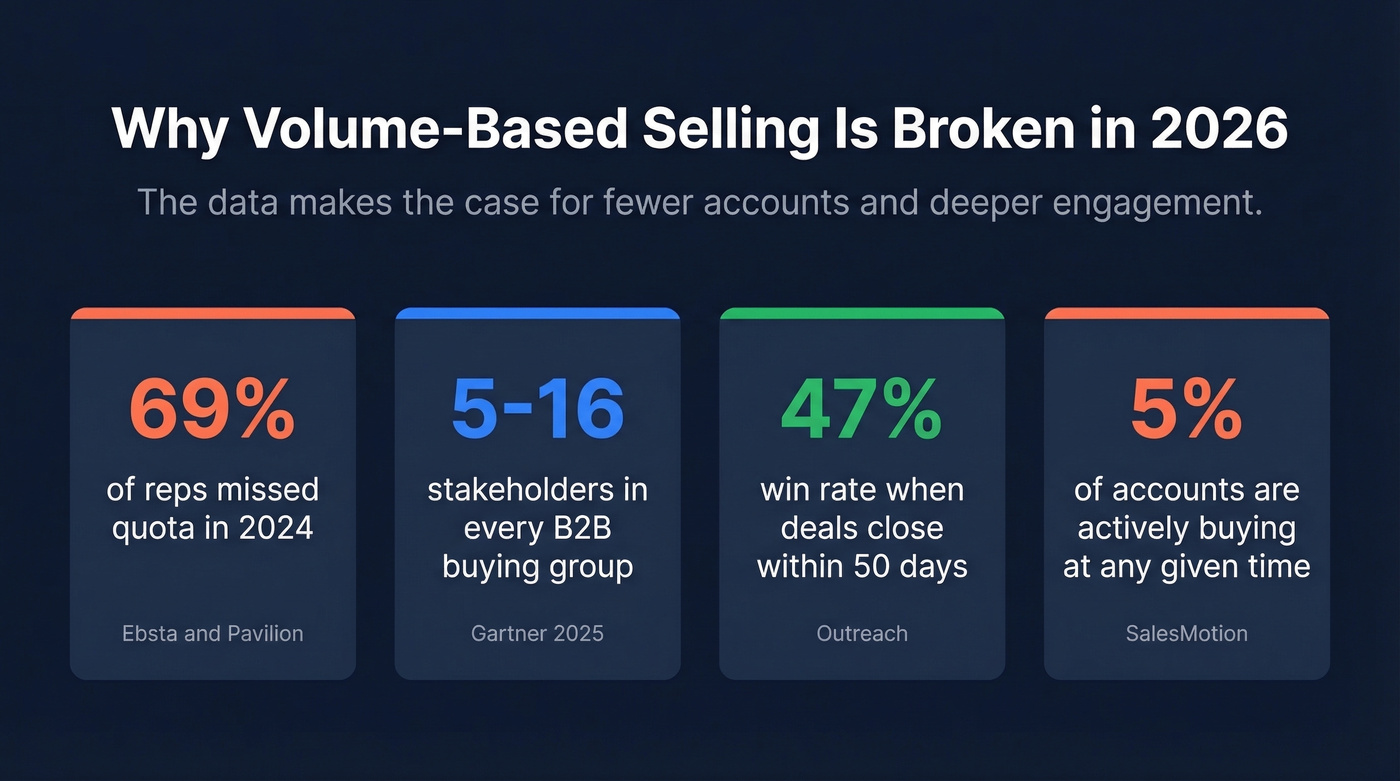
Here's the thing: you can't solve a quality problem with more volume. When reps spend roughly 30% of their time selling and 70% on non-selling activities, and buying groups are fighting internally, the answer isn't "more accounts." It's fewer accounts, deeper engagement, and better data. A disciplined TAS strategy forces that focus (more on data-driven selling).
TAS vs ABM - What's the Difference?
DemandScience frames it cleanly: ABM is a marketing technique focused on ongoing nurture. TAS is a sales technique focused on making the sale.
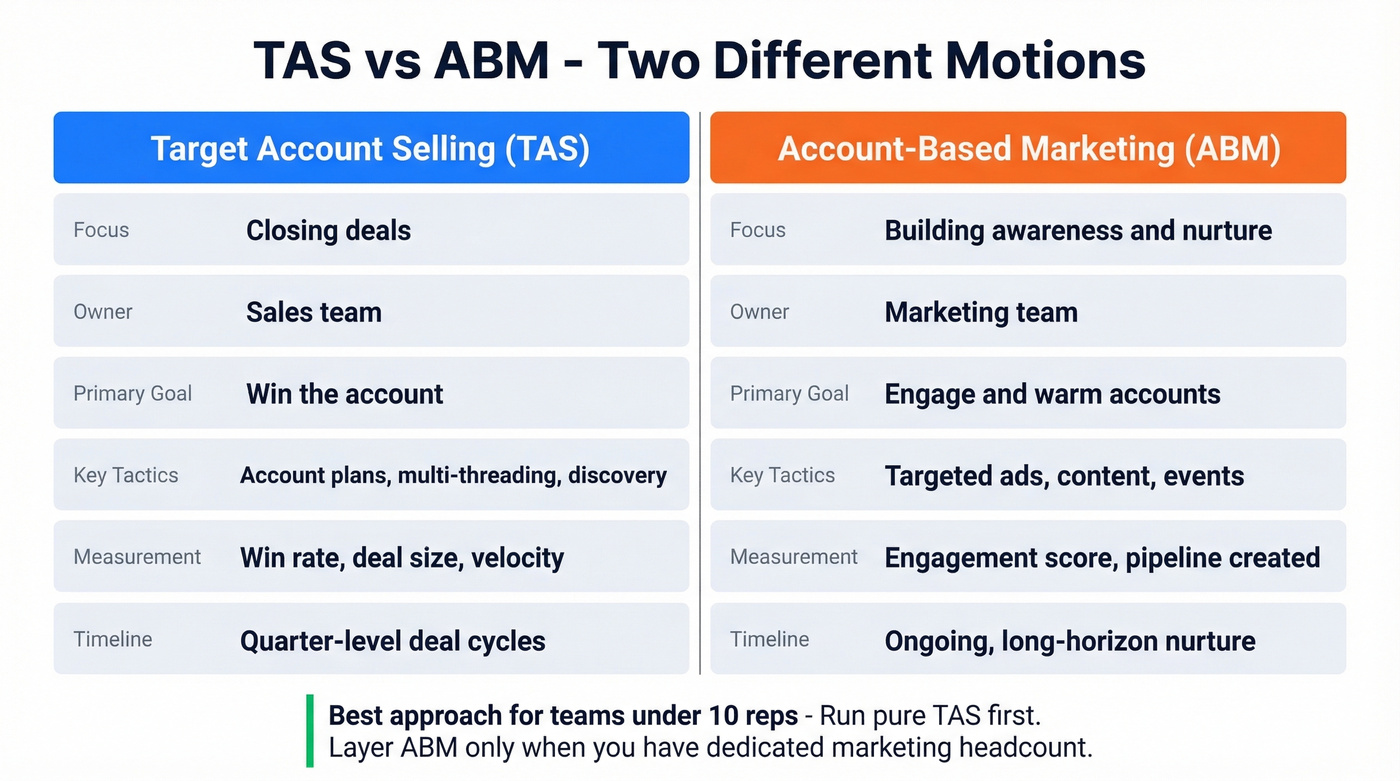
| Dimension | TAS | ABM |
|---|---|---|
| Focus | Closing deals | Building awareness |
| Owner | Sales team | Marketing team |
| Goal | Win the account | Nurture & engage |
| Tactics | Account plans, multi-threading | Ads, content, events |
| Measurement | Win rate, deal size | Engagement, pipeline |
| Timeline | Quarter-level cycles | Ongoing, long-horizon |
The best teams run ABM to warm accounts and TAS to close them. If you're a team under 10 reps, skip the ABM layer entirely and run pure TAS. You don't have the marketing resources to make ABM work, and splitting focus between both motions will dilute the one that actually closes revenue. Get TAS right first, then layer ABM when you have dedicated marketing headcount.
The 6-Step TAS Framework
Each step builds on the previous one. Skipping any of them is how implementations fail.
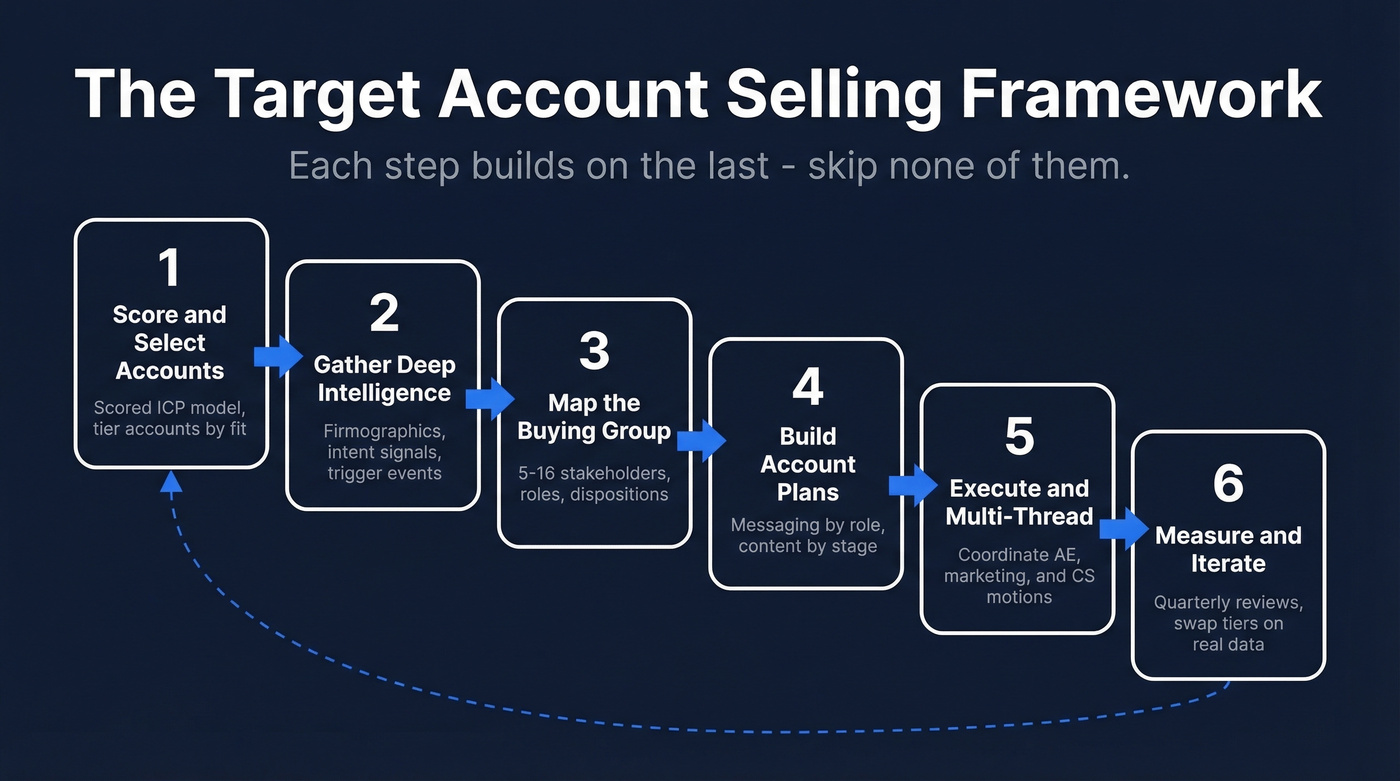
Score and Select Accounts
Stop building 100-account lists. Only 5% of B2B accounts are actively buying at any given time. If you're spreading your team across 100 accounts, you're guaranteeing that 95 of them won't convert this quarter - and you're under-resourcing the five that would.
The consensus on r/sales is that roughly 70% of target accounts get disqualified early. That's exactly what happens when you skip the scoring step. Rigorous selection criteria prevent wasted cycles on accounts that were never going to close (see lead scoring).
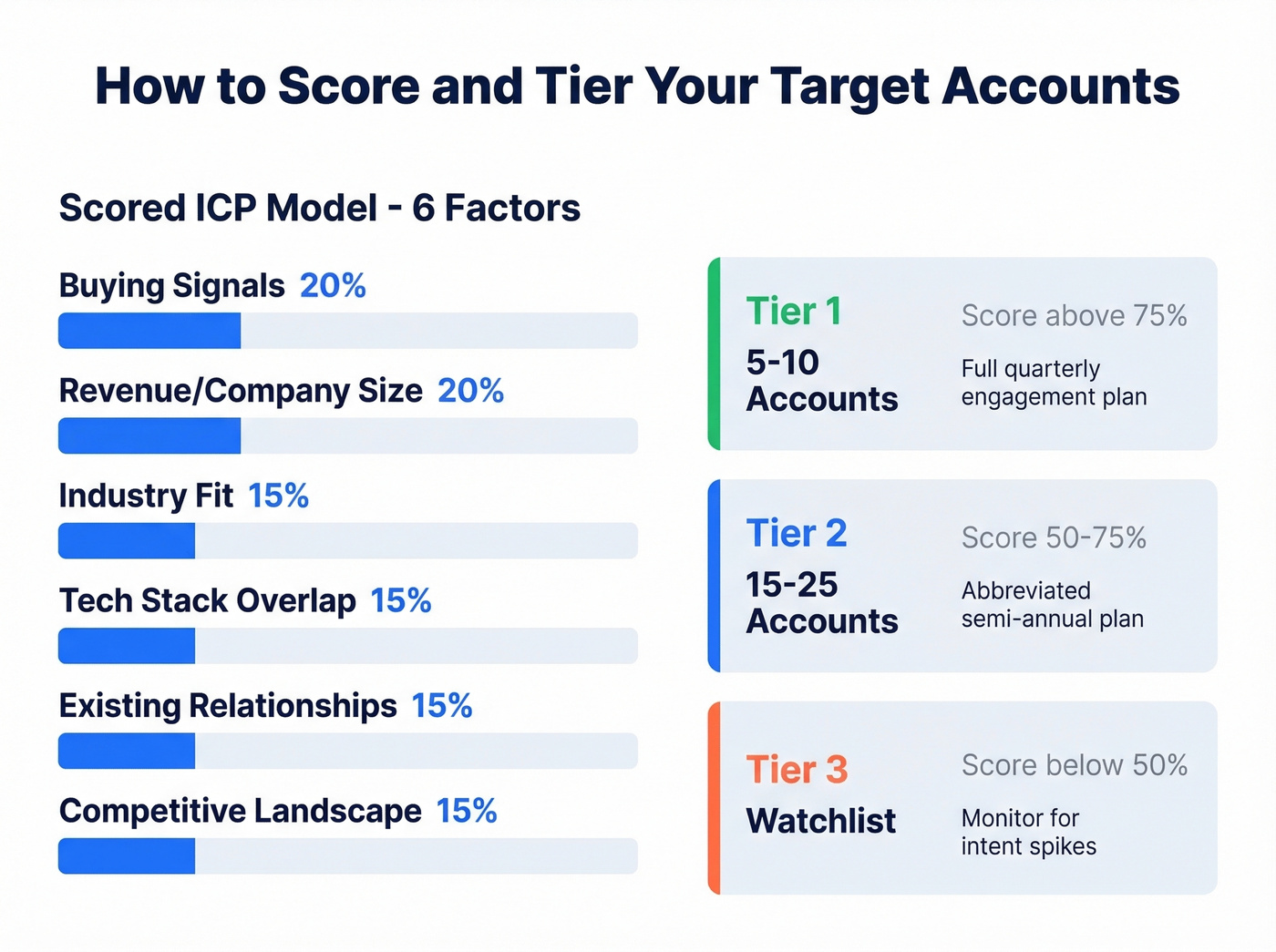
Use a scored ICP model to rank every potential account:
| Factor | Weight | Score 1 (Low) | Score 5 (High) |
|---|---|---|---|
| Revenue/Size | 20% | Outside range | Ideal sweet spot |
| Industry Fit | 15% | Tangential | Core vertical |
| Tech Stack | 15% | No overlap | Uses key tools |
| Buying Signals | 20% | No activity | Active intent |
| Relationship | 15% | No contacts | Exec sponsor |
| Competitive | 15% | Entrenched rival | Greenfield/unhappy |
Accounts scoring above 75% get a full engagement plan. Between 50-75%, a lighter plan. Below 50%, deprioritize and monitor.
For tier sizing: Tier 1 should be 5-10 accounts with full quarterly plans, Tier 2 is 15-25 with abbreviated semi-annual plans, and Tier 3 is a watchlist you revisit when intent signals spike. In our experience, teams that start with more than 25 Tier 1 accounts always end up under-resourcing all of them.
Gather Deep Account Intelligence
Once you've selected accounts, you need to know them cold - firmographics, technographics, intent signals, org structure, competitive landscape, and recent trigger events like funding rounds, leadership changes, and hiring surges (see how to track sales triggers).
Here's where most TAS implementations quietly fail: garbage in, garbage out. You build a beautiful account plan, map the buying group, craft personalized messaging - and then your first email bounces because the contact data is six months old. We've seen this kill more TAS programs than bad strategy ever has. Prospeo's 7-day data refresh cycle and 98% email accuracy exist specifically to solve this problem, so your outreach actually lands instead of bouncing into the void.
Reddit threads are full of reps asking for the easiest free way to build account lists with a CRM and spreadsheets. That manual approach works for 10 accounts. It breaks at 30. The intelligence-gathering phase should produce a one-page brief per Tier 1 account: who they are, what they're dealing with, who's involved in buying decisions, and what trigger would make them move now.
Map the Buying Group
Single-threading into a 12-stakeholder account is how you lose deals you should've won. Gartner's data is unambiguous: buying groups run 5-16 people deep, and 74% of them are fighting internally. Your job isn't just to reach more people - it's to build consensus across conflicting stakeholders.
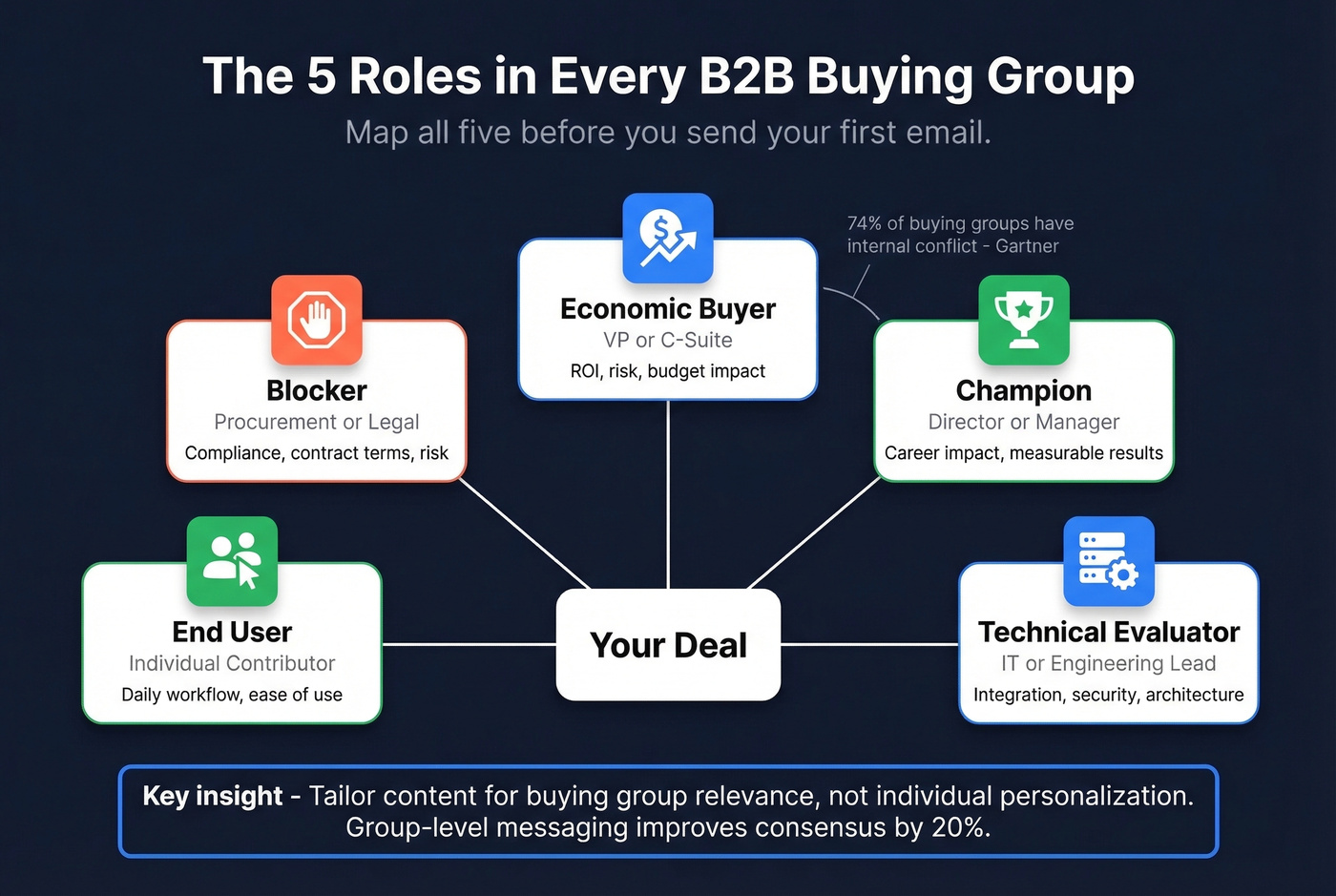
| Role | Typical Title | What They Care About | How to Engage |
|---|---|---|---|
| Economic Buyer | VP/C-suite | ROI, risk, budget | Exec briefings |
| Champion | Director/Manager | Career impact, results | Enable with ammo |
| Technical Eval | IT/Eng Lead | Integration, security | Demos, docs |
| End User | Individual Contrib | Daily workflow ease | Trials, use cases |
| Blocker | Procurement/Legal | Compliance, terms | Proactive answers |
One critical finding from Gartner: tailoring content for buying-group relevance improves consensus by 20%, but tailoring for individual-level relevance actually has a 59% negative impact on consensus. Let's be honest - stop sending hyper-personalized messages to each stakeholder that contradict each other. Align the narrative across the group.
Build Account-Specific Plans
Each Tier 1 account needs a plan mapping messaging to stakeholder roles, channels to preferences, and content to buying stages. Economic buyers get ROI models and executive briefings early. Champions need internal sell materials they can forward to their boss. Technical evaluators want integration docs and sandbox access before they'll advocate.
Content should progress from problem-awareness to solution-validation to risk-mitigation as the deal advances. This is where a strong account strategy becomes the difference between a deal that stalls and one that closes.
Execute and Multi-Thread
We've watched teams treat multi-threading as "email five people instead of one." That misses the point entirely.
Multi-threading means building consensus across stakeholders with conflicting priorities. The VP cares about cost reduction. The director cares about team productivity. The IT lead cares about security. Your job is to connect those threads into a coherent story that gets everyone to yes - or at least to "I won't block this."
Execution requires coordination between your AE, marketing, and customer success. Your AE runs discovery with the champion while marketing serves targeted content to the economic buyer and CS shares relevant case studies with the technical evaluator. If those three motions aren't synchronized, you're just creating noise inside the account instead of building momentum (see sales execution).
Measure, Review, Iterate
Set a calendar cadence: quarterly reviews for Tier 1 where you reassess scoring, update stakeholder maps, and adjust engagement plans. Semi-annual reviews for Tier 2 to check for buying signals that warrant promotion to Tier 1. Be willing to swap accounts in and out of tiers based on real data, not hope.

Your ICP scoring model is only as good as the data behind it. Prospeo gives you 30+ filters - buyer intent, technographics, headcount growth, funding - to score and select target accounts with precision, not guesswork.
Stop building target account lists on stale data. Build them on 300M+ verified profiles.
What Goes in a TAS Account Plan
Fewer than 20% of companies have fully embedded account planning into their operations, per Momentum ITSMA. The checklist below is what separates the 20% from the rest.
A TAS account plan isn't a CRM field you fill in once. It's a living document your entire team references before every touchpoint:
- Account overview: Company snapshot, strategic priorities, recent triggers, competitive landscape
- Whitespace analysis: Where you're already engaged vs. untapped departments or use cases
- Stakeholder map: Every person in the buying group, their role, disposition (champion/neutral/blocker), and last interaction
- Relationship strategy: Who owns each stakeholder relationship and the next move with each
- Milestones and timeline: Contract renewals, budget cycles, board meetings - dates that create urgency
- Competitive positioning: Who else is in the deal, their strengths, your counter-narrative (see competitive intelligence strategy)
- Next actions: Specific, assigned, time-bound steps - not vague "follow up" items
Build plan reviews into your existing pipeline meetings so they're part of the rhythm, not extra work. Plans that sit in a shared drive untouched are worthless.
Why Implementations Fail
Staying tactical instead of strategic. A team picks 30 accounts, builds a contact list, and starts blasting sequences. That's outbound with a fancier label. TAS requires account-level strategy: understanding buying group dynamics, mapping competitive positioning, and building engagement plans that span months.
Being reactive instead of proactive. The account goes dark for three weeks and nobody notices until the quarterly review. Proactive execution means monitoring trigger events and reaching out before the buyer signals they need something. By the time they come to you, they've already talked to two competitors.
Assuming internal alignment exists when it doesn't. We've watched this play out dozens of times - the champion is enthusiastic, the AE marks the deal as "on track," and procurement kills it three weeks later. SalesOutcomes' research confirms this is one of the most common failure modes. Account plans exist to fix it - they synthesize objectives, milestones, and action items so the entire team sees the same picture.
Real-World TAS Scenarios
The framework above isn't theoretical. Two common situations show where the difference between TAS and generic outbound becomes obvious:
A mid-market SaaS team identifies a Tier 1 account showing hiring surges in RevOps, maps five stakeholders across sales and IT, and runs a coordinated sequence that lands a VP demo within two weeks - because the account plan flagged a contract renewal with a competitor. Without the scoring model and stakeholder map, that timing window would've been invisible.
An enterprise rep inherits a "dead" account, re-scores it using the ICP rubric, discovers new intent signals, and re-engages through a different champion in a department the previous rep never touched. The deal closes in one quarter. Same account, completely different outcome - because the rep followed the framework instead of recycling the old approach.
8 TAS Performance KPIs
- Pipeline velocity - Are deals moving faster through stages? (track pipeline health)
- Average deal size - TAS should push this up as you land larger accounts
- Win rate - The headline metric; compare TAS accounts vs. non-TAS
- Sales cycle length - Should compress as multi-threading accelerates consensus
- Stakeholder engagement depth - How many contacts per account are actively engaged?
- Meeting-to-opportunity conversion - Are initial meetings turning into real pipeline?
- Revenue per account - Tracks expansion and cross-sell within target accounts
- Account penetration - Percentage of identified buying group members you've engaged
These metrics come from Highspot's ABS framework and map directly to TAS outcomes. Track them at the account level, not just the deal level.
The TAS Tech Stack
You need five categories covered, integrated so data flows without manual work.
CRM
Salesforce typically runs ~$25-$330/user/month depending on edition, and HubSpot offers a free CRM with paid Sales seats commonly ~$100+/user/month. This is your system of record for account plans, stakeholder maps, and deal tracking. Non-negotiable (see examples of a CRM).
Sales Engagement
Outreach and Salesloft are typically ~$100-$200/user/month depending on package and volume. They manage multi-channel sequences and track engagement across stakeholders (see implementing a sales engagement platform).
Data and Intent
This is where your TAS strategy lives or dies. Prospeo covers 300M+ professional profiles, 143M+ verified emails, and 125M+ verified mobile numbers on a 7-day refresh cycle. Use 30+ search filters to build your target account list by buyer intent, technographics, headcount growth, and funding - then export verified contacts directly to your CRM. Free tier available, paid plans from ~$0.01/email, no contracts.

Conversation Intelligence
Gong is typically enterprise-priced, often ~$1,200-$1,800/user/year. It records and analyzes sales calls, giving you visibility into multi-threaded accounts. Skip this if you have fewer than five AEs running TAS - prioritize data and engagement first, then add conversation intelligence once you have enough call volume to coach against.
You can run TAS with a CRM and a spreadsheet. I've seen teams do it. But manual processes break down past 30 account plans, and bad contact data will sabotage even the best strategy.
Mapping a 12-stakeholder buying group means nothing if half your contacts bounce. Prospeo delivers 98% email accuracy and 125M+ verified mobile numbers on a 7-day refresh cycle - so every thread in your multi-threading strategy actually connects.
Multi-thread into buying groups with contacts that pick up the phone.
FAQ
How many target accounts should I start with?
Start with 20-50 total across three tiers. Tier 1 gets full engagement plans for 5-10 accounts, Tier 2 runs lighter plans across 15-25, and Tier 3 is a monitoring list. Expand only after you've proven the model works on a small set - most teams that jump to 100+ accounts dilute their effort and see worse win rates than generic outbound.
What sales methodologies pair well with TAS?
TAS is the strategic wrapper that tells you where to focus. Layer MEDDIC for deal qualification, Challenger for messaging, and SPIN for discovery calls. They're complementary - MEDDIC validates the deal is real, Challenger shapes the narrative, and TAS ensures you're running those plays inside the right accounts.
How do I get verified contacts for my target accounts?
Use a B2B data platform with real-time verification and a fast refresh cycle. Prospeo's 30+ search filters let you build lists by role, seniority, intent signals, and technographics, then export verified emails and direct dials directly to your CRM. The free tier includes 75 email credits per month - enough to test the workflow on your first Tier 1 accounts without a contract.
What's the biggest mistake teams make with target account selling?
Treating it as outbound with a fancier label. Teams pick 50 accounts, build a contact list, and blast sequences - skipping account scoring, buying group mapping, and engagement planning entirely. Without those three steps, you're just doing volume-based selling to a smaller list, which gives you the worst of both worlds: low coverage and low personalization.