

Technology Leads: How to Find, Qualify, and Convert Tech Buyers in 2026
Last quarter, a RevOps director told us her team generated 4,200 technology leads in Q1. Eighty percent were useless - wrong titles, dead emails, companies that had already bought a competitor. She'd spent six figures on content syndication and a legacy database, and the pipeline impact was negligible. That's the problem in a nutshell: volume is easy, quality is rare.
If you landed here looking for the tech lead engineering role - the senior developer who owns architecture and mentors the team - this guide from Merit covers that well. This article is about generating, qualifying, and converting sales leads in the technology sector.
The Short Version
Technology leads convert when you prioritize data accuracy and buyer intent over raw volume - more than 90% of MQLs never become customers. Start with a verified data platform, layer in one intent signal like Bombora or TechTarget, and route leads through your CRM with clear handoff rules. Skip agencies until you've proven your ICP and messaging. DIY with good data beats outsourced volume every time.
What Are Technology Leads?
They fall into two buckets. First, decision-makers at technology companies - CTOs, VPs of Engineering, IT Directors at SaaS firms, hardware manufacturers, and MSPs. Second, decision-makers at any company who buy technology - the CIO at a healthcare system evaluating a new EHR, or the VP of Operations at a logistics company shopping for warehouse automation.
The distinction matters because your targeting, messaging, and channels shift depending on which bucket you're after. Selling cybersecurity to a fintech CTO requires different intent signals than selling the same product to a retail chain's IT director. And within each bucket, you need to separate MQLs from SQLs - leads with confirmed budget, authority, and timeline. Most teams treat these identically, which is why their pipeline is full of noise.
Here's the thing: the industry spent a decade optimizing for lead volume - form fills, gated PDFs, webinar registrations - while conversion rates stayed flat. The shift now is from capturing demand to creating it, and from counting MQLs to measuring pipeline influence. If your tech lead generation program still celebrates "leads generated" as a primary KPI, you're measuring the wrong thing. (If you want a tighter system, start with lead generation metrics and a documented lead generation workflow.)
The Technology Buyer in 2026
The B2B technology buying cycle is longer, more complex, and more front-loaded than most sellers realize.
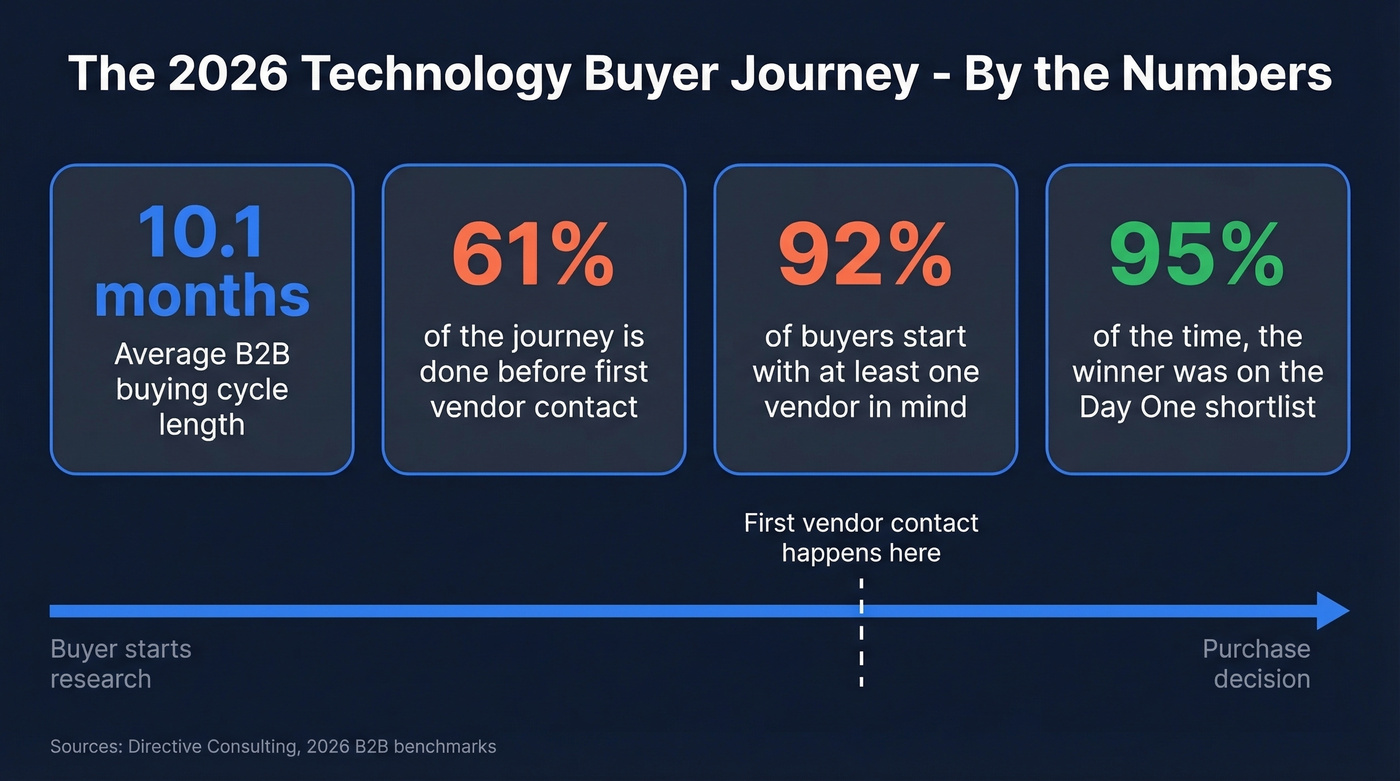
The average B2B buying cycle runs 10.1 months. For enterprise technology purchases with multiple stakeholders and security reviews, it stretches longer. First contact with a vendor doesn't happen until 61% of the journey is already complete - your prospect has done months of research, read analyst reports, and talked to peers before you even know they exist.
That front-loading creates a brutal dynamic. 92% of buyers start with at least one vendor in mind, and 41% already have a preferred vendor before formal evaluation begins. The winning vendor appears on the Day One shortlist 95% of the time. If you're not on that shortlist, your odds are terrible regardless of how good your demo is.
For technology purchases specifically, buying committees make this worse. IT purchases typically involve more than five stakeholders - the technical evaluator, the budget holder, the security team, procurement, and often a C-level sponsor. Each person has different concerns, different content preferences, and different timelines. A single lead is really an entry point into a committee, not a deal in itself.
Brand awareness and early-stage content matter more than most outbound teams want to admit. You need to be known before the buying cycle starts, and you need to reach multiple people in the account once it does. (This is where B2B brand positioning and account-based selling best practices pay off.)
Three Ways to Source Tech Leads
Data Platforms
Self-serve data platforms let you build your own lead lists using filters like job title, industry, company size, technographics, and intent signals. This is the fastest path from "I need contacts" to "I'm sending emails."
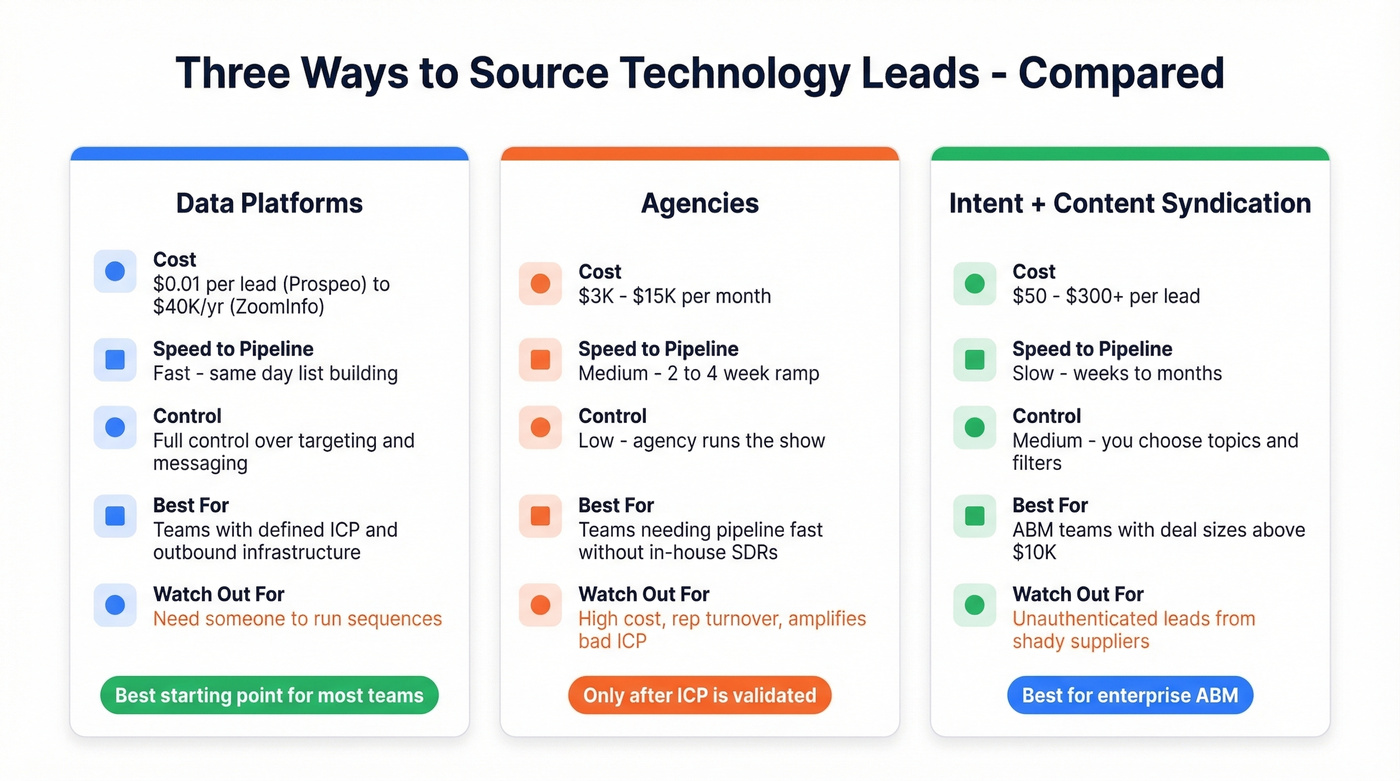
ZoomInfo is the enterprise benchmark - 500M+ professional contacts and deep workflow integrations. But mid-market contracts run $15K-$40K/year, and you're paying for modules whether you use them or not. Prospeo covers 300M+ profiles with 98% email accuracy and a 7-day data refresh cycle at roughly $0.01 per lead - no annual contracts, no sales calls required.
Use this if: You have a defined ICP and want to control targeting, messaging, and cadence yourself. Skip this if: You have zero outbound infrastructure and no one to run sequences. (If you're building your stack, compare sales prospecting databases and outbound lead generation tools.)
Agencies
Done-for-you lead generation agencies handle everything from list building to outreach to appointment setting. CIENCE runs multi-channel SDR programs but has high rep turnover. Belkins focuses on appointment setting with strong deliverability practices. Callbox specializes in technology and IT verticals with global reach. Expect $3K-$15K/month depending on scope.
Use this if: You need pipeline fast and don't have in-house SDRs. Skip this if: You haven't validated your ICP and messaging yet - agencies amplify what works, they don't figure it out for you.
Intent + Content Syndication
Intent data identifies companies actively researching topics related to your product. TechTarget leads with first-party intent from its owned tech media network. Bombora aggregates intent across a co-op of B2B publishers. Content syndication distributes your whitepapers and guides through publisher networks, generating leads who've downloaded your content.
Syndication has a catch, though. If your vendor can't show you exactly where leads came from - which sites, which content, which geography - fire them. Some suppliers buy unauthenticated leads from third-party networks, and you'll end up with garbage data dressed up as "technology decision-maker leads."
Good fit for ABM teams prioritizing accounts showing active buying signals. Bad fit for teams with average deal sizes under five figures - the CPL ($50-$200+ for syndication, $100-$300+ for intent-based ABM) won't pencil out.

That RevOps director's problem - 80% useless leads from a legacy database - doesn't happen with a 7-day data refresh cycle. Prospeo's 300M+ profiles, 30+ filters including technographics and buyer intent, and 98% verified email accuracy mean your technology lead lists connect you to real decision-makers, not dead ends.
Replace six-figure data contracts with $0.01 per verified tech lead.
Top Strategies for Tech Lead Generation
Content syndication. Distribute gated assets through publisher networks to reach buyers actively consuming content in your category. Demand supplier transparency on lead sourcing - if they can't tell you which sites generated your leads, the quality is suspect.
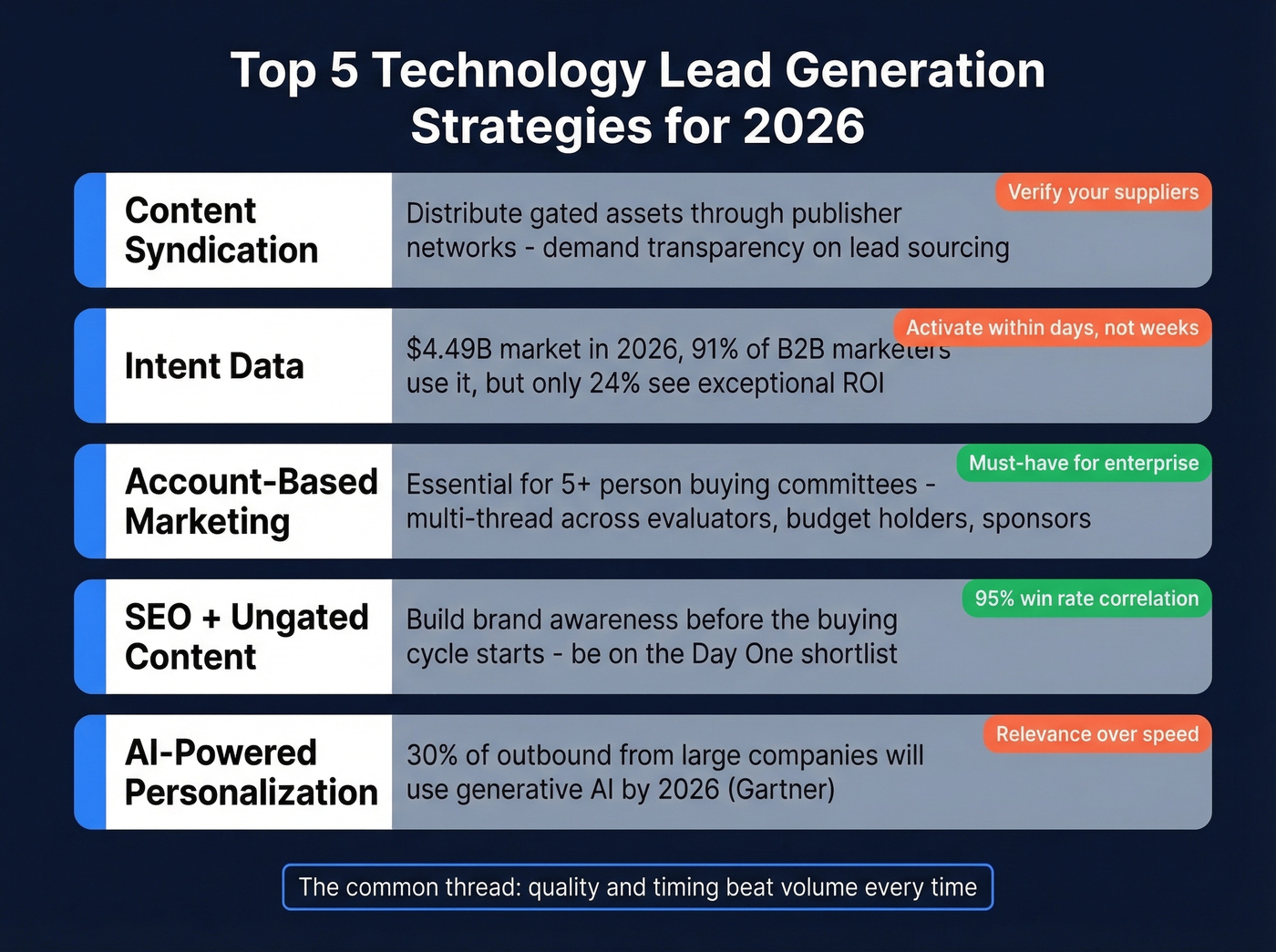
Intent data. The B2B intent data market hit $4.49B in 2026, and 91% of B2B marketers use some form of intent signal. Only 24% report exceptional ROI. The gap isn't the data - it's the activation. Intent signals need to trigger specific outreach sequences within days, not sit in a dashboard. (If you need a practical framework, use intent based segmentation and a simple lead scoring model.)
Account-based marketing. For technology purchases with five-plus-person buying committees, ABM isn't optional. It's the only motion that addresses the full decision group. Target the account, then multi-thread across technical evaluators, budget holders, and executive sponsors with tailored messaging for each.
SEO and ungated content. The 2026 shift is away from gated PDFs - which are non-trackable post-download and increasingly ignored - toward ungated, high-value content that builds brand awareness before the buying cycle starts. Remember: 95% of the time, the winner was on the Day One shortlist. SEO gets you there. (For a channel-specific playbook, see SEO sales leads.)
AI-powered personalization. Gartner predicts that by 2026, 30% of outbound messages from large companies will be personalized using generative AI. The teams seeing results aren't using AI to write generic emails faster - they're using it to reference specific technographic signals, recent funding rounds, and job postings. Personalization without relevance is just spam with the prospect's name on it. (If you're operationalizing this, start with AI cold email outreach.)
Best Tools for Technology Leads
The tool matters less than the data quality inside it. We've seen teams spend $40K/year on ZoomInfo and bounce 25% of their emails because they never verified the exports. (If you're troubleshooting, use these email bounce rate benchmarks and fixes.)
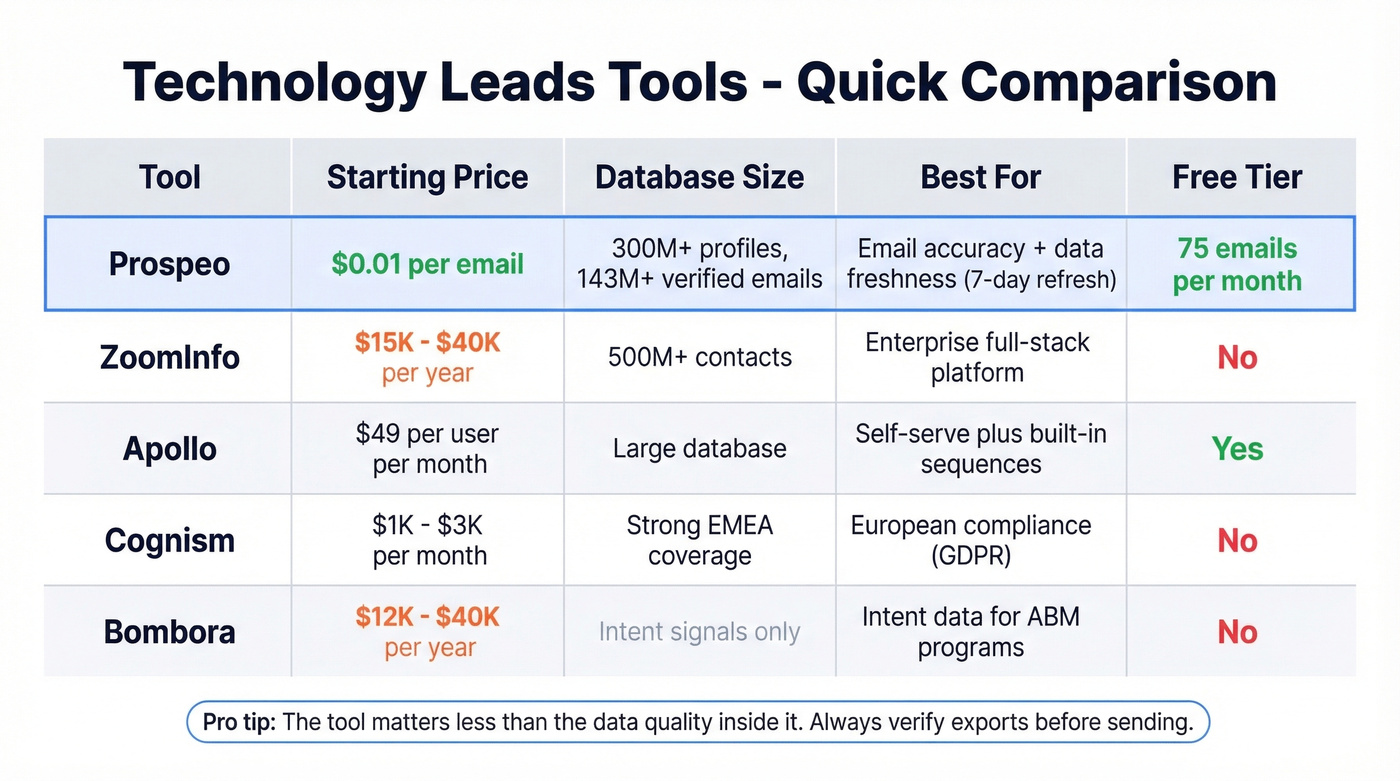
| Tool | Starting Price | Free Tier | Best For |
|---|---|---|---|
| Prospeo | ~$0.01/email | 75 emails/mo | Email accuracy + freshness |
| ZoomInfo | $15K-$40K/yr | No | Enterprise full-stack |
| Apollo | ~$49/mo/user | Yes | Self-serve + sequences |
| Cognism | ~$1K-$3K/mo | No | EMEA compliance |
| Bombora | $12K-$40K/yr | No | Intent signals |
| Lusha | $29-$51/user/mo | 5 credits/mo | Small team lookups |
| Hunter.io | $34-$349/mo | 25 searches/mo | Domain search |
| Kaspr | $49/mo/user | Yes | Quick lookups |
| Snov.io | $35-$75/mo | Trial | Email sequences |

Prospeo
Prospeo's database covers 300M+ professional profiles with 143M+ verified emails and 125M+ verified mobile numbers. The 98% email accuracy rate is backed by real results - Snyk's 50-person AE team switched and watched their bounce rate drop from 35-40% to under 5%, generating 200+ new opportunities per month. Meritt tripled their pipeline from $100K to $300K per week after making the same move.
What sets it apart is a 7-day data refresh cycle against an industry average of six weeks, plus proprietary email-finding infrastructure that doesn't rely on third-party providers. The 30+ search filters include Bombora-powered intent data across 15,000 topics, technographics, job changes, headcount growth, and funding signals - all exportable to Salesforce, HubSpot, Lemlist, or Instantly. At roughly $0.01 per lead with a free tier of 75 emails per month, it's the strongest starting point for B2B technology lead generation.
ZoomInfo
Here's the question Finance will eventually ask: why are we spending $35K/year on ZoomInfo when reps only use the search bar? ZoomInfo remains the 800-pound gorilla - 500M+ professional contacts, 200M verified business emails, 135M verified phone numbers, and 1.5B data points processed daily. The platform spans intent data, conversation intelligence, website visitor tracking, and workflow automation. For enterprise teams running coordinated outbound, ABM, and marketing programs from one platform, the breadth is unmatched.
The tradeoff is price and complexity. A 10-seat contract with intent data and mobile numbers can run $40-60K/year. The consensus on r/sales is that most teams pay for modules they never touch. If your primary need is accurate contact data for outbound sequences, you're buying a Swiss Army knife when you need a scalpel.
Apollo
The obvious starting point for SMBs or early-stage teams with no budget. Apollo's free tier gives you access to a large contact database with built-in email sequences and a clean UI that gets reps productive in hours. Paid plans start around $49/mo per user. Great for getting started, less reliable once you're sending at scale and deliverability matters.
Cognism
Selling into the UK or EU? Cognism is the compliance-first choice. Diamond-verified mobile data, checks against 15 DNC lists, and strong GDPR infrastructure make it the safest option for EMEA outbound. Pricing runs around $1K-$3K/month for small teams. ZoomInfo wins on US database depth. Cognism wins on EMEA mobile numbers and regulatory peace of mind.
Bombora
Bombora is the intent data layer, not a contact database. It powers the intent signals inside platforms like ZoomInfo and Demandbase. Standalone pricing runs $12K-$40K/year for account-level surge signals across thousands of topics - useful for ABM prioritization, but you'll still need a contact database to act on the signals.
Lusha, Hunter.io, Kaspr, Snov.io
Lusha ($29-$51/user/month) works for small teams needing quick contact lookups with a simple Chrome extension. Hunter.io ($34-$349/month) is best for domain-based email search - find everyone at a company, fast. Kaspr ($49/month/user) offers quick lookups with a free tier but limited database depth. Snov.io ($35-$75/month) bundles email finding with basic sequences - decent for solopreneurs, outgrown quickly by teams.
Reaching five-person buying committees means you need accurate emails and direct dials across every stakeholder. Prospeo delivers 98% email accuracy and 125M+ verified mobile numbers with a 30% pickup rate - so you actually get through to the CTO, the CISO, and the budget holder.
Reach every stakeholder in the buying committee, not just the one who filled out a form.
Compliance Before You Buy
Before you purchase or build any lead list, know the regulatory rules. Compliance is your responsibility regardless of which tool you use.
| Regulation | Key Requirement | Penalty |
|---|---|---|
| GDPR | Transparency + legal basis | Up to EUR 20M / 4% revenue |
| CCPA | Opt-out + right to know | $2,500-$7,500 per violation |
| CAN-SPAM | Opt-out + truthful headers | Up to ~$50K+ per email |
| TCPA | Prior consent + DNC scrub | $500-$1,500 per call/text |
| CASL | Consent + unsubscribe | Up to $10M CAD per violation |
Most teams ignore compliance until something goes wrong. CAN-SPAM penalties add up fast on a 5,000-contact campaign. TCPA violations for cold calling without DNC scrubbing can bankrupt a startup. Build compliance into your workflow from day one: verify opt-out status, include physical addresses, and scrub against do-not-call lists before every campaign.
Beyond fines, purchasing static lead lists can damage your brand reputation. When prospects receive unsolicited outreach from a company they've never heard of, using data they never consented to share, the brand impression is negative before you've said a word. Build your own lists with verified, fresh data instead.
Mistakes That Kill Tech Lead Generation
Misaligned handoffs. Marketing says it's an MQL. Sales says it's garbage. The fix is shared MQL/SQL definitions with documented criteria, plus SLAs on follow-up timing. If marketing and sales can't agree on what "qualified" means, nothing downstream works. (If you need templates, use these handoff email templates.)
Low-quality placements. Your content syndication vendor is inflating volume with leads from unknown third-party sites. Audit supplier transparency quarterly. Demand placement-level reporting showing which sites generated which leads.
Broken attribution. Your CRM, marketing automation, and intent tools aren't connected, so you can't tell which channels actually produce pipeline. Integrate your stack before scaling spend. We've seen outbound agencies achieve 94%+ deliverability, under 3% bounce rates, and zero domain flags across all clients - but only because they connected every tool in the chain.
Slow lead activation. A technology buyer who downloads your whitepaper today is talking to your competitor tomorrow. Manual lead routing kills speed-to-lead. Automated routing rules in your CRM with a speed-to-lead KPI are non-negotiable.
No real nurture. Generic drip sequences don't convert tech buyers with 10-month buying cycles. You need intent-driven nurture tracks that adapt based on what the account is researching, not just where they sit in your arbitrary funnel stages.
Benchmarks - What Good Looks Like
The number to know: across 100M+ data points and 14 industries, the average qualified lead conversion rate is 2.9%. That breaks down to a 1.7% form rate and a 1.2% call rate. For technology specifically, expect 1.5-3% given longer buying cycles and larger committees. (For more context, see average B2B lead conversion rate.)
Those numbers feel low, and they are. But they reflect the reality that most lead gen programs optimize for volume at the top while ignoring conversion quality throughout the funnel. Teams that layer intent signals on top of accurate contact data and run multi-threaded outreach into buying committees consistently beat these averages.
Let's be honest: if your average deal is under $15K, you probably don't need ZoomInfo-level data infrastructure. A self-serve platform with high email accuracy and basic intent signals will outperform an enterprise suite that your team uses at 20% capacity. The gap between "demand capture" and "demand creation" is where the best technology lead generation programs differentiate - and that gap is closed by strategy, not by spending more on tools.
FAQ
What's the difference between technology leads and IT leads?
They're the same concept with different labels. "IT leads" typically refers to infrastructure and operations decision-makers - sysadmins, IT directors, CIOs managing internal tech stacks. "Technology leads" is broader, encompassing software buyers, engineering leaders, and anyone making technology purchasing decisions. Use whichever term matches your prospect's self-identification.
How much does a technology lead cost?
Content syndication runs $50-$200+ per lead. Intent-based ABM campaigns cost $100-$300+ per qualified lead. Self-serve data platforms bring the cost down to roughly $0.01 per verified email - the most cost-effective option for teams building their own lists. The real question isn't CPL; it's cost per qualified opportunity.
Should I buy a lead list or build my own?
Build your own. Static purchased lists decay fast as people change jobs, companies merge, and emails go stale. Beyond data decay, purchased lists carry brand reputation risk - prospects who receive unsolicited outreach from unknown companies form negative impressions before you've said a word. Real-time verified data from a platform with weekly refresh cycles converts better and protects your sender reputation.
What's the best intent data provider for tech buyers?
Bombora for breadth across thousands of topics and the largest B2B publisher co-op. TechTarget for first-party tech intent from its owned media network - especially strong for IT infrastructure and enterprise software categories. Several platforms now bundle Bombora-powered intent signals with verified contact data, so you don't need to buy intent and contacts separately.
How do I verify leads before outreach?
Never send to an unverified list. Run every list through a dedicated verification tool that includes catch-all handling, spam-trap removal, and honeypot filtering before loading into your sequencer. A 20% bounce rate doesn't just waste sends - it damages your domain reputation and tanks deliverability for every future campaign. Top teams keep bounce rates under 3%.