

What Affects Email Open Rates? 7 Factors in 2026
Why Most Open Rate Advice Is Backwards
You've A/B tested 47 subject lines. Emojis, questions, first names, urgency words - your open rates haven't budged. One marketer on r/hubspot switched domains, batched sends to 30 emails every 15 minutes, ran a highly targeted list, and still sat at 12%. Another on r/DigitalMarketing said they can't crack 20% despite a year of verified lists and a dedicated sending platform.
So what actually affects email open rates if it isn't the subject line?
Here's the thing: most guides start with the one variable you can see (subject lines) and ignore the ones you can't - authentication, inbox placement, sender reputation. We've watched teams burn months optimizing copy when the real problem was that 17% of their emails never reached a human inbox. Let's flip the order.
Diagnostic Order: Where to Start
If your open rate is stuck below 20%, work through this list top to bottom:
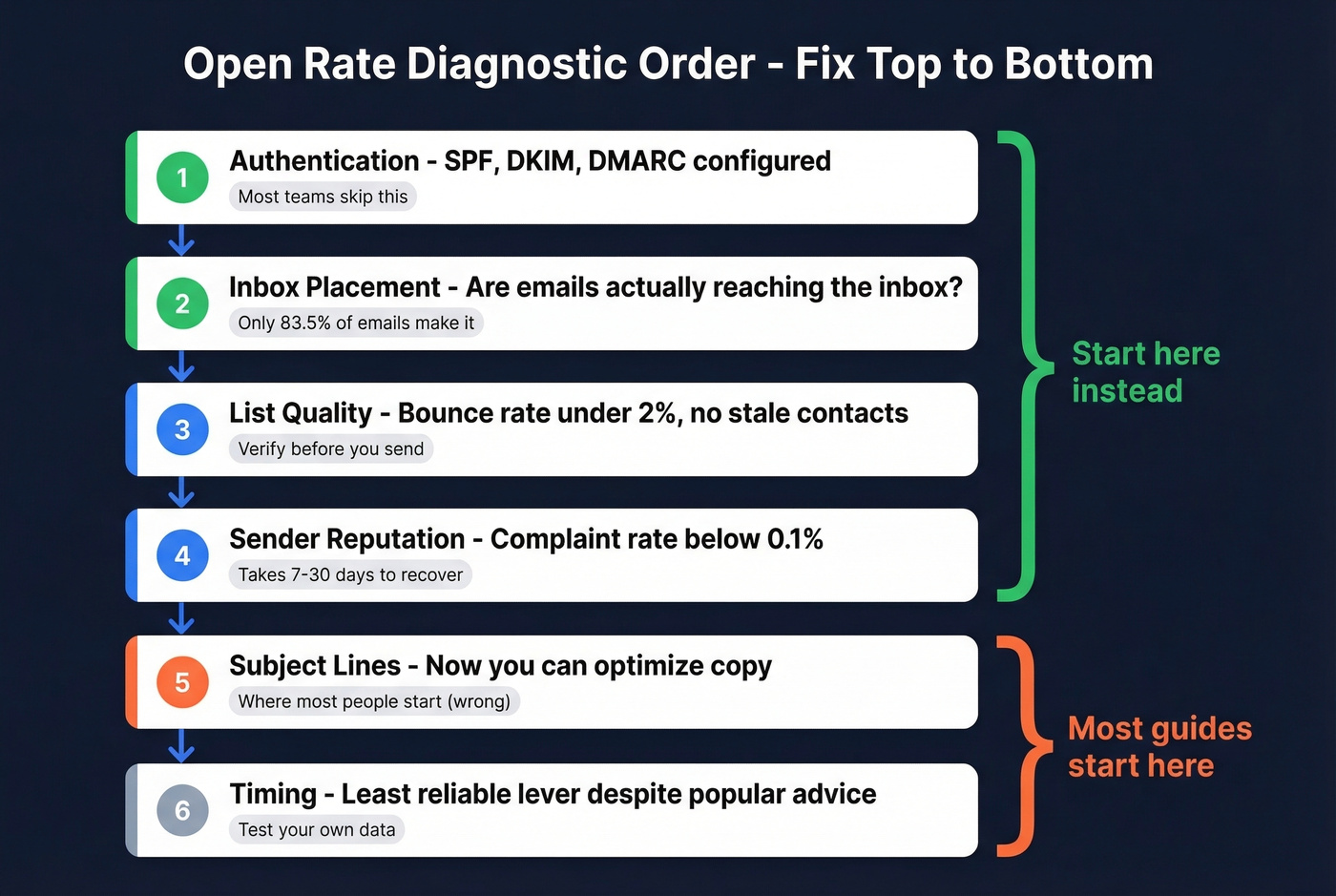
- Authentication - SPF, DKIM, DMARC properly configured
- Inbox placement - are emails actually reaching the inbox?
- List quality - bounce rate under 2%, no stale contacts
- Sender reputation - complaint rate below 0.1%
- Subject lines - now you can optimize copy
- Timing - one of the least reliable levers, despite what most guides lead with
Most people start at #5. That's why nothing moves.
7 Factors That Affect Email Open Rates
1. Inbox Placement and Deliverability
Your ESP might report a 98% delivery rate - meaning the receiving server accepted the email. But global average inbox placement sits at just 83.5%. Roughly 1 in 6 marketing emails never gets seen by a human.
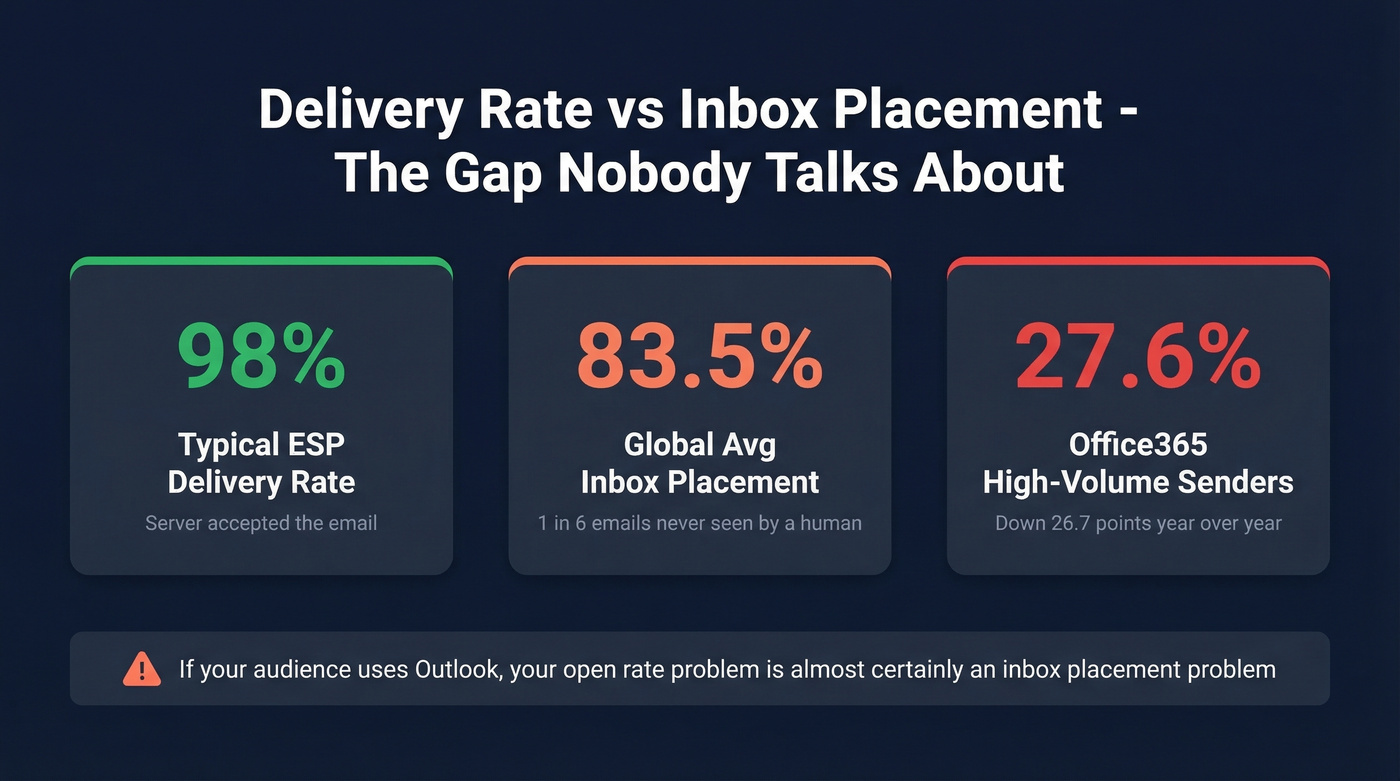
Microsoft has been especially brutal for B2B senders. Office365 inbox placement dropped 26.7 percentage points year-over-year, with high-volume senders seeing placement around 27.63%. If your audience skews corporate and uses Outlook, your open rate problem is almost certainly an inbox placement problem. Not a subject line problem. Not a timing problem. A "your email is in a folder nobody checks" problem.
2. Email Authentication
Since February 2024, Gmail and Yahoo require SPF, DKIM, and DMARC for anyone sending 5,000+ emails per day. Microsoft followed in May 2025. This isn't optional anymore.
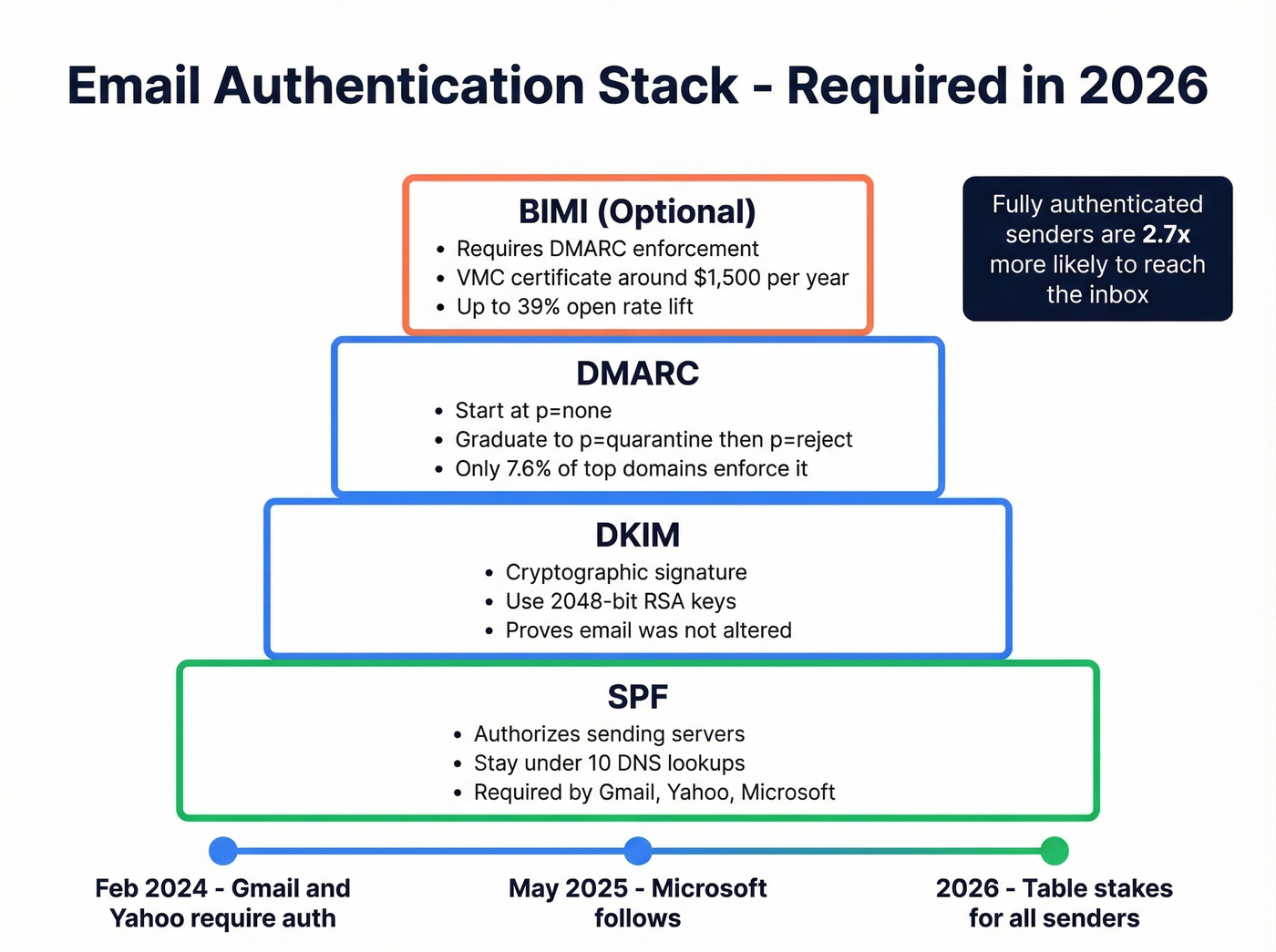
Get these right: SPF (stay under the 10 DNS lookup limit), DKIM (2048-bit RSA keys), and DMARC (start at p=none, graduate to quarantine, then reject). Fully authenticated senders are 2.7x more likely to reach the inbox. Only 18.2% of the top 10M domains have valid DMARC, and just 7.6% enforce it - getting this right puts you ahead of 92% of senders.
BIMI deserves a mention too. It requires DMARC enforcement plus a ~$1,500/year VMC certificate, but it can lift open rates up to 39% by displaying your brand logo in supporting inboxes. Expensive for small teams, but worth exploring once you're sending at scale.
3. Sender Reputation and Complaints
Complaint rates are one of the strongest signals ISPs use to decide where your email lands. Gmail recommends staying below 0.10%, with a hard ceiling at 0.3%. Exceed that, and automated restrictions kick in. Recovery typically takes 7-30 days of clean sending.
One-click unsubscribe via RFC 8058 is now mandatory and must be processed within 2 days. Make it easy for people to leave. It's far cheaper than tanking your reputation.
If you need a deeper playbook, start with sender reputation and the tooling that helps you monitor it.
4. List Quality and Hygiene
Bad contact data causes bounces. Bounces damage reputation. Damaged reputation routes future emails to spam. Spam means zero opens. Every link in that chain compounds the one before it, and a bounce rate above 2% actively erodes your sender score.
Clean your list every 3-6 months. Remove hard bounces immediately. Sunset non-engagers after 6-12 months with a re-engagement attempt first. The best fix, though, is preventing bad data from entering your list at all - Prospeo's 5-step verification process catches invalid addresses, spam traps, and honeypots before they reach your sending platform, with 98% email accuracy on a 7-day data refresh cycle.
If you're troubleshooting, it helps to understand bounce rate mechanics and how to run a proper spam trap removal process.

5. Subject Lines and Preheader Text
47% of recipients decide to open based on the subject line alone. But only after the email reaches the inbox - which is why this factor sits at #5, not #1.
Over 60% of emails are opened on mobile, so keep subject lines under 50 characters. Personalized subject lines are 26% more likely to be opened. Emojis can lift opens up to 56%, but they can tank credibility in B2B contexts, so test before committing. And treat your preheader as a second subject line across 80-100 characters, not an afterthought that defaults to "View this email in your browser."
If you want a swipe file, use these email subject line examples and pair them with Email Preview Text A/B Testing.
6. Segmentation and Email Type
Blasting your entire list with the same message drives weaker engagement signals, which hurts inbox placement over time. Klaviyo's data across 183,000+ customers tells the story clearly: automated flows generate 41% of total email revenue from just 5.3% of sends, with 3x higher click rates than campaigns.
Welcome emails drive a 33% increase in long-term engagement. And 69% of subscribers unsubscribe because they're getting too many emails - over-frequency generates the spam complaints that wreck your reputation. If you're sending daily to your full list, you're probably training ISPs to deprioritize you.
This is where targeted email campaigns and smarter personalized drip campaigns usually outperform "one list, one blast."
7. Send Timing and Frequency
Timing is the most over-discussed, least consistent factor on this list. Twilio analyzed a Memorial Day dataset and couldn't find a statistically significant best open time. HubSpot suggests Tuesday at 11 AM EST. Both can be true - timing varies wildly by audience.
Open rates also show a seasonal decline beginning around March that starts to correct around late August. Start with Tuesday at 7 AM or 11 AM as a control, then test your own data. Don't trust generic advice, including this paragraph.
If you're sending cold, use a dedicated timing framework like best time to send cold emails and keep an eye on email velocity.

You just read it: bounce rates above 2% erode sender reputation and tank open rates. Prospeo's 5-step verification delivers 98% email accuracy with a 7-day data refresh - so stale contacts never poison your list.
Stop optimizing subject lines for emails that land in spam.
2026 Benchmarks Snapshot
Apple MPP inflates open rates for any list with significant Apple Mail usage. These benchmarks are directionally useful, not gospel.
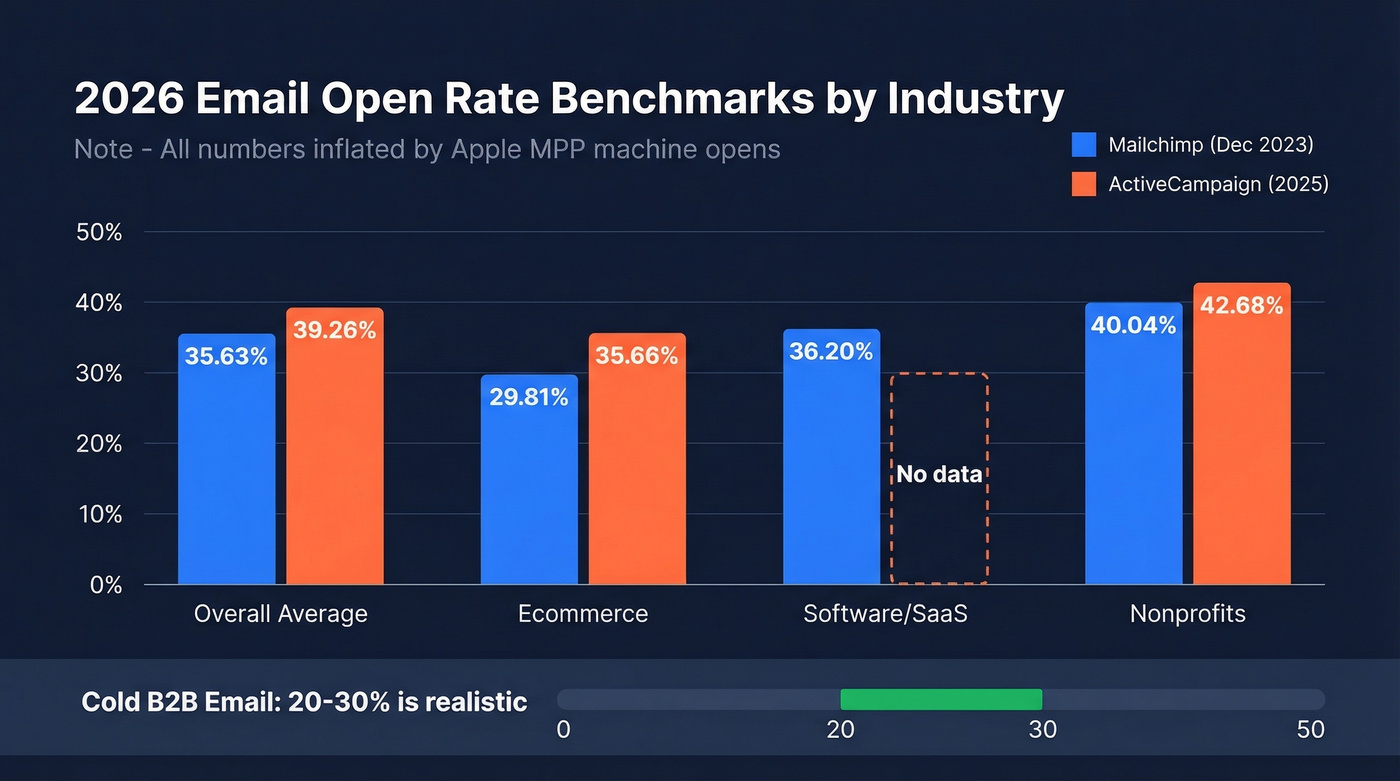
| Source | Scope | Avg Open Rate | Ecommerce | Software/SaaS | Nonprofits |
|---|---|---|---|---|---|
| Mailchimp | Billions of emails; last updated Dec 2023 | 35.63% | 29.81% | 36.20% | 40.04% |
| ActiveCampaign | Jan 1 - Dec 10, 2025 | 39.26% | 35.66% | - | 42.68% |
ActiveCampaign's numbers run higher, reflecting a different platform dataset and methodology. Mailchimp's data is older, so weight ActiveCampaign's more heavily for 2026 planning. For cold B2B email, 20-30% is a realistic range - and even that's inflated by machine opens.
If you want a single reference point to share internally, use this breakdown of what is a good email open rate.
Why Open Rates Are a Broken Metric
Apple Mail Privacy Protection preloads tracking pixels via proxy servers, firing the pixel whether or not a human reads the email. We've seen lists jump from 28% to 55% overnight after MPP adoption increased among recipients. And 77% of marketers incorrectly believe MPP is auto-enabled - it's opt-in, making the inflation unpredictable.
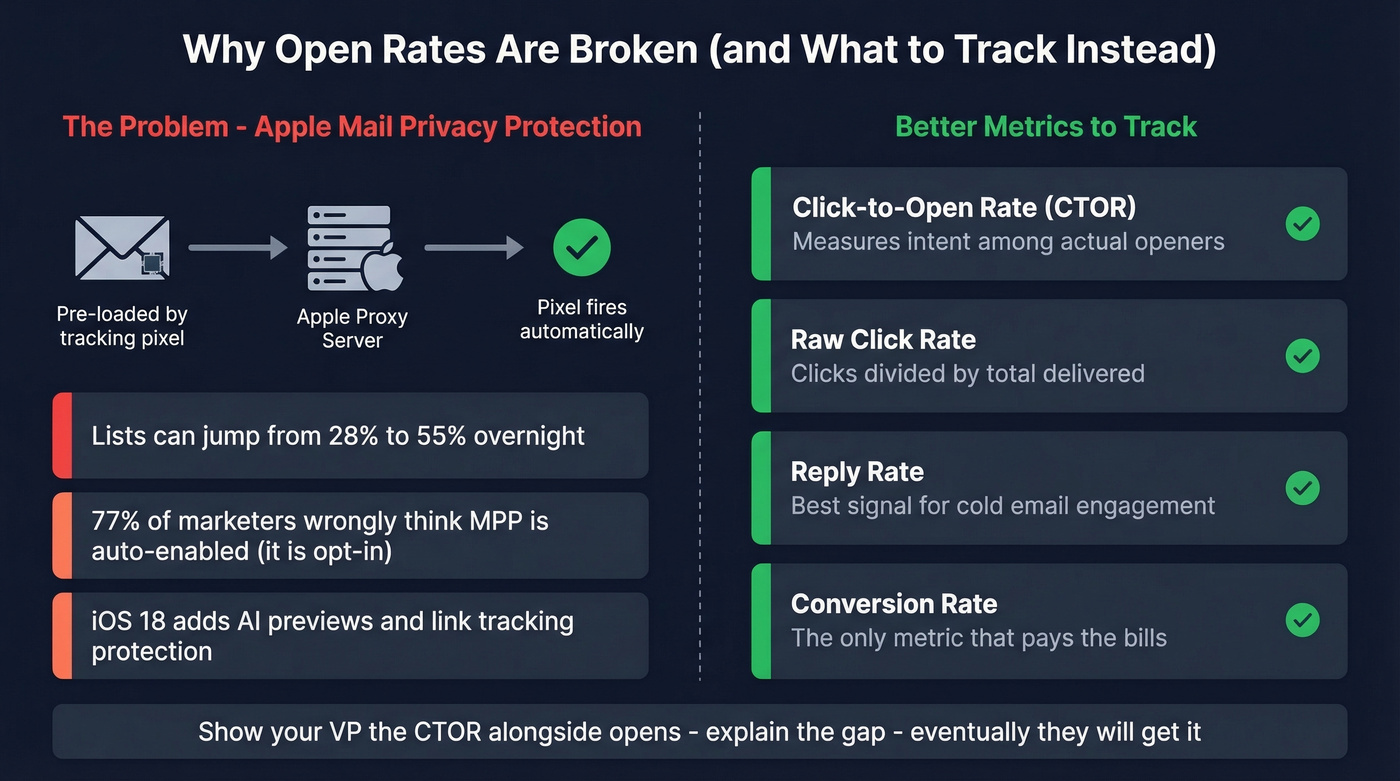
iOS 18 makes things worse with AI-generated previews, inbox categories, and Link Tracking Protection that strips UTMs.
Better metrics to track: click-to-open rate, raw click rate, replies, and conversions. These measure intentional human behavior, not pixel fires. Your VP still wants open rate reports - show them CTOR alongside opens and explain the gap. Eventually they'll get it.
If you need a clean definition and calculation, see the click rate formula.
Fix Your Data First
If your bounce rate is above 2%, nothing else in this article matters yet. Authenticate your domain. Clean your list. Then start optimizing subject lines and send times. Understanding what affects email open rates in the right order is the difference between incremental gains and spinning your wheels for months.
Skip the subject line obsession if you haven't checked Google Postmaster Tools recently. That dashboard will tell you more in five minutes than a dozen A/B tests.
If you're still diagnosing deliverability, use an email deliverability guide and run a quick check with an email spam checker.
One more thing: if your list is small - say, under 500 contacts - you don't have an open rate problem. You have a sample size problem. Fix data quality, nail authentication, and stop refreshing your dashboard every hour.
List hygiene isn't a quarterly project - it's a data source problem. Teams using Prospeo cut bounce rates from 35%+ to under 4% because every email is verified before it touches their sending platform. At $0.01 per email, clean data costs less than one spam complaint.
Fix the factor that actually moves open rates - start with your data.
FAQ
What is a good email open rate in 2026?
For marketing emails, 35-40% is the current benchmark range based on Mailchimp and ActiveCampaign data. Cold B2B email typically lands between 20-30%. All numbers are inflated by Apple MPP machine opens, so click-to-open rate is a more honest metric for measuring real engagement.
Do subject lines really matter for open rates?
Yes - 47% of recipients decide to open based on the subject line. But only after the email reaches the inbox. Broken authentication or damaged sender reputation means nobody sees your subject line at all. Fix deliverability first, then optimize copy.
How do I know if my emails are landing in spam?
Check inbox placement rate, not delivery rate - they're different metrics. Use Google Postmaster Tools to see how Gmail treats your domain. A high delivery rate paired with low opens is the classic sign of a spam folder problem.
Can bad email data hurt my open rates?
Invalid addresses cause bounces, bounces damage sender reputation, and damaged reputation routes future emails to spam. Keep bounce rates under 2% by verifying contacts before sending. A verification step before every campaign is the single cheapest insurance policy for your domain reputation.