

What Is a Go-to-Market Strategy (And Why Most Guides Get It Wrong)
If you've ever looked up "what is a go-to-market strategy" and felt like you were reading three different definitions at once, you're not alone. Most GTM guides bury you in frameworks and buzzwords without telling you what actually matters. The problem isn't that people don't understand the concept - it's that every definition they find is either too vague or too academic to be useful.
Quick version: A go-to-market strategy is the cross-functional operating system for how you bring a product to market - not a marketing plan with a new name. It covers ICP, value proposition, pricing, channels, sales motion, and metrics. The biggest mistake is treating it as a one-time launch doc instead of an adaptive system that evolves with your market.
What a GTM Strategy Really Means
A go-to-market strategy is the plan that connects your product to the people who'll pay for it. It answers six questions simultaneously: who's the buyer, what's the message, how much does it cost, where do we reach them, how do we sell, and how do we know it's working.
That's it. No mystery.
But the confusion starts when people conflate GTM with a marketing plan or a business plan. They're different animals entirely, and mixing them up leads to misaligned teams, wasted budget, and launches that fizzle.
| GTM Strategy | Marketing Plan | Business Plan | |
|---|---|---|---|
| Scope | One product to one market | Ongoing brand + demand | Entire company |
| Owner | Cross-functional (PM, sales, marketing, CS) | Marketing team | Executive / founders |
| Timeframe | 90-day launch + iteration | Annual / quarterly | 3-5 years |
| Output | Launch playbook + metrics | Campaign calendar | Financial model + vision |
Here's the thing: a marketing plan is a subset of your GTM strategy, not the other way around. Marketing handles demand generation and brand awareness. GTM covers the entire path from product to revenue - including sales motion design, pricing architecture, channel selection, and post-launch iteration.
A business plan tells investors why your company should exist. A go-to-market strategy tells your team how to actually sell the thing you built.
Why GTM Strategy Matters
Most companies think they have a growth problem. They actually have a GTM problem.
Bain surveyed 2,300 global companies and found that only 9% achieved 5.5%+ annual revenue and profit growth while earning their cost of capital over a decade. Management teams routinely promise 2x market-average revenue growth and 4x earnings growth. Almost none deliver. The gap isn't product quality or market size - it's execution. In recent GTM benchmark data, 36% of companies named scaling GTM motions and pipeline as their top challenge. Not product, not funding - the mechanics of getting to market.
Consider what happened to Nokia. In 2006, they dominated handsets. By 2010, Nokia's share had dropped roughly 6 points while Samsung gained nearly 6. Samsung didn't win on hardware specs alone - they moved faster on Android adoption, carrier distribution, and the Galaxy line. Their GTM system was adaptive. Nokia's was a fiefdom of disconnected functions that couldn't react.
The lesson isn't "be more like Samsung." It's that GTM isn't a launch checklist you file away after week one. It's an operating system that needs continuous input from sales conversations, product usage data, win/loss analysis, and market signals. Companies that treat GTM as a living system outperform those that treat it as a PowerPoint deck.
Core Components of a GTM Strategy
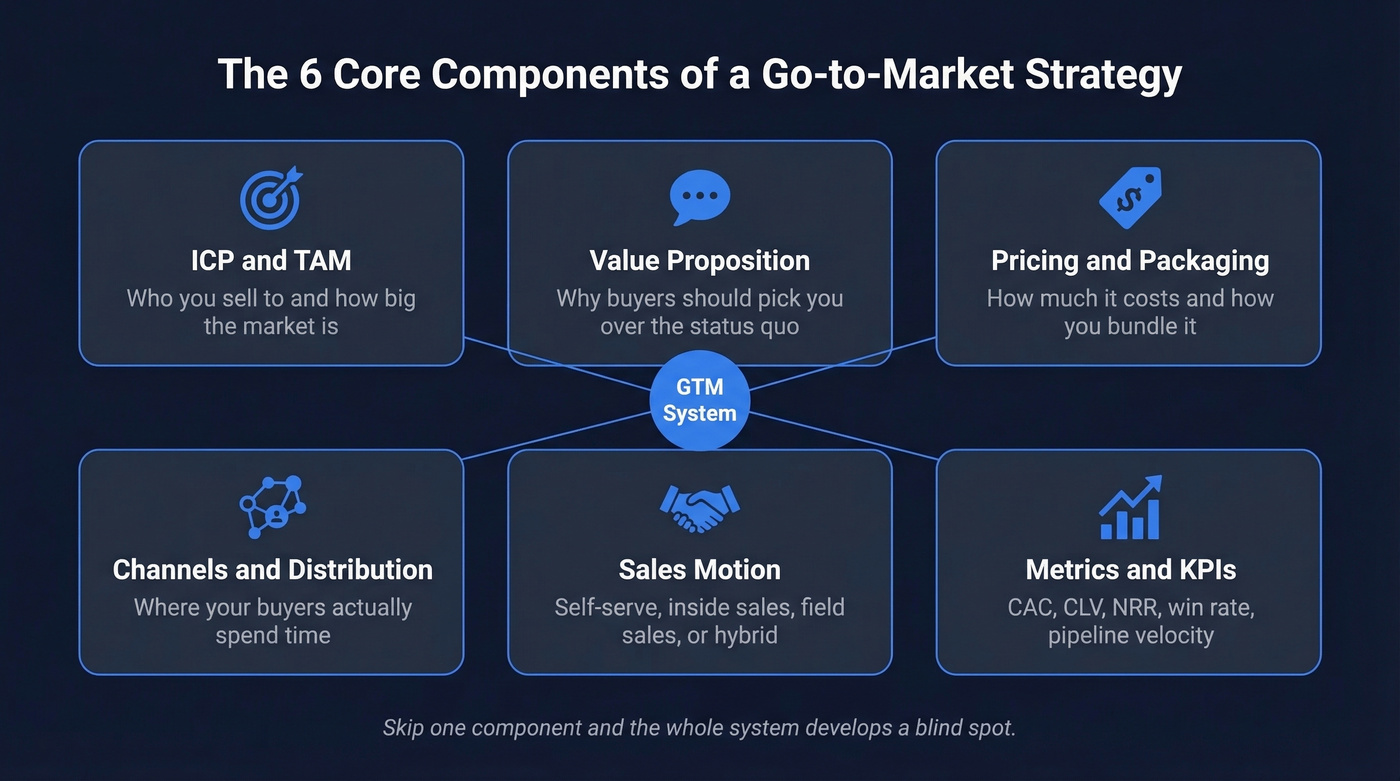
So what are go-to-market strategies actually made of? Every one needs these six components. Skip one and the whole system develops a blind spot.
Ideal Customer Profile and TAM
Your ICP defines who you're selling to with enough specificity that your SDRs can build a list without guessing. That means firmographics like industry, headcount, and revenue, plus technographics and behavioral signals such as hiring patterns and funding events. Layer in TAM/SAM/SOM sizing so you know the ceiling.
If your SAM is $50M and you're projecting $200M in revenue, your GTM math is broken before you start.
Value Proposition and Positioning
Positioning isn't a tagline. It's the answer to "why should this buyer pick us over the status quo?" Build a value map with three columns: buyer pain, your solution, competitor's solution. Any row where you can't beat the competitor is a positioning gap you need to close or avoid. Test positioning with real prospects before launch - not in a conference room with your marketing team nodding along. (If you want a deeper framework, see positioning.)
Pricing and Packaging
Pricing signals quality, shapes your sales motion, and determines your unit economics. We've seen a SaaS company underprice by 70% relative to competitors and spend months fighting the perception that their product was inferior. Price too low and buyers question your value. Price too high without proof points and you'll stall in procurement. Anchor to the value you deliver, not your costs.
Channels and Distribution
Where does your buyer actually spend time and make decisions? Map channels to your ICP's behavior, not to what worked at your last company. A channel that drives pipeline for a $10K ACV product - content plus self-serve - won't work for a $200K enterprise deal that needs direct sales and a partner ecosystem. Run small tests before committing budget.
Sales Motion
Self-serve, inside sales, field sales, channel partners, or a hybrid? The motion has to match your buyer's purchasing process. If your buyer needs procurement approval and a security review, a PLG-only motion won't close deals. If your buyer is a solo founder with a credit card, a 6-call enterprise sales cycle will lose them by call two. (Related: enterprise B2B.)
Metrics and KPIs
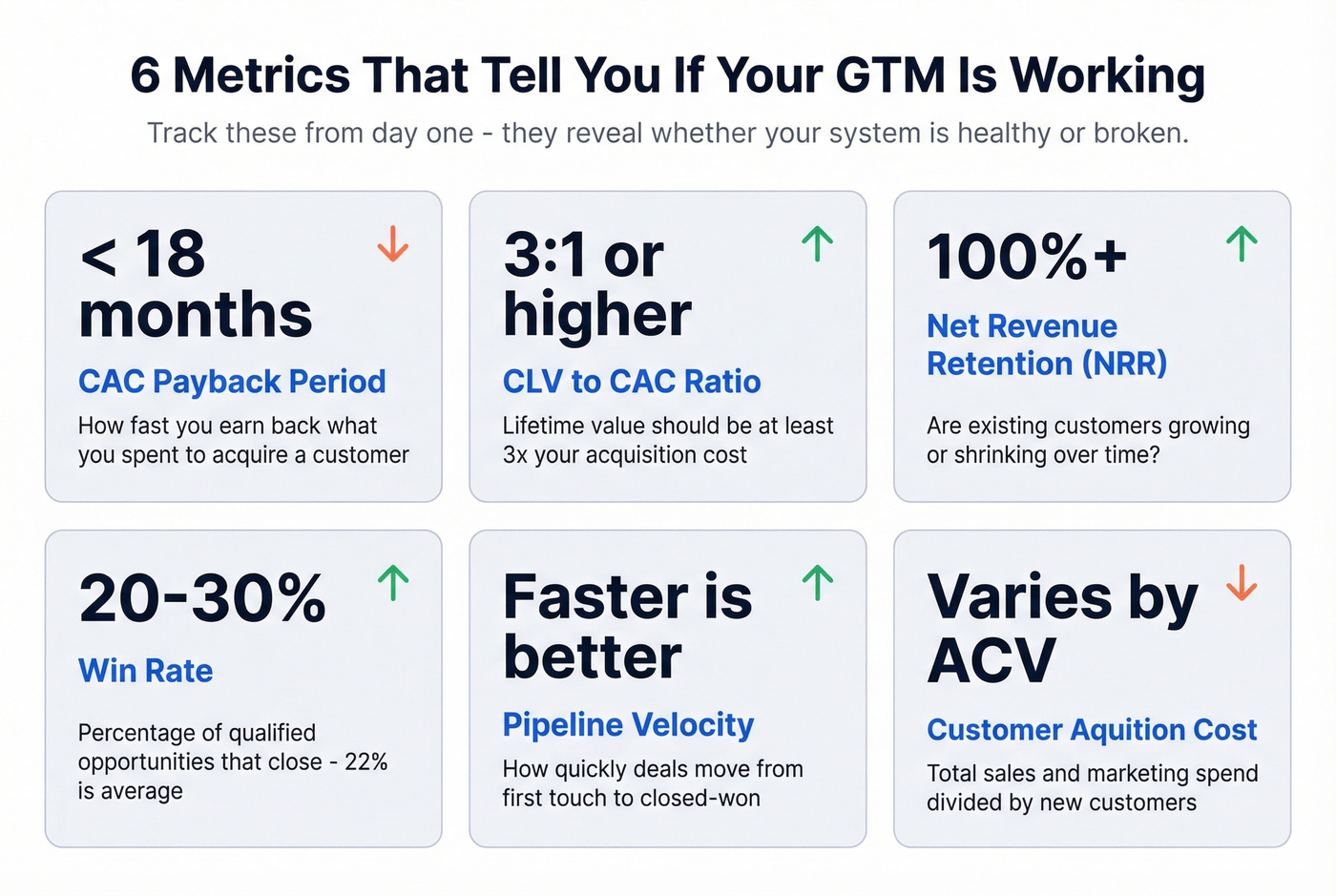
You can't iterate what you don't measure. At minimum, track customer acquisition cost (CAC), customer lifetime value (CLV), CAC payback period, net revenue retention (NRR), pipeline velocity, and win rate. Those six metrics tell you whether your GTM system is healthy or broken. For a broader view, use a funnel metrics checklist.
How to Build a Go-to-Market Strategy
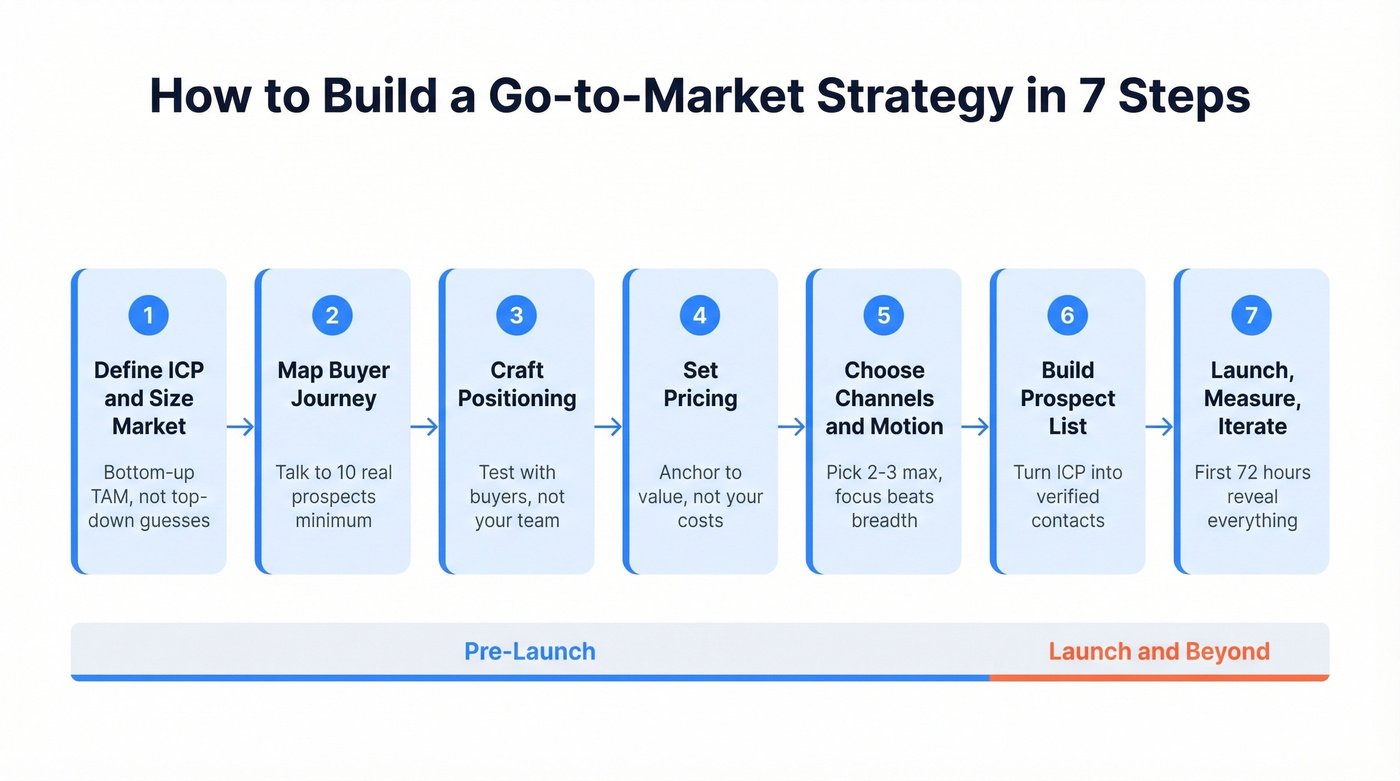
Let's ground this in reality. Imagine you're a 3-person team with 90 days to launch a B2B product. Here's the sequence.
Step 1: Define Your ICP and Size the Market
Start with your TAM/SAM/SOM. Use bottom-up sizing - count the actual companies that fit your criteria, multiply by your expected ACV. Top-down sizing ("the CRM market is $80B") is useless for execution. Get specific: "Mid-market SaaS companies, 50-500 employees, using HubSpot, with a VP of Sales who owns the budget." That's an ICP you can actually prospect against. If you need a starting point, use an ICP template.
Step 2: Map the Buyer Journey
Document every step from "unaware" to "closed-won." Who's involved at each stage? What questions do they ask? What objections come up? Where do deals stall? If you don't know, talk to 10 prospects. Real talk: most GTM failures trace back to founders who skipped this step and built a sales process around assumptions instead of evidence. (This pairs well with a B2B sales funnel template.)
Step 3: Craft Positioning and Messaging
Write your positioning statement: for [ICP], who [pain point], our product [solution], unlike [alternative], because [differentiator]. Then build messaging variants for each buyer persona and each stage of the journey. A CFO cares about ROI. A practitioner cares about workflow. Same product, different message. (If you're building talk tracks, start with these sample elevator pitches.)
Step 4: Set Pricing
Anchor to value, not cost. Research competitor pricing, run willingness-to-pay surveys if you can, and pick a model - per-seat, usage-based, or flat-rate - that aligns with how your buyer gets value. Usage-based pricing improves NRR by roughly 10% and cuts churn by about 22%, but it adds forecasting complexity. Choose deliberately.
Step 5: Choose Channels and Sales Motion
Match the motion to your ACV and buyer complexity. For deals under $50K, lean toward PLG or inside sales. For six-figure contracts, you need field sales and likely a partner ecosystem. Most companies spread across too many channels at once. Pick 2-3 max to start. Focus beats breadth every time.
Step 6: Build Your Prospect List and Enable the Team
Your ICP definition is worthless if you can't turn it into a list of real people with verified contact data. This is where strategy meets execution - and where we've seen more launches stall than anywhere else. Use your ICP criteria to build a targeted prospect list filtered by industry, headcount, tech stack, and intent signals. Prospeo's database covers 300M+ professional profiles with 30+ search filters and emails verified at 98% accuracy on a 7-day refresh cycle, which makes this step dramatically faster than manual research. (If you're building lists at scale, see lead generation workflow.)

Step 7: Launch, Measure, Iterate
Launch isn't the finish line - it's the starting gun. Monitor your core metrics daily for the first two weeks. Which channels are producing pipeline? Where are deals stalling? What objections keep surfacing? Adjust messaging, reallocate budget, and kill underperforming channels fast. The first 72 hours of a launch reveal more about your GTM than 6 months of planning ever will. (To keep execution tight, borrow a 30-60-90 day plan.)

Step 1 of any GTM strategy is defining your ICP - Step 1.5 is finding them. Prospeo's 30+ search filters let you target by buyer intent, technographics, headcount growth, funding, and more across 300M+ profiles. At $0.01 per email with 98% accuracy, your GTM launch budget goes further.
Turn your ICP definition into a verified prospect list in minutes.
Choosing Your GTM Motion
The PLG vs. sales-led debate generates more heat than light. Let's cut through it.
Product-Led Growth (PLG)
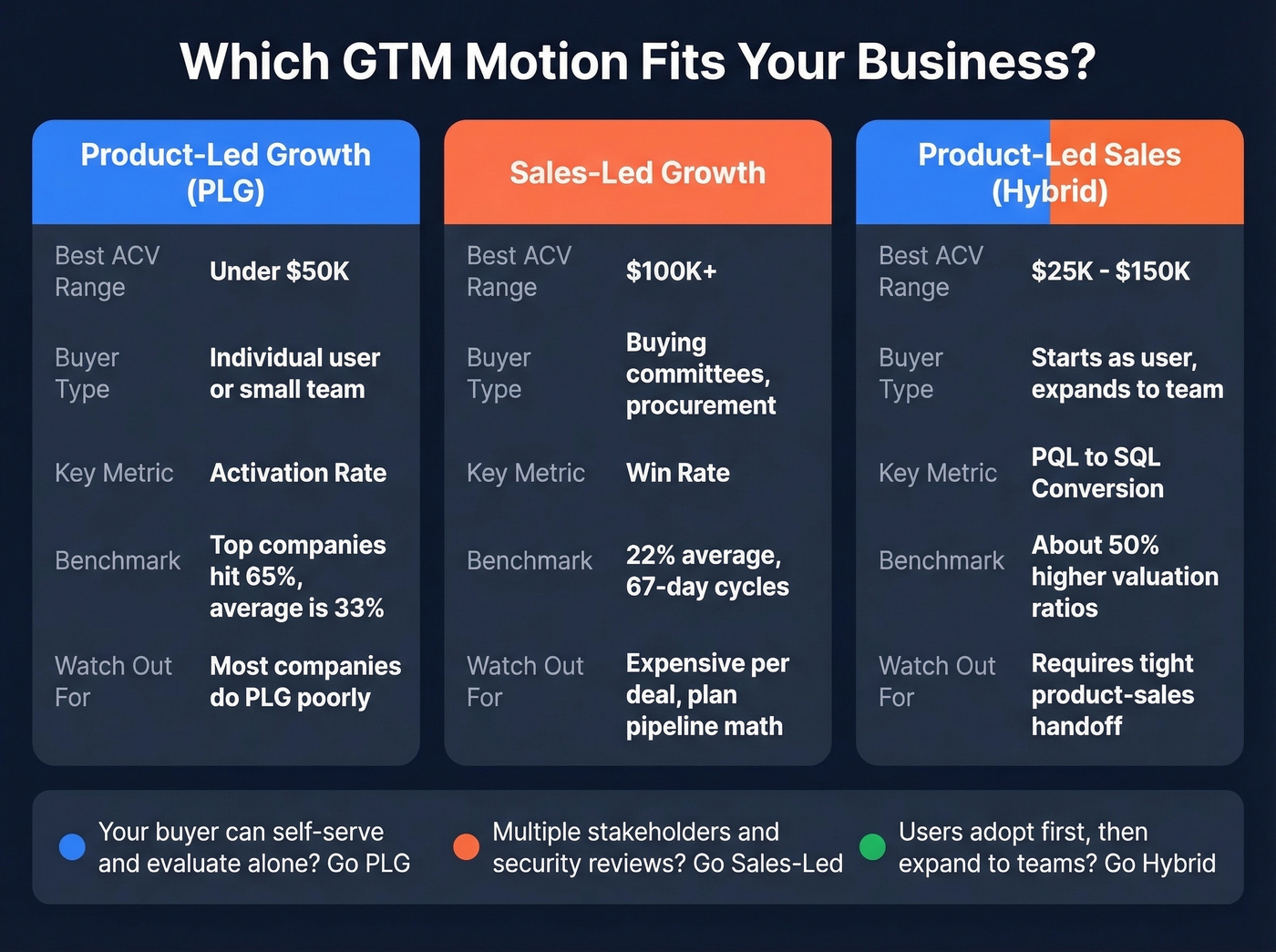
PLG means the product is the primary acquisition, activation, and retention vehicle. Think free trials, freemium tiers, and self-serve onboarding. It works beautifully when your product delivers value fast, your ACV is under $50K, and your buyer can evaluate without a sales conversation.
Top PLG companies hit 65%+ activation rates. The average sits at 33%. That gap is enormous - and it means most companies doing PLG are doing it poorly.
Sales-Led Growth
Sales-led is the right motion when deals involve multiple stakeholders, procurement cycles, security reviews, and ACV above $100K. The sales team drives pipeline, runs demos, navigates buying committees, and closes. It's more expensive per deal but necessary for complex B2B. Current benchmarks show 22% average win rates and 67-day sales cycles, so plan your pipeline math accordingly. (If you're tightening the process, use sales process optimization.)
For enterprise deals with named accounts, account-based marketing layers personalized campaigns on top of sales-led motions. It's not a separate motion - it's a targeting strategy that makes sales-led GTM more efficient by concentrating resources on the accounts most likely to close. (See account-based selling best practices.)
Product-Led Sales (The Hybrid)
McKinsey's analysis of 107 publicly listed B2B SaaS companies found that PLG high performers achieve roughly 50% higher valuation ratios and about 10 percentage points more ARR growth than sales-led high performers. But only a subset of PLG companies drive most of that outperformance. PLG isn't a magic bullet.
The modern compromise is product-led sales - let the product generate product-qualified accounts through free usage, then layer a sales team on top for expansion and enterprise deals. This requires a growth team of 7-9 people mixing PMs, data scientists, demand gen, content, and design running continuous experiments. It's the most resource-intensive motion, but for mid-five-figure ACV products, it's increasingly the default.
Hot take: If your ACV is under $15K and your product doesn't deliver an "aha moment" within 10 minutes, you don't have a PLG problem - you have a product problem. No GTM motion fixes a product that doesn't click fast.
| Motion | ACV Range | Buyer Complexity | Team Size | Example |
|---|---|---|---|---|
| PLG | < $50K | Low (self-serve) | 3-5 | Slack, Canva |
| Hybrid (PLS) | $50K-$100K | Medium | 7-12 | HubSpot, Datadog |
| Sales-Led | > $100K | High (committee) | 10-20+ | Salesforce, Workday |
GTM Benchmarks for 2026
Every GTM guide tells you to "define your ICP" and "track your metrics" but none tell you what good actually looks like. Here are the numbers that matter.
| Metric | Average | Top 10% |
|---|---|---|
| GTM initiatives running | 10.5 | 2-3 focused |
| Cold email reply rate | 5.8% | 10%+ |
| PLG activation rate | 33% | 65%+ |
| NRR | 100-110% | 120%+ |
| CAC:LTV ratio | 3:1 | 5:1+ |
| Win rate | 22% | 35%+ |
| Sales cycle length | 67 days | 40-50 days |
A few things jump out. Cold email reply rates dropped from 6.8% in 2024 to 5.8% in 2025, and the downward trend hasn't reversed. But the type of hook matters more than the channel: timeline-based hooks pull a 10.01% reply rate versus 4.39% for problem-statement hooks - a 2.3x difference from changing your opening line. Meeting rates show an even bigger gap: 2.34% for timeline hooks versus 0.69% for problem statements, a 3.4x difference. If you change nothing else about your outbound, change the first sentence. (For more, see sales prospecting techniques.)
The most important number on that table? The 10.5 average GTM efforts per company. Most companies are running too many initiatives at once. We've seen this pattern repeatedly - teams spread across 8 channels, none of them getting enough volume or iteration to actually work. Pick 2-3 channels, execute well, measure honestly, then expand. Best-in-class NRR above 120% doesn't come from channel proliferation. It comes from depth.
GTM Mistakes That Kill Launches
We've watched enough launches to know the patterns. These seven mistakes account for most GTM failures.
1. Confusing GTM with marketing. A go-to-market strategy isn't a campaign plan. It's a cross-functional operating system. When marketing owns GTM alone, pricing gets ignored, sales enablement gets skipped, and the launch becomes a series of blog posts with no pipeline behind them.
2. Targeting too broadly. Companies try to sell to everyone and end up resonating with no one. A property-tech startup targeting landlords, tenants, and commercial developers simultaneously will build messaging so generic it converts none of them. Pick a beachhead segment, dominate it, then expand.
3. Channel mix mismatch. Choosing channels based on what worked at your last company instead of where your current ICP actually makes decisions. If you're selling to CFOs at mid-market companies, TikTok ads aren't the play.
4. Underpricing or mispricing. Pricing is a signal. Get it wrong and you're fighting perception problems that no amount of marketing can fix. We've seen teams spend an entire year recovering from a pricing mistake that took one afternoon to make.
5. Overlooking pre-launch enablement. Your SDRs can't sell what they don't understand. And the best outbound strategy fails if your team is emailing invalid addresses. Verify your list before launch - a 98% accuracy rate on your contact data is the floor, not the ceiling. Build battle cards, objection docs, and demo scripts before day one. Not after. (Use sales battle cards as a baseline.)
6. Ignoring post-launch signals. The first 72 hours of a launch tell you more than your planning assumptions ever will. Set up real-time dashboards and run daily optimization standups during launch week. If a channel isn't producing by day 3, reallocate budget immediately.
7. Scaling before product-market fit. This is the most expensive mistake. Companies pour money into outbound - 500 emails a day at a 2% reply rate - before they've validated that the market actually wants what they're selling. If your reply rate is below 5% and your win rate is below 15%, the problem isn't your GTM execution. It's your product-market fit. Skip the scaling playbook and go back to customer discovery.
A GTM system breaks when your sales team wastes cycles on bad contact data. Prospeo delivers 98% email accuracy and 125M+ verified mobile numbers with a 30% pickup rate - refreshed every 7 days, not every 6 weeks. Teams using Prospeo book 26% more meetings than ZoomInfo users.
Fix the data layer of your GTM strategy before anything else.
GTM Strategy Examples
Theory is useful. Examples make it stick.
Slack (PLG)
Slack didn't sell to IT departments. They let individual teams sign up free, fall in love with the product, and then spread it organically across the company. By the time procurement got involved, 50+ people were already using it daily. The product was the sales team - classic PLG with low friction, fast time-to-value, and viral loops baked into every shared channel and notification.
HubSpot (Inbound)
HubSpot essentially invented inbound marketing as a GTM motion, then sold the tools to execute it. They built a massive content engine - blog, academy, certifications, free CRM - that attracted millions of marketers who eventually became paying customers. The free CRM was the wedge; the marketing and sales hubs were the expansion play. It's one of the clearest examples of a company using education as a distribution channel. (If you're building the content layer, see B2B content marketing.)
Oatly (Channel-First)
Most food brands launch in grocery stores. Oatly went to specialty coffee shops first, convincing baristas that oat milk foamed better than alternatives. Once baristas became advocates, consumer demand followed. By the time Oatly hit retail shelves, it already had brand credibility built through a channel most competitors ignored entirely.
Lick Paint (DTC / Education-Led)
Lick skipped traditional retail and built a DTC GTM strategy around education. Color specialists offered video consultations, "how to" guides reduced purchase uncertainty, and UGC showcasing room transformations built social proof. Every tactic addressed the actual GTM problem for DTC home goods: the anxiety of buying paint you can't see in person.
FAQ
What's a go-to-market strategy versus a marketing plan?
A go-to-market strategy is a cross-functional plan covering sales motion, pricing, channels, enablement, and metrics for a specific product launch. A marketing plan covers ongoing demand generation and brand awareness. Marketing is one component of GTM - confusing the two is the single most common mistake companies make.
Do all companies need a GTM strategy?
Yes, but depth scales with complexity. A solo founder needs a one-page GTM doc covering ICP, pricing, and one or two channels. An enterprise entering a new vertical needs a 90-day cross-functional playbook with enablement, partner alignment, and launch metrics.
How long does it take to build one?
Two to six weeks for most B2B companies. Don't let it stretch past eight weeks - speed matters more than perfection, and you'll learn more from launching than from planning. The first 72 hours post-launch teach you more than months of strategy sessions.
What GTM mistake do teams make most often?
Targeting too broadly. Companies try to sell to every segment simultaneously and end up with messaging so generic it resonates with no one. Pick a beachhead - one industry, one company size, one buyer persona - win it decisively, then expand.
What tools do you need to execute a GTM plan?
At minimum: a CRM like HubSpot or Salesforce, a prospecting tool for verified contact data, analytics for tracking KPIs, and an outreach platform such as Outreach, Instantly, or Lemlist. PLG teams add product analytics; sales-led teams add conversation intelligence.