

How to Start Winning Deals: 7 Strategies Backed by Data
The average B2B win rate is about 21%. Four out of five forecasted deals walk away. And it's getting worse - 61% of B2B buyers now prefer a rep-free buying experience, which means the opportunities you do get in front of carry more weight than ever.
Here's the thing: winning deals in 2026 isn't about working harder on your close. It's about sharper qualification, better data, and a process that matches how buyers actually buy.
The Quick Fix List
Three things to fix this quarter: (1) enforce qualification criteria and stop forecasting single-threaded deals, (2) multithread every deal above $25K, (3) verify your contact data before every campaign. The rest of this guide explains why, with benchmarks.
What a Sales Win Actually Looks Like
Most teams don't know whether their win rate is healthy or broken. A 25% rate sounds mediocre until you realize you're selling six-figure enterprise deals where 15% is the median.
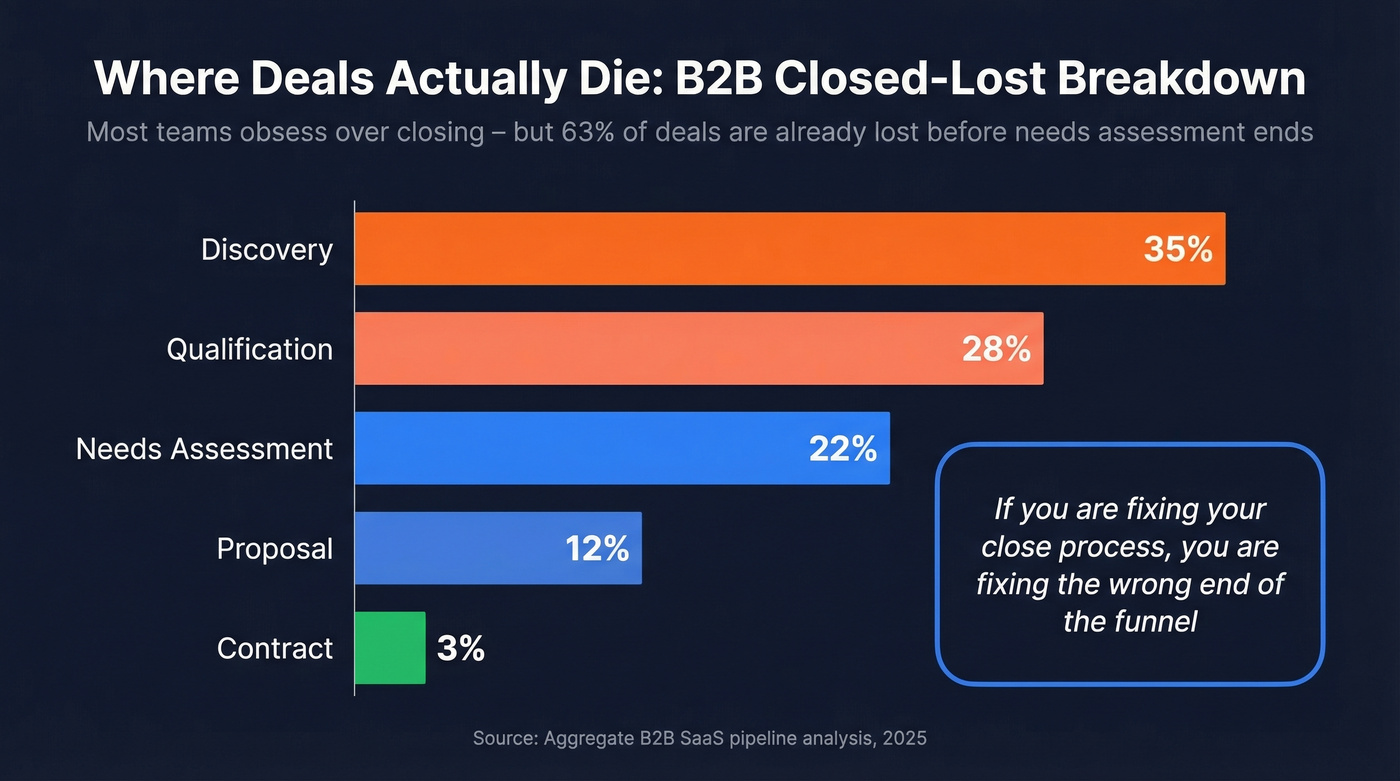
The data breaks down like this, based on the Optifai Pipeline Study (N=939 B2B SaaS companies, Q1-Q3 2025):
| ACV Tier | Win Rate Range | Median |
|---|---|---|
| Under $10K | 28-35% | 31% |
| $10K-$50K | 20-28% | 24% |
| $50K-$100K | 15-22% | 18% |
| Over $100K | 12-18% | 15% |
Those numbers get murkier when you factor in the "no decision" epidemic. Somewhere between 40-60% of enterprise pipeline ends in no decision at all - the buyer just goes dark. If you're excluding those from your win rate calculation, you're inflating the number by 10-15 percentage points.
And where do deals actually die? Not where most teams think. Roughly 35% of closed-lost deals fail at discovery, 28% at qualification, 22% at needs assessment, 12% at proposal - and just 3% at the contract stage. If you're obsessing over your close process, you're fixing the wrong end of the funnel.
One SaaS seller on r/sales reports an 8% discovery-to-closed-won rate on £25K ARR deals, which tracks with the enterprise benchmarks above and reinforces why discovery deserves the most attention.
A quick diagnostic: if your win rate exceeds 40%, you're probably under-qualifying - your pipeline feels healthy but you're avoiding the complex deals that actually move revenue. Below 15%? That's an ICP or process problem. The sweet spot for most B2B teams sits in the 20-35% range, and the goal isn't to hit 50%. It's to turn more of the right opportunities into closed revenue.
7 Strategies for Winning More Deals
1. Win in Discovery, Not the Demo
The deal is won or lost before you ever share your screen. We've watched teams obsess over demo polish while running 8-minute discoveries that barely scratch the surface. The best reps follow a cadence that looks like this:
- Open with a 30-60 second reference story about a similar company's challenge. This earns you the right to ask questions.
- Probe with open-ended questions, then narrow with yes/no follow-ups. Let the buyer talk 70%+ of the time.
- Confirm by playing it back: "Can I recap what I heard?" This catches misunderstandings before they become proposal mismatches.
- Always ask: "Is there anything else?" It surfaces the hidden objection that kills deals in week six.
Gong's data shows that a 3-5 minute discovery prompter - a short customer story about a real buyer problem - dramatically outperforms jumping straight into questions. Execs especially have discovery fatigue. They've answered the same questions from every vendor. Lead with insight, then earn the right to dig deeper. (If you want a tighter structure, use a set of discovery questions that map to your qualification criteria.)
2. Build Trust Before You Need It
Charlie Green's trust equation is the best mental model here: Credibility x Reliability x Intimacy / Self-Orientation. The denominator is what kills most sellers. The more you talk about yourself, the less the buyer trusts you.
69% of buyers report inconsistencies between what a supplier's website says and what the seller tells them. That gap destroys credibility before you even get to the proposal stage. Your messaging, your deck, your website, and your rep's talk track need to tell the same story (a simple set of talk track examples helps keep teams aligned).
Your value in a sales conversation comes from knowing things the buyer doesn't - about their market, their competitors, or the decision they're about to make. If you can't teach them something new, you're just a brochure with a calendar link. (This is the core of how to add value in sales.)
3. Multithread Every Deal Worth Closing
Picture your Thursday pipeline review. Your rep has a $75K deal at Stage 3. You ask who else they're talking to at the account. Silence. One champion. One thread. That deal is already dead - your rep just doesn't know it yet.
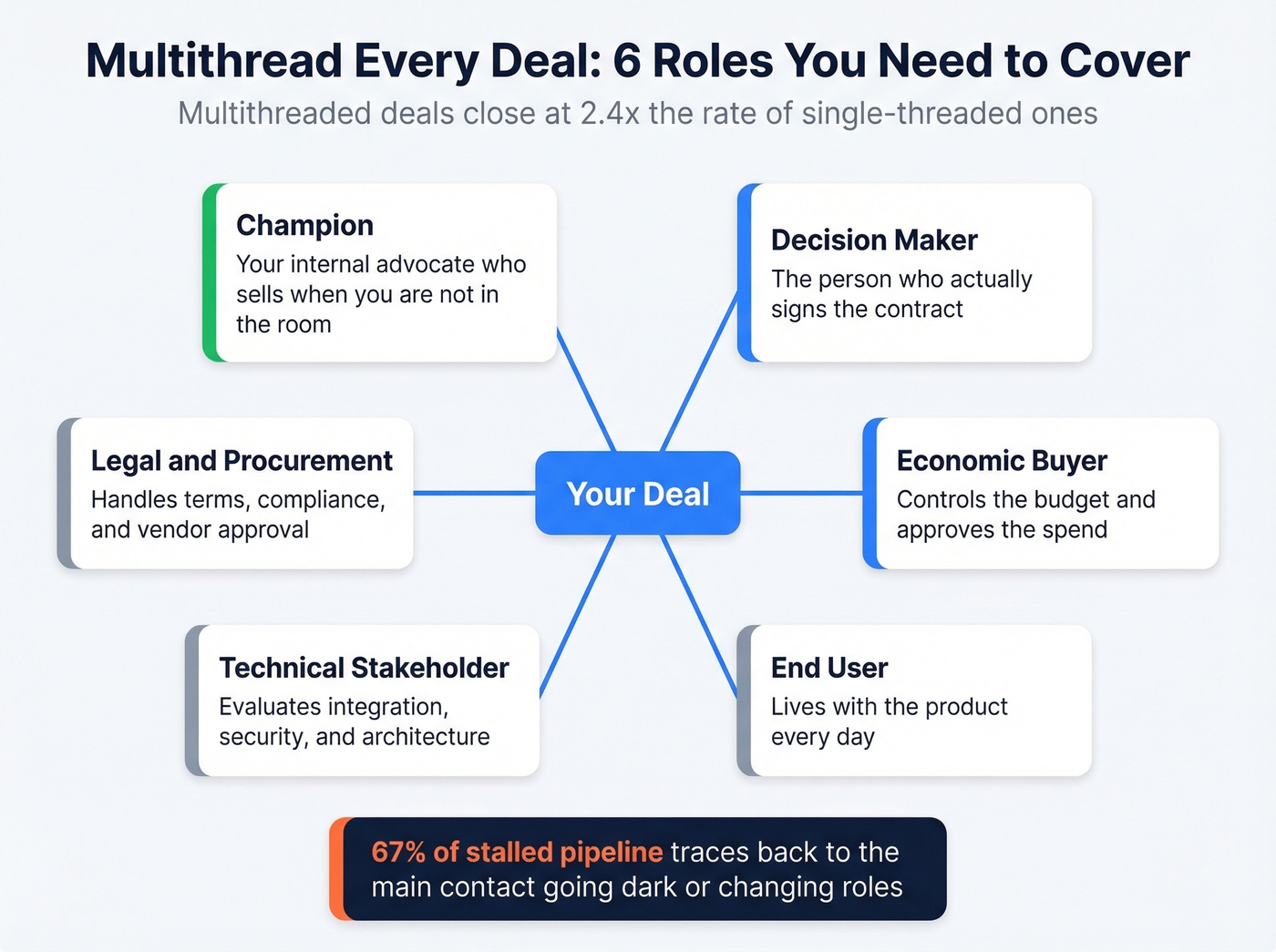
Multithreaded deals close at 2.4x the rate of single-threaded ones, and for enterprise, that jumps to nearly 3x. Meanwhile, 67% of stalled pipeline traces back to the main contact going dark or changing roles.
The framework is straightforward - cover six roles on every deal worth pursuing:
- Champion - your internal advocate
- Decision-maker - the person who signs
- Economic buyer - controls the budget
- End user - lives with the product daily
- Technical stakeholder - evaluates integration and security
- Legal/procurement - handles terms and compliance
Gartner puts the average B2B purchase at 6-10 decision-makers. You don't need to sell all of them, but you need to know who they are and what they care about. Tools like Prospeo's B2B database let you pull verified contacts across departments with 30+ filters - buyer intent, technographics, job changes, headcount growth - so you're not guessing who else sits on the buying committee. (This approach pairs well with account-based selling best practices.)
4. Create Urgency Without Manufacturing It
Fake urgency backfires. "This discount expires Friday" works once, then the buyer stops trusting your timelines. Real urgency comes from the cost of inaction.
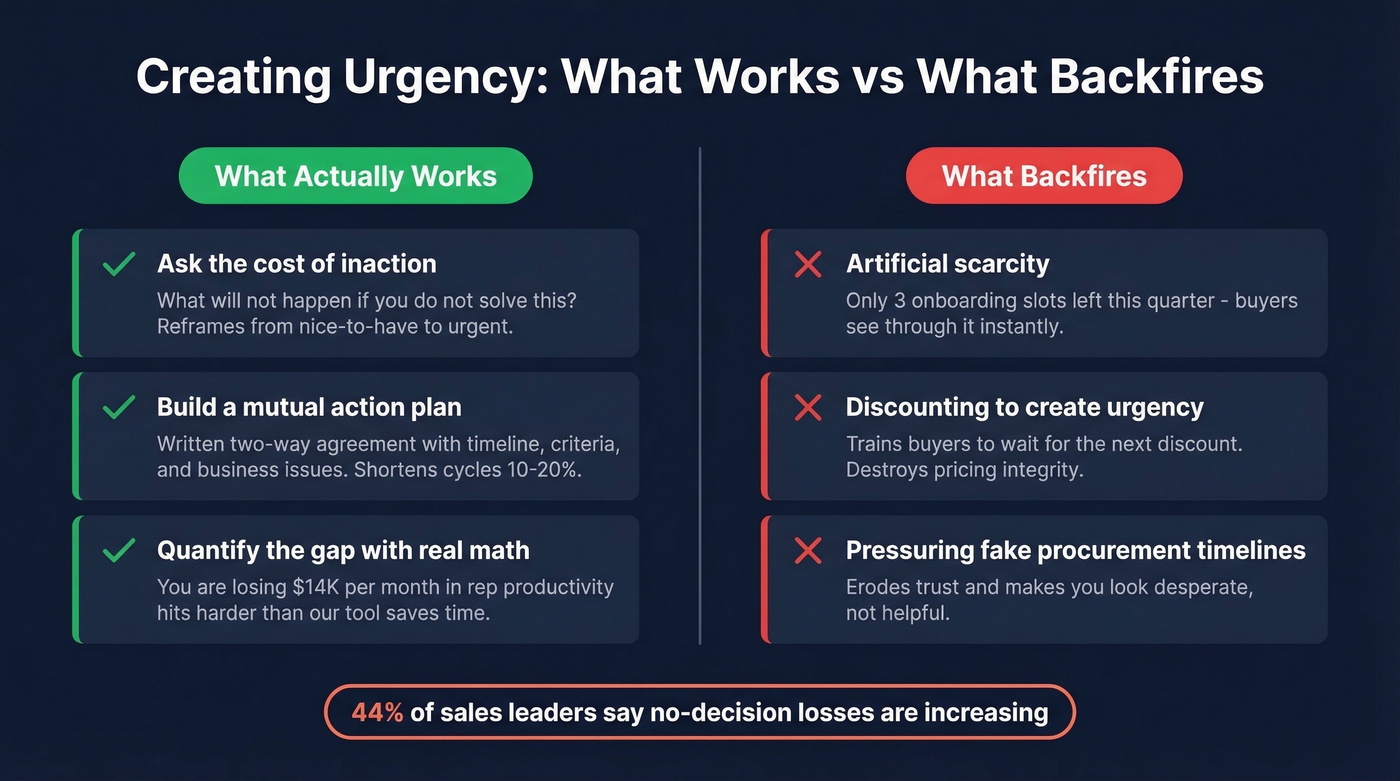
What works:
Ask "What won't happen if you don't solve this?" RAIN Group's research shows this reframes the conversation from "nice to have" to "can't afford to wait." Then build a mutual action plan: a written, two-way agreement documenting the business issues, activities, timeline, and decision criteria. Teams that adopt mutual action plans consistently see 10-20% shorter sales cycles.
Quantify the gap. "You're losing $14K/month in rep productivity" hits harder than "our tool saves time." Calculate it by multiplying the number of affected reps by hours lost per week by their loaded hourly cost.
What backfires:
Artificial scarcity ("only 3 slots left for onboarding this quarter"), discounting to create urgency - which trains buyers to wait - and pressuring procurement timelines that aren't real.
44% of sales leaders say no-decision losses are increasing. The mutual action plan is the single best tool for preventing deals from drifting into that void. (To spot drift earlier, track pipeline health consistently.)
5. Target Your Competitors' Customers
The best prospective clients are already using a competitor. They've bought the category, they understand the problem, and they have budget allocated. Your job is to give them a reason to switch.
Anthony Iannarino lays out a concrete cadence: list 60 competitor customers and rank them by revenue potential. Call 3 per day - that's 15 per week, 60 per month. Every touchpoint delivers an insight the incumbent isn't providing. This is insight-based selling at its core: you're not leading with "we're cheaper" or "we have more features," you're leading with "here's something you don't know about your market that changes how you should think about this problem." (If you need a repeatable system, build sales battle cards for each competitor.)
Let's be honest - most teams waste their displacement efforts on the competitor's happiest customers. Target the ones posting on G2 about missing features or complaining in Slack communities. Unhappy customers with allocated budget are the fastest path to closing deals you didn't even source.
6. Fix Your Data Before Your Process
You've built the playbook. Your reps know the discovery framework, they're multithreading, they've got mutual action plans. Then they launch a 2,000-contact campaign and 35% of the emails bounce.
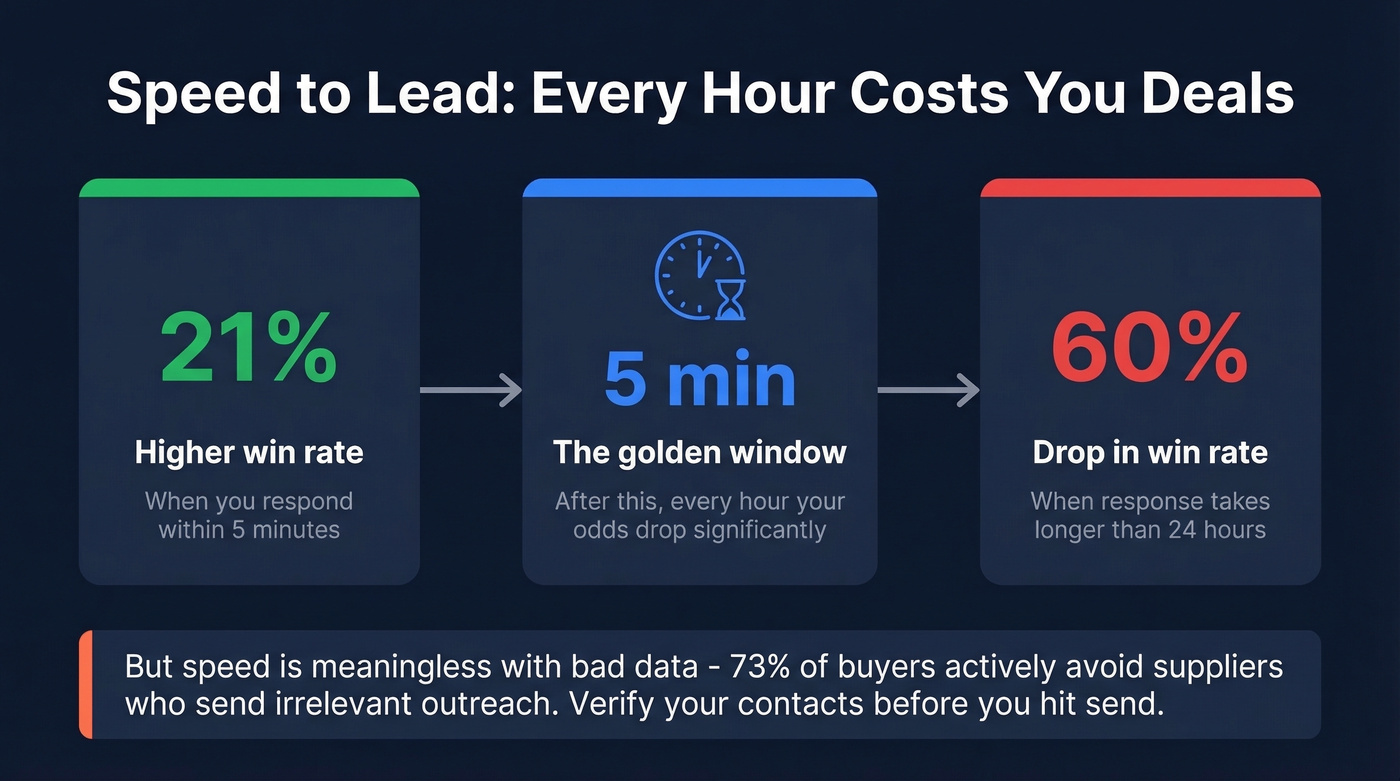
A third of the effort hits a wall before any selling happens.
Responding within 5 minutes correlates with 21% higher win rates. After 24 hours, win rates drop roughly 60%. But speed-to-lead is meaningless when you're reaching outdated contacts at companies that restructured six months ago. And 73% of buyers actively avoid suppliers who send irrelevant outreach - so bad data doesn't just waste effort, it burns your brand. (If you're seeing bounces, start with email bounce rate benchmarks and fixes.)
This is where Prospeo fits. The platform covers 143M+ verified emails and 125M+ verified mobile numbers with a 30% pickup rate, all on a 7-day refresh cycle - the industry average is 6 weeks, which means most databases are already stale by the time your reps use them. Snyk's outbound team went from a 35-40% bounce rate to under 5%, generating 200+ new opportunities per month. Meritt tripled pipeline from $100K to $300K/week after switching. (For a broader stack view, compare data enrichment services.)
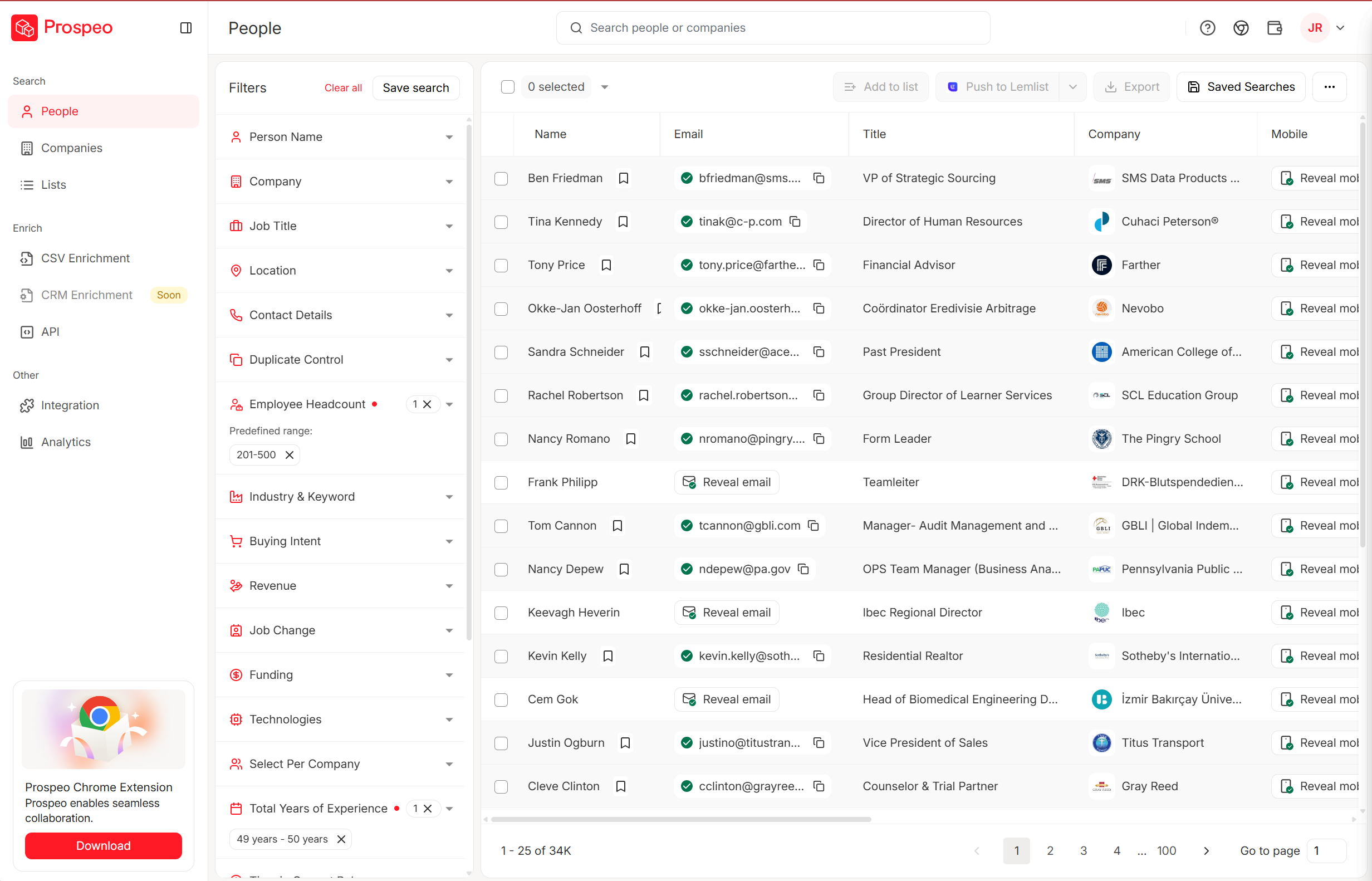

67% of stalled pipeline traces back to a single contact going dark. Prospeo gives you verified emails and direct dials for every stakeholder on the buying committee - across 300M+ profiles with 30+ filters including buyer intent, job changes, and department headcount.
Stop single-threading deals that deserve to close.
7. Build a Win/Loss Analysis System
Your CRM says you lost on price. The buyer says your rep didn't understand their business. Those are two very different problems, and only one of them is true.
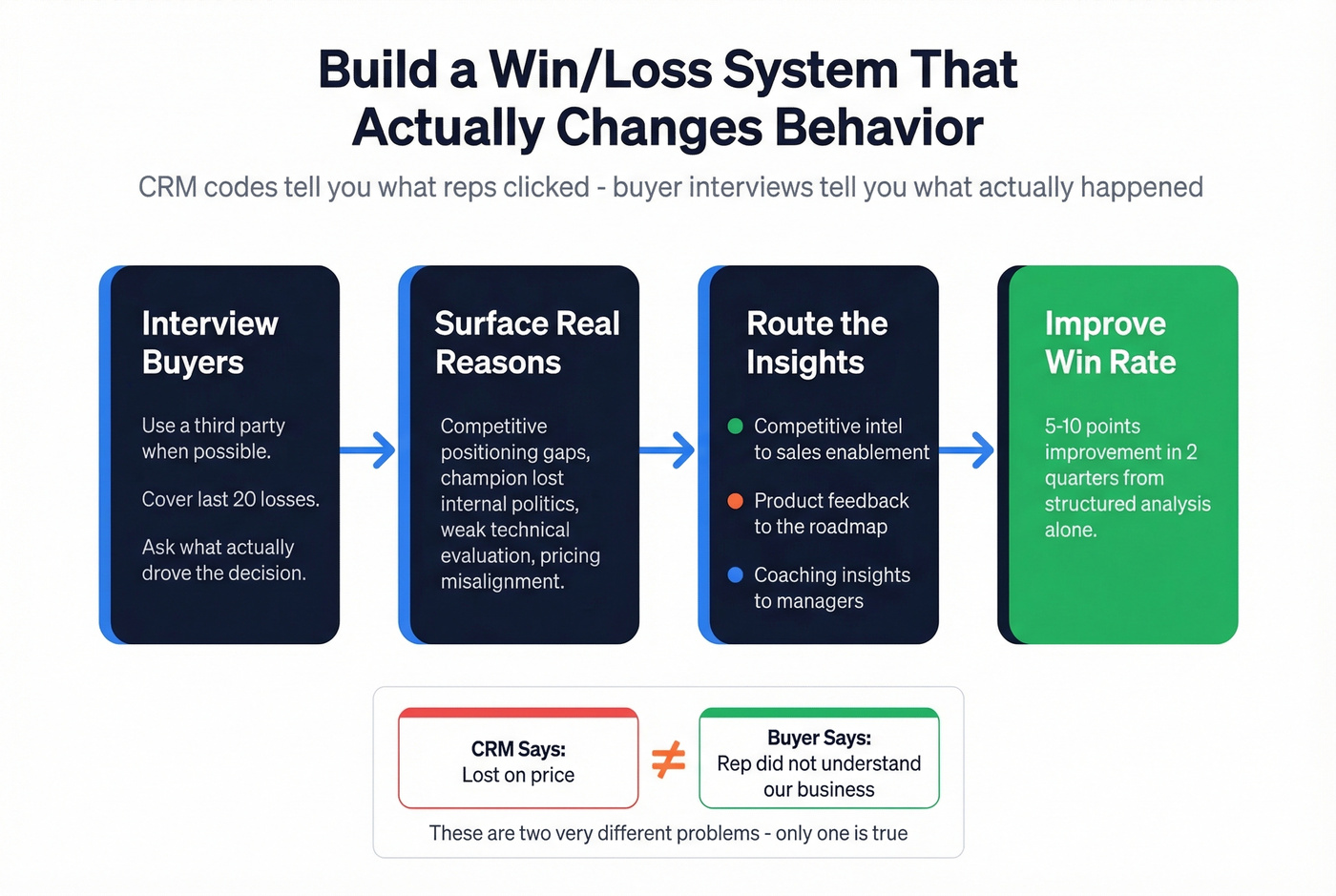
A real win/loss program interviews buyers - ideally through a third party - to surface the actual reasons deals were won or lost. CRM disposition codes are what reps click to close a task. Buyer interviews reveal that your competitor's SE ran a better technical evaluation, or that your champion lost an internal political fight you didn't even know about. (This is also where a lightweight competitive intelligence strategy pays off.)
The outputs compound over time: competitive intelligence on how rivals position and price, product feedback that actually reaches the roadmap, and coaching insights specific enough to change behavior. We've seen teams improve win rates 5-10 points in two quarters just by running structured buyer interviews on their last 20 losses. Understanding why you're winning deals - and why you're not - is the fastest feedback loop in revenue operations. (To operationalize it, align on sales operations metrics.)
You can't win deals with bad data. Bounced emails kill momentum, wrong numbers waste rep hours, and stale contacts mean you're pitching people who left six months ago. Prospeo refreshes every record every 7 days - not the 6-week industry average - with 98% email accuracy and 125M+ verified mobiles.
Clean data turns your 21% win rate into a competitive advantage.
Deal Health Score: A Quick Self-Audit
Before your next pipeline review, run every deal above $25K through these three questions:
- Thread count: Are you engaged with 3+ stakeholders? If not, the deal is single-threaded and statistically unlikely to close.
- Data freshness: When was the last time you verified your contacts' emails and direct dials? If it's been more than 30 days, assume at least 15% are stale.
- Mutual action plan: Does a written, two-way plan exist with dates and owners? If the timeline lives only in your head, the buyer doesn't share it.
Score each 0-2. A deal scoring 4+ is healthy. Below 3, it needs intervention this week - not next quarter.
Mistakes That Kill Your Close Rate
These are the anti-patterns we see most often. Every one is preventable.
Feature dumping. Gong calls this the "ultimate deal killer." Listing capabilities without tying them to the buyer's stated problem is the fastest way to lose attention. Stop it.
The grand finale demo. Saving the punchline for the last slide is a recipe for lost attention. Show the end result in the first two minutes, then drill into how you get there. If the buyer checks out before slide 12, your big reveal never lands. (Use a product demo checklist to keep it tight.)
Discovery fatigue with execs. Senior buyers have answered the same questions from every vendor. Lead with a 3-5 minute insight prompter - a customer story about their specific problem - before you start asking.
Steamrolling objections. When a buyer pushes back, the instinct is to counter. Instead: "Can you help me understand what's causing that concern?" Clarify first, respond second.
Not taking notes. Re-asking questions the buyer already answered signals you don't care. It's an unforced error that erodes trust instantly.
Single-threading. If your deal depends on one person, it's not a deal - it's a hope. Skip this section if you're already engaging 4+ stakeholders per opportunity, but in our experience, even teams that think they're multithreading are often relying on a single champion to relay messages internally.
Poor follow-through. You said you'd send the case study by Thursday. It's Monday. Reliability is the easiest part of the trust equation to control, and the most common one to fail. (If you need a system, keep a set of sales follow-up templates ready.)
The Numbers Behind Modern Buying
The buying environment has shifted dramatically, and the data explains why closing feels harder even when your process is solid.
| Metric | Data Point | Source |
|---|---|---|
| Avg sales cycle | 10.1 months (down from 11.3) | 6sense 2026 |
| Leaders saying cycle increased | 43% | RAIN Group |
| Buyers defining requirements pre-sales | 83% | Forrester |
| Buyers using LLMs in purchasing | 94% | 6sense 2026 |
| Purchases that stall | 86% | 6sense 2026 |
| No-decision losses increasing | 44% of leaders | RAIN Group |
| More decision-makers challenging | 85% of leaders | RAIN Group |
Estimated cycle lengths by segment: SMB deals typically close in 30-60 days, mid-market in 60-120 days, and enterprise deals run 6-12 months. The 6sense data shows economic pressure actually shortened the average cycle from 11.3 to 10.1 months - but 43% of sales leaders still report their cycles getting longer. The disconnect? Shorter cycles for deals that close, longer limbo for deals that stall.
83% of buyers mostly or fully define their requirements before they ever talk to a seller. 94% are using LLMs during the buying process. Your buyers are showing up more informed and more skeptical than at any point in the last decade. These seven strategies aren't a competitive edge - they're table stakes in a market where 86% of purchases stall at some point during the buying process.
FAQ
What's a good win rate in B2B sales?
The average B2B win rate is about 21%, rising to roughly 29% for qualified opportunities. Healthy ranges depend on deal size: 28-35% for deals under $10K, dropping to 12-18% for six-figure contracts. If yours exceeds 40%, you're likely under-qualifying your pipeline.
Why do most deals end in "no decision"?
Between 40-60% of enterprise pipeline ends in no decision because buyers lack internal urgency, can't align stakeholders, or don't see enough cost-of-inaction evidence. Building a mutual action plan and multithreading across 4-6+ stakeholders reduces this risk significantly.
How many stakeholders should I engage per deal?
For mid-market and enterprise deals, engage at least 4-6 stakeholders covering six roles: champion, decision-maker, economic buyer, end user, technical stakeholder, and legal/procurement. Deals with 3+ contacts engaged close at 2.4x the rate of single-threaded deals.
How does bad contact data affect win rates?
Bouncing 35% of your emails means a third of your team's effort dies before any selling happens. Responding within 5 minutes correlates with 21% higher win rates - impossible with outdated contacts. Prospeo verifies emails at 98% accuracy on a 7-day refresh cycle, with a free tier of 75 emails + 100 Chrome extension credits per month.
What is a mutual action plan in sales?
A mutual action plan is a written, two-way agreement between seller and buyer documenting the business issues to solve, activities required, timeline, and decision criteria. It replaces verbal commitments with documented accountability and helps prevent deals from stalling into "no decision."