

Account-Based Marketing Segmentation: The Operating Manual Nobody Gave You
You inherited a 2,000-account target account list. Marketing says it's "strategic." Sales says half the companies are wrong. Nobody can explain the scoring logic because there isn't one - someone exported a Salesforce report six months ago and called it ABM.
Now you're supposed to run personalized campaigns across this list without doubling headcount. The Reddit threads on this topic are blunt: "personalization at scale" advice is mostly reductive bullet-point tutorials that fall apart when you're juggling multiple regions and segments. What you actually need is an account-based marketing segmentation strategy with a scoring model you can copy, real case studies with dollar outcomes, and the data quality step that every other guide glosses over.
Quick Version
If you're short on time, here's the operating checklist:
- Start with a tight ICP, not a bloated TAL. A 2,000-account list isn't ABM - it's demand gen with extra steps. Narrow first, expand later. (If you need a starting point, use an ICP rubric.)
- Layer four signal types in order: firmographic → behavioral → intent → lifecycle. Each layer filters the previous one. (For deeper intent mechanics, see intent based segmentation.)
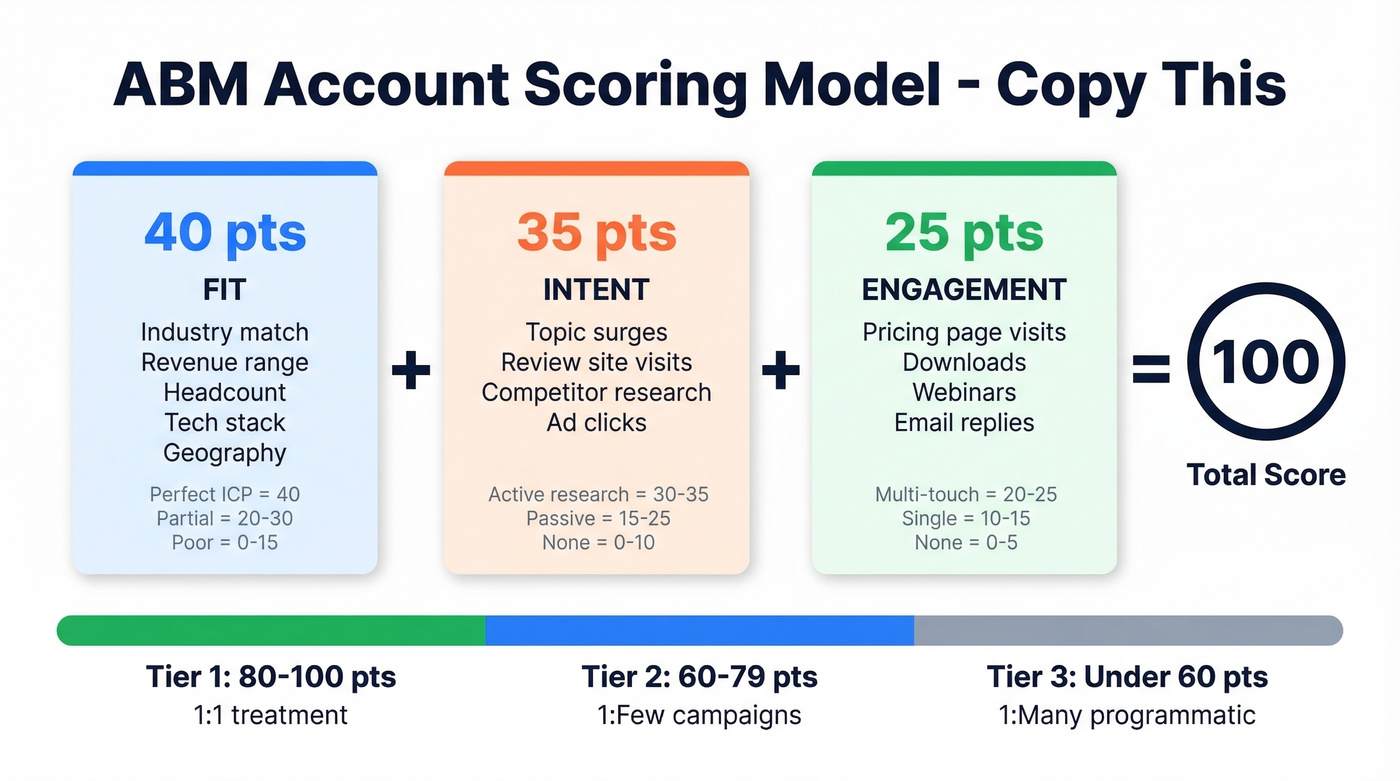
- Score and tier every account. Fit (40 pts) + Intent (35 pts) + Engagement (25 pts) = 100. Tier 1 ≥ 80, Tier 2 = 60-79, Tier 3 < 60. Full model below. (Related: lead scoring vs account scoring.)
- Clean and enrich your data before you segment. Segmenting dirty data just creates organized garbage. (More on lead enrichment.)
- Measure by account progression, not MQL count. One proof point: a B2B company generated $300k in revenue from just 30 well-segmented accounts. That doesn't happen with spray-and-pray.
What ABM Segmentation Actually Is
Account-based marketing traces back to ITSMA circa 2004, when the idea of flipping the funnel - starting with target accounts instead of casting a wide net - was genuinely radical. Two decades later, the concept is mainstream but the execution is still messy.
ABM segmentation isn't the same as demand gen segmentation. Demand gen segments audiences by persona or behavior. ABM segments accounts - whole companies - by fit, intent, and engagement, then maps the buying committee within each one. The distinction matters because it changes what you measure, how you allocate budget, and which tools you need. It's also why RevOps teams, not just marketing, should own the segmentation data: they're the ones maintaining the CRM fields and pipeline stages that make tiering possible (see what a RevOps Manager typically owns).
The ROI case is strong. Demandbase's 2024 benchmark, based on 300+ global marketers, found top B2B marketers achieve 81% higher ROI with ABM compared to traditional approaches. But that ROI depends entirely on how well you segment and tier accounts. A poorly built list with stale data will underperform a basic email blast.
The 4-Layer ABM Audience Segmentation Framework
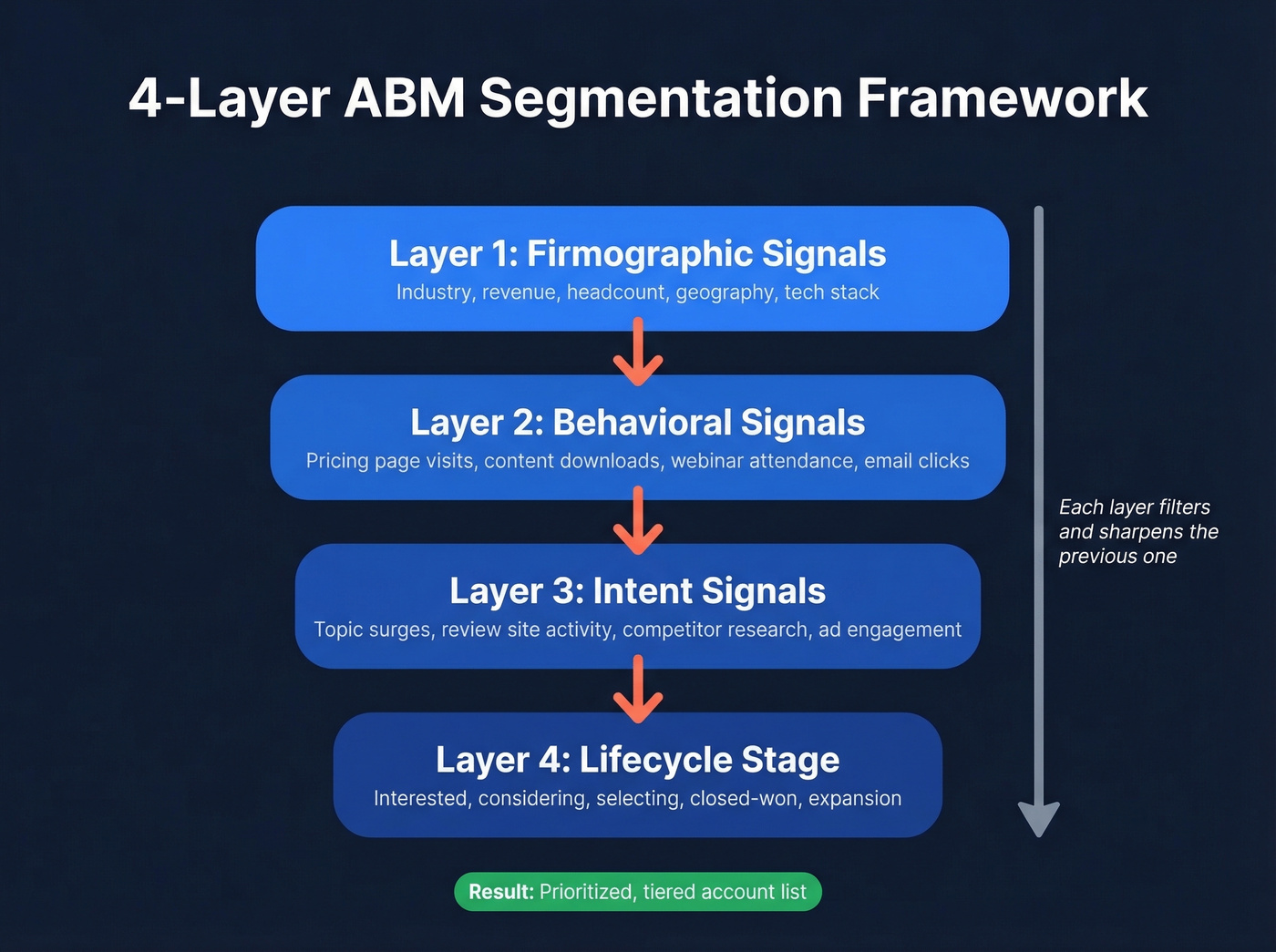
Every segmentation model worth using stacks four signal types. Think of them as filters - each layer narrows and sharpens the previous one.
Firmographic Signals
This is your foundation. Industry, revenue range, headcount, geography, and tech stack tell you whether a company could plausibly buy your product. Most teams stop here, which is why most target account lists are bloated. (If you want to operationalize this layer, start with firmographic filters.)
The nuance is buying committee size. Mid-market companies average 5.4 people in a buying committee. Enterprise deals can involve 6-10 stakeholders, sometimes [upwards of 12](https://www.inverta.com/resources/the-power-of-precision - building-effective-abm-campaigns-a-case-study). If you're only targeting one contact per account, you're ignoring the majority of the decision-making unit. Firmographic data should also inform how many contacts you need to map - a 50-person startup needs two; a 5,000-person enterprise needs eight to ten.
Behavioral Signals
Behavioral signals tell you what accounts are actually doing on your properties. Pricing page visits are one of the highest-signal behaviors - someone comparing your pricing is closer to buying than someone who downloaded a whitepaper. Content engagement clusters matter too: an account where three people attended your webinar and two downloaded your integration guide is showing coordinated interest.
Here's the thing: 97% of website visitors don't fill out a form. That means the vast majority of behavioral signal is anonymous. You need account identification tooling - reverse IP, first-party cookies, or platform-native tracking - to connect visits to accounts.
Intent Signals
Intent data comes in two flavors. First-party intent is what accounts do on your site and in your campaigns - you own this data and it's reliable. Third-party intent is aggregated from across the web: topic surges, review site activity, competitor research patterns. (If you’re building a repeatable process, use a simple buying signals checklist.)
Third-party intent is directional, not gospel. 93% of B2B purchases start with an internet search, and buyers average 12 searches before landing on a specific vendor's site - which means intent signals fire long before prospects find you. Buyers are roughly 70% done with their research before they talk to sales. So intent signals are real. But third-party data can be stale, noisy, or overly broad. Use it to prioritize, not to make binary decisions.
The best approach blends both: first-party engagement confirms what third-party intent suggests. When both signals align, you've got a Tier 1 candidate.
Lifecycle Stage
The final layer maps accounts to where they sit in your funnel. An account that's never heard of you needs awareness content. An account that attended a demo last quarter but went dark needs reactivation. A current customer showing expansion signals needs a different play entirely.
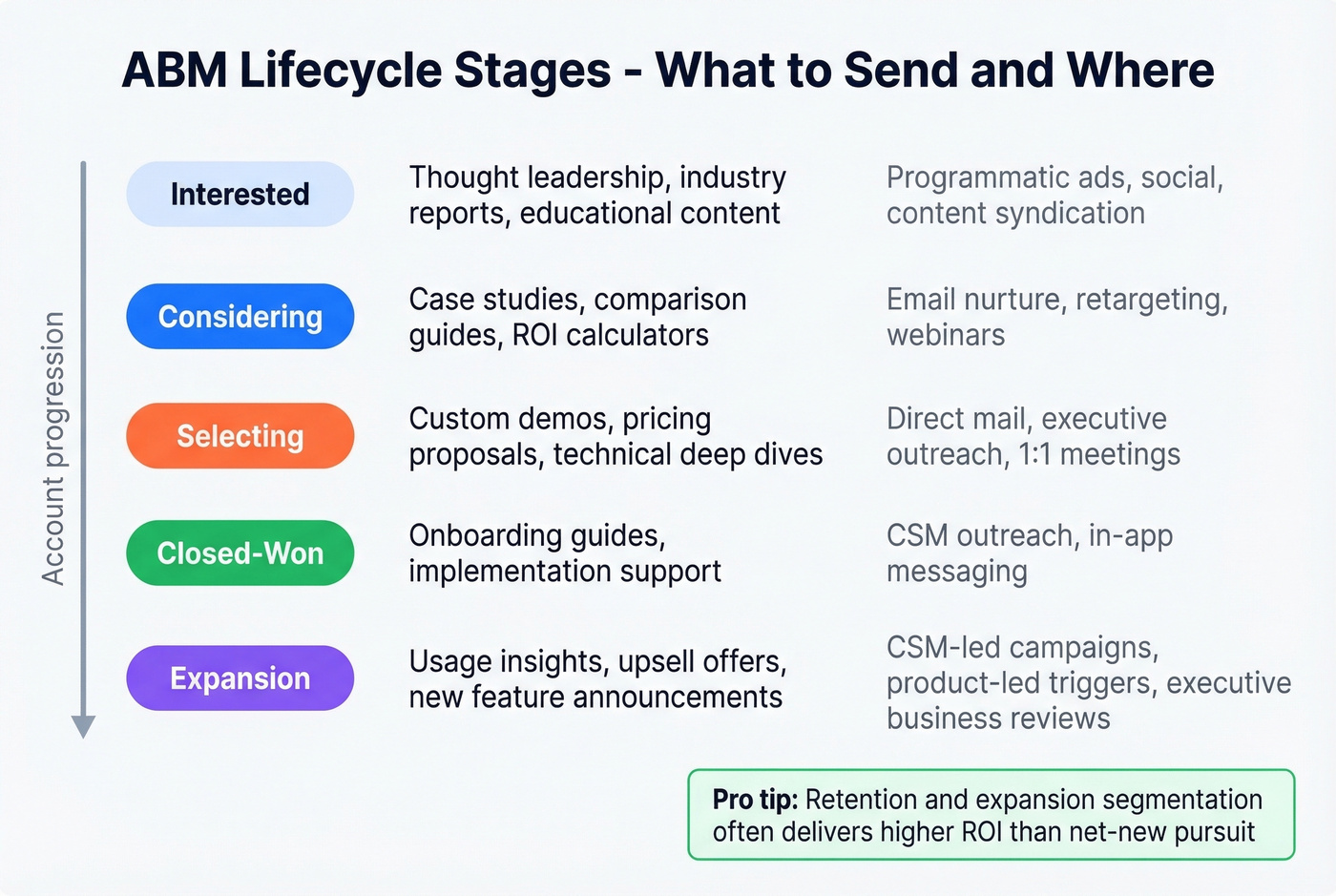
Accounts progress through four core stages: interested → considering → selecting → closed-won. Then you add a post-sale expansion motion for customers showing upsell or cross-sell signals. Each stage gets different content, different channels, and different success metrics. Most teams make the mistake of treating all ABM as acquisition. Retention and expansion segmentation - identifying which customers are ripe for upsell based on usage patterns and intent signals - often delivers higher ROI than net-new pursuit.
A Scoring Model You Can Copy
Frameworks are nice. A scoring model you can paste into a spreadsheet is better.
| Category | Weight | Inputs | Example Scoring |
|---|---|---|---|
| Fit | 40 pts | Industry, revenue, headcount, tech stack, geography | Perfect ICP = 40; partial = 20-30; poor = 0-15 |
| Intent | 35 pts | Topic surges, review site activity, competitor research, ad clicks | Active research = 30-35; passive = 15-25; none = 0-10 |
| Engagement | 25 pts | Pricing page visits, downloads, webinars, email replies | Multi-touch = 20-25; single = 10-15; none = 0-5 |
The weights reflect a simple reality: fit is table stakes (wrong company = wasted effort), intent is the strongest buying signal, and engagement confirms the other two. Add them up for a score out of 100.
Tier thresholds:
- Tier 1 (≥ 80): 1:1 treatment. Custom content, dedicated SDR, executive outreach. These are your best-fit accounts actively researching your category and engaging with your brand.
- Tier 2 (60-79): 1:Few. Cluster-based campaigns for 5-15 similar accounts. Personalized by industry or use case, not individually.
- Tier 3 (< 60): 1:Many. Programmatic ABM - targeted ads, nurture sequences, scaled content. Still better than spray-and-pray, but resource-light.
Let's walk through a quick example. A 500-person SaaS company in your target vertical scores 32/40 on Fit. They're actively researching your category on G2 and showing topic surges on Bombora, so Intent hits 28/35. Two people from the account visited your pricing page this month, giving Engagement 18/25. Total: 78 → Tier 2. Close to Tier 1, but the fit isn't perfect - maybe they're slightly below your revenue threshold.
One operational rule worth stealing from Demandbase: implement a 90-day lookback to identify accounts that showed strong engagement but didn't convert. These are your warmest re-engagement candidates and often get overlooked because they fell out of the active pipeline.
Database Enrichment: The Step Everyone Skips
Your segmentation model is only as good as the data feeding it. And most teams' data is a mess.
Xenia Busheva from Pronounce AI put it well - teams have "way more data than they know what to do with... scattered across CRMs, marketing automation tools, and sales outreach platforms." The result is analysis paralysis, or worse, confident decisions built on garbage inputs.
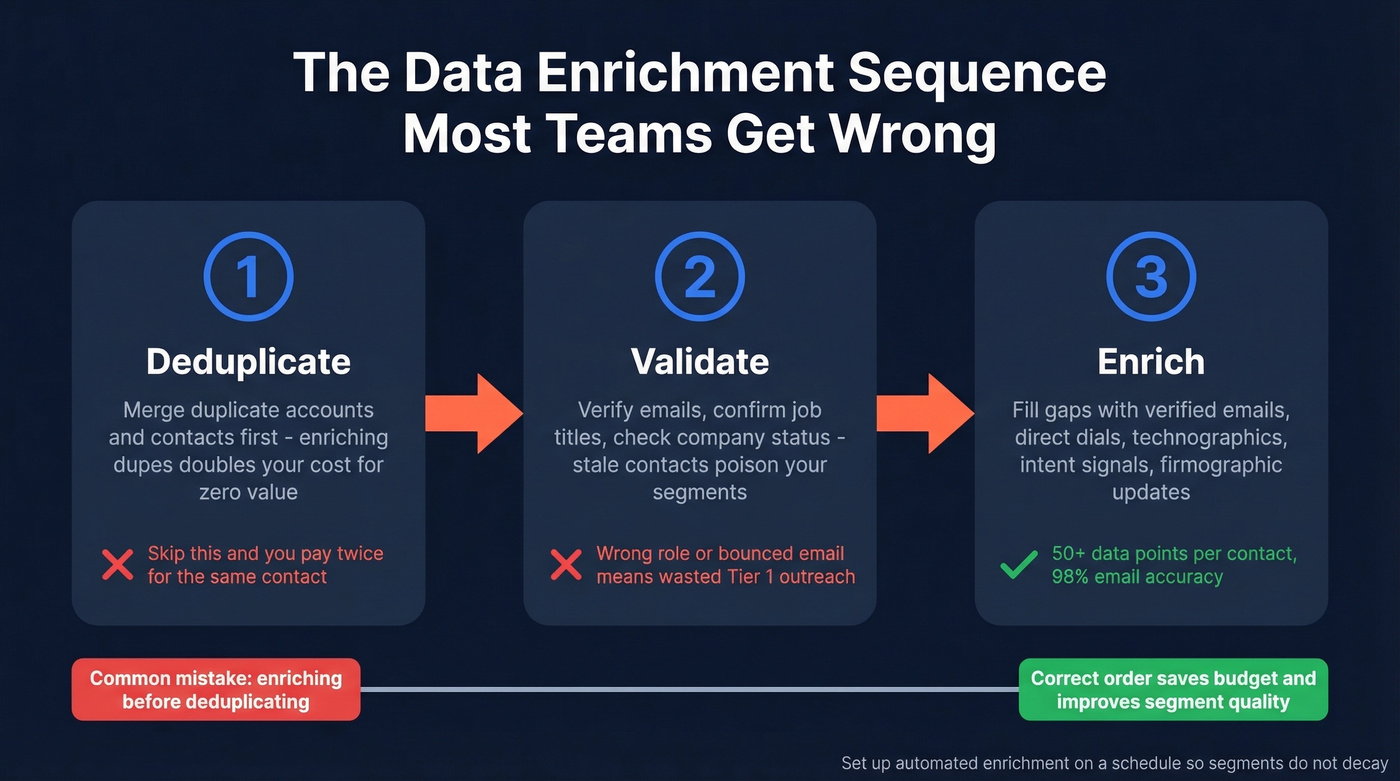
The sequence matters: deduplication → validation → enrichment. Deduplicate first because enriching duplicate records just doubles your costs. Validate next because stale contacts - wrong company, wrong role, bounced email - poison your segments. Enrich last because this is where you fill the gaps that make segmentation possible: verified emails, direct dials, technographic data, intent signals, firmographic updates. (If you’re comparing vendors, start with data enrichment services.)
We've tested a lot of enrichment tools for this step, and Prospeo is what we keep coming back to. Upload a CSV of your target accounts, get back verified contact data and intent signals. The numbers: 98% email accuracy, 92% API match rate, 83% enrichment match rate (meaning 83% of leads come back with usable contact data), 50+ data points per contact, and a 7-day refresh cycle compared to the 6-week industry average. Prospeo also layers Bombora intent data across 15,000 topics, so you're enriching and scoring intent in the same workflow. At roughly $0.01 per email, it's the cheapest insurance against wasted Tier 1 outreach.
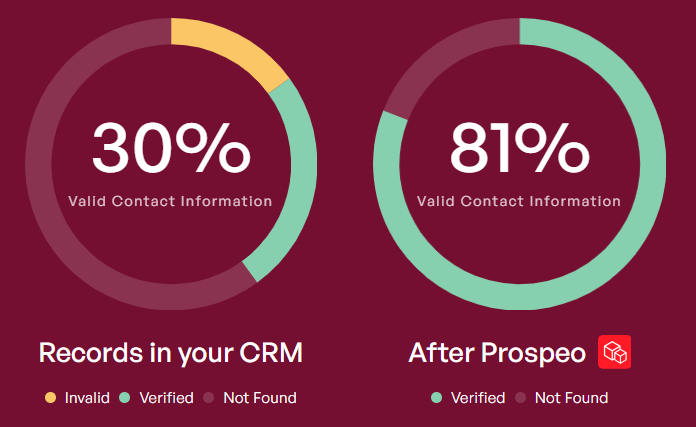
Skip manual enrichment - it doesn't scale past 50 accounts. Skip enriching before deduplication - you'll pay twice for the same contact. Do set up automated enrichment on a schedule so your segments don't decay between quarterly reviews.

You just read that mid-market buying committees average 5.4 people - and enterprise deals hit 12+. Mapping those contacts with stale data is how ABM lists rot. Prospeo's database covers 300M+ profiles with 30+ filters (intent, technographics, headcount growth, funding) so you can segment and enrich every account tier with 98% email accuracy on a 7-day refresh cycle.
Stop segmenting accounts you can't actually reach.
The article's scoring model gives Intent 35 out of 100 points - the strongest buying signal after fit. Prospeo tracks 15,000 intent topics via Bombora and layers them with job changes, department headcount, and tech stack filters. Enrich your CRM with 50+ data points per contact at $0.01/email so every tier in your ABM framework has verified, actionable contacts behind it.
Layer intent data on real contacts - not organized garbage.
Getting Sales Buy-In
The best segmentation model in the world is worthless if sales ignores it. And they will ignore it if they weren't involved in building it.
The internal politics reality is that your VP of Sales won't agree on the target account list without shared visibility into how accounts were scored and tiered. The fix is structural, not conversational:
Shared dashboard. Both teams see the same scoring data, updated in real time. If marketing sees a Tier 1 account and sales doesn't, you've got a visibility problem, not an alignment problem.
Quarterly Tier 1/Tier 2 review sessions. Sit down together, review account progression, and adjust tiers based on new signals. This isn't optional - it's the governance mechanism that keeps ABM from drifting. (If you need a structure, borrow a QBR questions format.)
Override mechanism. Sales can nominate accounts with justification, but the scoring model is the default. Without this rule, you'll end up with a "strategic" list that's really just the accounts sales already knows.
Here's our hot take: if your average deal is under $10k, you probably don't need ABM at all. The economics only work when the deal size justifies the per-account investment. A $5k contract doesn't warrant custom content hubs and executive outreach. Run demand gen, close efficiently, and save ABM for the accounts where a single deal moves the revenue needle.
For everyone else, "personalization at scale" is a lie for small teams. If you've got three marketers, don't try to run 1:1 programs for 100 accounts. Pick 50 and go deep. The teams that win at ABM aren't the ones with the biggest lists - they're the ones with the tightest focus. (If you’re aligning sales execution to tiers, use account-based selling best practices.)
Mistakes That Kill ABM Segments
Micro-segmentation. Segments so narrow they contain five accounts aren't segments - they're individual account plans mislabeled. If you can't create a reusable campaign for a segment, it's too small. The sweet spot for Tier 2 clusters is 10-30 accounts with shared characteristics.
Static segments. A segment built in January is stale by March. People change jobs, companies get acquired, intent signals shift weekly. If you aren't refreshing segments monthly at minimum - and ideally automating the refresh - you're making decisions on outdated data. We've seen teams run entire quarters on segments that were materially wrong by the time campaigns launched. It's frustrating to watch, and it's entirely preventable.
Lead-gen metrics on ABM. This is the most common mistake and the hardest to fix because it's cultural. ABM goals should be percentage of target accounts moving through stages - interested → considering → selecting → closed-won. If your CMO asks "how many MQLs did ABM generate," you haven't adopted ABM. You've just renamed demand gen.
Ignoring buying committees. Targeting one contact per account is single-threading, and it kills enterprise deals. If the average buying committee is 5.4 people in mid-market and 6-10+ in enterprise, your segments need to account for multi-threading - enriching multiple contacts per account and tracking engagement at the account level, not the contact level.
How to Measure ABM Segmentation
Different tiers need different KPIs. Measuring Tier 3 programmatic campaigns by pipeline value is as misguided as measuring Tier 1 strategic accounts by ad impressions.
| Tier | Primary KPIs | Secondary KPIs |
|---|---|---|
| Tier 1 (1:1) | Pipeline value, deal velocity, expansion revenue | Buying committee coverage, content depth |
| Tier 2 (1:Few) | MQA conversion, engagement rate | Meeting-to-opp ratio, multi-thread depth |
| Tier 3 (1:Many) | Awareness lift, cost per engaged account | Target account site visits, ad CTR |
Beyond tier-specific metrics, track the commercial outcomes that actually matter to the business: average selling price, discount incidence, pocket price versus floor, cycle time, and expansion revenue - all segmented by tier. (To keep reporting honest, track funnel metrics consistently across tiers.)
Attribution is where things get ugly. HubSpot's attribution relies on UTMs and the hubspotutk cookie, which means ad blockers, Safari ITP, redirects, link shorteners, and lead-gen sync issues all create blind spots. LinkedIn's Conversions API has a 90-day attribution window - anything outside that window disappears. The practical fix is to accept that ABM attribution will never be perfect and focus on directional trends. If your target-account pipeline share is growing quarter over quarter, your segmentation is working.
Real-World Results
67% of Lytx's closed-won deals traced back to ABM. That's the headline number, but the infrastructure behind it matters more. Lytx integrated their CRM fields with 6sense for segmentation and Tableau for reporting, giving both marketing and sales shared visibility into account progression. The lesson: measurement infrastructure - not just campaign execution - is what proves ABM's value to the C-suite.
The cloud services company that generated $1.3M in pipeline started with a problem most teams will recognize: too many accounts, too little personalization. An [Inverta case study](https://www.inverta.com/resources/the-power-of-precision - building-effective-abm-campaigns-a-case-study) documented how they narrowed focus to 50 enterprise manufacturing accounts, built personalized content hubs for each cluster, and coordinated outreach across the buying committee. The result was a 70% engagement rate and 190% increase in successful contacts. The key wasn't the platform - it was the tight account selection.
Then there's the $300k-from-30-accounts story, which is the best argument for tiering we've seen. A FullFunnel case study showed a company that segmented just 30 accounts by maturity: Tier 3 accounts were sub-40 employees with specific compliance needs (HL7, HIPAA), while Tier 2 accounts ran up to 200 employees with broader buying committees. Prior outreach had a reply rate under 2%. After segmentation and personalized messaging, reply rates hit 37%. Thirty accounts. $300k. That's what good segmentation does.
Tools for ABM Segmentation
You don't need a $50k platform. You need clean data and a scoring spreadsheet. We've seen teams with Demandbase contracts that underperform teams running ABM out of HubSpot with a well-maintained Google Sheet. The platform doesn't do the thinking for you.
That said, here's what's available:
| Category | Tool | Best For | Approx. Pricing |
|---|---|---|---|
| Data Enrichment | Prospeo | Accuracy + affordability | ~$0.01/email; free tier |
| Data Enrichment | ZoomInfo | Large teams, broad coverage | $15k-$40k+/yr |
| Data Enrichment | Cognism | EMEA-focused teams | ~$1k-$3k/mo |
| ABM Platform | Demandbase | Enterprise orchestration | $20k-$100k+/yr |
| ABM Platform | 6sense | AI-driven intent + predictive | Free (50 credits/mo); paid $20k-$100k+/yr |
| ABM Platform | Terminus | Mid-market multi-channel ABM | ~$20k-$100k+/yr |
| CRM + Marketing | HubSpot | SMB/mid-market CRM + marketing | Free CRM; Marketing Hub ~$800+/mo |
| Intent Data | Bombora | Standalone intent signals | ~$20k-$60k+/yr |
| Intent Data | G2 Buyer Intent | In-market signals from reviews | ~$10k-$50k/yr |
For most teams, the highest-ROI investment is the data layer, not the platform layer. If you're spending $40k on an ABM platform but your contact data bounces at double-digit rates, you've got the priorities backwards. (If bounce is a recurring issue, monitor your email bounce rate.)
The contrarian take: start with a CRM you already have, a data enrichment tool, and the scoring model from this article. Prove ROI on 50 accounts. Then evaluate whether a Demandbase or 6sense contract will actually improve outcomes or just add complexity. For free ABM planning, campaign, and reporting templates, Smartsheet offers a downloadable set that pairs well with the scoring model above.
FAQ
How do you segment an ABM target account list?
Start with firmographic fit to filter companies matching your ICP, then layer behavioral signals, intent data, and lifecycle stage. Score each account - Fit (40 pts) + Intent (35 pts) + Engagement (25 pts) - and assign tiers. Tier 1 gets 1:1 treatment, Tier 2 gets cluster campaigns, Tier 3 gets programmatic plays. Clean and enrich data before scoring so inputs are accurate.
How many accounts belong in each ABM tier?
Tier 1 should hold 10-50 accounts with full 1:1 treatment. Tier 2 fits 50-200 accounts in cluster campaigns. Tier 3 covers 200-1,000+ accounts programmatically. A 3-person marketing team shouldn't exceed 20 Tier 1 accounts - overloading that tier dilutes your best campaigns fastest.
What's the difference between ABM segmentation and lead scoring?
Lead scoring ranks individual contacts by conversion likelihood. ABM segmentation ranks whole companies using firmographic, behavioral, intent, and lifecycle signals at the account level. You score the account first, then map and prioritize contacts within it based on their buying-committee role.
How often should ABM segments be refreshed?
Monthly at minimum. People change jobs, companies get acquired, and intent signals shift weekly. Automated enrichment on a 7-day refresh cycle keeps underlying data current between quarterly tier-assignment reviews.
Do I need an ABM platform to run account-based marketing segmentation?
No. A CRM, a solid data enrichment tool, and a well-built scoring spreadsheet will outperform a poorly implemented $50k platform. Start simple, prove ROI on 50 accounts, then invest in automation once the model is validated.