

Best Cold Email Examples That Actually Get Replies in 2026
You've copied the "proven template" from some blog, swapped in your prospect's name, hit send 200 times, and gotten three replies - two of which were "please remove me." That's not a you problem. The best cold email examples from the last few years stopped working because everyone copied them. Across a study of 16.5 million emails, the average cold email reply rate dropped to 5.8%, down 15% year-over-year. Templates get copied, prospects get numb, and the same patterns stop working.
What still works are principles - and the examples below are built on them.
Three Things That Matter More Than Any Template
Keep it short - 40-60 words for targeted outreach, under 200 words for high-volume campaigns. Lead with a specific offer, not a vague ask. "I'll audit your top 3 landing pages and send a Loom with fixes" beats "I'd love to pick your brain" every time. And fix your deliverability before you touch your copy. A killer cold email doesn't matter if it lands in spam.
Here's the thing: most teams obsess over subject lines and templates when their real problem is that 10-20% of their list is bouncing. Deliverability is the #1 lever in 2026, not copywriting. Get that right first, then worry about your words. (If you want the full breakdown, start with this email deliverability guide.)
What the Data Says
The most thorough benchmark available comes from a study of 16.5 million emails across 93 business domains. Here's what it tells us:
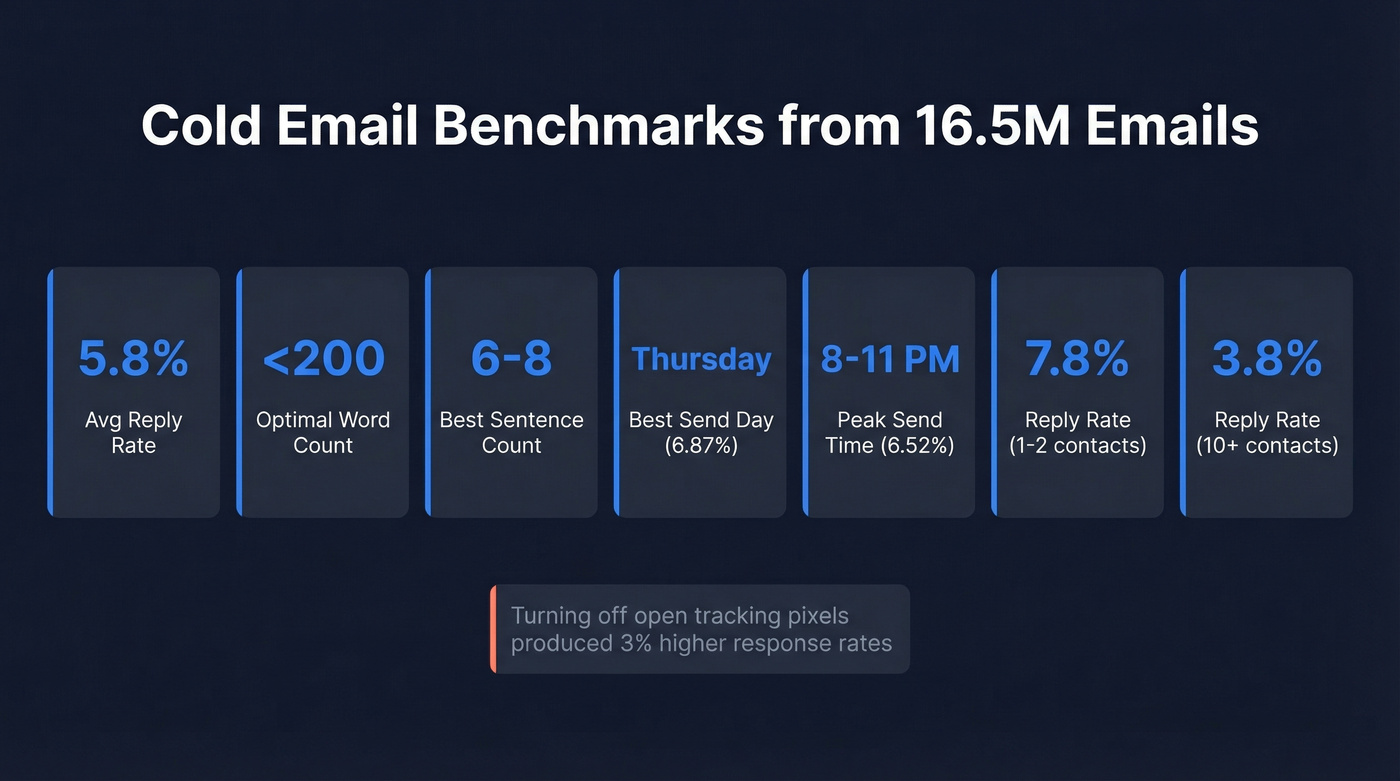
| Metric | Benchmark |
|---|---|
| Avg reply rate | 5.8% |
| Optimal length | <200 words |
| Optimal sentences | 6-8 |
| Best send day | Thursday (6.87%) |
| Peak send time | 8-11 PM (6.52%) |
| 1-2 contacts/company | 7.8% reply rate |
| 10+ contacts/company | 3.8% reply rate |
One detail that surprised us: turning off open tracking pixels produced 3% higher response rates. The tracking pixel itself is hurting you - inbox providers flag it, and savvy prospects notice the extra load. If you're optimizing for replies over vanity open metrics, kill the pixel. (More context: email tracking pixels.)
On length: the 16.5M-email dataset shows 6-8 sentences performing best at scale, while practitioners on r/coldemail and r/copywriting are pushing even shorter - 40-60 words - for targeted outreach. Both work. The difference is volume versus precision.
The Cold Email Math Nobody Shows You
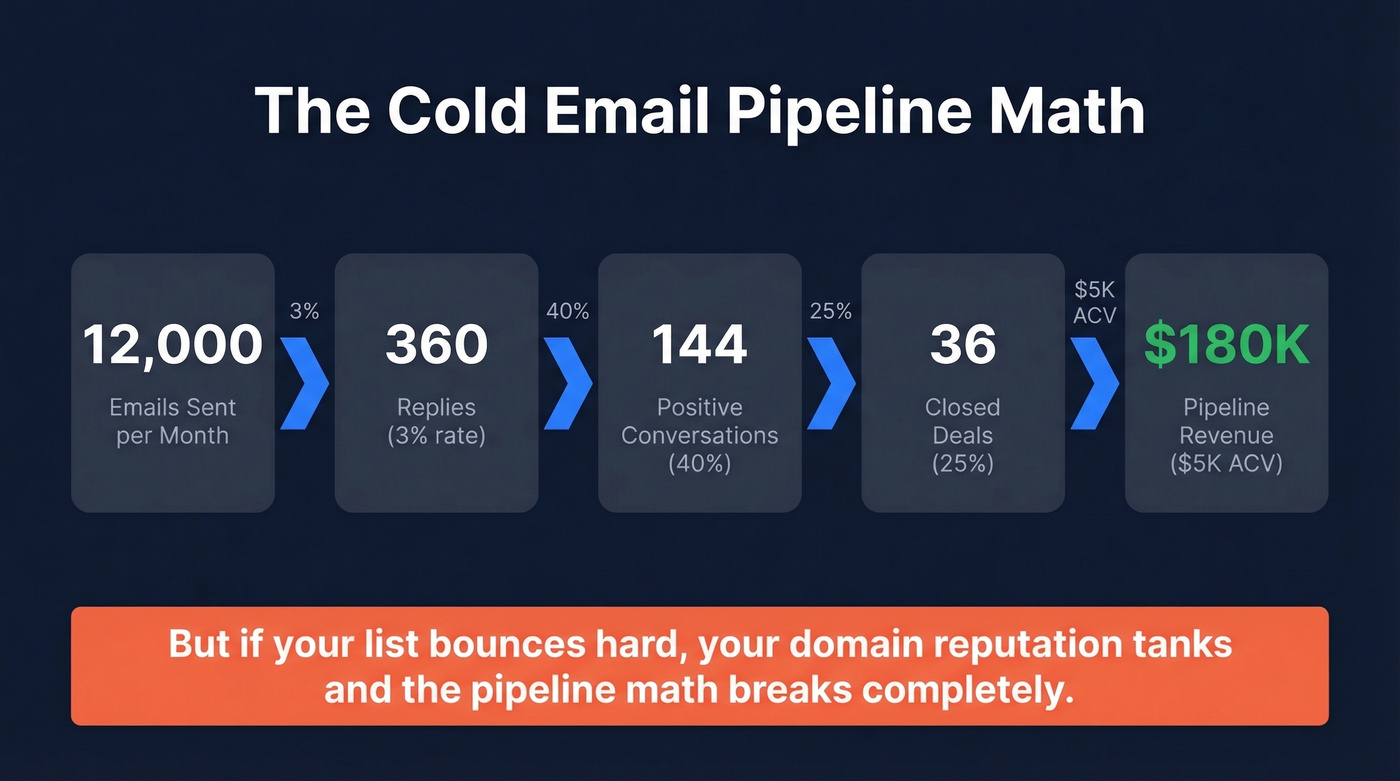
Say you're sending 12,000 emails per month at a 3% reply rate. That's 360 replies. If 40% are positive, you get 144 conversations. At a 25% meeting-to-close rate, that's 36 deals. At a $5K ACV, that's $180K in pipeline from cold email alone. But if your list bounces hard, your domain reputation tanks, your delivery rate collapses, and the pipeline math breaks completely. The math only works when the emails actually arrive. (If you're troubleshooting, start with email bounce rate benchmarks and fixes.)
Subject Lines - What 85 Million Emails Reveal
An analysis of Gong data across 85M+ cold emails boils down to a few rules.
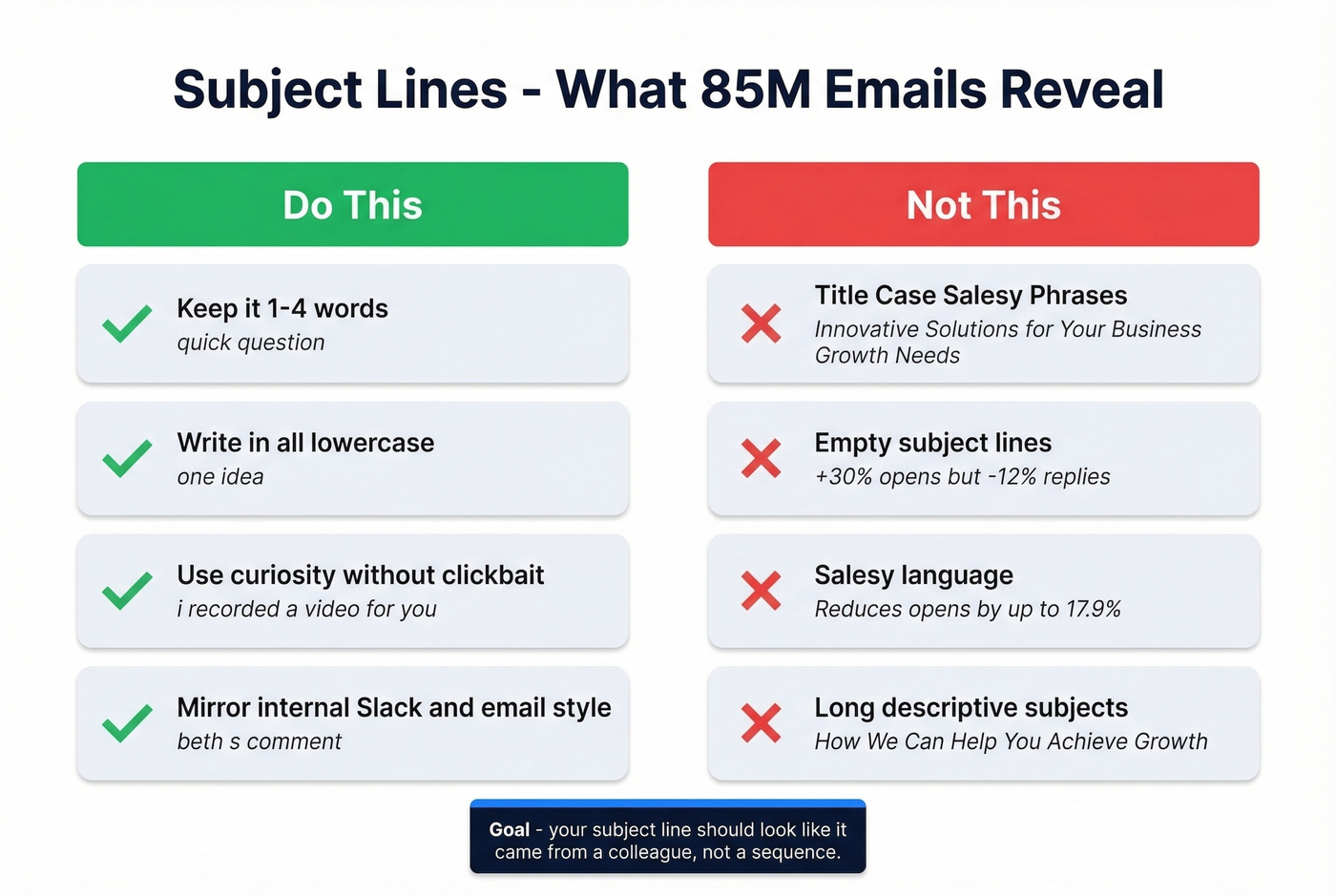
Keep subject lines to 1-4 words. Write in all lowercase - it mirrors internal Slack-and-email style and consistently gets the highest open rates. Use curiosity without clickbait: "quick question," "one idea," "i recorded a video for you." (If you want more options, see these cold email subject line examples.)
Avoid salesy language - it reduces opens by up to 17.9%. Don't send with an empty subject line. Yes, it boosts opens by 30%, but it tanks replies by 12%. It's a gimmick that costs you conversions. The goal is internal camouflage: your subject line should look like it came from a colleague, not a sequence. (Related: prospecting email subject lines.)
Micro-Rules for Effective Cold Emails
Maintain a 1:2 "I-to-you" ratio - for every time you mention yourself, mention the prospect twice. Keep your CTA to 1-2 words of action: "Worth exploring?" beats "Would you be open to scheduling a brief introductory call at your earliest convenience?" And never put two asks in the same email. One email, one action. (More examples: email call to action.)
What a Bad Cold Email Looks Like
Before the good examples, here's the kind of email that fills every prospect's trash folder:
Subject: Innovative Solutions for Your Business Growth Needs
Dear Decision Maker,
I hope this email finds you well! My name is Jake and I'm the VP of Sales at GrowthCo. We are an award-winning platform that uses AI-powered solutions to help companies like yours achieve unprecedented growth...
I'd love to schedule a quick 30-minute call to discuss how we can help. Also, feel free to check out our case studies, download our whitepaper, and visit our blog for more insights.
Everything wrong here: Title Case subject line with seven salesy words, generic greeting, self-focused opening, buzzword soup, and three CTAs competing for attention. The prospect stopped reading at "I hope this email finds you well." (If you want a cleaner structure, this email copywriting guide is a good baseline.)

The article says it clearly: deliverability is the #1 lever, not copywriting. A 10-20% bounce rate kills your domain reputation and your pipeline math. Prospeo's 98% email accuracy and 7-day data refresh mean the emails you craft actually land in inboxes - not spam folders.
Fix your list before you fix your copy. Start with 75 free verified emails.
7 Cold Email Examples That Get Replies
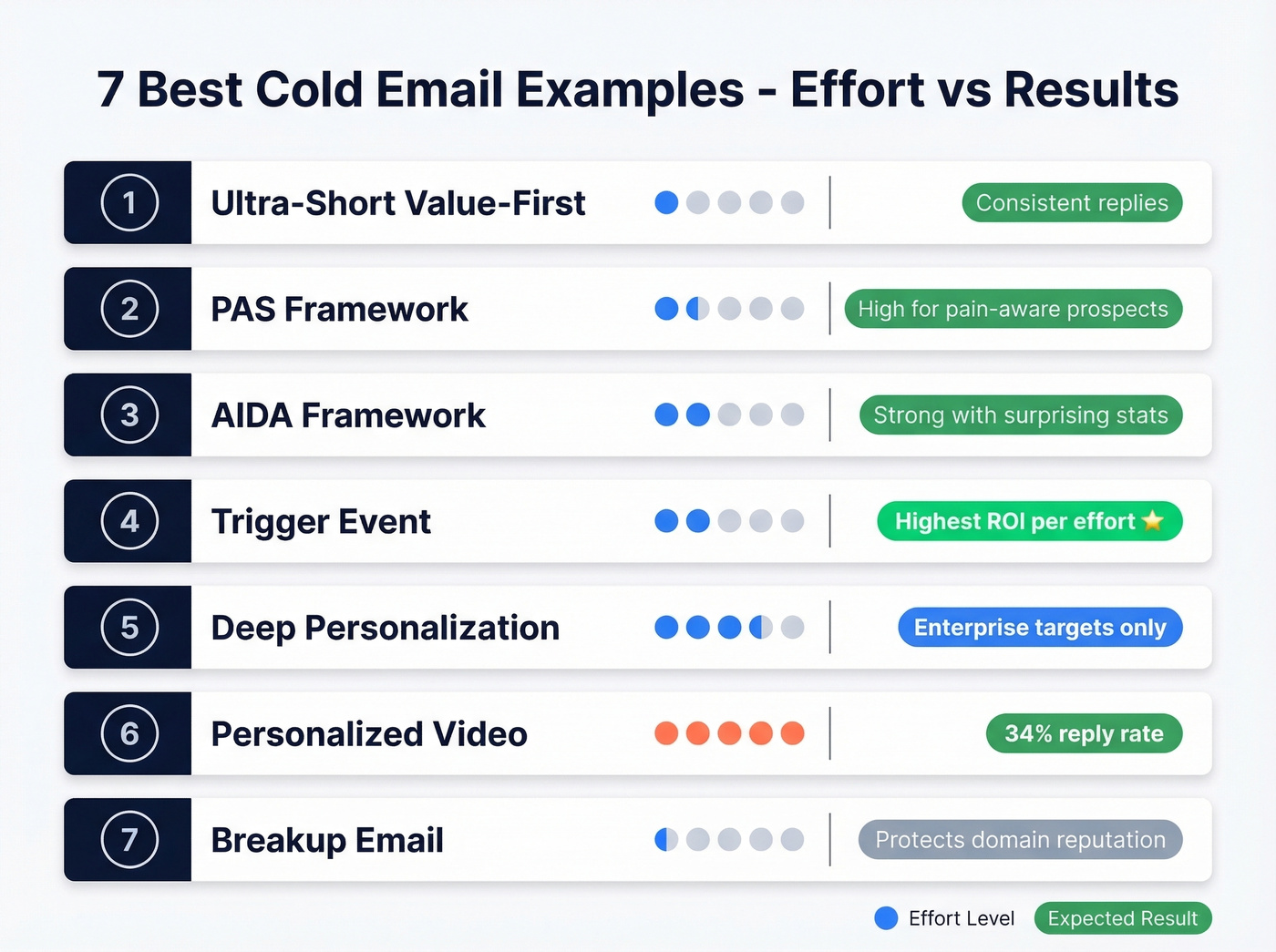
These are ordered by effort - easiest to hardest. Start with the ultra-short format if you're sending volume. Graduate to personalized video if you're targeting high-value accounts where the conversion math justifies the time investment. (For a full sequencing approach, see B2B cold email sequence.)
1. The Ultra-Short Value-First Email (47 Words)
Subject: quick question
Hi {{firstName}},
We help {{industry}} companies cut {{specific metric}} by {{X%}} - did it for {{similar company}} in {{timeframe}}.
Would it be worth a quick conversation to see if we could do the same for {{company}}?
Best, {{Your name}}
Forty-seven words. Context, specific outcome, social proof, soft CTA. The r/copywriting community consistently confirms that 40-60 word emails are the format getting responses right now. The offer matters more than the personalization - "I read your blog post" means nothing if the ask is vague. "Worth a conversation?" works because it asks for almost nothing. Among the cold outreach examples we've tested, this format delivers the most consistent reply rates relative to effort.
2. The PAS Framework Email
Subject: {{pain point}}
Hi {{firstName}},
{{Company}} is growing fast - but that usually means {{specific problem}} starts breaking.
When that happens, {{agitation - what gets worse}}.
We built {{solution}} specifically for this. Helped {{similar company}} fix it in {{timeframe}}.
Worth a look?
Problem, Agitate, Solution. Under 60 words. Most people botch the agitation line by inventing a problem. Don't. Name one the prospect already knows they have - something visible in their job postings, their tech stack, or their recent growth trajectory. The soft CTA keeps the ask low-friction.
3. The AIDA Framework Email
Subject: one idea for {{company}}
Hi {{firstName}},
{{Attention - surprising stat or observation about their industry}}.
{{Interest - how this connects to their specific situation}}.
{{Desire - what the outcome looks like with your solution}}.
Want me to send over a quick breakdown? {{Action}}
Skip this format if your attention line isn't genuinely surprising. AIDA lives or dies on that first sentence - a stat they haven't seen, or an observation about their own company that shows you did homework. If you're just going to write "Did you know 73% of companies struggle with X?" you're better off with the ultra-short format. One CTA at the end. Never ask for a meeting and offer a resource in the same email. (If you want to go deeper on the framework, see AIDA sales funnel.)
4. The Trigger Event Email
Subject: congrats on the round
Hi {{firstName}},
Saw {{company}} just closed a {{Series X}} - congrats. In our experience, that's usually when {{specific challenge}} becomes urgent.
We help post-funding teams {{specific outcome}} - did it for {{similar company}} within {{timeframe}} of their raise.
Open to a quick chat this week?
This is one of the highest-ROI formats per unit of effort. Trigger signals - new funding, new hire, job posting, tech adoption - do the personalization work for you. A "congrats on the round" email sent within days of a funding announcement tends to outperform templates sent to a static list. Signals beat templates, and successful cold outreach almost always rides a timely trigger. (More on operationalizing signals: how to track sales triggers.)
For teams that want to automate this, Prospeo tracks intent data across 15,000 topics powered by Bombora, so you can layer buyer intent with trigger events instead of guessing who's in-market.
5. The Deep Personalization Email
Subject: beth's comment
Hi {{firstName}},
Saw the comment from {{third party}} about their experience working with {{company}} - sounds like you're doing something different with {{specific area}}.
Most teams in {{industry}} are still stuck doing {{common approach}}, which usually means {{pain point}}.
What if you could {{ideal outcome}} without {{friction}}?
Happy to share how we helped {{similar company}} get there. Worth 15 minutes?
{{Your name}}
Referencing a third-party comment or external signal proves you actually did research. This format converted a client in the original case study, and the r/b2bmarketing community validated the approach across multiple verticals.
The downside? It's not scalable at 500 emails a day. You're spending 10-15 minutes per email on research. Reserve this for enterprise targets where a single deal justifies the time. For teams that want personalization without the time sink, the trigger event format above is a better starting point. (More ideas here: personalized outreach.)
6. The Personalized Video Email (34% Reply Rate)
Subject: i recorded a video for you
Hey {{firstName}},
I put together a quick strategy video specifically for {{company}} - covers a few things I noticed that could help with {{specific area}}.
I didn't want to just drop a link. Would you like me to send it over?
{{Your name}}
This format pulled a 34% reply rate across 150 e-commerce brands. The full funnel: 150 emails sent, 51 replies (34%), 31 booked calls, 8 paying clients, roughly EUR12K in revenue. Once a prospect replied "yes," the sender delivered a 3-5 minute Loom with a custom strategy walkthrough. About 60% of video viewers converted to calls.
The genius is the curiosity gap. No link, no pitch, just a question. The prospect has to reply to get the value. At around 20-30 minutes per email for research and recording, this is the highest-effort format here. But 34% reply rates on targeted accounts make the math work - especially when your deal size exceeds $5K. It's one of the most effective cold emails ever documented in terms of raw conversion, though the time investment limits scale. (If you want a step-by-step, see Loom video cold email.)
7. The Breakup Email (Last Touch)
Subject: closing the loop
Hi {{firstName}},
I've reached out a couple of times - totally understand if the timing isn't right.
If {{specific outcome}} becomes a priority, I'm here. Otherwise, I'll get out of your inbox.
Best, {{Your name}}
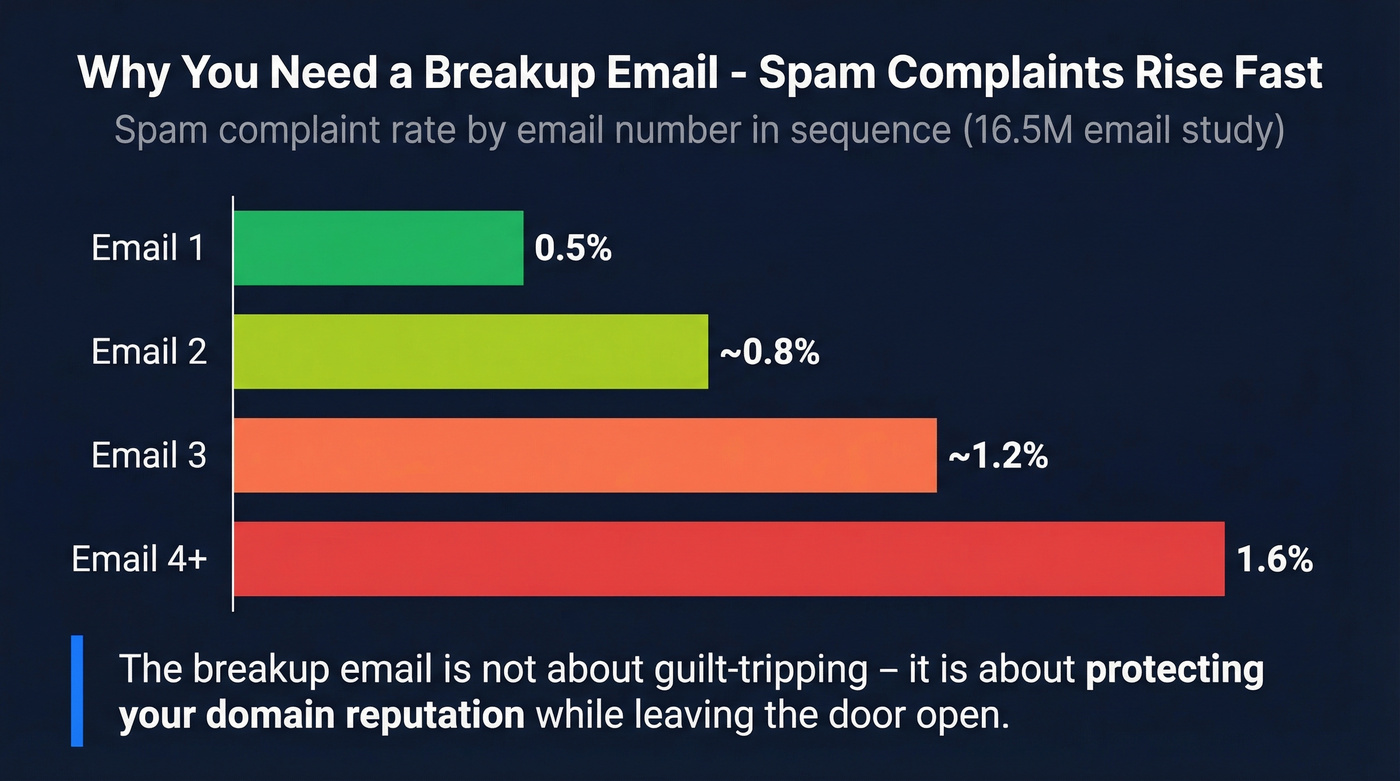
Know when to stop. Across 16.5M emails, spam complaints rise from 0.5% on the first email to 1.6% by the fourth. The breakup email isn't about guilt-tripping - it's about protecting your domain reputation while leaving the door open. Send it, then move on.
Follow-Up Examples That Don't Annoy
The first follow-up is essential. Data from the 16.5M-email study shows it can lift replies by up to 49% in high-performing campaigns. After that, diminishing returns hit hard - a third email drops reply rates by up to 20%, and spam complaints escalate with every touch.
Send your first follow-up 2-3 days after the initial email. Keep it shorter than the original. (If you want more variations, use these cold email follow-up templates.)
Subject: re: {{original subject}}
Hi {{firstName}},
Quick bump on this - figured it might've gotten buried.
{{One-sentence restatement of the offer or value prop}}.
Still worth a quick chat?
Cap your sequence at 3 total touches. The math doesn't support more unless you're adding genuinely new value in each follow-up.
Infrastructure - The Complete Pre-Send Checklist

Most cold email failures aren't copy failures. They're infrastructure failures. Even great outreach templates fall flat without a clean sending setup. Here's everything that needs to be true before you send a single email.
Domains and inboxes. Buy 3-5 secondary domains - variations of your brand - for cold outreach. Never send cold email from your primary domain. Run 2-3 inboxes per domain, max. If you're sending 10-15 emails per inbox per day, getting to ~400/day usually means ~10-12 domains with 2-3 inboxes each.
Authentication. SPF, DKIM, and DMARC configured on every sending domain. Google's bulk sender requirements now mandate all three, and Yahoo and Microsoft enforce similar standards. (If you need a quick check, see how to verify DKIM is working.)
Tracking and warmup. Set up a custom tracking domain via CNAME - shared tracking domains inherit every other user's reputation. Warm new domains for 14-21 days minimum, then ramp slowly over 4-6 weeks, starting at 5-10 emails per day. (More detail: tracking domain and email velocity.)
Compliance. CAN-SPAM requires a physical address and a clear opt-out mechanism in every email. GDPR applies if you're emailing EU prospects - you need a legitimate interest basis and must honor opt-out requests. Add a one-click unsubscribe header (RFC 8058) to stay ahead of inbox provider enforcement.
Thresholds. Spam complaints under 0.3%. Bounces under 2%. If you're above either, stop sending and fix your list before you send another email.
Your List Matters More Than Your Copy
Here's the scenario we see constantly. Your SDR sends 200 emails. Forty-seven bounce. The bounces tank your domain reputation. Now 80 of the remaining 153 land in spam. You're left with 73 emails that actually reached a human - and a domain that's getting worse by the day. You can study cold outreach examples all day, but none of them work if your data is bad.
Stack Optimize built from $0 to $1M ARR running cold outbound. Across all their clients, they maintained 94%+ deliverability, bounce rates under 3%, and zero domain flags. The difference wasn't better copy. It was verified data before every send.
Prospeo's email finder runs 98% accuracy through a 5-step verification process with catch-all handling, spam-trap removal, and honeypot filtering - all on a 7-day data refresh cycle. That means the email you verified on Monday is still good on Friday, unlike platforms refreshing every 6 weeks. The free tier gives you 75 verified emails per month, enough to validate your first campaign's list before scaling. Pair it with Instantly or Lemlist for sending, and you've got infrastructure that actually protects your domain.

You just saw the math: 12,000 emails at 3% reply rate = $180K in pipeline. But that only works when every address is real. Teams using Prospeo bounce under 4% and book 35% more meetings than Apollo users - because clean data turns great cold email copy into actual revenue.
Great templates deserve a list that won't destroy your domain.
FAQ
What's a realistic cold email reply rate?
At scale, 5.8% is the most recent large-scale benchmark, based on 16.5 million emails. A consistent 2-4% reply rate on large volumes is genuinely good. Double-digit rates are almost always small-sample or hyper-targeted campaigns - don't benchmark against them.
How many follow-ups should I send?
Cap at 3 total emails per prospect. The first follow-up can lift replies by up to 49%, but a third email drops reply rates by up to 20%. Spam complaints escalate from 0.5% to 1.6% by the fourth touch - not worth the domain risk.
How long should a cold email be?
Under 200 words for volume campaigns, 40-60 words for targeted outreach. Large-scale data shows 6-8 sentences hits the sweet spot at scale. But length optimization is pointless if your emails bounce - verify your list first so every word actually reaches someone.
Which cold email format works best for B2B?
The ultra-short value-first format and trigger event email consistently outperform longer templates for B2B outreach. For high-value accounts above $10K ACV, personalized video emails have documented 34% reply rates - but budget 20-30 minutes per email for research and recording.