

Best Ways to Follow Up With Customers: Templates, Timing, and Real Examples
62% of companies don't respond to customer service emails. 97% never send a follow-up to check if the customer was actually satisfied. That's not a data gap - it's a relationship gap, and it's costing revenue every single day.
Here's the thing: 42% of replies come from follow-ups, not the first email. The best ways to follow up with customers aren't complicated - they just require consistency and value. In our experience, the companies that build follow-up into their muscle memory win more deals, retain more customers, and generate more referrals. The ones that don't are leaving money on the table and wondering why churn keeps climbing.
Three Rules Before Anything Else
- Every follow-up must add new value. Never send "just checking in" with nothing attached.
- The sweet spot is 4-7 touchpoints spaced 3-4 days apart, sent Tuesday through Thursday mornings.
- Keep follow-ups under 80 words. Shorter emails outperform longer ones - one practitioner doubled their reply rate by cutting from 141 words to under 56.
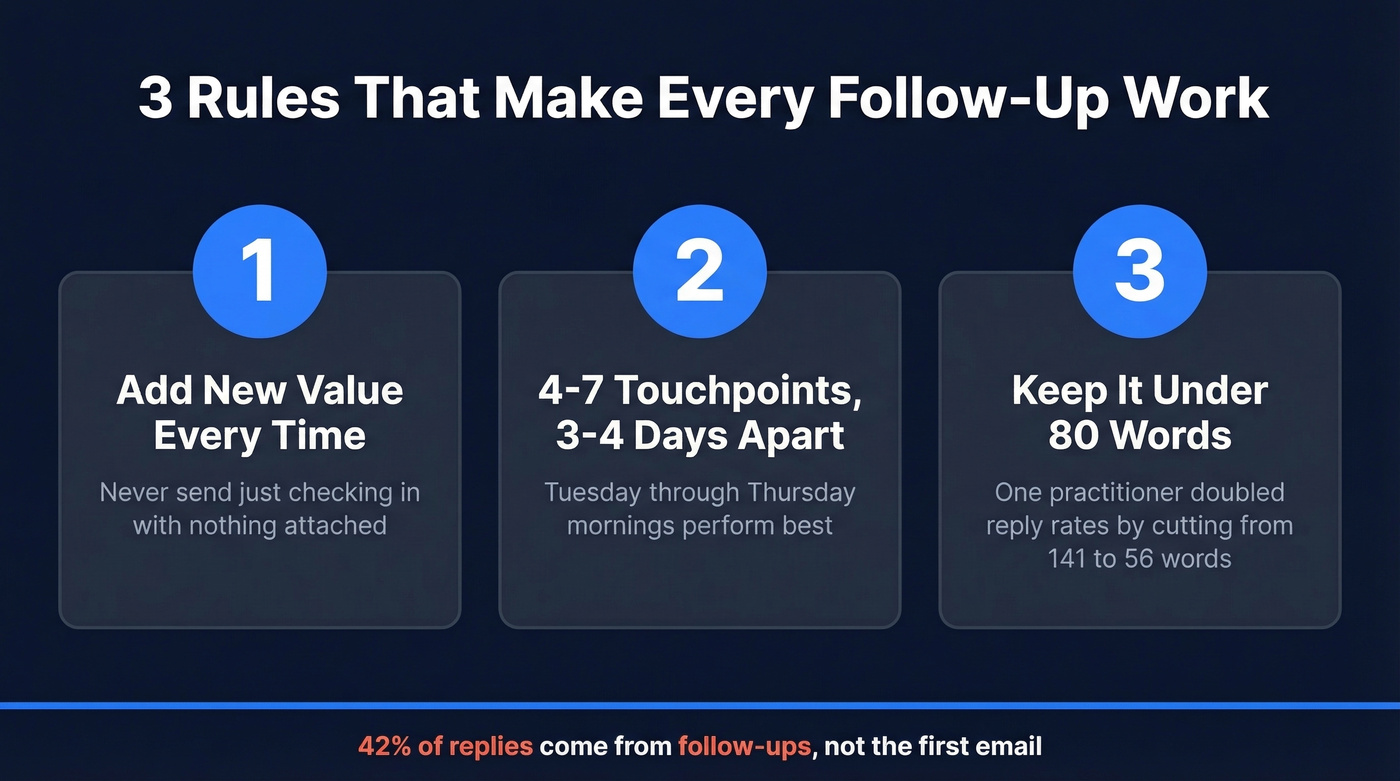
That's the framework. Everything below is the execution.
5 Rules That Make Any Follow-Up Work
Add New Value Every Time
Treat each follow-up as a new touchpoint, not a reminder of the old one. A case study, a relevant stat, a competitor insight, a resource they haven't seen - anything that gives them a reason to engage. If you can't articulate what's new, don't send it. (If you want a deeper framework, see how to add value in sales.)
Keep It Short
One Reddit practitioner cut their emails from 141 words to under 56 and watched reply rates double (3% to 6% over 62 days). Benchmark data from billions of cold email interactions confirms it: best-performing campaigns use emails under 80 words with a single CTA and problem-first positioning. Say less. Get more. (More examples: cold email follow-up templates.)
Personalize Beyond First Name
71% of customers expect personalized interactions, and 76% get frustrated when they don't get them. Companies that nail personalization generate 40% more revenue from those efforts. That means referencing their specific situation - a recent funding round, a product they bought, a problem they mentioned on a call - not just mail-merging their name. If you're building this into a system, personalized outreach helps.
One Clear CTA Per Email
Don't ask them to "check out the case study, book a call, and let me know your thoughts." Pick one. The best-performing campaigns all share this trait: a single, specific ask. "Does Thursday at 2 PM work?" beats "Let me know when you're free" every time. (Related: email call to action.)
Use the Right Channel
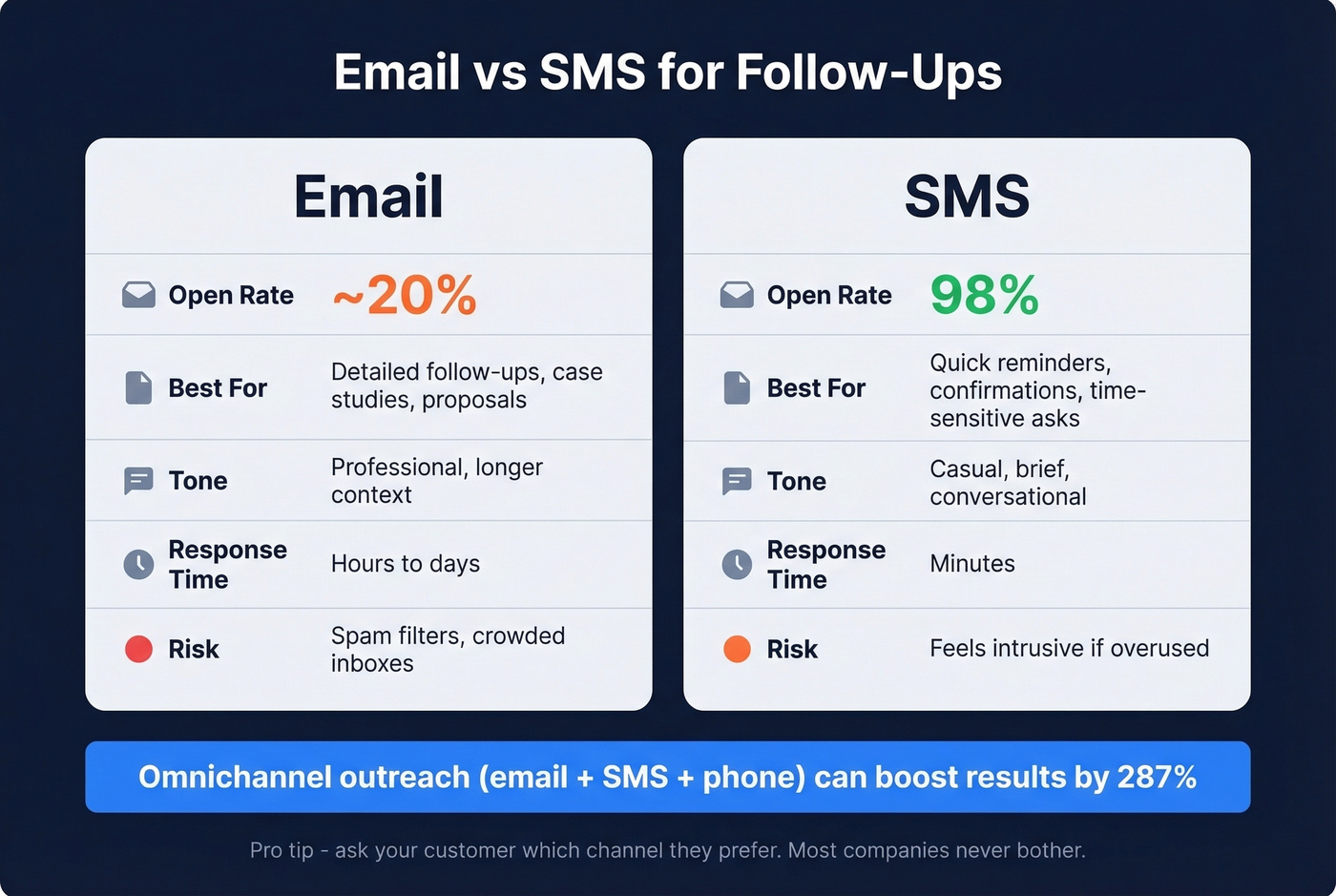
Email isn't always the answer. SMS has a 98% open rate versus roughly 20% for email. Phone works for high-value accounts. Ask your customer how they prefer to be reached - most people never bother, and it's a missed opportunity. If you're building an omnichannel motion, start with sequence management.
Follow-Up Timing and Cadence
Timing matters more than most teams realize. One practitioner reported a 16% improvement in open rates just by restricting sends to Tuesday through Thursday, 8-11 AM in the recipient's timezone. Based on Instantly's analysis of billions of cold email interactions, Wednesday is the highest-performing day. For a deeper timing breakdown, see best time to send cold emails.
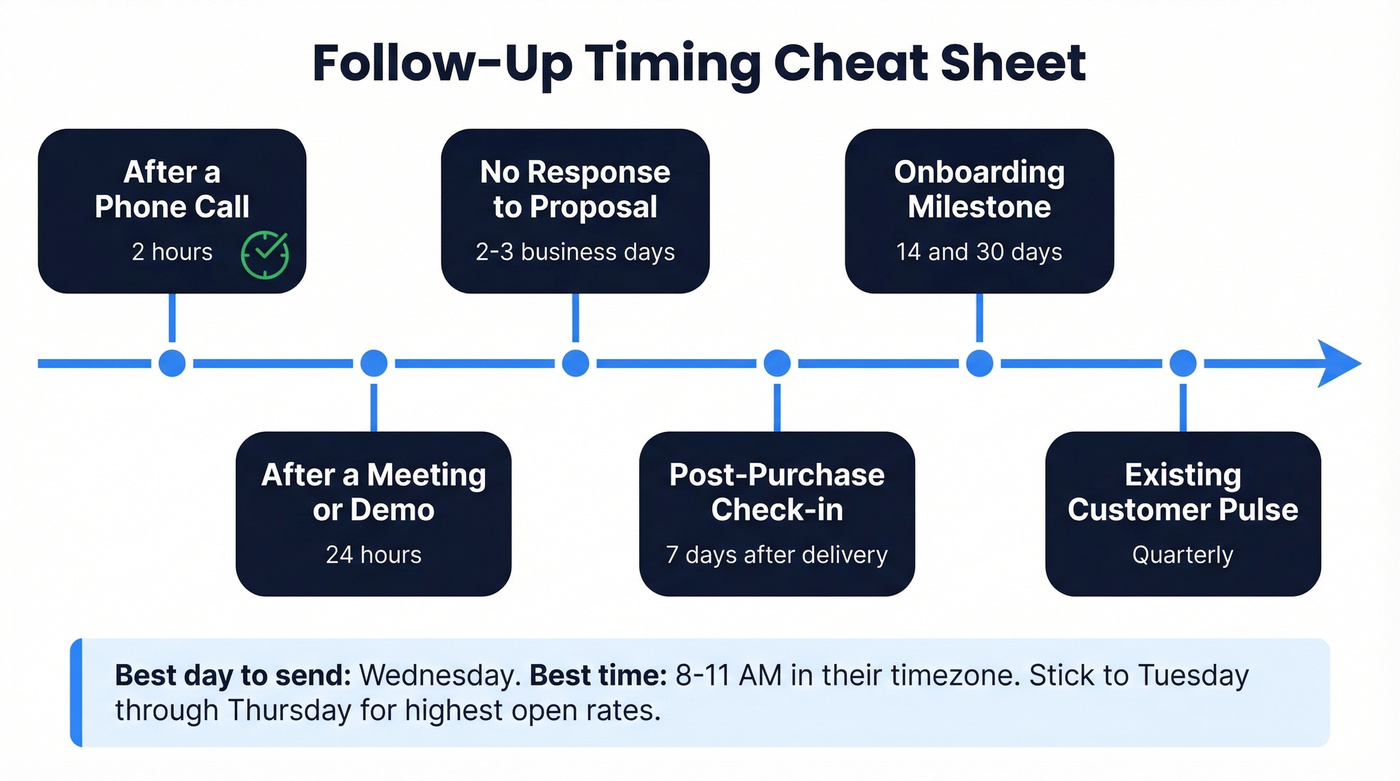
| Scenario | Follow-Up Timing |
|---|---|
| After a meeting/demo | Within 24 hours |
| After a phone call | Within 2 hours |
| No response to proposal | 2-3 business days |
| Post-purchase check-in | 7 days after delivery |
| Onboarding milestone | 14 and 30 days |
| Existing customer pulse | Quarterly |
For outbound sequences, the general cadence is 4-7 touchpoints spaced 3-4 days apart. Beyond 7 touches, returns diminish - unless each one genuinely adds something new. For existing customers, the rhythm stretches out: quarterly check-ins with lifecycle-triggered messages in between.
Your first email is a lottery ticket. Your follow-up sequence is the actual strategy. Most teams get that backwards.
Sales Follow-Up Email Examples
After a Meeting or Demo
Send within 24 hours of any live conversation.
Subject: Next step on [specific topic discussed]
Hi [Name],
Great talking through [specific pain point] today. I pulled together the [case study / ROI calculator / implementation timeline] we discussed - here it is: [link].
Does [day] at [time] work to walk through next steps?
This works because it references something specific from the conversation, delivers a promised resource, and includes a concrete scheduling ask. Keep subject lines under 8 words or 40 characters. (More options: email subject lines examples.)
After Sending a Quote (No Response)
Most reps send "Just wanted to follow up on the proposal I sent last week. Let me know if you have any questions!" That gets ignored. Here's what works instead - send 2-3 days after the proposal:
Subject: Quick thought on [their company]'s rollout
Hi [Name],
I was thinking about the timeline we discussed and wanted to share how [similar company] handled the same transition - they cut onboarding from 6 weeks to 2. [Link to case study]
Happy to walk through how that'd map to your team. Worth 15 minutes?
The consensus on r/sales is clear: value-add drips beat desperate check-ins every time.
Second Follow-Up (Still No Response)
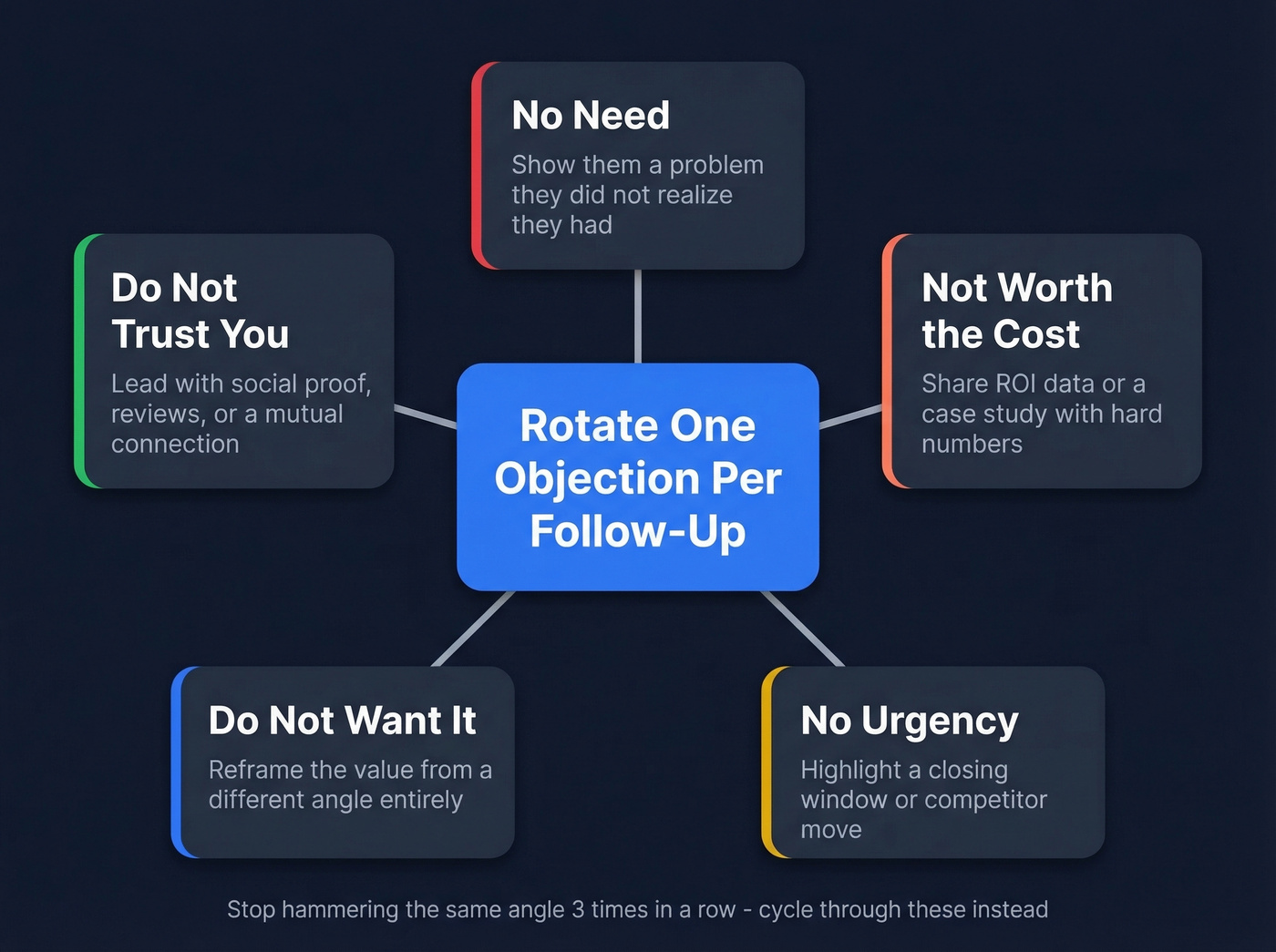
Send 3-4 days after your first follow-up. Rotate the objection you're addressing.
Subject: Different angle on [problem]
Hi [Name],
I know [problem] might not feel urgent right now. But [specific stat or competitor move] suggests the window is narrowing. Here's a 2-minute breakdown: [link].
If the timing's off, just say so - no hard feelings.
Instead of repeating the same pitch, cycle through five objection categories: no need, not worth the cost, no urgency, don't want it, don't trust you. One per follow-up. We've found this rotation approach works far better than hammering the same angle three times in a row, which is what most sequences do by default. (If you want more ready-to-send options, see sales follow-up templates.)
Trigger Event Follow-Up
When a prospect changes jobs, their company raises funding, or they're in the news - that's your opening. If you want to operationalize this, use how to track sales triggers.
Subject: Congrats on the Series B
Hi [Name],
Saw the funding news - congrats. Teams at this stage usually hit [specific scaling challenge] within 90 days. We helped [similar company] navigate that - happy to share what worked.
Worth a quick call next week?
Break-Up Email
After 7-10 touches with no response over about 2-3 weeks, send the closer.
Subject: Should I close your file?
Hi [Name],
I'm finalizing my schedule for next week and want to make sure I'm not cluttering your inbox. If [problem] isn't a priority right now, totally understand - I'll close this out.
If it is, I've got one slot open [day]. Just reply "yes" and I'll send the invite.
The "finalizing my schedule" framing - borrowed from a Reddit practitioner who uses it for site visits - creates soft urgency without desperation. Giving them permission to say no paradoxically makes them more likely to say yes.

The best follow-up sequence in the world fails if your emails bounce. 35% bounce rates kill domain reputation and tank deliverability for every campaign after. Prospeo's 98% email accuracy and 7-day data refresh mean your carefully crafted follow-ups actually land in inboxes - not spam folders.
Stop writing perfect follow-ups to dead email addresses.
Customer Follow-Up Examples (Post-Sale)
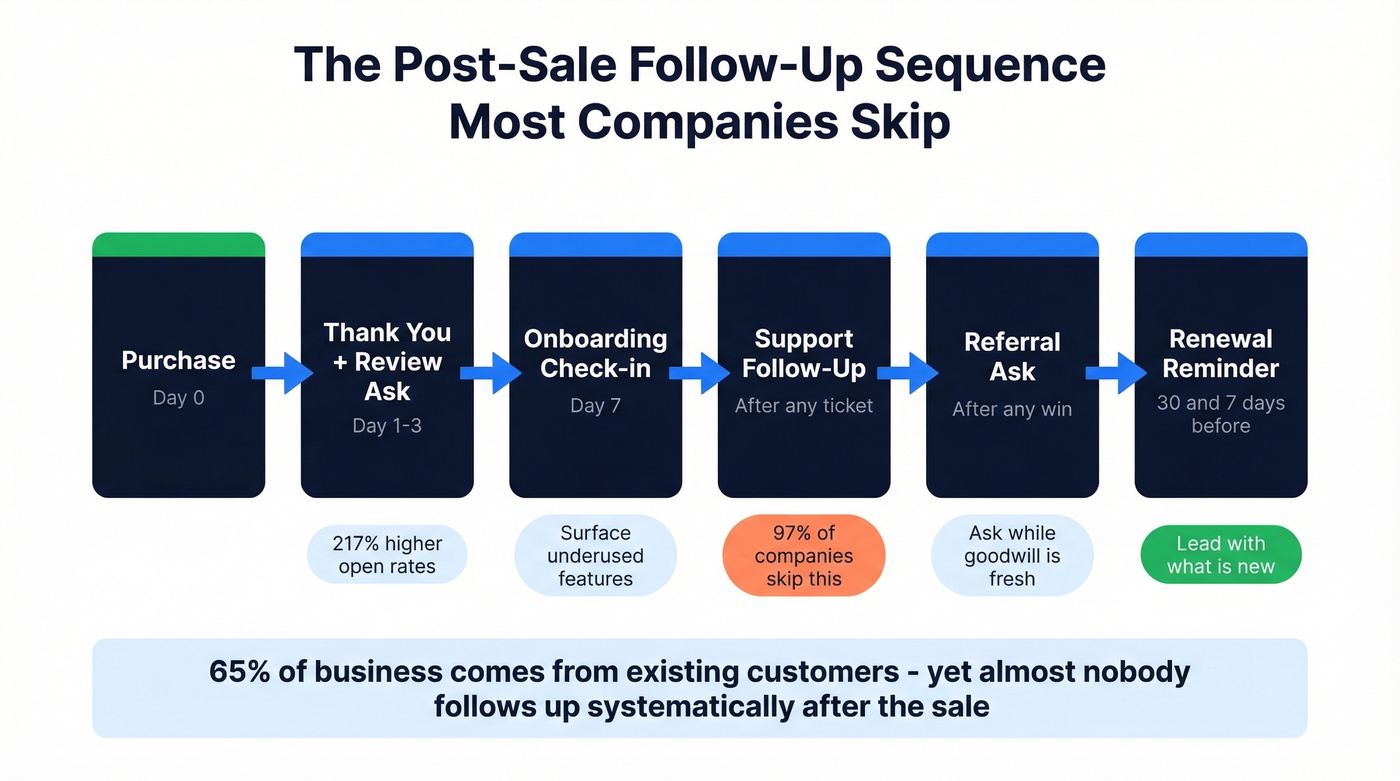
65% of a company's business comes from existing customers, and customers with the best past experiences spend 140% more than those with poor ones. Yet almost nobody follows up systematically after the sale. (If you're tracking retention, start with churn analysis.)
Post-Purchase Thank You + Review Request
Send 1-3 days after purchase or delivery.
Subject: How's everything with [product]?
Hi [Name],
Thanks for choosing [product]. I wanted to make sure everything arrived in great shape and you're off to a good start.
Quick favor: if things are going well, a 30-second review on [platform] would mean a lot. Here's the link: [link]
Post-purchase emails hit 217% higher open rates than standard marketing emails - order confirmations alone reach 114%. Capitalize on that attention window while satisfaction peaks.
Onboarding Check-In (7-Day)
Send one week after a customer starts using your product.
Subject: How's your first week going?
Hi [Name],
You've been live for a week - wanted to check in. Most teams at this stage haven't explored [underused feature] yet, but it's where the biggest time savings come from. Here's a 90-second walkthrough: [link]
Any questions or blockers? I'm here.
Use product analytics to identify which features they haven't touched, then send a targeted walkthrough. Proactive check-ins uncover issues before churn and surface adoption gaps you can fix with a quick tutorial.
Support Resolution Follow-Up
The day after resolving a support ticket - this is the most underused follow-up in business.
Subject: All good with ticket #[number]?
Hi [Name],
Just confirming everything's working after we resolved [issue]. If anything's still off, reply here and I'll jump back in.
97% of companies never check if the customer was satisfied after a support interaction. This 20-second email separates you from virtually every competitor.
Referral Request
Ask immediately after a successful outcome - a positive review, a completed project, or a milestone hit. The goodwill fades fast.
Subject: Know anyone dealing with [problem]?
Hi [Name],
Glad [outcome] worked out. If you know anyone dealing with a similar challenge, I'd love an intro. Happy to make it easy - just forward this email or reply with their name and I'll reach out gently.
Renewal / Subscription Reminder
Send at 30 days and 7 days before renewal.
Subject: Your [product] renewal is coming up
Hi [Name],
Your subscription renews on [date]. Before it does, I wanted to share what's new since you signed up: [1-2 new features or improvements].
Any questions about your plan? Happy to hop on a quick call.
Leading with what's improved since they signed up reframes renewal as an upgrade, not a cost.
Win-Back / Re-Engagement
Send 60-90 days after a customer goes inactive or churns.
Subject: Things have changed since you left
Hi [Name],
We've made some big updates since you were last active - [specific improvement]. I'd love to show you what's different.
Here's [a specific offer: free month, discount, or extended trial] if you want to give it another look. No pressure either way.
A specific "what changed" angle acknowledges the reason they left without dwelling on it. Pairing it with a concrete offer gives them a reason to come back.
SMS Follow-Up Templates
Omnichannel outreach - combining email, SMS, and phone - can boost results by 287%. SMS is the highest-impact addition because of its sheer visibility: 98% open rate, with 90% of texts read within 30 minutes. (If you're considering tooling, compare follow up email software.)
Appointment reminder:
Hi [Name], quick reminder about your [meeting type] tomorrow at [time]. Reply Y to confirm or suggest a new time. - [Your name]
Order/delivery update:
[Name], your order #[number] shipped! Track it here: [link]. Questions? Reply to this text. - [Company]
Support resolution check:
Hi [Name], we resolved ticket #[number] yesterday. Everything working? Reply if you need anything else. - [Company]
| Channel | Open Rate | Response Speed | Best For | Compliance |
|---|---|---|---|---|
| ~20% | Hours-days | Detailed follow-ups | CAN-SPAM, GDPR | |
| SMS | 98% | 90% in 30 min | Time-sensitive updates | TCPA, GDPR, opt-in |
| Phone | N/A | Immediate | High-value accounts | Do-not-call lists |
SMS compliance checklist: Get explicit opt-in consent before sending. Include a STOP keyword in every message. Never send outside business hours unless it's urgent. Keep messages under 160 characters.
7 Mistakes That Kill Response Rates
"Just checking in" with no value. Attach a case study, a relevant stat, or a new angle. Every touch needs to earn its place in their inbox. If you need alternatives, see how to say just checking in professionally.
Too long. Under 80 words. The Reddit case study is clear: cutting from 141 to under 56 words doubled reply rates. If your email needs a scroll bar, it's too long.
"Follow-up" in the subject line. Use a specific, curiosity-driven subject under 8 words. "Quick thought on [their problem]" beats "Following up" every time.
Same message repeated. Rotate through objections: no need, cost, urgency, desire, trust. Each follow-up should address a different reason they haven't replied.
No CTA. One specific ask. "Does Thursday at 2 work?" not "Let me know your thoughts."
Wrong channel. If they don't respond to email after three touches, try SMS or phone. Match the channel to the urgency and the relationship.
Sending to dead email addresses. 17% of cold emails never reach the inbox in the first place - bad data is often the reason. We've seen teams double their reply rates just by cleaning their contact lists before launching a sequence. One Reddit practitioner saw bounce rates drop from 11% to under 2% after manual verification, which is great, but manual verification doesn't scale when you're running thousands of contacts a week. (Related: email bounce rate.)
Fix Your Data Before You Follow Up
Let's be honest: the best follow-up template in the world is useless if it bounces. Bad data doesn't just waste one email - it tanks your sender reputation, which drags down deliverability for every message you send afterward. I've watched teams spend weeks perfecting their copy only to realize half their list was garbage. If deliverability is a priority, start with an email deliverability guide.
Skip this section if your bounce rate is already under 3% and you're happy with your data provider. For everyone else, bad data is probably the silent killer behind your low reply rates.
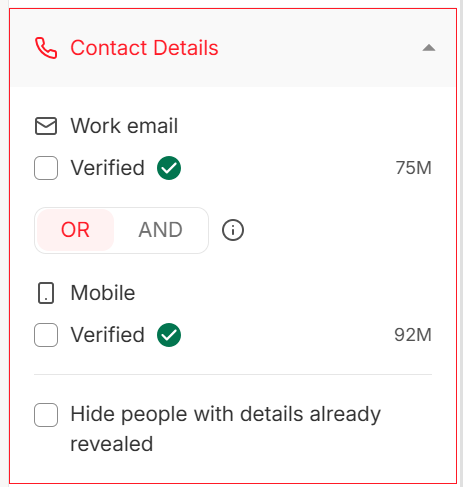
Trigger-event follow-ups like job changes and funding rounds only work if you have the right contact data the moment they happen. Prospeo tracks 300M+ profiles with 30+ filters - including job change signals and funding data - so you can reach the right person at the right time with a verified email or direct dial.
Catch every trigger event before your competitors do.
FAQ
How many follow-ups should I send before stopping?
Four to seven touchpoints spaced 3-4 days apart. 42% of replies come from follow-ups, not the initial message, so stopping after one or two touches leaves most responses on the table. After seven touches with no reply, send a break-up email and move on - unless you've got genuinely new value to share.
What's the best day and time to send a follow-up?
Tuesday through Thursday, 8-11 AM in the recipient's timezone. Wednesday performs best overall based on 2026 benchmark data. One practitioner reported 16% higher open rates by restricting sends to this window. Avoid Monday inbox overload and Friday checkout mode.
How do I follow up without sounding pushy?
Add new value with every touch - a relevant case study, a specific result, or a useful resource. Keep messages under 80 words with one clear ask. Enrichment data like job title, company size, and recent funding makes personalization feel natural rather than forced, so each follow-up references something specific to their situation instead of reading like a mass blast.