

Customer Relationship Building Strategy That Actually Works in 2026
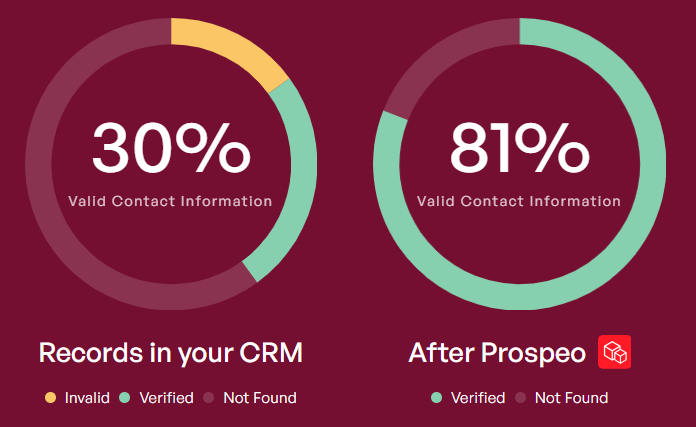
Only 38% of organizations rate themselves "very successful" at delivering positive customer interactions. That's from a study of 264 HBR audience members - people who should be ahead of the curve. Meanwhile, 76% of CRM users admit less than half of their CRM data is accurate and complete.
That gap between intention and execution is where most customer relationship building strategy efforts die. Companies invest in loyalty programs, personalization engines, and omnichannel support - then wonder why customers still feel like strangers. The problem usually isn't the strategy. It's the foundation underneath it.
The Three-Step Starting Framework
Before you read another word:
- Audit your data quality. If your CRM data is inaccurate, nothing else matters. Every personalization effort, every segmented campaign, every "relationship-building" initiative is built on sand. If you need options, start with CRM enrichment tools.
- Pick 3 KPIs. Not 12. Three. NPS, churn rate, and CLV cover most teams. Measure them monthly. If churn is your north star, use a simple churn analysis workflow.
- Map your customer lifecycle. Know exactly which stage each customer sits in - and what action triggers the next stage.
Here's the thing most articles won't tell you: most companies don't have a relationship problem. They have a data problem. Fix the data, and the relationships follow.
The Business Case for Relationship Building
The CRM market hit $112.9 billion in 2025 and is projected to reach $262 billion by 2032. Companies aren't spending that kind of money on sentiment - they're spending it because the ROI is real. The average return on CRM investment runs $8.71 for every $1 spent, with enterprise deployments hitting 299% ROI over three years.
The numbers get better from there. CRM-driven strategies improve customer retention by up to 27%, boost sales revenue by 29%, and can push lead conversion rates up to 300%. BCG's Personalization Index found that leaders in personalization grow 10% faster than laggards - with $2 trillion in value at stake over the next three years.
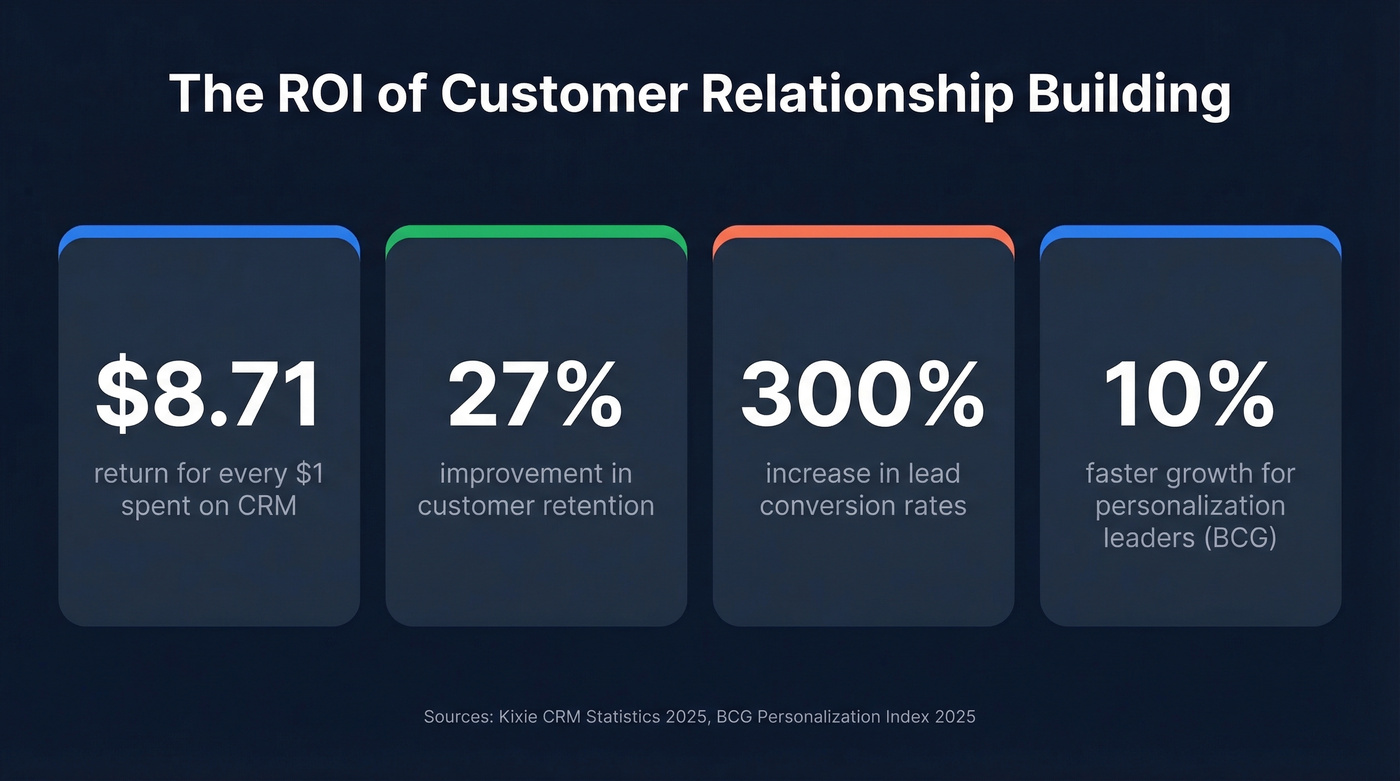
Only 10% of companies qualify as personalization leaders. That means 90% are leaving money on the table, and the gap isn't about technology - it's about execution, which starts with clean data and a clear lifecycle model.
The Customer Lifecycle in Five Stages
Every customer relationship follows a predictable arc. The Forbes Council framework breaks it into five stages: Reach, Acquisition, Conversion, Retention, Loyalty. Each demands different strategies and different metrics.
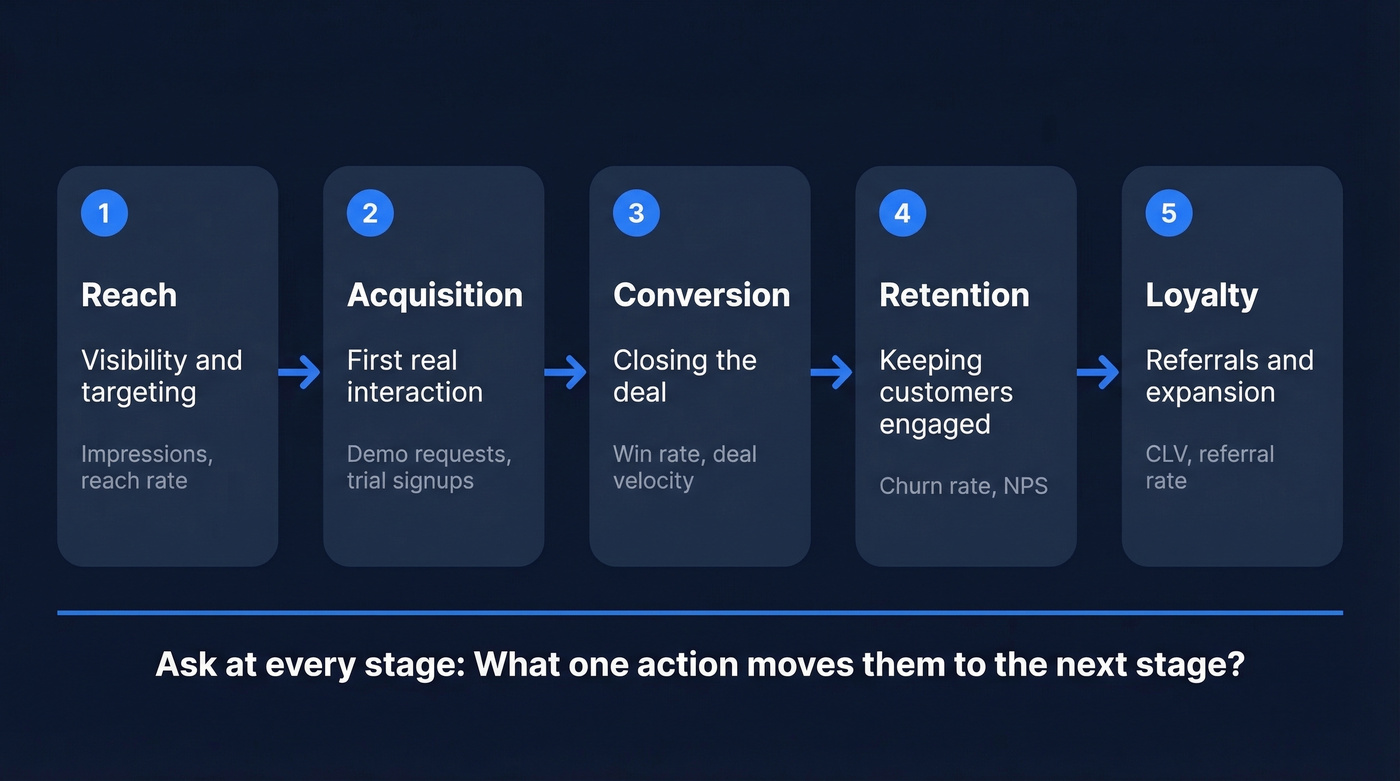
Reach is about visibility. Content, ads, referrals - anything that puts you in front of the right people. The strategy here is targeting precision, not volume. If you want a tighter top-of-funnel system, start with sales prospecting techniques.
Acquisition is the first real interaction. A demo request, a free trial signup, a discovery call. Your job is to make this frictionless and personalized from the first touch, because 80% of customers expect personalized service across all touchpoints, and that expectation starts here.
Conversion is where the deal closes. For B2B, this might take months and involve multiple stakeholders. For B2C, it could happen in seconds. Either way, the experience during conversion shapes everything that follows. If you need a clean framework, use these steps to close a sale.
Retention is where most companies underinvest. Proactive check-ins, QBRs, onboarding optimization, and fast support SLAs keep customers from drifting. 55% of organizations say making interactions more seamless is their top CX priority for the next 12 months - and they're right to focus there. Companies lose 10-30% of their customers annually, and most of that churn is preventable with basics done well. If QBRs are part of your motion, keep a bank of QBR questions to ask.
Loyalty is the endgame. 78% of customers are more likely to repurchase from businesses that personalize their offerings. Loyal customers refer, expand, and forgive the occasional misstep. They're also dramatically cheaper to retain than to replace - building lasting client relationships at this stage is what separates companies with predictable revenue from those constantly backfilling churn.
Map every customer to a stage. Then ask: what's the one action that moves them to the next one?
Core Strategies That Actually Deliver
You don't need 22 tactics. You need a handful executed well. In our experience working with B2B teams, these six consistently move the needle.
Personalization at Scale
BCG's Five Promises of Personalization - Empower Me, Know Me, Reach Me, Show Me, Delight Me - provide the framework. But only 10% of companies execute it at a leadership level. The gap isn't ambition; it's infrastructure. You can't personalize what you can't measure, and you can't measure what you haven't captured accurately. If you want practical examples, borrow patterns from personalized drip campaigns.
Proactive Feedback Loops
NPS tells you who's happy. CSAT tells you about specific interactions. CES tells you how hard it is to work with you. Run all three on a cadence - quarterly for NPS, post-interaction for CSAT, post-onboarding for CES. The companies that ask are the companies that retain.
Cross-Department Alignment
Amazon famously leaves an empty chair in meetings to represent the customer. Most companies don't need a ritual that dramatic - but they do need to stop letting their org chart become the customer's problem.
When marketing promises one thing, sales sells another, and support delivers a third, the relationship fractures. Shared dashboards, unified customer records, and cross-functional standups fix this, but only if leadership enforces them.
Dynamic Playbooks Over Static Ones
The old model: a PDF binder that gets updated annually and ignored daily. The new model: real-time guidance embedded in your CRM, surfaced contextually by deal stage, industry, and persona. Dynamic playbooks reduce time wasted searching for assets and improve consistency across reps. If your playbook lives in a Google Doc, it's already obsolete. If you need a structure for sequences and touches, use a sequence management approach.
Strategic Account Management
For your highest-value accounts, HBR's SAM framework aligns strategy, teams, and resources around complex customer partnerships. This isn't about assigning a CSM. It's about treating your top 20 accounts as business units with dedicated cross-functional teams, executive sponsors, and joint success plans. Long-term customer relationships in sales depend on this kind of structured investment - and the ROI compounds over years, not quarters. If you're running an account-based motion, align it with account-based selling best practices.
Data Hygiene as a Non-Negotiable
Gartner estimates poor data quality costs businesses $12.9 million annually. You can't personalize outreach or nurture relationships with contacts whose data is wrong. Job titles change, people switch companies, emails bounce - and every stale record is a missed connection or a damaged sender reputation.
This is where data infrastructure matters. Prospeo refreshes contact data every 7 days - compared to the 6-week industry average - catching job changes and bounced emails before they damage your outreach. With 98% email accuracy and 50+ data points per enrichment, it's the operational fix for CRM decay. Snyk's outbound team saw their bounce rate drop from 35-40% to under 5% after switching, with AE-sourced pipeline up 180%. If bounces are a recurring issue, start with email bounce rate benchmarks and fixes.

You just read that poor data quality costs businesses $12.9M annually. Prospeo refreshes every record on a 7-day cycle - not the 6-week industry average - and delivers 98% email accuracy through 5-step verification. Your CRM enrichment comes back with 50+ data points per contact at a 92% match rate. Clean data isn't a nice-to-have. It's the foundation every customer relationship strategy depends on.
Stop building relationships on bad data. Start with Prospeo's 300M+ verified profiles.
B2B vs B2C: Different Playbooks
The phrase "customer relationship building strategy" means fundamentally different things depending on who you're selling to. B2B is about relationships. B2C is about transactions at scale. Conflating the two is one of the most common strategic mistakes we see.
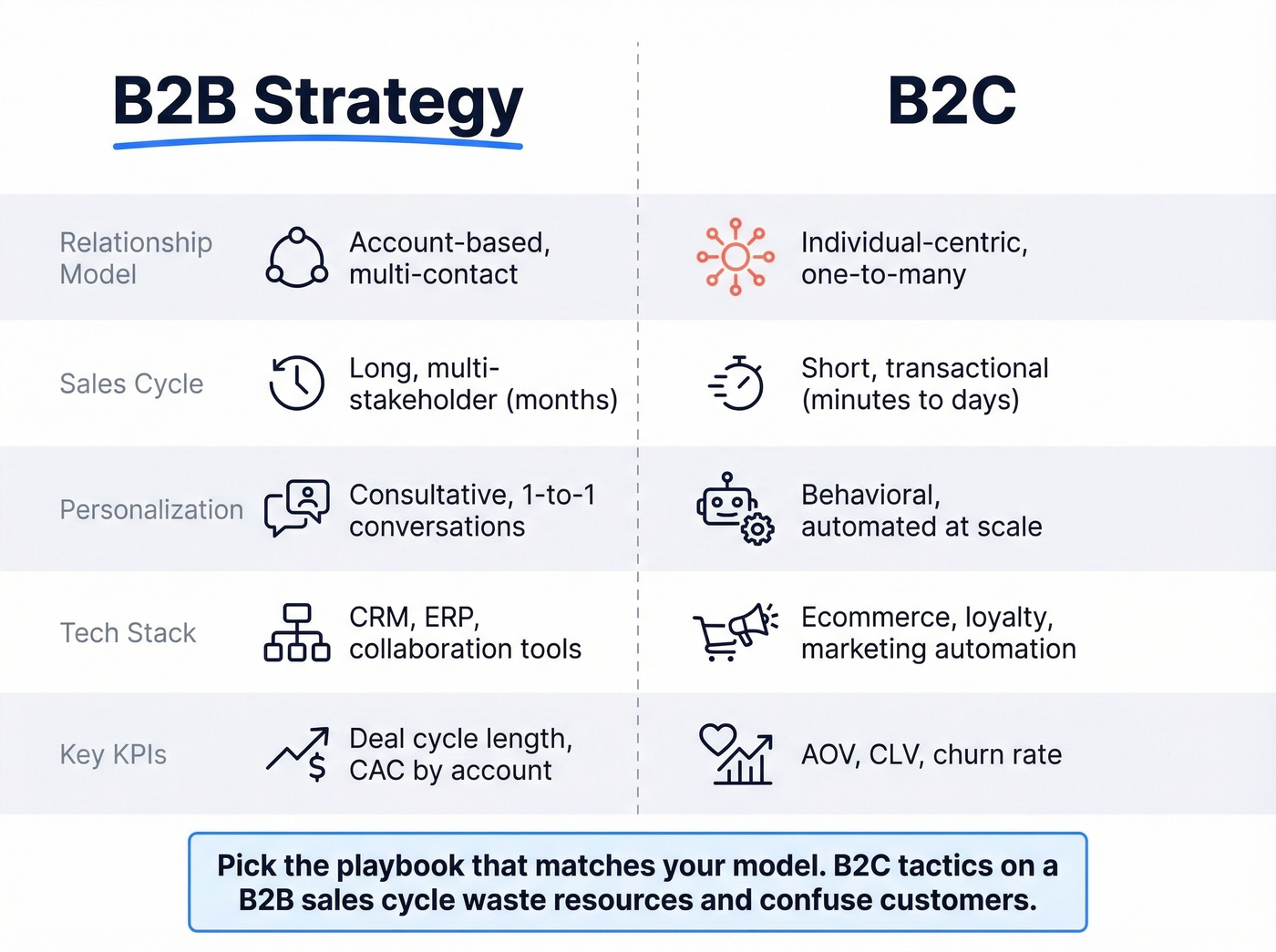
| Dimension | B2B | B2C |
|---|---|---|
| Relationship model | Account-based, multi-contact | Individual-centric |
| Sales cycle | Long, multi-stakeholder | Short, transactional |
| Personalization | Consultative, 1:1 | Behavioral, automated |
| Tech integrations | ERP, collaboration, finance | Ecommerce, loyalty, marketing |
| Key KPIs | Deal cycle, CAC by account | AOV, CLV, churn |
B2B teams need detailed interaction history across multiple stakeholders within a single account. Your CRM has to track not just the buyer, but the champion, the technical evaluator, and the executive sponsor - each with their own communication cadence and content needs.
B2C teams face a different challenge: speed and relevance at massive scale. Behavioral segmentation, cart abandonment flows, push notifications, and loyalty programs drive the relationship. The data volume is higher, but the individual interactions are simpler.
Let's be honest: if your average deal size is under five figures, you probably don't need an enterprise CRM or a 15-touchpoint nurture sequence. A clean contact list, a solid email tool, and genuine responsiveness will outperform a bloated tech stack every time. Pick the playbook that matches your model. Trying to run B2C tactics on a B2B sales cycle wastes resources and confuses customers.
Mistakes That Kill Relationships
We've seen teams invest six figures in CRM platforms and relationship programs, only to watch them fail for entirely preventable reasons. These five come up most often.
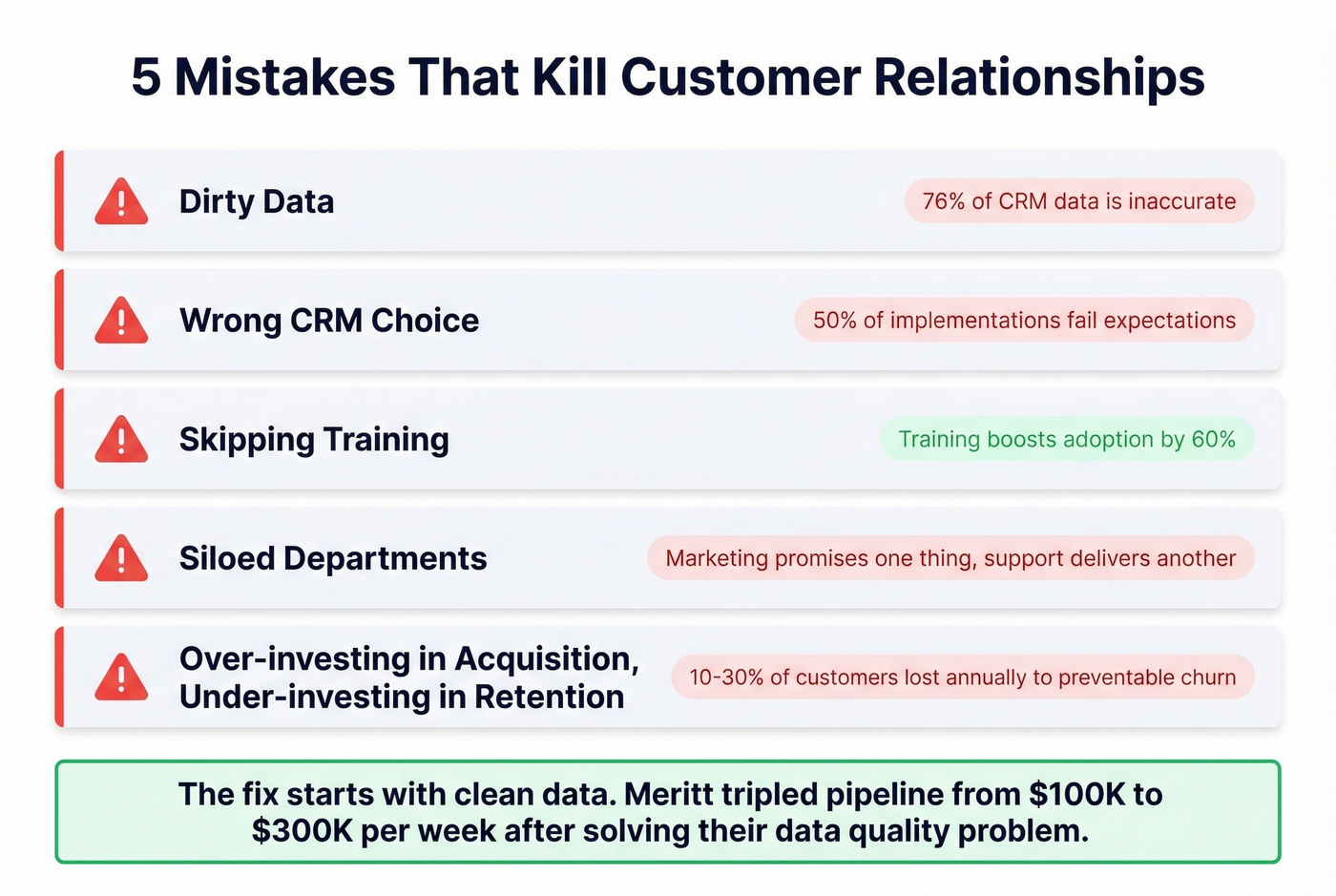
Dirty Data
76% of CRM users admit their data is less than half accurate. That's not a minor issue - it's a structural failure. Your sales rep just sent a "congratulations on the new role" email to someone who left that company eight months ago. That's not a relationship-building moment. It's a credibility-destroying one.
Meritt's pipeline tripled from $100K to $300K per week after fixing their data quality problem. Clean data isn't a nice-to-have. It's the foundation.
Wrong CRM Choice
Around 50% of CRM implementations fail to meet business expectations. The most common cause isn't the software - it's choosing a platform that doesn't match your team's actual workflow. For B2B teams under 50 people, HubSpot's free CRM paired with verified data is often all you need. Salesforce makes sense when you've outgrown simpler tools and need enterprise-grade customization. Skip Salesforce if you're a 10-person team with a simple sales process - you'll spend more time configuring it than selling. If you're comparing platforms, start with examples of a CRM.
Skipping Training
Proper training increases CRM adoption rates by 60%, per Forrester. Yet most companies treat training as a one-time onboarding session and wonder why reps revert to spreadsheets within a month. Ongoing enablement - monthly refreshers, workflow-specific sessions, and embedded guidance - separates adoption from abandonment. If you're building a repeatable onboarding motion, a 30-60-90 day plan for sales reps helps.
Siloed Departments
When customers switch from chat to phone to email and have to repeat their issue every time, the relationship erodes. The HBR/Tata study found that too many channels without integration creates more confusion than convenience. A unified customer record accessible across departments isn't optional. It's the minimum viable experience.
Over-Engineering
The flip side of siloed departments. The consensus across sales and CS communities on Reddit is that the tactics retention teams swear by aren't sophisticated - they're basics done well: proactive QBRs, same-day support responses, and onboarding checklists that actually get used. Teams that try to implement every tactic from every blog post end up with a Frankenstein system that nobody uses. Pick the strategies that match your lifecycle stage and resource level. Execute them well. Add complexity later.
What to Measure
A strategy without metrics is just a wish.
| KPI | What It Measures | SaaS Benchmark |
|---|---|---|
| NPS | Loyalty and advocacy | Varies by industry |
| CSAT | Interaction satisfaction | Varies by channel |
| CES | Effort to resolve issues | Lower is better |
| CLV | Total customer value | Varies by ACV |
| Churn rate | Annual attrition | 5.2% |
| LTV:CAC | Unit economics | 6:1 |
For SaaS specifically, benchmark against a 6:1 LTV:CAC ratio, 5.2% annual churn, and a 23% upsell/cross-sell rate. If you're below these numbers, your relationship strategy has a leak somewhere.
"Improve customer relationships" isn't a goal. "Reduce annual churn from 8% to 5.5% by Q3" is. Teams with strong CRM-driven strategies see a 34% sales productivity boost, 8-14% shorter sales cycles, and 32-42% improvement in forecasting accuracy - but only when they're measuring the right things and acting on what the data tells them. If you want a tighter view of leading indicators, track pipeline health.
AI and Personalization in 2026
70% of companies now use AI in their CRM, and 65% have adopted generative AI specifically. Businesses using genAI in their CRM are 83% more likely to exceed sales goals - and they're seeing a 15% increase in repeat sales and retention.
BCG's Five Promises framework provides the maturity model, and AI accelerates every promise within it. Predictive churn models flag at-risk accounts before they leave. Generative AI drafts personalized follow-ups at scale. Intent data surfaces buying signals before the prospect even fills out a form. If you're operationalizing signals, use a system for identifying buying signals.
But AI amplifies whatever data you feed it. Feed it stale contacts and inaccurate firmographics, and you'll get confidently wrong personalization at scale - which is worse than no personalization at all. The companies winning with AI in 2026 aren't the ones with the fanciest models. They're the ones with the cleanest data.
The Bottom Line
The companies building the strongest customer relationships in 2026 aren't doing anything exotic. They're doing the basics - clean data, clear lifecycle stages, consistent execution - better than everyone else. A customer relationship building strategy comes down to discipline, not complexity. Get the data right, pick three metrics, and run a handful of strategies with real commitment. Everything else is noise.
Personalization at scale fails when 76% of your CRM data is incomplete. Prospeo's enrichment engine fills the gaps - verified emails, direct dials, technographics, job changes, and buyer intent across 15,000 topics. At $0.01 per email, you get enterprise-grade data quality without enterprise pricing. Map every contact to the right lifecycle stage with data you can actually trust.
Personalize every touchpoint with data that's accurate, complete, and current.
FAQ
What's the fastest way to improve customer relationships?
Start with data quality. If your CRM data is inaccurate, every personalization effort misfires, outreach bounces, and reps lose credibility. Audit your contact records first - CRM enrichment tools that return 50+ data points per contact can automate the cleanup before you invest in new channels or loyalty programs.
How do you measure relationship strength?
Track NPS, CSAT, CES, CLV, and churn rate as your core dashboard. For SaaS teams, benchmark against a 6:1 LTV:CAC ratio and 5.2% annual churn. Add deal cycle duration and opportunity stage progression for B2B to measure how efficiently relationships convert to revenue.
What's the difference between B2B and B2C relationship strategies?
B2B focuses on account-based relationships with multiple stakeholders over long sales cycles, using consultative personalization and KPIs like deal cycle and CAC by account. B2C prioritizes individual behavioral personalization at scale, tracking AOV, CLV, and campaign effectiveness. Different models require different tech stacks and playbooks entirely.
Why do long-term customer relationships matter in sales?
Long-term relationships drive compounding returns - lower acquisition costs, higher lifetime value, and a steady referral stream. CRM-driven retention strategies improve revenue by up to 29% and reduce churn by up to 27%. Retaining an existing customer costs a fraction of acquiring a new one, and loyal accounts expand their spend over time.