

Demand Generation Channels: The 2026 Playbook for B2B Teams
41% of B2B buyers already have a single vendor in mind before they start the buying process. Another 51% have a shortlist locked in. That means 92% of your potential customers have effectively narrowed their decision before they ever fill out a demo form. The race for demand generation channels isn't won at the bottom of the funnel - it's won months earlier, through touchpoints most teams aren't even measuring.
Demand gen in 2026 looks nothing like it did three years ago. Millennials and Gen Z now make up over two-thirds of buyers in large B2B transactions, and Forrester predicts half of those younger buyers will involve 10+ external influencers - Reddit threads, YouTube breakdowns, newsletter recommendations, peer Slack groups. Over 70% of the buying journey happens before a prospect ever talks to sales. The old playbook of "run Google Ads, gate a whitepaper, pass to SDRs" doesn't hold up when your buyer has already formed opinions before they see your brand.
Here's the thing: budgets are trending up, but most teams are still allocating them wrong. Let's break down what actually works, how to pick the right mix, and the mistakes that quietly destroy ROI.
Quick Picks - Channel Rankings
If you've got limited budget and need to prioritize, here's the order we'd recommend for most B2B teams:
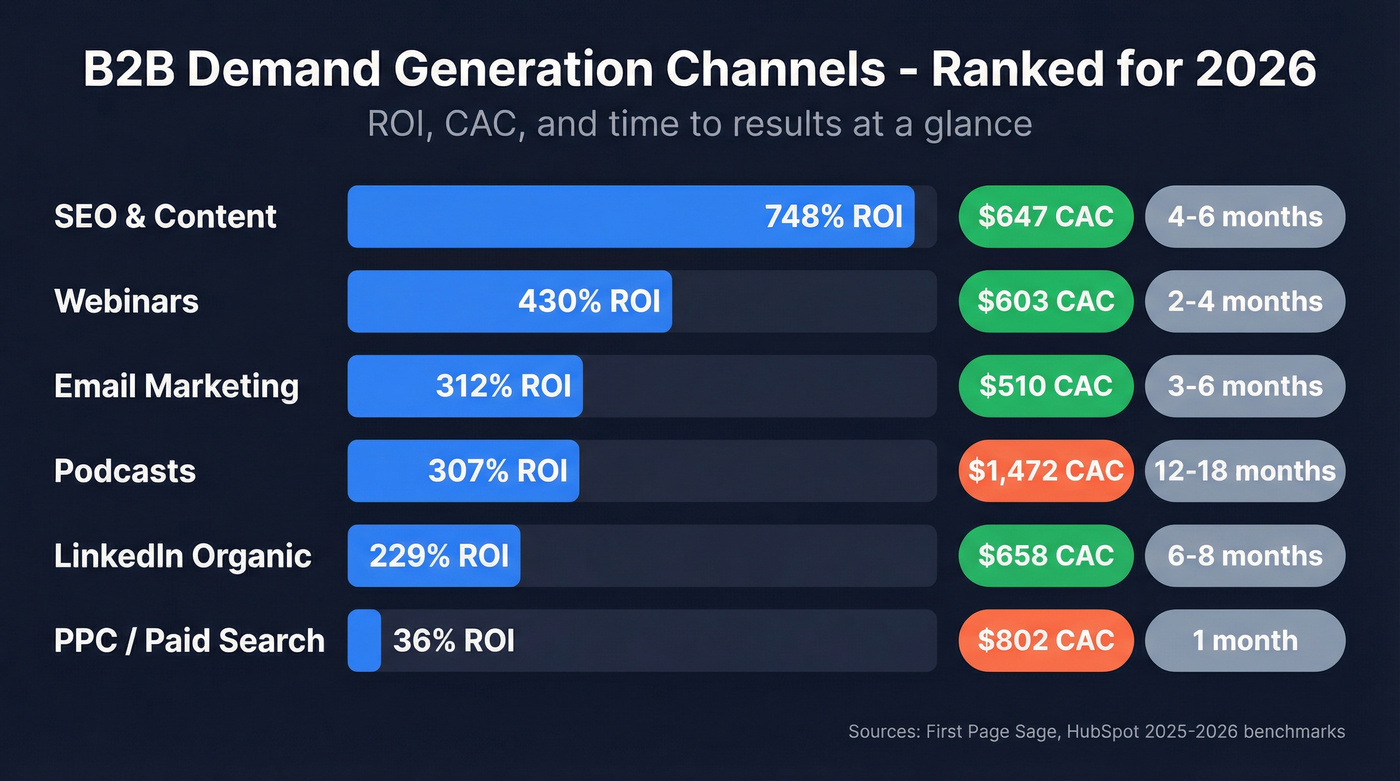
- SEO & thought leadership content - 748% ROI, 51% MQL-to-SQL conversion. Slow to start, but nothing compounds like this.
- Email & lifecycle marketing - $510 CAC, 46% MQL-to-SQL. The workhorse, but only if your list is clean (see CRM hygiene).
- Outbound (cold email + calling) - Worth it when your ACV clears five figures. Scales predictably once dialed in.
- Webinars & virtual events - 430% ROI, strong mid-funnel. Underrated by teams chasing top-of-funnel volume.
- LinkedIn organic - Free, but takes 6-8 months to build momentum. Founder-led content is what makes this work.
- PPC / paid search - Fast learning, not a crutch. Useful for testing messaging and capturing existing demand. Terrible as a primary engine.
The contrarian take: before you pick any channel, fix your data. Almost 50% of the average marketing database is useless due to outdated information. No channel survives that.
How to Choose the Right Mix
Most "best channels" articles hand you a ranked list and call it a day. That's not how this works. The right channel mix depends on three things: your product, your market, and your stage.
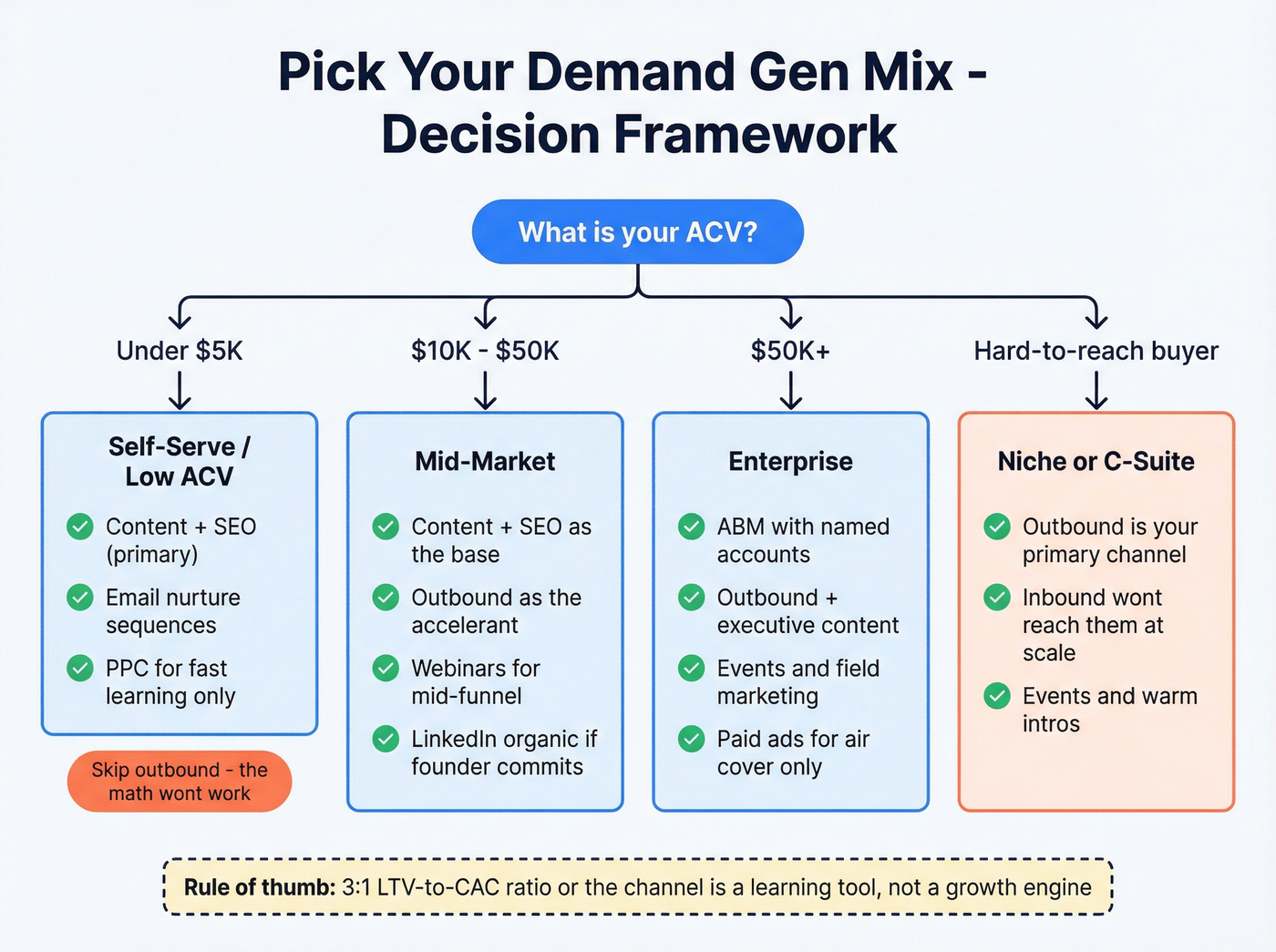
Stage2 Capital frames this well. Start with product complexity - a self-serve tool with a $500 ACV needs a completely different strategy than a $75K enterprise platform with a 6-month sales cycle. Then look at your market: are you selling to Fortune 1000 CxOs who won't respond to inbound, or to mid-market ops managers who live in Google and Reddit?
Then factor in your stage. A pre-revenue startup can't afford to wait 6 months for SEO to compound. A Series C company shouldn't be spending 40% of budget on Google Ads.
Here's the decision logic:
- ACV under $5K, simple product - Content + SEO, email nurture, PPC for fast learning. Outbound won't pencil out.
- ACV $10K-$50K, moderate complexity - Content + SEO as the base, outbound as the accelerant, webinars for mid-funnel. LinkedIn organic if a founder or exec can commit to posting.
- ACV $50K+, complex sale - ABM, outbound, events, and executive content. Paid channels for air cover, not lead gen.
- Unique or hard-to-reach buyer - Niche vertical, low-tech persona, C-suite only? Outbound is your primary channel. Inbound won't reach them at scale.
The $10K ACV threshold for outbound is real. Below that, the math breaks - you'll spend more acquiring each customer than they're worth in the first year.
Channel Benchmarks
These are planning ranges aggregated from First Page Sage and HubSpot's benchmark data. Use them as baselines, not gospel - your numbers will shift by ACV, sales cycle, and ICP.
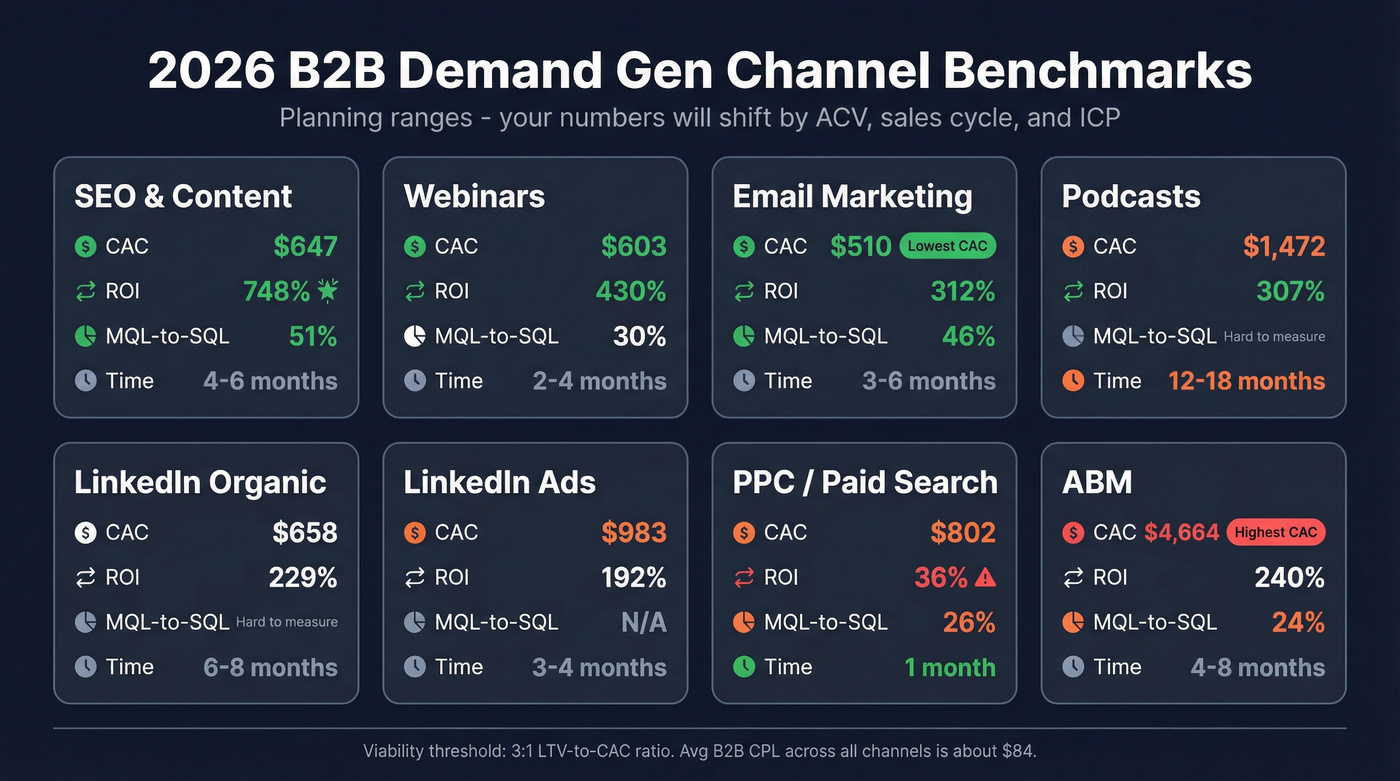
| Channel | Avg CAC | ROI | Time to Results | MQL-to-SQL |
|---|---|---|---|---|
| SEO & Content | $647 | 748% | 4-6 months | 51% |
| Webinars | $603 | 430% | 2-4 months | 30% |
| $510 | 312% | 3-6 months | 46% | |
| Podcasts | $1,472 | 307% | 12-18 months | N/A* |
| LinkedIn Organic | $658 | 229% | 6-8 months | N/A* |
| LinkedIn Ads | $983 | 192% | 3-4 months | - |
| PPC / SEM | $802 | 36% | 1 month | 26% |
| ABM | $4,664 | 240% | 4-8 months | 24%** |
*Podcasts and LinkedIn Organic lack reliable MQL-to-SQL data because attribution is notoriously difficult for brand-building channels. **Uses the common "events" benchmark as a planning proxy for ABM-style high-touch programs.
A few things jump out. SEO's ROI dwarfs everything else, but the 4-6 month lag means you need patience and budget runway. Email has one of the lowest CACs on the list, yet most teams underinvest in it because it's not "sexy." And PPC - the channel most B2B marketers default to - delivers a 36% ROI. That's barely above break-even.
The viability threshold to remember: a 3:1 LTV-to-CAC ratio (use the CAC LTV ratio framework). If a channel can't clear that bar within a reasonable timeframe, it's a learning tool, not a growth engine. Average B2B CPL across all channels runs about $84, but that swings wildly - Google Ads averages about $70 and LinkedIn about $110.

You just read it: nearly 50% of the average marketing database is useless. No demand gen channel survives bad data. Prospeo refreshes every 7 days - not 6 weeks - and delivers 98% email accuracy with 5-step verification. At $0.01 per email, fixing your data costs less than one wasted PPC click.
Fix your data before you pick your next channel.
The Channels, Broken Down
SEO & Content Marketing
SEO and thought leadership content deliver the highest returns in B2B demand gen - 748% ROI and 51% MQL-to-SQL - but 90% of the leads come from content published 3+ months ago. This is a compounding asset, not a quick win. You need a 6+ month runway, buyers who research online before buying, and the ability to produce genuinely useful content rather than keyword-stuffed filler (see inbound lead generation examples).
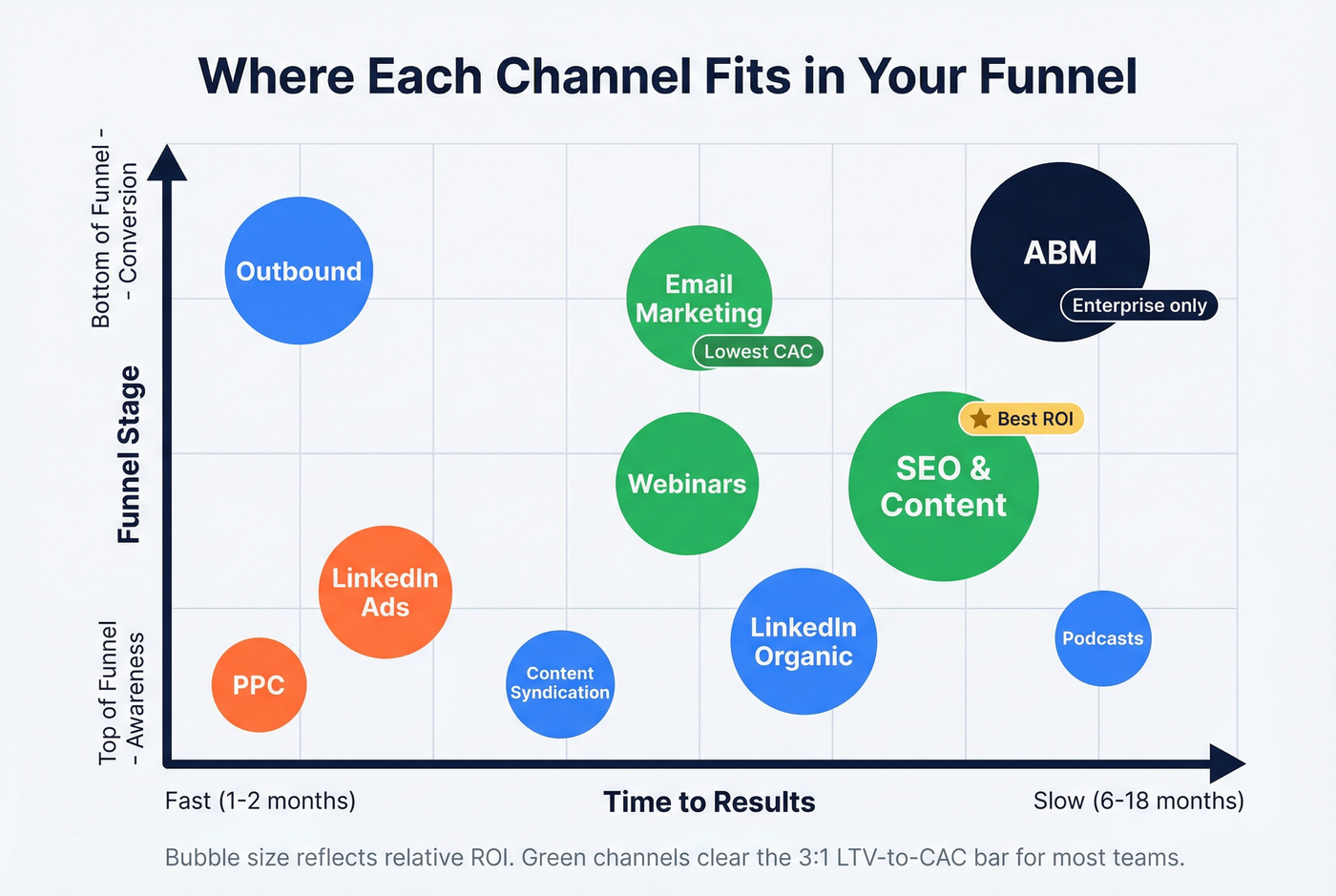
Skip it if your buyer doesn't Google their problems, you need pipeline in 30 days, or you can't commit to consistent publishing for at least six months. Track organic pipeline influenced, not just traffic.
Email & Lifecycle Marketing
At $510 CAC and 46% MQL-to-SQL, email is the most efficient channel on the board. Segmented sequences tied to buyer behavior outperform batch-and-blast by an order of magnitude. The problem is that most teams treat it as an afterthought - a monthly newsletter nobody reads (build it like lead nurturing emails).
Email is only as good as the data underneath it. If your contacts bounce, you're burning domain reputation and getting zero pipeline. We've seen teams with 30%+ bounce rates wonder why their outbound "doesn't work" - the channel was fine, the data was garbage. Track reply rate and MQL-to-SQL conversion, not open rate.
Outbound: Cold Email & Calling
If your ACV is above $10K and you're selling to a targeted buyer persona, outbound is one of the most predictable growth levers available. It shines when you're reaching Fortune 1000 CxOs, niche verticals, or low-tech buyers who don't consume content online.
The catch: bad contact data kills it. If your emails bounce at 15%+, you're torching sender reputation for nothing. The consensus on r/sales is pretty clear - most outbound failures aren't messaging problems, they're data problems (see B2B contact data decay).
Prospeo lets you build targeted prospect lists with 30+ filters - intent signals, technographics, job changes, funding events - and verify every email before it hits a sequence. At 98% email accuracy with a 7-day data refresh cycle, it's built for teams that can't afford bounces. Track meetings booked per 100 contacts reached.
Webinars & Virtual Events
Webinars are the most underrated channel in B2B demand gen. At $603 CAC and 430% ROI, they excel at mid-funnel acceleration - you've got awareness, but prospects need education or social proof before they'll talk to sales. Co-hosted webinars with partners or customers perform especially well because they borrow credibility.
They fail when you treat them as top-of-funnel lead magnets and gate the replay behind a form nobody fills out. Or when your "webinar" is a thinly disguised product demo. Track attendee-to-opportunity conversion rate.
LinkedIn: Organic vs. Paid
These are two completely different channels sharing a logo.
Organic costs $0 in ad spend but demands 6-8 months of consistent posting to build momentum. Personal accounts outperform company pages by a wide margin. If nobody on your team will post 3-5x per week, don't bother. In our experience, the teams that succeed here have a founder or VP who genuinely enjoys writing - you can't fake that for 8 months (see social selling thought leadership).
Paid runs a $983 CAC and 192% ROI with CPLs around $110. The targeting precision is unmatched for B2B, but those economics only work for retargeting and ABM air cover, not cold top-of-funnel. If your budget can't absorb $110+ CPLs, stick to organic.
ABM (Account-Based Marketing)
Let's be honest: most companies doing ABM are actually doing bad outbound with a fancier name. Real ABM - coordinated campaigns targeting named accounts with personalized content, ads, and outreach - has a $4,664 CAC and 240% ROI. That only makes sense when your ACV is high and you're navigating buying committees with multiple stakeholders (use an account-based marketing plan).
If you don't have the ops infrastructure to coordinate across channels, you're not doing ABM. You're doing expensive outbound. Track account engagement score and pipeline per target account.
PPC / Paid Search
The most overrated B2B channel. Period.
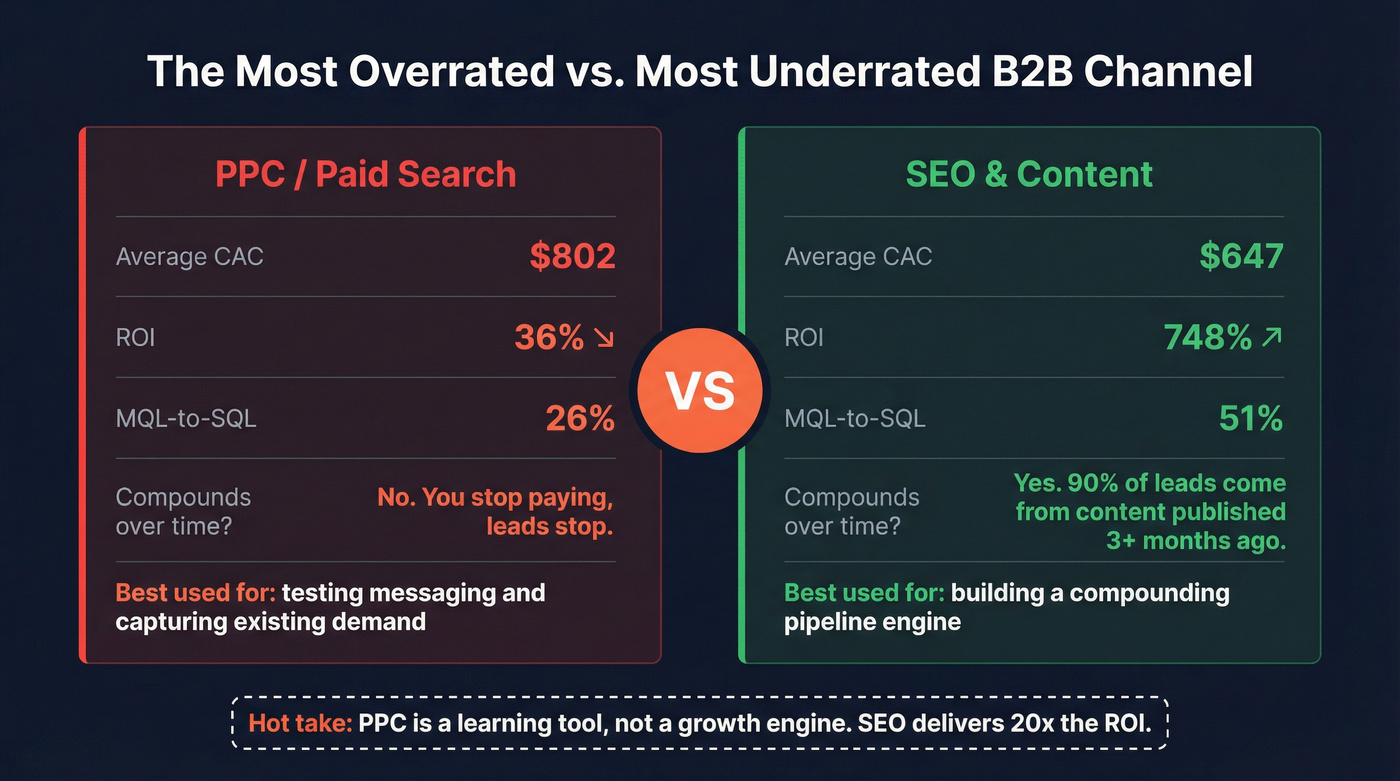
$802 CAC, 36% ROI, 26% MQL-to-SQL. The economics don't compound - you stop paying, the leads stop coming. PPC is useful for exactly two things: capturing existing demand from people already searching for your category, and fast learning - testing messaging, landing pages, and positioning in 30 days instead of six months. Use it as a learning channel. Track cost per SQL, not cost per click.
Syndication & Partnerships
Most demand gen guides ignore these entirely, which is a mistake. Content syndication - distributing your best content through third-party networks - delivers sales-qualified outcomes in 30-90 days. Partner co-marketing through joint webinars, shared audiences, and integration partnerships is one of the lowest-CAC channels available because you're borrowing someone else's trust.
Community-led growth fits here too. Sponsoring or participating in niche Slack groups, newsletters, and industry communities puts you in front of buyers during the preference-formation stage - before they ever Google your category. Conversational marketing tools and Connected TV ads are gaining traction in some B2B segments, but for most teams they're experiments, not core channels yet.
Budget Allocation by Stage
There's no universal budget split, but here's an operator-baseline framework we've seen work across different company stages.
Startups should allocate roughly 35% to content and SEO, 25% to paid channels, 15% to events and webinars, 15% to lifecycle and ops, and 10% to experiments. Content compounds and startups can't afford to burn cash on paid channels that don't convert.
Growth-stage companies shift toward 25% content, 30% paid, 20% events, 15% lifecycle, and 10% experiments. Pipeline targets demand more paid and event investment.
Enterprise teams run closer to 20% content, 25% paid, 25% events, 20% lifecycle, and 10% experiments. Their deal sizes justify the higher CAC of events and ABM.
The 10% experiments bucket is non-negotiable. That's where you test new channels - podcasts, community sponsorships, partner programs - before committing real budget. Teams that skip experimentation end up stuck on the same two channels for years, wondering why growth plateaued.
Mistakes That Kill Demand Gen ROI
Running channels on bad data. Almost 50% of the average marketing database is useless due to outdated information. Your SDRs are sending sequences to dead inboxes. Your ad targeting is burning budget on people who left the company two years ago. Fix the data first - everything else is downstream (see data quality).
Optimizing for MQLs instead of revenue. MQLs become vanity metrics the moment marketing and sales disagree on what "qualified" means. Track MQL-to-SQL conversion and pipeline influenced by channel. If a channel generates 500 MQLs and 3 deals, it's not working.
Treating channels as silos. SEO feeds email. Email feeds outbound. Webinars feed ABM. The best demand gen teams orchestrate multi-channel programs rather than running each touchpoint independently. A prospect who reads your blog, attends your webinar, and then gets a personalized outbound email is far more likely to convert than one who only sees a cold email (see B2B omnichannel marketing).
Static ICP definitions. Firmographics alone aren't enough. Layer behavioral and intent signals - who's researching your category right now, who just got funding, who hired a new VP of Sales. Only a small fraction of your target market is in-market at any given time. Find them (see intent signals).
Set-and-forget campaigns. Demand gen requires iteration. A strong operating rhythm means testing new messaging every few weeks, refreshing creative regularly, and killing underperforming channels on a quarterly cadence. If you launched a campaign 6 months ago and haven't touched it, it's probably underperforming.
The Foundation: Data Quality
Your demand generation channels are only as good as the data feeding them. Bad emails kill outbound deliverability. Inaccurate targeting wastes ad spend. Stale databases mean nurture campaigns reach dead inboxes. Every channel in this article assumes you have accurate, fresh contact data - and most teams don't.

One of our customers, Snyk, had 50 AEs prospecting 4-6 hours per week with bounce rates hovering around 35-40%. After switching to verified data with a weekly refresh cycle, bounces dropped under 5% and AE-sourced pipeline jumped 180%. That's not a channel problem solved - it's a data problem solved.
If your deal sizes sit below $10K, you probably don't need enterprise-grade data infrastructure. But you absolutely need verified emails. Bad data is the fastest way to turn outbound into a deliverability problem instead of a pipeline channel (see email verification for outreach).
Email has the lowest CAC on the board at $510 and 46% MQL-to-SQL - but only if your contacts are real. Teams using Prospeo cut bounce rates from 35%+ to under 4%. With 143M+ verified emails and proprietary catch-all handling, your outbound and lifecycle campaigns actually reach inboxes.
Stop blaming the channel when the data is the problem.
FAQ
What is a demand generation channel?
Any marketing or sales touchpoint used to create awareness and interest among potential buyers before they enter a formal sales process. These range from SEO and content marketing to outbound prospecting, events, paid advertising, and community-led growth. The goal is pipeline creation - building preference and trust - not just capturing leads from people who already want to buy.
How many channels should a B2B team run?
Start with 2-3 channels that match your ACV, buyer persona, and company stage. Spreading budget across 8+ channels dilutes everything. Prove ROI on your core set first, then add incrementally. Most successful B2B teams run 3-4 channels well rather than 7 poorly.
What's the highest-ROI demand gen channel?
SEO and thought leadership content at 748% ROI and 51% MQL-to-SQL conversion. The catch: it takes 4-6 months to produce measurable pipeline. If you need results in 30 days, paid search or outbound gets you learning faster while content compounds in the background.
How do I measure demand gen ROI?
Track MQL-to-SQL conversion rate, CAC by channel, and pipeline influenced - not just leads generated. The standard viability benchmark is a 3:1 LTV-to-CAC ratio. Any channel consistently below that threshold needs to be reworked or cut. Use both first-touch and multi-touch attribution models to get a complete picture.
What tools improve demand gen data quality?
For outbound and ABM, you need verified contact data with frequent refresh cycles - Prospeo's 98% email accuracy and 7-day refresh make it a strong foundation. For lifecycle marketing, CRM enrichment tools like HubSpot and Clearbit complement contact-level data with firmographic and behavioral signals. Clean data is the single biggest lever for improving performance across every channel.