

Email Opening Lines That Actually Get Replies (2026)
You've spent 45 minutes writing the perfect cold email. Tight value prop, clean CTA, personalized PS line. Then the prospect opens it, reads "I hope this email finds you well," and hits delete before the second sentence loads.
95% of cold emails fail to generate a reply. The platform-wide average reply rate sits at 3.43%. You don't need 100 templates - you need three frameworks and better data.
The Short Version
- Your opening line is preview text. It shows next to your subject line in every inbox. One A/B test found a 104% lift in clicks from optimizing this single element. (If you want to go deeper, see our email preview text testing guide.)
- Signal-based personalization gets 5-10x the reply rate. Generic openers pull 1-3%. Referencing a specific trigger event pushes reply rates to 15-25%. (More frameworks: personalized outreach.)
- None of it matters if your email bounces. 17% of cold emails never reach the inbox. Verify your data before you worry about your words. (Start with email bounce rate benchmarks and fixes.)
Your First Line Is Preview Text
Most people think of the opening line as the first thing a prospect reads inside the email. Wrong. It's the first thing they read in the inbox, right next to the subject line. (Related: email subject lines.)
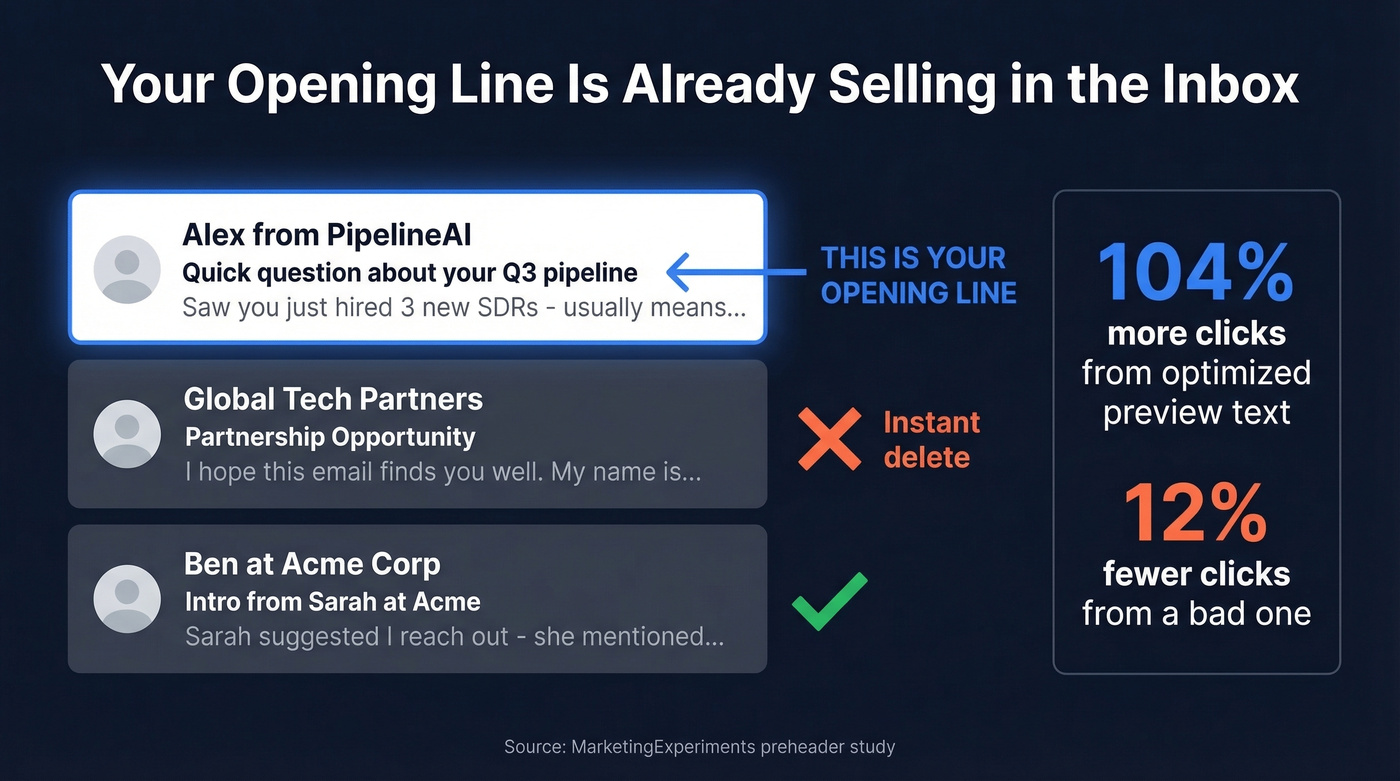
Gmail, Outlook, and Apple Mail all pull your first-line text into the preview pane. On mobile, preview text can take as much space as the subject line itself - sometimes more. You've got about 6 seconds once someone opens your email, but the decision to open happens even faster, and your first line is doing half the selling. In a Mixmax-run poll, 34% of respondents said preview text is nearly as important as the subject line. B2BRocket's research backs this up: prospects spend 74% of their time focusing on the top two sections of content.
A bad preview line actively hurts you. The same MarketingExperiments study that showed a 104% click lift from a good preheader also found a 12% decrease in clicks from a poorly written one. Your subject line and opening line need to tell a coherent story - the subject creates a promise, the preview text pays it off. If they feel disconnected, you lose the click.
Treat your first sentence like ad copy. Short, specific, impossible to ignore. (If you need help tightening copy, use these email copywriting rules.)
Why "I Hope This Finds You Well" Needs to Die
Linguist Naomi Baron put it bluntly in TIME: the phrase can feel like "an imposed relationship." What business is it of a stranger to ask about someone's health?
The phrase made sense centuries ago, when letters took weeks to arrive and the recipient's well-being was genuinely uncertain. It became frozen in email culture, stripped of its original meaning, and now reads as pure boilerplate. TIME's experts agreed - overuse signals zero thought.
It's gotten worse with AI. Autocomplete in Gmail and Outlook now surfaces "I hope this email finds you well" as a default opener, which means your carefully crafted email starts with the exact same words a bot would choose. The consensus on r/sales is brutal - people actively mock this line. If you're using it in cold outreach, you're telling the prospect you didn't try. (For a full system, see our AI cold email outreach playbook.)
The Personalization Ladder: 3% to 25%
Not all personalization is created equal. The gap between "Hi {first_name}" and a signal-based opener is the difference between a 5% reply rate and a 25% one. Here's the full ladder, compiled from benchmark data across Instantly, Belkins, and Martal via Autobound's 2026 analysis:
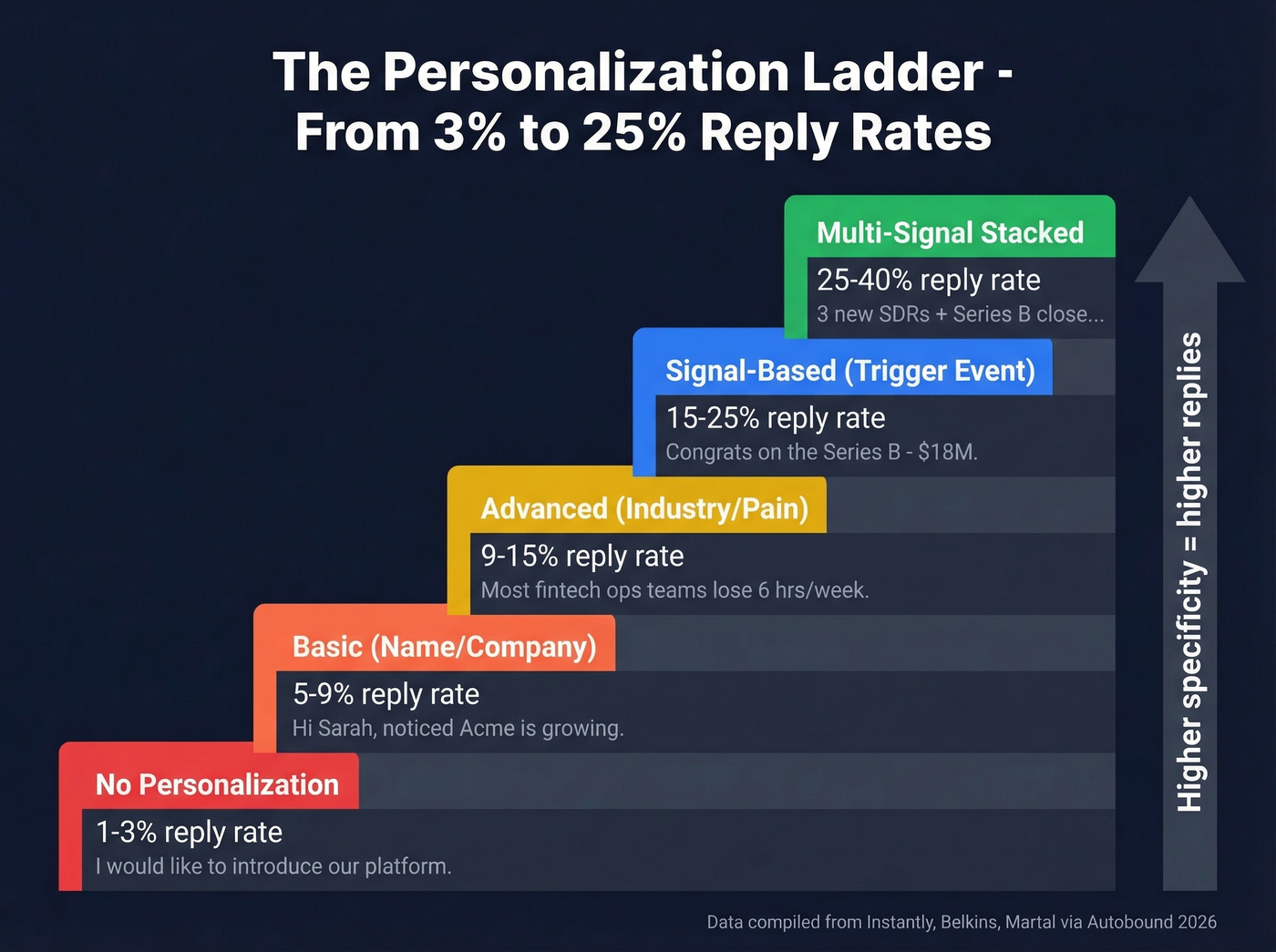
| Personalization Level | Reply Rate | Example Opener |
|---|---|---|
| None | 1-3% | "I'd like to introduce our platform." |
| Basic (name/company) | 5-9% | "Hi Sarah, noticed Acme is growing." |
| Advanced (industry/pain) | 9-15% | "Most fintech ops teams lose 6 hrs/week." |
| Signal-based (trigger) | 15-25% | "Congrats on the Series B - $18M." |
| Multi-signal stacked | 25-40% | "3 new SDRs + Series B close..." |
Personalized emails receive more than twice as many replies as non-personalized ones. Adding a greeting with the prospect's name alone can lift response rates by nearly 35%. But in our experience, the real jump happens when you move from basic personalization to signal-based - that's where reply rates go from single digits to double. (To operationalize this, use an ideal customer profile and consistent firmographic filters.)
Here's the thing: if you're closing deals under $10k, you probably don't need multi-signal stacking. Basic personalization with clean data will outperform over-researched emails sent to a list full of bounces every single time.

Signal-based openers need signal-based data. Prospeo tracks job changes, funding rounds, and headcount growth across 300M+ profiles - refreshed every 7 days. Build lists with the exact trigger events your opening lines reference, with 98% email accuracy so every personalized first line actually lands.
Stop crafting perfect openers for emails that bounce.
Openers That Actually Work
Mailchimp's taxonomy breaks openers into four types: personalization-based, question-based, benefit-focused, and storytelling. Let's break down how to apply each one.
Cold Outreach Openers
- Signal-based: "Saw you just brought on a new VP of Revenue - usually means the outbound playbook is getting a rewrite."
- Question-based: "Quick question - how's your team handling [specific pain point] since [industry shift]?"
- Benefit-focused: "We helped [similar company] cut list-building time from 15 hours to 3."
- Observation-based: "Your recent post on [topic] nailed something most people get wrong about [X]."
One tactic worth stealing: tone-mirroring. If your prospect writes casually on social media, match that energy. If they're formal in company blog posts, mirror that register. Matching the recipient's communication style removes friction before you've said anything substantive. (More tactics: sales prospecting techniques.)
Follow-Up Openers
42% of all campaign replies come from follow-up emails - yet 48% of reps never send a second message. Meanwhile, 90% of buyers respond within two days of their most recent message. That's a staggering amount of pipeline left on the table. (Steal these sales follow-up templates.)
- "Circling back with one thing I should've led with last time - [specific value prop]."
- "I re-read my last email and realized I buried the lead. Here's the 10-second version."
- "Not sure if timing was off - wanted to share [new data point] either way."
- "Three of your competitors signed up last quarter. Not name-dropping - just context."
Professional & Workplace Openers
TIME's experts gave explicit permission to skip pleasantries entirely. In professional contexts, starting with the point is more respectful of someone's time than a hollow nicety.
We've tested this internally - cutting the preamble and leading with "Two quick items on the Q3 roadmap" consistently gets faster responses than any warm-up sentence. The same principle applies to internal emails: "I owe you an update on [project] - short version, we're ahead of schedule" respects the reader's inbox and earns goodwill. AI tools can draft these efficiently, but always customize with real context. A bot-generated opener without specifics is just a fancier version of "I hope this email finds you well."
Networking & Warm Intro Openers
The mutual connection bridge works because it borrows trust. But you need permission from the connector, and you need to be specific about the link.
- "[Name] suggested I reach out - she mentioned you're rethinking your outbound stack."
- "We were both at [event] last week. Your take on [topic] during the panel stuck with me."
- "We share 4 mutual connections in the SaaS ops space. Figured it was time to connect directly."
Openers That Kill Your Reply Rate
Some openers don't just fail to help - they actively signal "delete me."
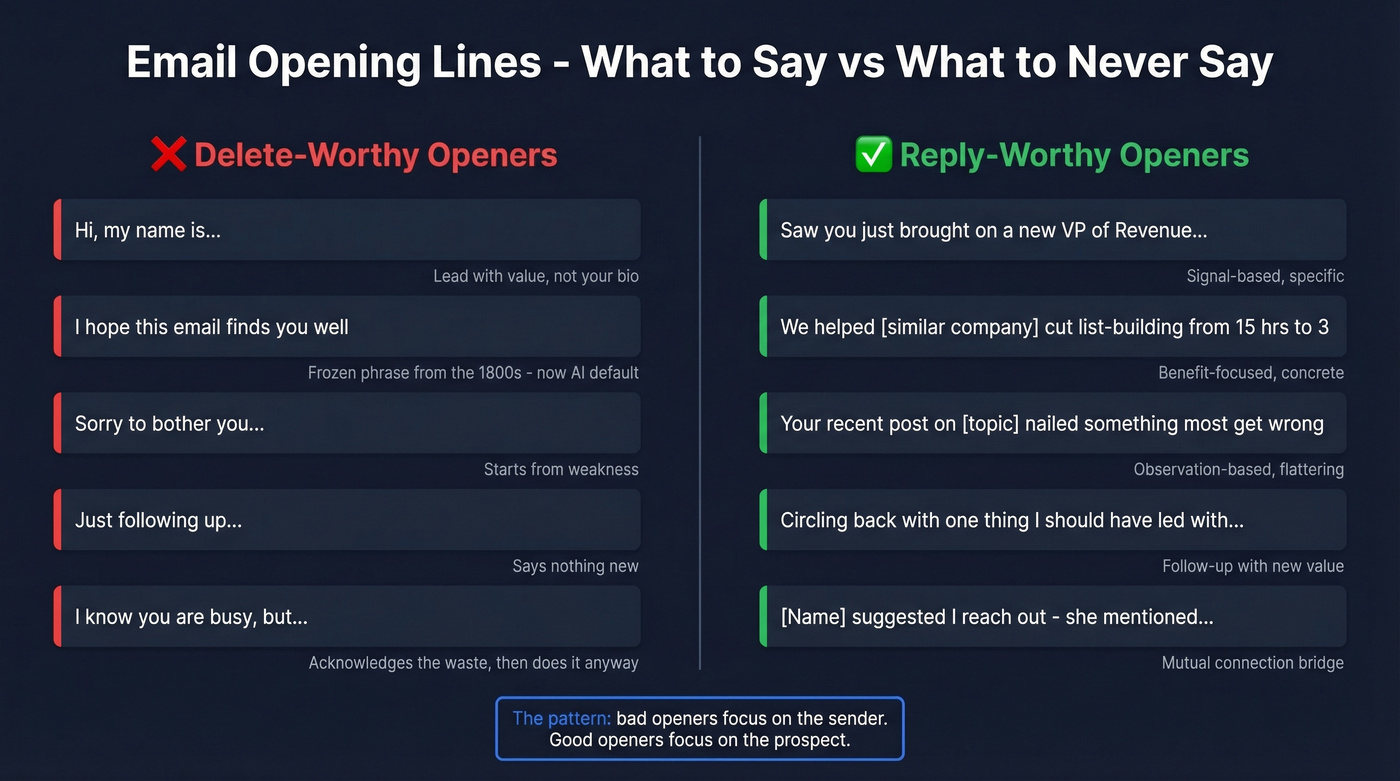
| Opening Line | Why It Fails |
|---|---|
| "Hi, my name is..." | Lead with value, not your bio. |
| "I'm reaching out because..." | Self-focused. Flip to their problem. |
| "Sorry to bother you..." | Starts from weakness. |
| "Just following up..." | Says nothing new. No reason to reply. |
| "I know you're busy, but..." | Acknowledges the waste, then does it anyway. |
| "Allow me to introduce myself." | Stiff. Screams mass email. |
| "Did you realize that [fact]?" | Condescending. |
| "Haven't heard back..." | Guilt-tripping. Never a good look. |
Every one of these lines puts the sender's needs ahead of the reader's. The best openers flip this - they lead with something the prospect cares about.
Signal-Based Openers: Advanced Playbook
Use this if you're selling into mid-market or enterprise accounts where generic outreach gets buried. Skip this if you're running high-volume campaigns to thousands of SMBs - the research time won't scale without automation.
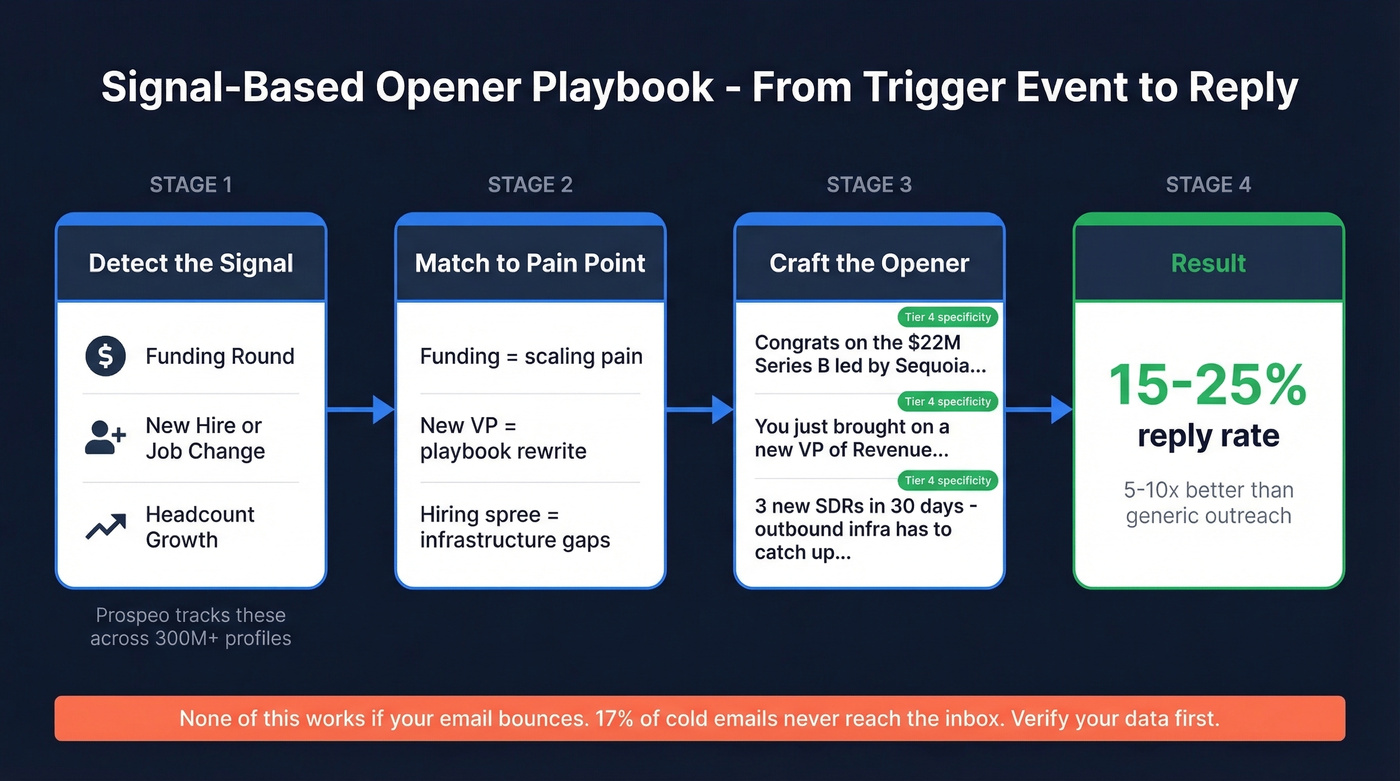
Trigger types that work, adapted from FundraiseInsider's frameworks:
Funding round: "Congrats on the $22M Series B led by Sequoia. Most teams at this stage hit scaling pain around [specific problem]."
Competitor intel: "Noticed [competitor] just launched [feature]. If that's creating pressure, we've helped 3 similar teams respond in under 60 days." (If you want to systematize this, build a competitive intelligence strategy.)
Hiring + ramp signals: "You're in growth mode right now - when headcount starts climbing, outbound infrastructure has to catch up fast."
The key is specificity. "Congrats on the funding" is tier 2. "Congrats on the $22M Series B led by Sequoia" is tier 4. Tools like Prospeo surface exactly these triggers through 30+ search filters - including job changes, funding events, and headcount growth - so you can build signal-based lists without hours of manual research. (More on operationalizing triggers: how to track sales triggers.)
The Prerequisite Nobody Talks About
The best email opening line in the world is worthless if the email never arrives.
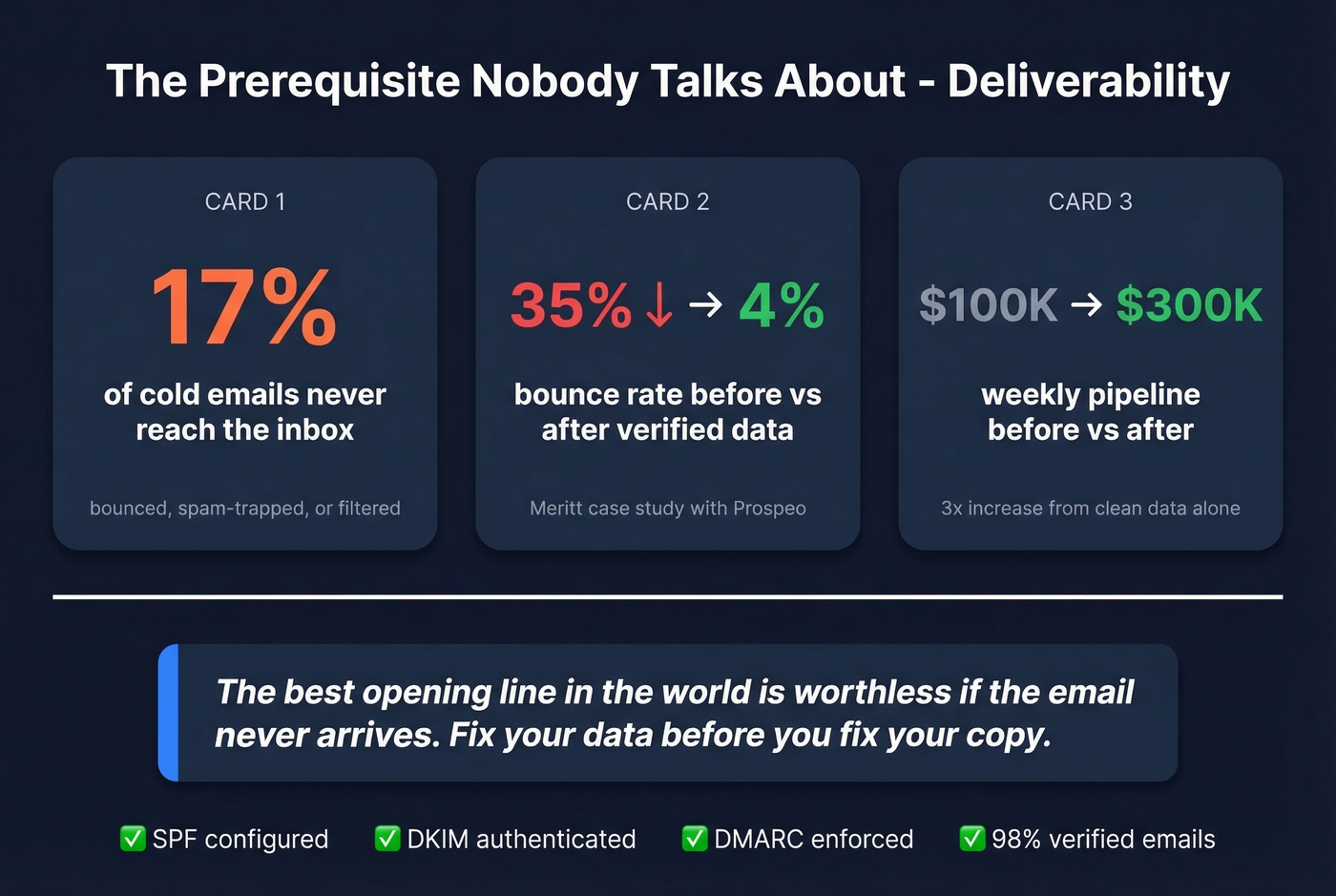
17% of cold emails never reach the inbox - they bounce, hit spam traps, or get filtered before the prospect sees a single word. With Google and Yahoo's tightened sender requirements around SPF, DKIM, and DMARC enforcement, deliverability has become even more unforgiving in 2026. (Full checklist: email deliverability guide.)
We've seen this pattern over and over. A team spends weeks perfecting their copy, their sequences, their A/B tests - then launches against a list with a 30% bounce rate and wonders why nothing works. The problem was never the words. It was the data. Meritt experienced this firsthand: after switching to Prospeo's 98% verified email accuracy and 7-day refresh cycle, their bounce rate dropped from 35% to under 4% while their pipeline tripled from $100K to $300K per week.

17% of cold emails never reach the inbox. No opening line fixes that. Prospeo's 5-step verification and catch-all handling keep bounce rates under 4% - the same result that helped Snyk's 50 AEs generate 200+ new opportunities per month. Your copy deserves data that delivers.
Fix your data before you fix your first line.
FAQ
How long should an opening line be?
Keep it to one sentence under 15 words. Your opener doubles as inbox preview text, and longer lines get truncated on mobile - especially on iOS, which shows roughly 90 characters.
Do personalized openers improve reply rates?
Signal-based personalization achieves 15-25% reply rates versus 1-3% for generic openers. Even basic name personalization doubles response rates according to GMass benchmarks.
What's the fastest way to personalize at scale?
Use a B2B data platform with filters for job changes, funding events, and headcount growth, then reference those signals directly in your opener. This turns hours of manual research into a 5-minute filtered search - and verified emails mean your messages actually land.
Should I A/B test different openers?
Yes - test your first line the same way you'd test subject lines. Small wording changes can swing reply rates by 5-10 percentage points, so run tests with at least 200 sends per variant before drawing conclusions.