

The Future of Sales Is a Contradiction - Here's How to Win Anyway
A VP of Sales we know went all-in on AI outbound last quarter. Automated sequences, AI-generated personalization, 10x the volume. Within three weeks, their domain reputation was torched - 38% bounce rate, spam complaints through the roof, and a deliverability hole that took two months to dig out of. The AI worked perfectly. The data underneath it was garbage.
That's the contradiction at the heart of the future of sales: more AI doesn't mean more productivity. The teams winning in 2026 aren't the ones with the most tools. They're the ones with the cleanest data and the most adaptable org structure.
The Snapshot
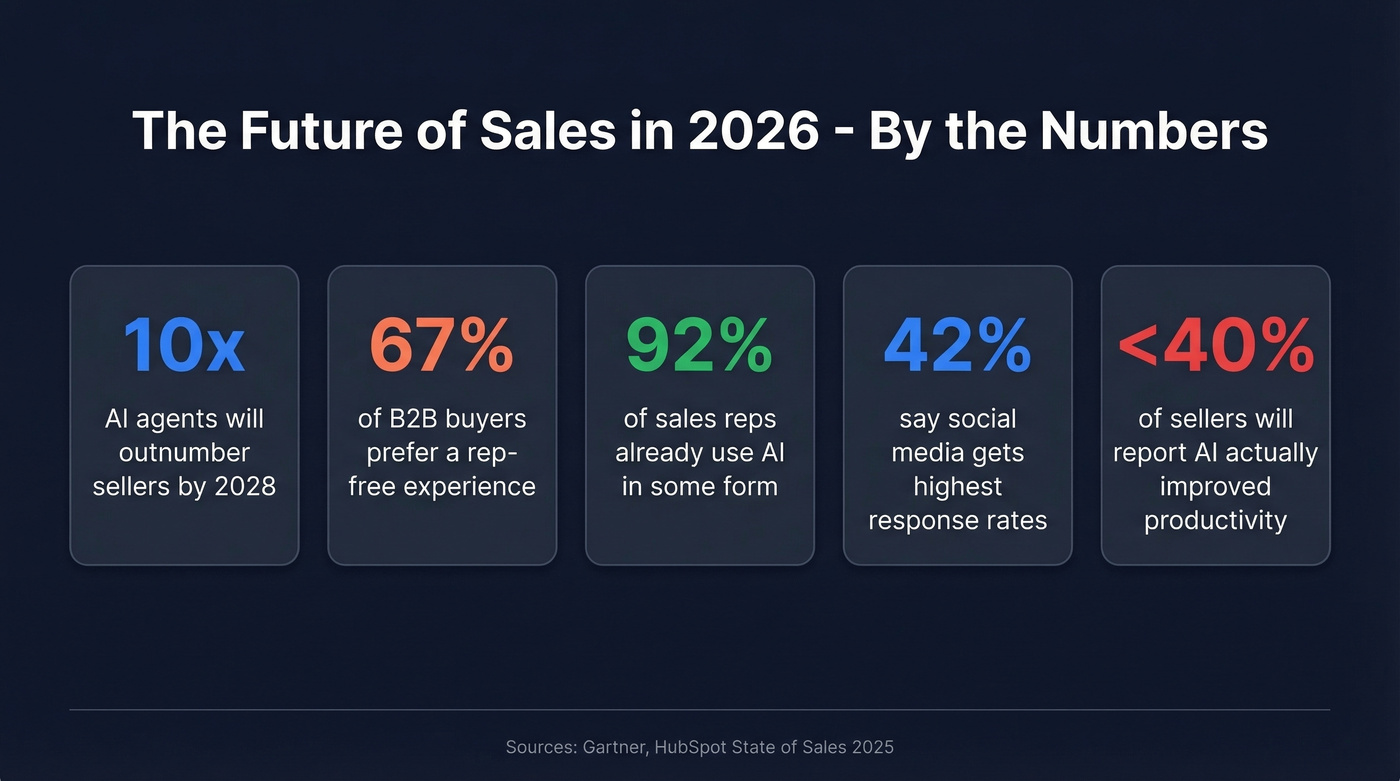
By 2028, AI agents will outnumber sellers 10x, yet fewer than 40% of sellers will report productivity gains. Buyers already prefer rep-free experiences at a rate of 67%. Clean data and org flexibility beat tool count every time. Below: the stats, the shifts, and the playbook.
Where Sales Stands in 2026
HubSpot's 2025 State of Sales report surveyed 1,000 global sales pros, and the picture is more stable than the hype cycle suggests. 92% of reps already use AI in some form. Win rates are holding steady - 91% report them stable or improving - and 93% say deal sizes are steady or growing. Lead quality is trending up too, with 68% reporting improvement year over year.
The channel mix is where things get interesting. 42% of reps say social media channels produce the highest prospect response rates, compared to just 26% for email. That's not a marginal difference. It's a structural shift in where buyers actually engage. Nearly 60% of teams are on track to meet or surpass revenue targets.
Sales isn't collapsing. But the mechanics of how deals happen are changing faster than most orgs are adapting, and the gap between teams that evolve and teams that don't is becoming a chasm - stalled pipelines, shrinking win rates, and a growing divide between top performers and everyone else.
The AI Contradiction
Look, the industry is pouring money into AI while the evidence says most of it won't pay off.
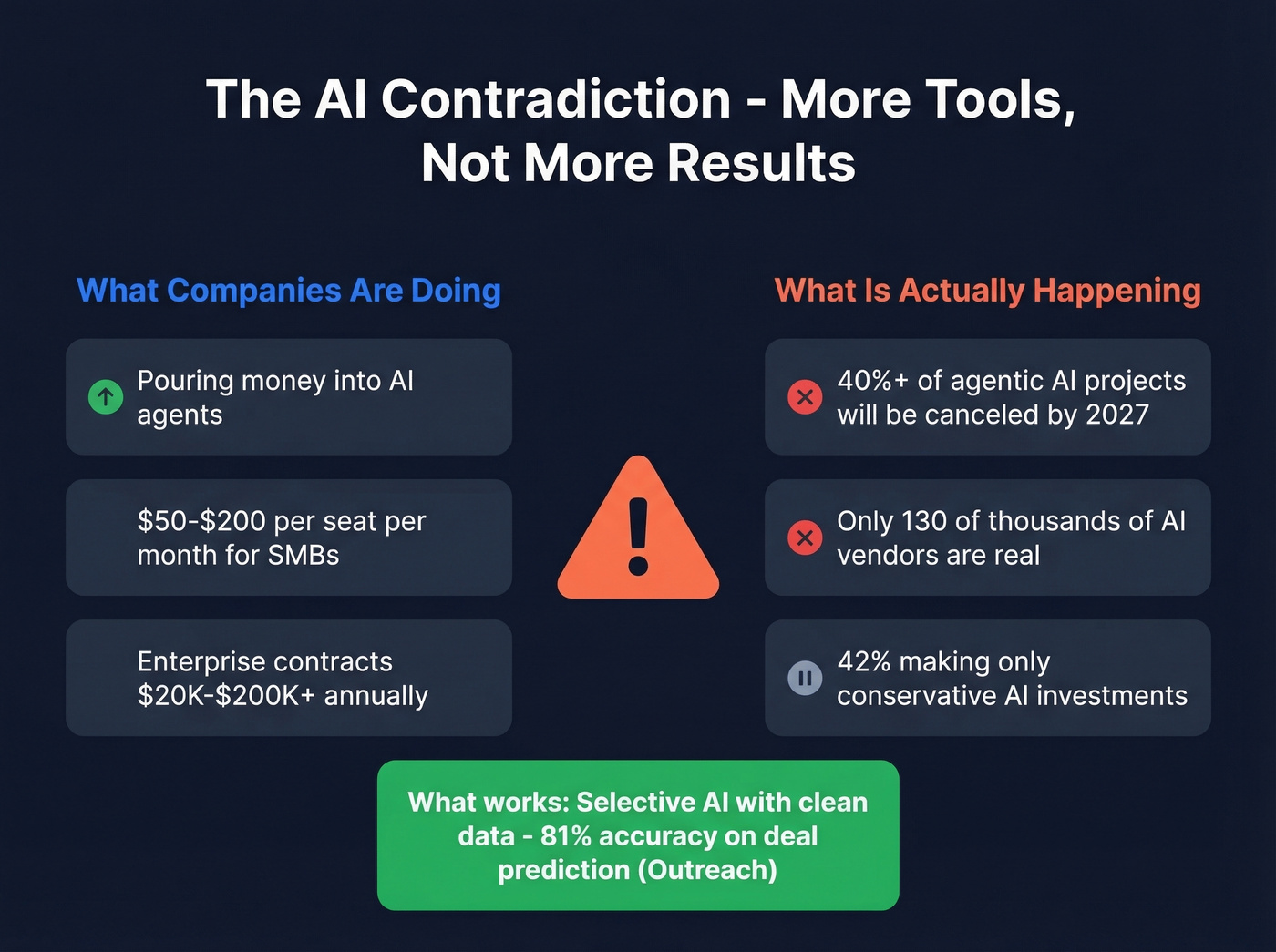
Gartner's sales-specific forecast is stark. By 2028, AI agents will outnumber human sellers 10x, but fewer than 40% of those sellers will report that AI agents actually improved their productivity. Analyst Melissa Hilbert put it bluntly: "more AI does not mean more productivity." It risks overwhelming sellers and accelerating burnout - one of the most underestimated challenges teams already face.
The broader agentic AI picture is even messier. Over 40% of agentic AI projects will be canceled by end of 2027 due to escalating costs, unclear business value, or inadequate risk controls. Of the thousands of vendors claiming agentic AI capabilities, only about 130 are real. The rest is "agent washing" - slapping an AI label on glorified automation. A January 2025 poll of 3,412 industry attendees found 42% making only conservative AI investments and 31% still in wait-and-see mode.
Most sales AI agent platforms run $50-$200/seat/month for SMBs, with enterprise contracts reaching $20K-$200K+ annually. That makes the ROI question urgent, not theoretical.
So what does "selective" AI look like? Outreach offers one model worth studying. Their platform analyzes 33M weekly interactions across 6,000+ customers, and their Deal Health Scores hit 81% accuracy at predicting outcomes. AI that's explainable, embedded in existing workflows, and focused on specific decisions outperforms AI that tries to replace the entire selling motion. Alert fatigue kills the rest.
Here's what we've seen firsthand: AI-generated outreach is already commoditized. The reps still winning are the ones manually verifying data and rewriting AI copy before it ships.
How Buyers Changed Faster Than Sellers
While sales orgs debate AI strategy, buyers have already moved. An Aug-Sep 2025 survey of 646 B2B buyers found 67% prefer a rep-free experience. And 45% reported using AI during a recent purchase - they aren't waiting for sellers to adopt it. Among buyers who used genAI for research, 36% felt more confident in their decision, but 20% felt less confident due to unreliable AI-generated information.
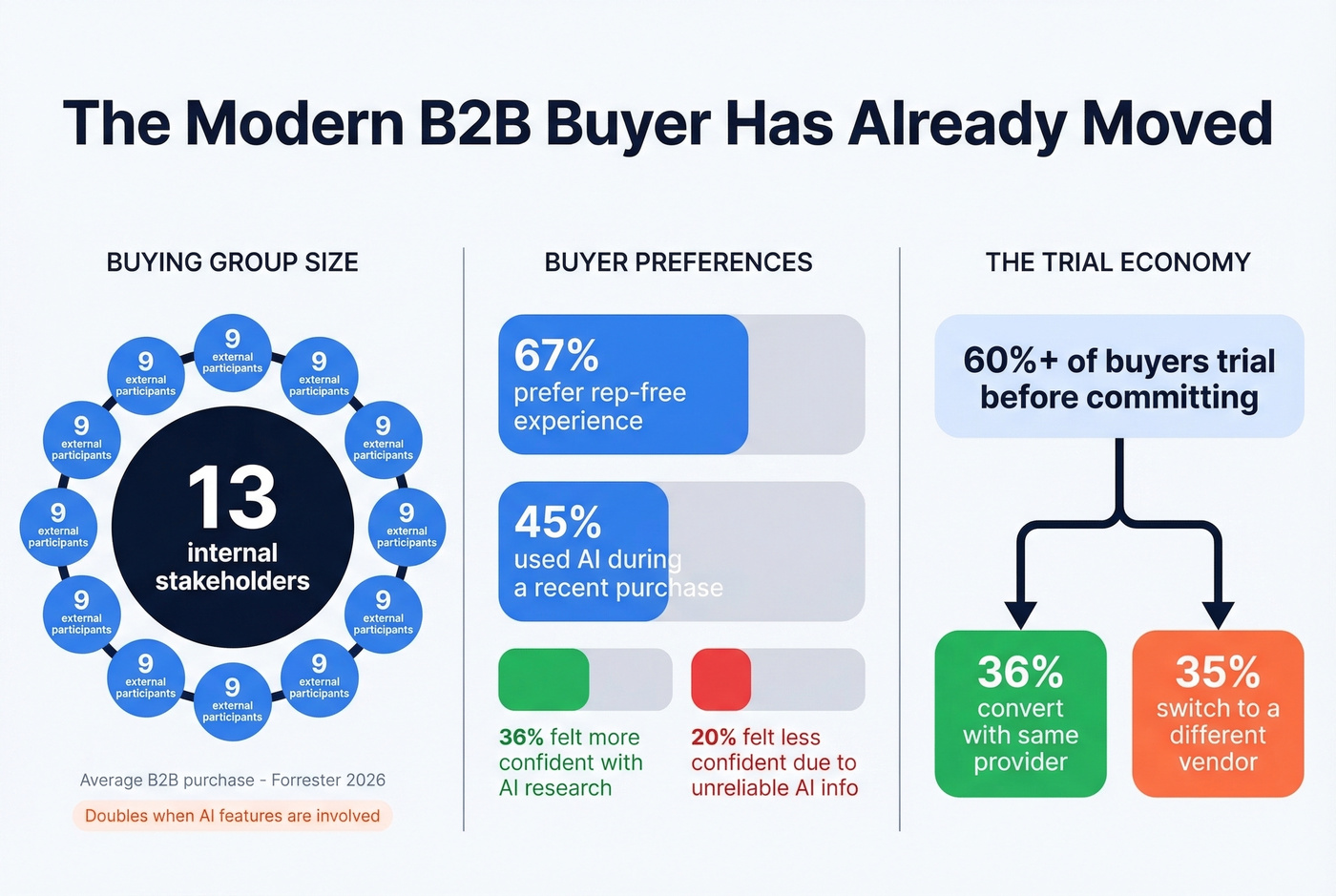
The buying group itself has ballooned. Forrester's 2026 State of Business Buying report found the average B2B purchase now involves 13 internal stakeholders and 9 external participants. When the purchase includes generative AI features, that buying group doubles. 53% identified procurement as a decision-maker, and procurement is getting involved earlier - not just rubber-stamping at the end.
The trial economy is real too. Over 60% of buyers engage in some form of trial before committing, but only 36% convert with the same provider post-trial. Another 35% switch to a different vendor entirely. Buyers are testing more, committing less, and making sellers earn every deal through demonstrated value rather than pitch decks.
If your sales motion still assumes a single champion guiding a 5-person committee through a linear funnel, you're selling into a world that doesn't exist anymore.

The future of sales isn't more AI tools - it's cleaner data powering smarter outreach. Prospeo's 7-day refresh cycle and 98% email accuracy mean your AI sequences actually land. No torched domains, no 38% bounce rates.
Stop feeding garbage data to great AI. Start with verified contacts.
The Outbound Reality Check
Cold outbound isn't dead, but it's on life support in its current form. 95% of cold emails fail to generate replies. Average open rate sits at 27.7%. Average reply rate: 3.43%. And 17% of cold emails never reach the inbox at all.
If you're rebuilding your outbound motion, start with a modern B2B cold email sequence and realistic sales prospecting techniques that match how buyers engage now.
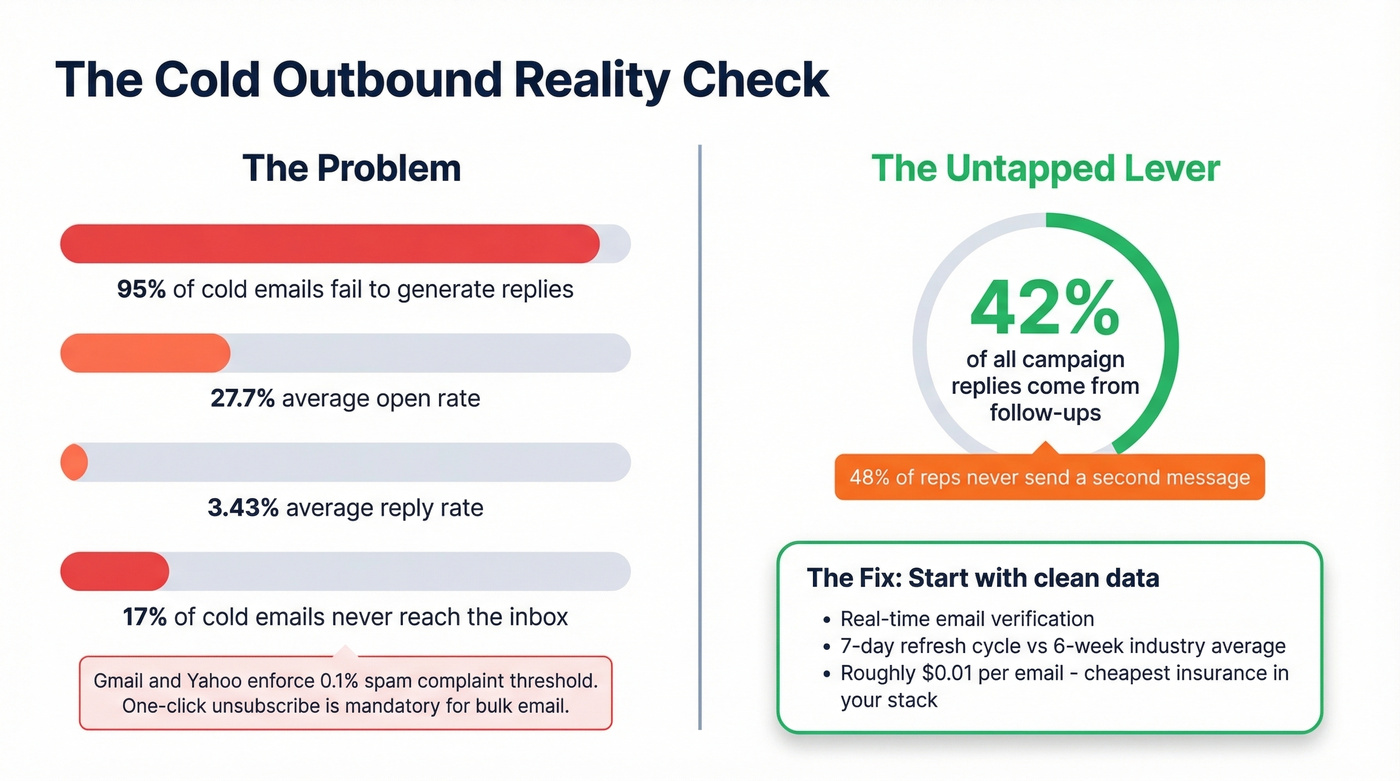
The deliverability environment has gotten unforgiving. SPF, DKIM, and DMARC alignment are table stakes. Gmail and Yahoo enforce a 0.1% spam complaint threshold - breach it and you're flagged. Bulk sender classification kicks in at 5,000+ messages per day. One-click unsubscribe is mandatory for bulk marketing email.
If you need a deeper checklist, use an email deliverability guide and validate your DMARC alignment before scaling volume.

Follow-ups remain the most underused lever in outbound. They generate 42% of all campaign replies, yet 48% of reps never send a second message. That's free pipeline left on the table.
If your team needs copy that doesn't sound like everyone else, keep a set of sales follow-up templates and track your follow-up email reply rate by segment.
The fix starts with your data. If 17% of emails never reach the inbox, bad data is a primary driver - not your subject line. Prospeo runs real-time email verification through a proprietary 5-step process on a 7-day refresh cycle, compared to the 6-week industry average, so you aren't burning domain reputation on contacts who left their company last quarter. At roughly $0.01 per email, it's the cheapest insurance policy in your stack.
If you're diagnosing list issues, start with email bounce rate benchmarks and a plan for spam trap removal.
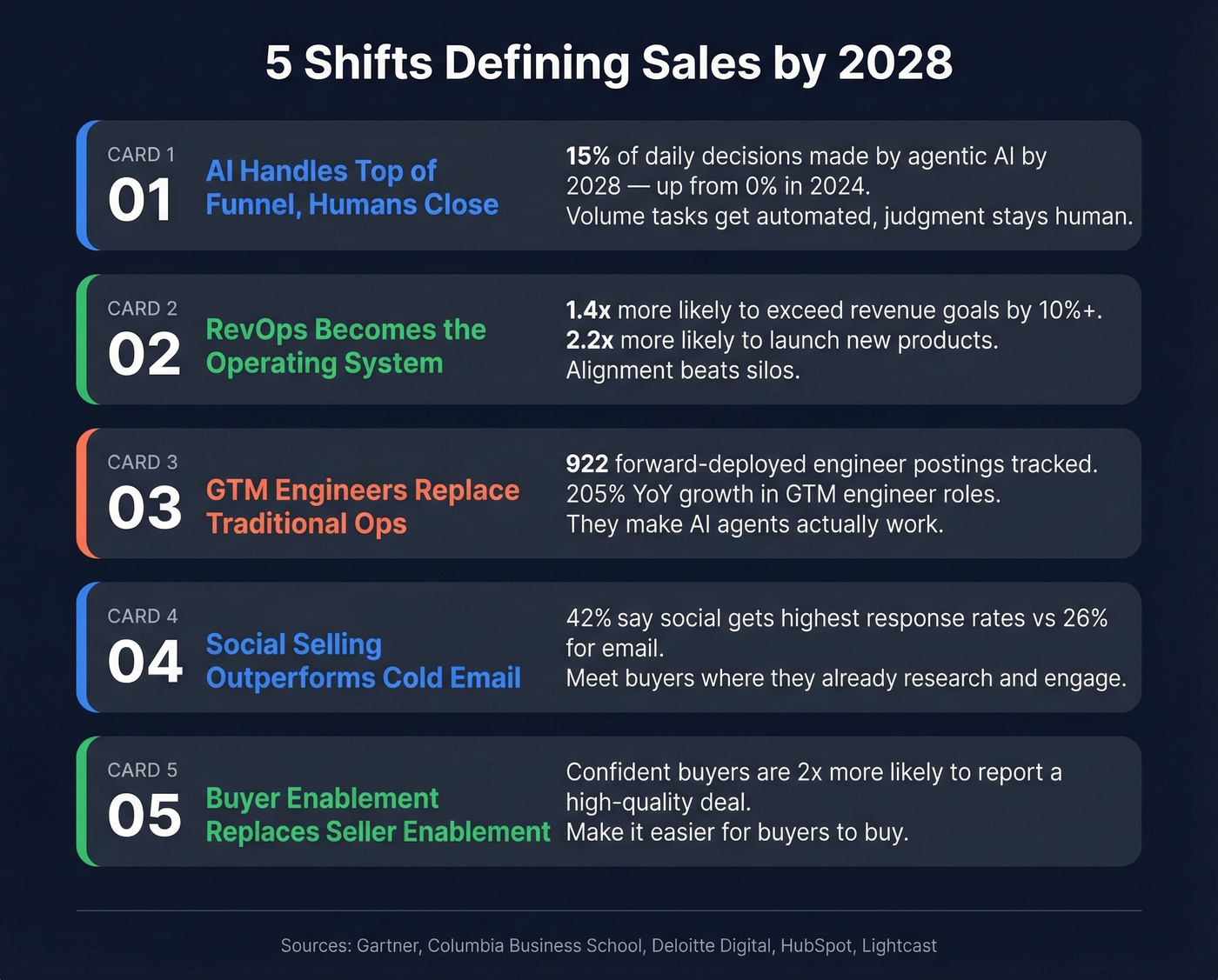
Five Shifts Defining Sales by 2028
AI Handles Top-of-Funnel, Humans Close
Columbia Business School's framework nails this: top-of-funnel tasks - ICP targeting, contact sourcing, personalization, cadence management - get automated. Bottom-of-funnel stays human. Negotiation, trust-building, multi-stakeholder persuasion - these are relatively unchanged. By 2028, 15% of day-to-day work decisions will be made autonomously by agentic AI, up from 0% in 2024. The split isn't "AI vs. humans." It's "AI for volume, humans for judgment." The role of sales reps isn't heading toward obsolescence - it's moving into the high-stakes conversations that machines can't navigate.
If you're operationalizing this split, it helps to map it to sequence management so automation doesn't create chaos.
RevOps Becomes the Operating System
What happens when you align marketing, sales, and customer success under one revenue operations umbrella? Deloitte Digital's research across 650 B2B sales executives in 13 industries found those orgs were 1.4x as likely to exceed revenue goals by 10%+, 1.9x more likely to invest in new tools, and 2.2x more likely to launch new products. Meanwhile, 40% of respondents said fewer than half their sales team hit quota.
The gap between RevOps-aligned orgs and siloed ones is widening, not closing. It's a growing polarization that separates data-driven teams from those still running on instinct and spreadsheets.
If you're building the function, start with what a RevOps Manager actually owns and how to measure pipeline health.
GTM Engineers Replace Traditional Ops
The GTM engineer isn't a buzzword - it's a real hiring trend with data behind it. Lightcast tracked 922 forward-deployed engineer postings as of November 2025, a fivefold increase year over year. Palantir, PwC, and Salesforce lead the hiring. Betts Recruiting found GTM engineer postings specifically grew roughly 205% YoY. These roles build and automate revenue systems - they're the people who make AI agents actually work inside a sales org instead of creating expensive chaos.
Social Selling Outperforms Cold Email
The data is unambiguous: 42% of reps say social channels produce the highest response rates, versus 26% for email. This isn't about posting thought leadership. It's about meeting buyers where they're already researching, engaging in conversations before a formal sales process begins, and building trust through visible expertise.
A sales leader we spoke with put it simply: "My top rep hasn't sent a cold email in six months. She closes everything through DMs and comments." The reps who treat social as a channel, not a chore, are outperforming.
Buyer Enablement Replaces Seller Enablement
Confident buyers are twice as likely to report a high-quality deal versus low-confidence buyers. The implication is straightforward: the best thing you can do for your close rate is make it easier for buyers to buy. That means shifting from static content distribution to AI-driven buyer support, modular content that buying groups can share internally, and embedding enablement into the workflows buyers actually use - not just the ones sellers prefer.
The Practical Playbook
Audit data quality before buying AI tools. We've seen teams cut bounce rates in half within a week just by running their list through verification first. Spending $50K on AI agents while running a $50/month contact list is putting diesel in a Ferrari.
If you're tightening your data layer, compare data enrichment services and your upstream B2B company data sources before you scale.
Build multi-channel sequences. Email alone won't cut it when social produces 42% response rates. Layer social touches, email, and phone into every sequence. The reps hitting quota in 2026 aren't single-channel - they're everywhere their buyers are.
Restructure around RevOps. If marketing, sales, and customer success still report into separate silos with separate dashboards, you're leaving the 1.4x revenue multiplier on the table. Align around shared revenue metrics, shared data, and shared accountability.
Upskill reps on AI tools and complex selling. 92% of reps use AI, but most use it for basic tasks. Train them on Deal Health Scores, AI-generated account research, and automated follow-up triggers. Simultaneously, invest in complex negotiation skills - that's the part automation can't replicate.
Verify before you send. Every email that bounces damages your domain. Every sequence sent to a stale list wastes money and erodes deliverability. Make verification the first step in every campaign, not an afterthought.
Let's be honest about one more thing: if your average deal size is under $15K, you probably don't need a $200/seat AI sales platform. You need clean data, a multi-channel sequence, and a rep who can actually close. The B2B trends everyone chases are tools-first. The teams winning are data-first.
Traditional Sales vs. 2026 Sales
| Dimension | Traditional (2020-2024) | 2026-2028 |
|---|---|---|
| Top-of-funnel | Manual SDR prospecting | AI agents + verified data |
| Buyer journey | Rep-guided | Self-serve (67% prefer) |
| Buying group | 5-7 stakeholders | 13 internal + 9 external |
| Primary channel | Cold email | Multi-channel (social leads) |
| Org model | Siloed sales/marketing | RevOps-aligned (1.4x rev) |
| Data refresh | Monthly/quarterly | Weekly (7-day cycle) |
| Key hire | SDR/BDR | GTM engineer / FDE |
| AI role | CRM automation | Agentic (10x agents/seller) |
When 17% of cold emails never reach the inbox, your data vendor is the bottleneck - not your copy. Prospeo's proprietary 5-step verification and spam-trap removal keep bounce rates under 4%, at $0.01 per email.
Your domain reputation is your 2026 competitive advantage. Protect it.
FAQ
Will AI replace salespeople?
No. AI agents will outnumber sellers 10x by 2028, but fewer than 40% will report productivity gains. Top-of-funnel tasks like prospecting and cadence management get automated; complex deals, trust-building, and multi-stakeholder negotiation stay human. The best reps become more valuable, not less.
What does the future of sales look like in 2026?
Data-first, multi-channel, and buyer-led. Buying groups now average 13+ internal stakeholders, 67% of buyers prefer self-serve, and social channels outperform email for response rates. RevOps-aligned orgs outperform siloed ones by 1.4x on revenue. Winners invest in data quality before adding more AI.
How should sales leaders prepare their teams?
Hire GTM engineers alongside traditional reps, restructure around RevOps metrics instead of siloed quotas, and invest in data infrastructure before layering on AI. Coach reps on complex deal navigation and multi-stakeholder selling while letting automation handle prospecting volume. Budget for verification tools before $200/seat AI platforms.
How do I fix outbound before investing in AI?
Start with data quality - verify your contact list on a 7-day refresh cycle instead of the 6-week industry average. Enforce SPF/DKIM/DMARC, keep complaint rates below 0.1%, and always send follow-ups. Follow-ups generate 42% of all campaign replies, yet 48% of reps never send a second message.