

How to Write a Gentle Reminder Email for No Response
You sent the email on Monday. It's Thursday. There's no "seen" indicator in email, so you're staring at your outbox wondering if they read it, forgot it, or quietly decided you don't matter. You're not alone - only 8.5% of outreach emails get any response at all. The average executive receives around 120 emails a day, and yours is competing with vendor pitches, internal fires, and a dozen other people doing exactly what you're doing right now: waiting.
Writing a gentle reminder email for no response shouldn't feel this stressful - but it does. There's the other side of the coin too: the anxiety that your follow-up will come across as pushy or guilt-tripping. A well-timed, well-worded follow-up changes the math entirely. Most people get the timing, the tone, or both completely wrong.
The Quick Framework
If you're short on time:
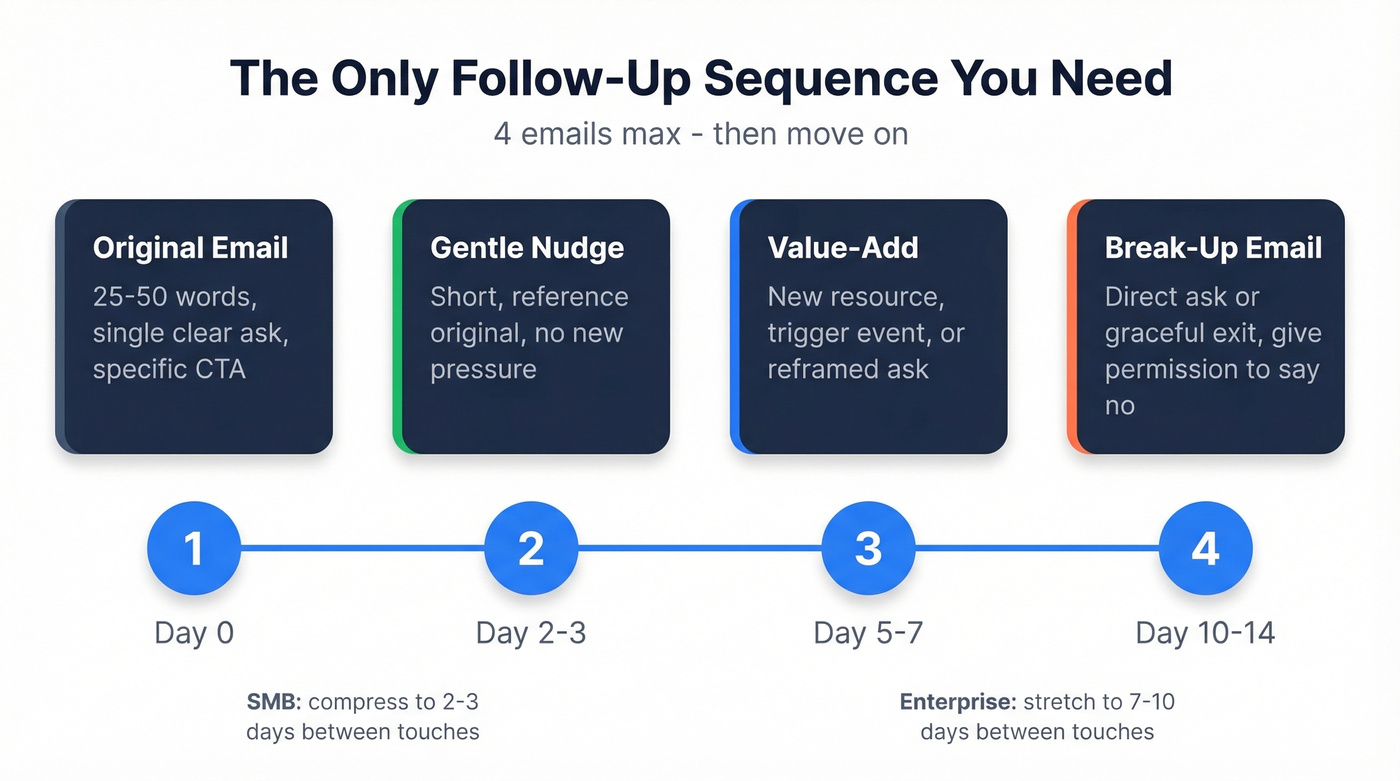
- The 3-email rule. Day 2-3: gentle nudge. Day 5-7: add value. Day 10-14: direct ask. After that, send a break-up email and move on. (If you want more options, see these follow-up templates.)
- Never write "per my last email." It's the fastest way to signal frustration and kill goodwill.
- The break-up email is your secret weapon. A respectful "should I stop following up?" often gets more replies than the three emails before it.
- Verify the address before you follow up. One team we've worked with found 35% of their emails were bouncing - not because their wording was bad, but because the addresses were dead. (If you’re troubleshooting bounces, start with email bounce rate.)
Why Your Polite Follow-Up Gets Ignored
Let's get the ego hit out of the way. Silence almost never means "I hate your email." It usually means one of five things.
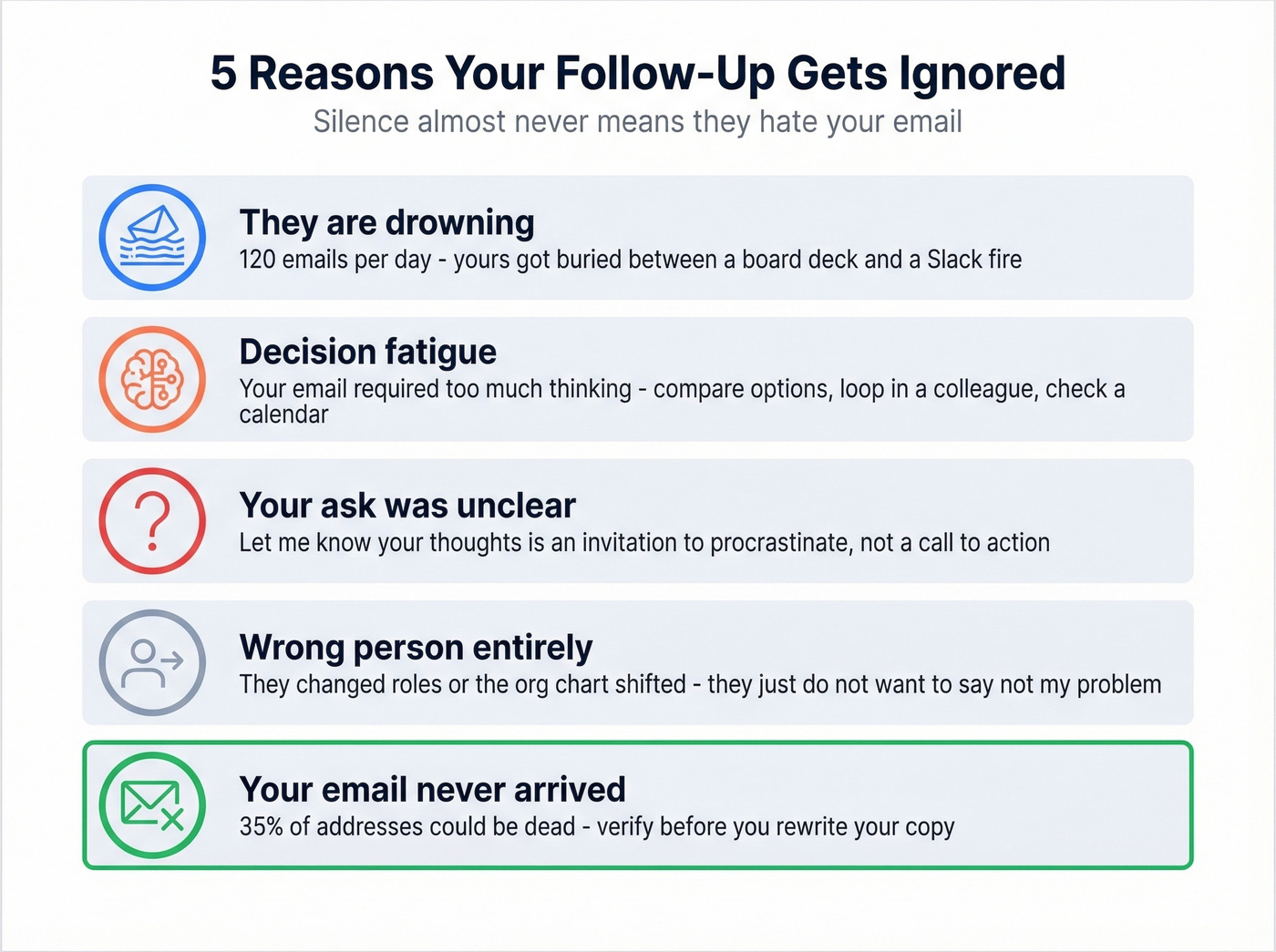
1. They're drowning. 120 emails a day. Your message landed between a board deck and a Slack fire. They read the subject line, meant to reply later, and "later" became "never."
2. Decision fatigue. If your email requires them to think - compare options, loop in a colleague, check a calendar - it gets deferred. Emails with a clear, single ask get answered faster than emails that require a decision tree.
3. Your ask was unclear. "Let me know your thoughts" isn't a call to action. It's an invitation to procrastinate. A specific question ("Does Tuesday at 2pm work?") converts better than an open-ended one every time. (More on tightening asks: email call to action.)
4. They're not the right person. Maybe they changed roles. Maybe the org chart shifted. They don't want to say "not my problem," so they say nothing. (This is where an ideal customer profile helps.)
5. Your email never arrived. Most people overlook this entirely. If the address is outdated or misspelled, your reminder went nowhere. We've seen teams waste weeks rewriting copy when the real issue was stale data - running contacts through Prospeo's verification before following up would've caught the problem in seconds. (If you need a process, see how to check if an email exists.)

A Belkins study of 16.5 million cold emails found the highest reply rate - 8.4% - came from the very first email. Every follow-up after that faces diminishing returns. So when you do follow up, make it count.
The Only Follow-Up Sequence You Need
Forget the 7-touch, 12-touch, 19-touch cadences that vendor blogs love to promote. The data says otherwise.
Belkins' 16.5M-email dataset tells a clear story: sending 4+ emails in a sequence more than triples unsubscribe and spam complaint rates. The founder segment is especially revealing - reply rates hold steady through two follow-ups (6.64% to 6.66% to 6.94%) then drop to 5.75% on the third and crater to 3.01% on the fourth. Separately, Artisan's research found one follow-up can increase response rates by 65.8%, but the second adds only 3%, and a third actually reduces overall response by 30%. Both datasets point to the same conclusion: one or two follow-ups is the sweet spot. (If you’re building a full cadence, use a B2B cold email sequence framework.)
Here's the cadence that balances persistence with respect:
Email 1 (Day 0): Your original message. Clear subject, single ask. Artisan's data suggests 25-50 words is the sweet spot for cold emails, though warm and internal emails can run slightly longer - cap everything at 90 words. (For structure, see email copywriting.)
Email 2 - The Gentle Nudge (Day 2-3): Short. Reference the original. Add no new pressure. For enterprise stakeholders, push this to Day 7-10 - senior buyers are allergic to rapid-fire follow-ups. (Timing benchmarks: best time to send cold emails.)
Email 3 - The Value-Add (Day 5-7): Don't just repeat yourself. Bring something new: a relevant resource, a trigger event, a reframed ask. This is where you earn the reply. (More ideas: personalized outreach.)
Email 4 - The Direct Ask or Break-Up (Day 10-14): Either get specific ("I need X by Friday to hit our deadline") or send the break-up email. There's no Email 5.
For SMB prospects, compress the timeline - 2-3 days between touches. For enterprise, stretch to 7-10 days. Event-driven outreach (post-conference, post-webinar) gets a tighter window: 24-48 hours for the first follow-up.
Copy-Paste Templates for Every Scenario
You don't need 19 templates. You need four scenarios covered well. Every template below has a clear CTA and a subject line.
The First Gentle Nudge (Day 2-3)
Cold outreach:
Subject: Quick follow-up on [topic]
Hi [Name],
I sent a note on [day] about [one-sentence summary]. Totally understand if the timing's off - just wanted to make sure it didn't get buried.
Would a 15-minute call on [day] or [day] work to see if this is relevant?
Best, [Your name]
Warm lead / proposal follow-up:
Subject: Following up on the [proposal/quote]
Hi [Name],
Wanted to check in on the [proposal/quote] I sent over on [date]. Happy to walk through any questions or adjust the scope if something doesn't fit.
What's the best way to move this forward on your end?
Thanks, [Your name]
Internal request:
Subject: [Project name] - still need your input
Hey [Name],
Circling back on the [deliverable] I mentioned on [day]. I need [specific thing] to keep [project] on track for [deadline].
Can you get that to me by [date]? If someone else owns this now, just point me their way.
Thanks, [Your name]
The Value-Add Follow-Up (Day 5-7)
These templates work because they give the recipient a reason to engage beyond guilt. Instead of repeating your ask, you're changing the conversation.
Add new context:
Subject: Thought this might be useful - [resource topic]
Hi [Name],
Since we last connected, [new development - a stat, article, or case study relevant to their problem]. Thought it might be useful context for [their initiative].
Still happy to chat if the timing works. Would [day] afternoon be open?
[Your name]
Reference a trigger event:
Subject: Saw the news about [company event]
Hi [Name],
Noticed [their company] just [trigger - funding round, new hire, product launch, expansion]. That usually means [relevant challenge your product/service addresses].
Worth a quick conversation? I can share how [similar company] handled the same thing.
[Your name]
Reframe the ask - use this when your original email was too vague:
Subject: Different angle on [original topic]
Hi [Name],
Realized my last email might've been too broad. Here's the specific question: [one clear, answerable question].
A one-line reply is totally fine.
[Your name]
The Direct Ask (Day 10-14)
By day 10-14, ambiguity is your enemy. These templates drop the softness and state exactly what you need. Directness at this stage isn't rude - it's respectful of everyone's time.
Client / invoice follow-up:
Subject: [Invoice #] - confirming receipt
Hi [Name],
Following up on invoice [number] sent on [date] for [amount]. Want to confirm it reached the right person and check if there's anything holding up processing.
Can you let me know the status by [date]?
Thanks, [Your name]
Meeting / scheduling:
Subject: Locking in a time for [topic]
Hi [Name],
I've followed up a couple of times on [topic] - want to be respectful of your inbox. If this is still a priority, I have [two specific time slots] open this week.
If the timing's wrong, just say so - no hard feelings.
[Your name]
The Break-Up Email
The break-up email often gets one of the highest response spikes in the entire sequence. The psychology behind it is simple: you're not guilting them. You're giving them permission to say no - and that permission is often what unlocks a yes.
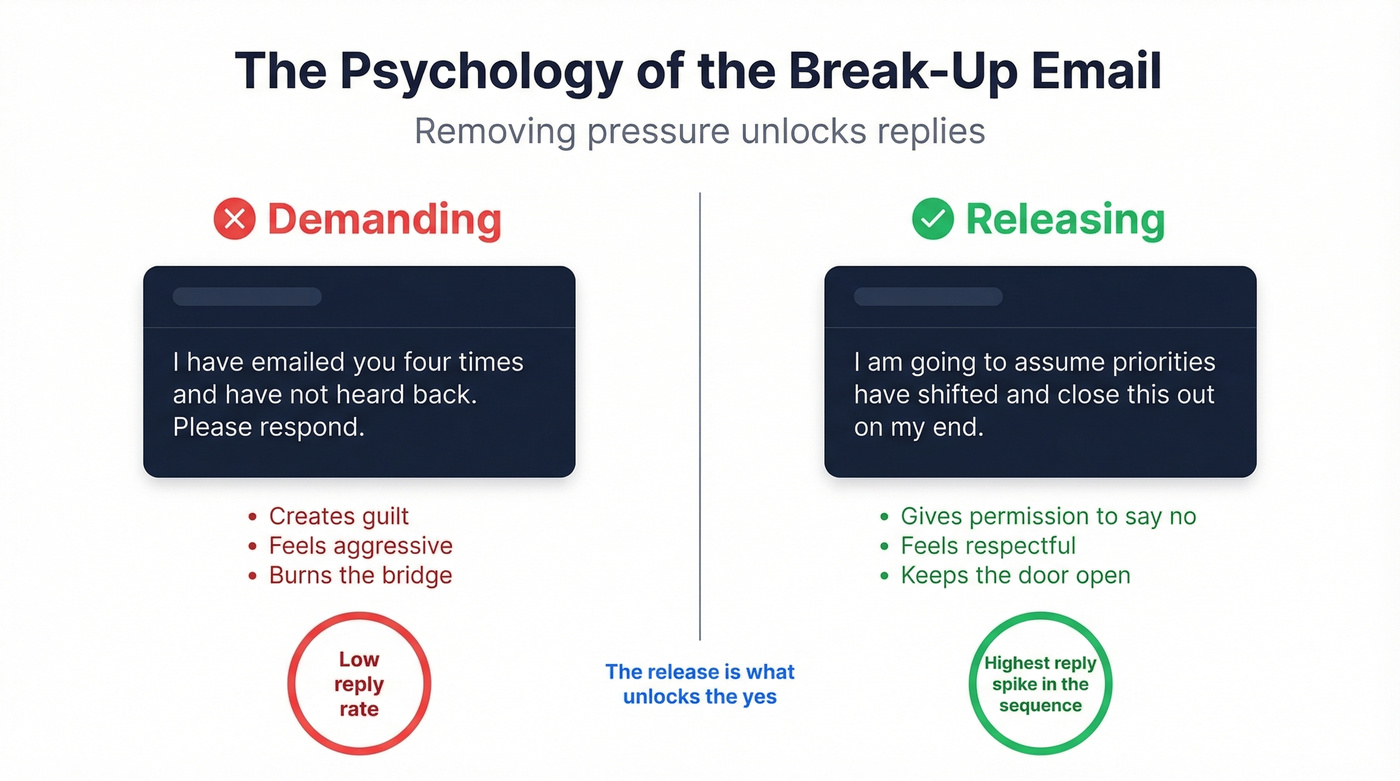
Watch how removing pressure changes the dynamic:
❌ "I've emailed you four times and haven't heard back. Please respond." ✅ "I'm going to assume priorities have shifted and close this out on my end."
The first version demands. The second releases. Three ways to execute it:
"Close your file" framing:
Subject: Can I close your file?
Hi [Name],
I've reached out a few times about [topic] and haven't heard back - which is totally fine. I'm going to assume priorities have shifted and close this out on my end.
If anything changes, I'm easy to find. Wishing you a great [quarter/season].
[Your name]
The easy out:
Subject: Should I stop following up?
Hi [Name],
Quick question - should I keep this on my radar or take it off the list? Either answer works. Just want to respect your time.
[Your name]
The "no hard feelings" close:
Subject: Final follow-up on [topic]
Hi [Name],
This'll be my last note on [topic]. If it's not the right time, no worries at all. I'll check back in [30/60/90 days] with fresh context.
Thanks for your time either way.
[Your name]
Subject Lines That Get Opened
Your template doesn't matter if the subject line gets ignored. Keep these under 40 characters and skip anything that feels like a trick. (For more options, browse these email subject line examples.)
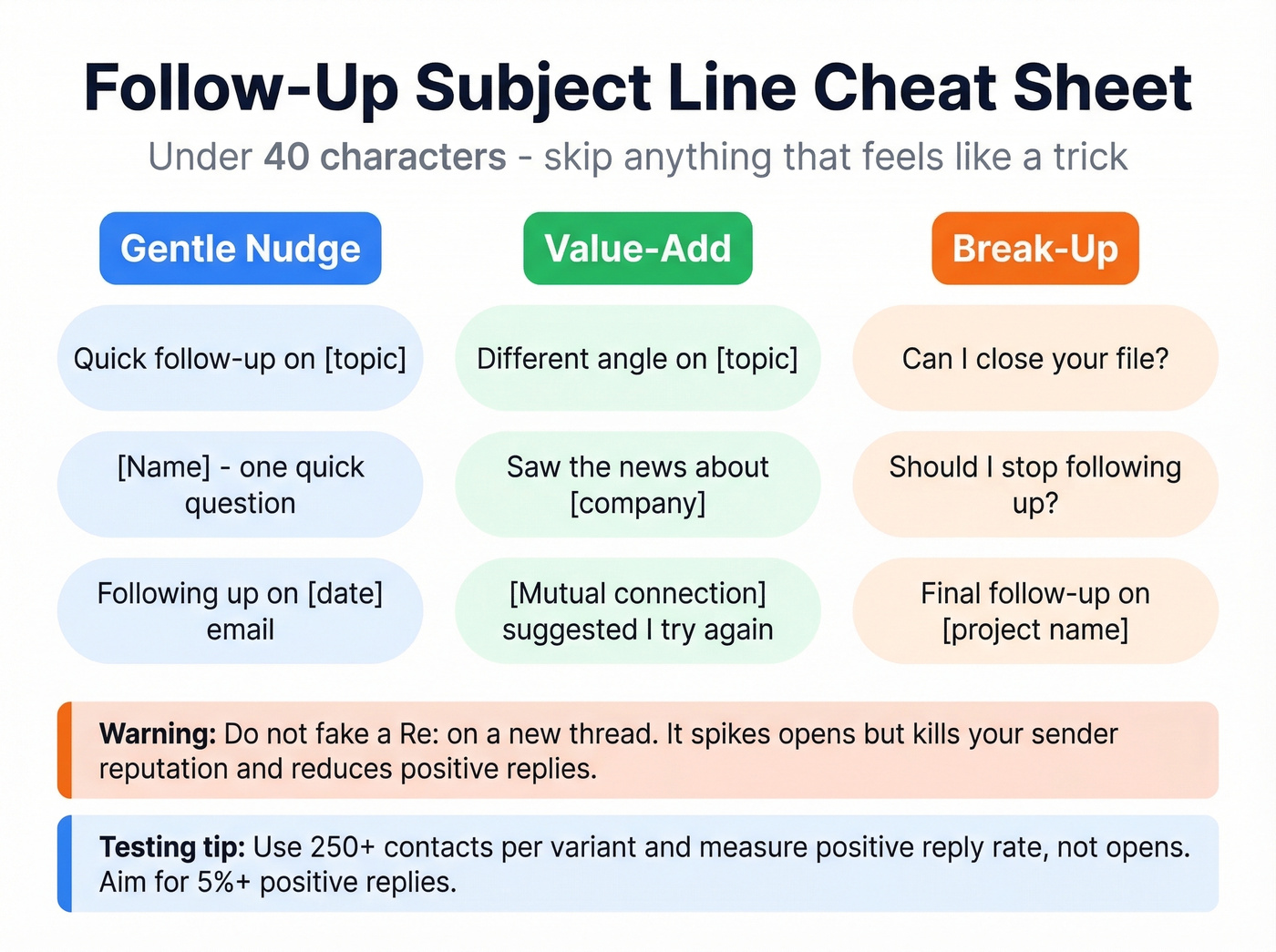
- Quick follow-up on [topic]
- Still interested in [specific thing]?
- [Name] - one quick question
- Following up on [date] email
- Can I close your file?
- Should I stop following up?
- [Mutual connection] suggested I try again
- Different angle on [topic]
- Saw the news about [company]
- [Topic] - need your input by [date]
- Final follow-up on [project name]
The "Re:" debate. Adding "Re:" to a new thread can spike opens, but Instantly's research warns that misleading subject lines hurt your sender reputation and reduce positive replies. Don't fake a thread that doesn't exist.
Testing tip: If you're running A/B tests on subject lines, use 250+ contacts per variant and measure positive reply rate - not opens. Aim for 5%+ positive replies. Open rates are a vanity metric, especially now that tracking pixels actively hurt deliverability. (If you’re diagnosing tracking, see email tracking pixel.)

35% of "no responses" aren't silence - they're bounces. Before rewriting your follow-up copy, verify the address actually exists. Prospeo's 5-step verification catches dead emails, spam traps, and catch-all domains with 98% accuracy.
Stop perfecting emails that never arrive. Verify first.
Phrases That Backfire
The words you think sound professional often signal something completely different to the reader. Melody Wilding, an executive coach quoted in Inc, puts it bluntly: passive-aggressive phrasing signals you can't handle conflict appropriately.
| Phrase | What it signals | Say this instead |
|---|---|---|
| Per my last email | "You didn't read it. Read it again." | "To build on what I shared on [date]..." |
| Just checking in | "I'll keep emailing until you answer." | "Following up because [specific reason]." |
| Kindly | Condescending, especially cross-culturally | Drop it entirely. Just ask directly. |
| As previously stated | "I already told you this." | "As a quick recap..." |
| Thanks in advance | "You don't have a choice." | "I'd appreciate your help with this." |
| Hope this helps | "This is all you're getting from me." | "Let me know if you need anything else." |
| Moving forward | "Stop wasting my time." | "For next steps..." |
| Just circling back | "I'll keep coming back around." | "I'm following up on [specific thing]." |
Here's the thing about "kindly" - it deserves special attention. In many English-speaking contexts, it reads as patronizing. It's a recurring complaint on r/email and r/jobs, especially among non-native speakers who use it thinking it adds politeness. It doesn't. It adds a subtle power dynamic that makes the reader feel managed, not respected.
The fix across all of these is the same: replace the vague phrase with a specific reason for following up. "I'm following up because I need your sign-off to hit our Friday deadline" is infinitely better than "just circling back." (More rewrites here: how to say just checking in professionally.)
When Gentle Stops Working
There's a moment - usually around reminder #5 or #6 - where politeness stops being a strategy and starts being a liability. One Reddit poster described sending a 7th reminder for a simple request, with the employee, two managers, and a VP all CC'd, still getting nothing. At that point, the goal isn't a perfect answer. It's any response so you can close the item.
Switch channels first. Before you CC anyone's boss, try a different medium. A 30-second phone call, a Slack message, or walking to their desk often breaks the logjam faster than another email. People who ignore emails sometimes respond instantly on other channels - Belkins found that message-plus-profile-visit combos can drive reply rates up to 11.87%, higher than any email follow-up in their dataset. Here's a quick Slack/SMS template for when email has failed:
Slack/SMS: Hey [Name] - sent a couple of emails about [topic] that might've gotten buried. Quick yes/no: is this still on your radar? No worries either way.
CC with purpose, not punishment. If you must escalate, CC their manager with a neutral framing: "Looping in [Manager] for visibility - want to make sure this doesn't fall through the cracks." Never use CC as a weapon. The moment it feels punitive, you've lost the relationship.
Know when to walk away. If the request isn't time-critical and the person isn't a direct report, the break-up email is almost always the better move. It preserves the relationship and often triggers a reply on its own.
Our honest take: if someone hasn't responded after three well-spaced, well-written follow-ups, the problem usually isn't your email. It's either the wrong person, the wrong time, or the wrong address. Most teams would get better results spending 20 minutes cleaning their contact list than spending 2 hours rewriting their fifth follow-up. (If you’re systematizing this, use sequence management.)
Reminder Norms by Culture
If you're working across borders, "gentle" means different things in different places. What feels appropriately persistent in New York can feel aggressive in Tokyo.
| Region | Expected response time | Formality level | Key norms |
|---|---|---|---|
| Japan | Several days | Very high | Use -san suffix; formal greetings; patience expected |
| Germany | 1-3 business days | High | Use Herr/Frau + title + last name; precision valued |
| China | Same business day | Moderate-high | Rapid replies common; follow up quickly if silent |
| United Kingdom | 1-2 business days | Moderate-high | Polite understatement preferred; avoid hard sells |
| India | 1-3 business days | Moderate-high | "Kindly" is common locally but can backfire with Western recipients |
| Brazil | A few days | Moderate | Less urgency around email; relationship-first |
| Nigeria | Within a week | Moderate-high | Follow-up within a week is standard practice |
| United States | 1-2 business days | Moderate-low | Direct is fine; informality accepted quickly |
The universal rule: default to the highest level of formality until the recipient signals otherwise in their replies. You can always dial it down. Dialing it up after starting casual is awkward.
Skip idioms, humor, and sarcasm in cross-cultural follow-ups. "Just wanted to ping you" doesn't translate well. "Following up on my email from [date] regarding [topic]" works everywhere.
The Hidden Problem: Your Email Never Arrived
Before you rewrite your subject line for the third time, consider the possibility that your follow-up never landed.
Check your technical setup first. SPF, DKIM, and DMARC misconfigurations can route your emails straight to spam - no subject line fix will help. If your IT team hasn't verified these records, that's step zero. Even perfect copy delivered to a valid address will fail if your sending domain isn't authenticated. (Start here: email deliverability guide.)
On the data side, we've seen teams cut their bounce rate from 35% to under 4% after switching to verified contact data through Prospeo. That's not a copywriting fix - it's a data quality fix. One in three of their emails had been going nowhere. The free tier gives you 75 email verifications per month, which is enough to test whether bad data is your actual problem before you burn another afternoon rewriting templates.
Reason #4 on that list - "they're not the right person" - kills more follow-up sequences than bad copy ever will. Prospeo's database of 300M+ profiles with 30+ filters lets you confirm the right contact, role, and verified email before you send a single reminder.
Find the right person at $0.01 per verified email.
Gentle Reminder Email FAQ
How long should I wait before sending a reminder?
Wait 2-3 business days for most contexts. For enterprise stakeholders or senior executives, extend to 7-10 business days. Following up the next day consistently hurts reply rates - it signals impatience, not professionalism.
How many follow-up emails is too many?
Three is the ceiling for most sequences. Belkins' 16.5M-email study shows that sending 4+ emails more than triples spam complaints while reply rates crater. One to two follow-ups after your initial message is the sweet spot.
Is "just checking in" passive-aggressive?
It is. The implied message is "I'll keep emailing until you answer," which creates pressure rather than goodwill. Replace it with a specific reason: a deadline, a new piece of context, or a direct question. Specificity signals respect.
What if the person never responds after my break-up email?
Move on. Close the thread, update your CRM, and set a reminder to revisit in 30-90 days with genuinely fresh context - not another version of the same ask. Persistence past the break-up email crosses into territory that damages your reputation.
How do I know if my reminder email actually arrived?
If you're working from a stale contact list, it probably didn't. Bounce notifications don't always come through, especially with catch-all domains. Tools like Prospeo offer free verification tiers - 75 checks per month at 98% accuracy - so you can audit whether bad addresses are your real problem before rewriting another follow-up.