

How to Close a Sale: 9 Techniques, Scripts, and What the Data Says
You had a great demo on Monday. The prospect was nodding, asking about implementation timelines, even looping in their VP. By Thursday afternoon - silence. No reply to your follow-up. No calendar hold. Just the slow, familiar drift toward a dead deal.
Most advice on how to close a sale recycles the same ten techniques without addressing why that Thursday silence happens and what you can actually do about it.
What Actually Moves the Needle
- Master three closes - the Question Close, the Summary Close, and the Collaborative Close. They cover most real-world scenarios.
- Follow up 5-12 times across multiple channels. 80% of sales require that many touches, yet nearly half of reps quit after one or two attempts. (If you need copy you can deploy fast, use these sales follow-up templates.)
- Verify your contact data before running any cadence. No technique saves a dead email or a disconnected number. (Here are the best data enrichment services to keep records current.)
What Closing Means in 2026
Closing isn't a moment. It's not a magic phrase you drop at the end of a call. It's the cumulative result of every interaction - from the first touchpoint through the signed contract.
67-80% of the [B2B buying process now happens digitally](https://www.gartner.com/en/newsroom/press-releases/2026-03-09-gartner-sales-survey-finds-67-percent-of-b2b-buyers-prefer-a-rep-free-experience). Your prospect has read your reviews, compared your pricing page to three competitors, and formed an opinion before they ever take your call. The old "Always Be Closing" mantra assumes you're in control of the conversation. You're not. The buyer is.
The better frame is "Always Be Qualifying." B2B operates on completely different mechanics than B2C - longer cycles, six-figure contracts, buying committees that need internal consensus before anyone signs. With 89% of revenue organizations now using AI to assist selling, the information gap between buyer and seller has shrunk even further. Your job isn't to "close" a single person. It's to build a case strong enough that your champion can sell it internally without you in the room. (If you're building a system around this, start with account-based selling best practices.)
Close Rate Benchmarks
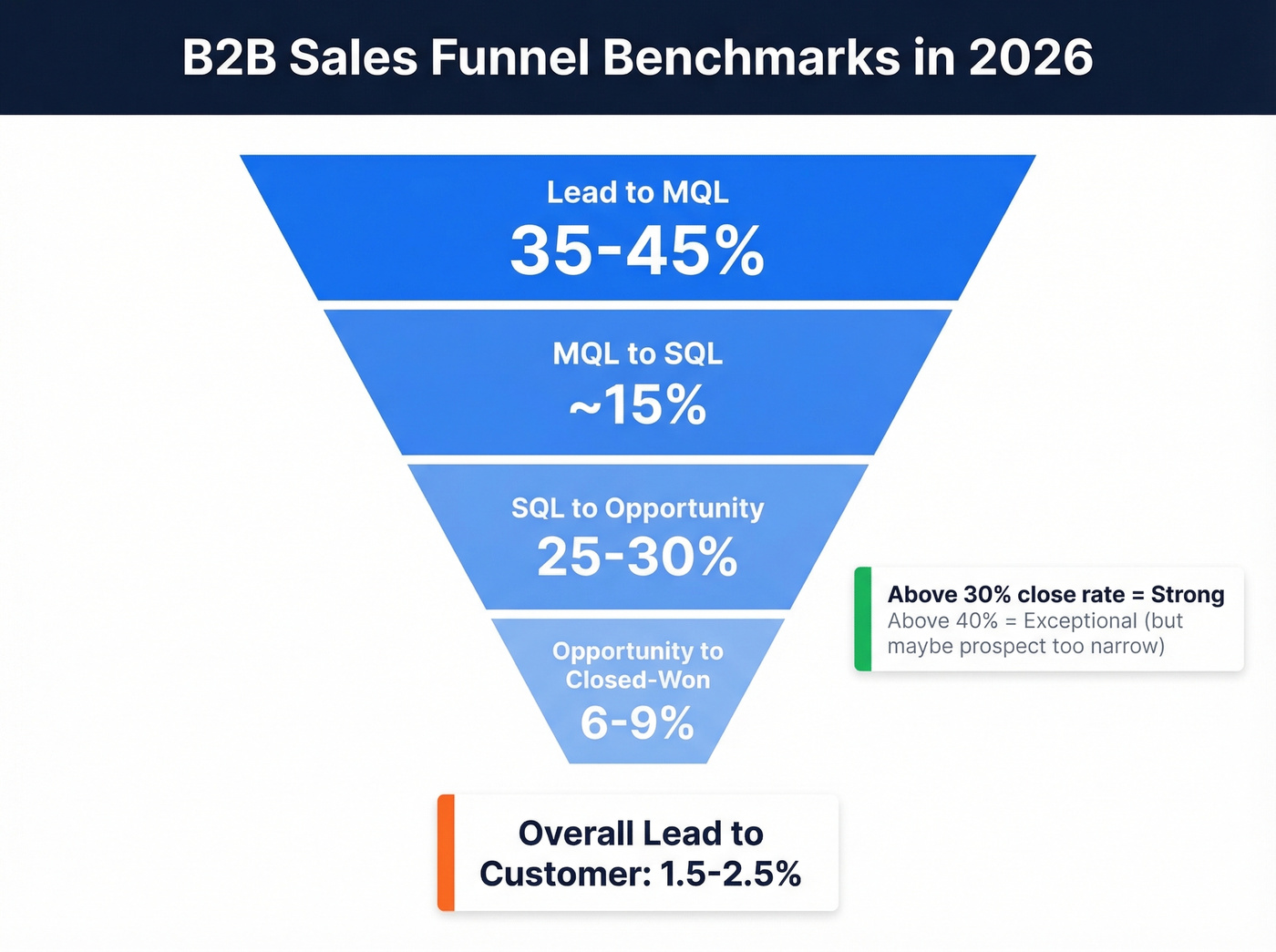
Here are common B2B funnel benchmarks in 2026:
| Funnel Stage | Conversion Rate |
|---|---|
| Lead to MQL | 35-45% |
| MQL to SQL | ~15% |
| SQL to Opportunity | 25-30% |
| Opportunity to Closed-Won | 6-9% |
| Overall Lead to Customer | 1.5-2.5% |
The often-cited 29% close rate refers to qualified opportunities that close - not raw leads. That distinction matters. Anything above 30% is strong. Above 40% is exceptional - and honestly, if you're consistently above 40%, you probably aren't prospecting broadly enough. (For more context, see sales conversion rate benchmarks.)
Don't confuse website conversion rates with sales close rates either. B2B SaaS site conversion averages just 1.1%, legal services hit around 7.4%, and manufacturing hovers near 2.2%. Those measure visitors completing a form, not deals closing - completely different metrics that lead to bad forecasting when you mix them up. (If you're mapping the full journey, use a B2B sales funnel template.)
Why 80% of Deals Stall
The real enemy isn't "no." It's "no decision."
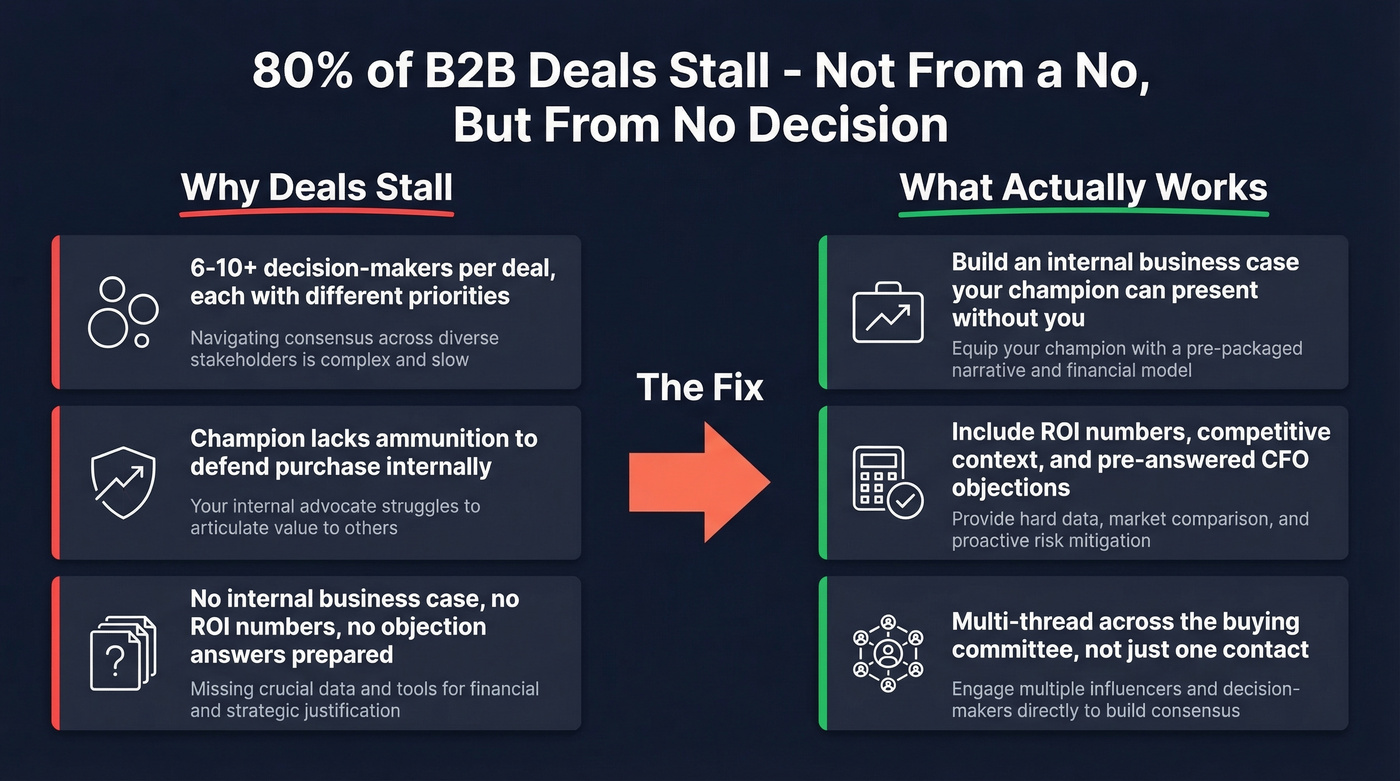
Nearly 80% of B2B buying decisions stall - not because someone rejected your proposal, but because the buying committee couldn't reach internal consensus. The average B2B deal now involves 6-10 or more decision-makers, each with different priorities, different risk tolerances, and different definitions of success. (This is where team selling becomes a real advantage.)
We've seen this pattern over and over: a rep builds a strong relationship with one champion, gets verbal buy-in, and then watches the deal die in a committee meeting they weren't invited to. The champion walked in without the ammunition to defend the purchase. The fix isn't a better closing line. It's building an internal business case your champion can present without you - complete with ROI numbers, competitive context, and answers to the objections you know the CFO will raise. (A simple way to tighten this is better sales qualification.)

80% of deals stall because reps can't reach the full buying committee. Prospeo gives you verified emails and direct dials for every stakeholder - 98% email accuracy, 125M+ verified mobiles, 30% pickup rate. Build your multi-threaded outreach on data that actually connects.
Stop losing deals to bad contact data. Start reaching the whole committee.
The Psychology Behind Every Close
Three psychological principles drive every successful close.
Loss aversion is the most powerful. People are more motivated to avoid losses than to pursue equivalent gains. Framing your pitch around what the prospect loses by maintaining the status quo - wasted hours, missed revenue, competitive disadvantage - consistently outperforms gain framing. "You're leaving $240K in pipeline on the table every quarter" hits harder than "You could add $240K in pipeline."
Trust economics now outweigh feature comparisons. Customers are 23% more likely to spend with brands they trust. Your prospect has already read your G2 reviews, checked your pricing page, and maybe talked to a current customer before your first call. Old-school pressure tactics assume an information asymmetry that simply doesn't exist anymore.
Urgency works only when it's real. Articulating the genuine consequences of inaction - a competitor moving faster, a budget window closing, a problem compounding - creates legitimate urgency. Manufactured scarcity ("only three spots left!") gets spotted instantly and destroys the trust you spent weeks building. (If you want a cleaner framework for value + urgency, see how to add value in sales.)
9 Sales Closing Techniques That Work
1. The Question Close
"What would need to happen for you to feel comfortable moving forward today?"
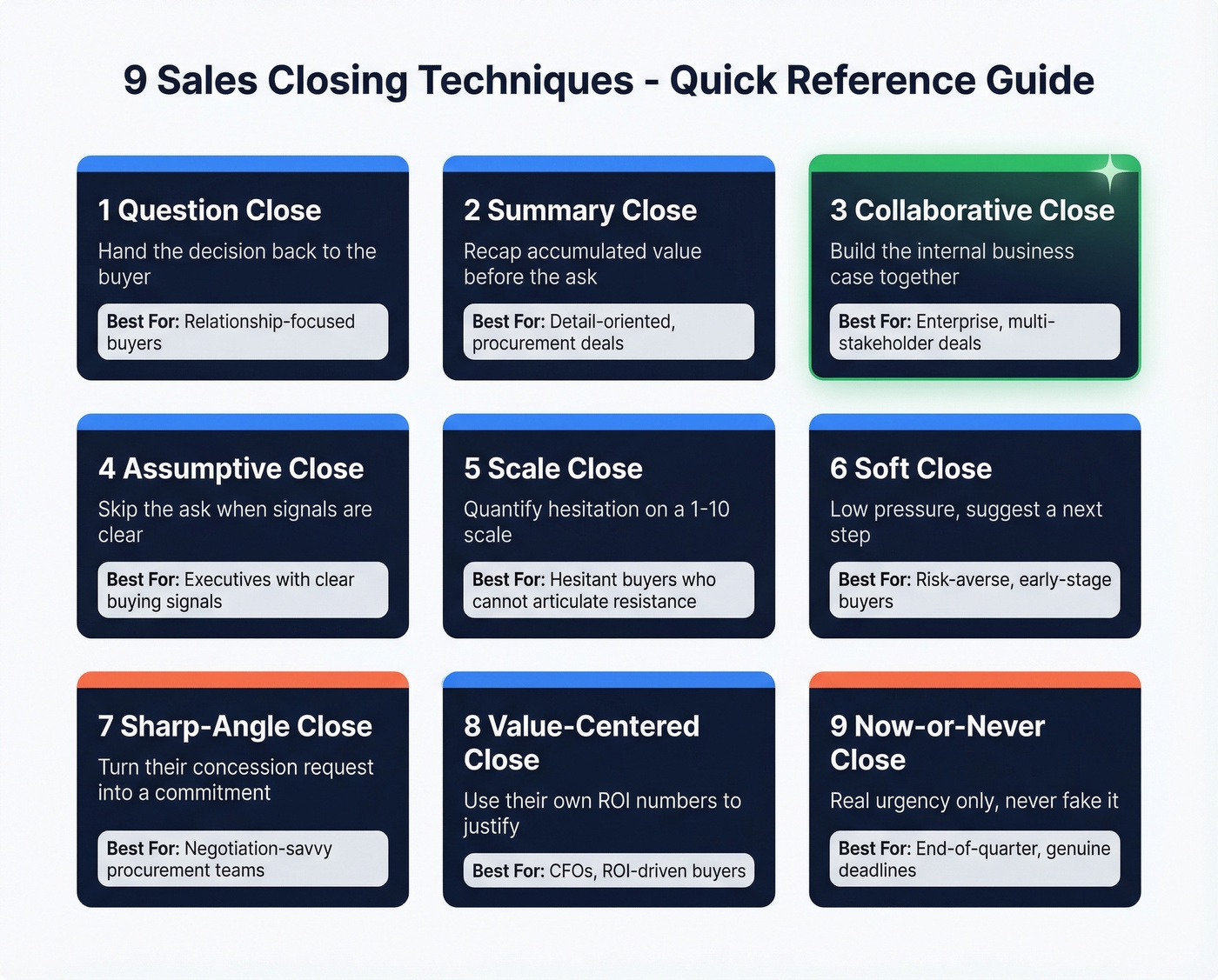
That single question does more work than most reps realize. It hands the decision back to the buyer without pressure, and it surfaces hidden objections you'd never uncover otherwise. If they say "I need to run it by finance," you've just learned who the real decision-maker is.
Best for: relationship-focused buyers in mid-stage deals where discovery went well but commitment hasn't landed.
2. The Summary Close
After a thorough demo or proposal review, analytical buyers want to see the logic laid out before they commit. The Summary Close gives them that structure.
Script: "So you'll get [feature A], [feature B], and [feature C] - all starting [date]. Ready to get started?"
Best for: detail-oriented buyers, procurement-involved deals, and any situation where you need to remind the prospect of accumulated value before asking for the signature.
3. The Collaborative Close
This is the most important close for modern B2B, and it's the one that directly addresses the 80% stall rate. Deals don't die because the champion said no - they die because the champion couldn't sell internally.
Script: "Let's map out who else needs to sign off and what each person needs to see. I'll build the internal business case with you."
This turns you from a vendor into a partner. We've found it works best for enterprise deals with multiple stakeholders - basically any deal where consensus is the blocker, not budget. (For a more structured approach, use these steps to close a sale.)
4. The Assumptive Close
The scenario: Your prospect just asked about implementation timelines, requested pricing for the annual plan, and mentioned wanting to start before Q3. Every signal says they've decided.
The close: "Would you prefer to start implementation this week or next?"
You have to earn the right to assume. Use this too early and you'll come across as presumptuous, not confident. Best for executive buyers who've given clear buying signals and don't want to be walked through a process they've already mentally completed. (If you want to systematize those signals, see identifying buying signals.)
5. The Scale Close
Script: "On a scale of 1-10, how ready are you to move forward? What would make it a 10?"
The gap between their number and 10 is your objection map. A "7" with "I'd need to see a case study from our industry" is infinitely more actionable than a vague "let me think about it." Best for hesitant buyers who can't articulate their resistance.
6. The Soft Close
Low-pressure, relationship-first. Use it with early-stage buyers or anyone who visibly resists being pushed.
Script: "Would it make sense to schedule a quick call next week to discuss next steps?"
Best for risk-averse buyers, early-stage conversations, and industries where trust-building cycles are long - financial services, healthcare, government.
7. The Sharp-Angle Close
Before: Prospect asks for a 15% discount. Rep says "let me check with my manager," disappears for two days, comes back with 10%, and the momentum is gone.
After: "If we include that 15% discount, can we get the contract signed by Friday?"
The Sharp-Angle Close turns a concession request into a commitment trigger in real time. Best for negotiation-savvy buyers, procurement teams, and any deal where the prospect is testing your flexibility. (If you want to go deeper on negotiation mechanics, read anchor in negotiation.)
8. The Value-Centered Close
Script: "Based on what you've shared, this would save your team [X hours/dollars] per month. Does that justify moving forward?"
Built for ROI-driven buyers - typically CFOs, VPs of Operations, or anyone who needs business-case justification before they can sign. The key is using their own numbers, not yours.
9. The Now-or-Never Close
Use this only - and I mean only - with genuine, verifiable urgency.
Script: "Our seasonal pricing ends Friday - after that it goes up 20%. Want to lock this in?"
Fake urgency destroys trust the moment a buyer discovers it's fake. And they will discover it. Best for end-of-quarter deals with real deadlines, limited-capacity services, and genuine price changes.
3 "Classic" Closes to Retire
The Ben Franklin Close. Drawing a pros-and-cons list with your prospect sounds collaborative in theory. In practice, your buyer already made that list before the call - and their version includes competitors you didn't mention. (If you still want to use it, at least do it intentionally: Ben Franklin Close.)
The Fake Deadline Close. "This price is only good until end of day" when it's actually good indefinitely. Modern buyers test this. They'll wait a day, email you, and watch the "expired" offer magically reappear. Credibility gone.
The High-Pressure Takeaway. "I'm not sure this is right for you" as a manipulation tactic. A head of sales at LinkBuilder.io reported a 20% win rate increase over two quarters by replacing urgency-based CTAs with data-backed proposals and tailored value maps. Trust beats tricks. Every time.
The Follow-Up Gap
Here's where most deals actually die - not in the close, but in the silence after it.
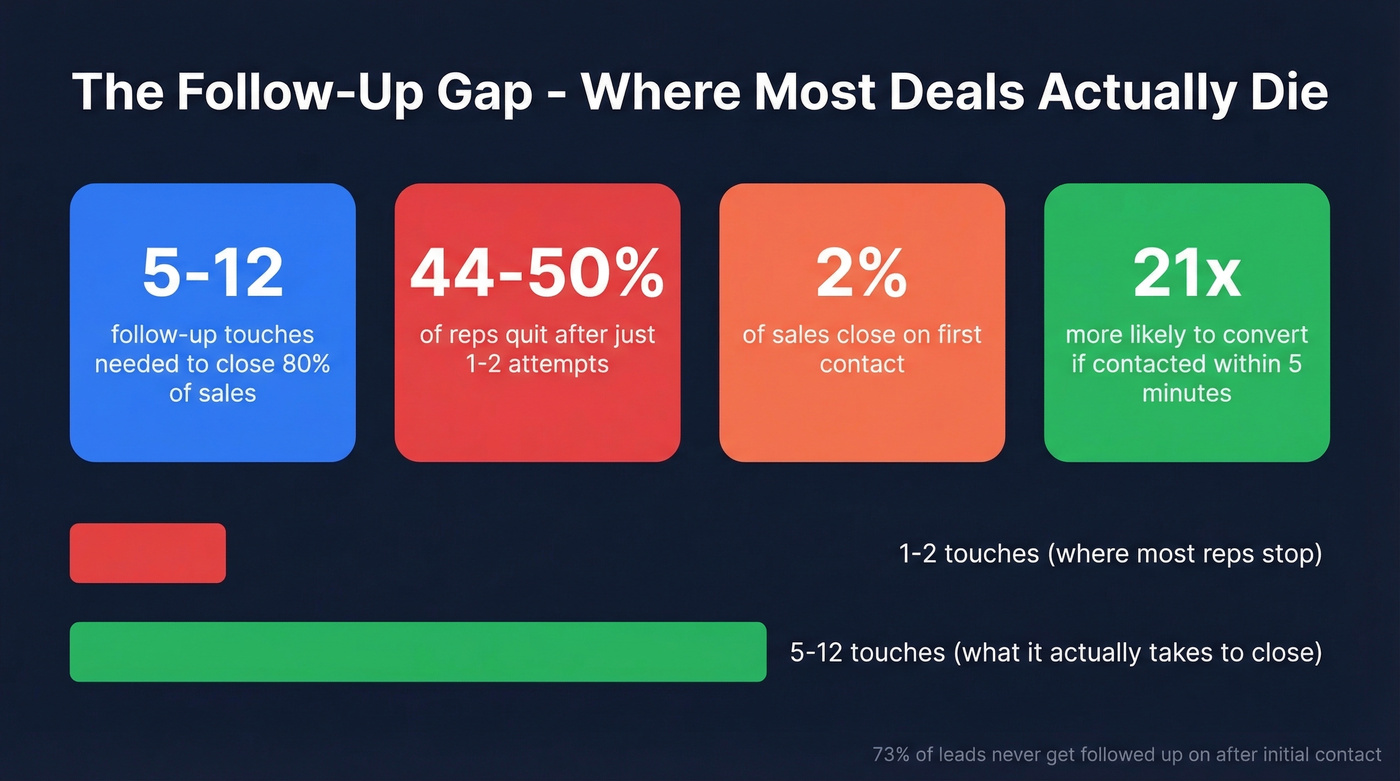
80% of sales require 5-12 follow-up touches, yet 44-50% of reps quit after just one or two. Only 2% of sales close on first contact. Leads contacted within five minutes of expressing interest are 21x more likely to convert. And 73% of leads never get followed up on at all after the initial contact. (More data here: importance of follow-up in sales.)
The average closed deal involves 62 touches across at least three channels. Multi-channel follow-ups - email, phone, social, video - boost engagement by up to 160% compared to single-channel outreach.

Here's the thing: the best follow-up cadence in the world doesn't matter if you're calling disconnected numbers or emailing dead inboxes. We've watched teams build beautiful 12-step sequences only to discover half their contact list had bounced. Prospeo's 98% email accuracy across 143M+ verified addresses on a 7-day refresh cycle keeps your sequences reaching real people, and 125M+ verified mobile numbers let you build genuinely multi-channel cadences instead of hoping a single email thread does the job. (If deliverability is the bottleneck, start with an email deliverability guide.)
Closing After the Pitch
Knowing what to do after your presentation is where most reps lose momentum. Five patterns destroy pipeline over and over.
Weak discovery and qualification. If you don't understand the prospect's actual problem, no closing technique saves you. Garbage in, garbage out. (Use better discovery questions.)
Pitching before connecting. Launching into a pitch deck two minutes into a call kills rapport before it starts. The consensus on r/sales is pretty clear on this one - they call it "showing up and throwing up," and it's the fastest way to lose a deal you should have won.
Chasing deals without confirmed budget. If you haven't validated budget, authority, and timeline, you're building a zombie pipeline that looks healthy in your CRM but will never convert.
No internal champion identified. Without someone inside the account actively advocating for your solution, you're relying on luck to navigate a buying committee.
Working off stale contact data. When you need to multi-thread into a buying committee, you need verified contact data for every stakeholder - not a list that's six months old with half the contacts in new roles. Skip this step and you'll spend more time tracking down current emails than actually selling.
Let's be honest: if your average deal size is under $15K, you probably don't need a 9-technique closing playbook. You need faster qualification, cleaner data, and a shorter sales cycle. The techniques in this article matter most when the deal size justifies the complexity.
Following up 5-12 times only works if your emails land and your calls connect. Prospeo's 7-day data refresh means you're never chasing stale contacts - at $0.01 per verified email. One dead deal costs more than a year of accurate data.
Every bounced email is a deal slipping away. Fix your data today.
FAQ
What's the most effective closing technique?
The Collaborative Close wins for complex B2B deals because it directly addresses the consensus problem that stalls 80% of purchases. For simpler transactions, the Question Close and Summary Close cover most scenarios.
How many follow-ups does it take to close a deal?
Research shows 80% of sales require 5-12 follow-up touches, yet nearly half of reps stop after one or two. The average closed deal involves 62 touches across at least three channels - email, phone, and social.
What's a good B2B close rate?
The average B2B qualified-opportunity close rate is around 29%. Above 30% is strong. Above 40% is exceptional - and it might indicate you're cherry-picking easy deals rather than prospecting broadly enough.
Why do deals stall instead of closing?
Nearly 80% of B2B deals stall because the buying committee can't reach internal consensus - not because someone said no. The fix is arming your champion with an internal business case that includes ROI projections and preemptive answers to the objections you know are coming.
What free tools help reps close more deals?
Prospeo offers 75 free verified emails per month with 98% accuracy, which keeps your follow-up sequences hitting real inboxes. HubSpot CRM's free tier handles pipeline tracking. Pairing accurate contact data with a solid CRM eliminates the two biggest deal-killers: stale info and lost follow-ups.