

How to Do High Ticket Sales: Scripts, Benchmarks, and a System That Actually Works
Every guide on high ticket sales tells you to "build trust" and "be consultative." None of them tell you what to say when the CFO asks why you cost 3x the alternative. Or how to handle the silence after you name your price. Or what to do when your champion goes dark for two weeks because the buying committee can't agree on lunch, let alone a six-figure purchase.
This is an operating manual for how to do high ticket sales - with scripts you can steal, benchmarks you can measure against, and a process that works whether you're selling enterprise software or $50K consulting engagements. The average B2B win rate hovers around 20-21%. Four out of five deals die. Let's fix the ones you can control.
The Quick Version
- Reach the right person with verified data. You can't close a deal you can't start. Get verified emails and direct dials for the 5-15 decision-makers inside each target account.
- Run a structured discovery call. Script your questions, listen 57% of the time, and never give away free consulting. (If you need a starting point, use a discovery call script.)
- Multi-thread across the buying committee. Single-threading one contact is how deals die. Engage 3-5 stakeholders minimum. (This is core to account-based selling.)
- Follow up systematically. 80% of sales require at least 5 follow-ups. Most reps quit after two. (Steal these sales follow-up templates.)
- Close with specific language, not vibes. Use exact closing lines. Make the decision easy, not pressured. (More closing frameworks: steps to close a sale.)
What Makes a Sale "High Ticket"
High ticket isn't just a price tag. A $5,000 deal can be high ticket for an SMB where the founder is writing the check personally. A $200,000 deal is high ticket for an enterprise buyer whose career is on the line if the implementation fails.
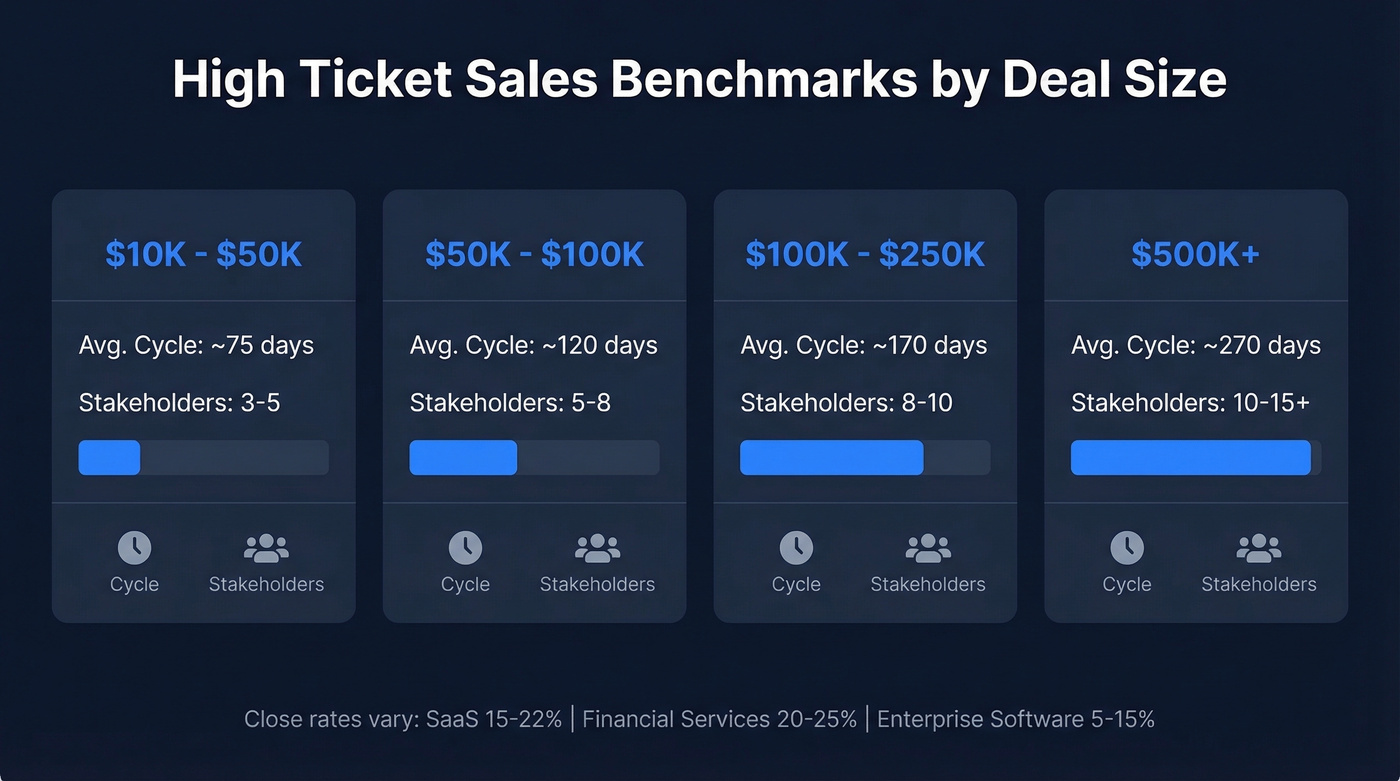
The real definition is risk-based: it's "high ticket" when the purchase decision feels career-risky to the buyer. That's when sales cycles stretch, committees form, and indecision becomes your biggest competitor. Gartner's data puts it plainly: the average purchase involves 6.8 stakeholders and 17 meaningful interactions before anyone signs.
| Deal Size (ACV) | Avg. Sales Cycle | Typical Stakeholders |
|---|---|---|
| $10K-$50K | ~75 days | 3-5 |
| $50K-$100K | ~120 days | 5-8 |
| $100K-$250K | ~170 days | 8-10 |
| $500K+ | ~270 days | 10-15+ |
Close rates vary by industry. SaaS deals close at 15-22%. Financial services runs 20-25%. Enterprise software sits at 5-15%. Know your baseline before you start optimizing. (If you want more benchmarks, see B2B sales explained.)
What's Changed in 2026
If you browse r/sales, you'll find endless threads asking "what even is high-ticket sales?" - and most answers boil down to vague advice about building trust. The reality is more specific, and it's shifted dramatically.
Buying committees have ballooned. The average B2B purchase now involves 8-13 stakeholders. That's not a typo. Your champion is one voice in a room full of people you've never spoken to, each with their own priorities and anxieties about making the wrong call.
Buyers do their homework first - [57% of the buying journey is complete](https://www.linkedin.com/business/sales/blog/b2b-sales/how-sales-can-win-before-57 - of-the-buyers-journey-is-over) before a prospect ever talks to sales. They've already read your case studies and compared your pricing. And here's the kicker: 87% of opportunities face moderate-to-high buyer indecision. The enemy isn't the other vendor. It's the status quo.
Multi-threaded deals - where you engage multiple stakeholders, not just one champion - lift win rates by 130%. Selling high ticket products in 2026 is a team sport played against indecision, not against competitors. (If you want the operating model, read what is team selling.)
If your deal size is under $25K and your sales cycle is under 30 days, skip this playbook. You need a faster funnel, not a longer one. Everything below is for deals where the wrong decision costs someone their job.

High ticket deals require multi-threading 5-15 decision-makers per account. Prospeo gives you verified emails and direct dials for every stakeholder - 98% email accuracy, 125M+ mobile numbers, refreshed every 7 days. Meritt tripled their pipeline from $100K to $300K/week.
Stop losing six-figure deals to bounced emails and bad phone numbers.
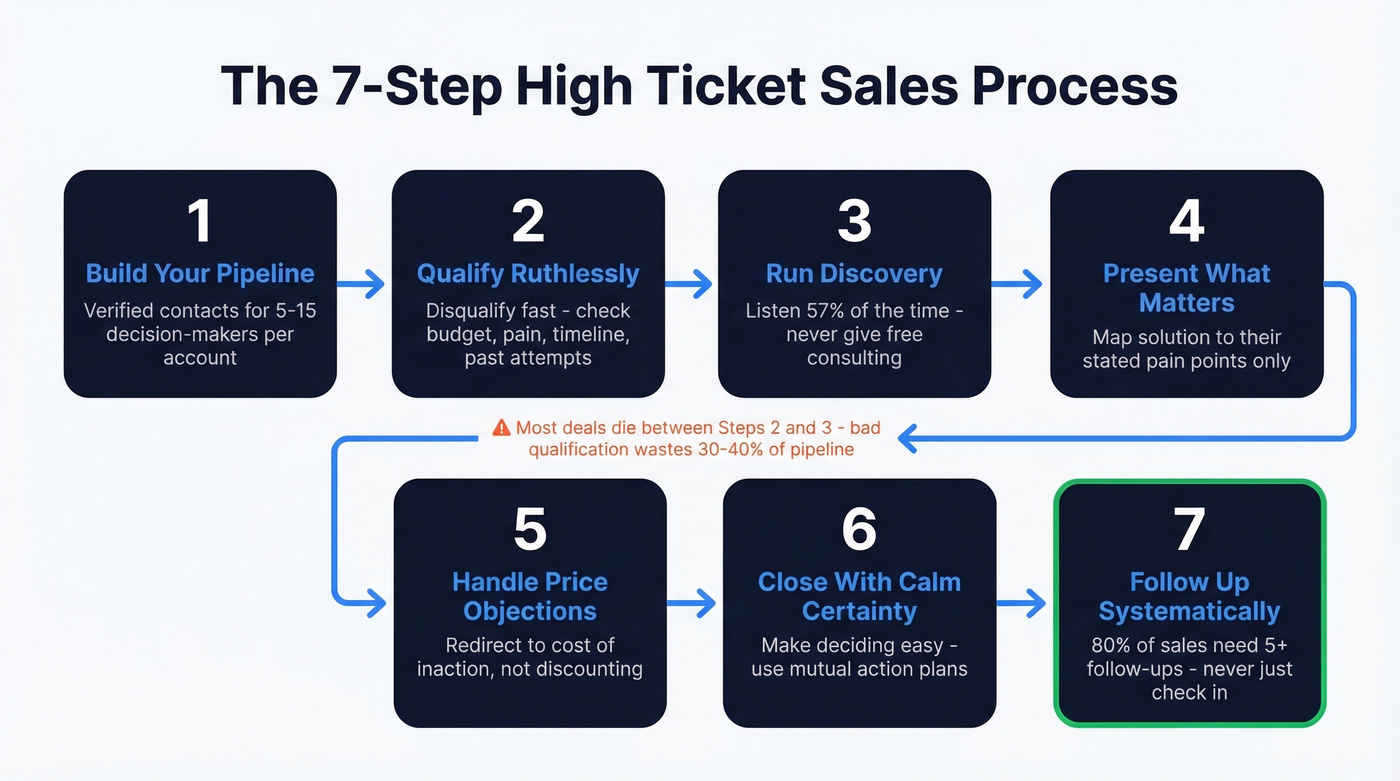
The 7-Step High Ticket Sales Process
Step 1: Build Your Pipeline
Every high ticket deal starts with the same question: are you talking to the right people? Not "people who might be interested" - people who have the problem, the budget, the authority, and the timing.
Start with your closed-won data from the last 6-12 months. What industries? What company sizes? What titles signed the contract? That's your ICP - built from evidence, not assumptions. (Use an ideal customer profile template if you need one.)
Next, layer in timing signals. The best accounts aren't just a good fit; they're a good fit right now. Look for trigger events: a new VP of Sales just started, the company posted 15 SDR roles in two weeks, they lost a key vendor, or they just raised a round. Fit plus timing plus reachability is the framework that actually works. (To operationalize this, see identifying buying signals.)
Once you've identified target accounts, you need verified contact data for the decision-makers inside them. This is where most pipelines break - bad data means bounced emails, burned domains, and wasted weeks chasing ghosts. We use Prospeo for this step: 98% email accuracy, 125M+ verified mobile numbers, and data refreshed every 7 days. One customer, Meritt, tripled pipeline from $100K to $300K per week after switching; their bounce rate dropped from 35% to under 4%. (If you're comparing vendors, start with data enrichment services.)
For context, the average cost per lead across all channels is $391.80. Outbound to verified contacts - where you control targeting and timing - is cheaper per qualified conversation than almost any inbound channel at the high ticket level.

Step 2: Qualify Ruthlessly
Most reps try to convince prospects to buy. High ticket closers do the opposite: they look for reasons to disqualify. (A structured framework like MEDDIC sales qualification helps.)
A quick disqualification checklist:
- Does the prospect have budget authority (or direct access to someone who does)?
- Is the pain severe enough to survive a committee review?
- Is there a real timeline, or is this "exploratory"?
- Have they attempted to solve this before? What happened?
If you can't check at least three of those boxes, move on. If you refuse to use a script, you won't close deals. In our experience, the reps who wing qualification calls waste 30-40% of their pipeline on deals that were never real.
Step 3: Run a Discovery Call That Sells
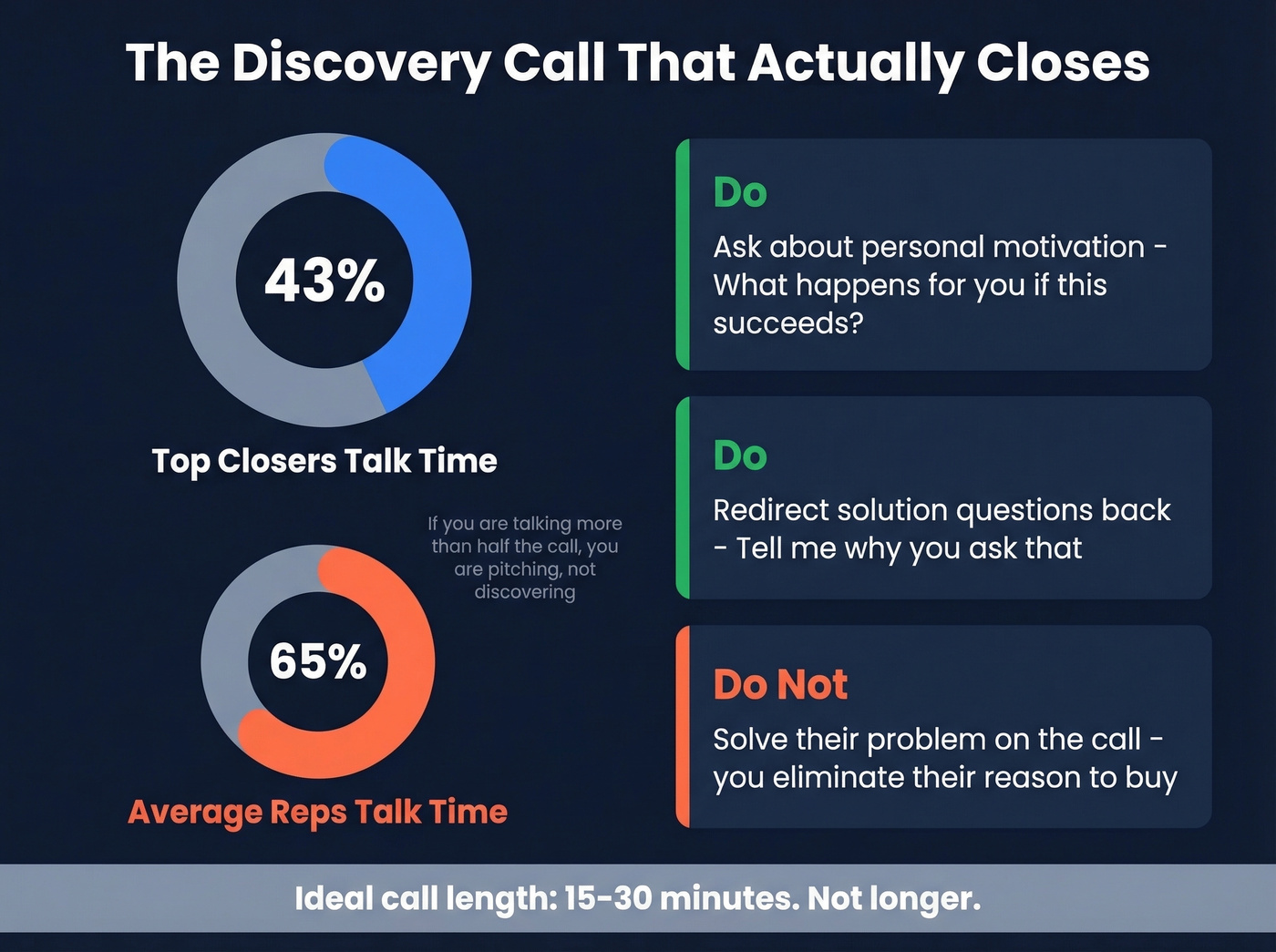
Discovery calls should run 15-30 minutes. Not longer.
Opener (30 seconds): "I'd like to learn more about your current situation and see if our solution might be a good fit. Does that sound good?"
Then dig into pain, business impact, decision process, timeline, and personal motivation. The personal motivation piece is what most reps skip entirely. "What happens for you if this project succeeds?" gets you information that "what are your business goals?" never will. (More prompts: discovery questions.)
Top-closing B2B reps speak only 43% of the time. Average performers talk 65%. If you're talking more than half the call, you're pitching, not discovering. And the moment you start solving their problem on the call, you've eliminated their reason to buy. When they ask "how would you handle X?" respond with: "Tell me why you ask that." Redirect back to their situation. Save the solution for the presentation.
Step 4: Present Only What Matters
Map your solution to the challenges they stated in discovery. Nothing extra. If they mentioned three pain points, address three pain points. If they didn't mention a feature, don't demo it.
Quantify the cost of inaction: "You told me this problem costs your team 15 hours a week. That's $78,000 a year in loaded labor cost. Our solution costs $45,000. The math works in year one." If you're presenting for more than 15 minutes, you didn't do discovery right. (Use a product demo checklist to keep it tight.)
Step 5: Handle the Price Objection
Never introduce pricing until you've established pain, success criteria, and ROI. The transition line: "Would it be helpful to talk about what an investment like this could look like?"
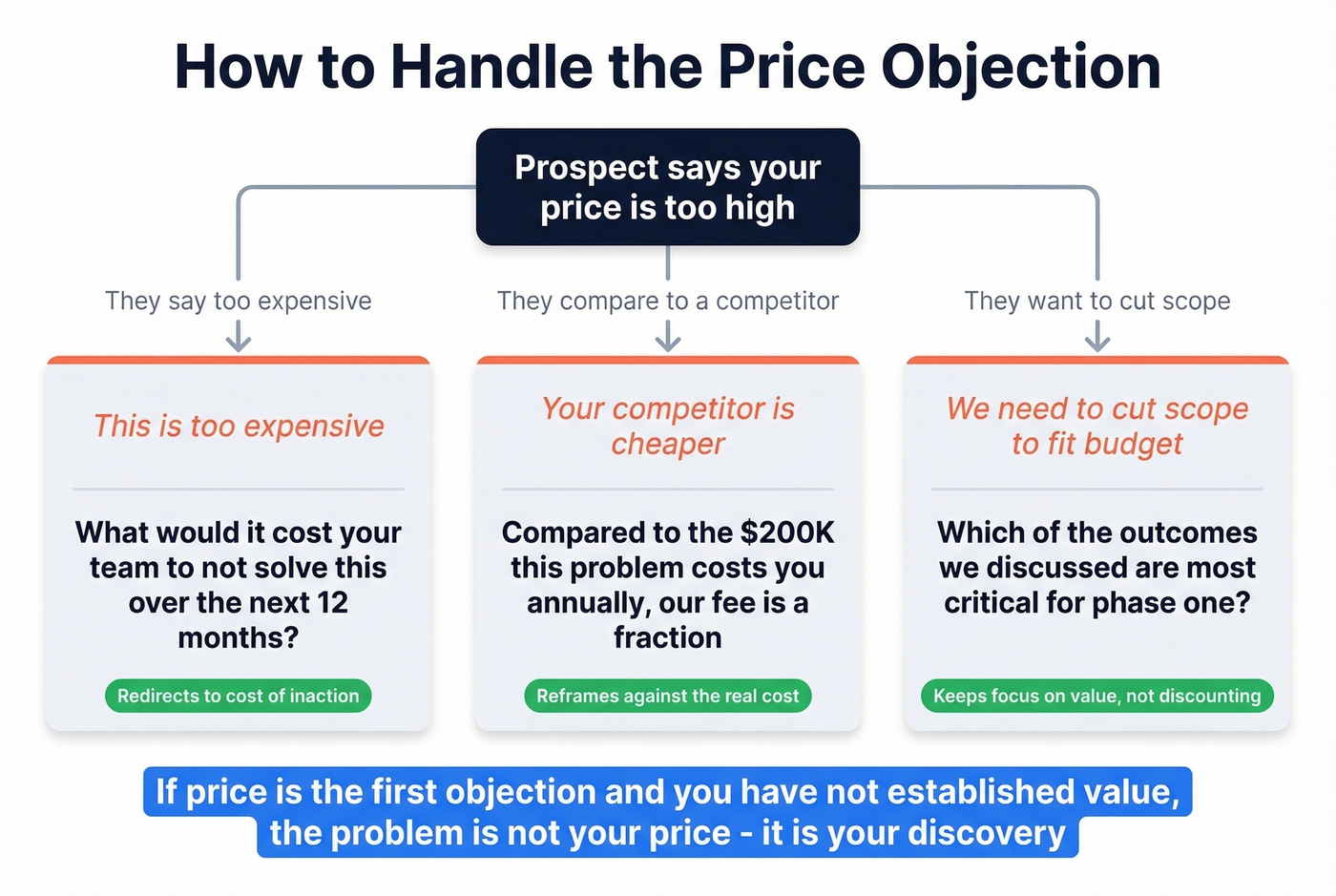
When they say "your price is too high":
| Objection | Response | Why It Works |
|---|---|---|
| "Too expensive" | "What would it cost your team to not solve this over the next 12 months?" | Redirects to cost of inaction |
| "Competitor is cheaper" | "Compared to the $200K this problem costs you annually, our fee is a fraction." | Reframes against the real cost |
| "Need to cut scope" | "Which of the outcomes we discussed are most critical for phase one?" | Keeps conversation on value, not discounting |
Here's the thing: if price is the first objection and you haven't established value, the problem isn't your price. It's your discovery. (If this is a recurring issue, see how to reduce sales objection rate.)
Step 6: Close With Calm Certainty
87% of opportunities face buyer indecision. Your job isn't to pressure - it's to make deciding easy.
Five closing approaches that work at the high ticket level:
- Assumptive: "When should we schedule onboarding?"
- If-Then: "If we can meet your launch timeline, are you ready to finalize today?"
- Option: "Would you prefer quarterly or annual?"
- Scale: "On a scale of 1-10, how ready are we to finalize?" Anything below 8 tells you exactly what objection to address next.
- Direct ask: "Are you ready to move forward today?"
For complex deals over $100K, build a mutual action plan: a shared document with milestones, owners, and dates that maps the path from "yes" to "live." We've seen these cut the legal-to-signature phase by 2-3 weeks on their own.
Step 7: Follow Up Like a Professional
80% of sales require at least 5 follow-ups. Closing a >$60K deal requires roughly 215 touchpoints and 8-13 human interactions. This is a long game.
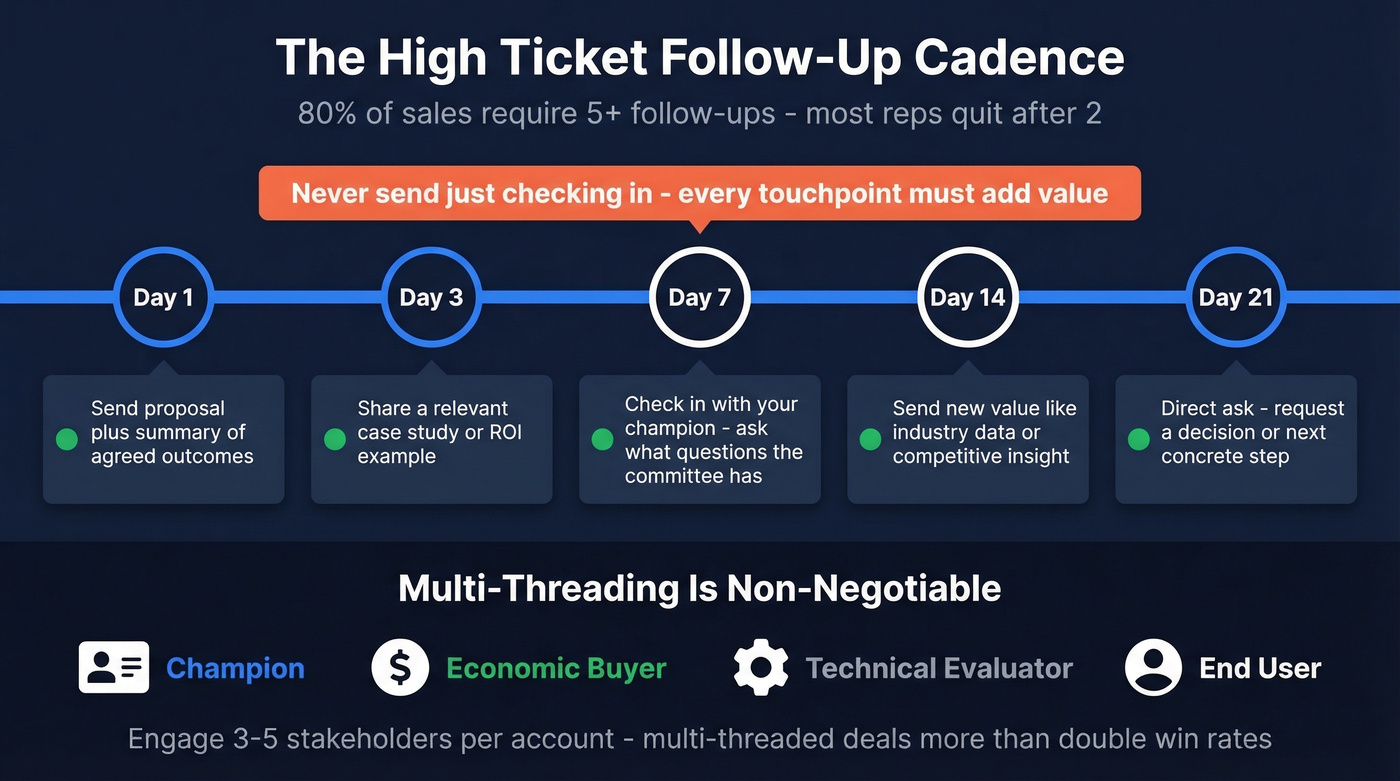
Multi-threading is non-negotiable. Engage 3-5 stakeholders per account - your champion, the economic buyer, the technical evaluator, and at least one end user. Multi-threaded deals more than double win rates. We've watched deals die in committee because the rep only knew one person's name.
Never send "just checking in." Every touchpoint should add value:
- Day 1: Send proposal + summary of agreed outcomes
- Day 3: Share a relevant case study or ROI example
- Day 7: Check in with the champion - ask what questions the committee has
- Day 14: Send new value (industry data, competitive insight)
- Day 21: Direct ask - "What do we need to finalize this?"
What a $150K Deal Actually Looks Like
Theory is nice. Here's what a representative high-ticket deal cycle looks like across 170 days.
Weeks 1-3: You identify the account through intent signals - they're hiring aggressively and just lost a key vendor. You pull verified contacts for the VP of Sales, the CRO, and two directors. Your first cold email lands a 15-minute discovery call with the VP.
Weeks 4-8: Discovery reveals a $200K/year problem. You multi-thread into the CFO and the head of RevOps. Two more discovery calls happen. The CFO wants an ROI model. You build one using their numbers, not yours.
Weeks 9-14: Presentation to the buying committee. Five people in the room, three of whom you've spoken to individually. You present three pain points, three solutions, one price. The CFO asks for a reference call. You provide two.
Weeks 15-20: The committee stalls. Your champion tells you "we're still discussing." You send a competitive insight on Day 105, a relevant case study on Day 112, and a direct ask on Day 119. On Day 130, the CFO emails back: "Let's finalize."
Weeks 21-24: Legal review, procurement, signature. The mutual action plan keeps everyone on track. Deal closes Day 168. That's 215+ touchpoints, roughly a dozen human interactions, and zero "just checking in" emails. Every touch added value or moved the deal forward.
Mistakes That Kill High Ticket Deals
The gap between average and top performers is smaller than you think - it's usually one or two habits.
Talking too much is the single easiest thing to fix. Average performers talk 65% of the call. Top closers talk 43%. Record your next five calls and count. I was genuinely surprised the first time I measured my own ratio.
Leading with features instead of outcomes kills deals before they start. Nobody buys a platform. They buy the result. "We reduce ramp time by 40%" beats "we have an AI-powered onboarding module" every time.
Giving free consulting on discovery calls eliminates the urgency to buy. Diagnose, don't prescribe. The moment you solve their problem for free, you've given them a reason to say "thanks, we'll handle it internally."
Single-threading one contact is how you lose to "we decided to go in a different direction" emails from people you never met. Your champion gets promoted, goes on leave, or loses internal influence - and your deal dies with them.
Using bad contact data is a silent killer. A 35% bounce rate on a 15-person target account list wrecks deliverability and makes it harder to reach anyone in the account. Verify your list before you send. Always. (If you want bounce benchmarks and fixes, see email bounce rate.)
Your high ticket pipeline is only as strong as your contact data. With 30+ filters - buyer intent, job changes, funding signals, headcount growth - Prospeo surfaces accounts that match your ICP and are ready to buy right now. At $0.01 per email, it's 90% cheaper than ZoomInfo.
Reach every stakeholder on the buying committee before your competitor does.
Scaling a High Ticket Sales Team
Once you've closed high ticket deals yourself, the temptation is to hire immediately. Resist it until you've systematized what works. Founder-led sales first. Document the process. Then hire.
The teams that scale successfully treat coaching as infrastructure, not a nice-to-have. New closers need to master your brand voice, product depth, and sales process before they touch a prospect - a two-day crash course isn't onboarding. Define your ICP before hiring so reps don't waste months figuring out who to target. Build a pipeline generation engine that feeds closers qualified opportunities instead of cold lists. Set clear compensation structures with explicit accelerators, because ambiguity breeds turnover. Weekly call reviews, shared win/loss analysis, and a real feedback loop tie it all together.
FAQ
What counts as a high ticket sale?
Any deal where the purchase decision feels career-risky to the buyer - typically $5,000+ for SMBs and $50,000+ for enterprise. If a buying committee has to approve it, it's high ticket.
How long does it take to close a high ticket deal?
Expect 75 days for $10K-$50K deals, roughly 120 days for $50K-$100K, and 270+ days for deals over $500K. Multi-threading and structured follow-up can compress these timelines by 15-20%.
What's a good close rate for high ticket sales?
Average B2B win rates sit around 20-21%. Enterprise software is lower at 5-15%. If you're consistently above 25%, your pipeline qualification is strong.
How do I find decision-makers for large deals?
Define your ICP from closed-won data, identify accounts showing buying signals, then use a verified data platform to pull direct emails and mobile numbers for the 5-15 stakeholders involved. Prospeo's 30+ search filters - including intent data and job-change signals - help you prioritize accounts that are actively in-market.
What's the biggest mistake in high ticket sales?
Talking too much. Top-closing B2B reps speak only 43% of the time on calls, while average performers talk 65%. Record your next five calls and measure your talk-to-listen ratio.