

How to Find Sales Qualified Leads: The Data-Backed Playbook
94% of buying groups have already ranked their preferred vendors before they ever talk to your sales team. They've consumed roughly 13 pieces of content, compared pricing pages, and formed opinions - all while your reps cold-call into the void at a 2-3% response rate.
The problem isn't lead volume. It's finding sales qualified leads - the ones with real budget, authority, and timeline - before a competitor locks them in.
What You Need (Quick Version)
Three consistently high-performing channels for SQL generation in 2026: inbound content and SEO (which averages a 51% MQL-to-SQL conversion rate), intent data layered on your ICP to catch in-market accounts, and job-change signals for warm outreach. Here's the thing, though - the biggest bottleneck isn't sourcing. It's the MQL-to-SQL conversion gap, which sits at 15-21% for most B2B companies. Tighten your qualification criteria, respond within 5 minutes of a high-intent signal, and verify your contact data before running any play. Everything else is optimization on top of those fundamentals.
What Is a Sales Qualified Lead?
A sales qualified lead (SQL) is a prospect that's been vetted by your sales team and confirmed to have genuine purchase potential - not just someone who downloaded an ebook. The distinction matters because most pipeline problems trace back to sloppy definitions at this stage. Some teams also use "pre-qualified leads," prospects filtered by firmographic fit before any engagement scoring, as an additional layer before the MQL stage.
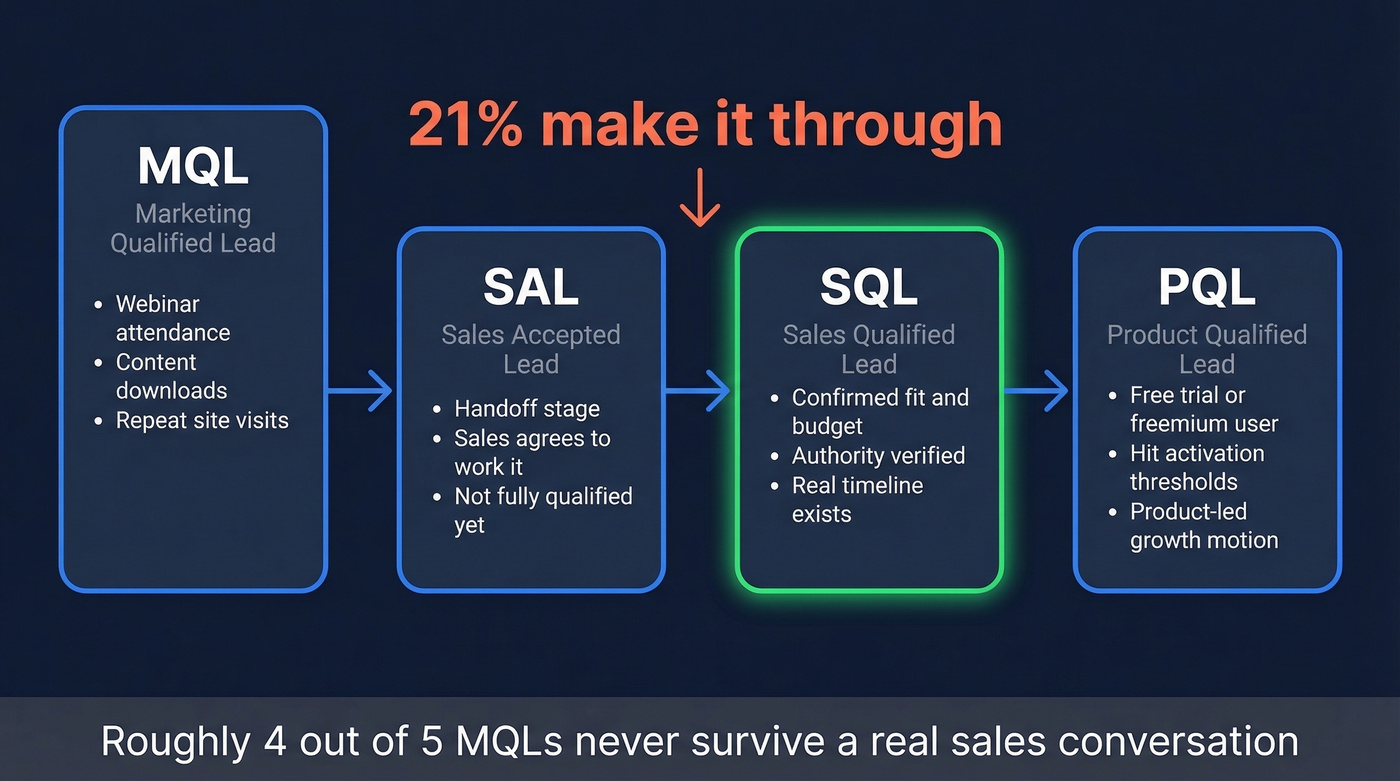
Here's how the lead types stack up:
- MQL (Marketing Qualified Lead): Shows engagement - webinar attendance, content downloads, repeat site visits. Marketing says "this one's warm."
- SQL (Sales Qualified Lead): Sales has spoken with them and confirmed fit, budget, authority, and timeline. This is where real pipeline starts.
- SAL (Sales Accepted Lead): The handoff stage. Sales has agreed to work the lead but hasn't fully qualified yet.
- PQL (Product Qualified Lead): Used in product-led growth motions. The prospect has used the product through free trials or freemium access and hit activation thresholds.
The critical benchmark: only about 21% of MQLs become SQLs. That means roughly 4 out of 5 leads that marketing celebrates never make it past a real sales conversation. If your number is worse than that, your MQL bar is too low.
SQL Conversion Benchmarks by Industry
Knowing your industry's baseline prevents two mistakes: panicking when your numbers are actually normal, and celebrating when they're mediocre. Here's what SQL-to-Closed Won looks like across sectors, based on First Page Sage's 2026 report covering 2019-2025 data:
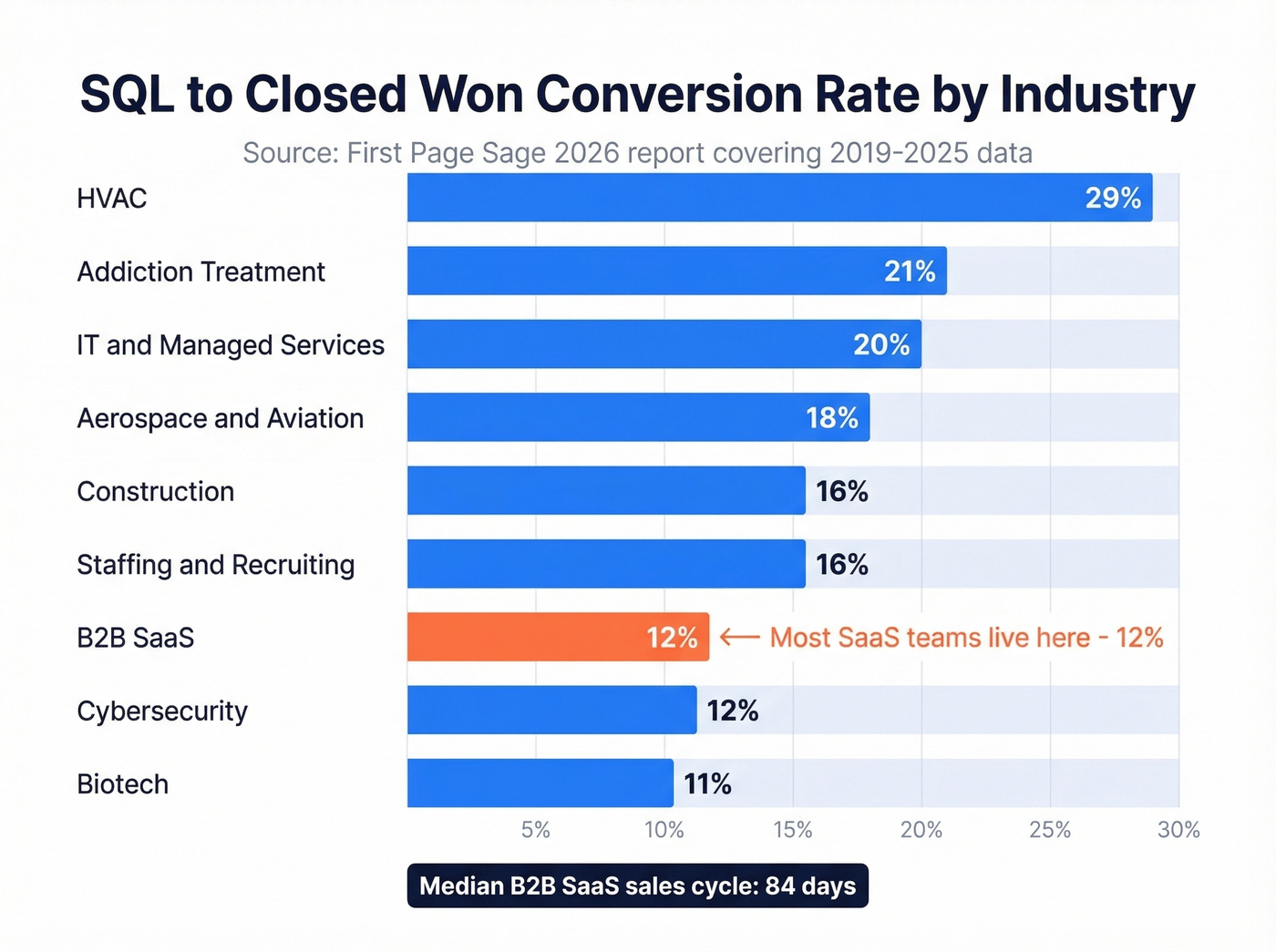
| Industry | SQL to Won |
|---|---|
| HVAC | 29% |
| Addiction Treatment | 21% |
| IT & Managed Services | 20% |
| Aerospace & Aviation | 18% |
| Construction | 16% |
| Staffing & Recruiting | 16% |
| B2B SaaS | 12% |
| Cybersecurity | 12% |
| Biotech | 11% |
Now the full funnel. These stage-by-stage ranges give you orientation bands for B2B SaaS:
| Stage | Conversion Range |
|---|---|
| MQL to SQL | 15-21% |
| SQL to Opportunity | 30-50% |
| Opportunity to Won | 20-35% |
The median B2B SaaS sales cycle runs about 84 days. If you're below 30% on SQL-to-Opportunity, your qualification criteria are too loose - you're letting unqualified prospects into the pipeline and wasting rep time on deals that were never real.
Which Qualification Framework Fits?
52% of sales reps still default to BANT. That's fine for high-volume inbound triage where you're sorting hundreds of leads quickly. It's not fine when the average B2B deal involves seven stakeholders and your champion needs internal ammunition to sell on your behalf.
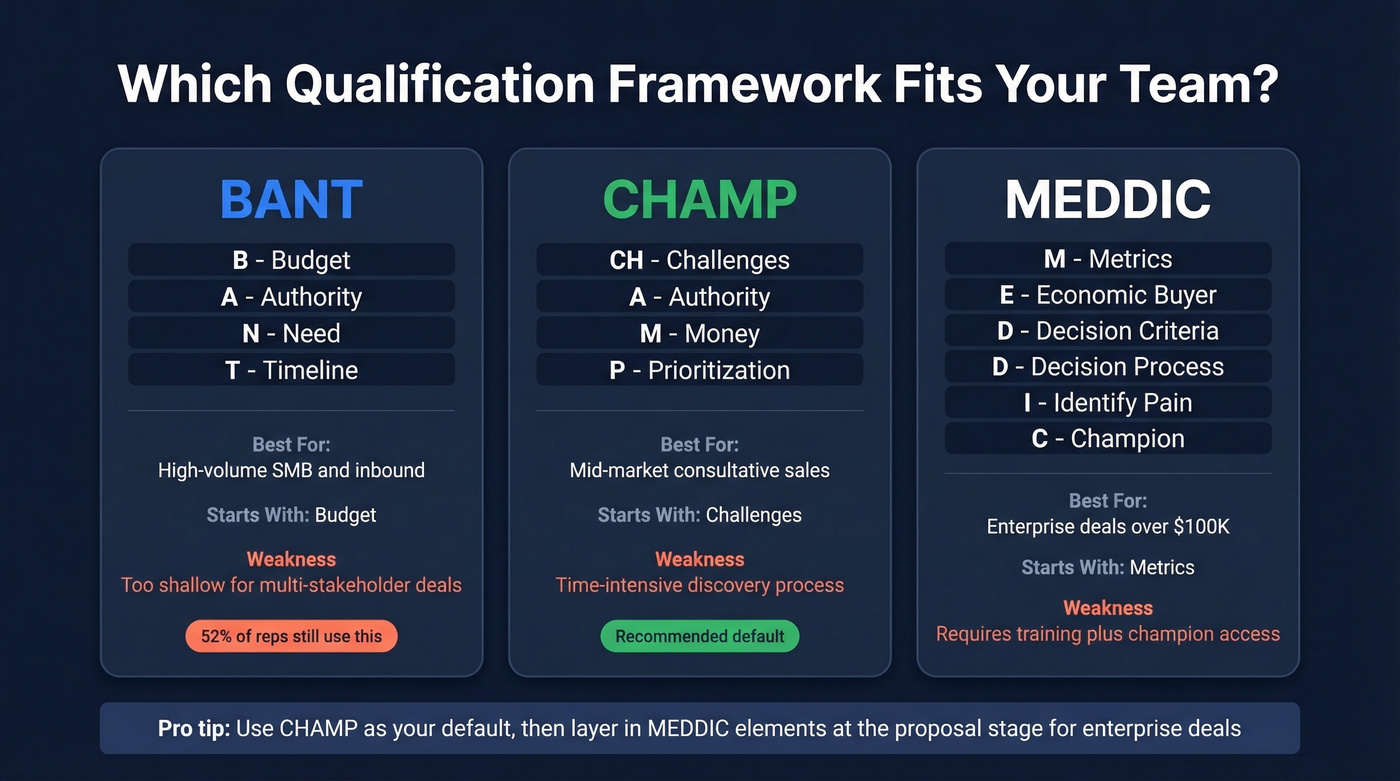
| Framework | Best For | Starts With | Weakness |
|---|---|---|---|
| BANT | High-volume SMB / inbound | Budget | Too shallow for multi-stakeholder |
| CHAMP | Mid-market consultative | Challenges | Time-intensive discovery |
| MEDDIC | Enterprise / $100K+ deals | Metrics | Requires training + champion access |
Let's be honest: if your deals involve three or more decision-makers, BANT is inadequate. It asks "do you have budget?" before understanding whether the prospect even has a problem worth solving. CHAMP flips that - start with challenges, then work toward budget. MEDDIC goes further, mapping the entire decision process and identifying a real internal champion.
In our experience, the best results come from CHAMP as the default with MEDDIC elements layered in once a deal reaches the proposal stage. Don't overcomplicate it for your SDRs, but don't let your AEs run enterprise deals on BANT alone.
The AI layer is coming fast. 89% of revenue organizations now use AI tools in their sales process, up from 34% in 2023. Gartner predicts 60%+ of B2B sales teams will use ML-derived intent scoring by 2027. AI-powered qualification won't replace frameworks like CHAMP or MEDDIC, but it'll handle the first pass - scoring thousands of leads against your ICP criteria so reps spend time on the 20% that actually matter. Teams already using AI scoring report a 31% increase in qualification accuracy. If you're still manually scoring every inbound lead, you're falling behind.

Your MQL-to-SQL gap isn't a strategy problem - it's a data problem. Prospeo layers Bombora intent data across 15,000 topics with 30+ ICP filters so you reach buyers already ranking vendors. 98% email accuracy means reps spend time on conversations, not bounces.
Close the 79% qualification gap before your competitors do.
7 Channels to Find Sales Qualified Leads
Inbound Content and SEO
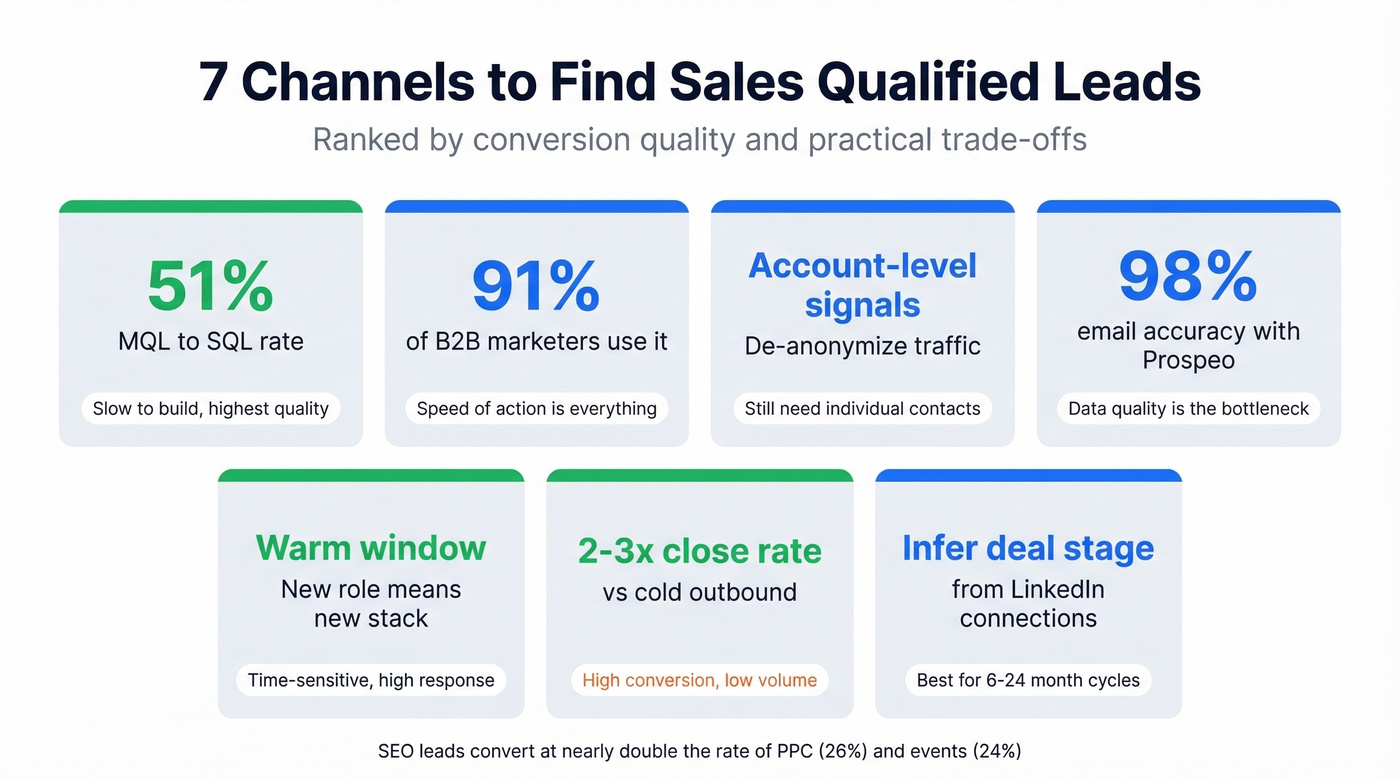
SEO-sourced leads convert from MQL to SQL at 51% - roughly double PPC at 26% and more than double events at 24%. Someone searching "enterprise endpoint security pricing" has more purchase intent than someone who wandered into your conference booth. The catch is timeline. Inbound content takes months to compound. But once it does, it's the highest-quality SQL channel you'll have, and the cost per lead drops with every month of compounding organic traffic. If you want a deeper breakdown, start with SEO sales leads and what is B2B content marketing.
Intent Data and Buyer Signals
The intent data market hit $4.49B in 2026 and 91% of B2B marketers use it. Remember that stat about 94% of buying groups ranking vendors before talking to sales? Intent data helps you show up while they're still deciding. In a 2024 study, 55% of sales leaders reported higher lead conversion after adopting intent data.
The gap between adoption and results usually comes down to speed. Teams buy intent data, dump it into a spreadsheet, and never act on it fast enough. Standalone contracts aren't cheap either - Bombora runs $12K-$40K/year, and 6sense can reach $300K+/year for enterprise deployments. If you're building a repeatable motion here, intent based segmentation helps you operationalize signals without drowning in noise.
Website Visitor Identification
Most of your website traffic is anonymous. Visitor identification tools de-anonymize that traffic so you can see which companies are browsing your pricing page. Warmly, for example, offers a free plan for up to 500 visitors/month, with AI agent products priced at $10,000/year and $16,000/year. The limitation: you're getting account-level signals, not individual contacts. You still need a way to find the right person at that company.
Cold Email with Verified Data
It's Thursday afternoon. Your SDR has spent three hours working a list. Fifteen disconnected phone numbers. Ten emails to people who left the company six months ago. The list was "verified" when you bought it - three months ago.
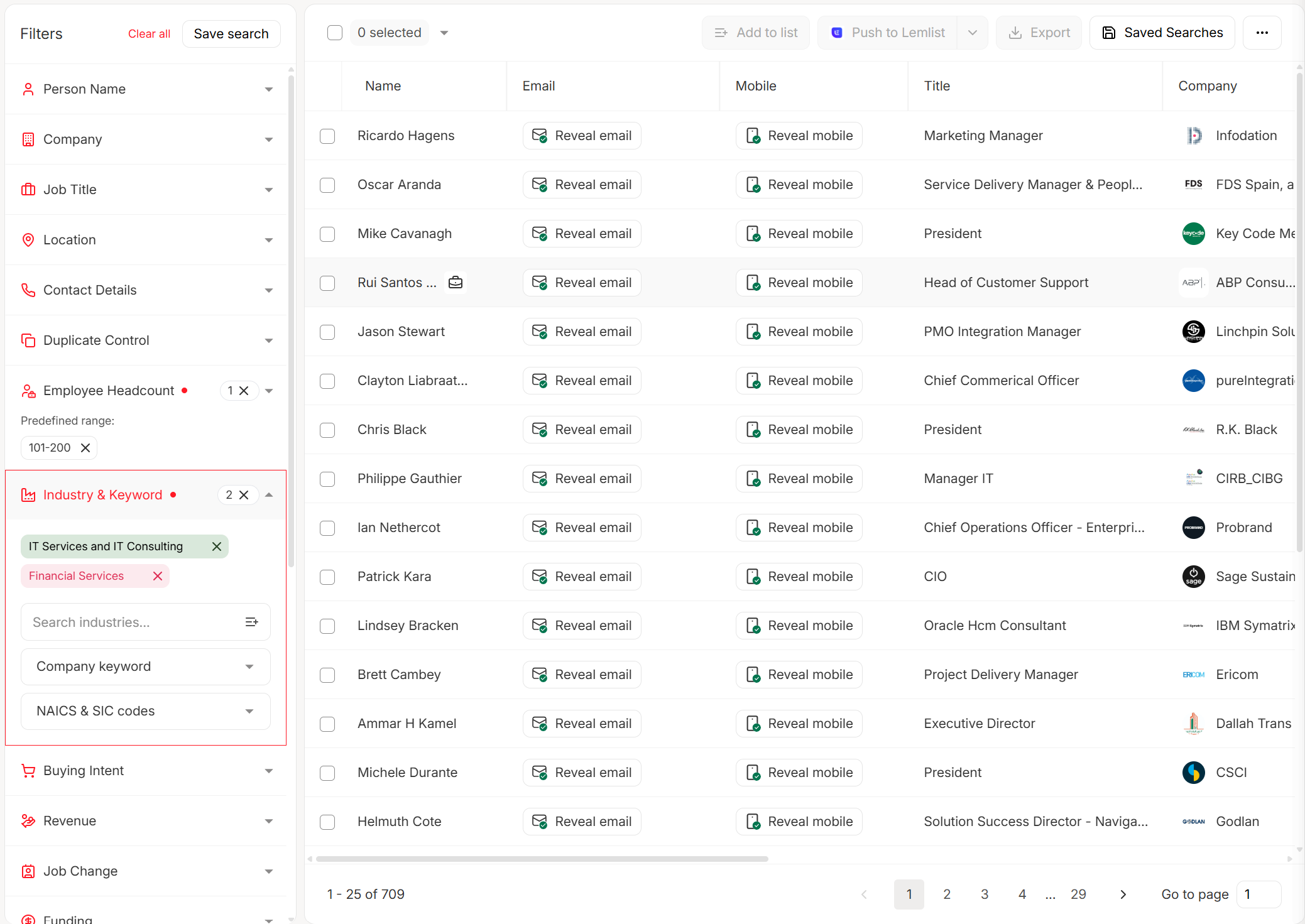
Look, your cold outreach is only as good as the data behind it. Before you optimize subject lines or call scripts, fix the data layer. Prospeo's 98% email accuracy and 7-day refresh cycle exist to solve exactly this problem - the platform covers 125M+ verified mobile numbers with a 30% pickup rate, meaning reps actually reach someone when they dial. Everything downstream depends on getting this right. (If you're tightening your outbound motion, pair this with sales prospecting techniques and a clean B2B cold email sequence.)
Job-Change Signals
When a VP of Sales starts a new role, they're rebuilding their stack. They're open to conversations they'd ignore six months later.
That's your window. Job-change signals give you a warm reason to reach out - "Congrats on the new role, here's how we help teams like yours" beats a generic cold email every time. Most B2B data platforms now include job-change filters in their search criteria, so you can surface these signals without a separate tool. To systematize this, use a lightweight process for how to track sales triggers.
Referrals and Warm Introductions
Referrals have the highest close rates of any channel - we've seen referred deals close at 2-3x the rate of cold outbound. The problem is volume. You can't build a pipeline on referrals alone. Treat them as a high-conversion supplement, not a primary channel. Ask every closed-won customer for two introductions. Systematize it.
Competitor-Connection Tracking
This practitioner play surfaced on r/sales and it's clever enough to deserve attention. Track your competitors' sales reps' new connections over 6, 4, and 1-month windows. Filter those connections to potential customer companies. Then infer deal stage by which departments are connecting - if product and engineering folks are linking up with the competitor's team, the prospect is likely in evaluation. If support is connecting, they're probably already onboarding.
The timing play is to arrive late with a stronger offer, after the competitor has done the education work. This works best for large contracts with 6-24 month sales cycles where "showing up second" is a legitimate strategy. If you want to formalize this into a repeatable motion, build a simple competitive intelligence strategy.
The MQL-to-SQL Handoff
Here's a scene we've all witnessed: marketing sends 200 webinar leads to the AE team. The AEs cherry-pick 30 that look interesting, ignore the rest, and close 2. Marketing claims 200 MQLs. Sales says the leads were garbage. Nobody learns anything.
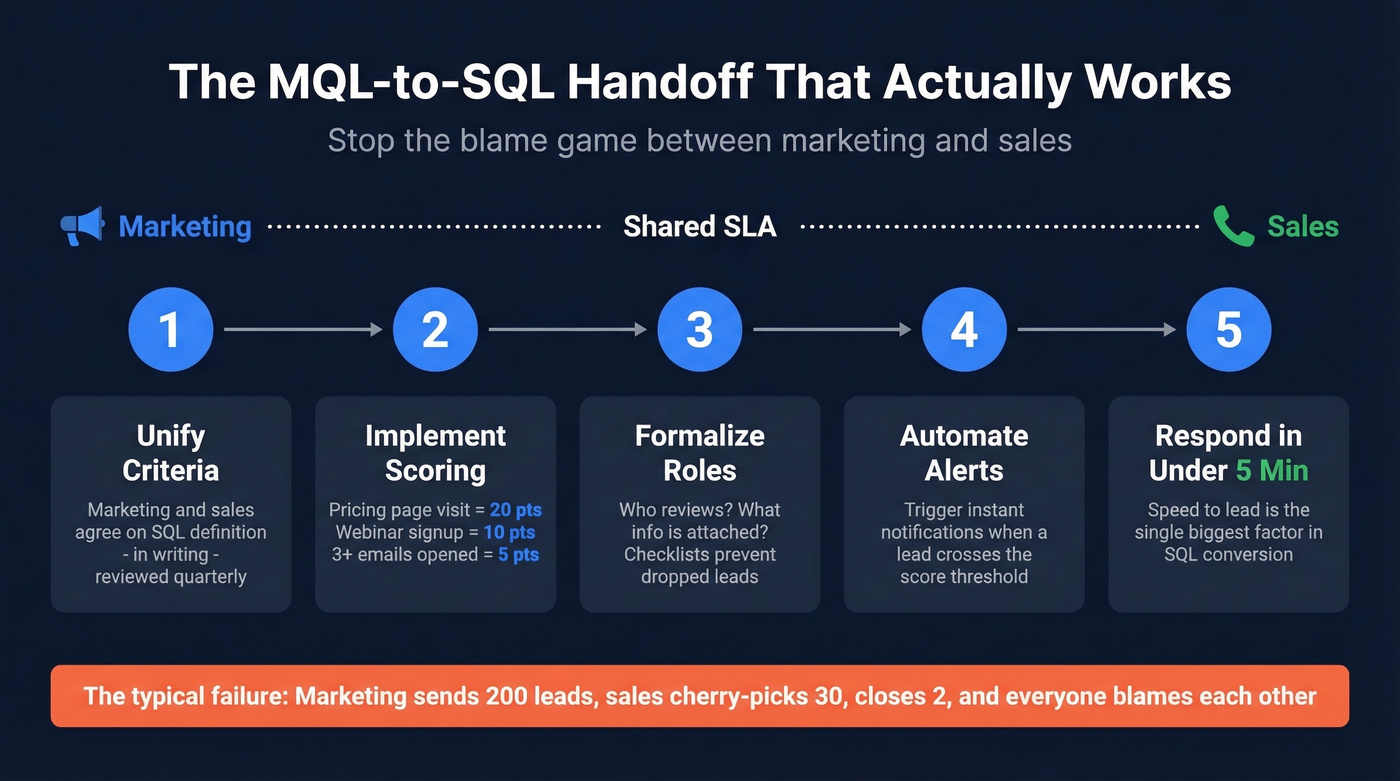
The fix is a structured handoff - and getting this right is one of the fastest ways to increase your SQL volume without adding a single new channel:
- Unify criteria. Marketing and sales agree on what an SQL looks like - in writing, reviewed quarterly.
- Implement scoring. Assign points by behavior: 10 for a webinar signup, 5 for opening 3+ emails, 20 for visiting the pricing page. Set a threshold that triggers handoff.
- Formalize roles and checklists. Who reviews the lead? What information must be attached? What's the SLA for follow-up?
- Automate alerts. When a lead hits threshold, the assigned rep gets a real-time notification with context - triggering event, engagement history, suggested next steps.
- Build feedback loops. Sales reports back on lead quality weekly. Marketing adjusts scoring weights monthly.
Speed matters more than most teams realize. Leads contacted within 5 minutes are 21x more likely to enter the sales cycle than those contacted after 30 minutes. If your SLA is "respond within 24 hours," you're losing deals to competitors who respond in five. To tighten execution, keep a set of sales follow-up templates ready for every trigger.
5 Mistakes That Kill Your SQL Pipeline
Setting the MQL bar too low. Counting every ebook download as an MQL inflates marketing's numbers and wastes sales' time. A real MQL shows intent, not just curiosity.
No feedback loop between sales and marketing. If sales never tells marketing which leads were garbage and why, the MQL definition degrades over time. This pattern shows up constantly in practitioner communities - marketing celebrates volume while sales ignores the leads. Schedule a weekly 15-minute sync. It's the highest-ROI meeting on your calendar.
Over-weighting vanity engagement. Page views and email opens feel like signals, but they're not buying behavior. A prospect who visits your pricing page twice is worth more than one who opened 10 newsletters.
Never updating criteria. Your product changes. Your market changes. Your ICP shifts. If you're running the same scoring model you built two years ago, it's wrong. Review quarterly at minimum.
Ignoring data quality. Every tactic on this list falls apart if your emails bounce and your phone numbers are disconnected. Whatever tool you use, verify before you dial. Bad data is the silent killer of outbound pipelines - and it's the one problem that compounds the longer you ignore it. If you need a framework to fix this systematically, start with lead enrichment and a dedicated data enrichment services workflow.
Your one-hour action plan: Pull your last 90 days of MQLs. Check how many became SQLs. If it's below 21%, your MQL bar is too low - tighten it before adding any new channel.
Tools for SQL Lead Generation
Enrichment and Contact Data
Prospeo is the strongest option for teams that care about data accuracy above all else. The platform covers 300M+ professional profiles, 143M+ verified emails, and 125M+ verified mobile numbers with 98% email accuracy and a 30% pickup rate. A 7-day data refresh cycle means you're not dialing numbers that went stale a month ago, and intent data across 15,000 topics is included without a separate contract.
Pricing starts with a free tier of 75 emails/month plus 100 Chrome extension credits/month, and paid plans run about $0.01 per email with no annual commitment. Real-world proof: Snyk's 50-person AE team dropped their bounce rate from 35-40% to under 5% and grew AE-sourced pipeline by 180% after switching.

Apollo.io has a generous free tier and paid plans from $49/user/month. The database is large but email accuracy runs lower than specialized tools. Good for teams just getting started with outbound who need an all-in-one platform. Skip it if data accuracy is your top priority.
CRM and Lead Scoring
HubSpot offers predictive lead scoring, but it requires Marketing Hub Enterprise at ~$3,200/month. Overkill for most teams, though it's strong if you're already running a marketing-heavy HubSpot stack.
Salesforce Einstein adds AI-powered scoring at $50/user/month. Best for teams already deep in the Salesforce ecosystem who want native scoring without another vendor. If you're rebuilding your process end-to-end, use a dedicated lead scoring model so sales and marketing stay aligned.
Intent Data Platforms
Bombora runs $12K-$40K/year and offers the broadest third-party intent coverage. A solid standalone option for teams with dedicated ops resources to actually act on the signals.
6sense is enterprise-grade, with pricing that can reach $300K+/year. Best for large revenue teams with the headcount to build and maintain the models.
Hot take: If your average contract value is under $25K, you don't need a $40K/year intent data contract. Layer intent signals from your existing data platform with job-change and technographic filters - you'll capture 80% of the value at a fraction of the cost.
Responding within 5 minutes of a high-intent signal means nothing if your contact data is wrong. Prospeo delivers verified emails at 98% accuracy and 125M+ direct dials with a 30% pickup rate - refreshed every 7 days, not 6 weeks. At $0.01 per email, bad data is no longer an excuse.
Verify your SQL contact data before running any play.
FAQ
How many SQLs should my team generate per month?
Work backward from revenue targets. If you need $500K/quarter and your average deal is $25K with a 20% close rate, you need about 33 SQLs per month. Adjust for your actual close rate and sales cycle length.
What's a good SQL-to-Closed Won rate?
B2B SaaS averages 12%. IT and managed services hits 20%. HVAC leads at 29%. If you're significantly below your industry benchmark, your qualification criteria are too loose - tighten them before adding volume.
How quickly should sales follow up on an SQL?
Within 5 minutes for high-intent signals like demo requests. Leads contacted in that window are 21x more likely to enter the sales cycle than those contacted after 30 minutes. A 24-hour SLA is effectively a lost-deal SLA.
What's the difference between an MQL and an SQL?
An MQL shows marketing engagement - downloads, webinar attendance, repeat visits. An SQL has been vetted by sales and confirmed to have budget, authority, need, and timeline. The gap between the two is where most pipeline leakage happens, with only 21% of MQLs converting.
Can I use intent data without a big budget?
Yes. Prospeo bundles Bombora-powered intent data across 15,000 topics into its standard plans starting at ~$0.01/email - no separate $40K/year contract required. Layer intent with job role and company growth filters to surface in-market accounts affordably.