

How to Start a Sales Email (Without Sounding Like Every Other SDR)
You've typed "Hope this email finds you well," deleted it, typed it again, and hated yourself a little. That opener is dead. The first line of your sales email needs to be about the prospect - their company, their problem, their world - not about you.
Here's how to write an opening line that actually earns a reply.
Before You Write a Word, Make Sure It Arrives
Most sales email guides teach you to craft a beautiful email that lands in spam. Let's fix the plumbing first. Your domain authentication is under a microscope, one bad list can torch months of warm-up work, and roughly 50-60% of email views now happen on mobile - meaning your formatting and subject line length matter more than ever.
Your deliverability checklist:
- Authenticate your domain. SPF, DKIM, and DMARC are required for bulk senders under Google and Yahoo's 2026 enforcement rules.
- Keep spam complaints under 0.3% and bounces under 2%.
- Warm up new domains at 5-10 emails per day, ramping over 4-6 weeks.
- Cap sending at ~20 emails per inbox per day. The consensus on r/coldemail is that anything higher torches your sender reputation fast.
- Turn off open tracking. Disabling it improved response rates by ~3% because tracking pixels trigger spam filters. (If you want the technical why, see tracking pixels and tracking domain.)
- Never send from a no-reply address. It kills trust and blocks responses.
- Verify your list before you send anything. Prospeo's 5-step verification catches catch-all domains, spam traps, and honeypots at 98% accuracy, and the free tier gives you 75 verifications per month to test the workflow. (More on email bounce rate and email deliverability.)

6 Opening Line Frameworks That Earn Replies
Stop obsessing over subject lines for a second. Your opening line matters more - it's visible in the inbox preview and determines whether anyone reads past sentence one. You've got about six seconds. Generic openers like "I help companies like yours" get deleted before the prospect even registers your name. Aim to reference something only that person's company is experiencing right now. (If you need a system for this, start with personalized outreach and identifying buying signals.)
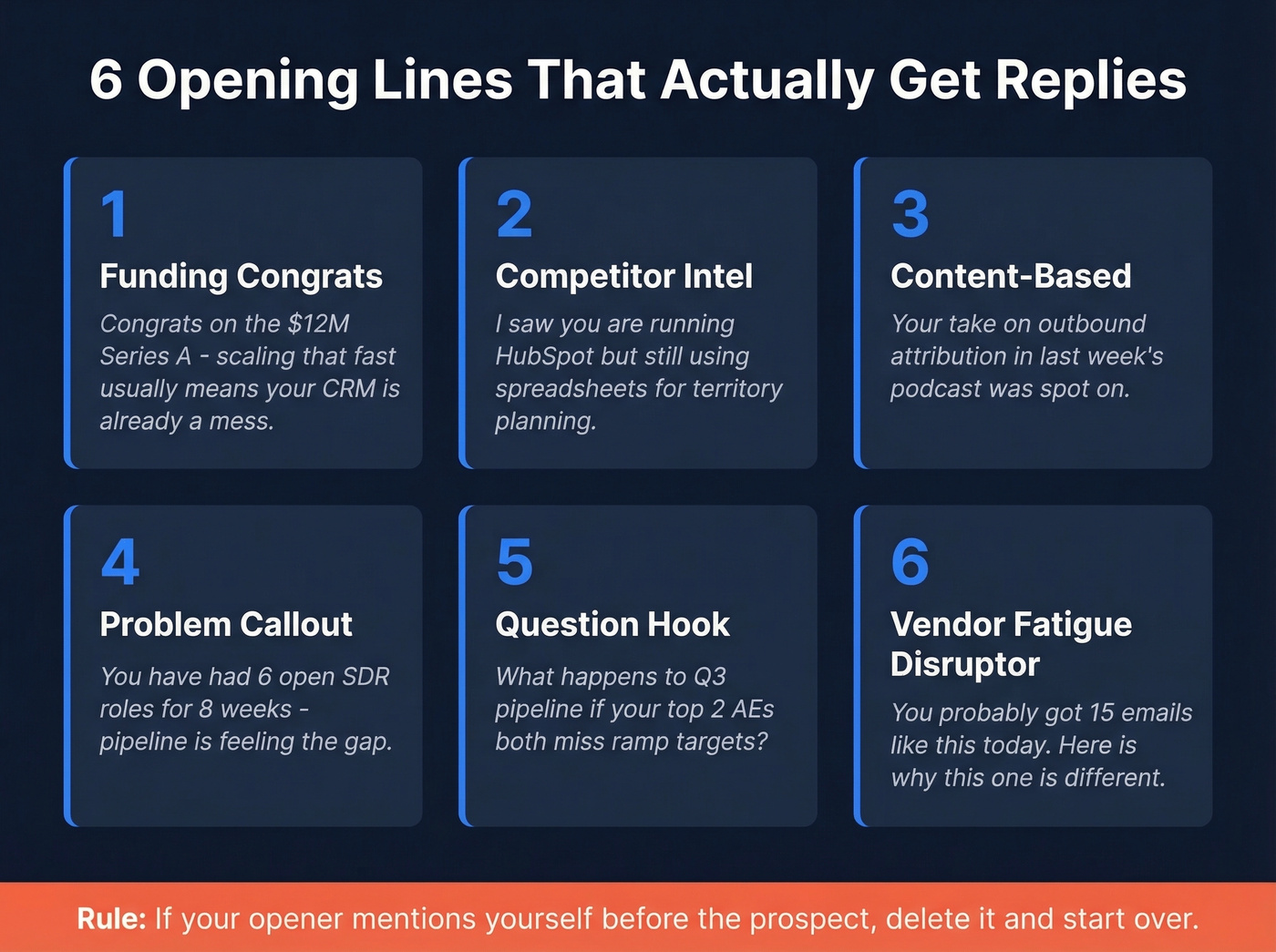
1. Funding congrats. The easiest high-impact opener for anyone selling into startups.
- Weak: "Congrats on the funding!"
- Strong: "Congrats on the $12M Series A led by Sequoia - scaling the sales team that fast usually means your CRM data is already a mess."
2. Competitor intelligence. Show you've done homework. (If you want to go deeper, build a lightweight competitive intelligence strategy.)
- Weak: "I noticed you're in the marketing space."
- Strong: "I saw you're running HubSpot but still using spreadsheets for territory planning - that gap usually costs 3-4 hours per rep per week."
3. Content-based. Reference a specific post, podcast, or talk.
- Strong: "Your take on outbound attribution in last week's podcast was spot on - especially the part about first-touch being a vanity metric. We've been rethinking the same thing internally."
No weak example needed here. If you can't cite something specific, pick a different framework.
4. Problem callout. Use public info - press releases, filings, job postings.
- Weak: "I know hiring is tough right now."
- Strong: "You've had 6 open SDR roles on your careers page for 8 weeks - that usually means pipeline is feeling the gap."
5. Question hook. Open a loop the prospect wants to close. The trick is making the question about their number, not a generic benefit. "What happens to your Q3 pipeline if your top 2 AEs both miss ramp targets?" works because it's specific enough to sting.
6. Vendor fatigue disruptor. Acknowledge the noise, then immediately prove you're different: "You probably got 15 emails like this today. Here's why this one's different: I'm not selling you software, I'm pointing out a $200K leak in your funnel." Use this when you're emailing a VP who's clearly drowning in vendor pitches - it works best when the next sentence delivers a genuinely specific insight.
Here's the thing: if your opener mentions yourself before the prospect, delete it and start over. Every time.
Greetings, Subject Lines, and CTAs
The Right Salutation
Before your opening line lands, the prospect sees your greeting. Keep it simple and direct - use their first name and skip the formality. "Hi Sarah," works. "Dear Sir/Madam," signals a mass blast. "Hey!" feels too casual for a first touch to a C-suite buyer. Match the greeting to seniority and culture: first-name greetings for most B2B outreach, slightly more formal for regulated industries or executive titles.
Subject Lines
69% of recipients mark emails as spam based on the subject line alone. Personalized subject lines hit a 46% open rate versus 35% without. Keep it under 50 characters - long subjects get truncated on mobile, where more than half of all email opens happen. And test two subject lines against at least 50 sends each before picking a winner. Anything less is noise, not data. (For swipeable ideas, see cold email subject line examples and email subject line examples.)
Body Length
75-100 words hits the sweet spot. Boomerang's study of 40M emails found that range correlates with a 51% response rate. Belkins' 2026 report analyzing 16.5M cold emails confirms it: 6-8 sentences perform best at a 6.9% reply rate. Moderate positive or negative tone drives 10-15% more responses than neutral writing. Have an opinion. Show some energy. (If you want a deeper craft guide, see email copywriting.)
Your CTA
One ask. Low friction. Specific. "Do you have 15 minutes Thursday afternoon?" beats "Let me know if you'd like to chat sometime" every single time. Vague CTAs give the prospect permission to do nothing. (More examples in email call to action.)

You just learned how to write an opening line that earns replies. But none of that matters if your email bounces or lands in spam. Prospeo's 5-step verification catches spam traps, honeypots, and catch-all domains - delivering 98% email accuracy at $0.01 per lead. Start with 75 free verifications.
Fix your list before you perfect your opener.
Timing, Follow-Ups, and When to Stop
Thursday pulls the best reply rate at 6.87%. Monday is the worst at 5.29%. The 8-11 PM window peaks at 6.52% - counterintuitive, but evening sends catch executives clearing their inbox before bed. (If you want the full breakdown, see best time to send cold emails.)
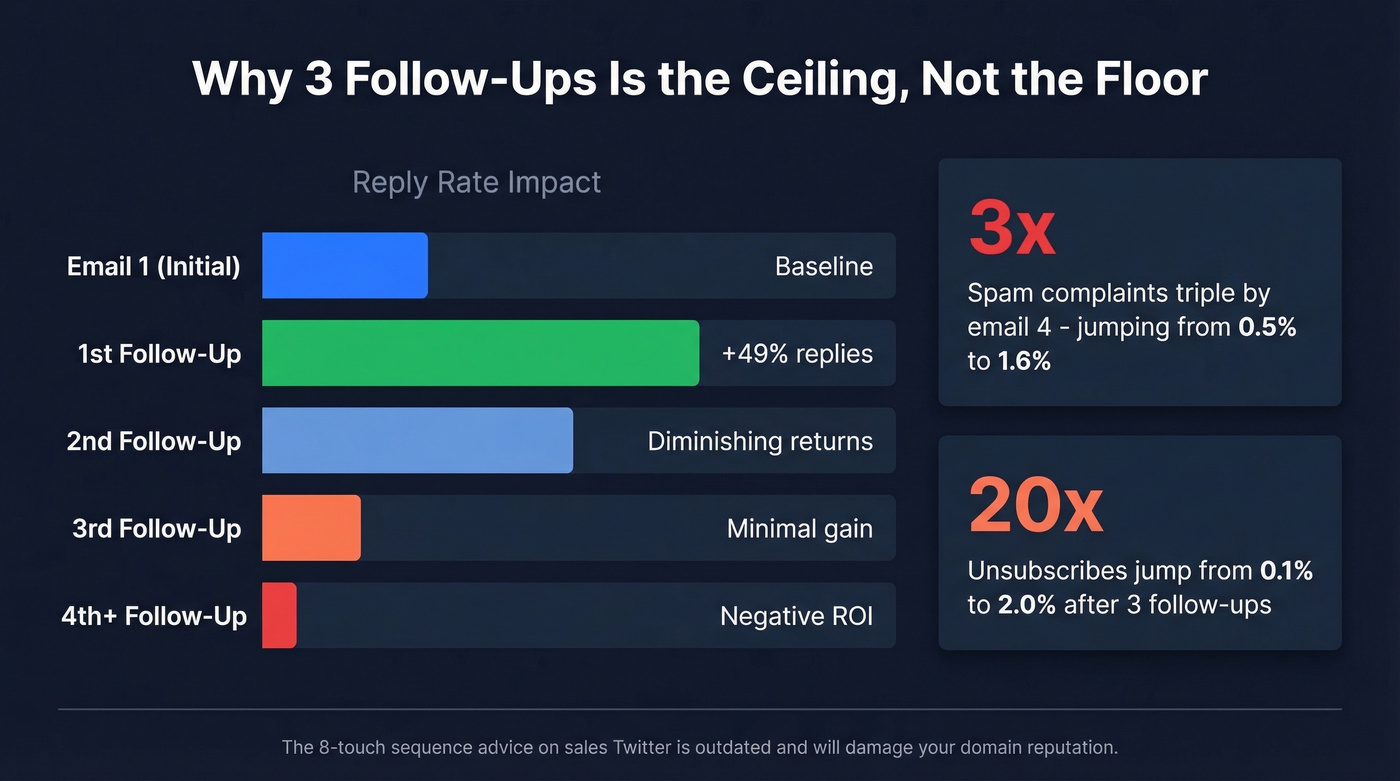
Three follow-ups is the ceiling, not the floor. The first follow-up can boost replies by 49%. But here's what happens when you push past that: by the fourth email, spam complaints triple from 0.5% to 1.6%, and unsubscribes jump from 0.1% to 2.0%. The 8-touch sequence advice floating around sales Twitter is outdated and will damage your domain reputation. (If you need copy, use these cold email follow-up templates.)
We've seen targeting depth matter just as much as sequence length. Emailing 1-2 contacts per company yields a 7.8% reply rate. Blast 10+ contacts at the same company and you drop to 3.8%. And if you're relying on email alone, expect roughly 3% response rates - adding a second channel like a call or connection request can push that above 15%. Nailing the first line is only step one; the real momentum comes from multi-channel follow-through. (More tactics in sales prospecting techniques.)
If your reply rate is below 3%, stop rewriting your email. The problem is almost certainly bad data or broken deliverability, not your copywriting. Fix the plumbing first.
Compliance in 30 Seconds
- CAN-SPAM (US): Accurate sender info, non-deceptive subject line, valid physical address, working unsubscribe link. Honor opt-outs within 10 business days. Penalty: up to $53,088 per violation.
- GDPR (EU/UK): Legitimate interest works for relevant B2B outreach, but you must provide opt-out and identify yourself. Max fines: EUR 20M or 4% of global annual turnover.
- Never use deceptive "Re:" or "Fwd:" tricks in subject lines. It's a fast track to spam complaints and legal exposure.
Benchmarks - What "Good" Looks Like
| Metric | Benchmark | Source |
|---|---|---|
| Average reply rate | 5.8% | Belkins 2026 (16.5M emails) |
| Best reply rate (6-8 sentences) | 6.9% | Belkins 2026 |
| Open rates | 31-46% | Belkins 2026 |
| Peak response word count | 75-100 words (51% response rate) | Boomerang (40M emails) |
| Best send day | Thursday (6.87%) | Belkins 2026 |
| Peak send time | 8-11 PM (6.52%) | Belkins 2026 |
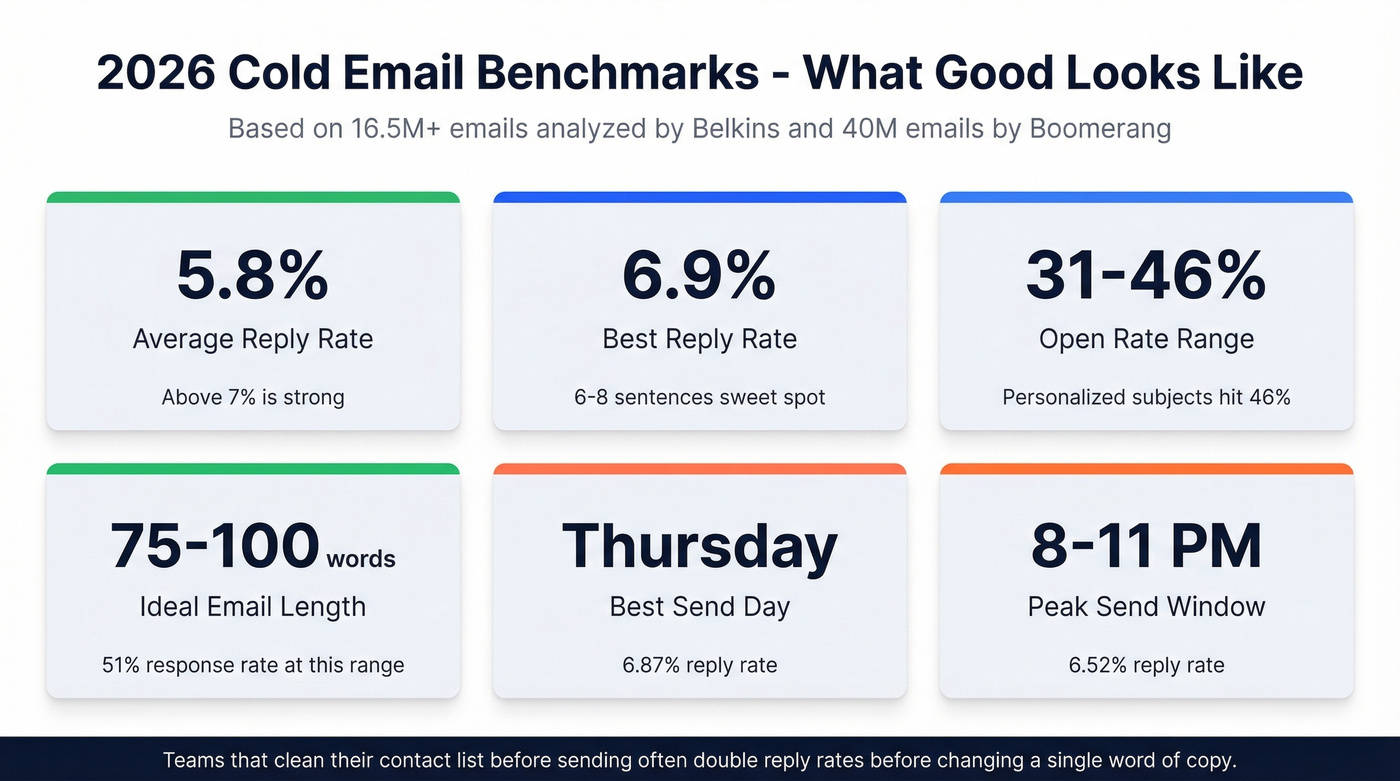
Anything above 7% is strong. In our experience, teams that clean their contact list before sending see the biggest jumps - often doubling reply rates before changing a single word of copy. That's not a writing problem. That's a data problem.
The best sales email opener references something specific - a funding round, an open role, a tech stack gap. Prospeo's 30+ search filters surface buyer intent signals, job changes, headcount growth, and technographics across 300M+ profiles so every first line you write hits a nerve.
Stop guessing what to write. Start with real prospect intel.
Sales Email FAQs
How long should a sales email be?
Aim for 75-100 words. Boomerang's study of 40M emails found that range hits a 51% response rate. At 200+ words, response rates trend steadily downward.
What's a good cold email reply rate in 2026?
The benchmark across 16.5 million emails is 5.8%. Above 7% is strong. Below 3% points to a data quality or deliverability problem, not a writing problem.
Should I use open tracking on cold emails?
Turn it off. Disabling open tracking improved response rates by roughly 3% - tracking pixels trigger spam filters and hurt deliverability across major inbox providers.
How many follow-ups should I send?
Two to three maximum. The first follow-up boosts replies by 49%, but by the fourth email, spam complaints triple and unsubscribes jump 20x. Protect your domain.
How do I verify emails before sending my first outreach?
Run your list through a verification tool before every campaign. A 5-step verification process that catches catch-all domains, spam traps, and honeypots is the standard you should expect - anything less and you're gambling with your sender reputation.