

How to Write a Follow-Up Email That Actually Gets a Reply
392.5B emails will hit inboxes daily by 2026. Your follow-up is competing with every newsletter, internal thread, and spam blast your prospect received that morning. Here's the uncomfortable truth: knowing how to write a follow-up email isn't really about copy. It's about systems. Infrastructure, data quality, and timing drive more replies than word choice ever will.
One practitioner on r/Entrepreneur rebuilt their entire cold email approach over 62 days and doubled their reply rate from 3% to 6%. The biggest lever wasn't better writing. It was fixing bounce rates, cutting email length in half, and spacing follow-ups properly. Their entire stack costs ~$420/month and generates 16 qualified leads. Let's break down exactly how to replicate that.
What You Need (Quick Version)
Three rules separate follow-ups that get replies from ones that get ignored:
Keep it under 125 words and add something new each time. Every follow-up that just says "bumping this" wastes one of your 2-3 chances to address the real reason they haven't replied. Jump to the writing framework below.
Use graduated spacing - 2, 4, 7, 14 days - not static intervals. Sending every two days looks automated and tanks deliverability. The timing section covers the full model.
Fix your infrastructure before your copy. Bad data and missing email authentication kill more follow-ups than bad writing ever will. If 10%+ of your list bounces, your domain reputation is already damaged. See the deliverability section.
What 16.5M Emails Reveal About Follow-Ups
Most follow-up advice cites HubSpot's claim that one follow-up lifts reply rates from 16% to 27%. That number gets repeated everywhere, but it's vague on methodology and sample size. Newer data tells a sharper story.
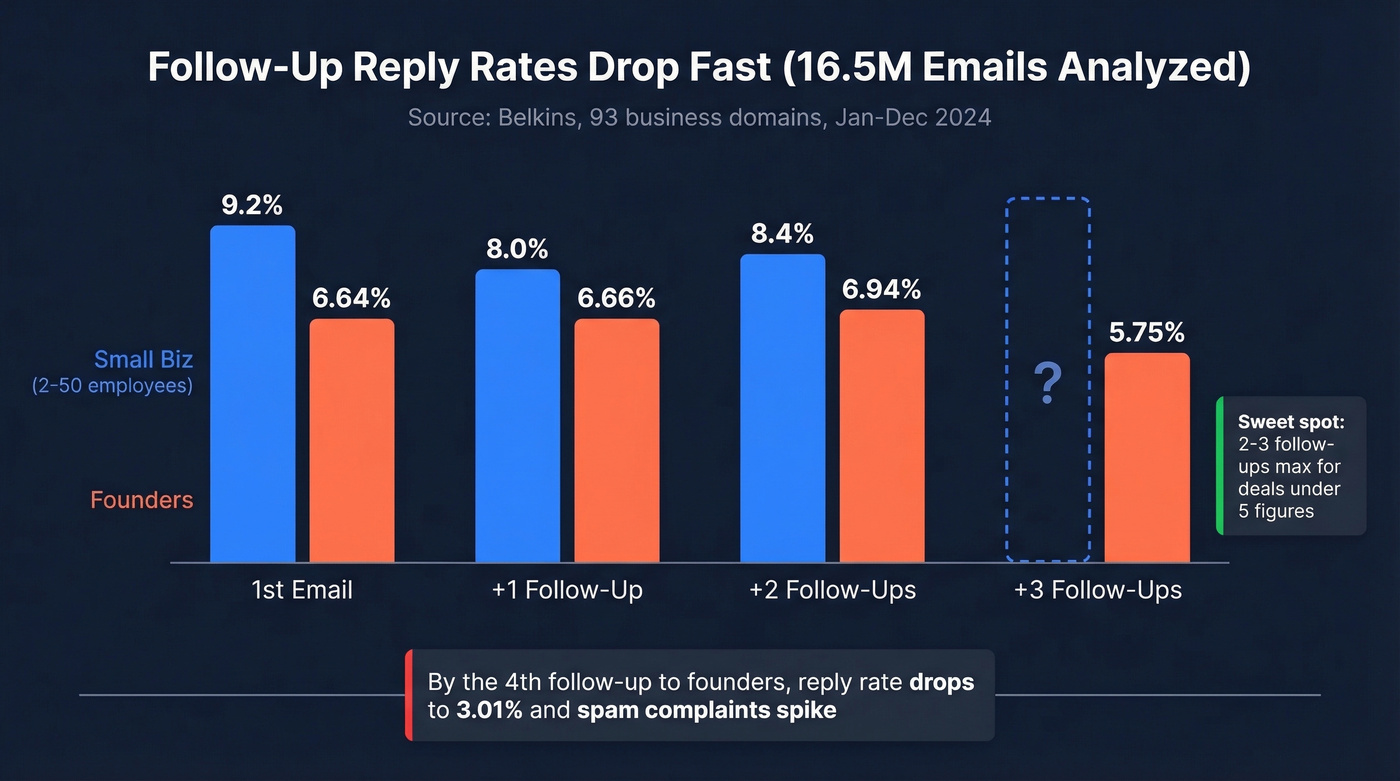
Belkins analyzed 16.5M cold emails across 93 business domains (January-December 2024) and found the highest reply rate - 8.4% - comes from the first email alone. Performance declines with each additional touch, and sending 4+ emails in a sequence more than triples unsubscribe and spam complaint rates.
The decay curve depends on who you're emailing:
Reply Rates by Company Size (Belkins, 16.5M emails)
| Recipient Type | 1st Email | +1 Follow-Up | +2 Follow-Ups | +3 Follow-Ups |
|---|---|---|---|---|
| Small Biz (2-50) | 9.2% | 8.0% | 8.4% | - |
| Founders | 6.64% | 6.66% | 6.94% | 5.75% |
Small businesses tolerate a couple of follow-ups reasonably well - reply rates actually tick up slightly on the second follow-up. Founders show a similar pattern through two follow-ups, then drop sharply. By the fourth follow-up to a founder, you're at 3.01% and generating spam complaints.
If your average deal is under five figures, three follow-ups is your ceiling. The math doesn't support a five-email sequence when the deal size can't absorb the deliverability risk. Save the longer sequences for enterprise deals where one reply justifies the cost.
One more finding worth highlighting: the same study found that a profile visit paired with a direct message hit an 11.87% reply rate - higher than any email-only follow-up in the dataset. If your prospect is active on social platforms, a multi-channel approach will outperform email alone.
Optimal length for those follow-ups? 50-125 words for warm follow-ups. For cold outreach, the practitioner who doubled their reply rate cut emails from 141 words to under 56. Shorter is almost always better.
How to Write a Follow-Up Email (5 Steps)
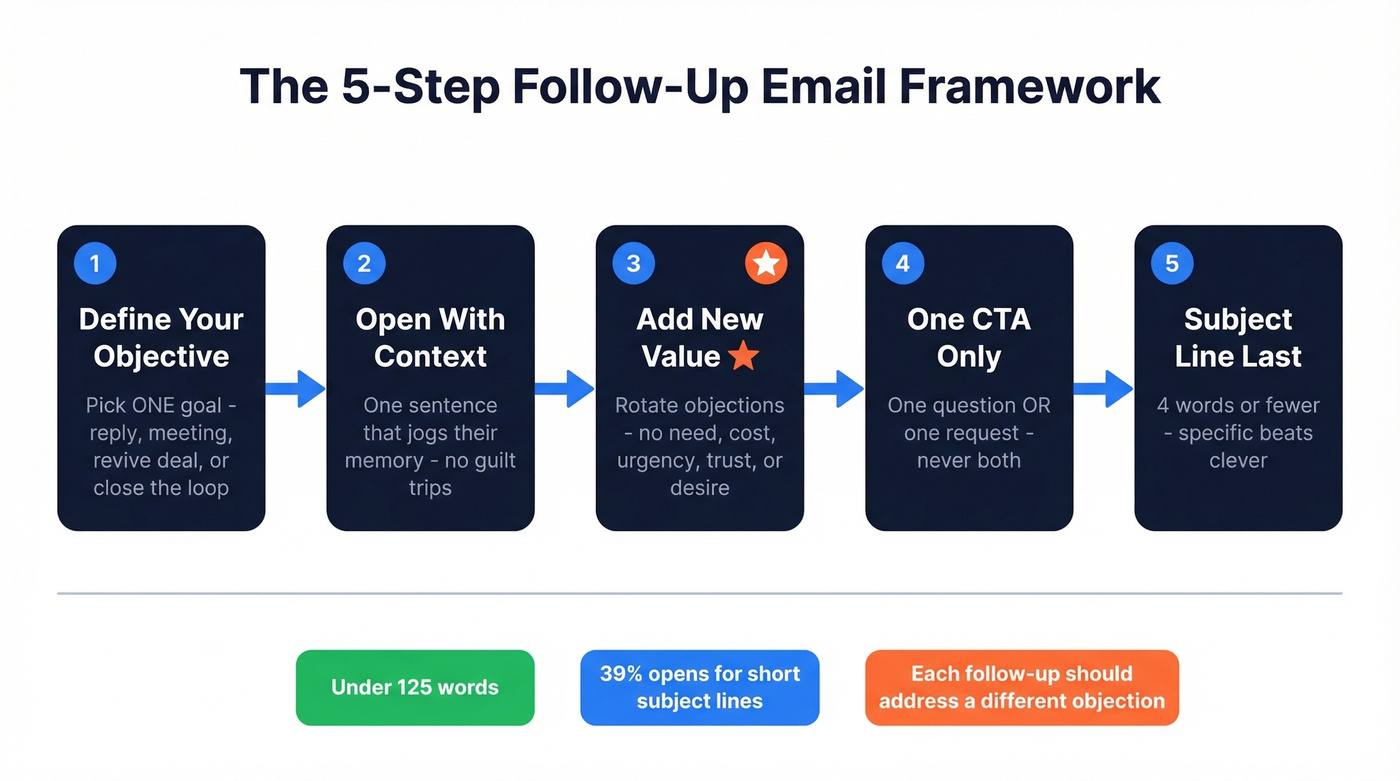
Whether you're composing a follow-up for the first time or refining an existing sequence, these five steps give you a repeatable framework.
Define Your Objective
Every follow-up falls into one of four categories: get a reply, book a meeting, revive a stalled deal, or close the loop. Pick one before you write a word. A follow-up trying to do all four reads like a desperate pitch and accomplishes none of them.
Open With Context
Your prospect doesn't remember your last email. Open with a single sentence that jogs their memory without rehashing the entire conversation. "I sent over the ROI breakdown for your Q3 migration last Tuesday" works. "As per my previous email" doesn't - it's a guilt trip disguised as context.
Add New Value (Objection Rotation)
This is where most follow-ups fail. "Just checking in" doesn't give the prospect a reason to reply - it just reminds them they didn't. Each follow-up should address a different reason they haven't responded.
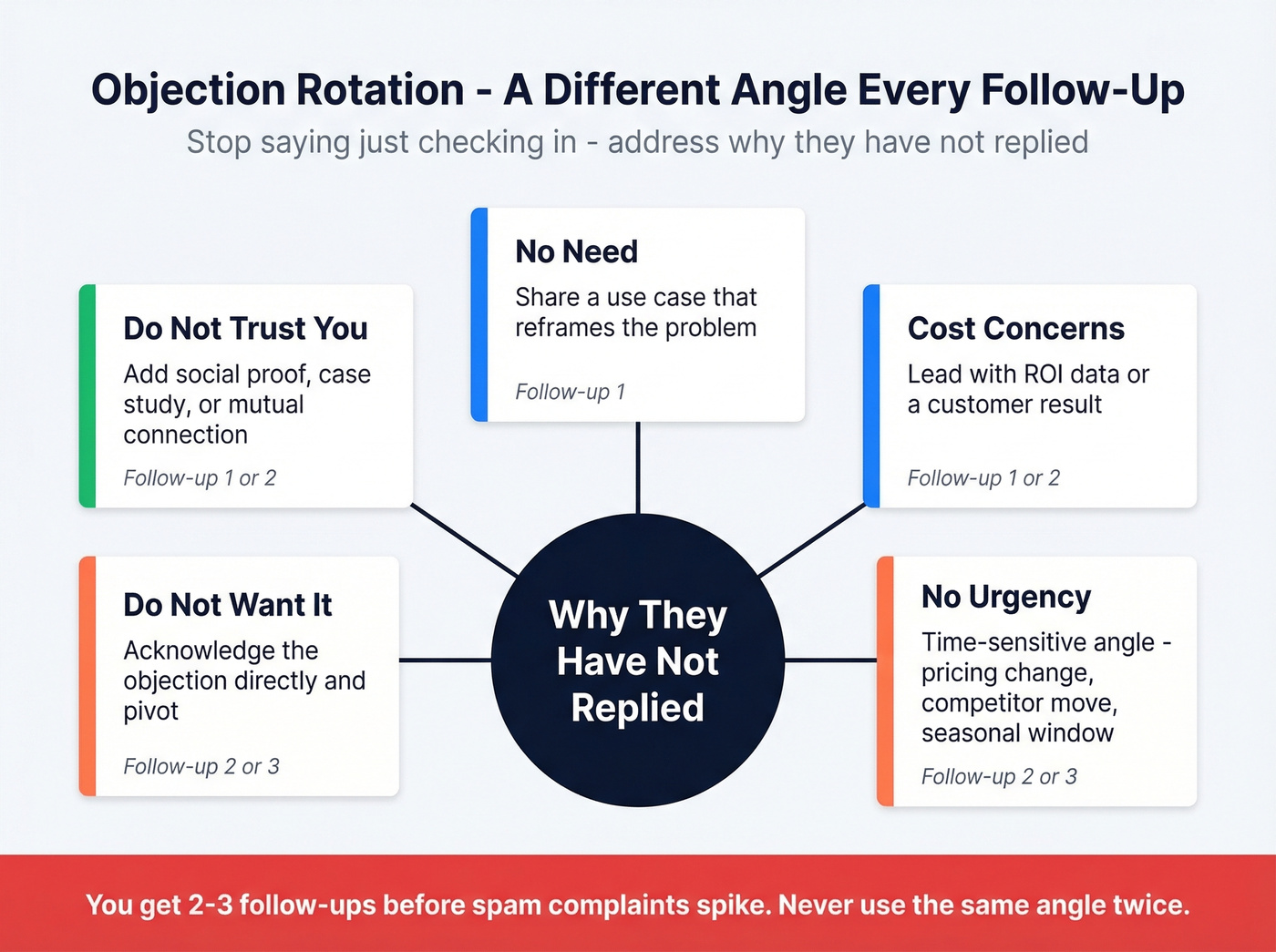
GMass outlines five core objections worth rotating through:
- No need - share a use case that reframes the problem
- Value not worth cost - lead with ROI data or a customer result
- No urgency - introduce a time-sensitive angle like a pricing change, competitor move, or seasonal window
- Don't want it - acknowledge the objection directly and pivot
- Don't trust you - add social proof, a case study, or a mutual connection
You've got 2-3 follow-ups before spam complaints spike. Don't waste two of them on the same angle.
One CTA, One Ask
Ask one question or make one request. Never both. "Would Thursday at 2 PM work for a 15-minute call?" is clear. "Let me know your thoughts, and if you're interested, I'd love to schedule a call - also, feel free to share this with your team" is three asks competing for attention. The prospect does the easiest thing: nothing.
Write the Subject Line Last
Write the email first, then craft a subject line that matches the tone. Keep it to four words or fewer. The practitioner case study found "Quick question" pulled 39% opens while "Partnership opportunity" dropped below 19%. HubSpot's study of 6.4 million emails found that "tomorrow" in the subject line increased opens by 10%, while "Quick" decreased opens by 17% - and emails with no subject line were opened 8% more than those with one.
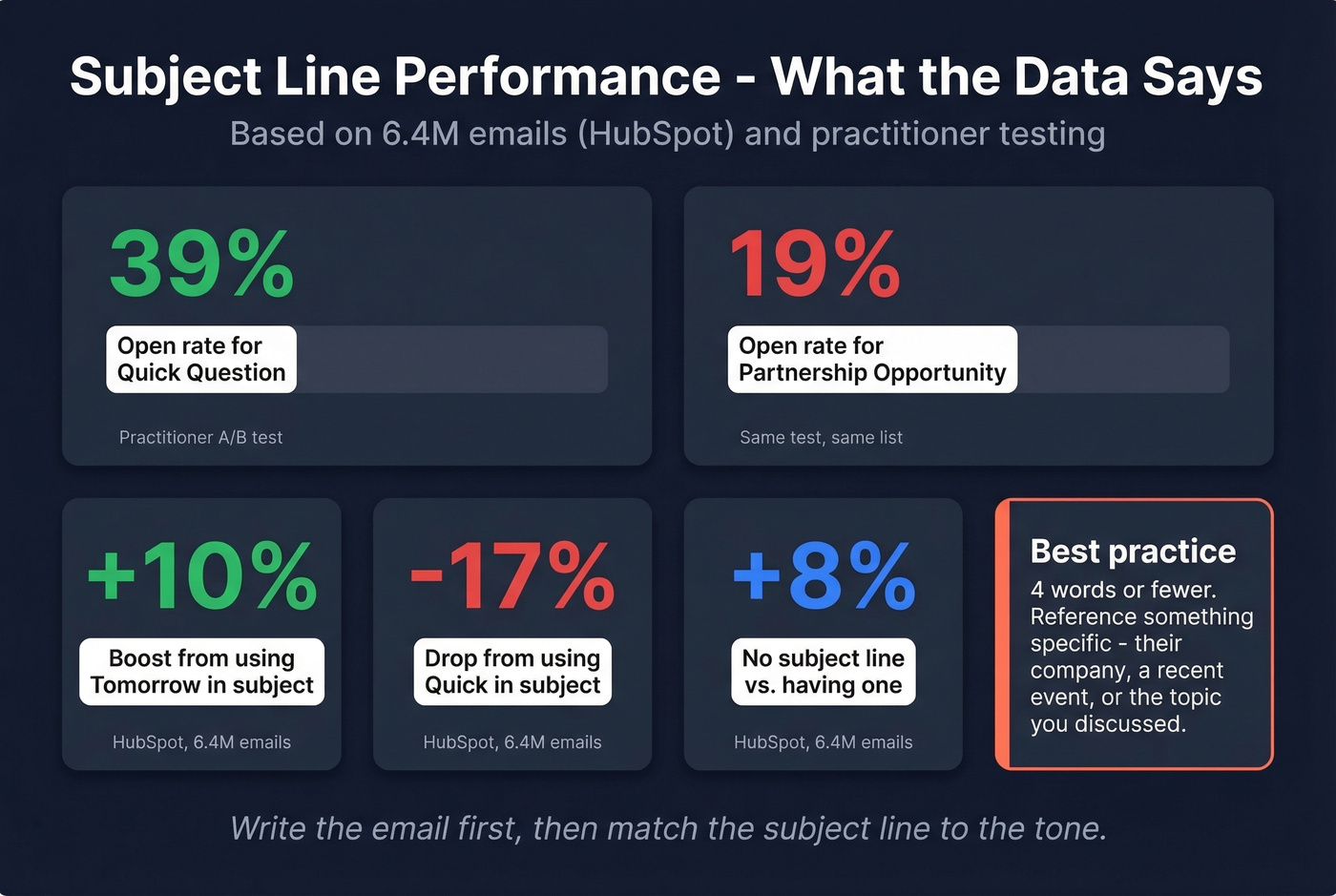
That said, "Quick question" is getting overused. The consensus on r/coldemail is that it still works but is losing edge. A subject line referencing something specific - their company name, a recent event, the topic you discussed - holds up better over time.

You just read it: 10%+ bounce rates destroy domain reputation and kill follow-up sequences before your copy even matters. Prospeo's 5-step email verification delivers 98% accuracy - and refreshes every 7 days, not 6 weeks. Teams using Prospeo cut bounce rates from 35%+ to under 4%.
Stop wasting follow-ups on bad emails. Start with verified data.
When to Send Your Follow-Up
Static spacing - every two days, like clockwork - looks automated and hurts deliverability. Use graduated spacing instead:
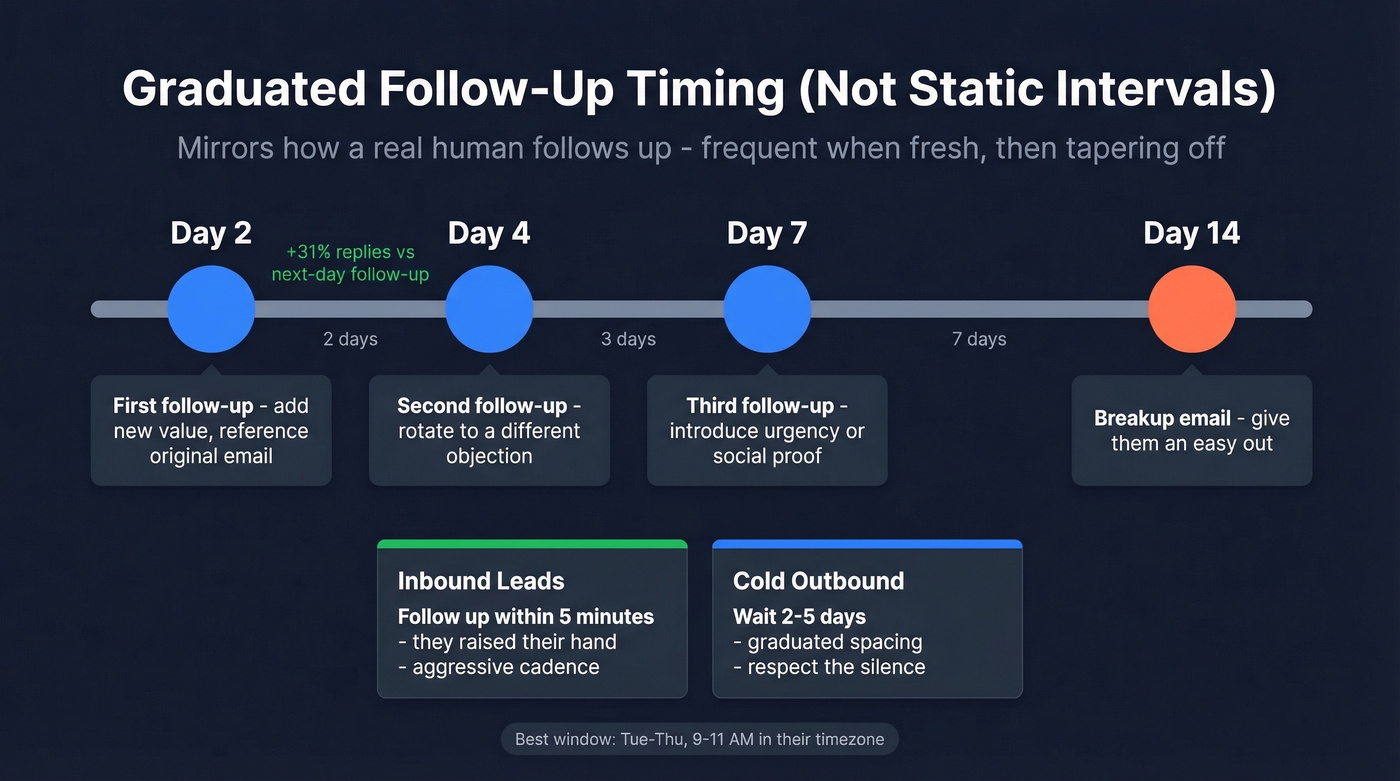
Day 2 → Day 4 → Day 7 → Day 14
This mirrors how a real human would follow up: more frequently when the conversation is fresh, then tapering off. Instantly's research found that next-day follow-ups reduce replies by 11%, while waiting three days increases replies by 31%.
Best days and times: Tuesday through Thursday, 9-11 AM in the recipient's local timezone. The practitioner who doubled their reply rate confirmed this window - sends during Tue-Thu, 8-11 AM improved their opens by 16%.
Inbound vs. outbound timing is completely different. Here's how to think about it:
| Scenario | First Follow-Up | Cadence |
|---|---|---|
| Inbound lead (demo request, whitepaper download) | Within 5 minutes | Aggressive - they raised their hand |
| Cold outbound (no prior relationship) | 2-5 days after initial email | Graduated - 2, 4, 7, 14 days |
Speed-to-lead matters enormously for inbound. For cold outbound, responding to silence within 24 hours feels pushy.
Same thread or new email? Keep the same thread when you're continuing the same topic - it preserves context and looks like a natural reply. Start a new thread when the subject has changed or the existing thread is too long. A fresh subject line can re-engage someone who mentally archived the original conversation.
If you want a deeper timing model, see when to follow up on an email and the data-backed best time to send cold emails.
Follow-Up Templates for Every Scenario
Every template below is under 125 words. Adapt the tone to your relationship and industry - these are frameworks, not scripts to copy verbatim.
If you want more plug-and-play options, browse these sales follow-up templates and cold email follow-up templates.
After No Response (Cold Outreach)
Subject: quick question about [specific topic]
Hi [Name], I reached out last [day] about [one-sentence context]. I wanted to share something that might change the calculus - [new value: case study, data point, or relevant insight]. Worth a 15-minute conversation this week?
This works because it adds new value instead of just bumping. It references the original email without rehashing it.
After a Meeting
Subject: next steps from [day]
Hi [Name], thanks for the conversation on [day]. You mentioned [specific pain point or goal they raised]. I put together [resource/proposal/timeline] that addresses that directly - attached here. What's the best next step on your end?
Proves you listened. Ties the follow-up to something they said, not something you want to sell.
If you’re following up after a call, use a dedicated sales meeting follow-up email structure.
After a Job Interview
Most interview follow-ups are interchangeable. The fix is dead simple: reference one specific thing from the conversation that no other candidate would know.
Bad version: "Thank you for taking the time to meet with me. I'm very excited about the opportunity and look forward to hearing from you."
Good version: "Hi [Name], the [specific project] you mentioned resonated - it's similar to [brief relevant experience]. I'm excited about the role and happy to provide anything else you need."
The second version proves you were actually in the room.
Proposals, Networking, and Scheduling
These three scenarios share a common structure: short context line, one specific reference, one clear ask.
After a proposal: "Wanted to check in on the proposal from [date]. If anything in the pricing or scope needs adjusting, I'm happy to revisit. What questions came up on your end?" - Opens the door to negotiation instead of demanding a yes/no.
After networking: "Great connecting at [event]. Your point about [topic] stuck with me - free for coffee next week?" - References a specific moment. Feels personal, not transactional.
Scheduling close: "I'm finalizing my schedule for next week. Would [day] at [time] work?" - This one comes from a practitioner on r/sales who uses it for in-person and phone follow-ups. It implies scarcity without being pushy, and the specificity makes it easy to say yes.
For more ways to phrase the ask, see email wording to schedule a meeting and these email call to action examples.
The Breakup Email
Subject: should I close the file?
Hi [Name], I've reached out a few times about [topic] and haven't heard back - totally understand if the timing isn't right. Should I close this out for now, or is it worth reconnecting in a few months?
The "should I close the file?" framing triggers loss aversion. It's also genuinely respectful - you're giving them an easy out, which paradoxically makes them more likely to reply. In our experience, breakup emails consistently pull the highest reply rates of any follow-up in a sequence.
Why Your Follow-Ups Land in Spam
Your copy can be perfect and your timing dialed in - none of it matters if the email never reaches the inbox. Deliverability is the invisible layer that most follow-up guides ignore entirely.
Start with authentication: set up SPF, DKIM, and DMARC on every sending domain. If you're doing cold outreach, use secondary domains - never your primary business domain. One bad campaign can torch a domain reputation you spent years building. (If you need a deeper walkthrough, start with this email deliverability guide and a practical SPF record example.)
Tracking pixels are another silent killer. Open-tracking and click-tracking inject invisible code that spam filters flag. For cold outreach, we've tested this extensively - plain-text emails consistently outperform HTML. No images, no GIFs, no calendar invites, no attachments. If you want the technical breakdown, see email tracking pixels and what an email spam checker actually catches.
Keep your sending volume disciplined: roughly 20 warm-up emails plus 30 cold emails per mailbox per day, across 2-3 mailboxes per domain. And keep bounce rates under 1% - never above 3%. If you spike past that threshold, pause everything. (More detail: email velocity and email bounce rate.)
The failure point most guides skip: contact data quality. If 10%+ of your list bounces, your domain reputation tanks regardless of how good your copy is. The practitioner who doubled their reply rate dropped their bounce rate from 11% to under 2% by verifying contacts - and that single change drove more improvement than any copywriting tweak. Tools like Prospeo run a 5-step verification process with 98% email accuracy, catching spam traps, honeypots, and catch-all domains before they damage your sender reputation. The free tier includes 75 email credits per month - enough to test whether your current list is the problem.
5 Mistakes That Kill Your Reply Rate
1. Bumping with no new info. "Just checking in" wastes one of your 2-3 finite touches. Every follow-up needs to add something - a case study, a data point, a new angle. If you don't have something new to say, don't send it. (If you need alternatives, see how to say just checking in professionally.)
2. Not rotating objections. If your first email pitched ROI and they didn't reply, your follow-up shouldn't pitch ROI again. Rotate through the five objections: no need, value unclear, no urgency, don't want it, don't trust you.
3. Too many follow-ups. The 16.5M-email study is clear: 4+ emails in a sequence more than triples spam complaints. Send 2-3 follow-ups, end with a breakup email, and move on. You can always re-engage in 90 days.
4. Buzzword subject lines. "Touching base," "circling back," "ducks in a row" - these phrases are spam-filter magnets and instant-delete triggers for anyone who gets more than 20 cold emails a week. Four words or fewer. Make them specific. (More ideas: email subject lines examples.)
5. Sending to unverified contacts. One bad batch with 10%+ invalid addresses costs months of domain reputation recovery. We've seen teams cut bounce rates in half just by running verification before each campaign. It takes minutes and saves you from a problem that's far harder to fix after the fact.
The data is clear - you get 2-3 follow-ups before spam complaints spike. Every send has to land in the inbox and reach the right person. Prospeo gives you 143M+ verified emails at $0.01 each, with catch-all handling and spam-trap removal built in, so your carefully crafted sequences actually connect.
Make every follow-up count with emails that don't bounce.
FAQ
How many follow-up emails should I send?
Two to three for cold outreach, then a breakup email. The 16.5M-email study found that 4+ emails in a sequence more than triples spam complaints. Three well-crafted follow-ups outperform six generic bumps every time.
What's the best subject line for a follow-up?
Four words or fewer, no buzzwords. Question formats and specific references to prior conversations consistently outperform generic lines. "Quick question about [topic]" still works but is losing edge - mentioning their company name or a concrete detail pulls better.
How long should a follow-up email be?
Fifty to 125 words for warm follow-ups, under 70 words for cold outreach. The practitioner who doubled their reply rate cut emails from 141 words to under 56. Shorter messages respect the reader's time and consistently earn more responses.
Should I reply in the same thread or start a new one?
Same thread if you're continuing the same topic - it preserves context and looks natural. Start a new thread when the subject has changed or the existing chain is too long. A fresh subject line can re-engage someone who mentally archived the original conversation.
How do I make sure my follow-up reaches the inbox?
Set up SPF, DKIM, and DMARC on your sending domains. Disable tracking pixels and send plain text for cold outreach. Keep bounce rates under 1% by verifying every address before sending - catch invalid contacts, spam traps, and catch-all domains before they do damage.