

How to Launch an Email Sequence That Actually Converts
You hit send on launch day. Open rate: 12%. Half your list didn't even see the email. The problem wasn't your subject line or your offer - it was the 2,000 dead addresses dragging your sender reputation through the mud during the one week you couldn't afford it. One in six marketing emails fails to reach the inbox during high-volume periods. Your launch is a high-volume period.
Stop obsessing over email copy. When you launch an email sequence, success depends on three things: list quality, segmentation, and send cadence. Here's the framework we've used and refined across dozens of product launches.
The Quick Version
- Verify your list before you send anything. Dead emails and spam traps tank deliverability during launch week. (If you need a shortlist, start with these email checker tools.)
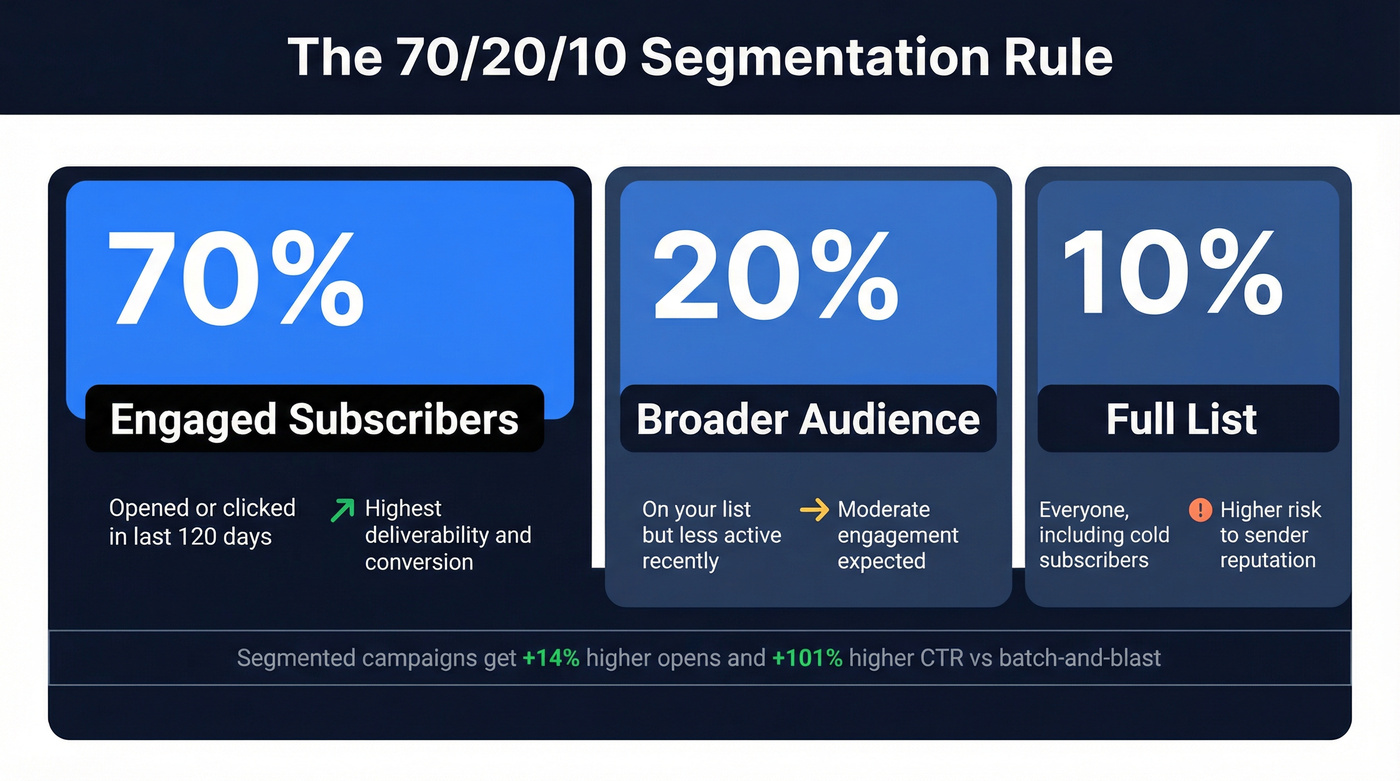
- Segment by engagement using the 70/20/10 rule - 70% of sends to engaged subscribers, 20% broader, 10% full list.
- Send 7 emails across three phases: pre-launch teaser, launch window, cart close.
- Don't stop at cart close. A post-launch sequence captures roughly 25% more revenue. Over 50% of buyers purchase in the last 48 hours - and the ones who don't still need a downsell path.
Under-emailing is the expensive mistake, not over-emailing.
Pre-Launch Checklist
Three things need to happen before launch day.
Verify your list. Run your entire send list through an email verification tool before launch. Dead emails and spam traps tank sender reputation during the exact week you need inbox placement most. Prospeo's 5-step verification catches invalid addresses, spam traps, and honeypots at 98% accuracy - including catch-all domains that other tools skip. The free tier covers 75 emails/month to test the workflow, and for full launch lists, credit-based pricing runs about $0.01 per email with no contracts.

Segment by engagement. Huda Beauty shifted to targeting subscribers engaged within the last 120 days and doubled their YoY growth in Klaviyo-attributed revenue. Send 70% of campaigns to engaged profiles, 20% broader, 10% full list. Brands that segment see +14.31% higher opens and +101% higher CTR versus batch-and-blast. Building a proper engagement-based sequence for each segment means you're speaking to people based on how they've interacted with you, not just that they're on a list.
Set cart open and close dates. Down to the minute. Every email in your sequence anchors to these two timestamps. No hard close means no urgency - and urgency drives that final-48-hour purchase spike.
The 7-Email Framework
A/B test subject lines on your first two sends - by Email 5, you'll know what your list responds to. Every email needs at least two links to your sales page. No exceptions.
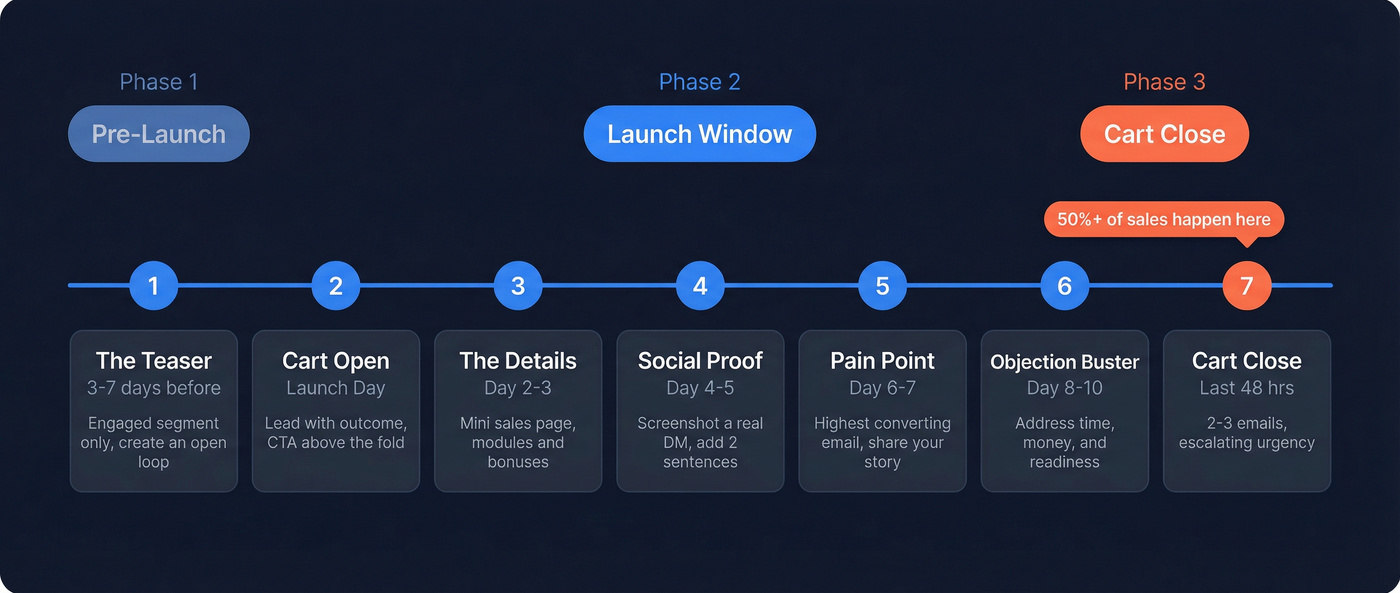
Unlike cold outreach sequences where you space 3-4 touches days apart, your launch list opted in. You can and should send more densely, especially in the final 48 hours. Here's the framework, expanded from Courtney Chaal's 6-email structure with an added pre-launch teaser.
Email 1: The Teaser (3-7 Days Before)
Send this only to your engaged segment. You're not selling yet - you're creating an open loop. Hint at the transformation, not the product. Subject line to steal: "Something's coming Thursday (you'll want to clear your calendar)"
Email 2: Cart Open
This is launch day. Lead with the outcome your buyer wants, then introduce the offer. Don't bury the CTA below the fold. Subject line: "It's live - here's what I built for you"
Email 3: The Details (Day 2-3)
Think mini sales page in email form. Modules, bonuses, what's included - make it scannable. Reuse sections directly from your sales page. Subject line: "Everything inside [Product Name] (the full breakdown)"
Email 4: Social Proof (Day 4-5)
Screenshot a DM from a happy customer, paste it into the email, and write two sentences of context around it. That's it. Don't overthink this one. Subject line: "[Customer name] went from X to Y in 30 days"
Email 5: The Pain Point (Day 6-7)
In our experience, this is consistently the highest-converting email in any product launch sequence. It works because it taps into something deeper than features - share the personal reason behind the offer. People buy from people they root for, and a vulnerability-driven story does what feature lists never will.
Here's a copy snippet you can adapt:
"I almost scrapped this entire project in March. I was staring at a half-finished draft at 2am thinking 'who am I to teach this?' Then I got a message from [name] saying the beta changed how she runs her business. That's when I knew I had to finish it - not for me, but for the people it would actually help."
Subject line: "Why I almost didn't create this"
Email 6: Objection Buster (Day 8-10)
Pull objections directly from your sales page FAQ - time, money, and readiness. If you don't know the top three objections, you aren't ready to launch. Subject line: "Is now really the right time? (honest answer)"
Email 7: Cart Close (Last 48 Hours)
Over 50% of buyers purchase in the final 48 hours. Send 2-3 emails in this window - treat these as an escalating urgency series. Here's your final email closer:
"Doors close at midnight. After that, [Product Name] won't be available until [date/never]. If you've been on the fence, this is the moment. [LINK] - I'll see you inside."
SaaS launches differ - longer drip sequences, focus on activation over purchase. But for course, product, and service launches, the last 48 hours is where the majority of revenue lives. Don't be shy about sending multiple emails in a single day during this window; your engaged subscribers expect it, and the data backs it up.
Post-Launch Sequence
Use this if you want to capture the 25% of revenue most launchers leave on the table.
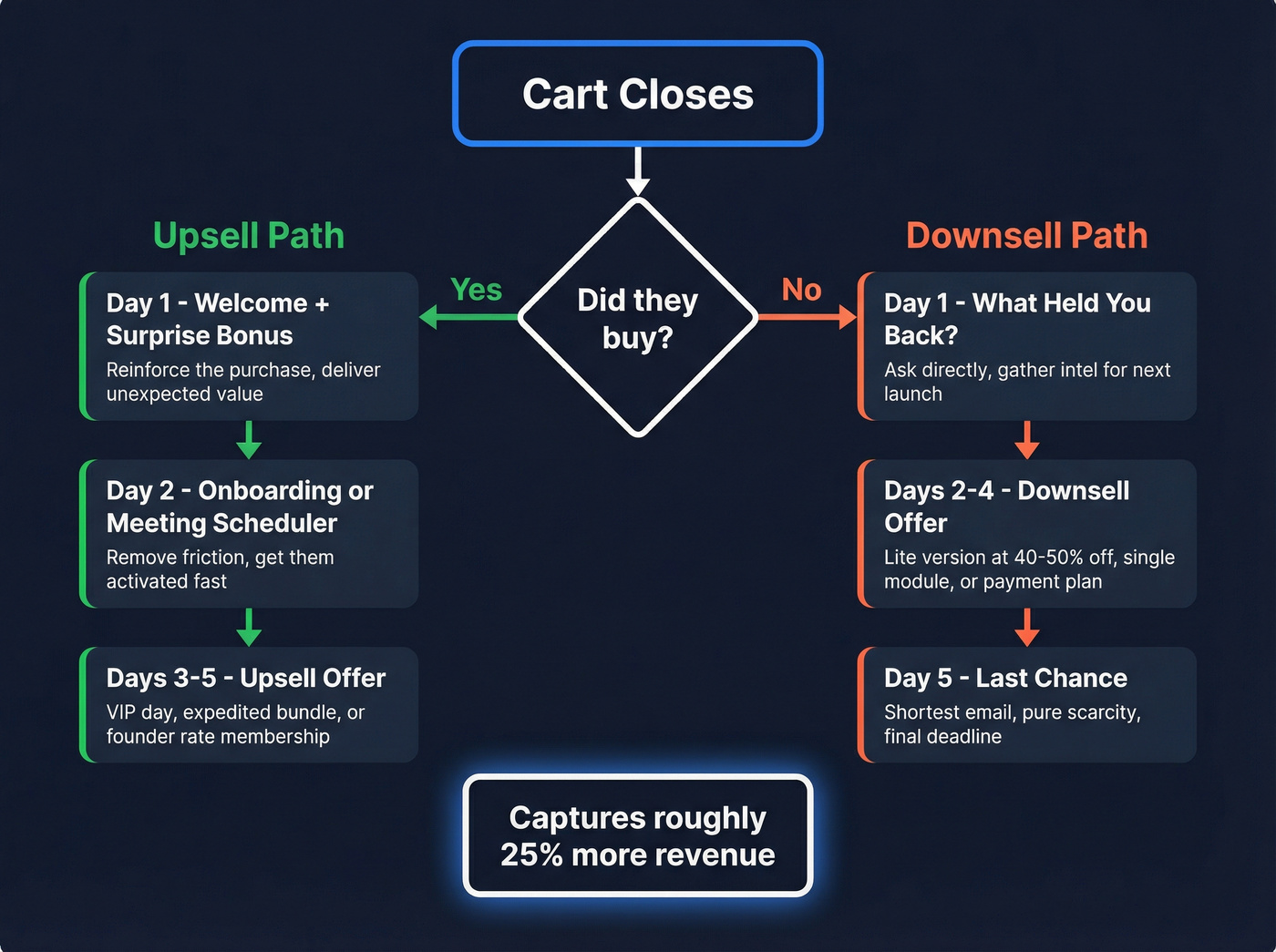
Split your list into two paths immediately after cart close. Make sure your ESP tags buyers automatically.
Buyers get the upsell path. Day 1 welcome with a surprise bonus, then Days 2-5 offer an implementation VIP day, expedited bundle, or membership at a founder rate. These people already trust you - upselling them is significantly easier than acquiring new buyers. If your product includes onboarding, a meeting scheduler email on Day 2 removes friction and gets new buyers activated fast.
Non-buyers get the downsell path. Day 1 "what held you back?" email, then Days 2-5 offer a lite version at 40-50% off, a single module for $47-$97, or an extended payment plan. Day 5 is the shortest email - pure scarcity, last chance.
Skip this if your product doesn't have a natural upsell or lite version. But most do if you think creatively about what a "lite" version of your offer looks like.

Dead emails during launch week don't just hurt opens - they tank your sender reputation for every email that follows. Prospeo's 5-step verification catches invalid addresses, spam traps, and honeypots at 98% accuracy, including catch-all domains most tools skip. At $0.01 per email, cleaning your entire launch list costs less than a single lost sale.
Verify your launch list before you hit send - not after your bounce rate spikes.
Deliverability Rules for Launch Week
Launch week is a volume spike, and ISPs treat volume spikes with suspicion. Five rules:
- Keep complaint rates under 0.2%. Gmail and Yahoo flag anything above 0.3%.
- Ramp volume gradually - no more than a 50% increase per day.
- Target a delivered rate above 95%. Investigate immediately if bounce rate exceeds 2%. (If you're troubleshooting, start with what a hard bounce actually means.)
- SPF, DKIM, and DMARC are mandatory. Gmail, Yahoo, and Microsoft all enforce strict bulk sender authentication requirements. (If you need a walkthrough, see SPF, DKIM, DMARC Explained.)
- Monitor with Gmail Postmaster Tools and Microsoft SNDS. Don't fly blind during your highest-stakes send week.
Bounce rates spike during launch week for teams that skip verification. Start with clean data - Prospeo refreshes records every 7 days compared to the 6-week industry average, so your list stays current between launches.
Benchmarks
| Metric | Average | Good | Great |
|---|---|---|---|
| Open rate | 42.35% | 45-50% | 50%+ |
| CTR | 2.3% | 3-4% | 5%+ |
| CTOR | 5.3% | 7-8% | 10%+ |
| Bounce rate | 2.48% | < 0.3% | < 0.1% |
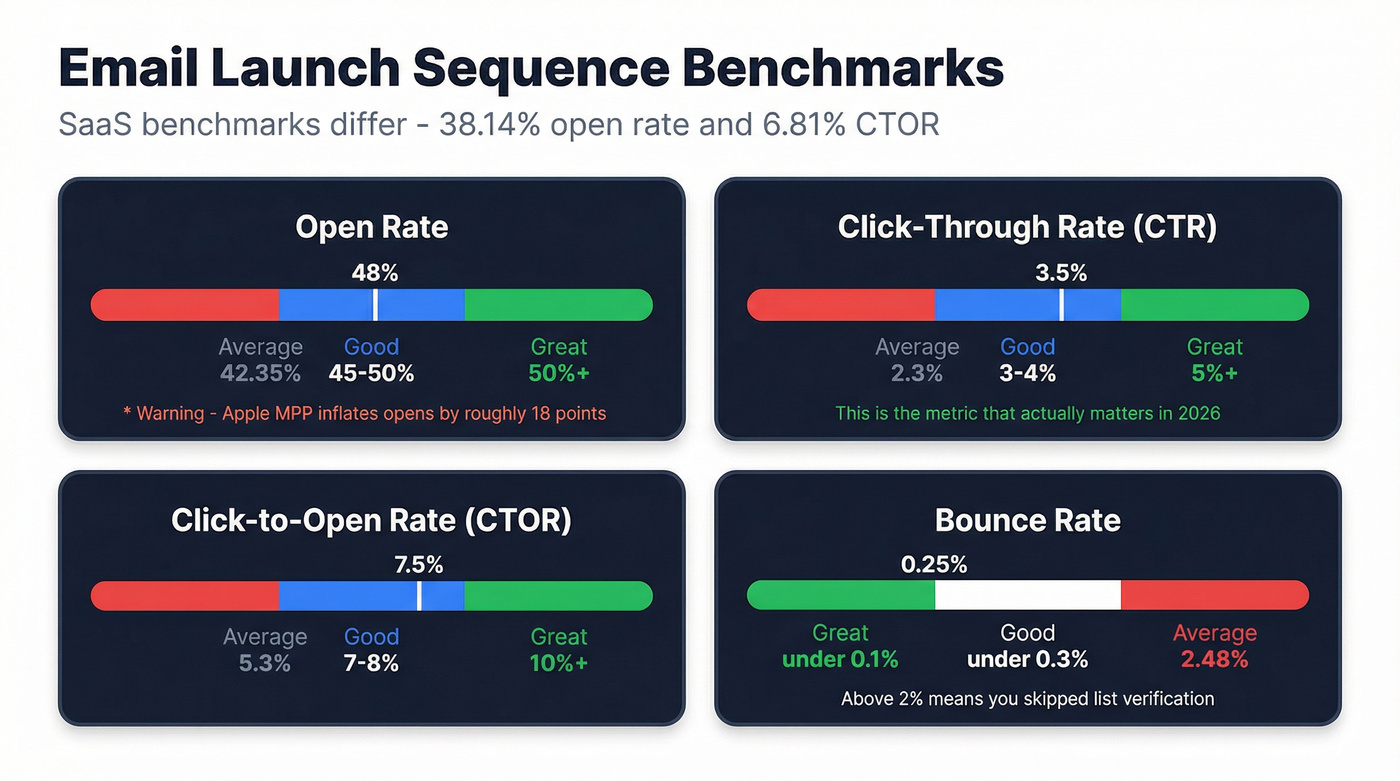
SaaS benchmarks run slightly different: 38.14% open rate and 6.81% CTOR.
Here's the thing: Apple Mail Privacy Protection covers 46% of email clients and inflates open rates by roughly 18 points. Track CTOR, not opens. Opens are a vanity metric in 2026. (If you want the full breakdown, compare open rate vs click rate.)
If your email automation platform doesn't let you segment by click behavior rather than just opens, switch before your next launch. The difference between a 2% and 5% CTR is almost always segmentation quality, not copywriting.
Adapting for Different Launch Types
Not every launch follows the same playbook.
SaaS and free trial launches should focus on activation milestones - first login, first feature used, first result achieved - rather than hard selling. Shift from "buy now" urgency to "here's what you're missing" education. We've seen SaaS teams stretch this to 10-12 emails over 21 days with strong results, because the buying cycle is longer and the decision involves more stakeholders.
Event and webinar launches need speed. Send the first follow-up within 2 hours of the event ending, then layer in the offer over the next 3-5 days. Attendees convert while the experience is fresh.
B2B sales launches are a different animal entirely. Cold outreach frameworks like the Basho email sequence and the Agoge sequence prioritize hyper-personalization and research-driven messaging. If you're launching to a list of prospects rather than warm subscribers, study these models before writing a word. (For a starting point, see these best sales sequences.)
The 7-email framework above is your foundation. Adapt the tone, timing, and CTA based on what you're selling and who you're selling to.
5 Mistakes That Kill Conversions
- No pre-launch warm-up. Jumping straight to "buy now" without a teaser email leaves money on the table.
- Sending to the entire list without segmentation. You're training ISPs to treat your emails as spam.
- Skipping list verification. One in six emails won't reach the inbox during high-volume sends. That's math, not opinion. (If you want a deeper dive, start with invalid emails.)
- Only sending 2-3 emails for a 2-week launch. Seven is the minimum. Your audience needs repetition to act.
- Relying on open rates instead of CTR. Apple MPP made opens unreliable. Clicks tell you who's actually interested.
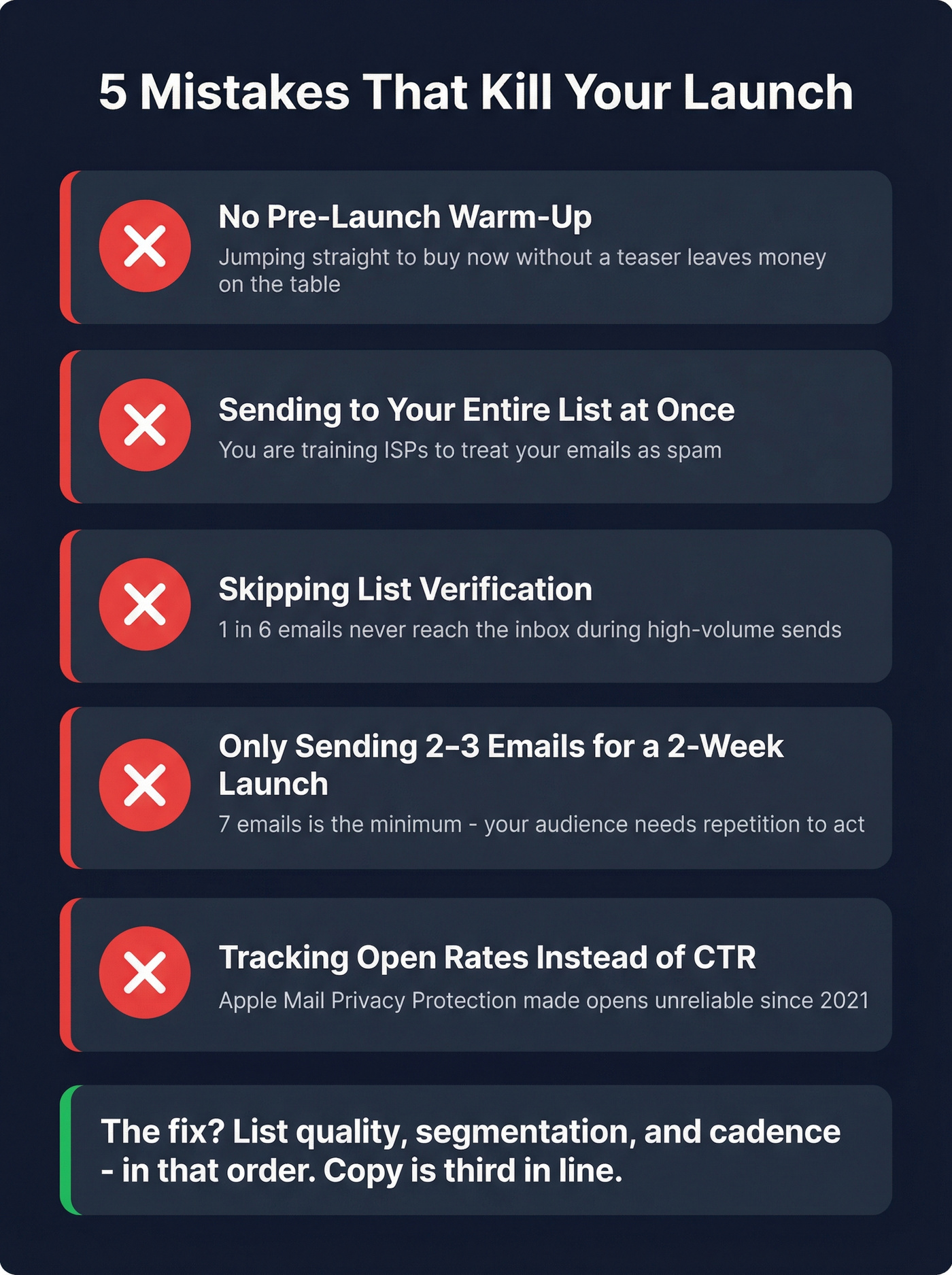
Let's be honest - list quality, segmentation, and cadence determine whether your launch email sequence works. The copy matters, but it's third in line.
Segmentation only works when your contact data is accurate and current. Prospeo refreshes all 300M+ profiles every 7 days - not every 6 weeks like most providers - so your engaged segment is built on data that's actually fresh. Upload your list, enrich with 50+ data points, and segment with confidence.
Stop launching on stale data. Get verified contacts refreshed every 7 days.
FAQ
How many emails should a launch sequence include?
Seven to twelve emails across a 7-14 day window is the sweet spot. Send every other day during the main launch, then 2-3 emails in the final 48 hours. Over 50% of buyers purchase at the last minute, so more emails at the end directly means more revenue.
What's a good open rate for launch emails?
Thirty percent or higher is solid, and 45-50% is strong. But Apple Mail Privacy Protection inflates open rates by roughly 18 points across 46% of email clients. Track click-to-open rate instead - 5.3% CTOR is the industry average, and anything above 7% is genuinely good.
Should I verify my list before launching?
Yes - always. During high-volume sends, one in six emails fails to reach the inbox. Run your list through a verification tool before every launch, not just the first one. Lists decay faster than most people realize.
Can I use polls to improve sequence engagement?
Absolutely. Adding polls - especially in your pre-launch teaser or post-launch follow-up - gives subscribers a low-friction way to interact. That click signals engagement to your ESP, which improves deliverability for your later, higher-stakes sends. You also get real-time data on what your audience cares about most.
What's a champion email sequence?
A champion sequence targets your most engaged contacts - people who open every email, click every link, and reply to surveys. During a launch, send these subscribers early access or exclusive bonuses. They become advocates who share your offer organically, extending reach beyond your own list.