

Lead Generation in Marketing: What Actually Works in 2026
Your SDR just pinged you. Half the phone numbers on the list are disconnected, the cold email sequence is sitting at a 2% reply rate, and the LinkedIn requests are vanishing into the void. Meanwhile, 97% of people ignore cold calls entirely. The playbook that worked in 2022 doesn't work anymore - and most guides on lead generation in marketing haven't caught up.
This isn't another glossary page. It's a practitioner's breakdown of what's actually generating pipeline in 2026, backed by benchmarks, scoring frameworks, and the tech stack decisions that separate teams filling pipeline from teams burning budget.
What You Need (Quick Version)
Three things move the needle in 2026 lead gen. Everything else is optimization.
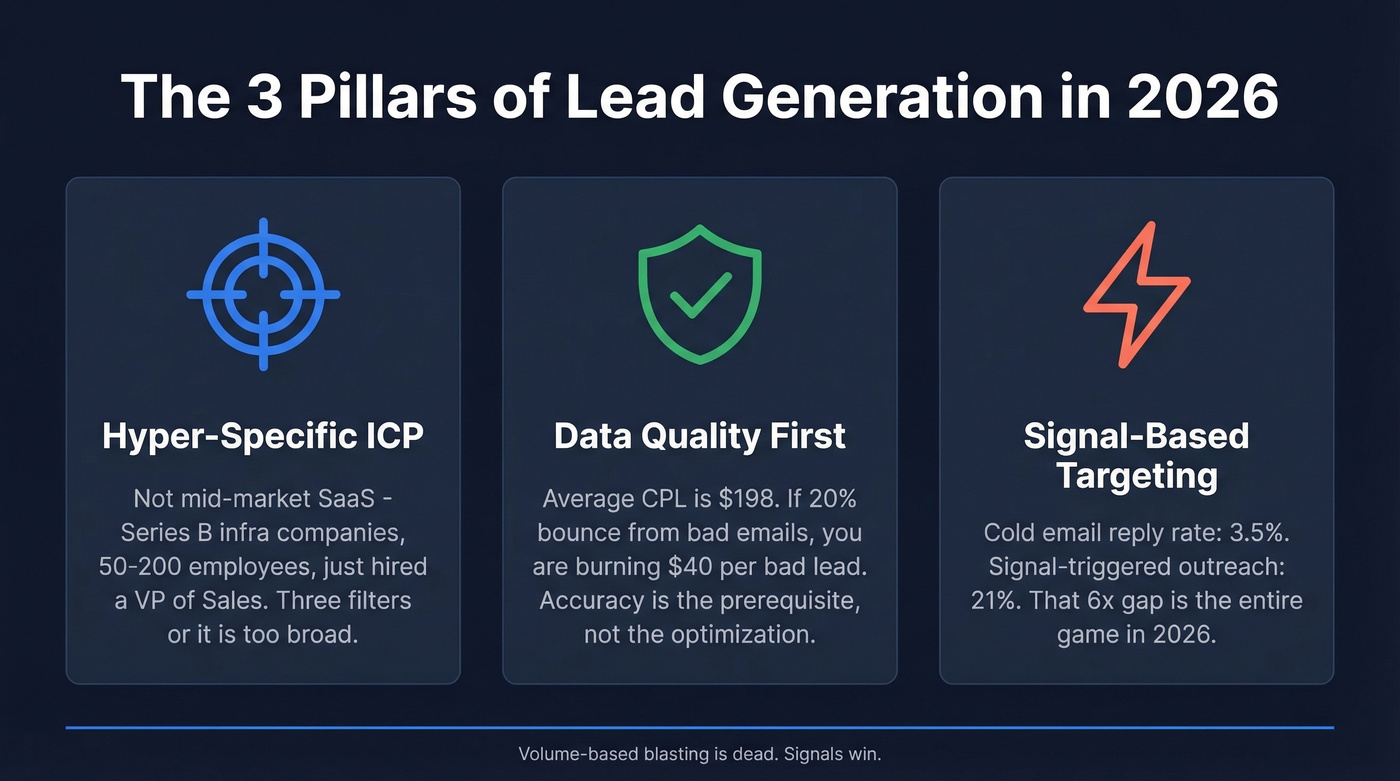
ICP definition that's actually specific. Not "mid-market SaaS companies" - more like "Series B infrastructure companies with 50-200 employees that just hired a VP of Sales." If you can't describe your ideal buyer in one sentence with three filters, your targeting is too broad. If you need a starting point, use an Ideal Customer Profile rubric.
Data quality as a non-negotiable foundation. The average cost per lead across all industries is $198. If 20% of those leads bounce because the emails are bad, you're lighting money on fire. Data accuracy isn't a nice-to-have. It's the prerequisite for everything downstream.
Signal-based targeting over volume-based blasting. The teams winning right now aren't sending 10,000 cold emails a week. They're tracking job changes, funding rounds, and intent signals, then reaching the right person at the right moment. Cold email reply rates average 3.5%. Warm, signal-triggered outreach hits 21%. That gap is the whole game.
What Is Lead Generation in Marketing?
Lead generation is the process of attracting potential buyers and capturing enough information to start a sales conversation. Simple definition. The execution, though, has changed dramatically.
The 2026 version of lead gen isn't about maximizing reach - it's about reading signals and showing up when a buyer is already in motion. Volume-based prospecting (blast 5,000 emails, hope for 100 replies) is giving way to signal-based prospecting: identify accounts showing buying intent, reach the right people with relevant messaging, and time it so you're not just another cold email in the inbox. (If you want a deeper playbook, see sales prospecting.)
The shift matters because buyers have more control than ever. They research anonymously, ignore cold outreach, and self-educate through content before they ever talk to a rep. Your strategy has to meet them where they already are.
Why It Matters (With Numbers)
The average organization generates 1,877 leads per month 1,877 leads per month. Sounds like a lot until you realize most never convert to pipeline. The disconnect between lead volume and revenue is the central problem in modern marketing.
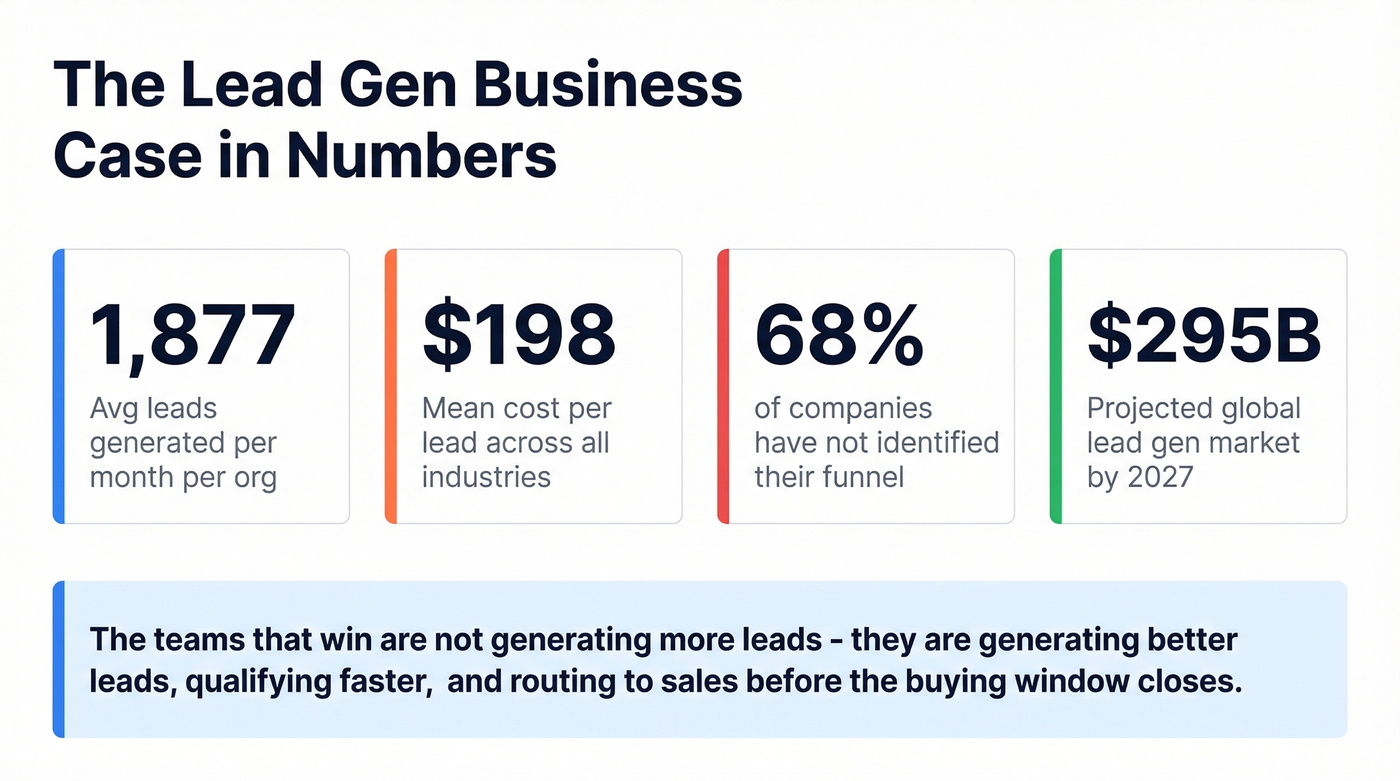
Here's the business case in three numbers. 50% of marketers say lead generation is their top priority. The mean cost per lead across all industries is $198. And yet, 68% of companies haven't even identified their funnel - meaning they're spending money to generate leads without a clear framework for what happens next.
The [global lead generation industry is projected to hit $295 billion by 2027](https://www.businesswire.com/news/home/20210126005925/en/Global-Content-Marketing-Market-Trajectory-Analytics-Report-2020-2027-Lead-Generation-is-Projected-to-Account-for-US%24295.1-Billion-of-the-Total-%24829.6-Billion-Industry - ResearchAndMarkets.com) (and yes, the money is flowing). The question is whether it's flowing to the right places.
The teams that win aren't generating more leads. They're generating better leads, qualifying them faster, and routing them to sales before the buying window closes. That usually starts with fixing lead generation workflow handoffs.
B2B vs. B2C: Key Differences
The strategies diverge more than most guides acknowledge. Here's the clean comparison, drawn from IMD's research on the structural differences:
| Dimension | B2B | B2C |
|---|---|---|
| Sales cycle | Longer, multi-step | Shorter, faster |
| Decision-makers | Multiple stakeholders | Fewer stakeholders |
| Messaging style | ROI, logic, proof | Emotion, identity |
| Top channels | Email, webinars, professional networks | Social, influencers |
| Key metric | Pipeline value | Purchase volume |
B2B lead gen is fundamentally a patience game. Over 30% of B2B sales take one to three months to close Over 30% of B2B sales take one to three months to close, and you're often selling to a committee, not an individual. That means your nurture engine needs to work in tandem with prospecting, not just feed a checkout page.
B2C optimizes for speed and emotion - get someone from ad impression to purchase in as few clicks as possible. Different problem, different stack, different metrics. This guide focuses on B2B, where the complexity and the payoff are highest.
How the Lead Gen Funnel Works
Every lead enters at the top and either progresses or drops off. The funnel isn't a metaphor - it's an operational framework that determines what content, messaging, and actions you deploy at each stage.
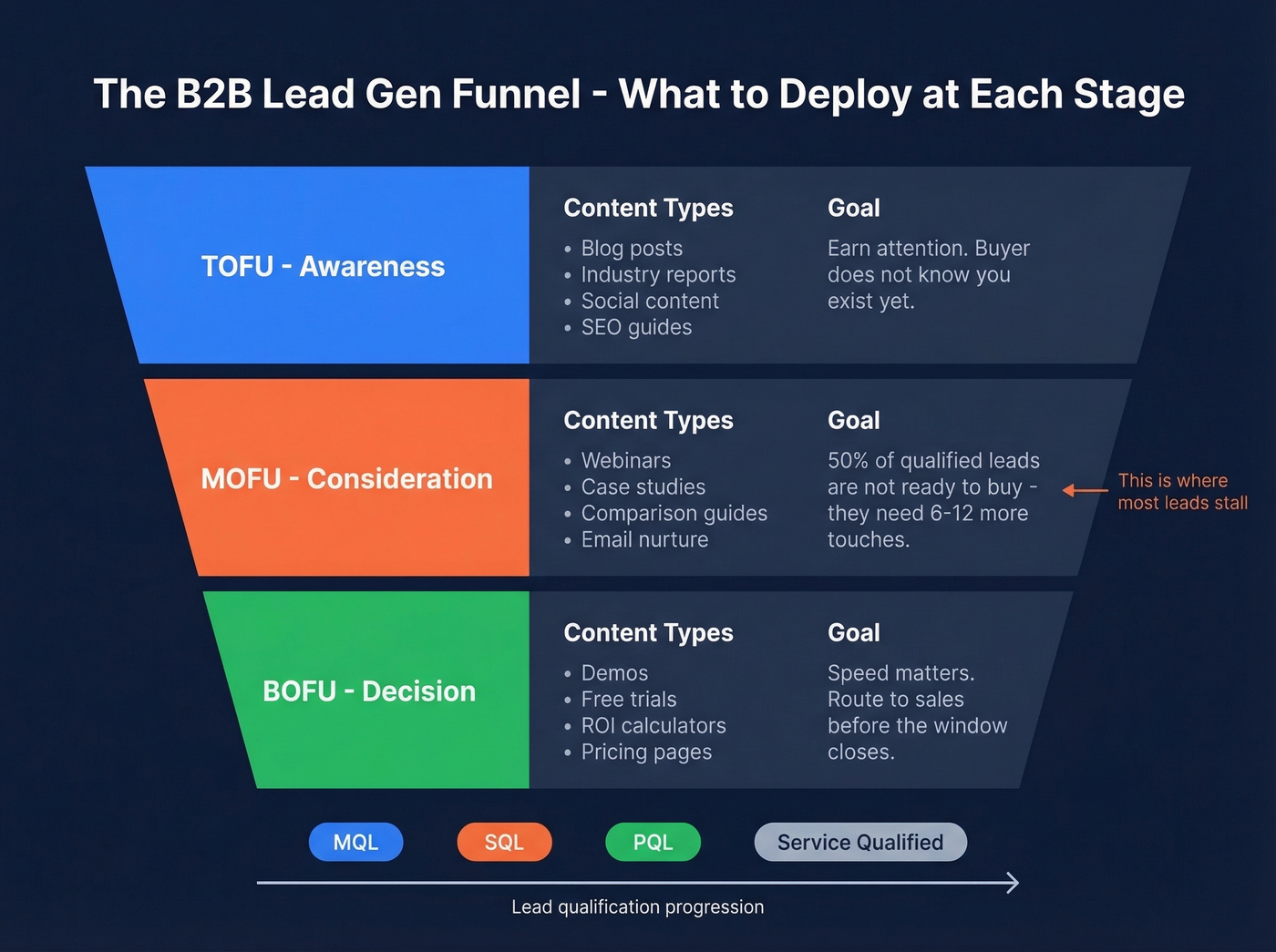
Top of funnel (TOFU) is awareness. The buyer doesn't know you exist or doesn't know they have a problem. Content here is educational - blog posts, industry reports, social content, SEO-driven guides. The goal isn't to sell. It's to earn attention.
Middle of funnel (MOFU) is consideration. The buyer knows the problem and is evaluating solutions. Content shifts to webinars, case studies, comparison guides, and email nurture sequences. This is where 50% of qualified leads aren't ready to purchase - they need 6-12 more touches before they'll talk to sales.
Bottom of funnel (BOFU) is decision. The buyer is ready to act. Content here is demos, free trials, ROI calculators, and pricing pages. Speed matters - we'll cover why in the AI section.
The mistake most teams make is producing only TOFU content and wondering why leads don't convert. You need content at every stage, and you need scoring to know which stage each lead is in. (If you want a framework, use an AIDA breakdown.)
MQL, SQL, PQL, and Service Qualified
Not all leads are equal, and the labels matter because they determine who owns the lead and what happens next.
MQL (Marketing Qualified Lead): Engaged with marketing content - downloaded a whitepaper, attended a webinar, filled out a content form. They've raised their hand, but they haven't asked about your product.
SQL (Sales Qualified Lead): Explicitly expressed interest in buying - requested a demo, asked about pricing, filled out a "talk to sales" form. Sales owns these.
PQL (Product Qualified Lead): Used your free tier or trial and hit usage thresholds that signal upgrade intent. Common in PLG companies.
Service Qualified Lead: An existing customer who tells your service team they want to upgrade or expand. Often the highest-converting lead type and the most overlooked.
Strategies That Work in 2026
Content and SEO
SEO leads close at 14.6% compared to 1.7% for outbound. That's an order of magnitude. Someone searching "best CRM for 50-person sales teams" has intent that no cold email can manufacture. If you're building this channel, track the right lead generation metrics.
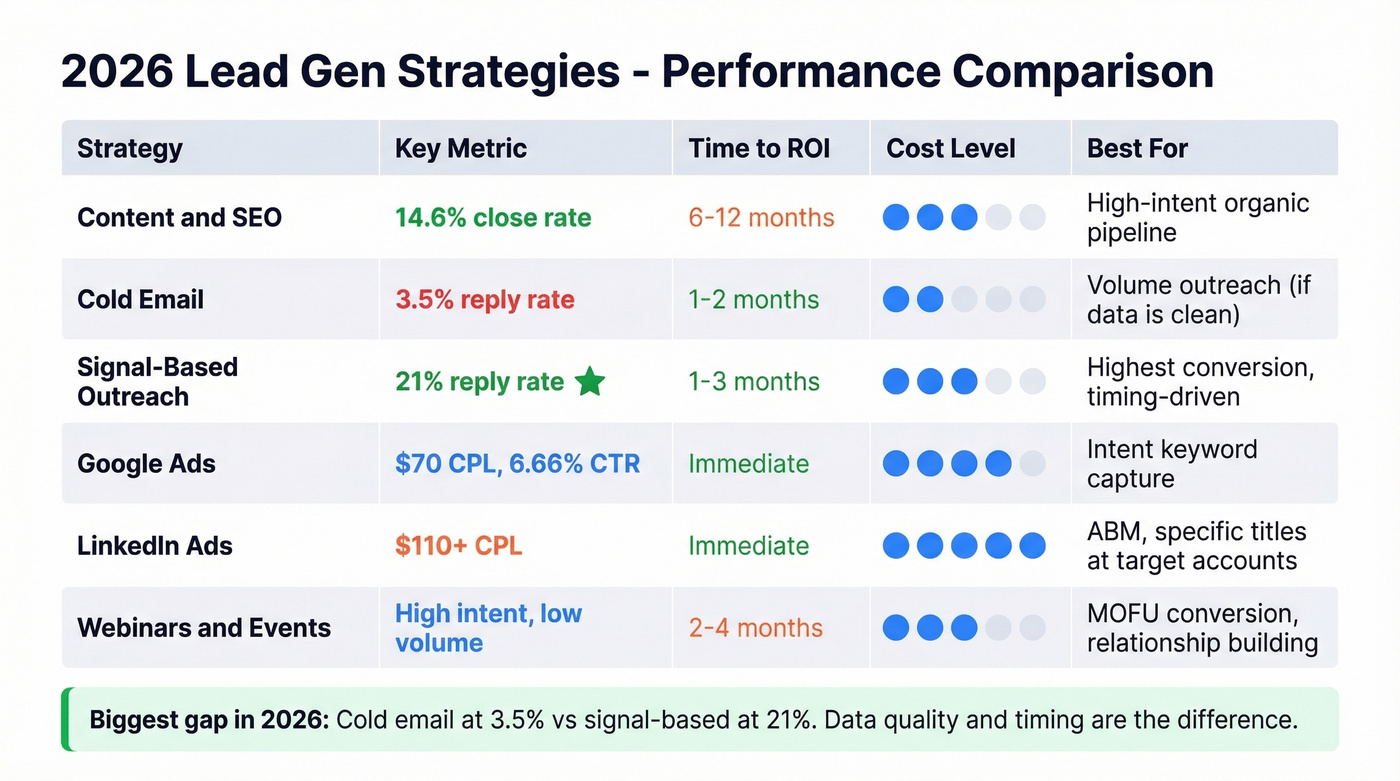
The tradeoff is time. SEO compounds but takes 6-12 months to build momentum. If you're not producing bottom-of-funnel content - comparison pages, "best X for Y" guides, integration tutorials - you're leaving the highest-intent traffic to competitors. We've watched teams triple organic pipeline in a year just by shifting 40% of their content calendar from thought leadership to BOFU comparison content.
Email (Cold and Warm)
Cold email averages a 3.5% reply rate. Warm email - triggered by a signal like a job change, funding event, or content engagement - hits 21%. That's not a marginal improvement. That's a different category of outreach.
Even the best cold email copy can't fix bad data. If 15% of your list bounces, your domain reputation takes the hit, and deliverability craters for every subsequent campaign. Signal-triggered outreach with verified contacts is how teams escape the 2% reply-rate trap. Data quality is the prerequisite, not the optimization. (If you're troubleshooting, start with email bounce rate.)
Paid Search and Social
Google Ads average CTR hit 6.66% based on 16,000+ campaigns, with an average CPL around $70. LinkedIn runs significantly more expensive at $110+ per lead. CPC increased across 87% of industries year-over-year, so expect these numbers to keep climbing.
The play: intent-based keyword targeting on Google paired with LinkedIn for ABM campaigns where you're willing to pay a premium to reach specific titles at specific companies. Running broad LinkedIn campaigns without tight targeting is how you burn $10k in a week with nothing to show for it.
Webinars, Events, and Community
Lower volume, higher intent. A webinar attendee who stays for the Q&A is a fundamentally different lead than someone who clicked a display ad. The challenge is scale - you can't run a webinar every day. Use them strategically for MOFU conversion, and repurpose the content into clips, blog posts, and nurture emails.
Signal-Based Prospecting
This is where the sharpest teams are investing in 2026. Instead of building static lists, they're monitoring signals - job changes, funding rounds, tech stack changes, hiring surges, intent spikes - and triggering outreach when the timing is right. If you want to operationalize this, start with identifying buying signals.
Tools like Clay (~$149/mo), Trigify, and Bombora power these workflows. The consensus on r/sales is clear: Clay is a go-to for orchestrating signal-based sequences, and practitioners are moving away from static list-building entirely. Blasting lists is out. Reading signals is in. (More detail: Clay list building.)
Landing Page Optimization
Average landing page conversion rate is 2.35%. Top performers hit 11%+. That gap represents the difference between a generic "request a demo" page and a targeted page with social proof, a clear value prop, and a short form.
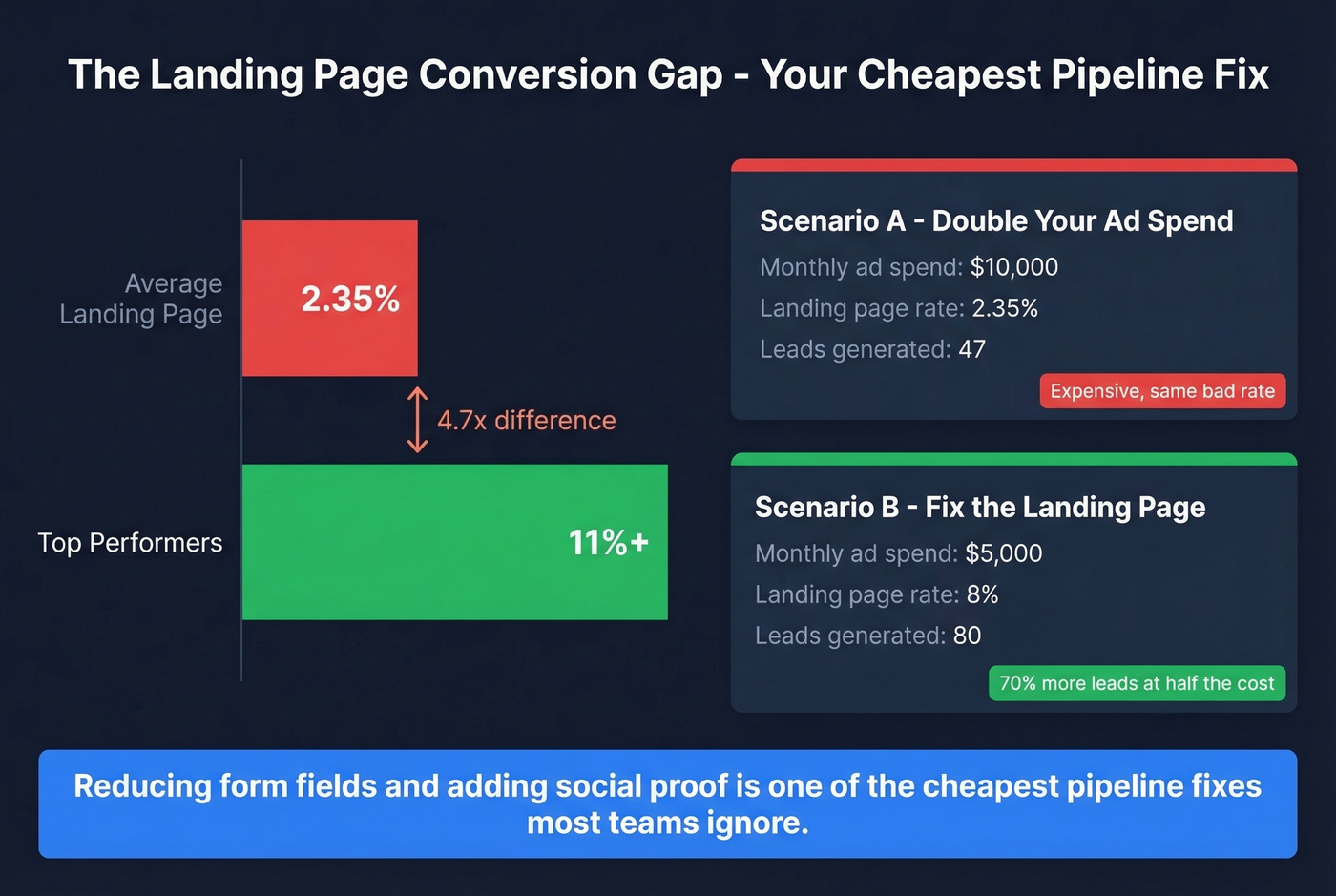
Here's the thing: if you're spending $5k/month on ads and sending traffic to a 2% landing page, fixing the page will do more for your pipeline than doubling your ad spend. Reducing form fields is one of the cheapest pipeline fixes most teams ignore.

You just read that 20% of leads bounce from bad data - at $198 per lead, that's devastating. Prospeo's 5-step verification delivers 98% email accuracy with a 7-day refresh cycle, so every lead you generate actually reaches a real inbox.
Stop lighting your lead gen budget on fire. Fix the data first.
2026 Lead Gen Benchmarks
Bookmark this table. These are the numbers your efforts should be measured against.
| Metric | Benchmark | Source |
|---|---|---|
| Avg CPL (all industries) | $198 | HubSpot |
| B2B paid digital CPL | $84 | Flyweel |
| Google Ads CPL | ~$70 | Flyweel |
| LinkedIn CPL | $110+ | Flyweel |
| Google Ads CTR | 6.66% | WordStream |
| Landing page CVR | 2.35% avg, 11%+ top | Industry data |
| Cold email reply | 3.5% | Industry data |
| Warm email reply | 21% | Industry data |
| SEO close rate | 14.6% vs. 1.7% outbound | Industry data |
| Speed-to-lead | 7x within 1 hour | Industry data |
| Healthy LTV:CAC ratio | 3:1 or higher | Industry standard |
A few things jump out. The gap between cold and warm email reply rates is the strongest argument for signal-based prospecting. The SEO close rate advantage makes the case for content investment. And the speed-to-lead multiplier - contacting within one hour makes you 7x more likely to qualify - is why AI-powered routing matters.
How to Score and Qualify Leads
Lead scoring separates pipeline from noise. Companies using lead scoring see 77% higher ROI on lead generation, and PQLs convert to opportunities at 20-30%. The framework has two dimensions.
Explicit scoring measures who they are - title, company size, industry, revenue. These are fit signals. Implicit scoring measures what they do - pages visited, content downloaded, emails opened, demo requested. These are intent signals. For a full setup, use a dedicated lead scoring model.
Here's a scoring template you can adapt today:
| Signal | Type | Points |
|---|---|---|
| C-level title | Explicit | +50 |
| Target industry | Explicit | +30 |
| Company size fit | Explicit | +20 |
| Pricing page visit | Implicit | +50 |
| Demo request | Implicit | +35 |
| Whitepaper download | Implicit | +20 |
| Blog visit | Implicit | +10 |
| Unsubscribed | Implicit | -50 |
Set your MQL threshold at 60-80 points. When a lead crosses it, route to sales automatically. The key is calibrating over time - if sales says the MQLs are garbage, your weights are wrong. In our experience, teams that skip scoring waste 30-40% of their SDR capacity on leads that were never going to convert. Review quarterly and adjust.
AI-Powered Lead Generation
AI isn't a magic bullet. It's a speed multiplier. And speed is everything when contacting a lead within one hour makes you 7x more likely to qualify them, while waiting 24+ hours drops that likelihood by 98%.
The problem AI solves is operational. Sellers spend just 28% of their time actually selling - the rest goes to admin, research, and data entry. AI recaptures that time through four concrete applications:
- Predictive lead scoring uses historical conversion data to weight signals automatically, reducing qualification time by up to 30% per Gartner. Best-in-class teams hit 90-95% forecasting accuracy with these models.
- Conversational AI - chatbots that actually qualify, not just deflect - can route high-intent visitors to sales in real time.
- Automated nurture triggers fire the right email when a lead hits a behavioral threshold, not when a marketer remembers to check.
- Personalization at scale tailors messaging to industry, role, and stage without requiring a human to write 50 email variants. (If you're applying this to outbound, see AI cold email outreach.)
A BCG analysis found that AI-leading companies achieve 1.7x revenue growth and 40% greater cost reductions than laggards. The gap is widening, not closing.
You don't need to build an AI team. You need to pick tools that embed AI into workflows you already run - scoring, routing, enrichment, sequencing. Let's break down the stack.
The Modern Lead Gen Tech Stack
You need 3-4 tools, not 15. We've seen teams with 12 tools in their stack that can't tell you which channel generated last quarter's pipeline. Complexity kills execution.
Here's the architecture that works: data, then enrichment/verification, then sequencing, then CRM, then analytics. Each layer has a job. Pick one tool per layer and make it work before adding anything else.
If your average deal size is under $10k, you almost certainly don't need a $15k/year data platform. A self-serve tool with verified data and a free tier will outperform an enterprise suite you're only using at 20% capacity.
Data layer (the foundation). Your entire lead generation strategy sits on top of your data. If the emails bounce and the phone numbers are disconnected, everything downstream fails. For this layer, we use Prospeo. It covers 300M+ professional profiles, including 143M+ verified emails and 125M+ verified mobile numbers, with 98% email accuracy on a 7-day refresh cycle - the industry average is six weeks. The 5-step verification process handles catch-all domains, spam traps, and honeypots, which means your sequences actually land. It plugs directly into Salesforce, HubSpot, Clay, Instantly, and Lemlist, so there's no manual export/import friction. With 30+ search filters including buyer intent signals, technographics, and job change data, you can build targeted lists without stitching together three different tools. Starts free with 75 emails/month, and paid plans run roughly $0.01 per email - no contracts.

Orchestration layer. Clay (~$149/mo) sits here, pulling signals from multiple sources and enriching records before they hit your sequencer. It's the workflow brain.
Sequencing layer. Instantly, Lemlist, or Smartlead (~$30-97/mo) handle the actual outreach - email sequences, follow-ups, A/B testing. Pick Instantly for multi-sender rotation or Lemlist for multichannel sequences.
CRM layer. HubSpot's free tier works for early-stage teams. Salesforce ($25-300/user/mo) is the enterprise standard. The CRM is the system of record, not the system of action. (If you're evaluating options, see examples of a CRM.)
Intent and analytics. Bombora and Trigify for buying signals. Semrush or Ahrefs ($99-449/mo) for SEO-driven lead gen tracking.
Mistakes That Kill Your Pipeline
Buying lead lists. Purchased lists are stale, unverified, and often scraped from questionable sources. Bounce rates above 10% are common, and your domain reputation takes months to recover. Build your own lists with verified data instead. If you're considering it anyway, read Is it illegal to buy email lists?
Skipping qualification. Sending every lead to sales wastes rep time and erodes trust between marketing and sales. Implement scoring - even a basic version - before you scale outreach.
Weak lead magnets. A generic "2026 Marketing Trends" PDF doesn't attract buyers - it attracts students. Create magnets that solve a specific problem for your ICP: templates, calculators, benchmark reports, checklists they can use today.
No follow-up strategy. 50% of qualified leads aren't ready at first contact, and the nurture cycle runs 6-12 touches. If your follow-up is "send one email, wait, give up," you're abandoning pipeline. That's frustrating to watch, and we see it constantly. Use proven sales follow-up templates instead of improvising.
Ignoring data quality. This is the silent killer. If your bounce rate is above 5%, your domain reputation is already damaged. One customer, Meritt, dropped their bounce rate from 35% to under 4% and tripled weekly pipeline from $100K to $300K after switching to verified data. That's the difference between a campaign that builds pipeline and one that gets your domain blacklisted.

Signal-based targeting beats volume blasting - the article proves it. Prospeo tracks 15,000 intent topics, job changes, and funding signals across 300M+ profiles so you reach buyers already in motion, not cold prospects who'll never reply.
Replace cold outreach with warm, signal-triggered prospecting at $0.01 per email.
Compliance: GDPR and CCPA
Compliance isn't optional, and getting it wrong is expensive. Here's what you actually need in place.
GDPR (EU/UK): Establish a lawful basis for processing - consent, legitimate interest, or contractual necessity. Consent must be freely given, specific, informed, and unambiguous, with no pre-checked boxes. Honor rights to access, correction, erasure, portability, and objection to marketing. Practice data minimization by collecting only what you need for the stated purpose. For cross-border transfers, use Standard Contractual Clauses or Binding Corporate Rules.
CCPA (California): Disclose what data you collect and why. Honor opt-out requests for sale or sharing of personal information. Process deletion requests within 45 days. Maintain clear privacy statements accessible from your website.
Vendor accountability matters too. Require Data Processing Agreements from every tool in your stack and audit your vendors annually. Any data provider you use should be GDPR compliant with opt-out enforced globally and DPAs available - that's the baseline, not a bonus. Skip this if you want to learn the hard way what a six-figure GDPR fine feels like.
FAQ
What is lead generation in marketing?
Lead generation in marketing is attracting potential buyers and capturing their contact information to nurture them toward a purchase. It spans the full funnel - from awareness content and SEO to qualification frameworks that identify who's ready for a sales conversation. Effective programs combine inbound tactics with signal-based outbound to fill pipeline with qualified prospects.
What's a good cost per lead in 2026?
Average B2B paid digital CPL is $84, Google Ads runs ~$70, and LinkedIn averages $110+. Across all channels and industries, the mean is $198. Aim for at least a 3:1 LTV-to-CAC ratio to ensure your spend generates profitable pipeline.
What's the difference between MQL and SQL?
An MQL has engaged with marketing content like downloads or webinar attendance but hasn't expressed buying intent. An SQL has explicitly signaled they want to evaluate your product - demo request, pricing inquiry, or "talk to sales" form. Lead scoring bridges the gap by assigning points to both fit and behavior signals.
Does cold outreach still work?
Lazy cold outreach doesn't - 2% reply rates and 97% cold call ignore rates prove that. Signal-triggered outreach with verified data hits 21% reply rates. Pairing accurate contact data with a tool like Clay for signal orchestration makes the difference between spam and timely, relevant outreach.
How many touches to convert a lead?
The nurture cycle runs 6-12 touches on average, and 50% of qualified leads aren't ready at first contact. Multi-channel sequences - email, social, phone - outperform single-channel. Space touches across 2-4 weeks and vary the format each time for best results.