

How to Build a Lead Nurturing Drip Campaign That Actually Converts
80% of new leads never convert into sales. Not because the leads are bad - because nobody followed up properly. You build a landing page, run ads, collect emails, and then blast the entire list with the same sequence. Half the emails bounce. Gmail flags your domain. The leads that were actually interested never hear from you again.
That's what happens without a lead nurturing drip campaign.
The fix isn't complicated. But most teams skip the one step that makes everything else work.
What You Need Before Building
Before you touch any automation tool, nail these three things:
- A clean, verified contact list. Bad data kills sequences before they start. If your bounce rate is in the double digits, nothing else matters. (If you want a deeper breakdown, start with email verification.)
- A 3-5 email sequence mapped to buyer stage with 2-4 day spacing. Not a newsletter. A journey. (Use a proven sales cadence structure as your baseline.)
- An automation tool. $8-$20/mo gets you most of what you need. Don't overthink it.
Only about 35% of B2B marketers have an established nurture strategy, and nurtured leads produce 50% more sales-ready opportunities at 33% lower cost. The bar is low, and the payoff is real.
Drip vs. Nurture - 30-Second Version
These terms get used interchangeably, but they aren't the same thing.
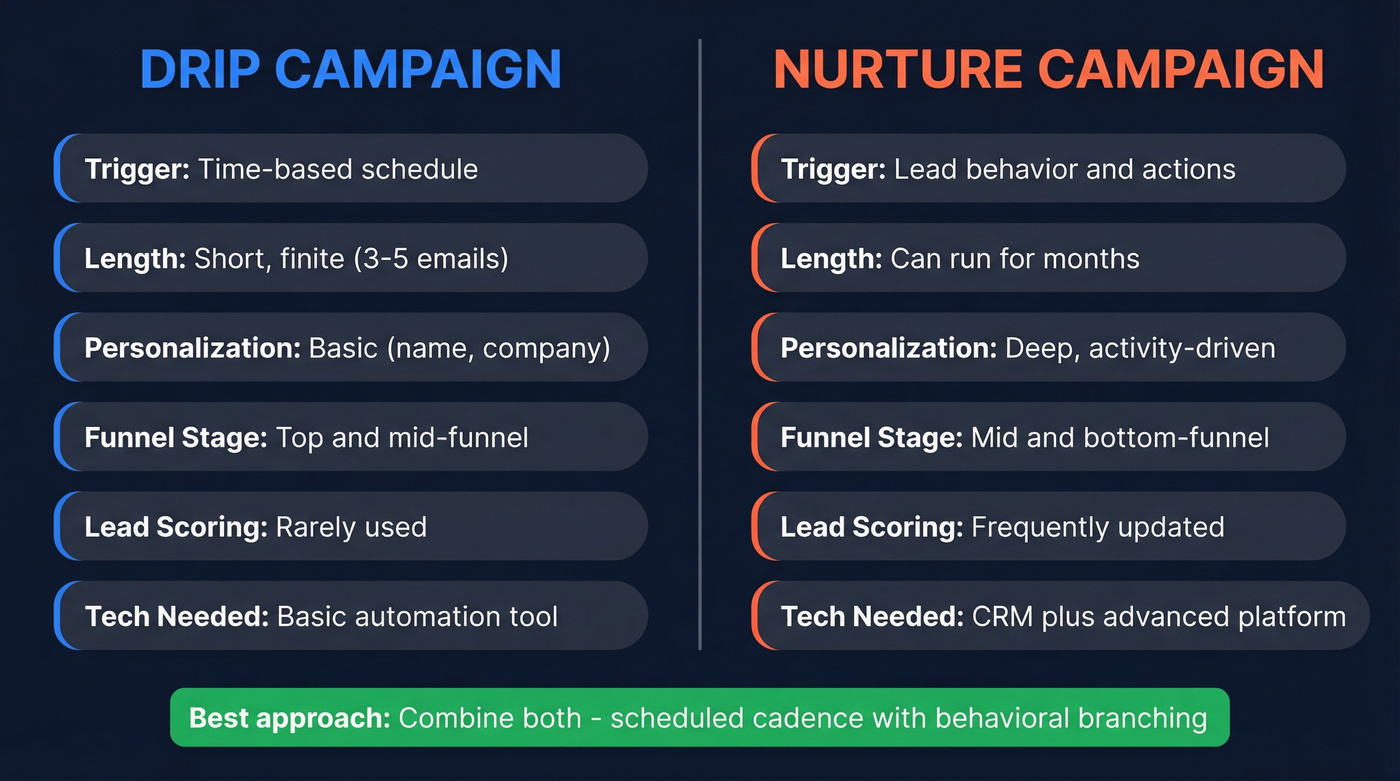
| Drip | Nurture | |
|---|---|---|
| Trigger | Time-based | Behavior-based |
| Length | Short, finite | Can run months |
| Personalization | Basic | Deep, activity-driven |
| Funnel stage | Top/mid | Mid/bottom |
| Lead scoring | Rare | Frequent |
| Tech needed | Basic automation | CRM + advanced platform |
A lead nurturing drip campaign combines both - a structured sequence that adapts based on engagement. You set the cadence, but the content shifts depending on what the lead actually does. That blend of behavioral logic and scheduled delivery is what separates high-performing sequences from generic autoresponders. (If you want examples you can copy, see lead nurturing emails.)

Step 1 of every successful drip campaign is a clean list - and most teams skip it. Prospeo verifies emails at 98% accuracy with a 7-day refresh cycle, so your nurture sequences actually reach inboxes instead of torching your domain. Upload a CSV, get verified contacts back in minutes, and push them straight to your sequencer.
Stop nurturing leads that don't exist. Start with verified data.
How to Build Your Sequence
Step 1 - Clean Your List First
This is the step every guide skips.
If a big chunk of your list bounces, your domain reputation tanks and Gmail throttles every subsequent email. We've seen teams burn through entire sending domains in weeks because they skipped verification. Meritt, an outbound agency, saw their bounce rate drop from 35% to under 4% after switching to verified data - that's the difference between a campaign that builds pipeline and one that torches your sender reputation. (Related: what a hard bounce actually means operationally.)

Prospeo handles this before you ever hit send. Real-time email verification at 98% accuracy, with a 7-day refresh cycle so your data doesn't go stale between campaigns. Upload a CSV, get clean results back in minutes, then push to your sequencer. (If you're cleaning lists across systems, follow a CRM hygiene process so bad records don’t creep back in.)
Step 2 - Define Audience and Triggers
Don't send the same sequence to everyone. A lead who downloaded a whitepaper is in a completely different headspace than someone who visited your pricing page three times this week. Segment by entry source and intent level. (This is basically behavioral segmentation applied to email.)
Common triggers that should launch a nurture sequence: form fill, content download, webinar signup, pricing page visit. Each one signals a different stage and deserves different content. A whitepaper download gets educational content; a pricing page visit gets a case study and a demo CTA.
Step 3 - Map the Sequence
A 3-email welcome series works for most B2B use cases. The complexity comes later in the funnel. (If you need templates, start from a drip campaign flowchart.)
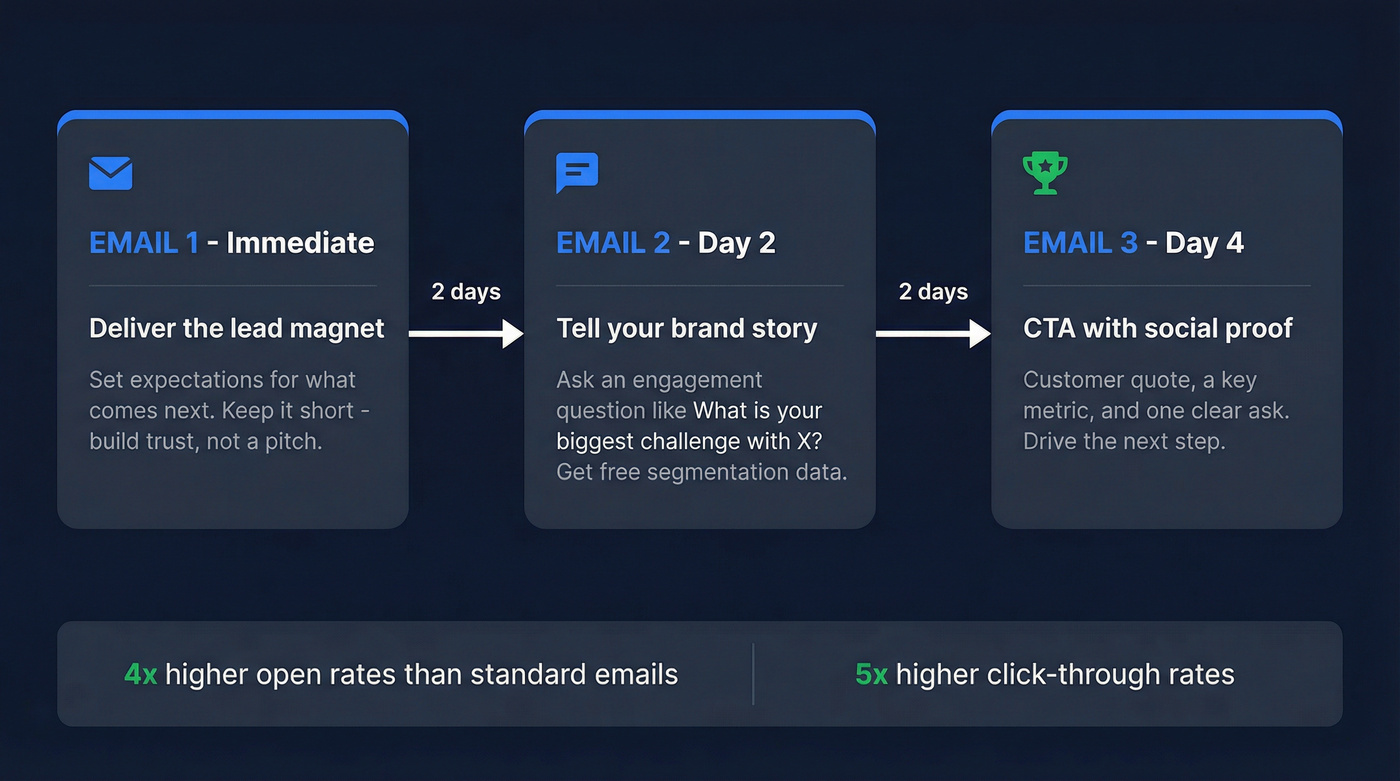
- Email 1 - immediate: Deliver the lead magnet. Set expectations for what's coming next. Keep it short - the goal is trust, not a pitch.
- Email 2 - Day 2: Tell your brand story. Ask an engagement question like "What's your biggest challenge with X?" This creates a reply opportunity and gives you segmentation data for free.
- Email 3 - Day 4: Next-step CTA with social proof. A customer quote, a metric, and a clear ask.
Welcome series emails see 4x higher open rates and 5x higher click-through rates than standard marketing emails, and 90% of welcome-series purchases happen in the first 72 hours. Front-load your best content.
Step 4 - Set Cadence and Timing
For most B2B sequences, stick to 1-2 emails per week during active nurture, spaced 2-4 days apart. Mid-week outperforms Monday and Friday. Aim for 8-10 AM in the recipient's timezone as your starting point, then test from there. (For more timing benchmarks, use best time to send prospecting emails as a reference point.)
Design every email mobile-first - over 50% of your audience will read on a phone. Match cadence to product complexity: simple products need a tight 2-3 email series, while complex or high-ticket products benefit from 5-7 emails over 2-3 weeks. Remember, subscribers skim emails for 2-8 seconds. Make every email skimmable with clear headers, short paragraphs, and one CTA.
Step 5 - Measure and Adjust
Track five metrics: open rate, click-through rate, bounce rate, unsubscribe rate, and conversion rate - whether that's a demo booked, a reply, or a purchase. Nurtured leads move through the sales cycle 23% faster, but only if you're iterating. (If you want to standardize reporting, map metrics to open rate vs click rate.)
Re-engage dormant leads after 30-60 days with a fresh angle. We've found that a simple "still interested?" email with a new resource can revive leads you'd otherwise write off entirely. (You can also pull ideas from re-engagement email subject lines.)
Mistakes That Kill Nurture Sequences
Here's the thing: most drip campaigns don't fail because of bad copy. They fail because of bad sequencing and bad data.
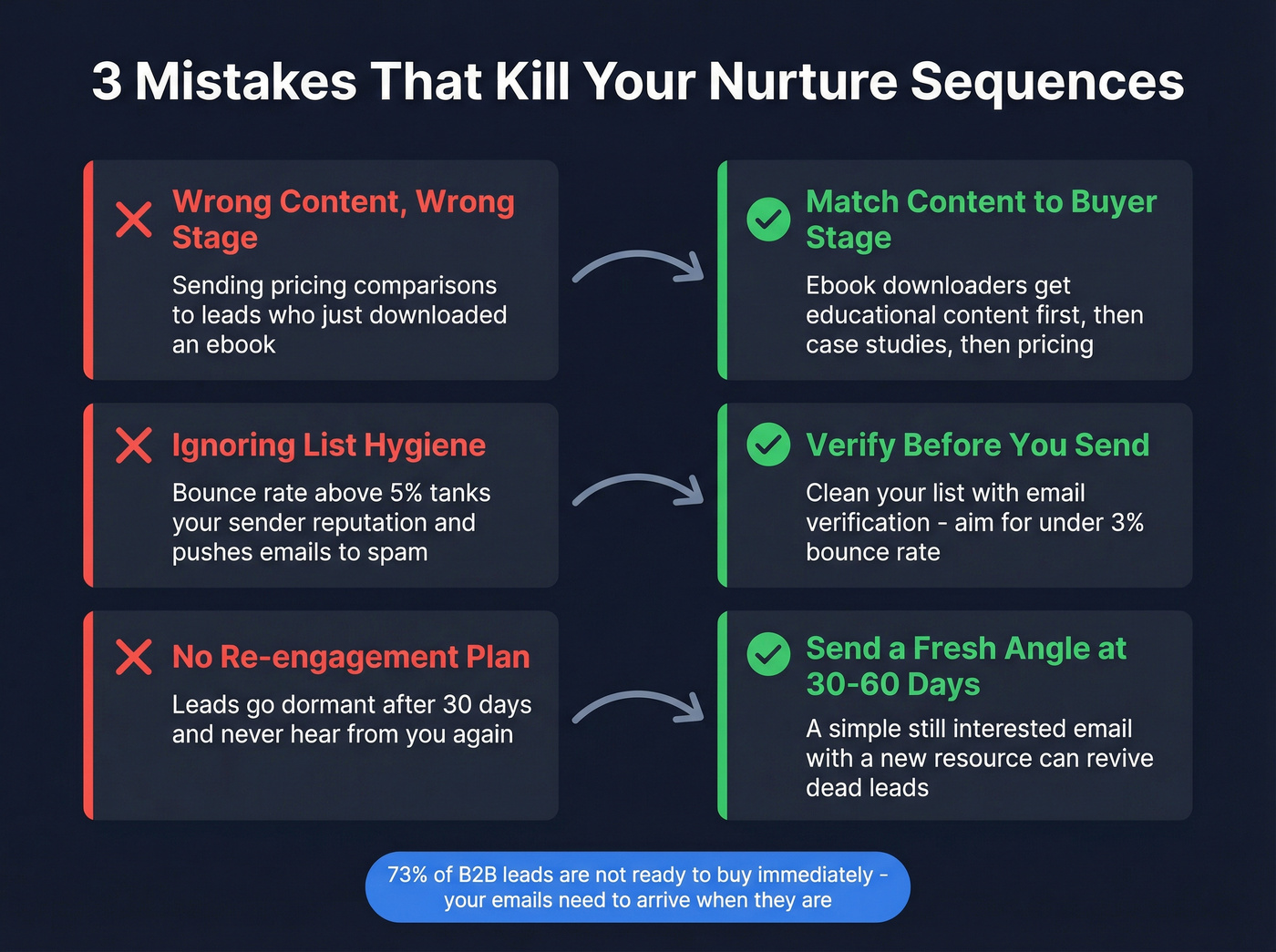
Sending decision-stage content to awareness-stage leads. Your lead downloaded an ebook about industry trends. Don't hit them with a pricing comparison on Day 1. Match content to where they are, not where you want them to be.
Ignoring list hygiene. If your bounce rate is above 5%, your automation tool isn't the problem - your data is. 73% of B2B leads aren't ready to buy immediately. You need those emails to actually arrive when they are ready. The consensus on r/sales is pretty clear on this: deliverability problems almost always trace back to dirty lists, not bad subject lines. (If you’re scaling volume, follow an email deliverability checklist so you don’t learn this the hard way.)
No re-engagement plan. Leads go dormant after 30 days and never hear from you again. A simple "still interested?" email with a fresh resource can revive leads you'd otherwise lose. Skip this step and you're leaving pipeline on the table.
Tools You Need (With Pricing)
You don't need a $500/month platform. In our experience, a ~$15/month automation tool paired with a clean list will outperform an enterprise stack with garbage data every single time. (If you’re comparing stacks, start with sales funnel tools.)
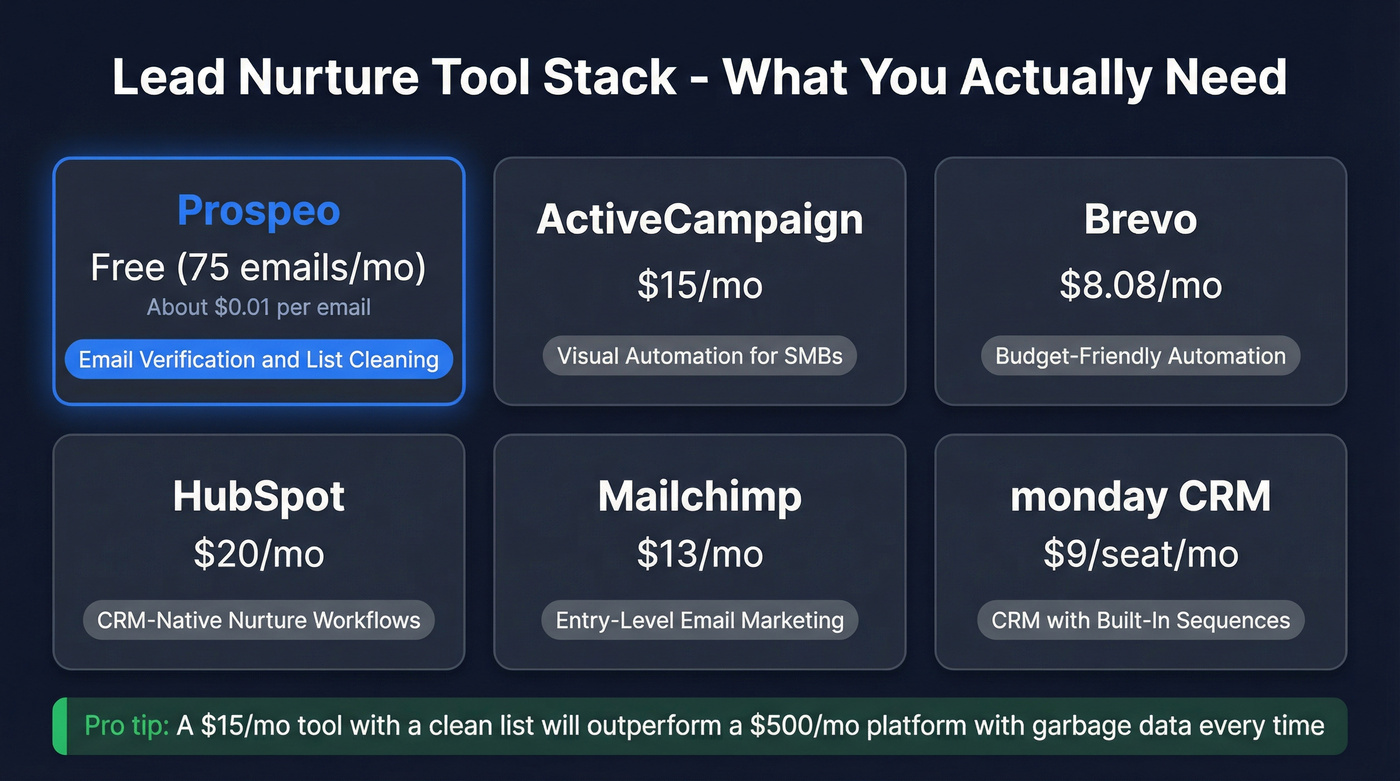
| Tool | Starting Price | Best For |
|---|---|---|
| Prospeo | Free (75 emails/mo); ~$0.01/email | Email verification and list cleaning |
| ActiveCampaign | $15/mo | Visual automation for SMBs |
| Brevo | $8.08/mo | Budget-friendly automation |
| HubSpot | $20/mo | CRM-native nurture workflows |
| Mailchimp | $13/mo | Entry-level email marketing |
| monday CRM | $9/seat/mo | CRM with built-in sequences |
If you're starting from zero, ActiveCampaign or Brevo gets most teams moving within a day. HubSpot makes sense when you want nurture sequences living inside your CRM. For teams already running outbound at scale through tools like Smartlead or Instantly, Prospeo plugs directly into those platforms via native integrations - so you can verify, enrich, and push contacts without switching tabs.
But regardless of which platform you pick, verify your list before you activate any sequence. Stack Optimize built from $0 to $1M ARR using verified data - deliverability stayed above 94% with bounce rates under 3% across all their clients. That's not a fluke; it's what happens when your foundation is clean.
Let's be honest: if you're spending hours crafting the perfect nurture sequence but sending it to unverified emails, you're optimizing the wrong thing.
Meritt tripled their pipeline from $100K to $300K/week after dropping their bounce rate from 35% to under 4% with Prospeo. Your drip campaign can't nurture leads that never receive your emails. At ~$0.01 per verified email, cleaning your list costs less than a single bounced send costs your domain reputation.
A 35% bounce rate kills campaigns. A 4% bounce rate builds pipeline.
FAQ
How many emails should a lead nurturing drip campaign have?
Three to five for most B2B sequences. Simple products with deal sizes under $5K need 2-3 emails. Complex or high-ticket products benefit from 5-7 emails over 2-3 weeks, matching the length of the buying cycle.
What's a good open rate for a nurture sequence?
Aim for 20-30% open rates on B2B nurture emails. Welcome series emails perform roughly 4x higher than standard sends. If you're consistently below 15%, check list quality and sender reputation first - bad data is usually the culprit, not your subject line.
Do I need to verify my list before sending?
Yes. A bounce rate above 5% damages your sender reputation and pushes future emails to spam. Most free tiers from verification tools let you test a small segment before scaling - that's enough to see the impact on deliverability before committing.
What's the difference between a drip campaign and a nurture email?
A standard drip campaign sends time-based messages on a fixed schedule. A nurture email adapts its content based on lead behavior - clicks, opens, page visits - making it far more effective at moving prospects through the funnel. The best sequences blend both approaches: scheduled cadence with behavioral branching.