

How to Build an Outbound Email Sequence That Actually Gets Replies
You launched 500 emails on Monday. By Thursday, you're staring at an 8% open rate and two replies - both asking to be removed from your list.
Your outbound email sequence isn't the problem. The infrastructure underneath it is. 17% of cold emails never reach the inbox, and most guides skip the part that actually fixes that. Here's the short version of what separates sequences that book meetings from sequences that burn domains:
- Fix your infrastructure first. Dedicated domains, warm-up, SPF/DKIM/DMARC. Without this, your copy doesn't matter. (If you need the full checklist, start with our email deliverability guide.)
- Run 4-7 emails using the cluster + bump structure (framework below). (You can also compare this to a B2B cold email sequence build.)
- Verify your list before sending. Bounce rates above 2% destroy domain reputation. (More on email bounce rate benchmarks and fixes.)
What Is a Cold Email Sequence?
A cold email sequence is a pre-planned series of emails sent to prospects over a set timeframe, designed to generate replies through multi-touch follow-up. The average cold email reply rate in 2026 is 3.43%. Top-quartile campaigns hit 5.5%+, and the top 10% exceed 10.7%.
The gap between average and elite comes down to three things: infrastructure, data quality, and sequence structure. Not subject lines. Not ChatGPT prompts. The boring stuff. (If you want a deeper playbook, see cold email marketing.)
Fix Your Infrastructure First
Look, this is the part everyone skips. They write clever subject lines while their emails land in spam folders. (If you're testing angles, pull from these cold email subject line examples.)
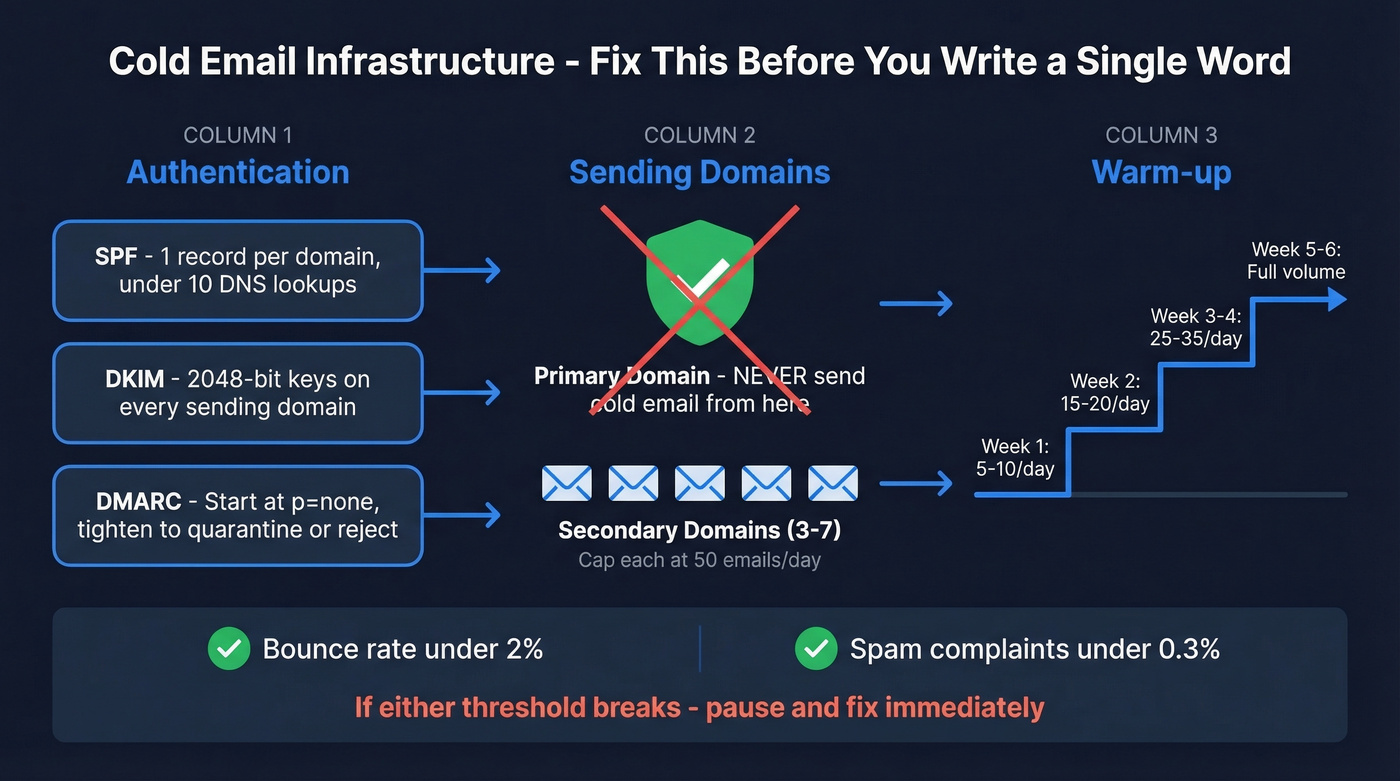
Without SPF, DKIM, and DMARC, nothing else matters. One SPF record per domain, under 10 DNS lookups, 2048-bit DKIM keys, and DMARC starting at p=none before tightening to quarantine or reject. Microsoft tightened enforcement around deliverability in 2025, making authentication even more critical. Include one-click unsubscribe headers (RFC 8058) - it's required for bulk senders on Gmail and Yahoo. (If you want to go deeper, review DMARC alignment and a practical SPF record example.)
Dedicated sending domains. Never send cold email from your primary domain. Buy 3-7 secondary domains and keep each under 50 emails/day. One practitioner on r/Entrepreneur doubled their reply rate from 3% to 6% after expanding from 3 domains to 7, capping at 26 emails/day per domain. Set up a custom tracking domain via CNAME to isolate your tracking reputation from your sending domain. (Here’s the full breakdown on what a tracking domain is and how to set it up.)
Warm-up takes 4-6 weeks. Start new domains at 5-10 emails/day and ramp gradually. Inbox placement varies by provider - Gmail sits at 87.2%, Microsoft at 75.6%. Teams that skip warm-up burn through domains in weeks. (To keep volume safe, follow email velocity limits.)
A realistic cold outbound stack runs about $420/month and generates roughly 16 qualified leads. That's the math you should benchmark against.
Your guardrails: bounce rate under 2%, spam complaints under 0.3%. If either threshold breaks, pause and fix before sending another email.
Clean Your Data Before You Send
Skip purchased lists. They're full of dead addresses, catch-all domains, and higher-risk emails that erode your sender reputation over weeks. The practitioner who doubled their reply rate also dropped their bounce rate from 11% to under 2% - simply by verifying every contact before sending. (If you’re building lists from scratch, use this how to generate an email list playbook.)
We've seen this pattern repeatedly: teams blame their copy when the real culprit is a 6% bounce rate silently tanking their domain reputation. Prospeo's real-time 5-step verification catches bounces, spam traps, and catch-all domains before they do damage. At 98% email accuracy, you're sending to real inboxes - not burning credits on dead addresses. (If you’re comparing vendors, start with data enrichment services.)
What that looks like in practice: Meritt tripled their pipeline from $100K to $300K/week after dropping bounce rates from 35% to under 4%. Stack Optimize maintains 94%+ client deliverability with zero domain flags across all their accounts.
The free tier gives you 75 emails/month to test it.

Bounce rates above 2% silently kill your outbound email sequence. Prospeo's 5-step verification delivers 98% email accuracy - catching spam traps, dead addresses, and catch-all domains before they torch your sender reputation.
Stop burning domains. Verify every contact before you hit send.
The 4-7 Touch Sequence Framework
The sweet spot is 4-7 touches. Beyond 7, returns diminish unless each email adds genuinely new value. Here's the cluster + bump model - a framework shared by a practitioner on r/sales that drove hundreds of millions in pipeline. (For ready-to-use copy, see these cold email follow-up templates.)
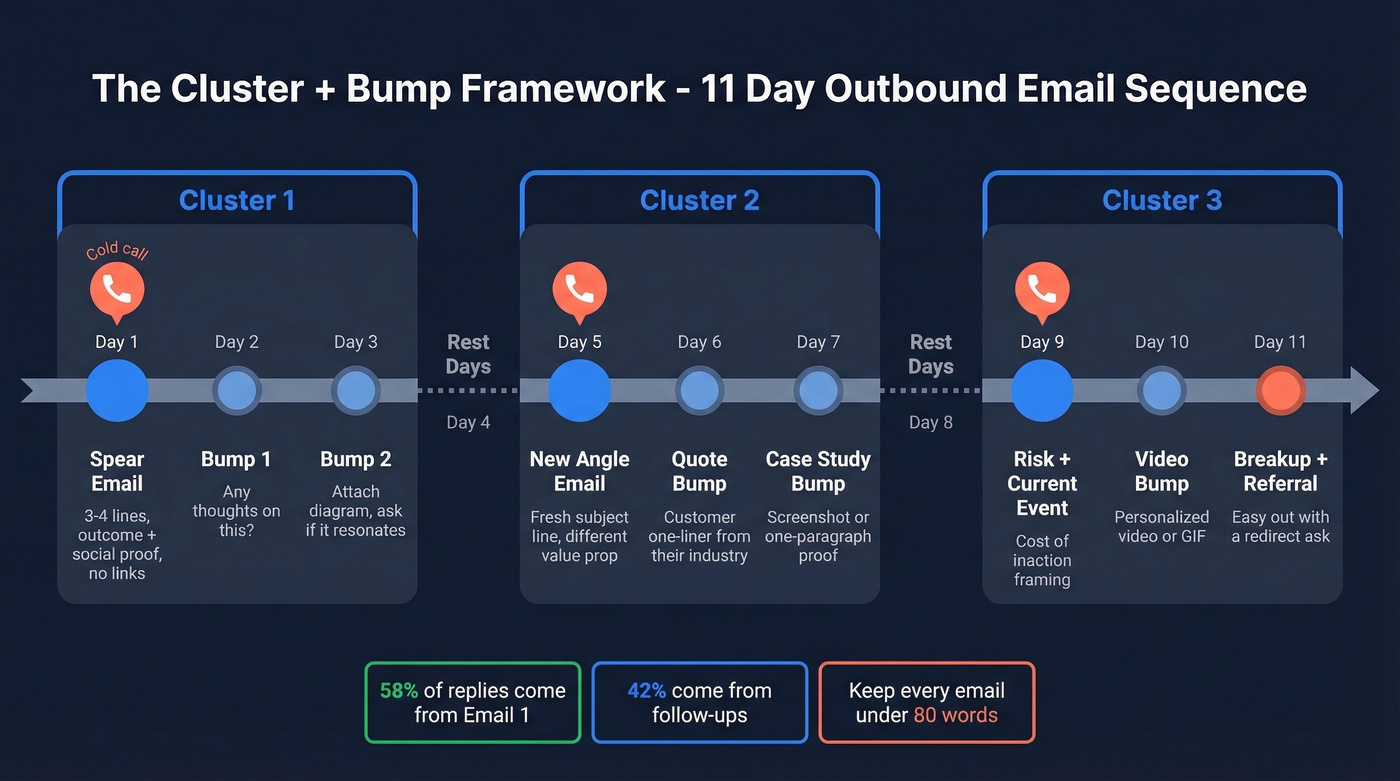
The structure uses 3 clusters across 11 days. Each cluster has one fresh email plus two "bumps" - short replies in the same thread that push the prospect back to your original message. Some frameworks rotate themes across emails; the cluster model rotates angles while keeping bumps in-thread, which consistently outperforms linear sequences in our experience.
Instantly's data shows 58% of replies come from the first step overall, but follow-ups contribute the other 42%. Don't skip them. Keep every email under 80 words. Pair cold calls on Days 1, 5, and 9 - email delivers context, phone breaks the pattern - for a multi-channel lift of 15-25% on positive reply rates. (If you’re building the calling side too, use a cold calling system.)
Cluster 1 (Days 1-3)
Day 1 - The spear email. Three to four lines. Lead with a customer outcome relevant to the prospect's role, add one line of social proof, and close with a low-friction ask. No links, no images on the first send.
Day 2 - Bump 1. Reply in the same thread: "Any thoughts on this, [Name]?" That's it.
Day 3 - Bump 2. Attach a simple diagram or screenshot and ask: "Curious if this resonates with what you're seeing at [Company]."
Cluster 2 (Days 5-7)
Day 5 - New angle email. Fresh subject line, different value prop. If Cluster 1 led with outcomes, lead with a specific customer quote or metric here.
Day 6 - Customer quote bump. Reply in-thread with a one-liner from a customer in their industry.
Day 7 - Case study bump. Drop a screenshot or one-paragraph case study. Keep it visual.
Cluster 3 (Days 9-11)
Day 9 - Current event + risk framing. Tie your outreach to something happening in their industry right now. Frame the cost of inaction.
Day 10 - Video bump. A short personalized video or relevant GIF breaks the pattern. Reply in-thread.
Day 11 - Last-touch breakup with a referral ask. "Seems like the timing isn't right - totally get it. Any chance you could point me at the person who handles [specific function] at [Company]?" The referral ask converts well because it gives them an easy out that still helps you.
2026 Benchmarks
| Metric | Average | Top Quartile |
|---|---|---|
| Open rate | 20-30% | 35-50% |
| Reply rate | 1-3% | 4-8% |
| Positive reply | 0.5-1.5% | 2-4% |
| Meeting booked | 0.3-0.8% | 1-2% |
| Bounce rate | <5% | <2% |
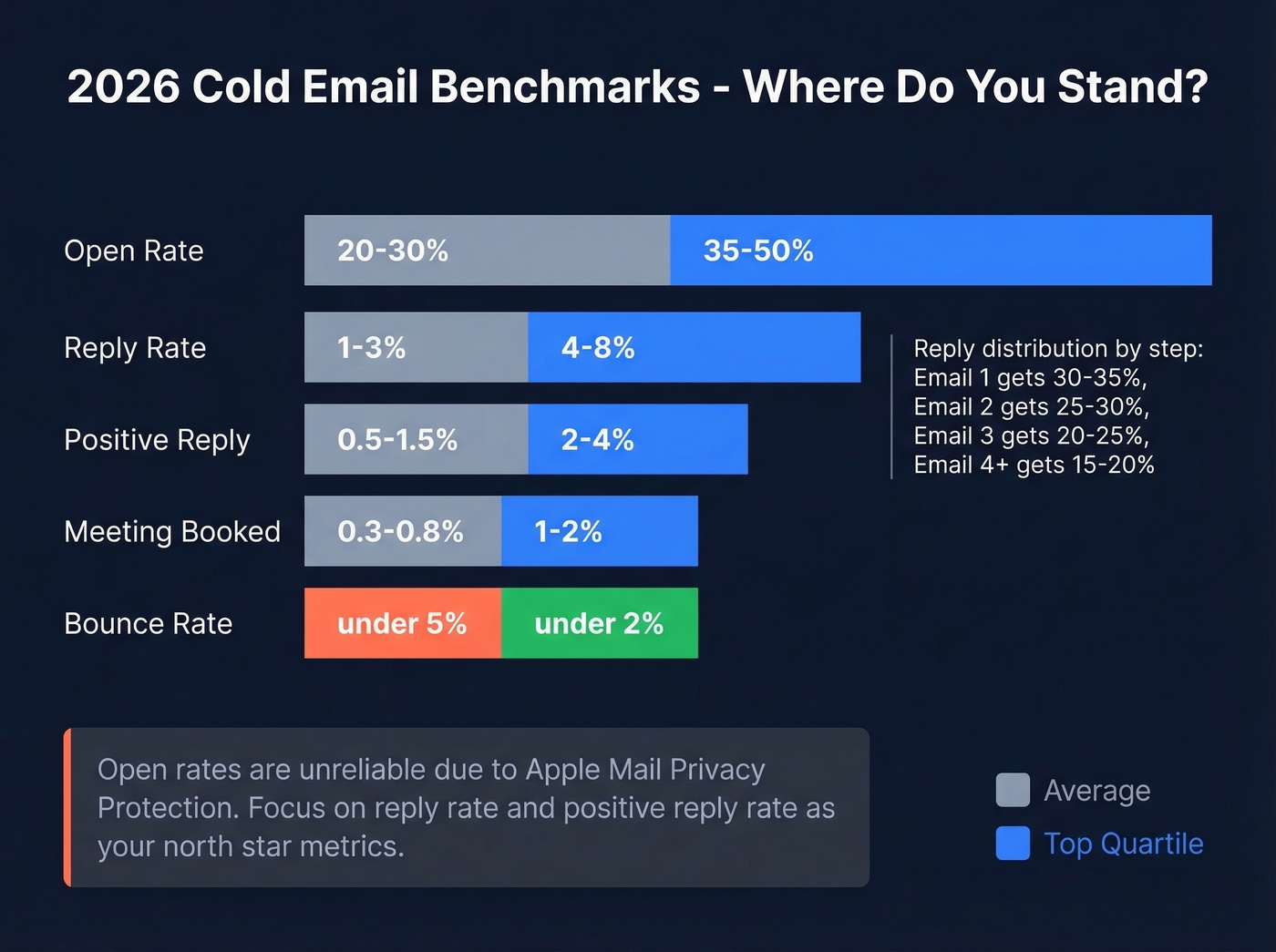
Open rates are increasingly unreliable thanks to Apple Mail Privacy Protection - prioritize reply rate and positive reply rate as your north star metrics. SaaS companies average 80.9% inbox placement with a 7.6% spam rate, so if you're below that, your infrastructure needs work before your copy does.
By sequence step, Email 1 generates 30-35% of replies in SaaS campaigns, Email 2 pulls 25-30%, Email 3 gets 20-25%, and Email 4+ accounts for 15-20%. Invest your best copy in the first two touches.
Tips to Sharpen Your Outbound Cadence
Here's a frustrating truth: if your reply rate is below 2%, rewriting your emails is a waste of time. The problem is almost always upstream - bad data, poor deliverability, or both. Fix those first, then worry about wordsmithing. (If you need a broader system, use these sales prospecting techniques.)
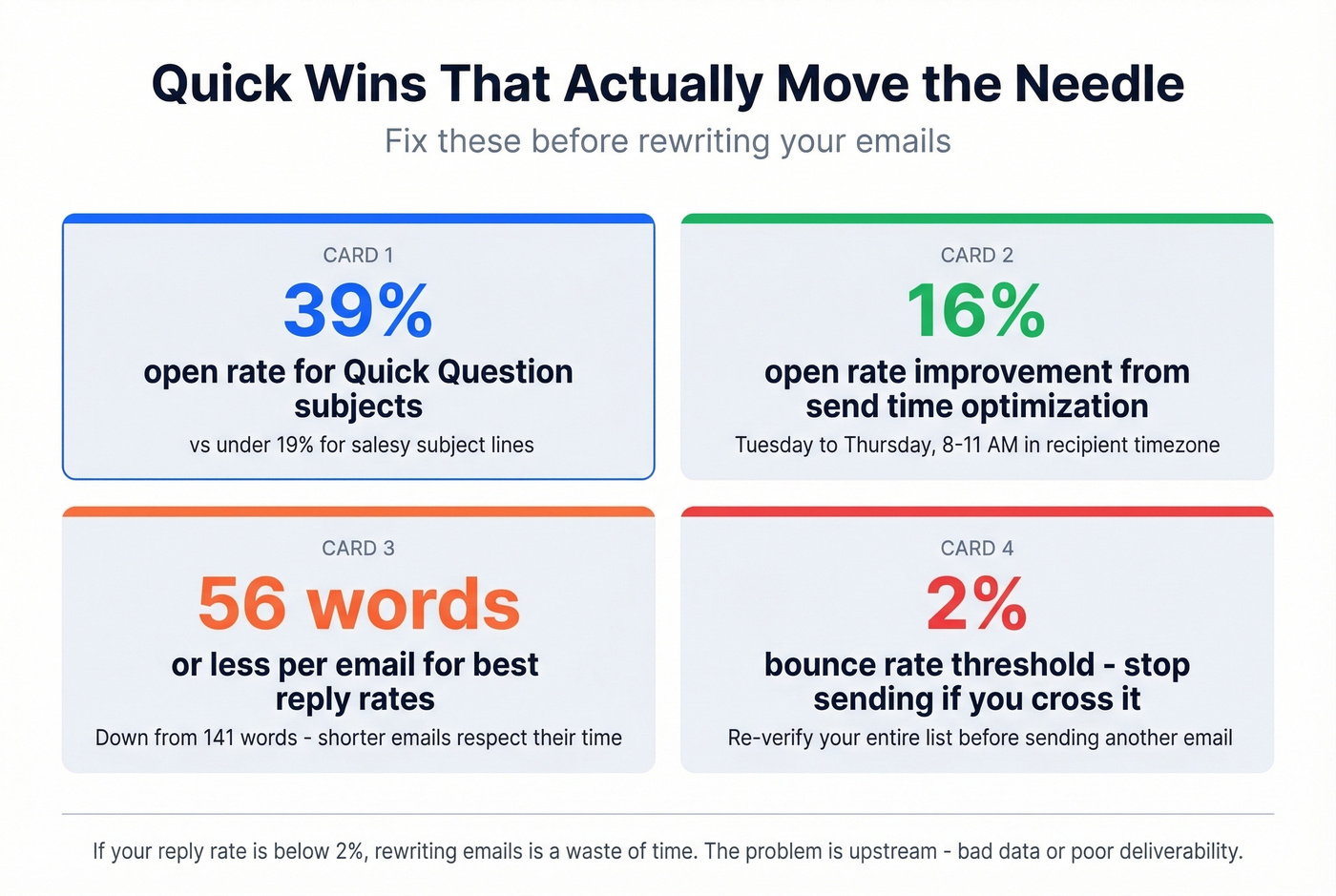
A/B test weekly, not monthly. Subject lines, opening lines, and CTAs. "Quick question" pulls 39% opens vs. under 19% for salesy subjects. One practitioner saw measurable improvement going from 141 words to under 56 - shorter emails respect the prospect's time and get more replies. (If you want more options, use these email subject line examples.)
Send Tuesday through Thursday, 8-11 AM in the recipient's timezone. This alone improved opens by 16% in one documented case. And if your bounce rate creeps above 2%, stop sending and re-verify your list before another email goes out. (Timing benchmarks: best time to send cold emails.)
Let's be honest about one more thing: if you're running sequences for multiple clients or territories, the math on domain management gets ugly fast. Budget for it. The teams we've seen scale past 10,000 emails/month without deliverability issues all treat domain infrastructure as a line item, not an afterthought.
A 7-touch sequence means nothing if half your emails land in spam. Teams using Prospeo data run bounce rates under 4% and book 26% more meetings than ZoomInfo users - because every address is verified on a 7-day refresh cycle, not stale 6-week-old records.
Clean data turns your sequence framework into actual pipeline.
FAQ
How many emails should an outbound email sequence have?
Four to seven. Benchmark data shows diminishing returns beyond 7 touches. If you're new to outbound, start with 5 - three fresh emails plus two bumps - and expand from there based on reply data.
What reply rate should I expect from cold email?
The 2026 average is 3.43%. Top-quartile campaigns hit 5.5%+. If you're below 2%, check deliverability and data quality before rewriting copy.
How do I stop my outbound emails from landing in spam?
Set up SPF, DKIM, and DMARC on dedicated sending domains. Warm up for 4-6 weeks. Keep bounce rates under 2% by verifying your list before every send. Include one-click unsubscribe headers. Skip this if you're only sending to warm contacts who've opted in - these rules are specifically for cold outreach at scale.
Do these principles apply to B2B outreach sequences?
Yes. B2B outreach sequences follow the same infrastructure and cadence rules, but the personalization bar is higher because you're targeting specific decision-makers. The cluster + bump framework above was designed for B2B - where each touch needs to reference the prospect's role, company, or industry to earn a reply.