

The 7 Personal Selling Process Steps: Scripts, Frameworks, and Benchmarks
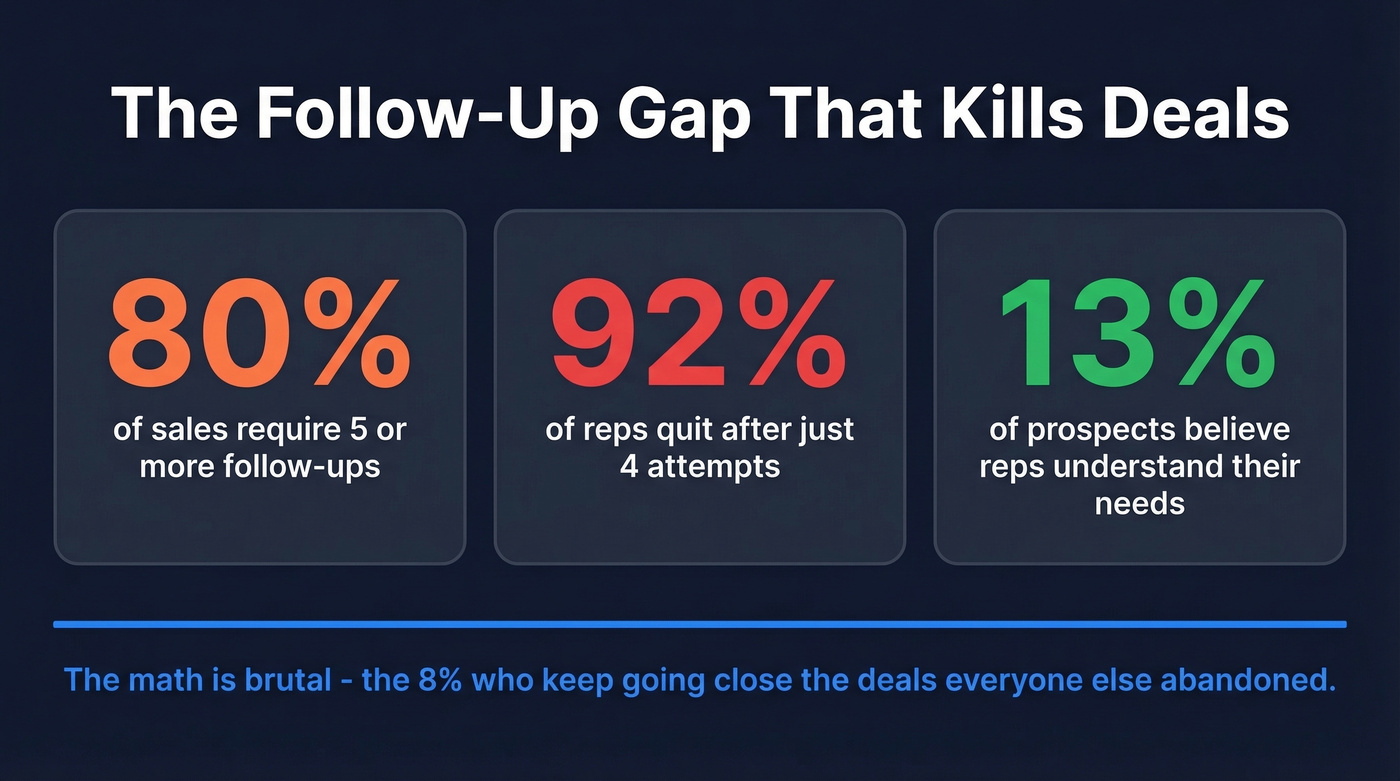
Every guide on the personal selling process steps reads like a marketing textbook from 2005. The steps are the same - they've been taught in essentially the same form for decades. But the game is completely different. Only 13% of prospects believe a sales rep can understand their needs, and just 5% of B2B buyers say salespeople exceed their expectations. The framework isn't the problem. The execution is.
The Short Version
The seven steps are: prospecting, pre-approach, approach, presentation, objection handling, closing, follow-up. That sequence is correct and has been standard for decades. What separates good reps from bad ones comes down to three things:
- They ask better questions. Not more questions - better ones. The kind that make a prospect pause and think. (If you want a tighter discovery system, start with these discovery questions.)
- They qualify ruthlessly. The best reps spend the majority of their energy making sure they're talking to the right person about the right problem at the right time. Use an Ideal Customer Profile so qualification isn’t vibes-based.
- They follow up longer than everyone else. 80% of sales require five or more follow-ups. 92% of reps quit after four. The math is brutal and obvious. If you need copy you can deploy today, use these sales follow-up templates.
The rest of this article is the tactical playbook behind those three truths.
What Is Personal Selling?
Personal selling is direct, two-way communication between a salesperson and a prospect - whether that happens in person, over the phone, on a video call, or through a well-timed email thread. It's the opposite of a billboard or a drip campaign. It's adaptive, responsive, and expensive to scale, which is exactly why it works for complex, high-value deals where the buyer needs more than a pricing page to make a decision.
Don't confuse personal selling with direct selling. Personal selling is about the approach - adaptive conversation - while direct selling is about the distribution model. And within personal selling, roles vary: order-takers process inbound demand, while order-getters (your BDRs, AEs, and enterprise reps) actively create new business. Most of this guide is written for order-getters, because that's where the process matters most. (If you’re building the stack around that motion, start with these SDR tools.)
If you're selling a $50/month SaaS tool, self-serve wins. If you're selling a $50,000 annual platform to a committee of 7+ stakeholders, you need a human in the room. The process earns its cost when the complexity of the deal demands real-time dialogue and trust-building that no automated sequence can replicate.
The 7 Steps in Personal Selling
Step 1 - Prospecting and Qualifying
42% of salespeople say prospecting is the hardest part of the job. That tracks. It's the step where most processes break before they even start - not because reps can't find names, but because they find the wrong ones, or the data behind those names is garbage. If you want a modern playbook, use these sales prospecting techniques.
Lead sources span inbound (website forms, content downloads, event signups) and outbound (cold lists, referrals, professional profile searches, intent signals). The source matters less than what you do next: qualify.
Here's the thing - qualification is the most underrated step in the entire process. Every minute invested here saves hours wasted on dead-end demos. The risk cuts both ways: over-qualifying slows your pipeline to a crawl, while under-qualifying inflates your forecast and wastes everyone's time.
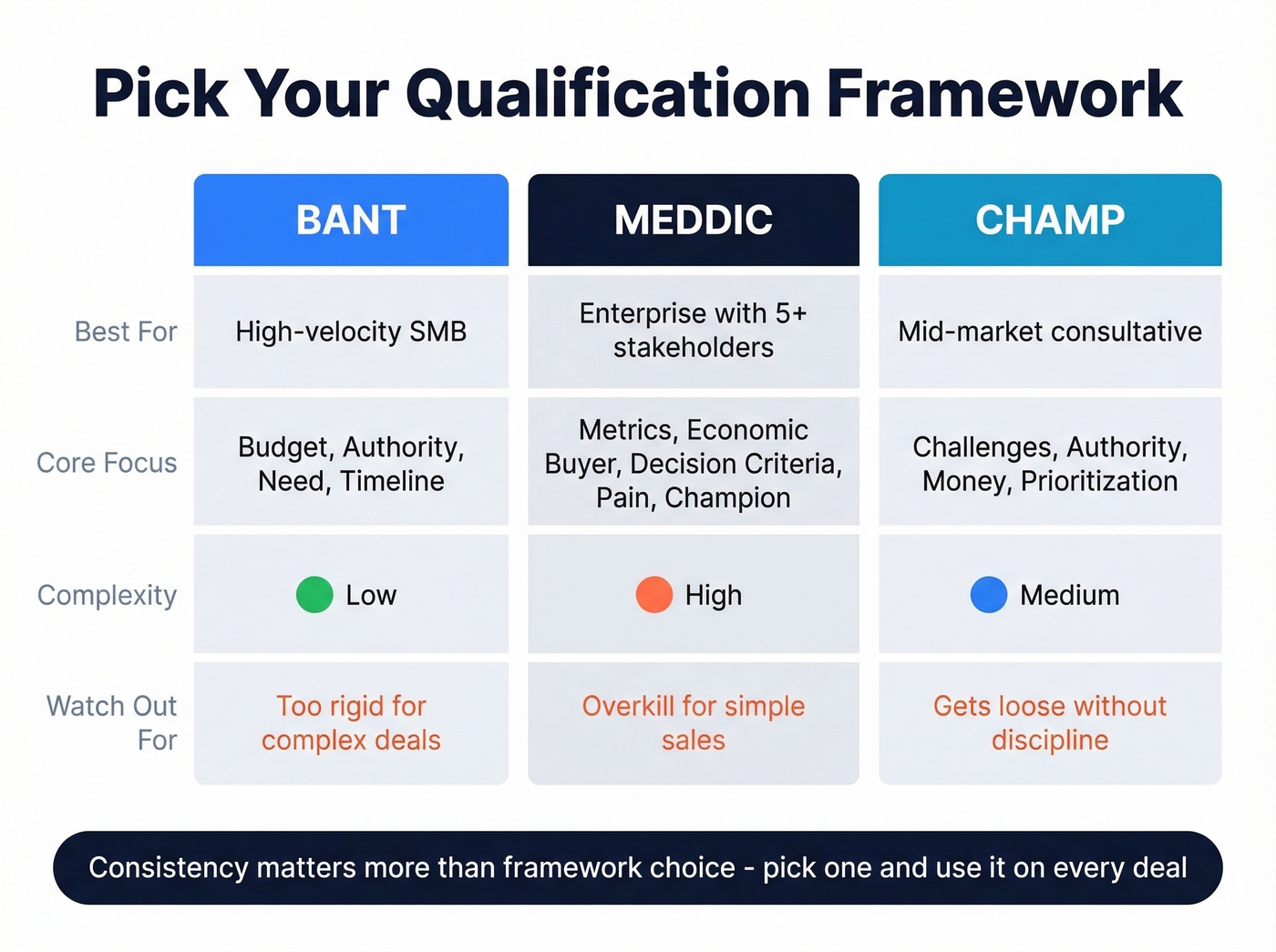
| Framework | Best For | Core Questions | Risk |
|---|---|---|---|
| BANT | High-velocity SMB | Budget, Authority, Need, Timeline | Too rigid for complex deals |
| MEDDIC | Enterprise, 5+ stakeholders | Metrics, Economic Buyer, Decision Criteria/Process, Pain, Champion | Overkill for simple sales |
| CHAMP | Mid-market consultative | Challenges, Authority, Money, Prioritization | Gets loose without discipline |
Consistency matters more than framework choice. Pick one, train your SDRs and AEs on it, and use it on every deal - not just the ones that feel uncertain. (If you’re standardizing MEDDIC, these MEDDIC discovery questions help.)
None of this matters if your prospecting data is broken. We've seen teams send 500 cold emails and watch 180 bounce - that's not a messaging problem, that's a data problem. Prospeo's database covers 300M+ professional profiles with 98% verified email accuracy on a 7-day data refresh cycle, versus a 6-week industry average. Before you invest in perfecting steps 2 through 7, make sure step 1 isn't leaking. If bounces are killing you, start with email bounce rate benchmarks and fixes.

Step 2 - Pre-Approach
Before you pick up the phone or write the first email, do the homework. The pre-approach turns a name on a list into a person you can have a relevant conversation with.
Your pre-approach checklist:
- Company research - recent funding, earnings, product launches, hiring patterns, tech stack
- Stakeholder mapping - who's the economic buyer, who's the champion, who's the blocker? With 7.4 decision-makers involved in a typical B2B purchase, you need to know the org chart before the first call
- CRM prep - log what you know in Salesforce, HubSpot, or whatever your team runs, and flag gaps (if you’re evaluating options, here are examples of a CRM)
- Data verification - confirm the email and phone you have are still valid, because people change jobs faster than most databases update (use this workflow to check if an email exists)
In our experience, this step takes 10-15 minutes per prospect. Reps who skip it routinely waste 30-45 minutes on calls that go nowhere.
Step 3 - Approach
The approach is your first real interaction with the prospect. Get it wrong and you're fighting uphill for the rest of the deal.
The best first touches share two traits: they're relevant to the prospect's world, and they set clear expectations for the conversation. Don't open with a pitch. Open with curiosity. Whether you follow SPIN Selling's situation-problem-implication-need framework, the Challenger model's teach-tailor-take-control approach, or a homegrown methodology, the principle is the same: lead with the buyer's reality, not your product. (For outreach that doesn’t sound templated, use this personalized outreach playbook.)
A practitioner-compiled question bank from r/sales organizes discovery questions by phase. Here are the ones worth memorizing:
Opening/Discovery:
- "What's going on in your world that made you decide to talk to me?"
- "Why did you agree to meet with me today?"
Uncovering Pain:
- "What happens if nothing changes?"
- "If you didn't solve this problem in the next 6-12 months, what would the impact be?"
Qualifying:
- "Who else should be involved in this decision before we move forward?"
Surfacing Objections Early:
- "What's the main reason you would hesitate?"
Set expectations upfront: "I'll ask some questions, share how we've helped similar teams, and if there's a fit, we'll talk next steps. If not, I'll tell you." That one sentence drops the prospect's guard more than any rapport-building small talk ever will.
Step 4 - Presentation
Here's where most reps blow it. They finally get the meeting, and they talk for 40 minutes straight about features the prospect didn't ask about.
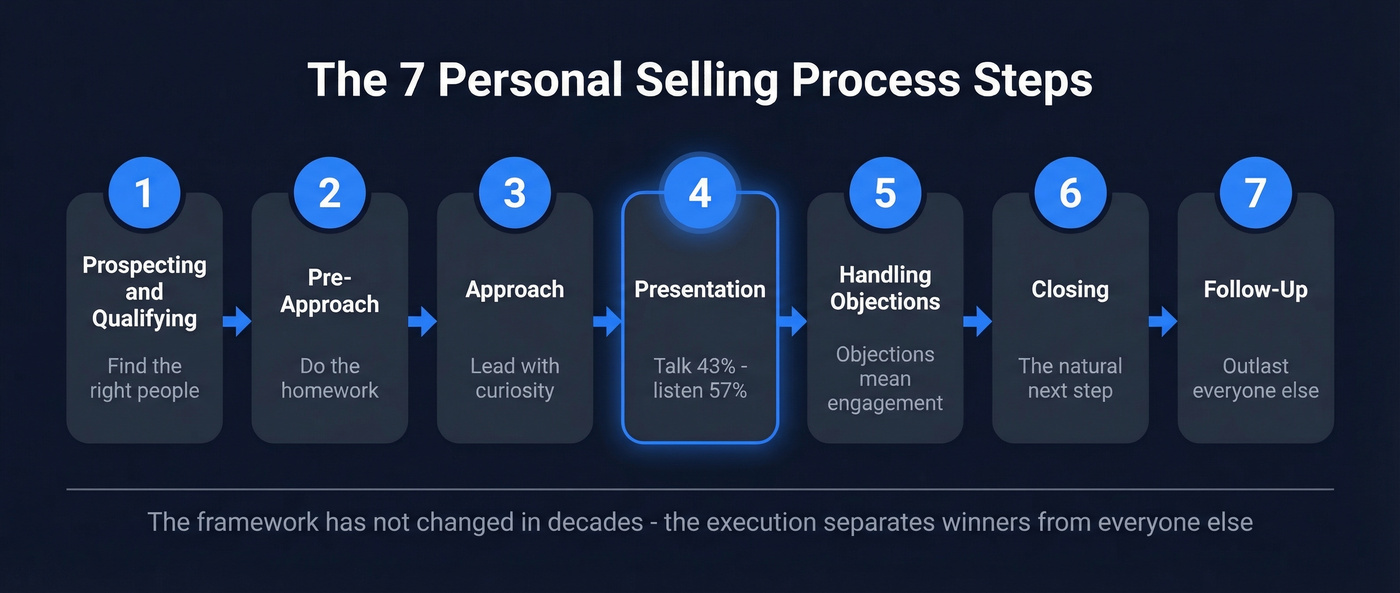
The data is clear: top-closing B2B reps speak about 43% of the time. Average performers? 65%. The best presentations aren't monologues - they're structured conversations where you connect what you learned in discovery to specific outcomes the buyer cares about. If you want a tighter structure for demos, use this product demo checklist.
The AIDA framework still works as a mental scaffold, but don't treat it like a script. Consultative selling beats formula selling every time. Lead with the prospect's problem, show how you solve it with proof - case studies, numbers, live demos - and let them ask questions. The more they talk, the more they're selling themselves.
Let's make this concrete. Picture a B2B cybersecurity vendor presenting to a mid-market CFO. Instead of walking through every feature, the rep opens with: "Companies your size in financial services typically lose $400K annually to phishing incidents - here's how we cut that by 70% for [similar client]." That's outcome-first selling, and it works because it mirrors what the buyer already cares about.
If you're doing 80% of the talking in a presentation, you didn't do enough discovery. Full stop.
Step 5 - Handling Objections
Objections aren't rejection - they're engagement. A prospect who pushes back is a prospect who's thinking about buying. The ones who say "looks great, we'll be in touch" are the ones you never hear from again.
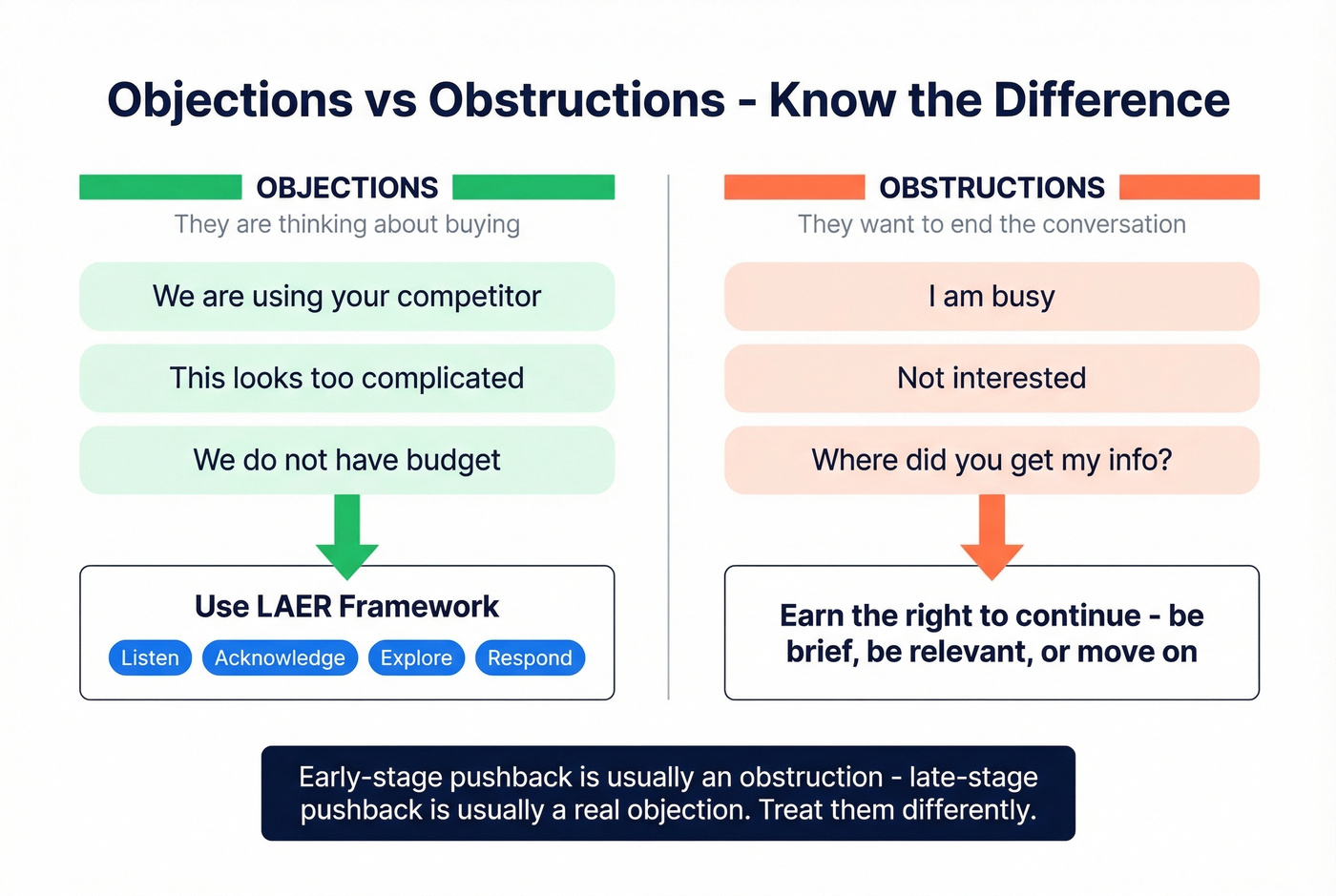
First, distinguish between objections and obstructions. An objection is a real reason they won't buy: "I don't see how this solves our problem." An obstruction is an excuse to end the conversation: "I don't have time for this." They require different responses. The LAER framework - Listen, Acknowledge, Explore, Respond - works well for real objections because it forces you to understand before you answer. (If objections are spiking, here’s how to reduce sales objection rate.)
| Objection | Category | Rebuttal |
|---|---|---|
| "We're using your competitor." | Need | "How are you finding them? What made you choose them originally?" |
| "Where'd you get my information?" | Trust | "From public professional sources. I reached out because [specific reason tied to their role]. Does that resonate?" |
| "I'm busy." | Timing | "I can tell you about this in 2 minutes. If it's not relevant, I won't call again." |
| "This looks too complicated." | Need | "What specifically looks complicated? Let's walk through that piece." |
| "We don't have budget." | Budget | "When does your next planning cycle start? Let's get this on the roadmap." |
Objections change by funnel stage. Early-call objections are usually obstructions - the prospect is annoyed you interrupted their day. Late-stage objections around budget, implementation, or stakeholder buy-in are real and require substantive answers. Don't treat a "not interested" on a cold call the same way you'd treat a budget concern in a proposal review.
Step 6 - Closing
If you've done steps 1 through 5 right, the close is a formality. It shouldn't feel like a hostage negotiation - it should feel like the natural next step in a conversation that's been building toward a decision.
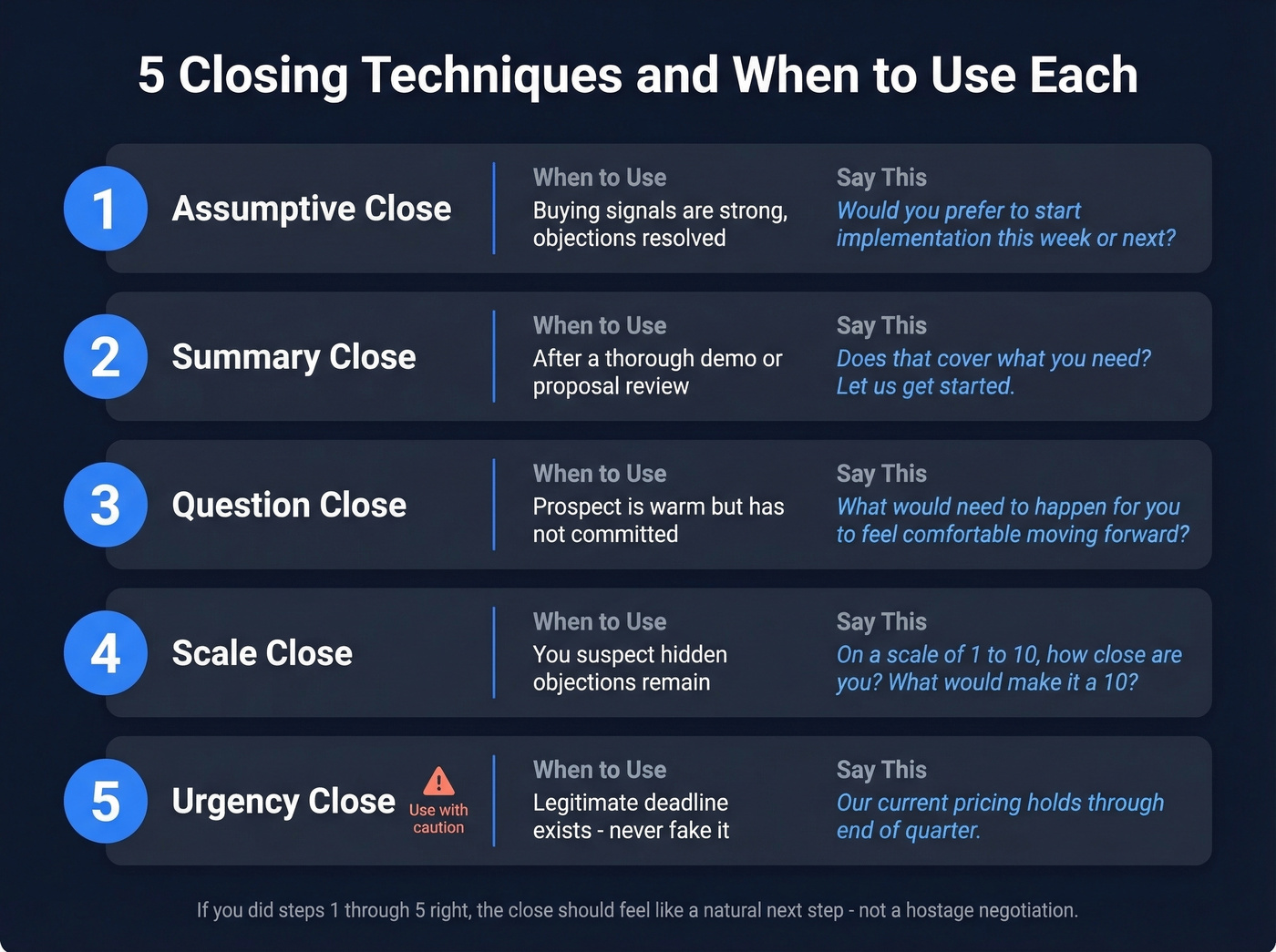
Five closing techniques, when to use each, and the exact language:
- Assumptive close - "Would you prefer to start implementation this week or next?" Use when buying signals are strong and objections are resolved.
- Summary close - Recap the three outcomes they care about, then ask: "Does that cover what you need? Let's get started." Best after a thorough demo or proposal review.
- Question close - "What would need to happen for you to feel comfortable moving forward?" Use when the prospect is warm but hasn't committed.
- Scale close - "On a scale of 1 to 10, how close are you to moving forward? What would make it a 10?" Great for surfacing hidden objections.
- Urgency close - "Our current pricing holds through end of quarter." Use only with legitimate deadlines - manufactured urgency destroys trust fast.
Watch for timing signals: when prospects ask about pricing details, implementation timelines, or onboarding logistics, they're mentally past the decision. That's your window. (To systematize this, use a scoring model for identifying buying signals.)
Step 7 - Follow-Up
Follow-up is where most reps silently lose. The stats are damning: 80% of sales require five or more follow-ups, but 92% of reps quit after four. That gap is where deals go to die.
The best follow-up cadences are multi-channel - email, phone, and video - spread across 2-3 weeks with value at every touch. Don't just "check in." Share a relevant case study, a benchmark, a competitive insight, or a piece of news about their industry. Every follow-up should give the prospect a reason to respond beyond guilt. Log every touch in your CRM so the next rep who inherits the account has full context.
Think about follow-up in terms of lifetime value, not just this deal. The prospect who doesn't buy today might buy in six months, or refer you to someone who buys next week. The rep who stays in touch - without being annoying - wins that future revenue.

You just read it: 42% of reps say prospecting is the hardest step. Most of that pain is bad data - bounced emails, wrong numbers, stale contacts. Prospeo's 300M+ profiles refresh every 7 days with 98% email accuracy, so your personal selling process starts on solid ground instead of a leaky foundation.
Stop losing deals at step 1 because your data expired six weeks ago.
Mistakes That Kill the Process
Talking too much. 43% talk time for top closers vs. 65% for average. If you're presenting more than you're listening, you're guessing at what the buyer wants.
Leading with features instead of outcomes. "We have AI-powered analytics" means nothing. "Teams like yours cut forecast error by 30%" means everything.
Skipping qualification to rush to the demo. You nailed the demo, the champion loved it, and the deal went dark. Why? Because the economic buyer was never in the room. That's a qualification failure, not a closing failure. (If your pipeline is full but revenue isn’t, diagnose it with these sales pipeline challenges.)
Abandoning follow-up after two or three touches. The math is simple and most reps ignore it. You can't complete the selling process if you don't actually finish it - and follow-up is where the majority of revenue is won or lost.
When Personal Selling Doesn't Make Sense
Skip this process entirely if your average contract value is under $15K. Build a great product, write clear docs, and let buyers self-serve. Personal selling earns its cost when deals are complex enough that a human conversation genuinely changes the outcome - when there are multiple stakeholders, long evaluation cycles, and real implementation risk. For everything else, it's overhead.
61% of B2B buyers say they'd prefer no rep at all. That doesn't mean personal selling is dying. It means the reps who do show up have to be significantly better than the self-serve alternative.
The Landscape Has Changed
80% of B2B sales interactions now happen virtually, and 9 out of 10 companies plan to keep hybrid models permanently. Hybrid selling is associated with up to 50% higher revenue growth compared to pure in-person or pure remote approaches. Inside sales reps now make up around 40% of high-growth B2B sales teams, up from 10% in 2017.
AI is accelerating every step. Tools can boost lead volume by up to 50% and cut call times by up to 60%. Omnichannel outreach - combining email, phone, video, and social touches - increases response rates by up to 300% compared to single-channel approaches. And 80% of buyers now expect a personalized experience, which means generic sequences are dead weight.
Real-world examples illustrate why the process still matters: a medical device rep walking a surgeon through a hands-on product trial, an enterprise SaaS AE building a custom ROI model for a CFO's board presentation, a financial services advisor tailoring a retirement plan across three in-person meetings. In each case, the sale depends on adaptive dialogue that no landing page can replicate.
Your pre-approach checklist demands verified emails, mapped stakeholders, and confirmed direct dials. Prospeo delivers all three - 143M+ verified emails, 125M+ mobile numbers, and 50+ data points per contact - so every rep walks into step 3 fully prepared, not guessing.
Cut pre-approach research from 15 minutes to 3 with data that's actually current.
Benchmarks - What "Good" Looks Like
Stop memorizing the seven steps and start tracking whether they're working. Here are B2B SaaS funnel benchmarks to measure yourself against - stage-to-stage conversion rates, not top-of-funnel visitor-to-lead metrics. (For more context on what “good” looks like across teams, see sales pipeline benchmarks.)
| Stage | B2B SaaS Benchmark |
|---|---|
| Lead to MQL | 39% |
| MQL to SQL | 38% |
| SQL to Opportunity | 42% |
| SQL to Closed Won | 37% |
Sales cycle length varies by segment. SMB deals typically close in 2-6 weeks. Mid-market runs 2-4 months. Enterprise deals stretch 6-12+ months, sometimes longer when procurement gets involved. Track your customer acquisition cost alongside these conversion rates - if your CAC exceeds the first-year value of the deal, your process has a leak somewhere.
If your Lead to MQL conversion is 20% while the benchmark is 39%, that's a prospecting or targeting problem - go back to step 1. If your SQL to Closed Won rate is strong but your MQL to SQL is weak, your qualification framework needs work. Use the numbers to diagnose where in the process you're leaking, not just to pat yourself on the back when one metric looks good.
FAQ
What are the 7 personal selling process steps?
The seven steps are: prospecting and qualifying, pre-approach, approach, presentation, handling objections, closing, and follow-up. Each step builds on the previous one - skip qualification and your close rate drops; skip follow-up and you lose deals you already earned. The framework has been standard for decades, but modern execution looks very different from what the textbooks describe.
What's the difference between personal selling and direct marketing?
Personal selling is two-way and adaptive - the rep adjusts the conversation based on what the buyer says. Direct marketing is one-way and scripted: emails, ads, mailers sent to a list. Personal selling costs more per interaction but converts at far higher rates for complex, high-value deals where buyers need dialogue, not a brochure.
Which qualification framework should I use?
BANT works best for high-velocity SMB and inbound leads where deals are straightforward. MEDDIC is built for enterprise sales with five or more stakeholders and long decision cycles. CHAMP fits mid-market consultative motions where leading with the prospect's challenges feels more natural than leading with budget. Pick one that matches your sales motion and use it consistently - the worst framework is the one your team only applies half the time.
How many follow-ups should I send before giving up?
At least five. The data shows 80% of sales require five or more follow-ups, but 92% of reps quit after four. Space your touches across email, phone, and video over 2-3 weeks, and bring value every time - a relevant case study, a benchmark, or an industry insight. "Just checking in" isn't a follow-up strategy; it's a guilt trip.
What tools help with prospecting in the selling process?
You need two things: a reliable data source and a CRM to track your activity. For data, Prospeo covers 300M+ profiles with 98% email accuracy and a 7-day refresh cycle, so your outreach starts with verified contacts instead of stale lists. Pair that with Salesforce or HubSpot for logging, and layer in intent signals to prioritize accounts that are actively researching solutions.